Eruvin 22a: Talmud study for Daf Yomi
Study the Talmud for Daf Yomi with scanned pages, Hebrew text, English translations from Sefaria and AI-generated French translations.
Passage selection and English or AI-generated French translation are available where the scan has annotations. Daf Study is independent of Torah-Box and Sefaria.
Browse Eruvin · עירובין · All tractatesEruvin 22a text and translations
This page of Eruvin includes the Aramaic text, an English translation and an AI-generated French translation, alongside the scan above.
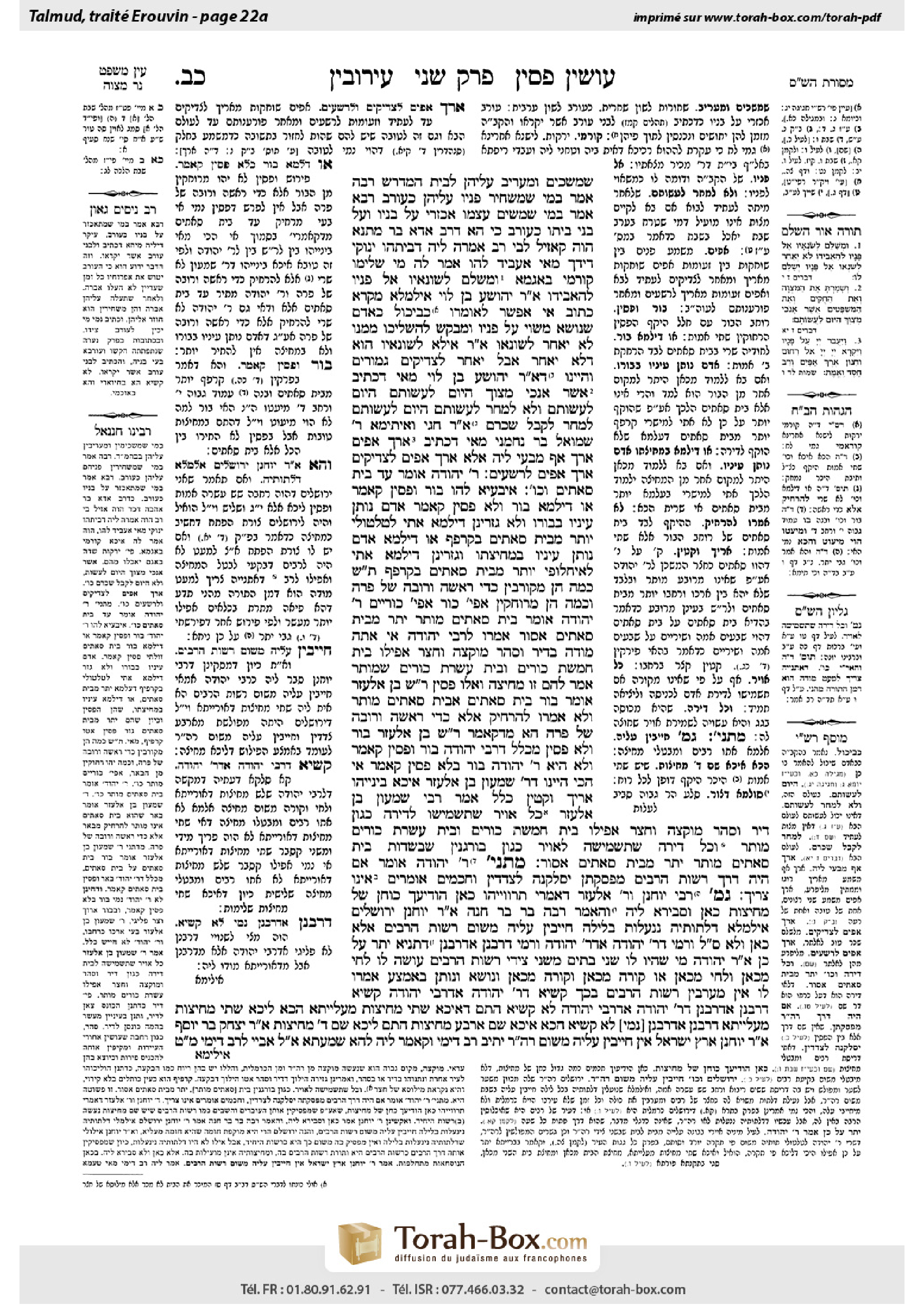
עירובין כ״ב א · Aramaic and Hebrew text
שֶׁמַּשְׁכִּים וּמַעֲרִיב עֲלֵיהֶן לְבֵית הַמִּדְרָשׁ. רַבָּה אָמַר: בְּמִי שֶׁמַּשְׁחִיר פָּנָיו עֲלֵיהֶן כְּעוֹרֵב.
רָבָא אָמַר: בְּמִי שֶׁמֵּשִׂים עַצְמוֹ אַכְזָרִי עַל בָּנָיו וְעַל בְּנֵי בֵּיתוֹ כְּעוֹרֵב. כִּי הָא דְּרַב אַדָּא בַּר מַתְנָא הֲוָה קָאָזֵיל לְבֵי רַב, אֲמַרָה לֵיהּ דְּבֵיתְהוּ: יָנוֹקֵי דִידָךְ מַאי אֶעֱבֵיד לְהוּ? אֲמַר לַהּ: מִי שְׁלִימוּ קוּרָמֵי בְּאַגְמָא?
״וּמְשַׁלֵּם לְשׂוֹנְאָיו אֶל פָּנָיו לְהַאֲבִידוֹ״, אָמַר רַבִּי יְהוֹשֻׁעַ בֶּן לֵוִי: אִילְמָלֵא מִקְרָא כָּתוּב, אִי אֶפְשָׁר לְאוֹמְרוֹ — כִּבְיָכוֹל כְּאָדָם שֶׁנּוֹשֵׂא מַשּׂוֹי עַל פָּנָיו, וּמְבַקֵּשׁ לְהַשְׁלִיכוֹ מִמֶּנּוּ.
״לֹא יְאַחֵר לְשׂוֹנְאוֹ״, אָמַר רַבִּי אִילָא: לְשׂוֹנְאָיו הוּא דְּלֹא יְאַחֵר, אֲבָל יְאַחֵר לַצַּדִּיקִים גְּמוּרִים.
וְהַיְינוּ דְּאָמַר רַבִּי יְהוֹשֻׁעַ בֶּן לֵוִי: מַאי דִּכְתִיב ״אֲשֶׁר אָנֹכִי מְצַוְּךָ הַיּוֹם לַעֲשׂוֹתָם״, ״הַיּוֹם לַעֲשׂוֹתָם״ — וְלֹא לְמָחָר לַעֲשׂוֹתָם, ״הַיּוֹם לַעֲשׂוֹתָם״ — לְמָחָר לְקַבֵּל שְׂכָרָם.
אָמַר רַבִּי חַגַּי, וְאִיתֵּימָא רַבִּי שְׁמוּאֵל בַּר נַחְמָנִי: מַאי דִּכְתִיב ״אֶרֶךְ אַפַּיִם״? ״אֶרֶךְ אַף״ מִבְּעֵי לֵיהּ!
אֶלָּא אֶרֶךְ אַפַּיִם לְצַדִּיקִים, אֶרֶךְ אַפַּיִם לָרְשָׁעִים.
רַבִּי יְהוּדָה אוֹמֵר עַד בֵּית סָאתַיִם וְכוּ׳. אִיבַּעְיָא לְהוּ: בּוֹר וּפַסִּין קָאָמַר, אוֹ דִילְמָא בּוֹר וְלֹא פַּסִּין קָאָמַר?
אָדָם נוֹתֵן עֵינָיו בְּבוֹרוֹ, וְלָא גָּזְרִינַן דִּילְמָא אָתֵי לְטַלְטוֹלֵי יוֹתֵר מִבֵּית סָאתַיִם בְּקַרְפֵּף;
אוֹ דִילְמָא, אָדָם נוֹתֵן עֵינָיו בִּמְחִיצָתוֹ, וְגָזְרִינַן דִּילְמָא אָתֵי לְאִיחַלּוֹפֵי יוֹתֵר מִבֵּית סָאתַיִם בְּקַרְפֵּף.
תָּא שְׁמַע: כַּמָּה הֵן מְקוֹרָבִין — כְּדֵי רֹאשָׁהּ וְרוּבָּהּ שֶׁל פָּרָה, וְכַמָּה הֵן מְרוּחָקִין — אֲפִילּוּ כּוֹר אֲפִילּוּ כּוֹרַיִים. רַבִּי יְהוּדָה אוֹמֵר: בֵּית סָאתַיִם — מוּתָּר, יָתֵר מִבֵּית סָאתַיִם — אָסוּר.
אָמְרוּ לְרַבִּי יְהוּדָה: אִי אַתָּה מוֹדֶה בְּדִיר וְסַהַר מוּקְצֶה וְחָצֵר, אֲפִילּוּ בֵּית חֲמֵשֶׁת כּוֹרִים וּבֵית עֲשֶׂרֶת כּוֹרִים, שֶׁמּוּתָּר.
אָמַר לָהֶם: זוֹ מְחִיצָה, וְאֵלּוּ פַּסִּין.
רַבִּי שִׁמְעוֹן בֶּן אֶלְעָזָר אוֹמֵר: בּוֹר בֵּית סָאתַיִם אַבֵּית סָאתַיִם — מוּתָּר, וְלֹא אָמְרוּ לְהַרְחִיק אֶלָּא כְּדֵי רֹאשָׁהּ וְרוּבָּהּ שֶׁל פָּרָה.
הָא מִדְּקָאָמַר רַבִּי שִׁמְעוֹן בֶּן אֶלְעָזָר בּוֹר וְלֹא פַּסִּין, מִכְּלָל דְּרַבִּי יְהוּדָה בּוֹר וּפַסִּין קָאָמַר. וְלָא הִיא, רַבִּי יְהוּדָה בּוֹר בְּלֹא פַּסִּין קָאָמַר.
אִי הָכִי, הַיְינוּ דְּרַבִּי שִׁמְעוֹן בֶּן אֶלְעָזָר! אִיכָּא בֵּינַיְיהוּ אֲרִיךְ וְקַטִּין.
כְּלָל אָמַר רַבִּי שִׁמְעוֹן בֶּן אֶלְעָזָר: כׇּל אֲוִיר שֶׁתַּשְׁמִישׁוֹ לְדִירָה, כְּגוֹן דִּיר וְסַהַר מוּקְצֶה וְחָצֵר, אֲפִילּוּ בֵּית חֲמֵשֶׁת כּוֹרִים וּבֵית עֲשֶׂרֶת כּוֹרִים — מוּתָּר.
וְכׇל דִּירָה שֶׁתַּשְׁמִישָׁהּ לַאֲוִיר, כְּגוֹן בּוּרְגָּנִין שֶׁבַּשָּׂדוֹת, בֵּית סָאתַיִם — מוּתָּר, יֶתֶר מִבֵּית סָאתַיִם — אָסוּר.
מַתְנִי׳ רַבִּי יְהוּדָה אוֹמֵר: אִם הָיָה דֶּרֶךְ רְשׁוּת הָרַבִּים מַפְסַקְתָּן — יְסַלְּקֶנָּה לִצְדָדִין. וַחֲכָמִים אוֹמְרִים: אֵינוֹ צָרִיךְ.
גְּמָ׳ רַבִּי יוֹחָנָן וְרַבִּי אֶלְעָזָר דְּאָמְרִי תַּרְוַויְיהוּ: כָּאן הוֹדִיעֲךָ כּוֹחָן שֶׁל מְחִיצּוֹת.
כָּאן, וּסְבִירָא לֵיהּ? וְהָאָמַר רַבָּה בַּר בַּר חָנָה אָמַר רַבִּי יוֹחָנָן: יְרוּשָׁלַיִם, אִילְמָלֵא דַּלְתוֹתֶיהָ נִנְעָלוֹת בַּלַּיְלָה, חַיָּיבִין עָלֶיהָ מִשּׁוּם רְשׁוּת הָרַבִּים.
אֶלָּא: כָּאן — וְלָא סְבִירָא לֵיהּ.
וּרְמִי דְּרַבִּי יְהוּדָה אַדְּרַבִּי יְהוּדָה. וּרְמִי דְּרַבָּנַן אַדְּרַבָּנַן.
דְּתַנְיָא, יָתֵר עַל כֵּן אָמַר רַבִּי יְהוּדָה: מִי שֶׁהָיוּ לוֹ שְׁנֵי בָתִּים מִשְּׁנֵי צִידֵּי רְשׁוּת הָרַבִּים, עוֹשֶׂה לוֹ לֶחִי מִכָּאן וְלֶחִי מִכָּאן, אוֹ קוֹרָה מִכָּאן וְקוֹרָה מִכָּאן, וְנוֹשֵׂא וְנוֹתֵן בָּאֶמְצַע. אָמְרוּ לוֹ: אֵין מְעָרְבִין רְשׁוּת הָרַבִּים בְּכָךְ.
קַשְׁיָא דְּרַבִּי יְהוּדָה אַדְּרַבִּי יְהוּדָה, קַשְׁיָא דְּרַבָּנַן אַדְּרַבָּנַן.
דְּרַבִּי יְהוּדָה אַדְּרַבִּי יְהוּדָה לָא קַשְׁיָא: הָתָם — דְּאִיכָּא שְׁתֵּי מְחִיצּוֹת מְעַלְּיָיתָא. הָכָא — לֵיכָּא שְׁתֵּי מְחִיצּוֹת מְעַלְּיָיתָא,
דְּרַבָּנַן אַדְּרַבָּנַן [נָמֵי] לָא קַשְׁיָא: הָכָא — אִיכָּא שֵׁם אַרְבַּע מְחִיצּוֹת, הָתָם — לֵיכָּא שֵׁם אַרְבַּע מְחִיצּוֹת.
אָמַר רַבִּי יִצְחָק בַּר יוֹסֵף אָמַר רַבִּי יוֹחָנָן: אֶרֶץ יִשְׂרָאֵל אֵין חַיָּיבִין עָלֶיהָ מִשּׁוּם רְשׁוּת הָרַבִּים. יָתֵיב רַב דִּימִי וְקָאֲמַר לֵיהּ לְהָא שְׁמַעְתָּא. אֲמַר לֵיהּ אַבָּיֵי לְרַב דִּימִי: מַאי טַעְמָא?
Eruvin 22a · English translation
who, for the Torah’s sake, gets up early in the morning [shaḥar] and stays late in the evening [erev] in the study hall. Rabba said: In him who, for the Torah’s sake, blackens his face like a raven, i.e., who fasts and deprives himself for the sake of Torah study.
Rava said: In him who makes himself cruel to his sons and other members of his household like a raven for the sake of Torah. This was the case with Rav Adda bar Mattana, who was about to go to the study hall to learn Torah, and his wife said to him: What shall I do for your children? How shall I feed them in your absence? He said to her: Are all the rushes [kurmei] in the marsh already gone? If there is no other bread, let them eat food prepared from rushes.
The Gemara proceeds to interpret a different verse homiletically: “And He repays them that hate Him to His face to destroy them; He will not be slack to him that hates Him, He will repay him to his face” (Deuteronomy 7:10). Rabbi Yehoshua ben Levi said: Were the verse not written in this manner, it would be impossible to utter it, in deference to God, for it could be understood, as it were, like a person who bears a burden on his face, and wishes to throw it off. Written slightly differently, the verse could have been understood as implying that God is unable, as it were, to bear the situation, but must punish the wicked immediately.
With regard to the words “He shall not be slack to him that hates Him,” Rabbi Ila said: He will not be slack in bringing punishment to him that hates Him, but He will be slack in rewarding those who are absolutely righteous, as the reward of the righteous does not arrive immediately, but only in the World-to-Come.
And that is what Rabbi Yehoshua ben Levi said: What is the meaning of that which is written: “And you shall keep the commandments, and the statutes, and the judgments which I command you today to do them” (Deuteronomy 7:11)? It means: Today is the time to do them, in this world, and tomorrow is not the time to do them, as there is no obligation or opportunity to fulfill mitzvot in the World-to-Come. Furthermore, it means: Today is the time to do them, but only tomorrow, in the ultimate future, is the time to receive reward for doing them.
In a similar vein, Rabbi Ḥaggai said, and some say it was Rabbi Shmuel bar Naḥmani: What is the meaning of that which is written: “And the Lord passed by before him, and proclaimed: The Lord, the Lord, merciful and gracious, long-suffering [erekh appayim], and abundant in love and truth” (Exodus 34:6)? Why does it say “erekh appayim,” using a plural form? It should have said erekh af, using the singular form.
What this means is that God is long-suffering in two ways: He is long-suffering toward the righteous, i.e., He delays payment of their reward; and He is also long-suffering toward the wicked, i.e., He does not punish them immediately.
The mishna stated that Rabbi Yehuda says: The area may be expanded up to an area of two beit se’a, an area of five thousand square cubits. A dilemma was raised before the Sages in clarification of this statement: Did he speak of the area of the cistern itself and that enclosed by the upright boards, that the total area enclosed by the upright boards may be expanded up to, but may not exceed, an area of two beit se’a? Or perhaps he spoke of the area of the cistern without that enclosed by the upright boards, that the cistern itself may be expanded up to an area of two beit se’a? In that case, the total area enclosed by the boards could exceed an area of two beit se’a.
The underlying rationale of each side of this dilemma is as follows: Does one fix his eyes on his cistern, keeping in mind that the partition is made because of it, and therefore, since the area of the cistern is not greater than an area of two beit se’a, we do not decree lest he come to carry also in an enclosure [karpef], an enclosed storage space behind the house that was not originally surrounded by a fence for the purpose of residence, even when it is more than an area of two beit se’a?
Or perhaps a person fixes his eyes on his partition, and does not pay attention to the cistern, but only to the area enclosed by the partition. And in this case we do decree, lest he come to confuse this case with that of a karpef that is larger than an area of two beit se’a, and come to carry there, because of the similarity between them.
In order to resolve this question, the Gemara cites a proof: Come and hear what was taught in a baraita: How close may the boards be to the well? They may be as close as the length of the head and most of the body of a cow. And how far may they be from the well? The enclosed area may be expanded even to the area of a beit kor and even two beit kor, provided that one adds more upright boards or increases their size so as to reduce the size of the gaps between them. Rabbi Yehuda says: Up to an area of two beit se’a, it is permitted to enclose the area in this manner; more than an area of two beit se’a, it is prohibited.
The other Rabbis said to Rabbi Yehuda: Do you not concede with regard to a pen, a stable, a backyard, and a courtyard, that even one the size of five beit kor and even of ten beit kor is permitted for use?
Rabbi Yehuda said to them: A distinction can be made between the cases, for this, the wall surrounding the pen, the stable or the yard, is a proper partition, and hence it is permitted to carry in them even if they are more than an area of two beit se’a. However, these are only upright boards, and they only allow one to carry if the area they enclose is not more than an area of two beit se’a.
Rabbi Shimon ben Elazar says: A cistern the length of two beit se’a by the width of two beit se’a is permitted, and they only said to distance the upright boards from the cistern as much as the length of the head and most of the body of a cow.
The Gemara tries to draw an inference from this baraita: From the fact that Rabbi Shimon ben Elazar spoke only of the cistern itself and not of the upright boards, we can infer that Rabbi Yehuda spoke of both the cistern itself and the area enclosed by the upright boards. The Gemara rejects this argument: It is not so. When Rabbi Yehuda said that the area may be expanded up to an area of two beit se’a, he was, in fact, speaking of the area of the cistern without that which is enclosed by the upright boards.
The Gemara asks: If so, that is exactly what Rabbi Shimon ben Elazar said. The Gemara answers: There is a practical halakhic difference between them in a case where the enclosed area is long and narrow. Rabbi Yehuda permits using it, whereas Rabbi Shimon ben Elazar requires that the area be square.
The Gemara adds: Rabbi Shimon ben Elazar stated a principle: With regard to any enclosed space that is used as a dwelling, such as a pen, a stable, a backyard, or a courtyard, even if it lacks a roof and even if the structure has the area of five beit kor and even ten beit kor, it is permitted to carry in it.
And with regard to any dwelling that is used for the space outside it, i.e., whose partitions were arranged not so that it could be lived in, but for the sake of the field or yard outside, such as field huts, if its area was two beit se’a, it is permitted to carry in it; but if its area was more than two beit se’a, it is prohibited to do so.
MISHNA: Rabbi Yehuda says: If the path of the public domain passes through the area of the upright boards surrounding a well and obstructs it, one must divert the path to the sides, so that the public will circumvent the enclosed area; otherwise, the partition is invalid and the enclosed area cannot be regarded as a private domain. And the Rabbis say: One need not divert the path of the public domain, for the partition is valid even if many people pass through it.
GEMARA: Rabbi Yoḥanan and Rabbi Elazar both said: Here, the Rabbis informed you of the strength of partitions; although a path of the public domain passes through the partitions and the partitions do not constitute effective barriers, they are still strong enough to allow one to carry.
The Gemara wishes to clarify the meaning of Rabbi Yoḥanan’s statement: Did he mean here that the Rabbis expressed this idea, and he agrees with them that a public thoroughfare does not invalidate a partition? Didn’t Rabba bar bar Ḥana say that Rabbi Yoḥanan said: With regard to Jerusalem, even though it is walled, were it not for the fact that its doors are locked at night, one would be liable for carrying in it on Shabbat because its thoroughfares are regarded as the public domain? Apparently, Rabbi Yoḥanan maintains that a partition is not strong enough to overcome the passage of many people.
Rather, Rabbi Yoḥanan’s statement must be understood as follows: Here, the Rabbis expressed this idea, although he does not agree with them.
The Gemara raised a contradiction between this statement of Rabbi Yehuda and another statement of Rabbi Yehuda, and raised a contradiction between this statement of the Rabbis and another statement of the Rabbis.
The other statements are as it was taught in the Tosefta: Furthermore, Rabbi Yehuda said: If one had two houses on the two sides of the public domain, and he wishes to carry from one house to the other on Shabbat via the public domain, he may place a side post from here, perpendicular to the public domain, and an additional side post from here, on the other side of the public domain, or he may place a cross beam from here, from one end of one house to the end of the house opposite it, and another cross beam from here, from the other side of the house, and carry objects and place them in the area between them because the two added partitions turn the area in the middle into a private domain. The Rabbis said to him: One cannot make the public domain fit for carrying by means of an eiruv in this manner, i.e., by means of a side post alone, when many people continue to walk through the public thoroughfare in the middle.
Consequently, there is a contradiction between one statement of Rabbi Yehuda and the other statement of Rabbi Yehuda, and there is also a contradiction between one statement of the Rabbis and the other statement of the Rabbis.
The Gemara answers: Between one statement of Rabbi Yehuda and the other statement of Rabbi Yehuda there is no contradiction, because one can differentiate between them. There, in the case of the two houses, there are two proper partitions, for the houses are real partitions, and two partitions suffice to establish a separate domain. However, here, in the case of the upright boards, there are not two proper partitions, for the upright boards are not real partitions.
Between one statement of the Rabbis and the other statement of the Rabbis there is also no contradiction, as here, with regard to the upright boards, there is a nominal set of four partitions; on all four sides side there are at least two cubits of some form of partition, so the cistern is regarded as enclosed by four partitions. However, there, with regard to the two houses, there is not a nominal set of four partitions.
Rabbi Yitzḥak bar Yosef said that Rabbi Yoḥanan said: In Eretz Yisrael one is not liable for carrying in the public domain. Rav Dimi sat and recited this halakha. Abaye said to Rav Dimi: What is the reason underlying this ruling?
Eruvin 22a · Traduction française (IA)
Celui qui, pour la Torah, se lève tôt le matin [shaḥar] et reste tard le soir [ereb] dans la salle de study. Rabba a dit : Celui qui, pour la Torah, noircit son visage comme un corbeau, c'est-à-dire celui qui jeûne et se prive pour l'étude de la Torah.
Rava a dit : Celui qui se rend cruel envers ses enfants et les autres membres de sa famille comme un corbeau, pour la Torah. C'était le cas de Rav Adda bar Mattana, qui était sur le point d'aller dans la salle de study pour étudier la Torah, et sa femme lui a dit : Que dois-je faire pour mes enfants ? Comment vais-je les nourrir en mon absence ? Il a répondu à sa femme : Les herbes [kurmei] du marais sont-elles toutes déjà épuisées ? Si il n'y a plus de pain, laisse-les manger de la nourriture préparée à partir d'herbes.
La Guemara continue à interpréter un autre verset de manière homélique : « Et Il récompense ceux qui le haïssent à son visage pour les détruire ; Il ne sera pas lent à celui qui le hait, Il récompensera celui-ci à son visage » (Deutéronome 7:10). Rabbi Yehoshua ben Levi a dit : Si ce verset n'avait pas été écrit ainsi, il serait impossible de le prononcer, en raison de Dieu, car il pourrait être compris, comme si un homme portait un fardeau sur son visage et souhaitait le jeter. Si le verset avait été écrit différemment, il pourrait avoir été compris comme impliquant que Dieu est incapable, comme si, de porter la situation, mais doit punir les méchants immédiatement.
Concernant les mots « Il ne sera pas lent à celui qui le hait », Rabbi Ila a dit : Il ne sera pas lent à punir celui qui le hait, mais Il sera lent à récompenser ceux qui sont absolument justes, car la récompense des justes ne vient pas immédiatement, mais seulement dans le Monde à Venir.
Et c'est ce que Rabbi Yehoshua ben Levi a dit : Quelle est la signification de ce qui est écrit : « Et vous observerez les commandements, les statuts et les jugements que je commande aujourd'hui pour les faire » (Deutéronome 7:11) ? Cela signifie : Aujourd'hui est le temps de les faire, dans ce monde, et demain n'est pas le temps de les faire, car il n'y a pas d'obligation ou d'opportunité de remplir des mitsvot dans le Monde à Venir. De plus, cela signifie : Aujourd'hui est le temps de les faire, mais seulement demain, dans l'avenir ultérieur, est le temps de recevoir la récompense de les avoir faits.
Dans un sens similaire, Rabbi Ḥaggai a dit, et certains disent que c'était Rabbi Shmuel bar Naḥmani : Quelle est la signification de ce qui est écrit : « Et l'Éternel passa devant lui, et proclama : L'Éternel, l'Éternel, miséricordieux et miséricordieux, long-souffrant [erekh appayim], et riche en amour et en vérité » (Exode 34:6) ? Pourquoi dit-on « erék appayim », en forme plurielle ? Il aurait dû dire erék af, en forme singulière.
Ce que cela signifie, c'est que Dieu est long-souffrant de deux manières : Il est long-souffrant envers les justes, c'est-à-dire qu'Il diffère le paiement de leur récompense ; et Il est également long-souffrant envers les méchants, c'est-à-dire qu'Il ne les punit pas immédiatement.
La michna a dit que Rabbi Yehuda dit : L'aire peut être étendue jusqu'à une aire de deux beit se’a, une aire de cinq mille carrés de cubits. Un dilemme a été soulevé devant les Sages pour clarifier cette déclaration : Parlait-il de l'aire du puits lui-même et de celle enfermée par les planches verticales, de sorte que l'aire totale enfermée par les planches verticales peut être étendue jusqu'à, mais ne doit pas dépasser, une aire de deux beit se’a ? Ou peut-être parlait-il de l'aire du puits sans celle enfermée par les planches verticales, de sorte que le puis lui-même peut être étendu jusqu'à une aire de deux beit se’a ? Dans ce cas, l'aire totale enfermée par les planches pourrait dépasser une aire de deux beit se’a.
Le raisonnement sous-jacent de chaque côté de ce dilemme est le suivant : Regarde-t-on le puits, en tenant compte du fait que la partition est faite à cause de lui, et donc, puisque l'aire du puits n'est pas plus grande qu'une aire de deux beit se’a, nous ne décrétons pas de peur qu'il vienne à porter aussi dans un enclos [karpef], un espace de stockage derrière la maison qui n'était pas initialement entouré d'un mur pour l'habitation, même s'il est plus grand qu'une aire de deux beit se’a ?
Ou peut-être une personne fixe son regard sur sa partition et ne prête pas attention au puits, mais seulement à l'aire enfermée par la partition. Et dans ce cas nous décrétons, de peur qu'il vienne à confondre ce cas avec celui d'un karpef plus grand qu'une aire de deux beit se’a, et vienne à porter là-bas, en raison de la similitude entre eux.
Afin de résoudre cette question, la Guemara cite une preuve : Viens écouter ce qui a été enseigné dans une baraïta : À quelle distance les planches peuvent-elles être du puits ? Elles peuvent être aussi proches que la longueur de la tête et la plupart du corps d'une vache. Et à quelle distance peuvent-elles être du puits ? L'aire enfermée peut être étendue même jusqu'à une aire de beit kor et même deux beit kor, à condition qu'on ajoute plus de planches verticales ou qu'on augmente leur taille afin de réduire la taille des espaces entre elles. Rabbi Yehuda dit : Jusqu'à une aire de deux beit se’a, il est permis d'enfermer l'aire ainsi ; au-delà d'une aire de deux beit se’a, il est interdit.
Les autres Rabbins ont dit à Rabbi Yehuda : Ne reconnais-tu pas, concernant un enclos, un étable, un jardin arrière et un cour, que même celui de cinq beit kor et même de dix beit kor est permis d'être utilisé ?
Rabbi Yehuda dit à ceux-ci : Une distinction peut être faite entre les cas, car ici, le mur entourant l'enclos, l'étable ou le jardin, est une partition appropriée, et donc il est permis de porter dedans même s'ils sont plus grands qu'une aire de deux beit se’a. Cependant, ces planches verticales ne permettent qu'à condition que l'aire qu'elles enferment ne soit pas plus grande qu'une aire de deux beit se’a.
Rabbi Shimon ben Elazar dit : Un puits dont la longueur est de deux beit se’a et la largeur de deux beit se’a est permis, et ils n'ont dit que de distancer les planches verticales du puits aussi loin que la longueur de la tête et la plupart du corps d'une vache.
La Guemara tente de tirer une conséquence de cette baraïta : du fait que Rabbi Shimon ben Elazar a parlé uniquement du puits lui-même et non des planches verticales, on peut en déduire que Rabbi Yehuda a parlé à la fois du puits lui-même et de la surface enclose par les planches verticales. La Guemara rejette cet argument : ce n'est pas ainsi. Lorsque Rabbi Yehuda affirmait que la surface pouvait être étendue jusqu'à une surface de deux beit se’a, il parlait en réalité de la surface du puits sans celle qui est enclose par les planches verticales.
La Guemara pose la question : si c'est ainsi, c'est exactement ce que Rabbi Shimon ben Elazar a dit. La Guemara répond : il existe une différence halakhique pratique entre eux dans le cas où la surface enclose est longue et étroite. Rabbi Yehuda permet son utilisation, tandis que Rabbi Shimon ben Elazar exige que la surface soit carrée.
La Guemara ajoute : Rabbi Shimon ben Elazar a énoncé un principe : concernant tout espace clos utilisé comme une résidence, tel qu'un enclos, un écurie, un jardin arrière ou un cour, même s'il n'a pas de toit et même si la structure a une surface de cinq beit kor et même de dix beit kor, il est permis de porter dedans.
Et concernant toute résidence utilisée pour l'espace en dehors d'elle, c'est-à-dire dont les cloisons n'étaient pas disposées pour qu'on y vive, mais pour l'usage du champ ou du jardin en dehors, telles que des huttes de campagne, si sa surface était de deux beit se’a, il est permis de porter dedans ; mais si sa surface était supérieure à deux beit se’a, il est interdit de le faire.
MICHNA : Rabbi Yehuda dit : Si le chemin du domaine public passe par la surface des planches verticales entourant un puits et en entrave, il faut dévier le chemin vers les côtés, de sorte que le public contourne l'espace enclos ; autrement, la cloison est invalide et l'espace enclos ne peut être considéré comme un domaine privé. Et les Rabbins disent : il n'est pas nécessaire de dévier le chemin du domaine public, car la cloison est valide même si beaucoup de personnes y passent.
GUEMARA : Rabbi Yoḥanan et Rabbi Elazar ont tous les deux dit : ici, les Rabbins vous ont informés de la force des cloisons ; bien qu'un chemin du domaine public passe par les cloisons et que les cloisons ne constituent pas des barrières efficaces, elles sont encore suffisamment solides pour permettre le port.
La Guemara souhaite clarifier le sens de l'affirmation de Rabbi Yoḥanan : voulait-il dire ici que les Rabbins ont exprimé cette idée, et qu'il est d'accord avec eux que le chemin public n'invalidise pas une cloison ? N'a-t-il pas dit Rabba bar bar Ḥana que Rabbi Yoḥanan a dit : concernant Jérusalem, même s'il est entouré de murailles, si ses portes n'étaient pas verrouillées la nuit, on serait puni pour porter dedans le sabbat, car ses rues sont considérées comme le domaine public ? Apparemment, Rabbi Yoḥanan maintient que la cloison n'est pas suffisamment solide pour surmonter le passage de beaucoup de personnes.
Au contraire, l'affirmation de Rabbi Yoḥanan doit être comprise ainsi : ici, les Rabbins ont exprimé cette idée, bien qu'il ne soit pas d'accord avec eux.
La Guemara a soulevé une contradiction entre cette affirmation de Rabbi Yehuda et une autre affirmation de Rabbi Yehuda, et une contradiction entre cette affirmation des Rabbins et une autre affirmation des Rabbins.
Les autres affirmations sont comme il a été enseigné dans la Tosefta : de plus, Rabbi Yehuda a dit : si l'on a deux maisons aux deux côtés du domaine public, et qu'on veut porter d'une maison à l'autre le sabbat via le domaine public, on peut placer un poteau latéral ici, perpendiculaire au domaine public, et un autre poteau latéral ici, du côté opposé du domaine public, ou on peut placer une poutre transversale ici, d'un côté de la maison à l'autre côté de la maison opposée, et une autre poutre transversale ici, du côté opposé de la maison, et porter des objets et les placer dans la zone entre eux, car les deux cloisons ajoutées transforment la zone du milieu en un domaine privé. Les Rabbins lui ont répondu : on ne peut pas rendre le domaine public adapté au portage par le biais d'un eiruv de cette manière, c'est-à-dire par le biais d'un poteau latéral seul, lorsque beaucoup de personnes continuent à marcher dans le passage principal du domaine public.
Par conséquent, il existe une contradiction entre une affirmation de Rabbi Yehuda et une autre affirmation de Rabbi Yehuda, et il existe également une contradiction entre une affirmation des Rabbins et une autre affirmation des Rabbins.
La Guemara répond : entre une affirmation de Rabbi Yehuda et une autre affirmation de Rabbi Yehuda, il n'y a pas de contradiction, car on peut distinguer entre elles. Là, dans le cas des deux maisons, il y a deux cloisons réelles, car les maisons sont des cloisons réelles, et deux cloisons suffisent pour établir un domaine séparé. Cependant, ici, dans le cas des planches verticales, il n'y a pas deux cloisons réelles, car les planches verticales ne sont pas des cloisons réelles.
Entre une affirmation des Rabbins et une autre affirmation des Rabbins, il n'y a pas non plus de contradiction, car ici, concernant les planches verticales, il y a un ensemble nominal de quatre cloisons ; sur tous les quatre côtés, il y a au moins deux coudées de quelque forme de cloison, donc le puits est considéré comme enclos par quatre cloisons. Cependant, là, concernant les deux maisons, il n'y a pas un ensemble nominal de quatre cloisons.
Rabbi Yitzḥak bar Yosef a dit que Rabbi Yoḥanan a dit : en Eretz Yisrael, on n'est pas puni pour porter dans le domaine public. Rav Dimi s'est assis et a récité cette halakha. Abaye a dit à Rav Dimi : quelle est la raison de cette décision ?
Traduction française générée par IA à partir de l’édition anglaise de Sefaria. Vérifie toujours un passage avec le texte source.
Text from Sefaria: William Davidson Edition - Vocalized Aramaic (CC BY NC); William Davidson Edition - English (CC BY NC).