Eruvin 22b: Talmud study for Daf Yomi
Study the Talmud for Daf Yomi with scanned pages, Hebrew text, English translations from Sefaria and AI-generated French translations.
Passage selection and English or AI-generated French translation are available where the scan has annotations. Daf Study is independent of Torah-Box and Sefaria.
Browse Eruvin · עירובין · All tractatesEruvin 22b text and translations
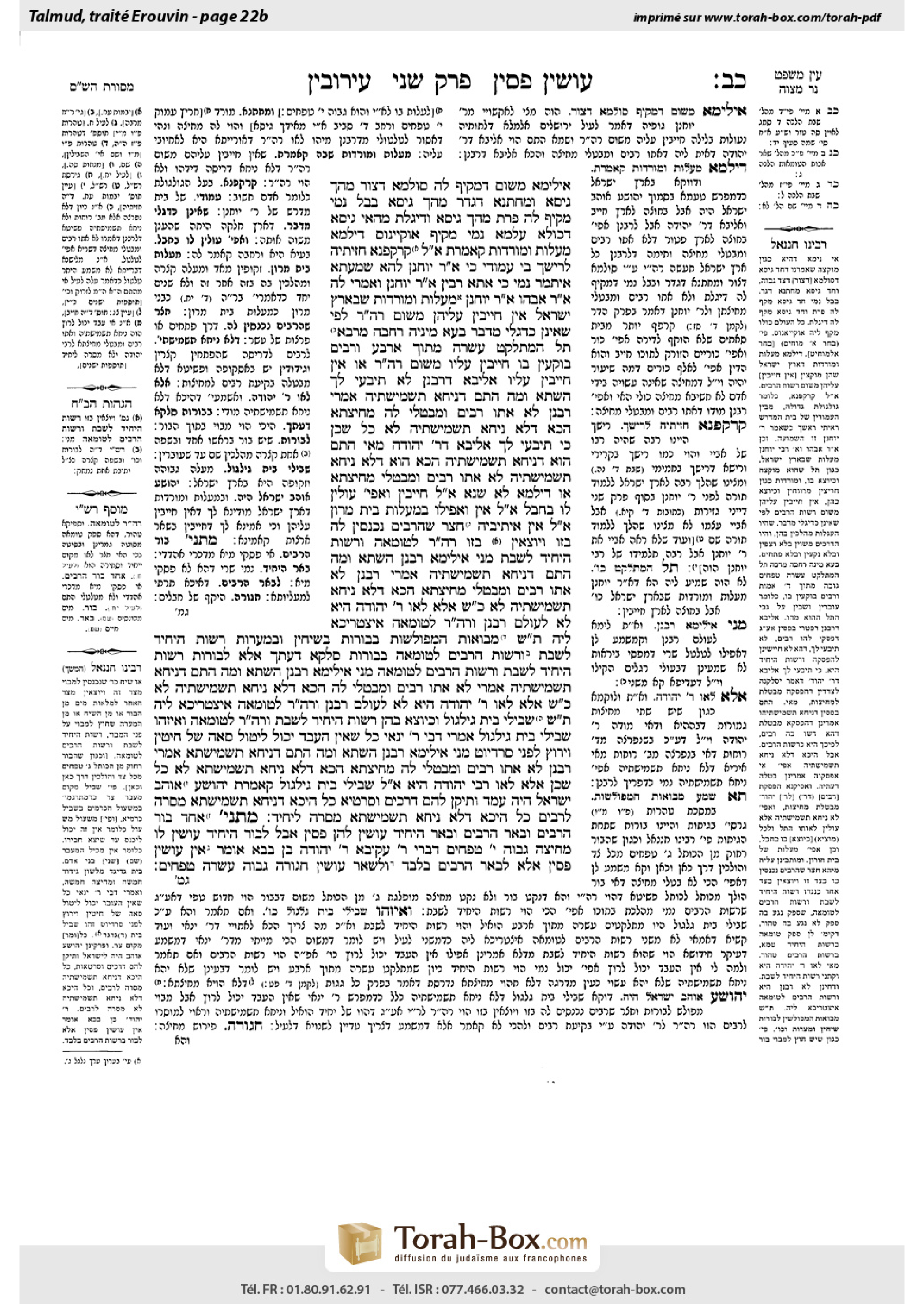
This page of Eruvin includes the Aramaic text, an English translation and an AI-generated French translation, alongside the scan above.
עירובין כ״ב ב · Aramaic and Hebrew text
אִילֵּימָא מִשּׁוּם דְּמַקֵּיף לַהּ סוּלְּמָא דְצוֹר מֵהָךְ גִּיסָא וּמַחְתָנָא דְגָדֵר מֵהָךְ גִּיסָא — בָּבֶל נָמֵי, מַקִּיף לֵהּ פְּרָת מֵהָךְ גִּיסָא וְדִיגְלַת מֵהַאי גִּיסָא! דְּכוּלָּא עָלְמָא נָמֵי מַקִּיף אוֹקְיָינוֹס! דִּילְמָא מַעֲלוֹת וּמוֹרָדוֹת קָאָמְרַתְּ?
אֲמַר לֵיהּ: קַרְקַפְנָא, חֲזִיתֵיהּ לְרֵישָׁךְ בֵּי עַמּוּדֵי כִּי אֲמַר רַבִּי יוֹחָנָן לְהָא שְׁמַעְתָּא.
אִיתְּמַר נָמֵי, כִּי אֲתָא רָבִין אָמַר רַבִּי יוֹחָנָן, וְאָמְרִי לַהּ, אָמַר רַבִּי אֲבָהוּ אָמַר רַבִּי יוֹחָנָן: מַעֲלוֹת וּמוֹרָדוֹת שֶׁבְּאֶרֶץ יִשְׂרָאֵל אֵין חַיָּיבִין עֲלֵיהֶן מִשּׁוּם רְשׁוּת הָרַבִּים לְפִי שֶׁאֵינָן כְּדִגְלֵי מִדְבָּר.
בְּעָא מִינֵּיהּ רַחֲבָה מֵרָבָא: תֵּל הַמִּתְלַקֵּט עֲשָׂרָה מִתּוֹךְ אַרְבַּע, וְרַבִּים בּוֹקְעִין בּוֹ, חַיָּיבִין עָלָיו מִשּׁוּם רְשׁוּת הָרַבִּים אוֹ אֵין חַיָּיבִין עָלָיו?
אַלִּיבָּא דְרַבָּנַן לָא תִּיבְּעֵי לָךְ: הַשְׁתָּא, וּמָה הָתָם דְּנִיחָא תַּשְׁמִישְׁתֵּיהּ — אָמְרִי רַבָּנַן לָא אָתוּ רַבִּים וּמְבַטְּלִי לַהּ מְחִיצְתָּא, הָכָא, דְּלָא נִיחָא תַּשְׁמִישְׁתֵּיהּ — לֹא כׇּל שֶׁכֵּן!
כִּי תִּיבְּעֵי לָךְ אַלִּיבָּא דְּרַבִּי יְהוּדָה. מַאי, הָתָם הוּא דְּנִיחָא תַּשְׁמִישְׁתֵּיהּ, הָכָא הוּא דְּלָא נִיחָא תַּשְׁמִישְׁתֵּיהּ — לָא אָתוּ רַבִּים וּמְבַטְּלִי מְחִיצְתָּא? אוֹ דִילְמָא לָא שְׁנָא? אֲמַר לֵיהּ: חַיָּיבִין.
וַאֲפִילּוּ עוֹלִין לוֹ בְּחֶבֶל? אֲמַר לֵיהּ: אִין. וַאֲפִילּוּ בְּמַעֲלוֹת בֵּית מָרוֹן?! אֲמַר לֵיהּ: אִין.
אֵיתִיבֵיהּ: חָצֵר שֶׁהָרַבִּים נִכְנָסִין לָהּ בָּזוֹ וְיוֹצְאִין בָּזוֹ — רְשׁוּת הָרַבִּים לַטּוּמְאָה, וּרְשׁוּת הַיָּחִיד לַשַּׁבָּת.
מַנִּי? אִילֵּימָא רַבָּנַן, הַשְׁתָּא וּמָה הָתָם — דְּנִיחָא תַּשְׁמִישְׁתֵּיהּ, אָמְרִי רַבָּנַן: לָא אָתוּ רַבִּים וּמְבַטְּלִי מְחִיצְתָּא, הָכָא — דְּלָא נִיחָא תַּשְׁמִישְׁתֵּיהּ, לֹא כׇּל שֶׁכֵּן!
אֶלָּא לָאו, רַבִּי יְהוּדָה הִיא?
לָא, לְעוֹלָם רַבָּנַן, וּרְשׁוּת הָרַבִּים לַטּוּמְאָה אִיצְטְרִיכָא לֵיהּ.
תָּא שְׁמַע: מְבוֹאוֹת הַמְפוּלָּשׁוֹת בְּבוֹרוֹת, בְּשִׁיחִין וּבִמְעָרוֹת — רְשׁוּת הַיָּחִיד לְשַׁבָּת וּרְשׁוּת הָרַבִּים לַטּוּמְאָה.
״בְּבוֹרוֹת״ סָלְקָא דַּעְתָּךְ? אֶלָּא: לְבוֹרוֹת — רְשׁוּת הַיָּחִיד לְשַׁבָּת וּרְשׁוּת הָרַבִּים לַטּוּמְאָה.
מַנִּי? אִילֵּימָא רַבָּנַן, הַשְׁתָּא וּמָה הָתָם — דְּנִיחָא תַּשְׁמִישְׁתֵּיהּ, אָמְרִי: לָא אָתוּ רַבִּים וּמְבַטְּלִי לַהּ, הָכָא — דְּלָא נִיחָא תַּשְׁמִישְׁתֵּיהּ, לֹא כׇּל שֶׁכֵּן! אֶלָּא לָאו רַבִּי יְהוּדָה הִיא?
לָא, לְעוֹלָם רַבָּנַן, וּרְשׁוּת הָרַבִּים לַטּוּמְאָה אִיצְטְרִיכָא לֵיהּ.
תָּא שְׁמַע: שְׁבִילֵי בֵּית גִּילְגּוּל וְכַיּוֹצֵא בָּהֶן — רְשׁוּת הַיָּחִיד לַשַּׁבָּת וּרְשׁוּת הָרַבִּים לַטּוּמְאָה.
וְאֵיזֶהוּ שְׁבִילֵי בֵּית גִּילְגּוּל? אָמְרִי דְּבֵי רַבִּי יַנַּאי: כֹּל שֶׁאֵין הָעֶבֶד יָכוֹל לִיטּוֹל סְאָה שֶׁל חִיטִּין וְיָרוּץ לִפְנֵי סַרְדְּיוֹט.
מַנִּי? אִילֵּימָא רַבָּנַן, הַשְׁתָּא וּמָה הָתָם — דְּנִיחָא תַּשְׁמִישְׁתָּא, אָמְרִי רַבָּנַן: לָא אָתוּ רַבִּים וּמְבַטְּלִי לַהּ מְחִיצְתָּא. הָכָא — דְּלָא נִיחָא תַּשְׁמִישְׁתָּא, לֹא כׇּל שֶׁכֵּן! אֶלָּא לָאו, רַבִּי יְהוּדָה הִיא?
אֲמַר לֵיהּ: שְׁבִילֵי בֵּית גִּילְגּוּל קָאָמְרַתְּ? יְהוֹשֻׁעַ אוֹהֵב יִשְׂרָאֵל הָיָה, עָמַד וְתִיקֵּן לָהֶם דְּרָכִים וּסְרַטְיָא, כֹּל הֵיכָא דְּנִיחָא תַּשְׁמִישְׁתָּא — מְסָרָהּ לָרַבִּים, כֹּל הֵיכָא דְּלָא נִיחָא תַּשְׁמִישְׁתָּא — מְסָרָהּ לַיָּחִיד.
מַתְנִי׳ אֶחָד בּוֹר הָרַבִּים וּבְאֵר הָרַבִּים וּבְאֵר הַיָּחִיד — עוֹשִׂין לָהֶן פַּסִּין.
אֲבָל לְבוֹר הַיָּחִיד — עוֹשִׂין לוֹ מְחִיצָה גָּבוֹהַּ עֲשָׂרָה טְפָחִים, דִּבְרֵי רַבִּי עֲקִיבָא.
רַבִּי יְהוּדָה בֶּן בָּבָא אוֹמֵר: אֵין עוֹשִׂין פַּסִּין אֶלָּא לִבְאֵר הָרַבִּים בִּלְבַד, וְלַשְּׁאָר — עוֹשִׂין חֲגוֹרָה גָּבוֹהַּ עֲשָׂרָה טְפָחִים.
Eruvin 22b · English translation
If you say this law because Eretz Yisrael is surrounded by the Ladder of Tyre on one side and the slope of Gader on the other side, each formation being over ten handbreadths high and constituting a valid partition, then Babylonia, which is also surrounded by the Euphrates River on one side and the Tigris River on the other side, should not be considered a public domain either. Moreover, the entire world is also surrounded by the ocean, and therefore there should be no public domain anywhere in the world. Rather, perhaps you spoke of the ascents and descents of Eretz Yisrael, which are not easy to traverse and hence should not have the status of a public domain?
Rav Dimi said to him: Man of great skull, i.e., man of distinction, I saw your head between the pillars of the study hall when Rabbi Yoḥanan taught this halakha, meaning you grasped the meaning as though you actually were present in the study hall and heard the statement from Rabbi Yoḥanan himself.
It was also stated that when Ravin came from Eretz Yisrael he said that Rabbi Yoḥanan said, and some say it was Rabbi Abbahu who said that Rabbi Yoḥanan said: In the case of the ascents and descents of Eretz Yisrael, one is not liable for carrying in the public domain, because they are not like the banners in the desert. To be regarded as a public domain, a place must be similar to the area in which the banners of the tribes of Israel passed in the desert, i.e., it must be level and suitable for the passage of large numbers of people.
Raḥava raised a dilemma before Rava: In the case of a mound that rises to a height of ten handbreadths within four cubits, thereby fulfilling the conditions that create a private domain, but many people traverse it, is one liable for carrying in the public domain or is one not liable?
The Gemara explains: According to the opinion of the Rabbis, this should not be a dilemma for you. Just as there, with regard to the upright boards surrounding a well, where the use of the public domain is convenient, the Rabbis say that the public does not come and invalidate the partition; here, where its use is inconvenient due to the slope, all the more so should the mound be considered partitioned off as a private domain, and the passage of the public should not invalidate it.
Where there should be a dilemma for you is according to the opinion of Rabbi Yehuda. What is the halakha? Does he maintain his position only there, because the use of the public domain is convenient, whereas here, where its use is inconvenient, he too would agree that the public does not come and invalidate the partition? Or perhaps there is no difference? Rava said to Raḥava: In such a case, one is liable for carrying in a public domain.
Raḥava asked him: And do you issue this ruling even in the case of a slope that is so steep that in order to climb it one must ascend it by means of a rope? He said to him: Yes. He asked him further: And even in the case of the ascents of Beit Meron, which are exceedingly steep? He said to him: Yes.
Raḥava raised an objection to Rava’s opinion from the Tosefta: A courtyard that was properly surrounded by partitions, into which many people enter on this side and exit on that other side, is treated like the public domain with regard to ritual impurity, so that in cases of doubt, the person is considered ritually pure, as uncertainty concerning ritual impurity only renders a person impure in an area defined as a private domain; however, it is still treated like the private domain with regard to Shabbat.
He proceeds to clarify the Tosefta: Who is the author of this statement? If you say it was the Rabbis, there is a difficulty: Just as there, with regard to the upright boards surrounding a well, where the use of the public domain is convenient, the Rabbis say that the public does not come and invalidate the partition; here, in the case of the courtyard, where its use as a path for a public domain is inconvenient, all the more so should they say that the passage of many people does not invalidate the partition and therefore there would be no need to discuss this case.
Rather, is it not in accordance with the opinion of Rabbi Yehuda? This indicates that even Rabbi Yehuda differentiates between different paths in the public domain.
Rava replied: No; actually, you can explain that this Tosefta was taught in accordance with the opinion of the Rabbis. As to the question raised with regard to the novelty of this case according to their approach, it was necessary for them to teach us that such a courtyard is treated like the public domain with regard to ritual impurity, even though it is considered a private domain with respect to Shabbat.
Raḥava attempts to cite a proof again, this time from a mishna: Come and hear the following teaching: Alleyways that open in cisterns, ditches or caves constitute the private domain with regard to Shabbat and the public domain with regard to ritual impurity.
The Gemara first clarifies the wording of the mishna: Should it enter your mind to say that the correct reading is in cisterns [baborot]; is it possible to speak of alleyways that open inside cisterns? Rather, it should be corrected as follows: Alleyways that open out into cisterns [laborot] constitute the private domain with regard to Shabbat and the public domain with regard to ritual impurity.
Raḥava proceeds to clarify the matter: Who is the author of this mishna? Now, if you say it is the Rabbis, there is a difficulty: Just as there, with regard to the upright boards surrounding a well, where the use of the public thoroughfare is convenient, the Rabbis say that the public does not come and invalidate the partition; here, in the case of an alleyway, where its use as a public thoroughfare is inconvenient, all the more so should they say that the passage of many people does not invalidate the partition, and so there was no need to discuss this case. Rather, isn’t it in accordance with the opinion of Rabbi Yehuda?
Rava refutes this argument: No; actually, you can explain that this mishna was taught in accordance with the opinion of the Rabbis. It does present a novel teaching, as it was necessary for them to teach us that such an alleyway has the status of the public domain with regard to ritual impurity. Although it is not a convenient place to cross, it is considered a public domain with respect to impurity, since many people are found there.
Once again Raḥava attempts to cite a proof from a mishna: Come and hear the following teaching: The paths of Beit Gilgul, which are difficult to traverse, and similar ones have the status of the private domain with regard to Shabbat, and that of the public domain with regard to ritual impurity.
The Gemara asks: And what paths are like the paths of Beit Gilgul? The school of Rabbi Yannai say: This is any path in which a slave [eved] is unable to take up a se’a of wheat by hand and run before an officer [sardeyot], despite his fear of him.
Raḥava proceeds to clarify the issue: Who is the author of this mishna? Now, if you say it is the Rabbis, there is a difficulty: Just as there, with regard to the upright boards surrounding a well, where the use of the public thoroughfare is convenient, the Rabbis say that the public does not come and invalidate the partition; here, in the case of the paths of Beit Gilgul, where their use as a public pathway is inconvenient, all the more so should they say that the passage of many people does not invalidate the partitions. Rather, is it not in accordance with the opinion of Rabbi Yehuda?
Rava said to him: Did you say the paths of Beit Gilgul? Joshua, who conquered the land and divided it among the tribes, was a lover of Israel. He rose up and established roads and highways for them; any place that was convenient to use he handed over to the public, and any place that was inconvenient to use he handed over to an individual. Therefore, the roads of Eretz Yisrael, which like the paths of Beit Gilgul are not easy to use, have the status of a private domain. However, there is no general rule in other places that roads that are difficult to traverse do not have the status of a public domain.
MISHNA: In the case of a public cistern containing collected water, as well as a public well containing spring water, and even a private well, one may arrange upright boards around them in order to allow one to carry in the enclosed area, as delineated above.
But in the case of a private cistern, there are two deficiencies: It belongs to an individual, and it does not contain spring water. Consequently, it is impossible to permit drawing from it on Shabbat by means of boards set up in the corners; rather, one must construct for it a proper partition ten handbreadths high; this is the statement of Rabbi Akiva.
Rabbi Yehuda ben Bava says: One may arrange upright boards only for a public well. But for the others, that is, a public cistern or a private well, one must set up a belt, i.e., a partition consisting of ropes, ten handbreadths high. Such an arrangement creates a proper partition based on the principle of lavud, namely, that solid surfaces with gaps between them smaller than three handbreadths are considered joined.
Eruvin 22b · Traduction française (IA)
Si vous dites que cette loi est due au fait que la Terre d'Israël est entourée par l'échelle de Tyr d'un côté et la pente de Gader de l'autre, chaque formation étant d'une hauteur de dix paumes et constituant une clôture valide, alors Babylone, qui est également entourée par le fleuve Euphrate d'un côté et le fleuve Tigris de l'autre, ne devrait pas non plus être considérée comme un domaine public. De plus, l'ensemble du monde est également entouré par la mer, et par conséquent, il ne devrait pas y avoir de domaine public nulle part dans le monde. Cependant, peut-être parlez-vous des montées et descentes de la Terre d'Israël, qui ne sont pas faciles à traverser et devraient donc ne pas avoir le statut de domaine public ?
Rav Dimi dit à lui : Homme à la tête grande, c'est-à-dire un homme distingué, j'ai vu votre tête entre les colonnes de la salle de étude lorsque Rabbi Yoḥanan a enseigné cette halakha, c'est-à-dire que vous avez compris le sens comme si vous étiez réellement présent dans la salle de étude et aviez entendu l'affirmation de Rabbi Yoḥanan lui-même.
Il a également été dit que lorsqu'Ravin est revenu de la Terre d'Israël, il a dit que Rabbi Yoḥanan a dit, et certains disent que c'était Rabbi Abbahu qui a dit que Rabbi Yoḥanan a dit : Dans le cas des montées et descentes de la Terre d'Israël, on n'est pas puni pour porter dans le domaine public, car elles ne sont pas comme les bannières du désert. Pour être considérées comme un domaine public, un lieu doit être semblable à la zone où les bannières des tribus d'Israël ont passé au désert, c'est-à-dire qu'il doit être plat et adapté à la circulation de nombreuses personnes.
Raḥava a soulevé un dilemme devant Rava : Dans le cas d'une butte qui atteint une hauteur de dix paumes à l'intérieur de quatre coudées, ce qui remplit les conditions qui créent un domaine privé, mais beaucoup de personnes y traversent, est-on puni pour porter dans le domaine public ou pas ?
La Guemara explique : Selon l'opinion des Rabbins, cela ne devrait pas être un dilemme pour vous. Tout comme là, concernant les planches verticales entourant un puits, où l'utilisation du domaine public est pratique, les Rabbins disent que le public ne vient pas et n'invalidé la clôture ; ici, où son utilisation est inconvenante en raison de la pente, tout autant que cela, la butte devrait être considérée comme clôturée comme un domaine privé, et la circulation du public ne devrait pas l'invalidé.
L'endroit où il devrait y avoir un dilemme pour vous est selon l'opinion de Rabbi Yehuda. Quelle est la halakha ? Maintient-il sa position uniquement là, car l'utilisation du domaine public est pratique, alors que ici, où son utilisation est inconvenante, il serait également d'accord que le public ne vient pas et n'invalidé la clôture ? Ou peut-être il n'y a pas de différence ? Rava dit à Raḥava : Dans un tel cas, on est puni pour porter dans un domaine public.
Raḥava lui demanda : Et vous émettez cette décision même dans le cas d'une pente si raide que pour monter, on doit monter avec une corde ? Il lui répondit : Oui. Il lui demanda encore : Et même dans le cas des montées de Beit Meron, qui sont extrêmement raides ? Il lui répondit : Oui.
Raḥava souleva une objection contre l'opinion de Rava, tirée de la Tosefta : Un jardin correctement entouré de clôtures, dans lequel beaucoup de personnes entrent d'un côté et sortent de l'autre, est traité comme le domaine public en ce qui concerne l'impureté rituelle, de sorte que, en cas de doute, la personne est considérée comme pure, car l'incertitude concernant l'impureté rituelle ne rend une personne impure qu'en un lieu défini comme un domaine privé ; cependant, il est encore traité comme le domaine privé en ce qui concerne le Sabbat.
Il poursuit pour clarifier la Tosefta : Qui est l'auteur de cette déclaration ? Si vous dites que c'est les Rabbins, il y a une difficulté : Tout comme là, concernant les planches verticales entourant un puits, où l'utilisation du domaine public est pratique, les Rabbins disent que le public ne vient pas et n'invalident la clôture ; ici, dans le cas du jardin, où son utilisation comme chemin pour un domaine public est inconvenante, tout autant que cela, ils devraient dire que la circulation de beaucoup de personnes n'invalident pas la clôture et par conséquent il n'aurait pas été nécessaire de discuter de ce cas.
En effet, n'est-ce pas selon l'opinion de Rabbi Yehuda ? Cela indique que même Rabbi Yehuda distingue entre différents chemins dans le domaine public.
Rava a répondu : Non ; en réalité, vous pouvez expliquer que cette Tosefta a été enseignée selon l'opinion des Rabbins. En ce qui concerne la question soulevée concernant la nouveauté de ce cas selon leur approche, il était nécessaire qu'ils nous enseignent que ce jardin est traité comme le domaine public en ce qui concerne l'impureté rituelle, même s'il est considéré comme un domaine privé en ce qui concerne le Sabbat.
Raḥava tente à nouveau de citer une preuve, cette fois-ci à partir d'une mitsna : Venez et entendez la suivante : Les ruelles qui s'ouvrent dans des citernes, des fossés ou des grottes constituent le domaine privé en ce qui concerne le Sabbat et le domaine public en ce qui concerne l'impureté rituelle.
La Guemara commence par clarifier la formulation de la mitsna : Devrait-il entrer en vous l'idée de dire que la lecture correcte est dans les citernes [baborot] ; est-il possible de parler de ruelles qui s'ouvrent à l'intérieur des citernes ? Plutôt, il devrait être corrigé comme suit : Les ruelles qui s'ouvrent vers les citernes [laborot] constituent le domaine privé en ce qui concerne le Sabbat et le domaine public en ce qui concerne l'impureté rituelle.
Raḥava passe à clarifier la question : Qui est l'auteur de cette mitsna ? Maintenant, si vous dites qu'il s'agit des Sages, il y a une difficulté : Tout comme là, concernant les planches verticales entourant un puits, où l'utilisation du passage public est commode, les Sages disent que le public ne vient pas et n'invalidé la séparation ; ici, dans le cas d'un passage étroit, où son utilisation comme passage public est inconvenante, tout autant encore devraient-ils dire que le passage de beaucoup de personnes n'invalidé la séparation, et donc il n'était pas nécessaire de discuter ce cas. Plutôt, n'est-ce pas selon l'opinion de Rabbi Yéhuda ?
Rava réfute cet argument : Non ; en réalité, vous pouvez expliquer que cette mitsna a été enseignée selon l'opinion des Sages. Elle présente une enseignement nouveau, car il était nécessaire qu'ils nous apprennent que ce passage étroit a le statut du domaine public en ce qui concerne l'impureté rituelle. Bien qu'il ne soit pas un lieu commode à traverser, il est considéré comme un domaine public en ce qui concerne l'impureté, car beaucoup de personnes y sont trouvées.
Raḥava tente à nouveau de citer une preuve à partir d'une mitsna : Approchez et écoutez l'enseignement suivant : Les chemins de Beit Gilgul, qui sont difficiles à traverser, et des semblables ont le statut de domaine privé en ce qui concerne le Sabbat, et celui de domaine public en ce qui concerne l'impureté rituelle.
La Guemara demande : Et quels chemins sont semblables aux chemins de Beit Gilgul ? La maison de Rabbi Yannai dit : C'est tout chemin dans lequel un esclave ne peut pas porter un se'ah de blé à la main et courir devant un officier, malgré sa peur de lui.
Raḥava passe à clarifier la question : Qui est l'auteur de cette mitsna ? Maintenant, si vous dites qu'il s'agit des Sages, il y a une difficulté : Tout comme là, concernant les planches verticales entourant un puits, où l'utilisation du passage public est commode, les Sages disent que le public ne vient pas et n'invalidé la séparation ; ici, dans le cas des chemins de Beit Gilgul, où leur utilisation comme passage public est inconvenante, tout autant encore devraient-ils dire que le passage de beaucoup de personnes n'invalidé la séparation. Plutôt, n'est-ce pas selon l'opinion de Rabbi Yéhuda ?
Rava dit à lui : Avez-vous dit les chemins de Beit Gilgul ? Josué, qui a conquis la terre et l'a divisée entre les tribus, était un amour pour Israël. Il s'est levé et a établi des routes et des routes pour eux ; tout lieu qui était commode à utiliser, il l'a remis au public, et tout lieu qui était inconvenant à utiliser, il l'a remis à un individu. Ainsi, les routes de la Terre d'Israël, qui comme les chemins de Beit Gilgul sont difficiles à utiliser, ont le statut de domaine privé. Cependant, il n'y a pas de règle générale ailleurs selon laquelle les routes difficiles à traverser n'ont pas le statut de domaine public.
MICHNA : Dans le cas d'un puits public contenant de l'eau collectée, ainsi qu'un puits public contenant de l'eau de source, et même un puits privé, on peut dresser des planches verticales autour d'eux afin de permettre de porter dans la zone délimitée, comme indiqué ci-dessus.
Mais dans le cas d'un puits privé, il y a deux défauts : Il appartient à un individu, et il ne contient pas de l'eau de source. Ainsi, il est impossible de permettre de tirer de lui le sabbat par le biais de planches dressées aux angles ; il faut plutôt construire pour lui une séparation appropriée de dix tefachim de haut ; c'est l'opinion de Rabbi Akiva.
Rabbi Yéhuda ben Bava dit : On peut dresser des planches verticales uniquement pour un puits public. Mais pour les autres, c'est-à-dire un puits public ou un puits privé, on doit dresser une ceinture, c'est-à-dire une séparation composée de cordes, de dix tefachim de haut. Une telle disposition crée une séparation appropriée selon le principe de lavud, c'est-à-dire que des surfaces solides avec des espaces entre elles inférieurs à trois tefachim sont considérées comme jointes.
Traduction française générée par IA à partir de l’édition anglaise de Sefaria. Vérifie toujours un passage avec le texte source.
Text from Sefaria: William Davidson Edition - Vocalized Aramaic (CC BY NC); William Davidson Edition - English (CC BY NC).