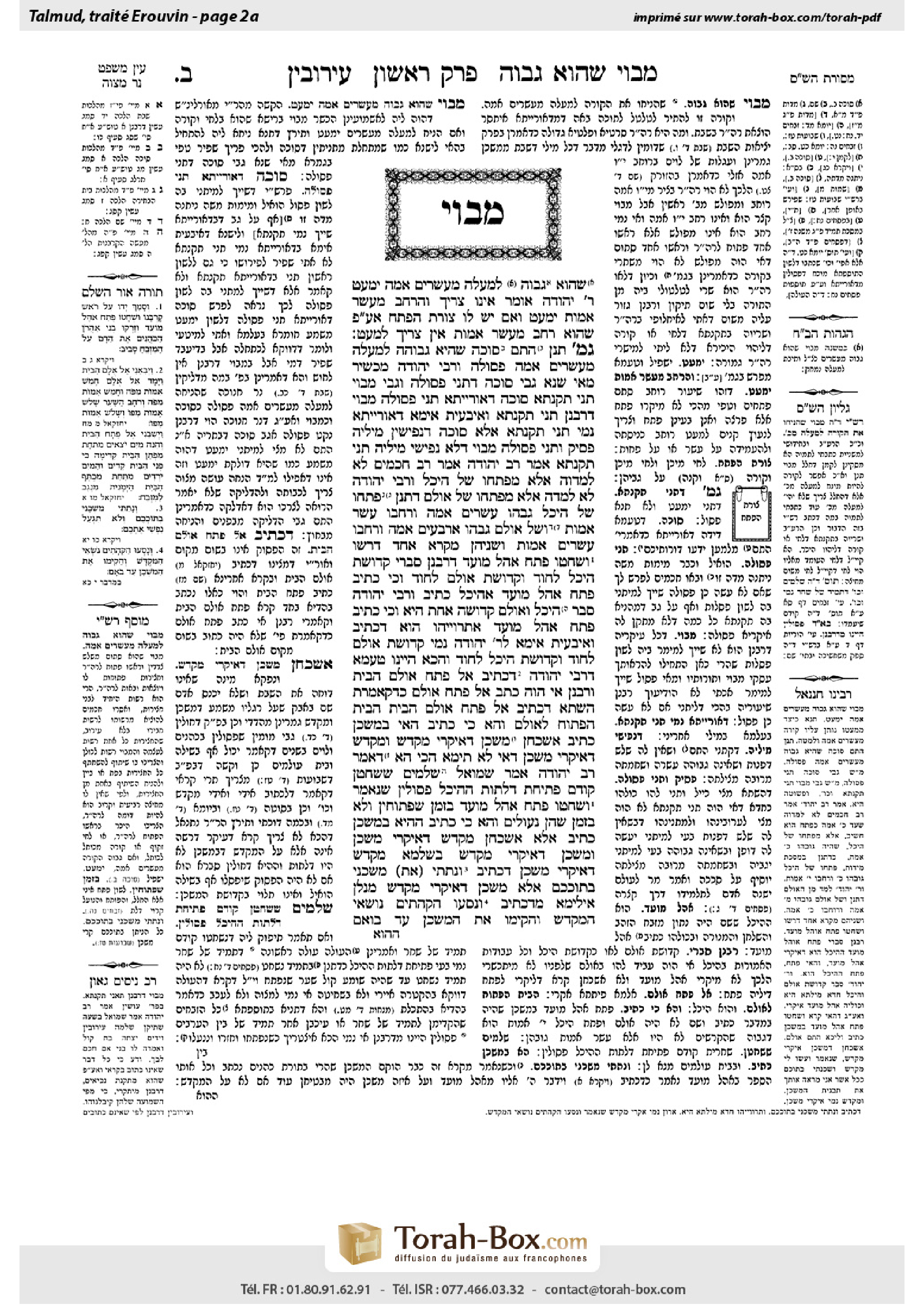
Eruvin 2a: Talmud study for Daf Yomi
Study the Talmud for Daf Yomi with scanned pages, Hebrew text, English translations from Sefaria and AI-generated French translations.
Passage selection and English or AI-generated French translation are available where the scan has annotations. Daf Study is independent of Torah-Box and Sefaria.
Browse Eruvin · עירובין · All tractatesEruvin 2a text and translations
This page of Eruvin includes the Aramaic text, an English translation and an AI-generated French translation, alongside the scan above.
עירובין ב׳ א · Aramaic and Hebrew text
מָבוֹי שֶׁהוּא גָּבוֹהַּ לְמַעְלָה מֵעֶשְׂרִים אַמָּה — יְמַעֵט. רַבִּי יְהוּדָה אוֹמֵר: אֵינוֹ צָרִיךְ.
וְהָרָחָב מֵעֶשֶׂר אַמּוֹת יְמַעֵט. וְאִם יֵשׁ לוֹ צוּרַת הַפֶּתַח, אַף עַל פִּי שֶׁהוּא רָחָב מֵעֶשֶׂר אַמּוֹת אֵין צָרִיךְ לְמַעֵט.
גְּמָ׳ תְּנַן הָתָם: סוּכָּה שֶׁהִיא גְּבוֹהָה לְמַעְלָה מֵעֶשְׂרִים אַמָּה פְּסוּלָה, וְרַבִּי יְהוּדָה מַכְשִׁיר. מַאי שְׁנָא גַּבֵּי סוּכָּה דְּתָנֵי ״פְּסוּלָה״ וְגַבֵּי מָבוֹי תָּנֵי תַּקַּנְתָּא?
סוּכָּה דְּאוֹרָיְיתָא, תָּנֵי ״פְּסוּלָה״. מָבוֹי דְּרַבָּנַן, תָּנֵי תַּקַּנְתָּא.
וְאִיבָּעֵית אֵימָא: דְּאוֹרָיְיתָא נָמֵי תָּנֵי תַּקַּנְתָּא. אֶלָּא, סוּכָּה דִּנְפִישִׁין מִילֵּיהּ — פָּסֵיק וְתָנֵי ״פְּסוּלָה״. מָבוֹי דְּלָא נְפִישִׁי מִילֵּיהּ — תָּנֵי תַּקַּנְתָּא.
אָמַר רַב יְהוּדָה אָמַר רַב: חֲכָמִים לֹא לְמָדוּהָ אֶלָּא מִפִּתְחוֹ שֶׁל הֵיכָל, וְרַבִּי יְהוּדָה לֹא לְמָדָהּ אֶלָּא מִפִּתְחוֹ שֶׁל אוּלָם.
דִּתְנַן: פִּתְחוֹ שֶׁל הֵיכָל גׇּבְהוֹ עֶשְׂרִים אַמָּה וְרׇחְבּוֹ עֶשֶׂר אַמּוֹת, וְשֶׁל אוּלָם גׇּבְהוֹ אַרְבָּעִים אַמָּה וְרׇחְבּוֹ עֶשְׂרִים אַמּוֹת.
וּשְׁנֵיהֶן מִקְרָא אֶחָד דָּרְשׁוּ: ״וּשְׁחָטוֹ פֶּתַח אֹהֶל מוֹעֵד״, דְּרַבָּנַן סָבְרִי: קְדוּשַּׁת הֵיכָל לְחוּד וּקְדוּשַּׁת אוּלָם לְחוּד. וְכִי כְּתִיב ״פֶּתַח אֹהֶל מוֹעֵד״ — אַהֵיכָל כְּתִיב.
וְרַבִּי יְהוּדָה סָבַר: הֵיכָל וְאוּלָם קְדוּשָּׁה אַחַת הִיא. וְכִי כְּתִיב: ״פֶּתַח אֹהֶל מוֹעֵד״ — אַתַּרְוַיְיהוּ הוּא דִּכְתִיב.
וְאִיבָּעֵית אֵימָא: לְרַבִּי יְהוּדָה נָמֵי קְדוּשַּׁת אוּלָם לְחוּד וּקְדוּשַּׁת הֵיכָל לְחוּד. וְהָכָא הַיְינוּ טַעְמָא דְּרַבִּי יְהוּדָה — דִּכְתִיב: ״אֶל פֶּתַח אוּלָם הַבַּיִת״.
וְרַבָּנַן: אִי הֲוָה כְּתִב ״אֶל פֶּתַח אוּלָם״ — כִּדְקָאָמְרַתְּ. הַשְׁתָּא דִּכְתִיב ״אֶל פֶּתַח אוּלָם הַבַּיִת״ — הַבַּיִת הַפָּתוּחַ לָאוּלָם.
וְהָא כִּי כְּתִיב הַאי, בְּמִשְׁכָּן כְּתִיב!
אַשְׁכְּחַן מִשְׁכָּן דְּאִיקְּרִי מִקְדָּשׁ, וּמִקְדָּשׁ דְּאִיקְּרִי מִשְׁכָּן. דְּאִי לָא תֵּימָא הָכִי, הָא דְּאָמַר רַב יְהוּדָה אָמַר שְׁמוּאֵל: שְׁלָמִים שֶׁשְּׁחָטָן קוֹדֶם פְּתִיחַת דַּלְתוֹת הַהֵיכָל — פְּסוּלִין, שֶׁנֶּאֱמַר: ״וּשְׁחָטוֹ פֶּתַח אֹהֶל מוֹעֵד״ — בִּזְמַן שֶׁפְּתוּחִין וְלֹא בִּזְמַן שֶׁהֵן נְעוּלִים, וְהָא כִּי כְתִיב הָהִיא, בְּמִשְׁכָּן כְּתִיב! אֶלָּא, אַשְׁכְּחַן מִקְדָּשׁ דְּאִיקְּרִי מִשְׁכָּן וּמִשְׁכָּן דְּאִיקְּרִי מִקְדָּשׁ.
בִּשְׁלָמָא מִקְדָּשׁ דְּאִיקְּרִי מִשְׁכָּן, דִּכְתִיב: ״וְנָתַתִּי (אֶת) מִשְׁכָּנִי בְּתוֹכְכֶם״. אֶלָּא מִשְׁכָּן דְּאִיקְּרִי מִקְדָּשׁ מְנָלַן? אִילֵּימָא מִדִּכְתִיב: ״וְנָשְׂאוּ הַקְּהָתִים נוֹשְׂאֵי הַמִּקְדָּשׁ וְהֵקִימוּ אֶת הַמִּשְׁכָּן עַד בּוֹאָם״ —
Eruvin 2a · English translation
MISHNA: If an alleyway is enclosed on three sides with courtyards opening into it from three sides, and the fourth side opens into a public domain, it is prohibited by rabbinic law to carry objects in it on Shabbat. However, carrying in an alleyway under those circumstances is permitted if a cross beam is placed horizontally over the entrance to the alleyway. The mishna teaches that if the cross beam spans the entrance to an alleyway at a height above twenty cubits, one must diminish the height of the cross beam so that it is less than twenty cubits. Rabbi Yehuda says: He need not diminish it, since the cross beam enables one to carry in the alleyway even at that height.
If the entrance to the alleyway is wider than ten cubits, one must diminish its width. However, if the entrance to the alleyway has the form of a doorway, i.e., two vertical posts on the two sides, and a horizontal beam spanning the space between them, even if it is wider than ten cubits, he need not diminish it, as it is then regarded as an entrance, rather than a breach, even if it is very wide.
GEMARA: We learned in a mishna there, in tractate Sukka: A sukka that is more than twenty cubits high is unfit, and Rabbi Yehuda deems it fit. The halakhot are similar in substance but differ in formulation, and accordingly the Gemara asks: What is the difference that with regard to a sukka the mishna teaches that it is unfit, whereas with regard to an alleyway, it teaches the method of rectification, that one must diminish the height of the cross beam?
The Gemara answers: With regard to sukka, since it is a mitzva by Torah law, the mishna teaches that it is unfit, as if it is not constructed in the proper manner, no mitzva is fulfilled. Whereas with regard to an alleyway, where the entire prohibition of carrying is only by rabbinic law, the mishna teaches the method of rectification, as the cross beam comes only to rectify a rabbinic prohibition, but does not involve a mitzva by Torah law.
The Gemara suggests an alternative explanation: And if you wish, say instead that even with regard to matters prohibited by Torah law, it would have been appropriate for the mishna to teach a method of rectification. However, with regard to sukka, whose matters are numerous, it categorically teaches that it is unfit. Merely diminishing the height of a sukka is insufficient to render it fit; it must also satisfy requirements governing its size, its walls, and its roofing. Teaching the remedy for each disqualification would have required lengthy elaboration. With regard to an alleyway, however, whose matters are not numerous, the mishna teaches the method of rectification. Once the height is diminished, it is permitted to carry in the alleyway.
Rav Yehuda said that Rav said: The Rabbis only derived this halakha, that an opening more than twenty cubits high is not considered an entrance, from the doorway of the Sanctuary, the inner sanctum of the Temple. And Rabbi Yehuda only derived his opinion, that even an opening more than twenty cubits high is considered an entrance, from the doorway of the Entrance Hall leading into the Sanctuary.
As we learned in a mishna: The doorway of the Sanctuary is twenty cubits high and ten cubits wide, and that of the Entrance Hall is forty cubits high and twenty cubits wide.
The Gemara explains the basis of this tannaitic dispute. Both of them, the Rabbis and Rabbi Yehuda, interpreted the same verse homiletically: “And he shall lay his hand upon the head of his offering and slaughter it at the doorway of the Tent of Meeting, and Aaron’s sons, the priests, shall sprinkle the blood on the altar round about” (Leviticus 3:2). As the Rabbis hold that the sanctity of the Sanctuary is discrete and the sanctity of the Entrance Hall is discrete, i.e., the Sanctuary and the Entrance Hall have distinct levels of sanctity. And since the essence of the Temple is the Sanctuary and not the Entrance Hall, and since the Sanctuary in the Temple parallels the Tent of Meeting in the Tabernacle, when the verse speaks of the doorway of the Tent of Meeting, it is referring to the doorway of the Sanctuary. Therefore, the term doorway applies to an opening similar to the doorway of the Sanctuary, which is twenty cubits high. There is no source indicating that an opening with larger dimensions is also considered a doorway.
And Rabbi Yehuda holds that the Sanctuary and the Entrance Hall are one, equal, sanctity, and therefore, when it is written: “The doorway of the Tent of Meeting,” it is referring to both of them, and accordingly, the term doorway applies to a larger entrance as well.
The Gemara suggests an alternative understanding of the dispute. And if you wish, say instead that even according to Rabbi Yehuda, the sanctity of the Sanctuary is discrete and the sanctity of the Entrance Hall is discrete. And here, this is the reasoning of Rabbi Yehuda: By fusing together language from different verses, the result is as it is written: To the doorway of the Entrance Hall of the House. Therefore, even the doorway of the Entrance Hall is referred to in the Torah as a doorway, and the same is true of any opening with comparable dimensions.
And the Rabbis say: Had the verse written: “To the doorway of the Entrance Hall,” it would be interpreted as you said. However, now that it is written: “To the doorway of the Entrance Hall of the House,” it is to be understood: To the doorway of the House that opens into the Entrance Hall, i.e., the Sanctuary, and consequently, the definition of doorway is derived from the dimensions of the doorway of the Sanctuary.
The Gemara raises a difficulty with the very basis of this explanation: But when this is written: “The doorway of the Tent of Meeting,” isn’t it written with regard to the Tabernacle in the wilderness? How can the status in the permanent Sanctuary, i.e., the Temple in Jerusalem, be derived from matters stated with regard to the Tabernacle?
The Gemara answers: We find that the Tabernacle is called Temple, and that the Temple is called Tabernacle; therefore, the halakhot that govern one can be derived from the other. As if you do not say so, that the Tabernacle and the Temple are one with regard to their halakhot, that which Rav Yehuda said that Shmuel said: Peace-offerings that were slaughtered in the Temple prior to the opening of the doors of the Sanctuary in the morning are disqualified would be difficult. That halakha is derived as it is stated: “And he shall slaughter it at the doorway [petaḥ] of the Tent of Meeting,” from which it is derived: When the doors to the Tent of Meeting are open [petuḥin], and not when they are closed. But when this is written: The doorway of the Tent of Meeting, isn’t it written with regard to the Tabernacle? Rather, for halakhic purposes, we find the Temple called Tabernacle, and the Tabernacle called Temple.
The Gemara questions its previous conclusion: Granted, the Temple is called Tabernacle, as it is written: “And I will set My Tabernacle among you” (Leviticus 26:11), and the reference is to the permanent Sanctuary, i.e., the Temple, as the verse is referring to that which will transpire after the Jewish people settle in their land. However, the fact that the Tabernacle is called Temple, from where do we derive it? The Gemara answers: If you say that it is derived from that which is written: “And the Kehatites, the bearers of the Temple, set forward, that they may set up the Tabernacle before they came” (Numbers 10:21),
Eruvin 2a · Traduction française (IA)
MICHNA: Si un passage est entouré de trois côtés par des courtyards qui s'ouvrent sur lui depuis trois côtés, et le quatrième côté s'ouvre sur un domaine public, il est interdit par la loi rabbinique de porter des objets dans ce passage le sabbat. Cependant, porter dans un passage dans ces circonstances est permis si un poteau transversal est placé horizontalement sur l'entrée du passage. La mésorah enseigne que si le poteau transversal traverse l'entrée d'un passage à une hauteur supérieure à vingt coudées, il faut diminuer la hauteur du poteau transversal afin qu'elle soit inférieure à vingt coudées. Rabbi Yehuda dit : Il n'est pas nécessaire de le diminuer, car le poteau transversal permet de porter dans le passage même à cette hauteur.
Si l'entrée du passage est plus large que dix coudées, il faut la diminuer. Cependant, si l'entrée du passage a la forme d'une porte, c'est-à-dire deux poteaux verticaux sur les deux côtés, et un poteau horizontal qui traverse l'espace entre eux, même si elle est plus large que dix coudées, il n'est pas nécessaire de la diminuer, car elle est alors considérée comme une entrée, et non comme une ouverture, même si elle est très large.
GUEMARA : Nous avons appris dans une mésorah là, dans le traité de Sukka : Une sukka dont la hauteur est supérieure à vingt coudées est inutilisable, et Rabbi Yehuda considère qu'elle est utilisable. Les halakhot sont similaires en substance mais diffèrent en formulation, et par conséquent, la Guemara pose la question : Quelle est la différence qui fait que, concernant la sukka, la mésorah enseigne qu'elle est inutilisable, alors que concernant un passage, elle enseigne la méthode de rectification, à savoir qu'il faut diminuer la hauteur du poteau transversal ?
La Guemara répond : Concernant la sukka, puisque c'est une mitsva par la Torah, la mésorah enseigne qu'elle est inutilisable, car si elle n'est pas construite correctement, aucune mitsva n'est accomplie. Concernant un passage, où l'interdiction de porter est uniquement par la loi rabbinique, la mésorah enseigne la méthode de rectification, car le poteau transversal vient uniquement à corriger une interdiction rabbinique, mais ne concerne pas une mitsva par la Torah.
La Guemara suggère une autre explication : Et si vous le souhaitez, dites plutôt que même concernant les choses interdites par la Torah, il aurait été approprié que la mésorah enseigne une méthode de rectification. Cependant, concernant la sukka, dont les points sont nombreux, elle enseigne catégoriquement qu'elle est inutilisable. Seulement diminuer la hauteur d'une sukka n'est pas suffisant pour la rendre utilisable ; elle doit aussi satisfaire aux exigences concernant sa taille, ses murs et son toit. Enseigner la solution pour chaque inaptitude aurait nécessité une longue explication. Concernant un passage, cependant, dont les points ne sont pas nombreux, la mésorah enseigne la méthode de rectification. Une fois la hauteur diminuée, il est permis de porter dans le passage.
Rav Yehuda a dit que Rav a dit : Les Rabbins ont dérivé cette halakha, que les ouvertures supérieures à vingt coudées ne sont pas considérées comme des entrées, uniquement à partir de la porte du Sanctuaire, l'intérieur du Temple. Et Rabbi Yehuda a dérivé son opinion, que même une ouverture supérieure à vingt coudées est considérée comme une entrée, à partir de la porte de la Salle d'Entrée menant au Sanctuaire.
Comme nous avons appris dans une mitsva : La porte du Sanctuaire est de vingt coudées de hauteur et de dix coudées de largeur, et celle de la Salle d'Entrée est de quarante coudées de hauteur et de vingt coudées de largeur.
La Guemara explique la base de ce débat tannaitique. Les deux, les Rabbins et Rabbi Yehuda, ont interprété le même verset de manière homélique : « Et il posera sa main sur la tête de son offrande et le sacrifiera à la porte du Tenta de Rencontre, et Aaron, le fils de Moïse, les prêtres, verseront le sang sur l'autel autour de lui » (Lévitique 3:2). Comme les Rabbins considèrent que la sanctité du Sanctuaire est distincte et la sanctité de la Salle d'Entrée est distincte, c'est-à-dire que le Sanctuaire et la Salle d'Entrée ont des niveaux distincts de sanctité. Et puisque l'essence du Temple est le Sanctuaire et non la Salle d'Entrée, et que le Sanctuaire du Temple correspond au Tenta de Rencontre du Tabernacle, lorsque le verset parle de la porte du Tenta de Rencontre, il fait référence à la porte du Sanctuaire. Par conséquent, le terme « porte » s'applique à une ouverture similaire à la porte du Sanctuaire, qui est de vingt coudées de hauteur. Il n'y a pas de source indiquant qu'une ouverture de dimensions plus grandes soit également considérée comme une porte.
Et Rabbi Yehuda considère que le Sanctuaire et la Salle d'Entrée sont un, égaux en sanctité, et par conséquent, lorsque cela est écrit : « La porte du Tenta de Rencontre », cela fait référence à tous les deux, et par conséquent, le terme « porte » s'applique à une entrée plus grande également.
La Guemara suggère une autre compréhension du débat. Et si vous le souhaitez, dites plutôt que même selon Rabbi Yehuda, la sanctité du Sanctuaire est distincte et la sanctité de la Salle d'Entrée est distincte. Et ici, c'est la raison du Rabbi Yehuda : En combinant des expressions tirées de versets différents, le résultat est comme il est écrit : « À la porte de la Salle d'Entrée de la Maison ». Par conséquent, même la porte de la Salle d'Entrée est mentionnée dans la Torah comme une porte, et de même pour toute ouverture ayant des dimensions comparables.
Et les Rabbins disent : Si le verset avait dit : « À la porte de la Salle d'Entrée », il serait interprété comme vous le dites. Cependant, maintenant qu'il est dit : « À la porte de la Salle d'Entrée de la Maison », il faut comprendre : À la porte de la Maison qui s'ouvre sur la Salle d'Entrée, c'est-à-dire le Sanctuaire, et par conséquent, la définition de porte est dérivée des dimensions de la porte du Sanctuaire.
La Guemara soulève une difficulté concernant la base même de cette explication : Mais lorsque cela est écrit : « La porte du Tenta de Rencontre », n'est-ce pas écrit concernant le Tabernacle en désert ? Comment peut-on dériver le statut du Sanctuaire permanent, c'est-à-dire le Temple à Jérusalem, à partir de choses mentionnées concernant le Tabernacle ?
La Guemara répond : Nous trouvons que le Tabernacle est appelé Temple et que le Temple est appelé Tabernacle ; donc, les halakhot qui régissent l’un peuvent être déduites de l’autre. Comme si l’on ne disait pas cela, c’est-à-dire que le Tabernacle et le Temple sont un en ce qui concerne leurs halakhot, ce que Rav Yehuda rapporte que Shmuel a dit : les offrandes de paix tuées dans le Temple avant l’ouverture des portes du Sanctuaire le matin sont invalides serait difficile. Cette halakha est déduite comme il est dit : « Et il tuera [l’animal] à la porte [petaḥ] du Tenta de Rencontre », d’où on déduit : lorsque les portes du Tenta de Rencontre sont ouvertes [petuḥin], et non lorsque elles sont fermées. Mais lorsque cela est écrit : la porte du Tenta de Rencontre, n’est-ce pas écrit en référence au Tabernacle ? Plutôt, pour les besoins halakhiques, nous trouvons le Temple appelé Tabernacle et le Tabernacle appelé Temple.
La Guemara questionne sa conclusion précédente : D’accord, le Temple est appelé Tabernacle, comme il est écrit : « Et je placerai mon Tabernacle parmi vous » (Lévitique 26:11), et la référence est au Sanctuaire permanent, c’est-à-dire le Temple, car la versette fait référence à ce qui arrivera après que le peuple juif aura acquis sa terre. Cependant, le fait que le Tabernacle soit appelé Temple, d’où le dérive-t-on ? La Guemara répond : Si vous dites qu’il est dérivé de ce qui est écrit : « Et les Kéhatites, les porteurs du Temple, marchèrent en avant, afin de dresser le Tabernacle avant qu’ils ne vinrent » (Nb 10:21),
Traduction française générée par IA à partir de l’édition anglaise de Sefaria. Vérifie toujours un passage avec le texte source.
Text from Sefaria: William Davidson Edition - Vocalized Aramaic (CC BY NC); William Davidson Edition - English (CC BY NC).