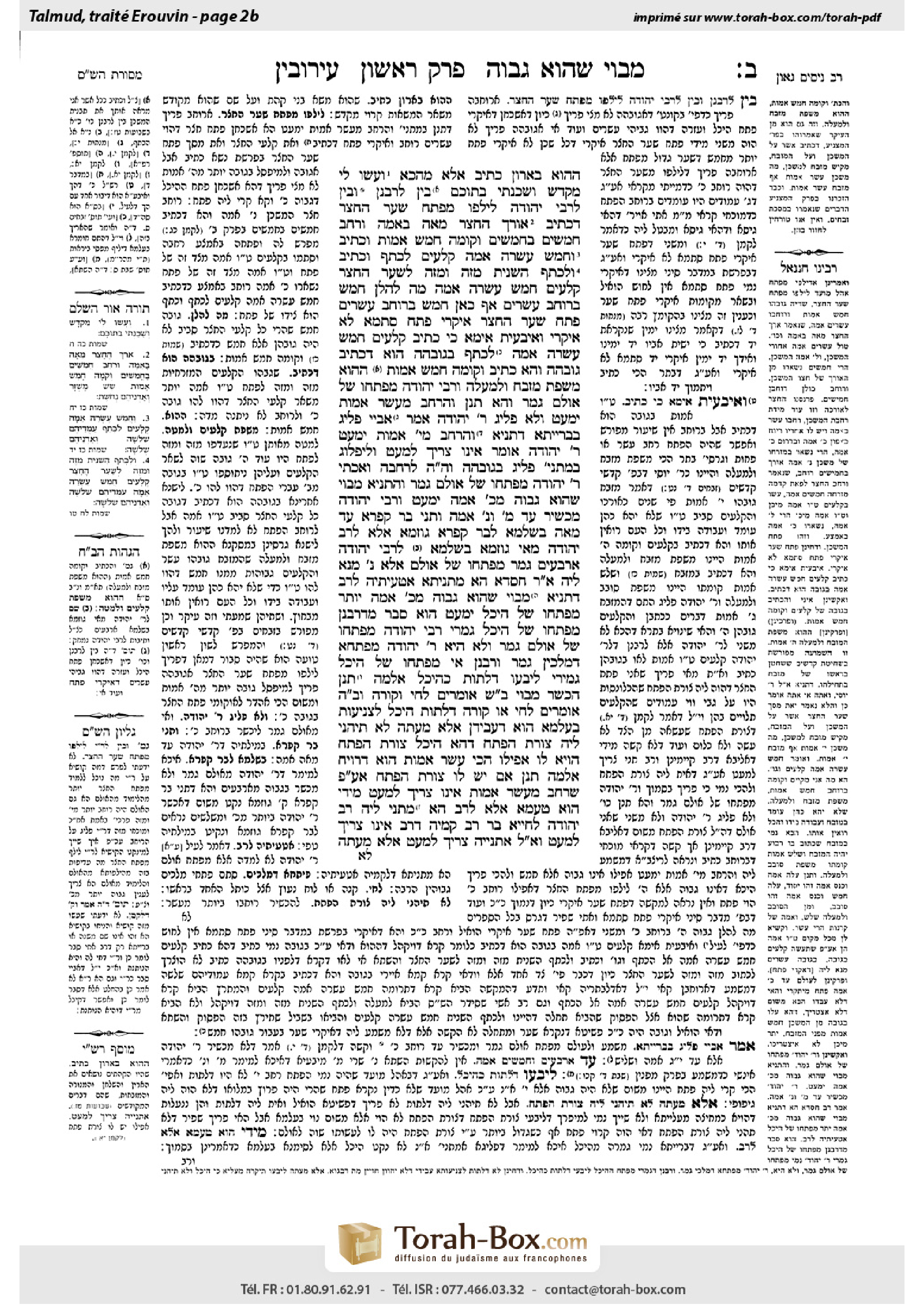
Eruvin 2b: Talmud study for Daf Yomi
Study the Talmud for Daf Yomi with scanned pages, Hebrew text, English translations from Sefaria and AI-generated French translations.
Passage selection and English or AI-generated French translation are available where the scan has annotations. Daf Study is independent of Torah-Box and Sefaria.
Browse Eruvin · עירובין · All tractatesEruvin 2b text and translations
This page of Eruvin includes the Aramaic text, an English translation and an AI-generated French translation, alongside the scan above.
עירובין ב׳ ב · Aramaic and Hebrew text
הָהוּא בְּאָרוֹן כְּתִיב. אֶלָּא מֵהָכָא: ״וְעָשׂוּ לִי מִקְדָּשׁ וְשָׁכַנְתִּי בְּתוֹכָם״.
בֵּין לְרַבָּנַן וּבֵין לְרַבִּי יְהוּדָה לֵילְפוּ מִפֶּתַח שַׁעַר הֶחָצֵר, דִּכְתִיב: ״אוֹרֶךְ הֶחָצֵר מֵאָה בָאַמָּה וְרֹחַב חֲמִשִּׁים בַּחֲמִשִּׁים וְקוֹמָה חָמֵשׁ אַמּוֹת״, וּכְתִיב: ״וַחֲמֵשׁ עֶשְׂרֵה אַמָּה קְלָעִים לַכָּתֵף״, וּכְתִיב: ״וְלַכָּתֵף הַשֵּׁנִית מִזֶּה וּמִזֶּה לְשַׁעַר הֶחָצֵר קְלָעִים חֲמֵשׁ עֶשְׂרֵה אַמָּה״, מָה לְּהַלָּן חָמֵשׁ בְּרוֹחַב עֶשְׂרִים, אַף כָּאן חָמֵשׁ בְּרוֹחַב עֶשְׂרִים!
״פֶּתַח שַׁעַר הֶחָצֵר״ אִיקְּרִי, פֶּתַח סְתָמָא — לָא אִיקְּרִי.
וְאִיבָּעֵית אֵימָא, כִּי כְתִיב: ״קְלָעִים חֲמֵשׁ עֶשְׂרֵה אַמָּה לַכָּתֵף״ — בְּגוּבְהָה הוּא דִּכְתִיב.
גּוּבְהָה?! וְהָא כְּתִיב: ״וְקוֹמָה חָמֵשׁ אַמּוֹת״! הָהוּא מִשְּׂפַת מִזְבֵּחַ וּלְמַעְלָה.
וְרַבִּי יְהוּדָה מִפִּתְחוֹ שֶׁל אוּלָם גָּמַר? וְהָא תְּנַן: וְהָרָחָב מֵעֶשֶׂר אַמּוֹת יְמַעֵט, וְלָא פְּלִיג רַבִּי יְהוּדָה!
אָמַר אַבָּיֵי: פְּלִיג בְּבָרַיְיתָא, דְּתַנְיָא: וְהָרָחָב מֵעֶשֶׂר אַמּוֹת יְמַעֵט, רַבִּי יְהוּדָה אוֹמֵר: אֵינוֹ צָרִיךְ לְמַעֵט.
וְלִיפְלוֹג בְּמַתְנִיתִין? פְּלִיג בְּגוּבְהָה, וְהוּא הַדִּין לְרֻחְבָּה.
וְאַכַּתִּי, רַבִּי יְהוּדָה מִפִּתְחוֹ שֶׁל אוּלָם גָּמַר? וְהָתַנְיָא: מָבוֹי שֶׁהוּא גָּבוֹהַּ מֵעֶשְׂרִים אַמָּה יְמַעֵט, וְרַבִּי יְהוּדָה מַכְשִׁיר עַד אַרְבָּעִים וַחֲמִשִּׁים אַמָּה. וְתָנֵי בַּר קַפָּרָא: עַד מֵאָה.
בִּשְׁלָמָא לְבַר קַפָּרָא גּוּזְמָא. אֶלָּא לְרַב יְהוּדָה מַאי גּוּזְמָא? בִּשְׁלָמָא לְרַבִּי יְהוּדָה אַרְבָּעִים — גָּמַר מִפִּתְחוֹ שֶׁל אוּלָם, אֶלָּא חֲמִשִּׁים מְנָא לֵיהּ?
אָמַר רַב חִסְדָּא: הָא מַתְנִיתָא אַטְעִיתֵיהּ לְרַב, דְּתַנְיָא: מָבוֹי שֶׁהוּא גָּבוֹהַּ מֵעֶשְׂרִים אַמָּה, יוֹתֵר מִפִּתְחוֹ שֶׁל הֵיכָל — יְמַעֵט. הוּא סָבַר: מִדְּרַבָּנַן מִפִּתְחוֹ שֶׁל הֵיכַל גָּמְרִי, רַבִּי יְהוּדָה מִפִּתְחוֹ שֶׁל אוּלָם גָּמַר. וְלָא הִיא, רַבִּי יְהוּדָה מִפִּתְחָא דְמַלְכִין גָּמַר.
וְרַבָּנַן, אִי מִפִּתְחוֹ שֶׁל הֵיכָל גְּמִירִי — לִיבְעוֹ דְּלָתוֹת כְּהֵיכָל, אַלְּמָה תְּנַן: הֶכְשֵׁר מָבוֹי, בֵּית שַׁמַּאי אוֹמְרִים: לֶחִי וְקוֹרָה, וּבֵית הִלֵּל אוֹמְרִים: לֶחִי אוֹ קוֹרָה!
דַּלְתוֹת הֵיכָל לִצְנִיעוּת בְּעָלְמָא הוּא דַּעֲבִידָן.
אֶלָּא מֵעַתָּה, לָא תַּיהֲנֵי לֵיהּ צוּרַת הַפֶּתַח, דְּהָא הֵיכַל צוּרַת הַפֶּתַח הָוְיָא לוֹ, אֲפִילּוּ הָכִי עֶשֶׂר אַמּוֹת הוּא דִּרְוִיח. אַלְּמָה תְּנַן: אִם יֵשׁ לוֹ צוּרַת הַפֶּתַח, אַף עַל פִּי שֶׁרָחָב מֵעֶשֶׂר אַמּוֹת — אֵינוֹ צָרִיךְ לְמַעֵט!
מִידֵּי הוּא טַעְמָא אֶלָּא לְרַב, הָא מַתְנֵי לֵיהּ רַב יְהוּדָה לְחִיָּיא בַּר רַב קַמֵּיהּ דְּרַב: אֵינוֹ צָרִיךְ לְמַעֵט. וַאֲמַר לֵיהּ: אַתְנְיֵיהּ ״צָרִיךְ לְמַעֵט״.
אֶלָּא מֵעַתָּה
Eruvin 2b · English translation
that instance of the term Temple is not written with regard to the Tabernacle; rather, it is written with regard to the ark and the other sacred objects in the Tabernacle, as the sons of Kehat carried only the sacred vessels and not the Tabernacle itself. Rather, it is derived from here: “And let them make Me a Temple that I may dwell among them” (Exodus 25:8), where the reference is to the Tabernacle.
The Gemara asks: Both according to the opinion of the Rabbis and according to the opinion of Rabbi Yehuda, let them derive the maximum width of a doorway from the doorway of the gate of the courtyard of the Tabernacle. As it is written: “The length of the courtyard shall be one hundred cubits and the breadth fifty everywhere, and the height five cubits” (Exodus 27:18). And it is written: “The hangings on one side of the gate shall be fifteen cubits; their pillars three and their sockets three” (Exodus 27:14). And it is written: “And for the other side of the court gate, on this hand and on that hand, were hangings of fifteen cubits; their pillars three and their sockets three” (Exodus 38:15). If the hangings on both sides of the gate covered thirty of the courtyard’s total width of fifty cubits, apparently, the gate of the courtyard was twenty cubits wide and five cubits high. Therefore, just as there, with regard to the Tabernacle, an entrance five cubits high by twenty cubits wide is considered a doorway, so too here, with regard to the halakhot of eiruv, an entrance five cubits high by twenty cubits wide should be considered a doorway.
The Gemara rejects this assertion: There is no proof from there, as that entrance is called the doorway of the gate of the courtyard, but it is not called a doorway, unmodified. Consequently, the dimensions of a doorway mentioned without qualification cannot be derived from that doorway.
The Gemara offers an alternative answer: And if you wish, say instead that when it is written: “The hangings on one side of the gate shall be fifteen cubits,” it is referring to the height of the hangings. The width of the hangings, however, is not specified in the Torah at all, and therefore the width of the doorway of the gate of the courtyard is unknown.
The Gemara raises an objection: Could it be that the height of the hangings was fifteen cubits? Isn’t it written explicitly in the verse: “And the height five cubits”? The Gemara answers: The verse is stating that the height of the hangings was five cubits, measured from the edge of the altar and above. The altar itself was ten cubits high, while the hangings of the courtyard were fifteen cubits high, five cubits higher than the altar.
The Gemara asks: Did Rabbi Yehuda actually derive his opinion from the doorway of the Entrance Hall? But didn’t we learn in the mishna that if the entrance to an alleyway is wider than ten cubits, one must diminish its width? And Rabbi Yehuda does not dispute this ruling. Wasn’t the doorway of the Entrance Hall wider than ten cubits?
Abaye said: In fact, Rabbi Yehuda disagrees with the unattributed opinion of the first tanna in a baraita. As it was taught in a baraita: If the entrance to an alleyway is wider than ten cubits, he must diminish its width; Rabbi Yehuda disagrees and says: He need not diminish it.
The Gemara asks further: If so, let him disagree in the mishna. Why is Rabbi Yehuda’s dispute cited only in the baraita, and not in the mishna? The Gemara answers: Rabbi Yehuda disagrees in the mishna with regard to an entrance’s height, but the same applies to its width. His statement: He need not reduce it, is referring both to the entrance’s height and to its width.
The Gemara poses a question: And still, is it possible that Rabbi Yehuda derived his opinion from the doorway of the Entrance Hall? Wasn’t it taught in a baraita: With regard to a cross beam spanning the entrance to an alleyway that is higher than twenty cubits, one must diminish its height; and Rabbi Yehuda deems it fit up to forty and fifty cubits. And in a different baraita, bar Kappara taught the opinion of Rabbi Yehuda: It is fit up to a hundred cubits.
The Gemara clarifies its question: Granted, according to bar Kappara, the phrase: Up to a hundred, can be understood as an exaggeration, not as an exact number. All that Rabbi Yehuda meant to say is that it is permitted to carry in the alleyway even if the cross beam is significantly higher than twenty cubits. However, according to the opinion of Rav Yehuda in the name of Rav, what exaggeration is there? He certainly meant precisely what he said. Granted, with regard to forty cubits, Rabbi Yehuda derived it from the doorway of the Entrance Hall. However, with regard to fifty cubits, from where does he derive it? Apparently, Rabbi Yehuda did not derive the dimensions of an entrance from the doorway of the Entrance Hall. He derived them from a different source.
Rav Ḥisda said: It was this baraita that misled Rav and led him to explain that Rabbi Yehuda derived the measurements of an entrance from the doorway of the Entrance Hall. As it was taught in a baraita: With regard to a cross beam spanning the entrance to an alleyway that is higher than twenty cubits, higher than the doorway of the Sanctuary, one must diminish its height. Rav maintains: From the fact that the Rabbis derived the dimensions of an entrance from the doorway of the Sanctuary, Rabbi Yehuda must have derived those dimensions from the doorway of the Entrance Hall. But that is not so. Rather, Rabbi Yehuda derived the dimensions of an entrance from the entrance of kings, whose regular practice was to erect their entrances exceedingly high and wide.
The Gemara asks: And, according to the Rabbis, if they derived their opinion from the doorway of the Sanctuary, let them require doors in order to render an alleyway fit for one to carry within it, just as there were doors in the Sanctuary. Why then did we learn in the mishna: With regard to the method of rendering an alleyway fit for carrying within it, Beit Shammai say: Both a side post placed adjacent to one of the sides of the alleyway’s entrance and a cross beam over the entrance to the alleyway are required. And Beit Hillel say: Either a side post or a cross beam is sufficient. However, not even according to the more stringent opinion of Beit Shammai are doors required.
The Gemara answers: The Sanctuary doors were made solely for the purpose of privacy, but served no practical function. The doorway of the Sanctuary did not require doors to be considered an entrance. It was a full-fledged entrance even without them.
The Gemara raises another question: But if so, that the Rabbis derive their opinion from the entrance to the Sanctuary, the form of a doorway, i.e., two vertical posts on the two sides, with a horizontal cross beam spanning the space between them, should not be effective if the alleyway is more than ten cubits wide, as the Sanctuary had the form of a doorway, and even so, it was no more than ten cubits wide. Why then did we learn in the mishna: If the entrance has the form of a doorway, then even if it is wider than ten cubits, he need not diminish its width?
The Gemara answers: As that is the reason only according to Rav, who holds that the Rabbis derive their opinion from the doorway of the Sanctuary. Didn’t Rav Yehuda teach this mishna to Ḥiyya bar Rav before Rav, saying that if the entrance had the form of a doorway he need not diminish it, and Rav said to him to teach a different version: He must diminish it. Apparently, according to Rav himself, the form of a doorway does not render it permitted to carry within the alleyway if its entrance is wider than the doorway of the Sanctuary, and therefore the question about the form of a doorway poses no difficulty to his opinion.
The Gemara raises an additional difficulty: However, if that is so,
Eruvin 2b · Traduction française (IA)
que cette occurrence du terme « Temple » ne se réfère pas au Tabernacle ; plutôt, elle se réfère à l'arche et aux autres objets sacrés du Tabernacle, car les fils de Kehat transportaient uniquement les objets sacrés et non le Tabernacle lui-même. Cela est déduit de là : « Et ils doivent me faire un Temple afin que je demeure parmi eux » (Exode 25:8), où la référence est au Tabernacle.
Le Guemara pose la question : Selon l'opinion des Rabbins et selon l'opinion de Rabbi Yehuda, on doit déduire la largeur maximale d'une porte de la porte de l'entrée du cour de l'Enclos. Car il est écrit : « La longueur du cour sera cent coudées et la largeur cinquante partout, et la hauteur cinq coudées » (Exode 27:18). Et il est écrit : « Les rideaux d'un côté de la porte seront quinze coudées ; leurs poteaux trois et leurs socles trois » (Exode 27:14). Et il est écrit : « Et pour l'autre côté de la porte du cour, sur cette main et sur celle-ci, les rideaux étaient quinze coudées ; leurs poteaux trois et leurs socles trois » (Exode 38:15). Si les rideaux des deux côtés de la porte couvraient trente des cinquante coudées de largeur totale du cour, apparemment, la porte de l'entrée du cour mesurait vingt coudées de largeur et cinq coudées de hauteur. Ainsi, tout comme là, concernant le Tabernacle, une entrée de cinq coudées de hauteur par vingt coudées de largeur est considérée comme une porte, de même ici, concernant les halakhot de l'eiruv, une entrée de cinq coudées de hauteur par vingt coudées de largeur devrait être considérée comme une porte.
Le Guemara rejette cette affirmation : Il n'y a pas de preuve à partir de là, car cette entrée est appelée la porte de l'entrée du cour, mais elle n'est pas appelée une porte sans qualification. Par conséquent, les dimensions d'une porte mentionnées sans qualification ne peuvent pas être déduites de cette porte.
Le Guemara propose une réponse alternative : Et si vous le souhaitez, dites plutôt que lorsque cela est écrit : « Les rideaux d'un côté de la porte seront quinze coudées », cela fait référence à la hauteur des rideaux. La largeur des rideaux, cependant, n'est pas spécifiée dans la Torah du tout, et par conséquent, la largeur de la porte de l'entrée du cour est inconnue.
Le Guemara soulève une objection : Pourrait-il être que la hauteur des rideaux était quinze coudées ? N'est-il pas écrit explicitement dans la versette : « Et la hauteur cinq coudées » ? Le Guemara répond : La versette indique que la hauteur des rideaux était cinq coudées, mesurée depuis le bord de l'autel et au-dessus. L'autel lui-même mesurait dix coudées de hauteur, tandis que les rideaux du cour mesuraient quinze coudées de hauteur, cinq coudées plus haut que l'autel.
Le Guemara pose la question : Rabbi Yehuda a-t-il vraiment déduit son opinion de la porte de la Salle d'Entrée ? Mais n'avons-nous pas appris dans la mishna que si l'entrée d'un passage est plus large que dix coudées, on doit la réduire ? Et Rabbi Yehuda ne conteste pas cette décision. N'était-ce pas l'entrée de la Salle d'Entrée qui mesurait plus de dix coudées ?
Abaye dit : En réalité, Rabbi Yehuda conteste l'opinion non attribuée du premier tanna dans une baraïta. Car il était enseigné dans une baraïta : Si l'entrée d'un passage est plus large que dix coudées, il faut la réduire ; Rabbi Yehuda conteste et dit : Il n'est pas nécessaire de la réduire.
Le Guemara pose une autre question : Si c'est ainsi, pourquoi Rabbi Yehuda conteste-t-il seulement dans la baraïta ? Pourquoi n'est-il pas contesté dans la mishna ? Le Guemara répond : Rabbi Yehuda conteste dans la mishna concernant la hauteur de l'entrée, mais cela s'applique également à sa largeur. Son affirmation : « Il n'est pas nécessaire de le réduire », fait référence à la fois à la hauteur et à la largeur de l'entrée.
Le Guemara pose une question : Et pourtant, est-il possible que Rabbi Yehuda ait déduit son opinion à partir de la porte de la Salle d'Entrée ? N'était-il pas enseigné dans une baraïta : Concernant une poutre traversant l'entrée d'un passage qui est plus haute que vingt coudées, il faut la réduire ; et Rabbi Yehuda considère qu'elle est acceptable jusqu'à quarante et cinquante coudées. Et dans une autre baraïta, bar Kappara enseigna l'opinion de Rabbi Yehuda : Elle est acceptable jusqu'à cent coudées.
Le Guemara clarifie sa question : En effet, selon bar Kappara, la phrase : « Jusqu'à cent », peut être comprise comme une exagération, et non comme un nombre exact. Tout ce que Rabbi Yehuda voulait dire, c'est qu'il est permis de porter dans le passage même si la poutre est nettement plus haute que vingt coudées. Cependant, selon l'opinion de Rav Yehuda en nom de Rav, quelle exagération y a-t-il ? Il a certainement voulu dire exactement ce qu'il a dit. En effet, concernant quarante coudées, Rabbi Yehuda l'a déduit de la porte de la Salle d'Entrée. Cependant, concernant cinquante coudées, d'où l'a-t-il déduit ? Apparemment, Rabbi Yehuda n'a pas déduit les dimensions d'une entrée de la porte de la Salle d'Entrée. Il les a déduites d'une autre source.
Rav Ḥisda dit : C'est cette baraïta qui a trompé Rav et l'a conduit à expliquer que Rabbi Yehuda avait déduit les mesures d'une entrée de la porte de la Salle d'Entrée. Car il était enseigné dans une baraïta : Concernant une poutre traversant l'entrée d'un passage qui est plus haute que vingt coudées, plus haute que la porte du Sanctuaire, il faut la réduire. Rav maintient : Du fait que les Rabbins ont déduit les dimensions d'une entrée de la porte du Sanctuaire, Rabbi Yehuda doit avoir déduit ces dimensions de la porte de la Salle d'Entrée. Mais cela n'est pas vrai. En réalité, Rabbi Yehuda a déduit les dimensions d'une entrée de l'entrée des rois, dont la pratique habituelle était d'élever leurs entrées extrêmement haut et large.
La Guemara pose la question : Selon les Rabbins, si leur opinion provient de la porte du Sanctuaire, qu'ils exigent des portes afin de rendre un passage adapté au transport, comme il y avait des portes dans le Sanctuaire. Pourquoi alors avons-nous appris dans la mitsna : En ce qui concerne la méthode de rendre un passage adapté au transport, Beit Shammai disent : Il faut à la fois un poteau latéral placé adjacent à l'une des côtés de l'entrée du passage et une traverse au-dessus de l'entrée du passage. Et Beit Hillel disent : Soit un poteau latéral, soit une traverse suffisent. Cependant, même selon l'opinion la plus stricte de Beit Shammai, des portes ne sont pas nécessaires.
La Guemara répond : Les portes du Sanctuaire étaient faites uniquement à des fins de confidentialité, sans fonction pratique. La porte du Sanctuaire ne nécessitait pas de portes pour être considérée comme une entrée. C'était une entrée complète même sans elles.
La Guemara soulève une autre question : Mais si c’est ainsi, que les Sages tirent leur opinion de l’entrée du Sanctuaire, c’est-à-dire de la forme d’une porte, c’est-à-dire de deux poteaux verticaux aux deux côtés, avec une traverse horizontale qui s’étend entre eux, ne devrait-ce pas être inefficace si le passage est plus large de dix coudées, puisque le Sanctuaire avait la forme d’une porte, et même ainsi, il n’était pas plus large de dix coudées. Pourquoi alors avons-nous appris dans la mitsna : Si l’entrée a la forme d’une porte, alors même qu’elle est plus large de dix coudées, il n’est pas nécessaire de la rétrécir ?
La Guemara répond : C’est ainsi que le dit Rav, qui considère que les Sages tirent leur opinion de la porte du Sanctuaire. N’a-t-il pas appris cette mitsna à Chiya bar Rav avant Rav, en disant que si l’entrée avait la forme d’une porte, il n’était pas nécessaire de la rétrécir, et Rav lui a dit de lui enseigner une version différente : Il faut la rétrécir. Apparemment, selon Rav lui-même, la forme d’une porte ne rend pas l’entrée permise à porter des objets à l’intérieur du passage si l’entrée est plus large que la porte du Sanctuaire, et par conséquent, la question sur la forme d’une porte ne pose pas de difficulté à son opinion.
La Guemara soulève une difficulté supplémentaire : Cependant, si c’est ainsi,
Traduction française générée par IA à partir de l’édition anglaise de Sefaria. Vérifie toujours un passage avec le texte source.
Text from Sefaria: William Davidson Edition - Vocalized Aramaic (CC BY NC); William Davidson Edition - English (CC BY NC).