Eruvin 56a: Talmud study for Daf Yomi
Study the Talmud for Daf Yomi with scanned pages, Hebrew text, English translations from Sefaria and AI-generated French translations.
Passage selection and English or AI-generated French translation are available where the scan has annotations. Daf Study is independent of Torah-Box and Sefaria.
Browse Eruvin · עירובין · All tractatesEruvin 56a text and translations
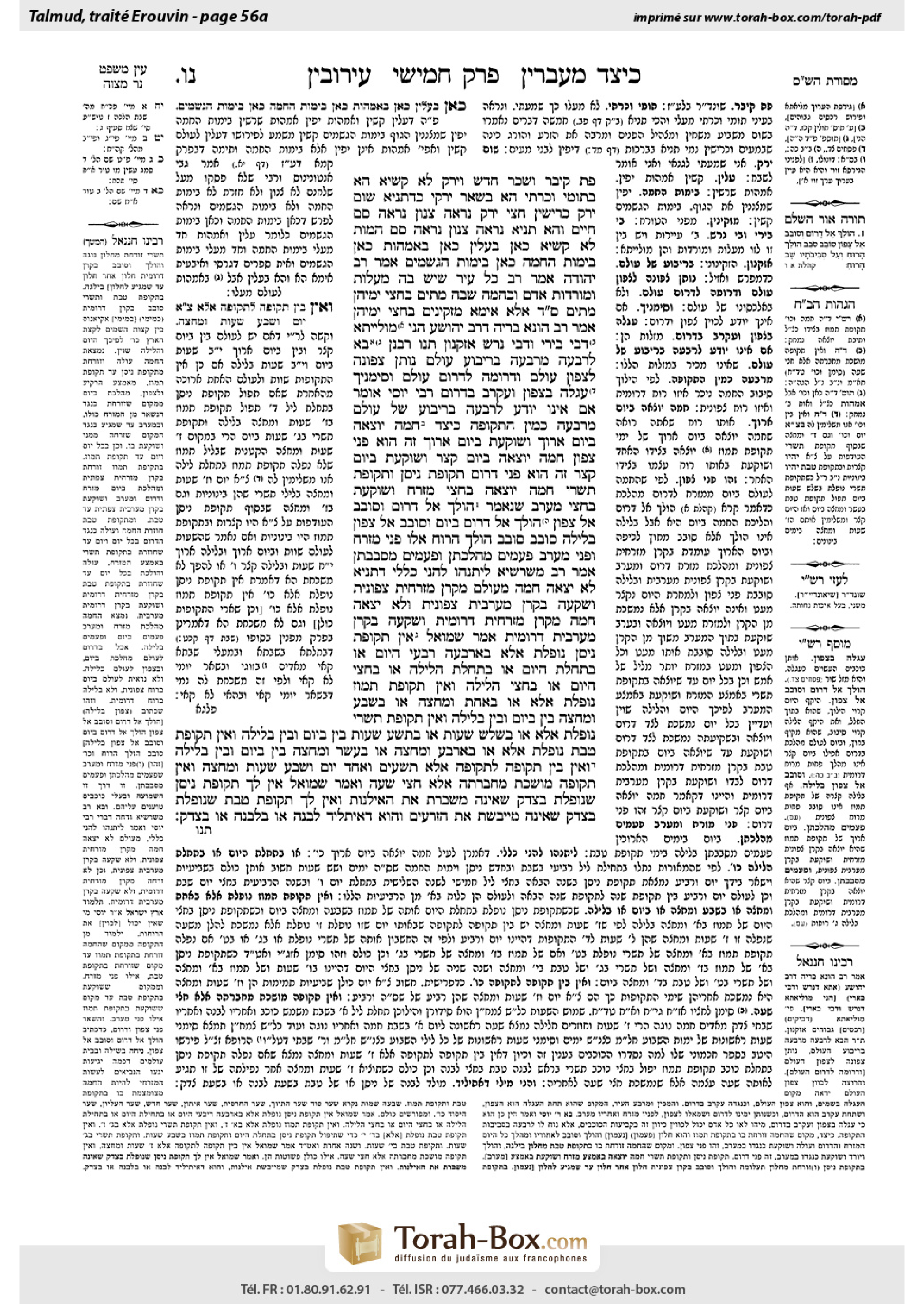
This page of Eruvin includes the Aramaic text, an English translation and an AI-generated French translation, alongside the scan above.
עירובין נ״ו א · Aramaic and Hebrew text
פַּת קִיבָּר וְשֵׁכָר חָדָשׁ וְיָרָק. לָא קַשְׁיָא: הָא — בְּתוּמֵי וְכַרָּתֵי, הָא — בִּשְׁאָר יַרְקֵי. כִּדְתַנְיָא: שׁוּם — יָרָק, כְּרֵישִׁין — חֲצִי יָרָק, נִרְאֶה צְנוֹן — נִרְאֶה סַם חַיִּים.
וְהָא תַנְיָא: נִרְאֶה צְנוֹן — נִרְאֶה סַם הַמָּוֶת! לָא קַשְׁיָא: כָּאן — בֶּעָלִין, כָּאן — בָּאִמָּהוֹת. כָּאן — בִּימוֹת הַחַמָּה, כָּאן — בִּימוֹת הַגְּשָׁמִים.
אָמַר רַב יְהוּדָה אָמַר רַב: כׇּל עִיר שֶׁיֵּשׁ בָּהּ מַעֲלוֹת וּמוֹרָדוֹת, אָדָם וּבְהֵמָה שֶׁבָּהּ מֵתִים בַּחֲצִי יְמֵיהֶן. מֵתִים סָלְקָא דַּעְתָּךְ? אֶלָּא אֵימָא: מַזְקִינִים בַּחֲצִי יְמֵיהֶן. אָמַר רַב הוּנָא בְּרֵיהּ דְּרַב יְהוֹשֻׁעַ: הָנֵי מוּלְיָיתָא דְּבֵי בֵירֵי וּדְבֵי נָרֶשׁ אַזְקְנוּן.
תָּנוּ רַבָּנַן: בָּא לְרַבְּעָהּ — מְרַבְּעָהּ בְּרִיבּוּעַ עוֹלָם, נוֹתֵן צְפוֹנָהּ לִצְפוֹן עוֹלָם וּדְרוֹמָהּ לִדְרוֹם עוֹלָם, וְסִימָנָיךְ: עֲגָלָה בַּצָּפוֹן, וְעַקְרָב בַּדָּרוֹם.
רַבִּי יוֹסֵי אוֹמֵר: אִם אֵינוֹ יוֹדֵעַ לְרַבְּעָהּ בְּרִיבּוּעַ שֶׁל עוֹלָם, — מְרַבְּעָהּ כְּמִין הַתְּקוּפָה. כֵּיצַד? חַמָּה יוֹצְאָה בְּיוֹם אָרוֹךְ וְשׁוֹקַעַת בְּיוֹם אָרוֹךְ — זֶה הוּא פְּנֵי צָפוֹן. חַמָּה יוֹצְאָה בְּיוֹם קָצָר וְשׁוֹקַעַת בְּיוֹם קָצָר — זֶה הוּא פְּנֵי דָרוֹם. תְּקוּפַת נִיסָן וּתְקוּפַת תִּשְׁרֵי — חַמָּה יוֹצְאָה בַּחֲצִי מִזְרָח וְשׁוֹקַעַת בַּחֲצִי מַעֲרָב,
שֶׁנֶּאֱמַר: ״הוֹלֵךְ אֶל דָּרוֹם וְסוֹבֵב אֶל צָפוֹן״, הוֹלֵךְ אֶל דָּרוֹם — בַּיּוֹם, וְסוֹבֵב אֶל צָפוֹן — בַּלַּיְלָה. ״סוֹבֵב סוֹבֵב הוֹלֵךְ הָרוּחַ״ — אֵלּוּ פְּנֵי מִזְרָח וּפְנֵי מַעֲרָב, פְּעָמִים מְהַלַּכְתָּן וּפְעָמִים מְסַבַּבְתָּן.
אָמַר רַב מְשַׁרְשְׁיָא: לֵיתַנְהוּ לְהָנֵי כְּלָלֵי, דְּתַנְיָא: לֹא יָצְאָה חַמָּה מֵעוֹלָם מִקֶּרֶן מִזְרָחִית צְפוֹנִית וְשָׁקְעָה בְּקֶרֶן מַעֲרָבִית צְפוֹנִית, וְלֹא יָצְאָה חַמָּה מִקֶּרֶן מִזְרָחִית דְּרוֹמִית וְשָׁקְעָה בְּקֶרֶן מַעֲרָבִית דְּרוֹמִית.
אָמַר שְׁמוּאֵל: אֵין תְּקוּפַת נִיסָן נוֹפֶלֶת אֶלָּא בְּאַרְבָּעָה רִבְעֵי הַיּוֹם, אוֹ בִּתְחִלַּת הַיּוֹם אוֹ בִּתְחִלַּת הַלַּיְלָה, אוֹ בַּחֲצִי הַיּוֹם אוֹ בַּחֲצִי הַלַּיְלָה.
וְאֵין תְּקוּפַת תַּמּוּז נוֹפֶלֶת אֶלָּא אוֹ בְּאַחַת וּמֶחֱצָה, אוֹ בְּשֶׁבַע וּמֶחֱצָה, בֵּין בַּיּוֹם וּבֵין בַּלַּיְלָה. וְאֵין תְּקוּפַת תִּשְׁרֵי נוֹפֶלֶת אֶלָּא אוֹ בְּשָׁלֹשׁ שָׁעוֹת אוֹ בְּתֵשַׁע שָׁעוֹת, בֵּין בַּיּוֹם וּבֵין בַּלַּיְלָה. וְאֵין תְּקוּפַת טֵבֵת נוֹפֶלֶת אֶלָּא אוֹ בְּאַרְבַּע וּמֶחֱצָה אוֹ בְּעֶשֶׂר וּמֶחֱצָה, בֵּין בַּיּוֹם וּבֵין בַּלַּיְלָה.
וְאֵין בֵּין תְּקוּפָה לִתְקוּפָה אֶלָּא תִּשְׁעִים וְאֶחָד יוֹם וְשֶׁבַע שָׁעוֹת וּמֶחֱצָה. וְאֵין תְּקוּפָה מוֹשֶׁכֶת מֵחֲבֶרְתָּהּ אֶלָּא חֲצִי שָׁעָה.
וְאָמַר שְׁמוּאֵל: אֵין לְךָ תְּקוּפַת נִיסָן שֶׁנּוֹפֶלֶת בְּצֶדֶק, שֶׁאֵינָהּ מְשַׁבֶּרֶת אֶת הָאִילָנוֹת. וְאֵין לְךָ תְּקוּפַת טֵבֵת שֶׁנּוֹפֶלֶת בְּצֶדֶק, שֶׁאֵינָהּ מְיַיבֶּשֶׁת אֶת הַזְּרָעִים. וְהוּא, דְּאִיתְיְלִיד לְבָנָה אוֹ בִּלְבָנָה אוֹ בְּצֶדֶק.
Eruvin 56a · English translation
coarse bread, made from coarse flour that has not been thoroughly sifted, new beer, and vegetables. This indicates that vegetables are harmful to one’s well-being. The Gemara answers: This is not difficult. This statement of Rav Huna is referring to garlic and leeks, which are beneficial; that baraita is referring to other vegetables, which are harmful. As it was taught in a baraita: Garlic is a healthy vegetable; leeks are a half-vegetable, meaning they are half as healthful. If radish has been seen, an elixir of life has been seen, as it is very beneficial to the body.
The Gemara asks: Wasn’t it taught in a different baraita: If radish has been seen, a lethal drug has been seen? The Gemara answers: This is not difficult. Here, in the baraita that deprecates radish, it is referring to its leaves; there, in the baraita that praises radish, it is referring to the roots. Alternatively, here it is referring to the summer, when radish is beneficial; there, it is referring to the winter, when it is harmful.
On the topic of the attributes of different locations, Rav Yehuda also said that Rav said: In any city that has many ascents and descents, which can be taxing to the body, people and animals die at half their days, meaning half of their life expectancy. The Gemara expresses surprise: Can it enter your mind that Rav really meant to say that they die prematurely? Even in such cities they are known to have a regular life expectancy. Rather, say: They grow old at half their days, i.e., they age prematurely due to the strain of climbing up and down the inclines. Similarly, Rav Huna, son of Rav Yehoshua, said: The ascents and descents between Beit Biri and Beit Neresh, my place of residence, made me grow old prematurely.
With regard to the measurements of a city’s boundaries, the Sages taught the following baraita: If, in order to measure the Shabbat limit, one comes to square a city, i.e., to extend the city’s boundaries to include all of its protrusions within an imaginary square, he squares it so that the sides of the square align with the four directions of the world. He sets the northern side of the square to align with the north of the world, and its southern side to align with the south of the world. And your sign by which you can recognize the directions of the world is as follows: The constellation of Ursa Major is in the north and Scorpio is in the south. The directions of the city are determined by these constellations.
Rabbi Yosei says: If one does not know how to square the city in alignment with the four directions of the world based upon the constellations, he should square it based upon the seasons, although this is less precise. How so? Where the sun rises and sets on the longest day of the year, the summer solstice, this route of the sun is the face of the north. The sun rises in the northeast and sets in the northwest, and thus travels from east to west across the north side of the world. Conversely, where the sun rises and sets on the shortest day of the year, the winter solstice, this route of the sun is the face of the south. Whereas at the vernal equinox and the autumnal equinox, when day and night are equal in length, the sun rises in the middle of the east and sets in the middle of the west.
As it is stated: “One generation passes away and another generation comes; but the earth abides forever. The sun also rises and the sun goes down, and hastens to its place, where it rises again. It goes toward the south, and turns about to the north; round and round goes the wind, and on its circuits the wind returns” (Ecclesiastes 1:4–6). The verse is understood as describing the sun’s movements, as follows: “It goes toward the south” during the day; “and turns about to the north,” on the other side of the earth, at night. “Round and round goes the wind [ruaḥ];” the word ruaḥ can also mean direction or side. Rabbi Yosei explains that these are the face of the east and the face of the west; sometimes the sun traverses them visibly, and sometimes it turns about them without being seen.
Rav Mesharshiya said: There is no validity to these rules established by Rabbi Yosei, as it was taught in a baraita: The sun has never risen, even during the summer, at the northeastern corner of the sky and set in the northwestern corner, nor has the sun ever risen, even during the winter, at the southeastern corner and set in the southwestern corner. Therefore, one can establish the directions of the world according to the sun’s path only during the autumn and spring.
On the topic of the previous discussion with regard to calculating the directions of the world based upon the seasons, Shmuel said: The vernal equinox occurs only at the beginning of one of the four quarters of a day: Either precisely at the beginning of the day, or precisely at the beginning of the night, or at midday, or at midnight.
Similarly, the summer solstice occurs only at certain times of the day: Either at the conclusion of one and a half hours or seven and a half hours of the day or night. And the autumnal equinox occurs only at certain times: Either at the conclusion of three hours or nine hours of the day or night. And the winter solstice occurs only at certain times: Either at the conclusion of four and a half hours or ten and a half hours of the day or night.
And all this is based on the principle that there are only ninety-one days and seven and a half hours between the beginning of one season and the next, as he assumed that a year is exactly 365¼ days. And similarly, each season begins precisely one-half planetary hour past the beginning of the previous season. There are seven heavenly bodies that are each ascendant for an hour at a time in a constant rotation: Mercury, Moon, Saturn, Jupiter, Mars, the Sun, and Venus. Each season begins half an hour later in this rotation than the previous season.
And Shmuel said: There is no instance when the vernal equinox occurs in the planetary hour of Jupiter and it does not break the trees with its strong winds; and there is no instance when the winter solstice occurs in the planetary hour of Jupiter and it does not dry up the seeds. And this applies only where the new moon appeared either at the hour of the Moon or at the hour of Jupiter.
Eruvin 56a · Traduction française (IA)
du pain grossier, fait à partir de farine grossière qui n’a pas été suffisamment tamisée, du nouveau vin, et des légumes. Cela indique que les légumes sont nuisibles à la santé. La Guemara répond : Ce n’est pas difficile. La déclaration de Rav Huna fait référence à l’ail et aux échalotes, qui sont bénéfiques ; cette baraïta fait référence à d’autres légumes, qui sont nuisibles. Comme il a été enseigné dans une baraïta : L’ail est un légume sain ; les échalotes sont un demi-légume, c’est-à-dire qu’elles sont aussi saines que la moitié. Si l’on a vu un radis, on a vu un élixir de vie, car il est très bénéfique pour le corps.
La Guemara demande : N’a-t-il pas été enseigné dans une autre baraïta : Si l’on a vu un radis, on a vu un poison mortel ? La Guemara répond : Ce n’est pas difficile. Ici, dans la baraïta qui déprécie le radis, il s’agit de ses feuilles ; là, dans la baraïta qui loue le radis, il s’agit de ses racines. Alternativement, ici il s’agit de l’été, lorsque le radis est bénéfique ; là, il s’agit de l’hiver, lorsque le radis est nuisible.
Sur le sujet des caractéristiques des différents lieux, Rav Yéhuda a aussi dit que Rav a dit : Dans toute ville qui a beaucoup d’ascensions et de descentes, qui peuvent être épuisants pour le corps, les gens et les animaux meurent à la moitié de leurs jours, c’est-à-dire à la moitié de leur espérance de vie. La Guemara exprime une surprise : Est-ce que cela entre dans votre esprit que Rav ait vraiment voulu dire qu’ils meurent prématurément ? Même dans de telles villes, on sait qu’ils ont une espérance de vie normale. Plutôt, disons : Ils vieillissent à la moitié de leurs jours, c’est-à-dire qu’ils vieillissent prématurément en raison de la fatigue des montées et des descentes. De même, Rav Huna, fils de Rav Yéhoshua, a dit : Les ascensions et descentes entre Beit Biri et Beit Neresh, mon lieu de résidence, m’ont fait vieillir prématurément.
En ce qui concerne les mesures des limites d’une ville, les Sages ont enseigné la suivante baraïta : Si, afin de mesurer la limite du Shabbat, on vient à carrer une ville, c’est-à-dire étendre les limites de la ville pour inclure toutes ses extrémités dans un carré imaginaire, on le carré de sorte que les côtés du carré s’alignent avec les quatre directions du monde. On place le côté nord du carré pour s’aligner avec le nord du monde, et son côté sud pour s’aligner avec le sud du monde. Et votre signe par lequel vous pouvez reconnaître les directions du monde est le suivant : La constellation de l’Ursa Major est au nord et la constellation du Scorpion est au sud. Les directions de la ville sont déterminées par ces constellations.
Rabbi Yosei dit : Si l’on ne sait pas carrer la ville en alignement avec les quatre directions du monde en se basant sur les constellations, on doit carrer la ville en se basant sur les saisons, bien que cela soit moins précis. Comment cela fonctionne-t-il ? Lorsque le soleil se lève et se couche sur le jour le plus long de l’année, l’été solstice, ce trajet du soleil est la face du nord. Le soleil se lève à l’est-nord-est et se couche à l’ouest-nord-ouest, et ainsi traverse de l’est à l’ouest le côté nord du monde. À l’inverse, lorsque le soleil se lève et se couche sur le jour le plus court de l’année, l’hiver solstice, ce trajet du soleil est la face du sud. Alors que lors des équinoxes de printemps et d’automne, lorsque la durée du jour et de la nuit sont égales, le soleil se lève au milieu de l’est et se couche au milieu de l’ouest.
Comme il est dit : « Une génération passe et une autre vient ; mais la terre demeure toujours. Le soleil lève aussi et le soleil se couche, et hâte son chemin, où il renaît. Il va vers le sud, et tourne autour du nord ; tour à tour va le vent [ruaḥ] ; et sur ses circuits le vent revient » (Ecclésiaste 1:4–6). La verset est comprise comme décrivant les mouvements du soleil, comme suit : « Il va vers le sud » pendant la journée ; « et tourne autour du nord », de l’autre côté de la terre, la nuit. « Tour à tour va le vent [ruaḥ] » ; le mot ruaḥ peut aussi signifier direction ou côté. Rabbi Yosei explique que ces sont les faces de l’est et de l’ouest ; parfois le soleil traverse visiblement ces faces, et parfois il tourne autour sans être vu.
Rav Mesharshiya a dit : Il n’y a pas de validité à ces règles établies par Rabbi Yosei, car il a été enseigné dans une baraïta : Le soleil n’a jamais levé, même en été, au coin nord-est du ciel et s’est couché au coin nord-ouest, ni n’a jamais levé, même en hiver, au coin sud-est et s’est couché au coin sud-ouest. Par conséquent, on peut établir les directions du monde en se basant sur le trajet du soleil uniquement pendant l’automne et le printemps.
Sur le sujet de la discussion précédente concernant le calcul des directions du monde en se basant sur les saisons, Shmuel a dit : L’équinoxe de printemps se produit uniquement au début d’un des quatre quartiers d’un jour : Soit précisément au début du jour, soit précisément au début de la nuit, soit à la mi-jour, soit à la mi-nuit.
De même, le solstice d’été se produit uniquement à certaines heures de la journée : Soit à la fin d’une heure et demie ou de sept heures et demie de la journée ou de la nuit. Et l’équinoxe d’automne se produit uniquement à certaines heures : Soit à la fin de trois heures ou de neuf heures de la journée ou de la nuit. Et le solstice d’hiver se produit uniquement à certaines heures : Soit à la fin de quatre heures et demie ou de dix heures et demie de la journée ou de la nuit.
Et tout cela est basé sur le principe que seuls 91 jours et 7 heures et demie séparent le début d’une saison du début de la suivante, car il a supposé qu’une année est exactement de 365 jours et un quart. De même, chaque saison commence précisément une demi-heure après le début de la saison précédente. Il y a sept corps célestes qui sont chacun ascendants pendant une heure à la fois dans une rotation constante : Mercure, Lune, Saturne, Jupiter, Mars, le Soleil et Vénus. Chaque saison commence demi-heure plus tard dans cette rotation que la saison précédente.
Et Shmuel a dit : Il n'y a pas d'instance où l'équinoxe vernal se produit dans l'heure planétaire de Jupiter et où il ne brise les arbres avec ses vents puissants ; et il n'y a pas d'instance où le solstice d'hiver se produit dans l'heure planétaire de Jupiter et où il ne dessèche les semences. Et cela s'applique uniquement là où la nouvelle lune est apparue soit à l'heure de la Lune soit à l'heure de Jupiter.
Traduction française générée par IA à partir de l’édition anglaise de Sefaria. Vérifie toujours un passage avec le texte source.
Text from Sefaria: William Davidson Edition - Vocalized Aramaic (CC BY NC); William Davidson Edition - English (CC BY NC).