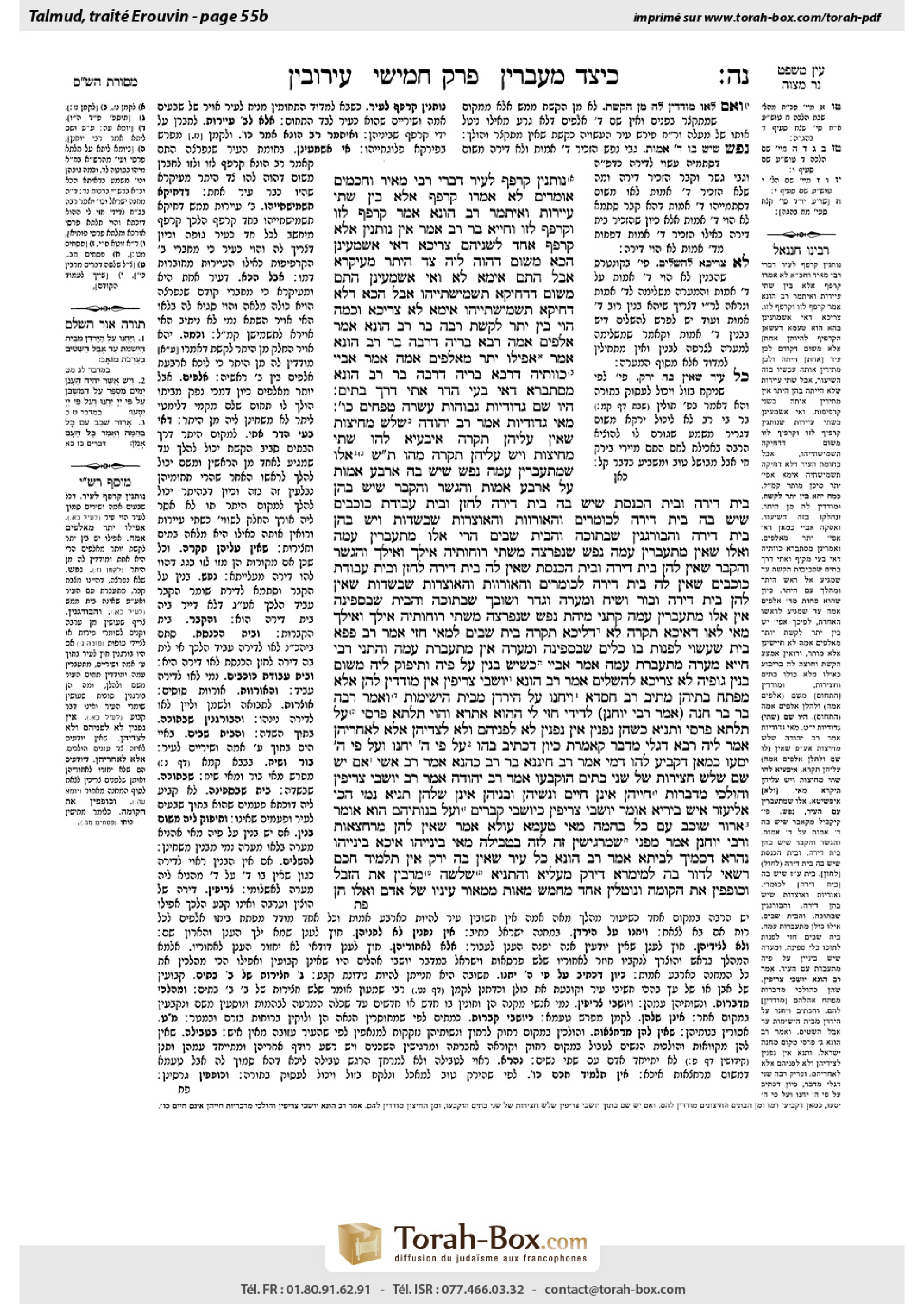
Eruvin 55b: Talmud study for Daf Yomi
Study the Talmud for Daf Yomi with scanned pages, Hebrew text, English translations from Sefaria and AI-generated French translations.
Passage selection and English or AI-generated French translation are available where the scan has annotations. Daf Study is independent of Torah-Box and Sefaria.
Browse Eruvin · עירובין · All tractatesEruvin 55b text and translations
This page of Eruvin includes the Aramaic text, an English translation and an AI-generated French translation, alongside the scan above.
עירובין נ״ה ב · Aramaic and Hebrew text
נוֹתְנִין קַרְפֵּף לָעִיר, דִּבְרֵי רַבִּי מֵאִיר. וַחֲכָמִים אוֹמְרִים: לֹא אָמְרוּ קַרְפֵּף אֶלָּא בֵּין שְׁתֵּי עֲיָירוֹת.
וְאִיתְּמַר, רַב הוּנָא אָמַר: קַרְפֵּף לָזוֹ וְקַרְפֵּף לָזוֹ. וְחִיָּיא בַּר רַב אָמַר: אֵין נוֹתְנִין אֶלָּא קַרְפֵּף אֶחָד לִשְׁנֵיהֶם!
צְרִיכָא, דְּאִי אַשְׁמְעִינַן הָכָא — מִשּׁוּם דַּהֲוָה לֵיהּ צַד הֶיתֵּר מֵעִיקָּרָא. אֲבָל הָתָם, אֵימָא לָא.
וְאִי אַשְׁמְעִינַן הָתָם — מִשּׁוּם דִּדְחִיקָא תַּשְׁמִישְׁתַּיְיהוּ, אֲבָל הָכָא דְּלָא דְּחִיקָא תַּשְׁמִישְׁתַּיְיהוּ — אֵימָא לָא, צְרִיכָא.
וְכַמָּה הָוֵי בֵּין יֶתֶר לַקֶּשֶׁת? רַבָּה בַּר רַב הוּנָא אָמַר: אַלְפַּיִם אַמָּה, רָבָא בְּרֵיהּ דְּרַבָּה בַּר רַב הוּנָא אָמַר: אֲפִילּוּ יָתֵר מֵאַלְפַּיִם אַמָּה.
אָמַר אַבָּיֵי: כְּווֹתֵיהּ דְּרָבָא בְּרֵיהּ דְּרַבָּה בַּר רַב הוּנָא מִסְתַּבְּרָא, דְּאִי בָּעֵי הָדַר אָתֵי דֶּרֶךְ בָּתִּים.
הָיוּ שָׁם גְּדוּדִיּוֹת גְּבוֹהוֹת עֲשָׂרָה טְפָחִים כּוּ׳. מַאי גְּדוּדִיּוֹת? אָמַר רַב יְהוּדָה: שָׁלֹשׁ מְחִיצּוֹת שֶׁאֵין עֲלֵיהֶן תִּקְרָה.
אִיבַּעְיָא לְהוּ: שְׁתֵּי מְחִיצּוֹת וְיֵשׁ עֲלֵיהֶן תִּקְרָה, מַהוּ? תָּא שְׁמַע, אֵלּוּ שֶׁמִּתְעַבְּרִין עִמָּהּ: נֶפֶשׁ שֶׁיֵּשׁ בָּהּ אַרְבַּע אַמּוֹת עַל אַרְבַּע אַמּוֹת, וְהַגֶּשֶׁר וְהַקֶּבֶר שֶׁיֵּשׁ בָּהֶן בֵּית דִּירָה, וּבֵית הַכְּנֶסֶת שֶׁיֵּשׁ בָּהּ בֵּית דִּירָה לַחַזָּן, וּבֵית עֲבוֹדָה זָרָה שֶׁיֵּשׁ בָּהּ בֵּית דִּירָה לַכּוֹמָרִים, וְהָאוּרְווֹת וְהָאוֹצָרוֹת שֶׁבַּשָּׂדוֹת וְיֵשׁ בָּהֶן בֵּית דִּירָה, וְהַבּוּרְגָּנִין שֶׁבְּתוֹכָהּ, וְהַבַּיִת שֶׁבַּיָּם — הֲרֵי אֵלּוּ מִתְעַבְּרִין עִמָּהּ.
וְאֵלּוּ שֶׁאֵין מִתְעַבְּרִין עִמָּהּ: נֶפֶשׁ שֶׁנִּפְרְצָה מִשְׁתֵּי רוּחוֹתֶיהָ אֵילָךְ וְאֵילָךְ, וְהַגֶּשֶׁר וְהַקֶּבֶר שֶׁאֵין לָהֶן בֵּית דִּירָה, וּבֵית הַכְּנֶסֶת שֶׁאֵין לָהּ בֵּית דִּירָה לַחַזָּן, וּבֵית עֲבוֹדָה זָרָה שֶׁאֵין לָהּ בֵּית דִּירָה לַכּוֹמָרִים, וְהָאוּרְווֹת וְהָאוֹצָרוֹת שֶׁבַּשָּׂדוֹת שֶׁאֵין לָהֶן בֵּית דִּירָה, וּבוֹר וְשִׁיחַ וּמְעָרָה וְגָדֵר וְשׁוֹבָךְ שֶׁבְּתוֹכָהּ, וְהַבַּיִת שֶׁבַּסְּפִינָה — אֵין אֵלּוּ מִתְעַבְּרִין עִמָּהּ.
קָתָנֵי מִיהַת: נֶפֶשׁ שֶׁנִּפְרְצָה מִשְׁתֵּי רוּחוֹתֶיהָ אֵילָךְ וְאֵילָךְ. מַאי לָאו דְּאִיכָּא תִּקְרָה! לָא — דְּלֵיכָּא תִּקְרָה.
בַּיִת שֶׁבַּיָּם. לְמַאי חֲזֵי? אָמַר רַב פָּפָּא: בַּיִת שֶׁעָשׂוּי לְפַנּוֹת בּוֹ כֵּלִים שֶׁבַּסְּפִינָה.
וּמְעָרָה אֵין מִתְעַבֶּרֶת עִמָּהּ, וְהָתָנֵי רַבִּי חִיָּיא: מְעָרָה מִתְעַבֶּרֶת עִמָּהּ! אָמַר אַבָּיֵי: כְּשֶׁיֵּשׁ בִּנְיָן עַל פִּיהָ.
וְתִיפּוֹק לֵיהּ מִשּׁוּם בִּנְיָן גּוּפֵיהּ! לָא צְרִיכָא, לְהַשְׁלִים.
אָמַר רַב הוּנָא: יוֹשְׁבֵי צְרִיפִין, אֵין מוֹדְדִין לָהֶן אֶלָּא מִפֶּתַח בָּתֵּיהֶן.
מֵתִיב רַב חִסְדָּא: ״וַיַּחֲנוּ עַל הַיַּרְדֵּן מִבֵּית הַיְשִׁימוֹת״, וְאָמַר רַבָּה בַּר בַּר חָנָה (אָמַר רַבִּי יוֹחָנָן): לְדִידִי חֲזֵי לִי הָהוּא אַתְרָא, וְהָוֵי תְּלָתָא פַּרְסֵי עַל תְּלָתָא פַּרְסֵי.
וְתַנְיָא: כְּשֶׁהֵן נִפְנִין — אֵין נִפְנִין לֹא לִפְנֵיהֶם, וְלֹא לְצִדֵּיהֶן, אֶלָּא לְאַחֲרֵיהֶן?
אֲמַר לֵיהּ רָבָא: דִּגְלֵי מִדְבָּר קָאָמְרַתְּ? כֵּיוָן דִּכְתִיב בְּהוּ: ״עַל פִּי ה׳ יַחֲנוּ וְעַל פִּי ה׳ יִסָּעוּ״ — כְּמַאן דִּקְבִיעַ לְהוּ דָּמֵי.
אָמַר רַב חִינָּנָא בַּר רַב כָּהֲנָא אָמַר רַב אָשֵׁי: אִם יֵשׁ שָׁם שָׁלֹשׁ חֲצֵירוֹת שֶׁל שְׁנֵי בָתִּים — הוּקְבְּעוּ.
אָמַר רַב יְהוּדָה אָמַר רַב: יוֹשְׁבֵי צְרִיפִין וְהוֹלְכֵי מִדְבָּרוֹת — חַיֵּיהֶן אֵינָן חַיִּים, וּנְשֵׁיהֶן וּבְנֵיהֶן אֵינָן שֶׁלָּהֶן.
תַּנְיָא נָמֵי הָכִי, אֱלִיעֶזֶר אִישׁ בִּירְיָא אוֹמֵר: יוֹשְׁבֵי צְרִיפִין כְּיוֹשְׁבֵי קְבָרִים. וְעַל בְּנוֹתֵיהֶם הוּא אוֹמֵר: ״אָרוּר שׁוֹכֵב עִם כׇּל בְּהֵמָה״.
מַאי טַעְמָא? עוּלָּא אָמַר: שֶׁאֵין לָהֶן מֶרְחֲצָאוֹת. וְרַבִּי יוֹחָנָן אָמַר: מִפְּנֵי שֶׁמַּרְגִּישִׁין זֶה לָזֶה בִּטְבִילָה.
מַאי בֵּינַיְיהוּ? אִיכָּא בֵּינַיְיהוּ נַהֲרָא דִּסְמִיךְ לְבֵיתָא.
אָמַר רַב הוּנָא: כׇּל עִיר שֶׁאֵין בָּהּ יָרָק — אֵין תַּלְמִיד חָכָם רַשַּׁאי לָדוּר בָּהּ. לְמֵימְרָא דְּיָרָק מְעַלְּיָא? וְהָתַנְיָא: שְׁלֹשָׁה מַרְבִּין אֶת הַזֶּבֶל, וְכוֹפְפִין אֶת הַקּוֹמָה, וְנוֹטְלִין אֶחָד מֵחֲמֵשׁ מֵאוֹת מִמְּאוֹר עֵינָיו שֶׁל אָדָם, וְאֵלּוּ הֵן:
Eruvin 55b · English translation
One allocates a karpef to every city, i.e., an area of slightly more than seventy cubits is added to the boundary of a city and the Shabbat limit is measured from there; this is the statement of Rabbi Meir. And the Sages say: They spoke of the measure of a karpef only with regard to the space between two adjacent cities, i.e., if adjacent cities are separated by a shorter distance than that, they are considered one city.
And it was stated that the amora’im disputed this issue. Rav Huna said: A karpef is added to this city and another karpef is added to that city, so that as long as the cities are not separated by a distance of slightly more than 141 cubits, they are considered one entity. And Ḥiyya bar Rav said: One allocates only one karpef to the two of them. Accordingly, Rav Huna has already stated that the measure of a karpef is added to both cities in determining whether they are close enough to be considered a single entity.
The Gemara answers: It is necessary for Rav Huna to state this halakha in both instances, as, had he taught it to us only here, in the case of the breached wall, one might have said that a karpef is allocated to each city only in that case because it had an aspect of permissibility from the outset, namely, the two sections originally formed one city. But there, with regard to the two cities, say that this is not the case and the two cities are only considered as one if they are separated by less than the measure of a single karpef.
And had he taught it to us only there, with regard to the two cities, one might have said that only in that case is a karpef allocated to each city because one karpef would be too cramped for the use of both cities. But here, in the case of the breached wall, where one karpef would not be too cramped for the use of both sections, as the vacant space is inside the city, in an area that had not been used in this fashion before the wall was breached, say that this is not the case and a single karpef is sufficient. Therefore, it was necessary to state this halakha in both cases.
The Gemara asks: And how much distance may there be between the imaginary bowstring and the center of the bow in a city that is shaped like a bow? Rabba bar Rav Huna said: Two thousand cubits. Rava, son of Rabba bar Rav Huna, said: Even more than two thousand cubits.
Abaye said: It stands to reason in accordance with the opinion of Rava, son of Rabba bar Rav Huna, as if one wants, he can return and go anywhere within the bow by way of the houses. Since one can always walk to the end of the city, and from there he is permitted to walk down the line of the imaginary bowstring, he should also be permitted to walk from the middle of the bow to the bowstring, even if the distance is more than two thousand cubits.
We learned in the mishna: If there were remnants of walls ten handbreadths high on the outskirts of a city, they are considered part of the city, and the Shabbat limit is measured from them. The Gemara asks: What are these remnants? Rav Yehuda said: Three partitions that do not have a roof over them, which are considered part of the city despite the fact that they do not comprise a proper house.
The dilemma was raised before the Sages: In the case of two partitions that have a roof over them, what is the halakha? Is this structure also treated like a house? Come and hear a proof from the Tosefta: These are the structures that are included in the city’s extension: A monument [nefesh] over a grave that is four cubits by four cubits; and a bridge or a grave in which there is a residence; and a synagogue in which there is a residence for the sexton or synagogue attendant, and which is used not only for prayer services at specific times; and an idolatrous temple in which there is a residence for the priests; and similarly, horse stables and storehouses in the fields in which there is a residence; and small watchtowers in the fields; and similarly, a house on an island in the sea or lake, which is located within seventy cubits of the city; all of these structures are included in the city’s boundaries.
And these structures are not included in the boundaries of a city: A tomb that was breached on both sides, from here to there, i.e., from one side all the way to the other; and similarly, a bridge and a grave that do not have a residence; and a synagogue that does not have a residence for the sexton; and an idolatrous temple that does not have a residence for the priests; and similarly, stables and storehouses in fields that do not have a residence, and therefore are not used for human habitation; and a cistern, and an elongated water ditch, and a cave, i.e., a covered cistern, and a wall, and a dovecote in the field; and similarly, a house on a boat that is not permanently located within seventy cubits of the city; all of these structures are not included in the city’s boundaries.
In any case, it was taught that a tomb that was breached on both sides, from here to there, is not included in the city’s boundaries. What, is this not referring to a case where there is a roof on the tomb, and the two remaining walls are not included in the city’s boundaries even though they have a roof? The Gemara answers: No, the Tosefta is referring to a case where there is no roof on the tomb.
The Gemara asks: A house on an island in the sea, what is it suitable for if it is not actually part of the inhabited area? Rav Pappa said: It is referring to a house used to move a ship’s utensils into it for storage.
The Gemara raises another question with regard to the Tosefta: And is a cave on the outskirts of a city really not included in its extension? Didn’t Rabbi Ḥiyya teach in a baraita: A cave is included in its extension? Abaye said: That statement applies when there is a structure built at its entrance, which is treated like a house on the outskirts of the city.
The Gemara asks: If there is a structure at the entrance to the cave, why is the cave mentioned? Let him derive the halakha that it is treated like a house because of the structure itself. The Gemara answers: No, it is necessary only in a case where the cave serves to complete the structure, i.e., where the area of the structure and cave combined are only four by four cubits, which is the minimum size of a house.
The discussion with regard to measuring Shabbat limits has been referring to a properly built city. Rav Huna said: Those who dwell in huts, i.e., in thatched hovels of straw and willow branches, are not considered inhabitants of a city. Therefore, one measures the Shabbat limit for them only from the entrance to their homes; the huts are not combined together and considered a city.
Rav Ḥisda raised an objection: The Torah states with regard to the Jewish people in the desert: “And they pitched by the Jordan, from Beit-HaYeshimot to Avel-Shittim in the plains of Moab” (Numbers 33:49), and Rabba bar bar Ḥana said that Rabbi Yoḥanan said: I myself saw that place, and it is three parasangs [parsa], the equivalent of twelve mil, by three parasangs.
And it was taught in a baraita: When they would defecate in the wilderness, they would not defecate in front of themselves, i.e., in front of the camp, and not to their sides, due to respect for the Divine Presence; rather, they would do so behind the camp. This indicates that even on Shabbat, when people needed to defecate, they would walk the entire length of the camp, which was considerably longer than two thousand cubits, which equals one mil. It is apparent that the encampment of the Jewish people was considered to be a city despite the fact that it was composed of tents alone. How, then, did Rav Huna say that those who live in huts are not considered city dwellers?
Rava said to him: The banners of the desert, you say? Are you citing a proof from the practice of the Jewish people as they traveled through the desert according to their tribal banners? Since it is written with regard to them: “According to the commandment of the Lord they remained encamped, and according to the commandment of the Lord they journeyed” (Numbers 9:20), it was considered as though it were a permanent residence for them. A camp that is established in accordance with the word of God is regarded as a permanent settlement.
Rav Ḥinnana bar Rav Kahana said that Rav Ashi said: If there are three courtyards of two properly built houses among a settlement of huts, they have been established as a permanent settlement, and the Shabbat limit is measured from the edge of the settlement.
On the topic of people who dwell in huts, Rav Yehuda said that Rav said: Those who dwell in huts, such as shepherds who pass from one place to another and stay in a single location for only a brief period, and desert travelers, their lives are not lives, i.e., they lead extremely difficult lives, and their wives and children are not always their own, as will be explained below.
That was also taught in the following baraita: Eliezer of Biriyya says: Those who dwell in huts are like those who dwell in graves. And with regard to one who marries their daughters, the verse says: “Cursed be he who sleeps with any manner of beast” (Deuteronomy 27:21).
The Gemara asks: What is the reason for this harsh statement with regard to the daughters of those who dwell in huts or travel in deserts? Ulla said: They do not have bathhouses, and therefore the men have to walk a significant distance in order to bathe. There is concern that while they are away their wives commit adultery, and that consequently their children are not really their own. And Rabbi Yoḥanan said: Because they sense when one another immerses. Similarly to the men, the women must walk a significant distance in order to immerse in a ritual bath. Since the settlement is very small and everyone knows when the women go to immerse, it is possible for an unscrupulous man to use this information to engage in adulterous relations with them by following them and taking advantage of the fact that they are alone.
The Gemara asks: What is the practical difference between the explanations of Ulla and Rabbi Yoḥanan? The Gemara explains: There is a practical difference between them in a case where there is a river that is adjacent to the house, and it is suitable for immersion but not for bathing. Consequently, the women would not have to go far to immerse themselves, but the men would still have to walk a significant distance in order to bathe.
Having mentioned various places of residence, the Gemara cites what Rav Huna said: Any city that does not have vegetables, a Torah scholar is not permitted to dwell there for health reasons. The Gemara asks: Is that to say that vegetables are beneficial to a person’s health? Wasn’t it taught in a baraita: Three things increase one’s waste, bend his stature, and remove one five-hundredth of the light of a person’s eyes; and they are
Eruvin 55b · Traduction française (IA)
On attribue un karpef à chaque ville, c'est-à-dire qu'une surface légèrement supérieure à soixante-dix coudées est ajoutée à la limite d'une ville et la limite du Shabbat est mesurée à partir de là ; c'est la déclaration du Rabbi Meir. Et les Sages disent : Ils parlaient de la mesure d'un karpef uniquement concernant l'espace entre deux villes adjacentes, c'est-à-dire que si deux villes adjacentes sont séparées par une distance inférieure à celle-ci, elles sont considérées comme une seule ville.
Et il a été dit que les amora’im ont disputé cette question. Rav Huna a dit : Un karpef est ajouté à cette ville et un autre karpef est ajouté à celle-ci, de sorte que tant que les villes ne sont pas séparées par une distance légèrement supérieure à cent quarante et une coudées, elles sont considérées comme un seul entité. Et Ḥiyya bar Rav a dit : On attribue un seul karpef aux deux d'entre elles. Ainsi, Rav Huna a déjà déclaré que la mesure d'un karpef est ajoutée aux deux villes pour déterminer si elles sont suffisamment proches pour être considérées comme un seul entité.
La Guemara répond : Il est nécessaire que Rav Huna déclare cette halakha dans les deux cas, car, s'il nous l'avait enseignée uniquement ici, dans le cas du mur percé, on aurait pu dire qu'un karpef est attribué à chaque ville uniquement dans ce cas, car il avait un aspect de permisibilité dès le départ, à savoir que les deux sections formaient initialement une seule ville. Mais là, concernant les deux villes, disons que cela n'est pas le cas et que les deux villes sont considérées comme une seule si elles sont séparées par une distance inférieure à la mesure d'un seul karpef.
Et s'il nous l'avait enseignée uniquement là, concernant les deux villes, on aurait pu penser qu'un karpef est attribué à chaque ville uniquement dans ce cas, car un karpef serait trop étroit pour l'usage des deux villes. Mais ici, dans le cas du mur percé, où un karpef ne serait pas trop étroit pour l'usage des deux sections, puisque l'espace vide est à l'intérieur de la ville, dans une zone qui n'avait pas été utilisée ainsi avant que le mur ne soit percé, disons que cela n'est pas le cas et qu'un seul karpef suffit. Par conséquent, il était nécessaire de déclarer cette halakha dans les deux cas.
La Guemara pose une question : Et quelle distance peut-il y avoir entre la corde imaginaire et le centre de l'arc dans une ville ayant la forme d'un arc ? Rabba bar Rav Huna a dit : Deux mille coudées. Rava, fils de Rabba bar Rav Huna, a dit : Même plus de deux mille coudées.
Abaye a dit : Cela semble logique selon l'opinion de Rava, fils de Rabba bar Rav Huna, car si l'on veut, il peut retourner et se rendre n'importe où dans l'arc par le biais des maisons. Puisque l'on peut toujours marcher jusqu'à la fin de la ville, et d'où l'on est autorisé à marcher le long de la corde imaginaire, on devrait aussi être autorisé à marcher du milieu de l'arc à la corde, même si la distance est supérieure à deux mille coudées.
Nous avons appris dans la Michna : Si des restes de murs de dix tefachim de haut existaient à l'extérieur d'une ville, ils sont considérés comme faisant partie de la ville, et la limite du Shabbat est mesurée à partir d'eux. La Guemara pose la question : Quels sont ces restes ? Rav Yehuda a dit : Trois partitions qui n'ont pas de toit au-dessus d'elles, qui sont considérées comme faisant partie de la ville, malgré le fait qu'elles ne constituent pas une maison complète.
La question a été soulevée devant les Sages : Dans le cas de deux partitions qui ont un toit au-dessus d'elles, quelle est la halakha ? Cette structure est-elle traitée comme une maison ? Vient-on entendre une preuve à partir de la Tosefta : Ces sont les structures qui sont incluses dans l'extension de la ville : Un monument [nefesh] sur une tombe de quatre coudées par quatre coudées ; et un pont ou une tombe dans laquelle il y a une résidence ; et une synagogue dans laquelle il y a une résidence pour le sexton ou l'employé de la synagogue, et qui est utilisée non seulement pour les services de prière à des moments précis ; et un temple idolâtre dans lequel il y a une résidence pour les prêtres ; et de même, des écuries et des entrepôts dans les champs dans lesquels il y a une résidence ; et des petites tours de garde dans les champs ; et de même, une maison sur une île en mer ou lac, qui est située à l'intérieur de soixante-dix coudées de la ville ; toutes ces structures sont incluses dans les limites de la ville.
Et ces structures ne sont pas incluses dans les limites d'une ville : Une tombe percée des deux côtés, d'ici à là, c'est-à-dire d'un côté jusqu'à l'autre ; et de même, un pont et une tombe qui n'ont pas de résidence ; et une synagogue qui n'a pas de résidence pour le sexton ; et un temple idolâtre qui n'a pas de résidence pour les prêtres ; et de même, des écuries et des entrepôts dans les champs qui n'ont pas de résidence, et par conséquent ne sont pas utilisés pour l'habitation humaine ; et un cistern, et un canal d'eau allongé, et une grotte, c'est-à-dire un cistern recouvert, et un mur, et un poulaillon dans le champ ; et de même, une maison sur un bateau qui n'est pas constamment située à soixante-dix coudées de la ville ; toutes ces structures ne sont pas incluses dans les limites de la ville.
En tout cas, il a été enseigné qu'une tombe percée des deux côtés, d'ici à là, n'est pas incluse dans les limites de la ville. Qu'est-ce que cela ne signifie pas, ce n'est pas un cas où il y a un toit sur la tombe, et les deux murs restants ne sont pas inclus dans les limites de la ville même s'ils ont un toit ? La Guemara répond : Non, la Tosefta fait référence à un cas où il n'y a pas de toit sur la tombe.
La Guemara pose une question : Une maison sur une île en mer, à quoi sert-elle si elle n'est pas réellement partie de la zone habitée ? Rav Pappa a dit : Il s'agit d'une maison utilisée pour transporter les ustensiles d'un bateau à l'intérieur pour le stockage.
La Guemara soulève une autre question concernant la Tosefta : Une grotte située à l'extérieur d'une ville est-elle vraiment exclue de son extension ? N'a-t-il pas été enseigné par Rabbi Ḥiyya dans une baraïta : Une grotte est incluse dans son extension ? Abaye a dit : Cette déclaration s'applique lorsque l'on a construit une structure à son entrée, qui est traitée comme une maison située à l'extérieur de la ville.
La Guemara pose la question : Si une structure est située à l'entrée de la grotte, pourquoi la grotte est-elle mentionnée ? Lui permettre de déduire la halakha selon laquelle elle est traitée comme une maison en raison de la structure elle-même. La Guemara répond : Non, cela est nécessaire uniquement dans le cas où la grotte complète la structure, c'est-à-dire lorsque la surface combinée de la structure et de la grotte est de quatre par quatre coudées, qui est la taille minimale d'une maison.
La discussion concernant la mesure des limites du Shabbat s'applique à une ville correctement construite. Rav Huna a dit : Ceux qui habitent dans des huttes, c'est-à-dire dans des abris de paille et de branches de saule, ne sont pas considérés comme des habitants d'une ville. Par conséquent, on mesure la limite du Shabbat pour eux uniquement à partir de l'entrée de leurs maisons ; les huttes ne sont pas combinées ensemble et considérées comme une ville.
Rav Ḥisda a soulevé une objection : La Torah mentionne les Israélites dans le désert : « Et ils campèrent au Jourdain, de Beit-HaYeshimot à Avel-Shittim dans les plaines de Moab » (Nombres 33:49), et Rabba bar bar Ḥana a dit que Rabbi Yoḥanan a dit : Je-même ai vu ce lieu, et il est de trois parasangs [parsa], l'équivalent de douze mil, par trois parasangs.
Et cela a été enseigné dans une baraïta : Lorsqu'ils défécaient dans le désert, ils ne défécaient pas devant eux, c'est-à-dire devant le camp, ni à leurs côtés, en raison du respect pour la Présence Divine ; ils le faisaient plutôt derrière le camp. Cela montre que même le Shabbat, lorsqu'ils avaient besoin de déféquer, ils marchaient toute la longueur du camp, qui était considérablement plus long que deux mille coudées, ce qui équivaut à un mil. Il est évident que l'encampement du peuple d'Israël était considéré comme une ville, malgré le fait qu'il était composé uniquement de tentes. Comment alors Rav Huna a-t-il dit que ceux qui habitent dans des huttes ne sont pas considérés comme des habitants de ville ?
Rava a dit à lui : Les bannières du désert, tu dis ? Est-ce que tu cites une preuve tirée de la pratique du peuple d'Israël lorsqu'ils voyageaient dans le désert selon leurs bannières ? Puisque cela est écrit à leur sujet : « Selon l'ordre du Seigneur ils campèrent, et selon l'ordre du Seigneur ils marchèrent » (Nombres 9:20), cela était considéré comme une résidence permanente pour eux. Un camp établi selon la parole de Dieu est considéré comme un établissement permanent.
Rav Ḥinnana bar Rav Kahana a dit que Rav Ashi a dit : Si trois courtyards de deux maisons correctement construites sont présents dans un ensemble de huttes, ils sont considérés comme un établissement permanent, et la limite du Shabbat est mesurée à partir de la limite de l'ensemble.
Sur le sujet des personnes qui habitent dans des huttes, Rav Yehuda a dit que Rav a dit : Ceux qui habitent dans des huttes, tels que les bergers qui passent d'un lieu à un autre et restent dans un seul endroit pendant une courte période, et les voyageurs du désert, leur vie n'est pas une vie, c'est-à-dire qu'ils mènent une vie extrêmement difficile, et leurs épouses et enfants ne sont pas toujours les leurs, comme cela sera expliqué ci-dessous.
Cela a également été enseigné dans la baraïta suivante : Eliezer de Biriyya dit : Ceux qui habitent dans des huttes sont comme ceux qui habitent dans des tombes. Et concernant celui qui épouse leurs filles, la Bible dit : « Maudit soit celui qui dort avec toute sorte d'animal » (Deutéronome 27:21).
La Guemara pose la question : Quel est le motif de cette déclaration sévère concernant les filles des personnes qui habitent dans des huttes ou voyageant dans le désert ? Ulla a dit : Ils n'ont pas de bains, et par conséquent les hommes doivent marcher une grande distance pour se baigner. Il y a une crainte que pendant qu'ils sont absents, leurs épouses commettent l'adultère, et que par conséquent leurs enfants ne soient pas vraiment leurs enfants. Et Rabbi Yoḥanan a dit : Parce qu'ils perçoivent quand l'autre s'immerge. De la même manière que les hommes, les femmes doivent marcher une grande distance pour s'immerger dans un bain rituel. Puisque l'installation est très petite et que tout le monde sait quand les femmes vont s'immerger, il est possible qu'un homme malhonnête utilise cette information pour avoir des relations adultères avec elles en les suivant et en profitant du fait qu'elles sont seules.
La Guemara pose la question : Quelle est la différence pratique entre les explications d'Ulla et de Rabbi Yoḥanan ? La Guemara explique : Il y a une différence pratique entre eux dans le cas où il y a un fleuve adjacent à la maison, et qui est adapté à l'immergence mais pas à la baignade. Par conséquent, les femmes n'auraient pas besoin de marcher loin pour s'immerger, mais les hommes devraient encore marcher une grande distance pour se baigner.
Ayant mentionné divers lieux de résidence, la Guemara cite ce que Rav Huna a dit : Toute ville qui n'a pas de légumes, un savant de la Torah n'est pas autorisé à y habiter pour des raisons de santé. La Guemara pose la question : Est-ce que cela signifie que les légumes sont bénéfiques pour la santé d'une personne ? N'avait-on pas été enseigné dans une baraïta : Trois choses augmentent l'excès, déforment la stature et enlèvent un cinquième de la lumière des yeux d'une personne ; et elles sont
Traduction française générée par IA à partir de l’édition anglaise de Sefaria. Vérifie toujours un passage avec le texte source.
Text from Sefaria: William Davidson Edition - Vocalized Aramaic (CC BY NC); William Davidson Edition - English (CC BY NC).