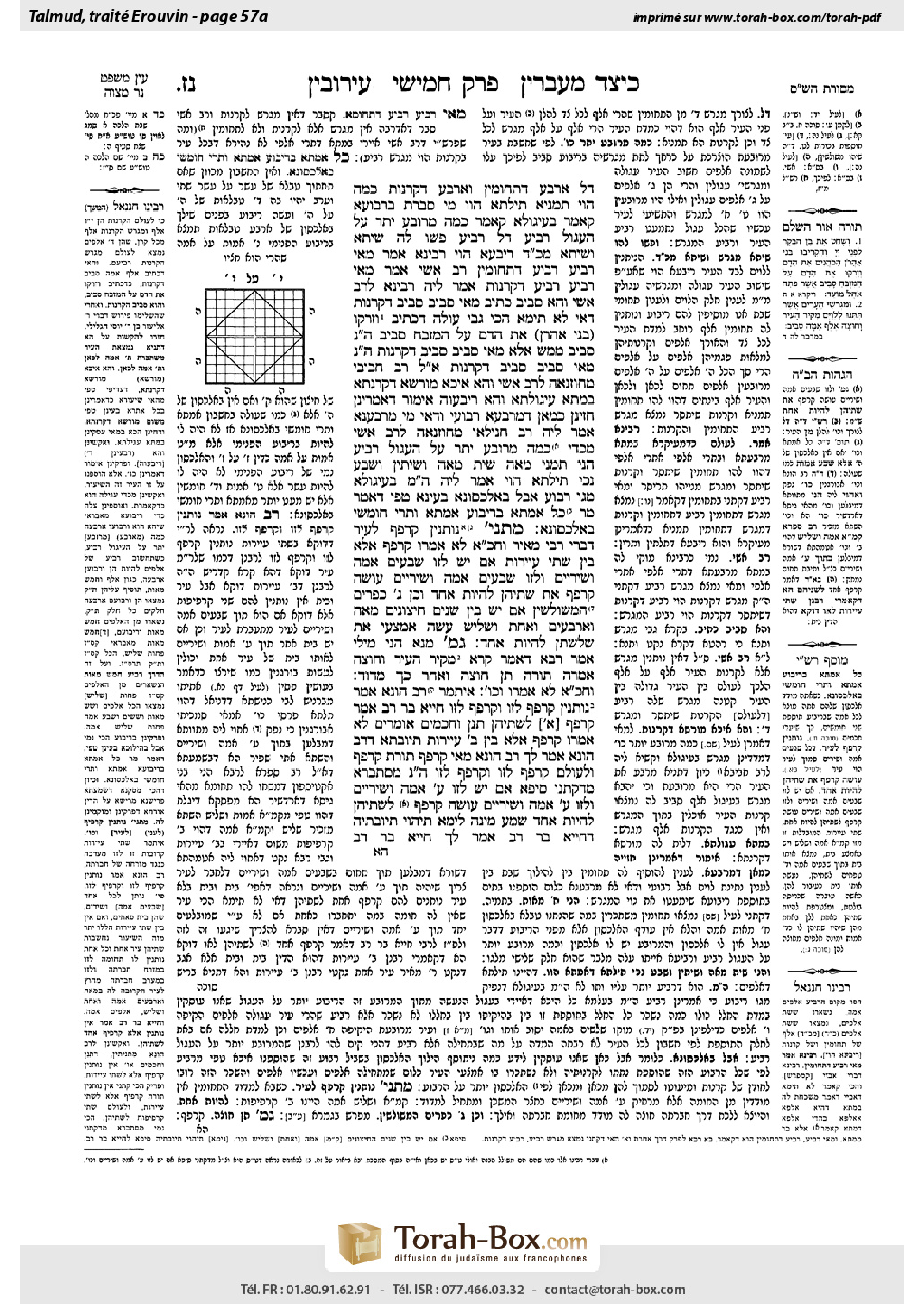
Eruvin 57a: Talmud study for Daf Yomi
Study the Talmud for Daf Yomi with scanned pages, Hebrew text, English translations from Sefaria and AI-generated French translations.
Passage selection and English or AI-generated French translation are available where the scan has annotations. Daf Study is independent of Torah-Box and Sefaria.
Browse Eruvin · עירובין · All tractatesEruvin 57a text and translations
This page of Eruvin includes the Aramaic text, an English translation and an AI-generated French translation, alongside the scan above.
עירובין נ״ז א · Aramaic and Hebrew text
דַּל אַרְבַּע דִּתְחוּמִין וְאַרְבַּע דִּקְרָנוֹת. כַּמָּה הָוֵי? תְּמָנְיָא.
תִּילְתָּא הָווּ! מִי סָבְרַתְּ בְּרִבּוּעָא קָאָמַר? בְּעִיגּוּלָא קָאָמַר. כַּמָּה מְרוּבָּע יָתֵר עַל הֶעָגוֹל — רְבִיעַ, דַּל רְבִיעַ — פָּשׁוּ לַהּ שִׁיתָּא. וְשִׁיתָּא מֵעֶשְׂרִים וְאַרְבַּע, רִיבְעָא הָוֵי.
רָבִינָא אָמַר: מַאי רְבִיעַ, רְבִיעַ דִּתְחוּמִין.
רַב אָשֵׁי אָמַר: מַאי רְבִיעַ, רְבִיעַ דִּקְרָנוֹת.
אֲמַר לֵיהּ רָבִינָא לְרַב אָשֵׁי: וְהָא ״סָבִיב״ כְּתִיב!
מַאי ״סָבִיב״ — סָבִיב דִּקְרָנוֹת, דְּאִי לָא תֵּימָא הָכִי, גַּבֵּי עוֹלָה דִּכְתִיב: ״וְזָרְקוּ (בְּנֵי אַהֲרֹן) אֶת הַדָּם עַל הַמִּזְבֵּחַ סָבִיב״, הָכִי נָמֵי סָבִיב מַמָּשׁ?! אֶלָּא מַאי ״סָבִיב״ — סָבִיב דִּקְרָנוֹת, הָכִי נָמֵי: מַאי ״סָבִיב״ — סָבִיב דִּקְרָנוֹת.
אֲמַר לֵיהּ רַב חֲבִיבִי מָחוֹזְנָאָה לְרַב אָשֵׁי: וְהָא אִיכָּא מוּרְשָׁא דְקַרְנָתָא!
בְּמָתָא עִיגּוּלְתָּא. וְהָא רַיבְּעוּהָ? אֵימוֹר דְּאָמְרִינַן חֲזֵינַן כְּמַאן דִּמְרַבְּעָא. רַבּוֹעֵי וַדַּאי מִי מְרַבַּעְנָא?!
אֲמַר לֵיהּ רַב חֲנִילַאי מָחוֹזְנָאָה לְרַב אָשֵׁי: מִכְּדִי כַּמָּה מְרוּבָּע יָתֵר עַל הֶעָגוֹל — רְבִיעַ, הָנֵי תַּמְנֵי מְאָה? שֵׁית מְאָה וְשִׁיתִּין וּשְׁבַע נָכֵי תִּילְתָּא הָוֵי!
אֲמַר לֵיהּ: הָנֵי מִילֵּי בְּעִיגּוּלָא מִגּוֹ רִבּוּעַ. אֲבָל בַּאֲלַכְסוֹנָא — בָּעֵינָא טְפֵי. דְּאָמַר מָר, כׇּל אַמְּתָא בְּרִיבּוּעַ — אַמְּתָא וּתְרֵי חוּמְּשֵׁי בַּאֲלַכְסוֹנָא.
מַתְנִי׳ נוֹתְנִין קַרְפֵּף לָעִיר, דִּבְרֵי רַבִּי מֵאִיר. וַחֲכָמִים אוֹמְרִים: לֹא אָמְרוּ קַרְפֵּף אֶלָּא בֵּין שְׁתֵּי עֲיָירוֹת, אִם יֵשׁ לָזוֹ שִׁבְעִים אַמָּה וְשִׁירַיִים וּלָזוֹ שִׁבְעִים אַמָּה וְשִׁירַיִים — עוֹשֶׂה קַרְפֵּף אֶת שְׁתֵּיהֶן לִהְיוֹת אֶחָד.
וְכֵן שְׁלֹשָׁה כְּפָרִים הַמְשׁוּלָּשִׁין, אִם יֵשׁ בֵּין שְׁנַיִם חִיצוֹנִים מֵאָה וְאַרְבָּעִים וְאַחַת וּשְׁלִישׁ — עָשָׂה אֶמְצָעִי אֶת שְׁלָשְׁתָּן לִהְיוֹת אֶחָד.
גְּמָ׳ מְנָא הָנֵי מִילֵּי? אָמַר רָבָא: דְּאָמַר קְרָא: ״מִקִּיר הָעִיר וָחוּצָה״. אָמְרָה תּוֹרָה: תֵּן חוּצָה, וְאַחַר כָּךְ מְדוֹד.
וַחֲכָמִים אוֹמְרִים לֹא אָמְרוּ וְכוּ׳. אִיתְּמַר, רַב הוּנָא אָמַר: נוֹתְנִין קַרְפֵּף לָזוֹ וְקַרְפֵּף לָזוֹ. חִיָּיא בַּר רַב אָמַר: קַרְפֵּף [אֶחָד] לִשְׁתֵּיהֶן.
תְּנַן, וַחֲכָמִים אוֹמְרִים: לֹא אָמְרוּ קַרְפֵּף אֶלָּא בֵּין שְׁתֵּי עֲיָירוֹת, תְּיוּבְתָּא דְרַב הוּנָא!
אָמַר לְךָ רַב הוּנָא: מַאי קַרְפֵּף, תּוֹרַת קַרְפֵּף, וּלְעוֹלָם קַרְפֵּף לָזוֹ וְקַרְפֵּף לָזוֹ.
הָכִי נָמֵי מִסְתַּבְּרָא, מִדְּקָתָנֵי סֵיפָא: אִם יֵשׁ לָזוֹ שִׁבְעִים אַמָּה וְשִׁירַיִים וְלָזוֹ שִׁבְעִים אַמָּה וְשִׁירַיִים — עוֹשֶׂה קַרְפֵּף לִשְׁתֵּיהֶן לִהְיוֹת אֶחָד. שְׁמַע מִינַּהּ.
לֵימָא תֶּיהְוֵי תְּיוּבְתֵּיהּ דְּחִיָּיא בַּר רַב! אָמַר לְךָ חִיָּיא בַּר רַב:
Eruvin 57a · English translation
Subtract four million square cubits of the extended boundary for the area of the open space, which is a thousand cubits by a thousand cubits on each side, and an additional four million square cubits from the corners, a thousand cubits by a thousand cubits in each corner, which are connected to the open space. How much is the sum total? It is eight million square cubits.
The Gemara asks: According to this calculation, the eight million square cubits of open space are one-third of the total area of the extended boundary, which is twenty-four million square cubits. The Gemara answers as it answered above: Do you think that this halakha was stated with regard to a square city? It was stated with regard to a round city. How much larger is the area of a square than the area of a circle? It is one quarter of the area of the circle. Subtract one quarter from the eight million square cubits of open space, and six million square cubits are left; and six is precisely one quarter of twenty-four.
Ravina said: What is the meaning of the statement that the open space is one quarter? It is one quarter of the boundary. This halakha was indeed stated with regard to a square city. However, there is open space only along the sides of the city but not at its corners. Accordingly, a city that is two thousand cubits by two thousand cubits has a total extended boundary of thirty-two million square cubits, of which eight million square cubits, two thousand cubits by one thousand cubits on each side, is open space. The open space is thus one quarter of the total.
Rav Ashi said the opposite: What is the meaning of the statement that the open space is one quarter of the total extended boundary? One quarter of the corners. Open space is granted only in the corners, and not along the sides. Accordingly, the open space is one thousand cubits by a thousand cubits in each corner, for a total of four million square cubits. The total extended boundary in each corner is two thousand cubits by two thousand cubits, or four million square cubits per corner, which equals a grand total of sixteen million square cubits. Consequently, the open space is one quarter of the total extended boundary.
Ravina said to Rav Ashi: Isn’t it written in the verse: “And the open spaces of the cities, that you shall give to the Levites, shall be from the wall of the city and outward one thousand cubits around” (Numbers 35:4)? The verse indicates that the city is provided with open space on all sides and not merely at its corners
Rav Ashi responded: What is the meaning of around? Around at the corners, i.e., an open space of this size is provided at each corner. As, if you do not say so, that the area of the corners is also called around, with regard to the burnt-offering, as it is written: “And they shall sprinkle the blood around upon the altar” (Leviticus 1:5), here, too, will you say that the blood must be sprinkled literally “around” the altar on all sides? The blood is sprinkled only upon the corners of the altar. Rather, what is the meaning of around? Around the corners, i.e., the mitzva is to sprinkle the blood at the corners, and this is considered sprinkling blood “around upon the altar.” Here too, with regard to the open space of the cities of the Levites, what is the meaning of around? Around the corners.
The Gemara returns to its previous statement that the open space around a city of the Levites is one quarter of the total extended boundary when the city is round. It questions this statement based upon the mishna’s ruling that the boundaries of a city are always delineated as a square. Rav Ḥavivi from Meḥoza said to Rav Ashi: But aren’t there the protrusions of the corners? How can there be a thousand cubits of open space on each side; when the city is squared, the corners of the square protrude into the open space, thus reducing its area?
Rav Ashi replied: We are dealing with a circular city. Rav Ḥavivi responded: But haven’t they squared the city? Rav Ashi responded: Say that we say the following: We view the city as if it were squared. Do we actually add houses and square it? Although for the purpose of calculating the extended boundary we view the city as a square, in actuality the uninhabited sections are part of the open space.
Rav Ḥanilai from Meḥoza said to Rav Ashi: Now, how much larger is the area of a square than the area of a circle? One quarter. Therefore, if we calculate how much area a circular city with a diameter of two thousand cubits gains when it is squared, does it add up to these eight hundred cubits mentioned above? The extra area added is only 667 minus one-third cubits.
Rav Ashi said to him: This statement applies only to a circle enclosed within a square, as the area of a circle is three-quarters the area of the square around it. However, with regard to the additional diagonal [alakhsona] space added in the corners of the square, more is required. As the Master said: Every cubit in the side of a square is one and two-fifths cubits in its diagonal. Based on this rule, the calculation is exact.
MISHNA: One allocates a karpef to every city, i.e., the measure of a karpef, which is slightly more than seventy cubits, is added to every city, and the two thousand cubits of the Shabbat limit are measured from there; this is the statement of Rabbi Meir. And the Rabbis say: They spoke of the addition of a karpef only with regard to the space between two adjacent cities. How so? If this city has seventy cubits and a remainder vacant on one side, and that city has seventy cubits and a remainder vacant on the adjacent side, and the two areas of seventy-plus cubits overlap, the karpef combines the two cities into one.
And likewise, in the case of three villages that are arranged as a triangle, if there are only 141⅓ cubits separating between the two outer villages, the middle village combines the three villages into one.
GEMARA: The Gemara asks: From where are these matters, that a karpef is added to a city, derived? Rava said: As the verse states: “And the open spaces of the cities, that you shall give to the Levites, shall be from the wall of the city and outward a thousand cubits around. And you shall measure from outside the city on the east side two thousand cubits” (Numbers 35:4–5). The Torah says: Provide a certain vacant space outside the city, and only afterward measure the two thousand cubits.
We learned in the mishna: And the Rabbis say: They spoke of the addition of a karpef only with regard to the space between two adjacent cities. It was stated that the amora’im disagreed with regard to this issue. Rav Huna said: One allocates a karpef to this city and a karpef to that city, so that the two cities together are granted a total of slightly more than 141 cubits. Ḥiyya bar Rav said: One allocates only one common karpef to the two of them.
The Gemara raises possible proofs for each opinion. We learned in the mishna: And the Rabbis say: They spoke of the addition of a karpef only with regard to the space between two adjacent cities. This appears to be a conclusive refutation of the opinion of Rav Huna, as it states that one karpef is allocated rather than two.
The Gemara answers that Rav Huna could have said to you in response to this difficulty: What is meant here by a karpef ? It means the principle of a karpef. In actuality, one allocates a karpef to this city and a karpef to that city.
The Gemara comments: So, too, it is reasonable to explain the mishna in the following manner: From the fact that it teaches in the latter clause: If this city has seventy cubits and a remainder vacant on one side, and that city has seventy cubits and a remainder vacant on the adjacent side, and the two areas of seventy-plus cubits overlap, the karpef combines the two cities into one. This indicates that an area of seventy cubits and a remainder is added to each city. The Gemara concludes: Indeed, learn from this that this is the correct understanding of the mishna.
The Gemara asks: Let us say that this mishna is a conclusive refutation of the opinion of Ḥiyya bar Rav, that two adjacent cities are granted only one karpef. The Gemara answers that Ḥiyya bar Rav could have said to you:
Eruvin 57a · Traduction française (IA)
On retire quatre millions de coudées carrées de la limite étendue pour l'espace ouvert, qui mesure mille coudées par mille coudées sur chaque côté, et quatre millions de coudées carrées supplémentaires aux coins, mille coudées par mille coudées dans chaque coin, qui sont connectés à l'espace ouvert. Quelle est la somme totale ? Elle est de huit millions de coudées carrées.
Le Guemara demande : Selon ce calcul, les huit millions de coudées carrées d'espace ouvert représentent un tiers de la surface totale de la limite étendue, qui est de vingt-quatre millions de coudées carrées. Le Guemara répond comme il l'a fait ci-dessus : Pensez-vous que cette halakha a été énoncée concernant une ville carrée ? Elle a été énoncée concernant une ville ronde. De combien la surface d'un carré est-elle plus grande que celle d'un cercle ? Elle est un quart de la surface du cercle. On retranche un quart des huit millions de coudées carrées d'espace ouvert, et six millions de coudées carrées restent ; et six est exactement un quart de vingt-quatre.
Ravina dit : Quelle est la signification de l'affirmation que l'espace ouvert est un quart ? C'est un quart de la limite. Cette halakha a effectivement été énoncée concernant une ville carrée. Cependant, l'espace ouvert n'existe que le long des côtés de la ville, pas aux coins. Ainsi, une ville de deux mille coudées par deux mille coudées a une limite étendue totale de trente-deux millions de coudées carrées, dont huit millions de coudées carrées, deux mille coudées par mille coudées sur chaque côté, sont l'espace ouvert. L'espace ouvert est donc un quart du total.
Rav Ashi dit l'inverse : Quelle est la signification de l'affirmation que l'espace ouvert est un quart de la limite étendue totale ? Un quart des coins. L'espace ouvert est accordé uniquement aux coins, pas le long des côtés. Ainsi, l'espace ouvert est de mille coudées par mille coudées dans chaque coin, pour un total de quatre millions de coudées carrées. La limite étendue totale dans chaque coin est de deux mille coudées par deux mille coudées, soit quatre millions de coudées carrées par coin, ce qui équivaut à un total de seize millions de coudées carrées. Par conséquent, l'espace ouvert est un quart de la limite étendue totale.
Ravina dit à Rav Ashi : N'est-il pas écrit dans la Torah écrite : « Et les espaces ouverts des villes, que tu donnes aux Lévites, seront à partir du mur de la ville et vers l'extérieur une coudée de mille autour » (Nombres 35:4) ? La Torah écrite indique que la ville est dotée d'espace ouvert sur tous les côtés et non seulement aux coins.
Rav Ashi répondit : Quelle est la signification de « autour » ? Autour des coins, c'est-à-dire un espace ouvert de cette taille est fourni à chaque coin. Car, si vous ne dites pas cela, que la surface des coins est aussi appelée « autour », concernant l'holocauste, comme il est écrit : « Et ils verseront le sang autour sur l'autel » (Lévitique 1:5), ici aussi, direz-vous que le sang doit être versé littéralement « autour » de l'autel sur tous les côtés ? Le sang est versé uniquement sur les coins de l'autel. Plutôt, quelle est la signification de « autour » ? Autour des coins, c'est-à-dire la mitsva est de verser le sang aux coins, et cela est considéré comme « verser le sang autour sur l'autel ». Ici aussi, concernant l'espace ouvert des villes des Lévites, quelle est la signification de « autour » ? Autour des coins.
Le Guemara revient sur son affirmation précédente selon laquelle l'espace ouvert autour d'une ville des Lévites est un quart de la limite étendue totale lorsque la ville est ronde. Il questionne cette affirmation en se basant sur la décision de la Michna selon laquelle les limites d'une ville sont toujours délimitées comme un carré. Rav Ḥavivi de Meḥoza dit à Rav Ashi : Mais ne sont-ce pas les protrusions des angles ? Comment peut-il y avoir mille coudées d'espace ouvert sur chaque côté ; lorsque la ville est carrée, les angles du carré pénètrent dans l'espace ouvert, réduisant ainsi sa surface ?
Rav Ashi répondit : Nous traitons d'une ville ronde. Rav Ḥavivi répondit : Mais n'ont-ils pas carré la ville ? Rav Ashi répondit : Dites que nous disons cela : Nous considérons la ville comme si elle était carrée. Est-ce que nous ajoutons réellement des maisons et la carrons ? Bien que pour le calcul de la limite étendue nous considérions la ville comme un carré, en réalité les sections inhabitées font partie de l'espace ouvert.
Rav Ḥanilai de Meḥoza dit à Rav Ashi : Maintenant, de combien la surface d'un carré est-elle plus grande que celle d'un cercle ? Un quart. Ainsi, si nous calculons combien de surface gagne une ville ronde de deux mille coudées de diamètre lorsqu'elle est carrée, cela correspond-il à ces huit cents coudées mentionnées ci-dessus ? L'aire supplémentaire ajoutée est seulement 667 et un tiers de coudées.
Rav Ashi dit à lui : Cette affirmation s'applique uniquement à un cercle enfermé dans un carré, car la surface d'un cercle est trois-quarts de la surface du carré autour de lui. Cependant, concernant l'espace supplémentaire diagonal ajouté aux coins du carré, plus est requis. Comme le Maître a dit : Chaque coudée du côté d'un carré est une coudée et deux-cinquièmes dans sa diagonale. Selon cette règle, le calcul est exact.
MICHNA : On alloue un karpef à chaque ville, c'est-à-dire la mesure d'un karpef, qui est légèrement plus de soixante-dix coudées, est ajoutée à chaque ville, et les deux mille coudées de la limite du Shabbat sont mesurées à partir de là ; c'est la déclaration de Rabbi Meir. Et les Rabbins disent : Ils parlaient de l'ajout d'un karpef uniquement concernant l'espace entre deux villes adjacentes. Comment cela ? Si cette ville a soixante-dix coudées et un reste vide sur un côté, et que cette autre ville a soixante-dix coudées et un reste vide sur le côté adjacent, et que les deux zones de soixante-dix coudées plus sont superposées, le karpef combine les deux villes en une seule.
Et de même, dans le cas de trois villages disposés en triangle, si la distance entre les deux villages externes est de seulement 141⅓ coudées, le village du milieu combine les trois villages en un.
GUEMARA : La Guemara pose la question : D'où sont tirés ces enseignements, selon lesquels un karpef est ajouté à une ville ? Rava dit : Comme le texte saint le dit : « Et les espaces ouverts des villes, que tu donnes aux Lévites, seront à partir du mur de la ville et vers l'extérieur un mille de coudées autour. Et tu mesureras à l'extérieur de la ville, du côté de l'Est, deux mille coudées » (Nombres 35 : 4-5). La Torah dit : Fournir un espace vacant déterminé en dehors de la ville, et ensuite mesurer les deux mille coudées.
Nous avons appris dans la mitsna : Et les Sages disent : Ils parlaient de l'ajout d'un karpef uniquement concernant l'espace entre deux villes adjacentes. Il a été dit que les amoraïm étaient en désaccord sur cette question. Rav Huna dit : On alloue un karpef à cette ville et un karpef à celle-ci, de sorte que les deux villes ensemble sont accordées un total légèrement supérieur à 141 coudées. Ḥiyya bar Rav dit : On alloue un seul karpef commun aux deux.
La Guemara soulève des preuves possibles pour chaque opinion. Nous avons appris dans la mitsna : Et les Sages disent : Ils parlaient de l'ajout d'un karpef uniquement concernant l'espace entre deux villes adjacentes. Cela semble être une preuve concluante contre l'opinion de Rav Huna, car il indique qu'un seul karpef est alloué plutôt que deux.
La Guemara répond que Rav Huna aurait pu dire à vous en réponse à cette difficulté : De quoi parle-t-on ici par un karpef ? Il s'agit du principe du karpef. En réalité, on alloue un karpef à cette ville et un karpef à celle-ci.
La Guemara commente : De même, il est raisonnable d'expliquer la mitsna de la manière suivante : D'après le fait qu'elle enseigne dans la clause ultérieure : Si cette ville a soixante-dix coudées et un espace vacant sur un côté, et que celle-ci a soixante-dix coudées et un espace vacant sur le côté adjacent, et que les deux zones de soixante-dix coudées et plus se chevauchent, le karpef combine les deux villes en une. Cela indique qu'un espace de soixante-dix coudées et un reste est ajouté à chaque ville. La Guemara conclut : En effet, apprenez-en que c'est la bonne compréhension de la mitsna.
La Guemara pose la question : Disons que cette mitsna est une preuve concluante contre l'opinion de Ḥiyya bar Rav, selon laquelle deux villes adjacentes sont accordées un seul karpef. La Guemara répond que Ḥiyya bar Rav aurait pu dire à vous :
Traduction française générée par IA à partir de l’édition anglaise de Sefaria. Vérifie toujours un passage avec le texte source.
Text from Sefaria: William Davidson Edition - Vocalized Aramaic (CC BY NC); William Davidson Edition - English (CC BY NC).