Eruvin 74b: Talmud study for Daf Yomi
Study the Talmud for Daf Yomi with scanned pages, Hebrew text, English translations from Sefaria and AI-generated French translations.
Passage selection and English or AI-generated French translation are available where the scan has annotations. Daf Study is independent of Torah-Box and Sefaria.
Browse Eruvin · עירובין · All tractatesEruvin 74b text and translations
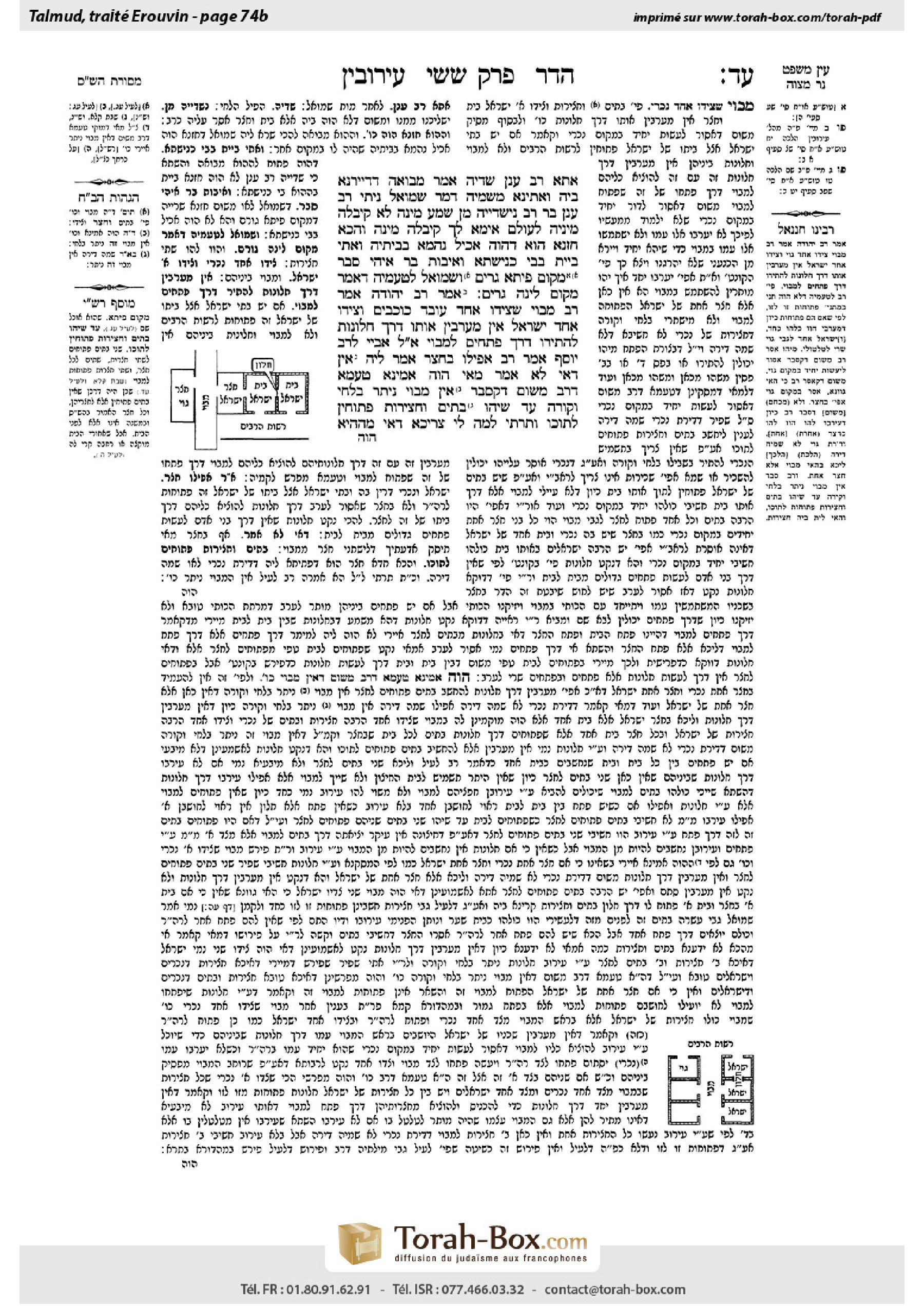
This page of Eruvin includes the Aramaic text, an English translation and an AI-generated French translation, alongside the scan above.
עירובין ע״ד ב · Aramaic and Hebrew text
אֲתָא רַב עָנָן שַׁדְיֵהּ. אָמַר: מְבוֹאָה דְּדָיַירְנָא בֵּיהּ וְאָתֵינָא מִשְּׁמֵיהּ דְּמָר שְׁמוּאֵל, נֵיתֵי רַב עָנָן בַּר רַב נִישְׁדְּיֵיהּ מִן?! שְׁמַע מִינַּהּ לָא קַיבְּלַהּ מִינֵּיהּ.
לְעוֹלָם אֵימָא לָךְ קַיבְּלַהּ מִינֵּהּ, וְהָכָא חַזָּנָא הוּא דַּהֲוָה אָכֵיל נַהֲמָא בְּבֵיתֵיהּ וְאָתֵי בָּיֵית בְּבֵי כְנִישְׁתָּא.
וְאַיְבוּת בַּר אִיהִי סָבַר: מְקוֹם פִּיתָּא גָּרֵים. וּשְׁמוּאֵל לְטַעְמֵיהּ דְּאָמַר: מָקוֹם לִינָה גָּרֵים.
אָמַר רַב יְהוּדָה אָמַר רַב: מָבוֹי שֶׁצִּידּוֹ אֶחָד גּוֹי וְצִידּוֹ אֶחָד יִשְׂרָאֵל — אֵין מְעָרְבִין אוֹתוֹ דֶּרֶךְ חַלּוֹנוֹת לְהַתִּירוֹ דֶּרֶךְ פְּתָחִים לַמָּבוֹי.
אֲמַר לֵיהּ אַבָּיֵי לְרַב יוֹסֵף: אָמַר רַב אֲפִילּוּ בְּחָצֵר? אֲמַר לֵיהּ: אִין, דְּאִי לָא אָמַר מַאי?
הֲוָה אָמֵינָא טַעְמָא דְּרַב מִשּׁוּם דְּקָסָבַר: אֵין מָבוֹי נִיתָּר בְּלֶחִי וְקוֹרָה עַד שֶׁיְּהוּ בָּתִּים וַחֲצֵירוֹת פְּתוּחִין לְתוֹכוֹ.
וְתַרְתֵּי לְמָה לִי! צְרִיכָא, דְּאִי מֵהַהִיא —
Eruvin 74b · English translation
Following Shmuel’s death, Rav Anan came and threw the side post down, thus indicating to Ivut bar Ihi that it is prohibited to carry in the alleyway, as a side post is effective only for an alleyway that has at least two courtyards containing at least two houses each. Ivut bar Ihi said with resentment: The alleyway in which I have been living and walking based on a ruling in the name of Master Shmuel, shall Rav Anan bar Rav come now and throw its side post away from me? The Gemara comments: Learn from the fact that this side post remained intact throughout Shmuel’s lifetime that he did not accept Rabbi Elazar’s objection.
The Gemara rejects this proof. Actually, you can say that Shmuel accepted Rabbi Elazar’s objection and retracted his opinion, and here there was a synagogue attendant [ḥazzana] who would eat bread in his own house that was located elsewhere, but would come and sleep in the synagogue, which was open to the alleyway.
And Ivut bar Ihi holds that the place where a person eats his bread determines his place of residence. Therefore, he did not consider the synagogue a residence, as the attendant would eat elsewhere, and Ivut bar Ihi thought that Shmuel had permitted him to set up a side post for his alleyway even though he lived there by himself. In fact, however, this was not the case, as Shmuel followed his regular line of reasoning, as he said: The place where a person sleeps determines his place of residence. Since the attendant would sleep in the synagogue, it was considered a residence. Consequently, the alleyway contained two houses and courtyards, and could be made permitted for carrying by means of a side post or a cross beam.
Rav Yehuda said that Rav said: With regard to an alleyway, one side of which was occupied by a gentile and one side of which was occupied by a Jew, and the house of the Jew was connected to the houses of other Jews via windows but not via doors, and those other houses open directly into the public domain, the residents of the houses on the side of the alleyway where the Jews live may not establish an eiruv through the windows in order to render it permitted for the residents of the other houses to carry through the doors of the house leading to the alleyway.
Abaye said to Rav Yosef: Did Rav say this even with regard to a courtyard, one side of which was occupied by a gentile and the other side of which was occupied by a Jew whose house was connected through windows to the houses of other Jews? He said to him: Yes, as even if he did not say so, what would be the difference? It is the exact same principle.
Abaye responded: I would have said that the rationale for the opinion of Rav is because he holds that an alleyway cannot be rendered permitted for carrying within it with a side post and a cross beam unless there are houses and courtyards opening into it.
Rav Yosef said: If that were the reason, why would I need two rulings regarding the same issue? Rav already stated that an alleyway can be rendered permitted for carrying within it only if it has houses and courtyards opening into it. Abaye explained that both rulings are necessary. As, if Rav had taught this halakha only from that general ruling,
Eruvin 74b · Traduction française (IA)
Après la mort de Shmuel, Rav Anan est venu et a jeté le poteau latéral, ce qui indiquait à Ivut bar Ihi que le portage dans la cour est interdit, car un poteau latéral est efficace uniquement pour une cour qui possède au moins deux jardins, chacun contenant au moins deux maisons. Ivut bar Ihi a dit avec amertume : La cour dans laquelle j’ai vécu et marché selon une décision portant le nom de Maître Shmuel, que Rav Anan bar Rav viendra-t-il maintenant et jetera-t-il son poteau latéral loin de moi ? La Guemara commente : Apprenez-en que ce poteau latéral a resté intact tout au long de la vie de Shmuel, ce qui signifie qu’il n’a pas accepté l’objection de Rabbi Elazar.
La Guemara rejette cette preuve. En réalité, vous pouvez dire que Shmuel a accepté l’objection de Rabbi Elazar et a rétracté son opinion, et ici il y avait un serviteur de synagogue [ḥazzana] qui mangeait du pain dans sa propre maison, située ailleurs, mais qui venait dormir dans la synagogue, qui était ouverte sur la cour.
Et Ivut bar Ihi considère que l’endroit où une personne mange son pain détermine son lieu de résidence. Par conséquent, il ne considérait pas la synagogue comme un lieu de résidence, car le serviteur mangeait ailleurs, et Ivut bar Ihi pensait que Shmuel avait permis à Ivut bar Ihi de poser un poteau latéral pour sa cour même s’il y vivait seul. En réalité, cependant, ce n’était pas le cas, car Shmuel suivait sa ligne de raisonnement habituelle, car il disait : L’endroit où une personne dort détermine son lieu de résidence. Puisque le serviteur dormait dans la synagogue, cela était considéré comme un lieu de résidence. Ainsi, la cour contenait deux maisons et jardins, et pouvait être rendue permise au portage grâce à un poteau latéral ou à une traverse.
Rav Yehuda a dit que Rav a dit : En ce qui concerne une cour dont une des rives était occupée par un non-Juif et l’autre par un Juif, et la maison du Juif était connectée aux maisons d’autres Juifs par des fenêtres mais pas par des portes, et ces autres maisons s’ouvraient directement sur le domaine public, les habitants des maisons situées sur la rive de la cour où les Juifs habitent ne peuvent pas établir un eiruv par les fenêtres afin de rendre cette cour permise au portage pour les habitants des autres maisons qui entrent dans la cour par les portes de leurs maisons.
Abaye a dit à Rav Yosef : Rav a-t-il dit cela même concernant un jardin dont une des rives était occupée par un non-Juif et l’autre par un Juif dont la maison était connectée par des fenêtres aux maisons d’autres Juifs ? Il lui a répondu : Oui, car même s’il n’a pas dit cela, qu’y a-t-il de différent ? C’est exactement le même principe.
Abaye a répondu : Je pensais que la raison de l’opinion de Rav était qu’il considère qu’une cour ne peut être rendue permise au portage à l’intérieur grâce à un poteau latéral et une traverse que si des maisons et des jardins s’ouvrent sur elle.
Rav Yosef a dit : Si c’était la raison, pourquoi aurais-je besoin de deux décisions concernant la même question ? Rav a déjà dit qu’une cour ne peut être rendue permise au portage à l’intérieur que si elle possède des maisons et des jardins s’ouvrant sur elle. Abaye a expliqué que les deux décisions sont nécessaires. En effet, si Rav avait enseigné cette halakha uniquement à partir de cette décision générale,
Traduction française générée par IA à partir de l’édition anglaise de Sefaria. Vérifie toujours un passage avec le texte source.
Text from Sefaria: William Davidson Edition - Vocalized Aramaic (CC BY NC); William Davidson Edition - English (CC BY NC).