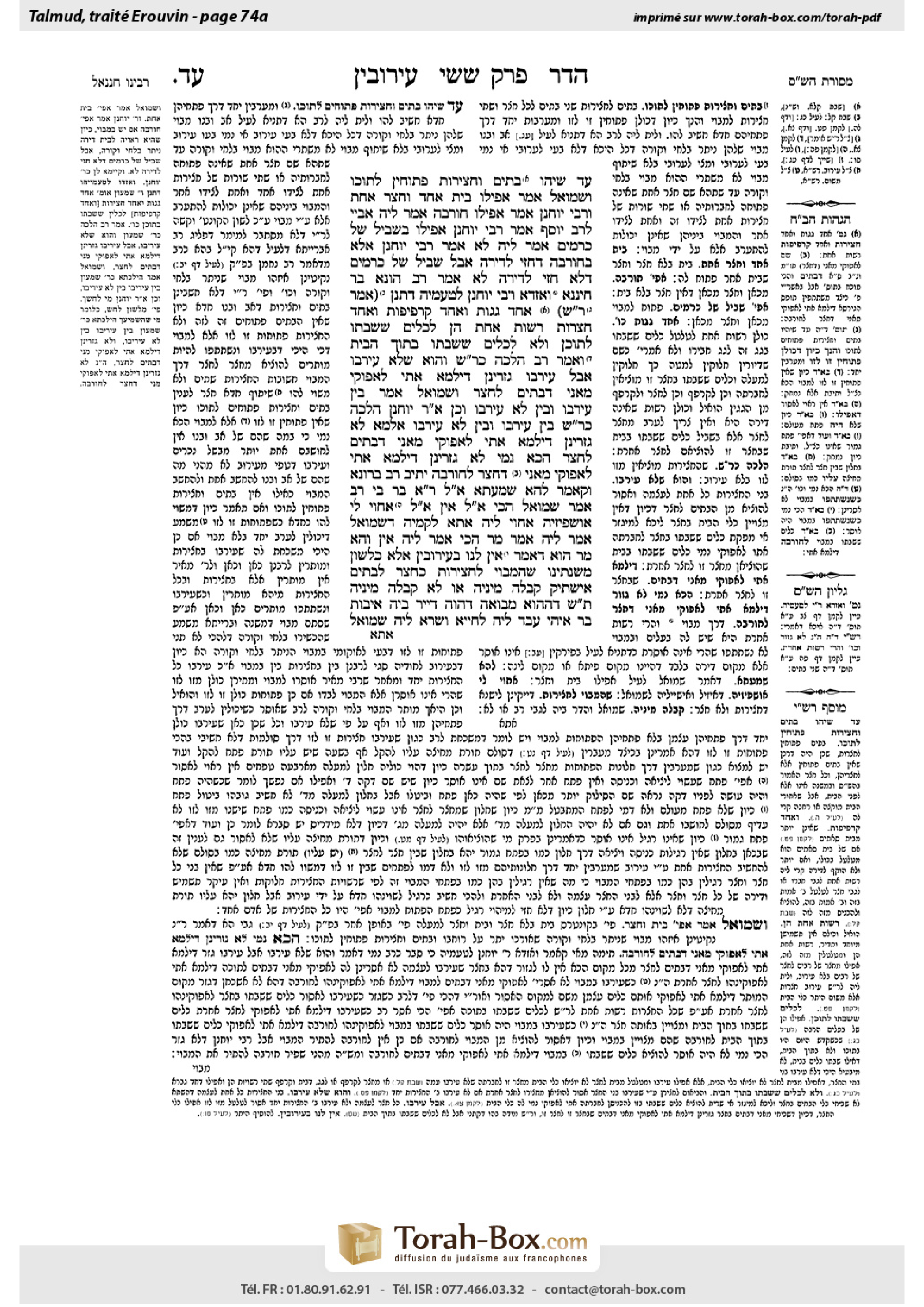
Eruvin 74a: Talmud study for Daf Yomi
Study the Talmud for Daf Yomi with scanned pages, Hebrew text, English translations from Sefaria and AI-generated French translations.
Passage selection and English or AI-generated French translation are available where the scan has annotations. Daf Study is independent of Torah-Box and Sefaria.
Browse Eruvin · עירובין · All tractatesEruvin 74a text and translations
This page of Eruvin includes the Aramaic text, an English translation and an AI-generated French translation, alongside the scan above.
עירובין ע״ד א · Aramaic and Hebrew text
עַד שֶׁיְּהוּ בָּתִּים וַחֲצֵירוֹת פְּתוּחִין לְתוֹכוֹ. וּשְׁמוּאֵל אָמַר: אֲפִילּוּ בַּיִת אֶחָד וְחָצֵר אַחַת. וְרַבִּי יוֹחָנָן אָמַר: אֲפִילּוּ חוּרְבָּה.
אֲמַר לֵיהּ אַבָּיֵי לְרַב יוֹסֵף: אָמַר רַבִּי יוֹחָנָן אֲפִילּוּ בִּשְׁבִיל שֶׁל כְּרָמִים? אֲמַר לֵיהּ: לָא אָמַר רַבִּי יוֹחָנָן אֶלָּא בְּחוּרְבָּה, דַּחֲזֵי לְדִירָה. אֲבָל שְׁבִיל שֶׁל כְּרָמִים, דְּלָא חֲזֵי לְדִירָה — לָא.
אָמַר רַב הוּנָא בַּר חִינָּנָא: וְאַזְדָּא רַבִּי יוֹחָנָן לְטַעְמֵיהּ, דִּתְנַן (אָמַר רַבִּי שִׁמְעוֹן): אֶחָד גַּגּוֹת וְאֶחָד קַרְפֵּיפוֹת וְאֶחָד חֲצֵרוֹת — רְשׁוּת אַחַת הֵן לְכֵלִים שֶׁשָּׁבְתוּ לְתוֹכָן, וְלֹא לְכֵלִים שֶׁשָּׁבְתוּ בְּתוֹךְ הַבַּיִת.
וְאָמַר רַב: הֲלָכָה כְּרַבִּי שִׁמְעוֹן, וְהוּא שֶׁלֹּא עֵירְבוּ. אֲבָל עֵירְבוּ, גָּזְרִינַן דִּילְמָא אָתֵי לְאַפּוֹקֵי מָאנֵי דְבָתִּים לְחָצֵר.
וּשְׁמוּאֵל אָמַר: בֵּין עֵירְבוּ וּבֵין לֹא עֵירְבוּ. וְכֵן אָמַר רַבִּי יוֹחָנָן: הֲלָכָה כְּרַבִּי שִׁמְעוֹן, בֵּין עֵירְבוּ וּבֵין לֹא עֵירְבוּ. אַלְמָא: לָא גָּזְרִינַן דִּילְמָא אָתֵי לְאַפּוֹקֵי מָאנֵי דְבָתִּים לְחָצֵר, הָכָא נָמֵי לָא גָּזְרִינַן דִּילְמָא אָתֵי לְאַפּוֹקֵי מָאנֵי דְחָצֵר לְחוּרְבָּה.
יָתֵיב רַב בְּרוֹנָא וְקָאָמַר לְהָא שְׁמַעְתָּא. אֲמַר לֵיהּ רַבִּי אֶלְעָזָר בַּר בֵּי רַב: אָמַר שְׁמוּאֵל הָכִי?! אֲמַר לֵיהּ: אִין, אֲמַר לֵיהּ: אַחְוִי לִי אוּשְׁפִּיזֵיהּ, אַחְוִי לֵיהּ. אֲתָא לְקַמֵּיהּ דִּשְׁמוּאֵל, אֲמַר לֵיהּ: אֲמַר מָר הָכִי? אֲמַר לֵיהּ: אִין.
וְהָא מָר הוּא דְּאָמַר: אֵין לָנוּ בְּעֵירוּבִין אֶלָּא כִּלְשׁוֹן מִשְׁנָתֵינוּ, שֶׁהַמָּבוֹי לַחֲצֵירוֹת כֶּחָצֵר לַבָּתִּים. אִישְׁתִּיק.
קַבְּלַהּ מִינֵּיהּ, אוֹ לָא קַבְּלַהּ מִינֵּיהּ? תָּא שְׁמַע, דְּהָהוּא מְבוֹאָה דַּהֲוָה דָּיַיר בֵּיהּ אַיְבוּת בַּר אִיהִי, עֲבַד לֵיהּ לִחְיָיא, וּשְׁרָא לֵיהּ שְׁמוּאֵל,
Eruvin 74a · English translation
unless there are houses and courtyards opening into it. This formulation implies that there must be at least two courtyards, each of which contains at least two houses. In the absence of these conditions, however, it is not considered an alleyway that can be permitted by means of a side post or a cross beam. And Shmuel said: Even one house without a courtyard and one courtyard with just one house is enough. And Rabbi Yoḥanan said: Even a ruin and a courtyard with a house suffice for a side post or a cross beam to render carrying in an alleyway permitted.
Abaye said to Rav Yosef: Did Rabbi Yoḥanan say that even a vineyard path and a courtyard with a house suffice to allow a side post or a cross beam to render carrying in the alleyway permitted? He said to him: Rabbi Yoḥanan said his ruling only in the case of a ruin, which is fit to serve as a residence. However, a vineyard path, which is not fit to serve as a residence, is not sufficient.
Rav Huna bar Ḥinnana said: And Rabbi Yoḥanan followed his regular line of reasoning in this regard, as we learned in a mishna that Rabbi Shimon said: Roofs, enclosures, and courtyards are all considered one domain with regard to vessels that rested inside them at the beginning of Shabbat. Therefore, it is permitted to carry vessels that were in one of these areas at the beginning of Shabbat to any of the other areas. However, they are not considered the same domain with regard to vessels that rested inside the house at the beginning of Shabbat. If the homeowners did not join the courtyard by means of an eiruv, it is prohibited to carry vessels from their houses to the roof, enclosure, or courtyard.
And Rav said: The halakha is in accordance with the opinion of Rabbi Shimon. And this is only in a case where the residents of the courtyards did not establish an eiruv for each courtyard, so that they may only carry the vessels left in the courtyards, but they may not take out vessels from their houses into their courtyards. However, if they established an eiruv for each courtyard, we decree against carrying even vessels that were in the courtyard when Shabbat began, lest they come to take out objects from their houses to the courtyard. This would lead to the mistake of carrying those objects from one courtyard to another, which is prohibited.
And Shmuel said: The halakha is in accordance with the opinion of Rabbi Shimon, whether the residents of the courtyards established an eiruv for each courtyard or whether they did not establish an eiruv for each courtyard. And so too, Rabbi Yoḥanan said: The halakha is in accordance with the opinion of Rabbi Shimon, whether they established an eiruv for each courtyard or whether they did not establish an eiruv for each courtyard. Apparently, Rabbi Yoḥanan maintains that we do not decree against carrying vessels that began Shabbat in the courtyard lest they come to take out objects from their houses to the courtyard. Here too, with regard to an alleyway that contains a ruin, we do not decree against carrying in the alleyway lest they come to take out objects from the courtyard to the ruin by carrying it through the alleyway. Although the ruin is not included in the eiruv, as it has no residents, and one may not carry objects into it, Rabbi Yoḥanan is not concerned that one might come to carry in this prohibited manner.
Rav Beruna sat and recited this halakha stated by Shmuel, that an alleyway containing one house and one courtyard can be rendered permitted for carrying by means of a side post or a cross beam. Rabbi Elazar, a student of a Torah academy, said to him: Did Shmuel really say this? Rav Beruna said to him: Yes, he did. He said to him: Show me his lodging and I will go and ask him myself, and he showed him. Rabbi Elazar came before Shmuel and said to him: Did the Master actually say this? Shmuel said to him: Yes, I did.
Rabbi Elazar raised the following objection: Wasn’t it the Master himself who said concerning a different issue: With regard to the halakhot of eiruv, we have only the wording of our mishna. The mishna states that an alleyway is to its courtyards like a courtyard is to its houses, which indicates that an alleyway must have at least two courtyards in order to be considered an alleyway and be rendered permitted for carrying through a side post or cross beam. Shmuel was silent and did not answer him.
The Gemara asks: Did Shmuel’s silence indicate that he accepted Rabbi Elazar’s objection and retracted his statement, or did he not accept it from him? The Gemara attempts to bring a proof from the following incident. Come and hear: There was a certain alleyway that Ivut bar Ihi lived in, which contained only one house and one courtyard. He erected a side post for it, and Shmuel permitted him to carry in it.
Eruvin 74a · Traduction française (IA)
sauf s'il y a des maisons et des cours donnant sur elle. Cette formulation implique qu'il faut au moins deux cours, chacune contenant au moins deux maisons. En l'absence de ces conditions, cependant, elle n'est pas considérée comme une rue étroite pouvant être permise par un poteau latéral ou une poutre transversale. Et Shmuel a dit : Même une seule maison sans cour et une cour avec une seule maison suffit. Et Rabbi Yoḥanan a dit : Même un ruine et une cour avec une maison suffisent pour que le poteau latéral ou la poutre transversale permettent le transport dans la rue étroite.
Abaye a dit à Rav Yosef : Rabbi Yoḥanan a-t-il dit que même un chemin de vigne et une cour avec une maison suffisent pour permettre au poteau latéral ou à la poutre transversale de rendre le transport dans la rue étroite permis ? Il lui a répondu : Rabbi Yoḥanan a formulé son avis uniquement dans le cas d'un ruine, qui est adapté à servir de résidence. Cependant, un chemin de vigne, qui n'est pas adapté à servir de résidence, n'est pas suffisant.
Rav Huna bar Ḥinnana a dit : Et Rabbi Yoḥanan a suivi sa ligne de raisonnement habituelle à cet égard, comme nous avons appris dans une mitsna que Rabbi Shimon a dit : Les toits, les enclos et les cours sont tous considérés comme un domaine unique concernant les objets qui y étaient restés au début du Shabbat. Par conséquent, il est permis de transporter des objets qui étaient dans l'un de ces lieux au début du Shabbat vers l'un des autres lieux. Cependant, ils ne sont pas considérés comme un même domaine concernant les objets qui étaient restés dans la maison au début du Shabbat. Si les propriétaires n'ont pas joint la cour par l'intermédiaire d'un eiruv, il est interdit de transporter des objets de leurs maisons vers le toit, l'enclos ou la cour.
Et Rav a dit : La halakha suit l'opinion de Rabbi Shimon. Et cela est seulement dans le cas où les habitants des cours n'ont pas établi un eiruv pour chaque cour, de sorte qu'ils ne peuvent transporter que les objets restés dans les cours, mais ils ne peuvent pas prendre des objets de leurs maisons vers leurs cours. Cependant, si ils ont établi un eiruv pour chaque cour, nous décrétons contre le transport même des objets qui étaient dans la cour au début du Shabbat, de peur qu'ils viennent prendre des objets de leurs maisons vers la cour. Cela entraînerait l'erreur de transporter ces objets d'une cour à une autre, ce qui est interdit.
Et Shmuel a dit : La halakha suit l'opinion de Rabbi Shimon, quels que soient les habitants des cours aient établi un eiruv pour chaque cour ou non. Et de même, Rabbi Yoḥanan a dit : La halakha suit l'opinion de Rabbi Shimon, quels que soient les habitants des cours aient établi un eiruv pour chaque cour ou non. Apparemment, Rabbi Yoḥanan maintient que nous ne décrétons pas contre le transport d'objets qui ont commencé le Shabbat dans la cour, de peur qu'ils viennent prendre des objets de leurs maisons vers la cour. De même, concernant une rue étroite contenant un ruine, nous ne décrétons pas contre le transport dans la rue étroite, de peur qu'ils viennent prendre des objets de la cour vers le ruine en les transportant par la rue étroite. Bien que le ruine ne soit pas inclus dans l'eiruv, car il n'y a pas de résidents, et qu'on ne peut pas transporter d'objets dedans, Rabbi Yoḥanan n'est pas inquiet que l'on vienne à transporter ainsi de manière interdite.
Rav Beruna s'est assis et a récité cette halakha énoncée par Shmuel, selon laquelle une rue étroite contenant une seule maison et une seule cour peut être rendue permise pour le transport par un poteau latéral ou une poutre transversale. Rabbi Elazar, un étudiant d'une yétsiva, lui a dit : Le Maître a-t-il vraiment dit cela ? Rav Beruna lui a répondu : Oui, il l'a dit. Il lui a dit : Montre-moi son logement et je vais aller le lui demander moi-même, et il lui a montré. Rabbi Elazar est venu devant Shmuel et lui a dit : Le Maître a-t-il vraiment dit cela ? Shmuel lui a répondu : Oui, je l'ai dit.
Rabbi Elazar a soulevé l'objection suivante : N'était-ce pas le Maître lui-même qui a dit concernant une autre question : Concernant les halakhot de l'eiruv, nous n'avons que la formulation de notre mitsva. La mitsva stipule que la rue est à ses cours comme la cour est à ses maisons, ce qui indique que la rue doit avoir au moins deux cours pour être considérée comme une rue et être rendue permise pour le transport par un poteau latéral ou une poutre transversale. Shmuel a gardé le silence et n'a pas répondu à lui.
La Guemara pose la question : Le silence de Shmuel indiquait-il qu'il a accepté l'objection de Rabbi Elazar et a rétracté son déclaration, ou n'a-t-il pas accepté cela ? La Guemara tente de rapporter une preuve à partir de l'incident suivant. Viens écouter : Il y avait une certaine rue étroite où Ivut bar Ihi habitait, qui contenait seulement une seule maison et une seule cour. Il a érigé un poteau latéral pour elle, et Shmuel a permis à lui de transporter dedans.
Traduction française générée par IA à partir de l’édition anglaise de Sefaria. Vérifie toujours un passage avec le texte source.
Text from Sefaria: William Davidson Edition - Vocalized Aramaic (CC BY NC); William Davidson Edition - English (CC BY NC).