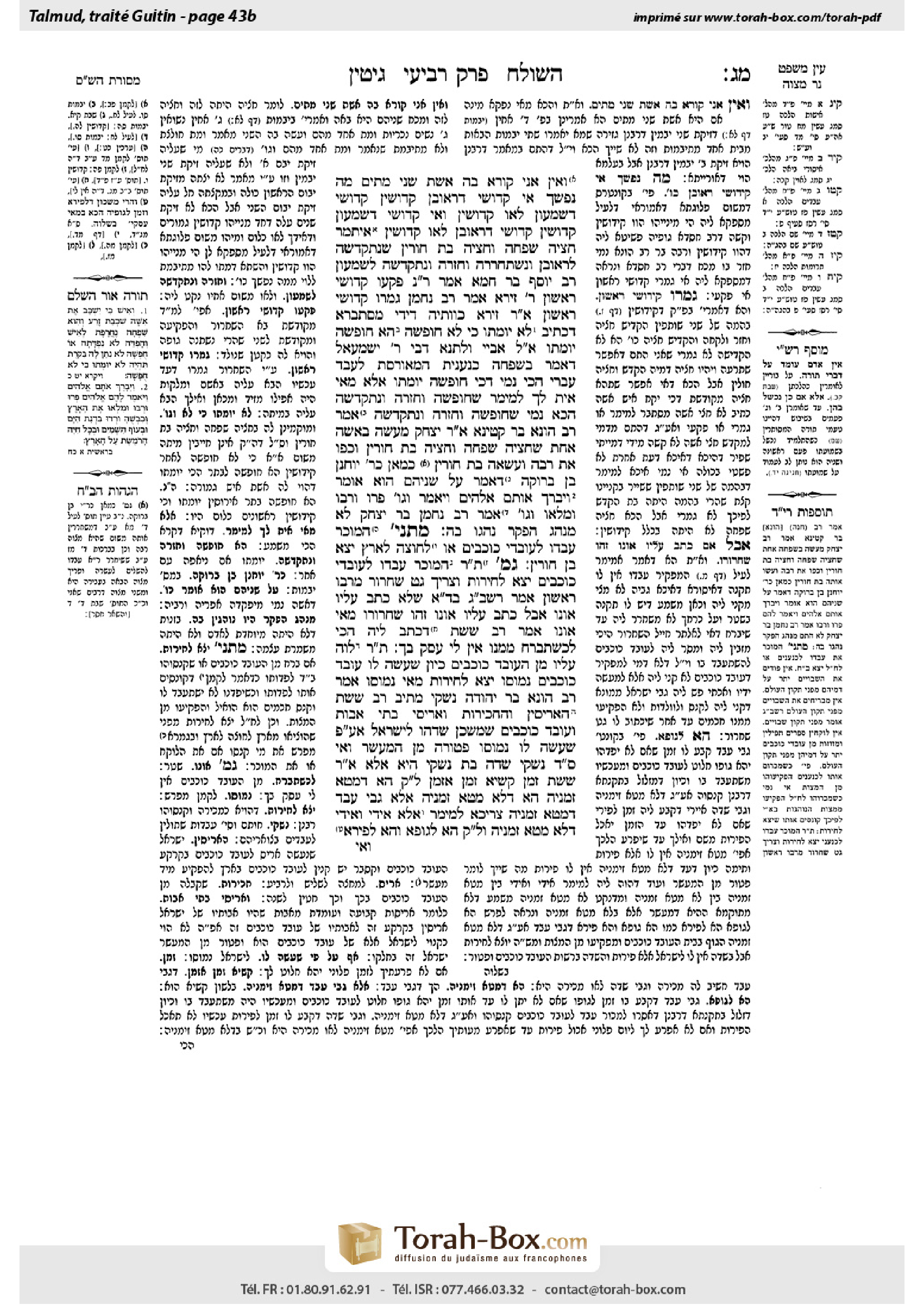
Gittin 43b: Talmud study for Daf Yomi
Study the Talmud for Daf Yomi with scanned pages, Hebrew text, English translations from Sefaria and AI-generated French translations.
Passage selection and English or AI-generated French translation are available where the scan has annotations. Daf Study is independent of Torah-Box and Sefaria.
Browse Gittin · גיטין · All tractatesGittin 43b text and translations
This page of Gittin includes the Aramaic text, an English translation and an AI-generated French translation, alongside the scan above.
גיטין מ״ג ב · Aramaic and Hebrew text
וְאֵין אֲנִי קוֹרֵא בָּהּ אֵשֶׁת שְׁנֵי מֵתִים; מָה נַפְשָׁךְ, אִי קִדּוּשֵׁי דִּרְאוּבֵן קִדּוּשִׁין – קִדּוּשֵׁי דְּשִׁמְעוֹן לָאו קִדּוּשִׁין, וְאִי קִדּוּשֵׁי דְּשִׁמְעוֹן קִדּוּשִׁין – קִדּוּשֵׁי דִּרְאוּבֵן לָאו קִדּוּשִׁין.
אִיתְּמַר: חֶצְיָהּ שִׁפְחָה וְחֶצְיָהּ בַּת חוֹרִין שֶׁנִּתְקַדְּשָׁה לִרְאוּבֵן, וְנִשְׁתַּחְרְרָה, וְחָזְרָה וְנִתְקַדְּשָׁה לְשִׁמְעוֹן, רַב יוֹסֵף בַּר חָמָא אָמַר רַב נַחְמָן: פָּקְעוּ קִדּוּשֵׁי רִאשׁוֹן; רַבִּי זֵירָא אָמַר רַב נַחְמָן: גָּמְרוּ קִדּוּשֵׁי רִאשׁוֹן.
אָמַר רַבִּי זֵירָא: כְּווֹתֵיהּ דִּידִי מִסְתַּבְּרָא, דִּכְתִיב: ״לֹא יוּמְתוּ כִּי לֹא חוּפָּשָׁה״ – הָא חוּפָּשָׁה, יוּמְתוּ!
אֲמַר לֵיהּ אַבָּיֵי: וּלְתָנָא דְּבֵי רַבִּי יִשְׁמָעֵאל, דְּאָמַר: בְּשִׁפְחָה כְּנַעֲנִית הַמְאוֹרֶסֶת לְעֶבֶד עִבְרִי; הָכִי נָמֵי דְּכִי חוּפָּשָׁה – יוּמְתוּ?! אֶלָּא מַאי אִית לָךְ לְמֵימַר – שֶׁחוּפְּשָׁה וְחָזְרָה וְנִתְקַדְּשָׁה, הָכָא נָמֵי – שֶׁחוּפְּשָׁה וְחָזְרָה וְנִתְקַדְּשָׁה.
אָמַר רַב הוּנָא בַּר קַטִּינָא אָמַר רַבִּי יִצְחָק: מַעֲשֶׂה בְּאִשָּׁה אַחַת שֶׁחֶצְיָהּ שִׁפְחָה וְחֶצְיָהּ בַּת חוֹרִין, וְכָפוּ אֶת רַבָּהּ וַעֲשָׂאָהּ בַּת חוֹרִין. כְּמַאן? כְּרַבִּי יוֹחָנָן בֶּן בְּרוֹקָה, דְּאָמַר: עַל שְׁנֵיהֶם הוּא אוֹמֵר: ״וַיְבָרֶךְ אוֹתָם אֱלֹהִים וַיֹּאמֶר וְגוֹ׳ פְּרוּ וּרְבוּ וּמִלְאוּ וְגוֹ׳״
אָמַר רַב נַחְמָן בַּר יִצְחָק: לֹא, מִנְהַג הֶפְקֵר נָהֲגוּ בָּהּ.
מַתְנִי׳ הַמּוֹכֵר עַבְדּוֹ לַגּוֹיִם אוֹ לְחוּצָה לָאָרֶץ – יָצָא בֶּן חוֹרִין.
גְּמָ׳ תָּנוּ רַבָּנַן: הַמּוֹכֵר עַבְדּוֹ לַגּוֹיִם – יָצָא לְחֵירוּת, וְצָרִיךְ גֵּט שִׁחְרוּר מֵרַבּוֹ רִאשׁוֹן. אָמַר רַבָּן שִׁמְעוֹן בֶּן גַּמְלִיאֵל: בַּמֶּה דְּבָרִים אֲמוּרִים – שֶׁלֹּא כָּתַב עָלָיו אוֹנוֹ, אֲבָל כָּתַב עָלָיו אוֹנוֹ – זֶהוּ שִׁחְרוּרוֹ.
מַאי ״אוֹנוֹ״? אָמַר רַב שֵׁשֶׁת, דִּכְתַב לֵיהּ הָכִי: לִכְשֶׁתִּבְרַח מִמֶּנּוּ, אֵין לִי עֵסֶק בָּךְ.
תָּנוּ רַבָּנַן: לָוָה עָלָיו מִן הַגּוֹי, כֵּיוָן שֶׁעָשָׂה לוֹ גּוֹי נִמוּסוֹ – יָצָא לְחֵירוּת. מַאי נִמוּסוֹ? אָמַר רַב הוּנָא בַּר יְהוּדָה: נַשְׁקִי.
מֵתִיב רַב שֵׁשֶׁת: הָאֲרִיסִין, וְהַחֲכִירוֹת, וַאֲרִיסֵי בָּתֵּי אָבוֹת, וְגוֹי שֶׁמִּשְׁכֵּן שָׂדֵהוּ לְיִשְׂרָאֵל; אַף עַל פִּי שֶׁעָשָׂה לוֹ נִמוּסוֹ – פְּטוּרָה מִן הַמַּעֲשֵׂר.
וְאִי סָלְקָא דַעְתָּךְ נַשְׁקִי, שָׂדֶה בַּת נַשְׁקִי הִיא? אֶלָּא אָמַר רַב שֵׁשֶׁת: זְמַן.
קַשְׁיָא זְמַן אַזְּמַן! לָא קַשְׁיָא: הָא דִּמְטָא זִמְנֵיהּ, הָא דְּלָא מְטָא זִמְנֵיהּ.
אֶלָּא גַּבֵּי עֶבֶד, דִּמְטָא זִמְנֵיהּ צְרִיכָא לְמֵימַר?! אֶלָּא אִידֵּי וְאִידֵּי דְּלָא מְטָא זִמְנֵיהּ, וְלָא קַשְׁיָא: הָא לְגוּפָא, וְהָא לְפֵירָא.
Gittin 43b · English translation
and I do not declare her to be the wife of two dead men. The halakha is that a yevama whose requirement for levirate marriage results from marriage to two brothers does not enter into levirate marriage at all. Here, that halakha does not apply, as whichever way you look at it, she was not married to two brothers: If Reuven’s betrothal was a valid betrothal, then Shimon’s betrothal was not a valid betrothal, and she is only Reuven’s widow. And if Shimon’s betrothal was a valid betrothal, it could only be that Reuven’s betrothal was not a valid betrothal. Either way, she had been married to only one of the brothers, and therefore she enters into levirate marriage with the third.
It was stated: If there was a half-maidservant half-free woman who was betrothed to Reuven, and afterward she was emancipated entirely, and she went back and was betrothed to Shimon, who in this case was not the brother of Reuven, then Rav Yosef bar Ḥama says that Rav Naḥman says: Through her emancipation the first betrothal was entirely abrogated, and the second betrothal takes effect. Rabbi Zeira says that Rav Naḥman says: The first betrothal was completed. Reuven’s betrothal took effect immediately once she was emancipated. Consequently, Shimon’s betrothal did not take effect at all.
Rabbi Zeira says: It stands to reason in accordance with my opinion, as it is written with regard to one who engages in sexual intercourse with a designated maidservant: “They shall not be put to death, because she was not free” (Leviticus 19:20), and one can infer: But if she was free, then they will be put to death, because she is a married woman. This teaches that her betrothal is complete once she is emancipated.
Abaye said to him: And according to the tanna of the school of Rabbi Yishmael, who says: It is referring to a Canaanite maidservant betrothed to a Hebrew slave, so too, will you say that when she is free they are put to death? Once she is free, her betrothal to a Hebrew slave certainly is abrogated. Rather, what have you to say in order to understand the inference from the verse according to Rabbi Yishmael? That is a case where she was free, and she then went back and was betrothed. Here too, even if the verse is discussing a half-maidservant half-free woman, they will be put to death only in a case where she was free and she then went back and was betrothed, but the emancipation itself does not complete her earlier betrothal.
§ Rav Huna bar Ketina says that Rabbi Yitzḥak says: An incident occurred involving one woman who was a half-maidservant half-free woman, and they forced her master to emancipate her, and he made her a free woman. The Gemara asks: In accordance with whose opinion is it? Is it in accordance with the opinion of Rabbi Yoḥanan ben Beroka, who says: For both Adam and Eve the verse states: “And God blessed them, and God said to them: Be fruitful, and multiply, and replenish the earth and subdue it” (Genesis 1:28), indicating that the mitzva to procreate is incumbent upon women as well, and therefore a half-maidservant half-free woman must be freed to enable her to procreate?
Rav Naḥman bar Yitzḥak said: No, it need not be in accordance with the opinion of Rabbi Yoḥanan ben Beroka, as the reason that he was forced to emancipate her was because she was unable to marry, and other men took liberties with her, i.e., engaged in intercourse with her. Consequently, the court forced her master to emancipate her so that she could marry.
MISHNA: In a case of one who sells his slave to gentiles, or even to a Jew outside of Eretz Yisrael, the slave is emancipated. Since the slave, who is partially obligated in the fulfillment of mitzvot, would be restricted in his ability to fulfill them in his new situation, either because he would be under the authority of a gentile or because he will no longer be in Eretz Yisrael, the Sages penalized his original owner that he should become a freeman, so that if he succeeds in escaping his new owner, he is a full-fledged freeman.
GEMARA: The Sages taught (Tosefta, Avoda Zara 3:16): In a case of one who sells his slave to gentiles, the slave is emancipated, but nevertheless requires a bill of manumission from his first master. Rabban Shimon ben Gamliel said: In what case is this statement said? When the master did not write a document for him, but if he wrote a document for him, then this is his emancipation and he does not require a bill of manumission.
The Gemara asks: What is the nature of this document? Rav Sheshet said: He writes to him like this: When you will escape from the gentile, I have no business with you. Even though this is not an explicit bill of manumission, it is sufficient for him to be considered a freeman.
§ The Sages taught: If he borrows from a gentile on the basis of the slave, i.e., using the slave as collateral so that the creditor can collect the slave in payment of the debt in the event that the debtor defaults, then once the gentile behaves with the slave according to his law [nimmuso], the slave is emancipated, just like a slave who is sold to a gentile. The Gemara asks: What is defined as: His law? The Gemara answers: Rav Huna bar Yehuda said: He places a seal [nashkei] upon him.
Rav Sheshet raises an objection to this based on a baraita (Tosefta, Terumot 2:11): If there was a field owned by a gentile, but there were Jewish sharecroppers, or Jewish tenant farmers, or Jewish family sharecroppers, i.e., an entire family of sharecroppers who work a field generation after generation; or in the case of a gentile who mortgaged his field to a Jew, then even though the gentile acted for the Jew based on his, the Jew’s, law, the field is exempt from tithes, because the field belongs to a gentile. It is not considered as if it were transferred to the Jew.
And if it enters your mind that the phrase: His law, means a seal, is a field able to be sealed? Rather, Rav Sheshet says: The expression: He acted for him based on his law, means time. In other words, a deadline was set and if the debt was not paid by the given date the slave would automatically be transferred to the possession of the gentile.
The Gemara asks: If that is so, there is a difficulty with regard to the issue of time in the case of the slave and the issue of time in the case of the field. In the case of the slave the halakha is that after the set time, he leaves the debtor’s authority and is emancipated, while in the case of the field its produce does not become obligated to be tithed like the produce of a Jew’s field after that set time. The Gemara answers: This is not difficult, since the following distinction can be made: This, the case of the slave who is emancipated, is referring to when his time to be transferred has arrived, and this, the case of the field, is referring to where its time to be transferred has not yet arrived.
The Gemara asks: But with regard to a slave whose time to be transferred has arrived, does it need to be said that he is emancipated? Isn’t it obvious that once he is transferred to the authority of the gentile, he is emancipated, just as in the case of a sale? Rather, the Gemara offers a different explanation: This case and that case are referring to when his time to be transferred has not yet arrived, and it is not difficult: This, the case of the slave who is emancipated, is with regard to the slave himself, as the slave himself is to be transferred to the gentile, and that case is with regard to the produce. In other words, the Jewish creditor has the rights to the produce of the field, but he does not take possession of the actual field. Therefore, it remains exempt from tithes.
Gittin 43b · Traduction française (IA)
et je ne déclare pas qu'elle est la femme de deux hommes décédés. La halakha est que la yevama dont le devoir de mariage levirique provient d'un mariage avec deux frères ne contracte pas de mariage levirique du tout. Ici, cette halakha ne s'applique pas, car quels que soient les cas, elle n'a pas été mariée à deux frères : si l'engagement de Réouven était un engagement valide, alors celui de Siméon n'était pas un engagement valide, et elle est seulement la veuve de Réouven. Et si l'engagement de Siméon était valide, cela ne peut signifier que l'engagement de Réouven n'était pas valide. Quel que soit le cas, elle a été mariée à seulement un des frères, et donc elle entre en mariage levirique avec le troisième.
Il a été dit : Si une demi-maîtresse demi-libre avait été engagée à Réouven, et ensuite elle avait été entièrement libérée, et elle est revenue et engagée à Siméon, qui, dans ce cas, n'était pas le frère de Réouven, alors Rav Yosef bar Ḥama dit que Rav Naḥman dit : Par sa libération, l'engagement initial a été entièrement annulé, et l'engagement suivant est entré en vigueur. Rabbi Zeira dit que Rav Naḥman dit : L'engagement initial était accompli. L'engagement de Réouven a pris effet immédiatement une fois qu'elle avait été libérée. Ainsi, l'engagement de Siméon n'a pas pris effet du tout.
Rabbi Zeira dit : Cela est logique selon mon opinion, car il est écrit concernant celui qui a relations sexuelles avec une maîtresse désignée : « Ils ne seront pas punis, car elle n'était pas libre » (Lévitique 19:20), et on peut en déduire : Mais si elle était libre, alors ils seront punis, car elle est une femme mariée. Cela enseigne que son engagement est accompli une fois qu'elle est libérée.
Abaye dit à lui : Et selon le tanna de la maison de Rabbi Yishmael, qui dit : Il s'agit d'une servante cananéenne fiancée à un esclave hébreu, tu diras aussi que lorsqu'elle est libre, ils sont punis ? Une fois qu'elle est libre, son fiancement à un esclave hébreu est certainement annulé. Plutôt, que dis-tu pour comprendre l'inférence tirée de la parole selon Rabbi Yishmael ? C'est un cas où elle était libre, et elle est revenue et fiancée. Ici aussi, même si la parole parle d'une femme moitié servante moitié libre, ils seront punis seulement dans le cas où elle était libre et qu'elle est revenue et fiancée, mais la libération elle-même ne termine pas son fiancement antérieur.
§ Rav Huna bar Ketina dit que Rabbi Yitzḥak dit : Un incident s'est produit concernant une femme qui était à la fois une servante et une femme libre, et on a forcé son maître à la libérer, et il l'a rendue libre. La Guemara demande : Selon quel avis est-ce ? Est-ce selon l'opinion de Rabbi Yoḥanan ben Beroka, qui dit : Pour Adam et Ève, la Parashah dit : « Et Dieu bénit, et Dieu dit à eux : Faites-vous des enfants, et multipliez-vous, et remplissez la terre et dominez-la » (Genèse 1:28), indiquant que la mitsva de procréer incombe aussi aux femmes, et donc une femme à la fois servante et libre doit être libérée afin qu'elle puisse procréer ?
Rav Naḥman bar Yitzḥak dit : Non, il n'est pas nécessaire selon l'opinion de Rabbi Yoḥanan ben Beroka, car la raison pour laquelle il a été forcé de la libérer est qu'elle ne pouvait pas se marier, et d'autres hommes prenaient des libertés avec elle, c'est-à-dire engageaient des relations sexuelles avec elle. Ainsi, le tribunal a forcé son maître à la libérer afin qu'elle puisse se marier.
MICHNA : Dans le cas d'un homme qui vend son esclave aux gentils, ou même à un Juif hors de la Terre d'Israël, l'esclave est libéré. Puisque l'esclave, qui est partiellement tenu de remplir des mitsvot, serait restreint dans sa capacité à les remplir dans son nouveau statut, soit parce qu'il serait sous l'autorité des gentils, soit parce qu'il ne serait plus en Terre d'Israël, les Sages ont puni son propriétaire original en le rendant libre, afin que s'il réussit à s'échapper de son nouveau propriétaire, il soit un homme libre complet.
GUEMARA : Les Sages ont enseigné (Tosefta, Avoda Zara 3:16) : Dans le cas d'un homme qui vend son esclave aux gentils, l'esclave est libéré, mais il faut tout de même un acte de libération de son premier maître. Rabban Shimon ben Gamliel dit : Dans quel cas cette déclaration est-elle faite ? Lorsque le maître n'avait pas écrit un document pour lui, mais si le maître avait écrit un document pour lui, alors cela est sa libération et il n'a pas besoin d'un acte de libération.
La Guemara demande : Quelle est la nature de ce document ? Rav Sheshet dit : Il écrit à lui comme suit : Lorsque tu échapperas des gentils, je n'ai plus affaire à toi. Même si cela n'est pas un acte de libération explicite, cela est suffisant pour qu'il soit considéré comme un homme libre.
§ Les Sages ont enseigné : Si l'on emprunte à un gentil sur la base de l'esclave, c'est-à-dire en utilisant l'esclave comme caution afin que le créancier puisse récupérer l'esclave en paiement de la dette en cas de défaut du débiteur, alors une fois que le gentil agit avec l'esclave selon sa loi [nimmuso], l'esclave est libéré, tout comme un esclave vendu aux gentils. La Guemara demande : Qu'est-ce que l'on définit comme : sa loi ? La Guemara répond : Rav Huna bar Yehuda dit : Il place un sceau [nashkei] sur lui.
Rav Sheshet émet un objet à cela basé sur une baraïta (Tosefta, Terumot 2:11) : Si un champ appartenait à un gentil, mais il y avait des cultivateurs juifs, ou des fermiers juifs, ou des familles de cultivateurs juifs, c'est-à-dire une famille entière de cultivateurs travaillant un champ de génération en génération ; ou dans le cas d'un gentil qui a hypothéqué son champ à un Juif, alors même que le gentil agissait pour le Juif selon sa loi, le champ est exempt de dîmes, car le champ appartient à un gentil. Il n'est pas considéré comme transféré au Juif.
Et si cela entre dans votre pensée que la phrase : Sa loi, signifie un sceau, un champ pouvant être scellé ? Plutôt, Rav Sheshet dit : L'expression : Il a agi en son égard selon sa loi, signifie le temps. En d'autres termes, un délai a été fixé, et si la dette n'était pas payée à la date donnée, l'esclave serait automatiquement transféré en possession du non-Juif.
La Guemara pose la question : Si c'est ainsi, il y a une difficulté concernant la question du temps dans le cas de l'esclave et dans le cas du champ. Dans le cas de l'esclave, la halakha est que, après le délai fixé, il quitte l'autorité du débiteur et est emancipé, tandis que dans le cas du champ, ses récoltes ne deviennent pas obligatoires à la tithe comme les récoltes d'un champ juif après ce délai fixé. La Guemara répond : Ce n'est pas difficile, puisque la distinction suivante peut être faite : Celui-ci, le cas de l'esclave qui est emancipé, fait référence au moment où son délai de transfert est arrivé, et celui-ci, le cas du champ, fait référence à un moment où son délai de transfert n'est pas encore arrivé.
La Guemara pose la question : Mais concernant un esclave dont le délai de transfert est arrivé, faut-il dire qu'il est emancipé ? N'est-ce pas évident que, dès qu'il est transféré en autorité du non-Juif, il est emancipé, tout comme dans le cas d'une vente ? Plutôt, la Guemara propose une autre explication : Ce cas et celui-ci font référence au moment où son délai de transfert n'est pas encore arrivé, et il n'y a pas de difficulté : Celui-ci, le cas de l'esclave qui est emancipé, fait référence à l'esclave lui-même, car l'esclave lui-même est à transférer au non-Juif, et celui-ci fait référence aux récoltes. En d'autres termes, le créancier juif a le droit sur les récoltes du champ, mais il ne prend pas possession du champ lui-même. Ainsi, il reste exempt de tithe.
Traduction française générée par IA à partir de l’édition anglaise de Sefaria. Vérifie toujours un passage avec le texte source.
Text from Sefaria: William Davidson Edition - Vocalized Aramaic (CC BY NC); William Davidson Edition - English (CC BY NC).