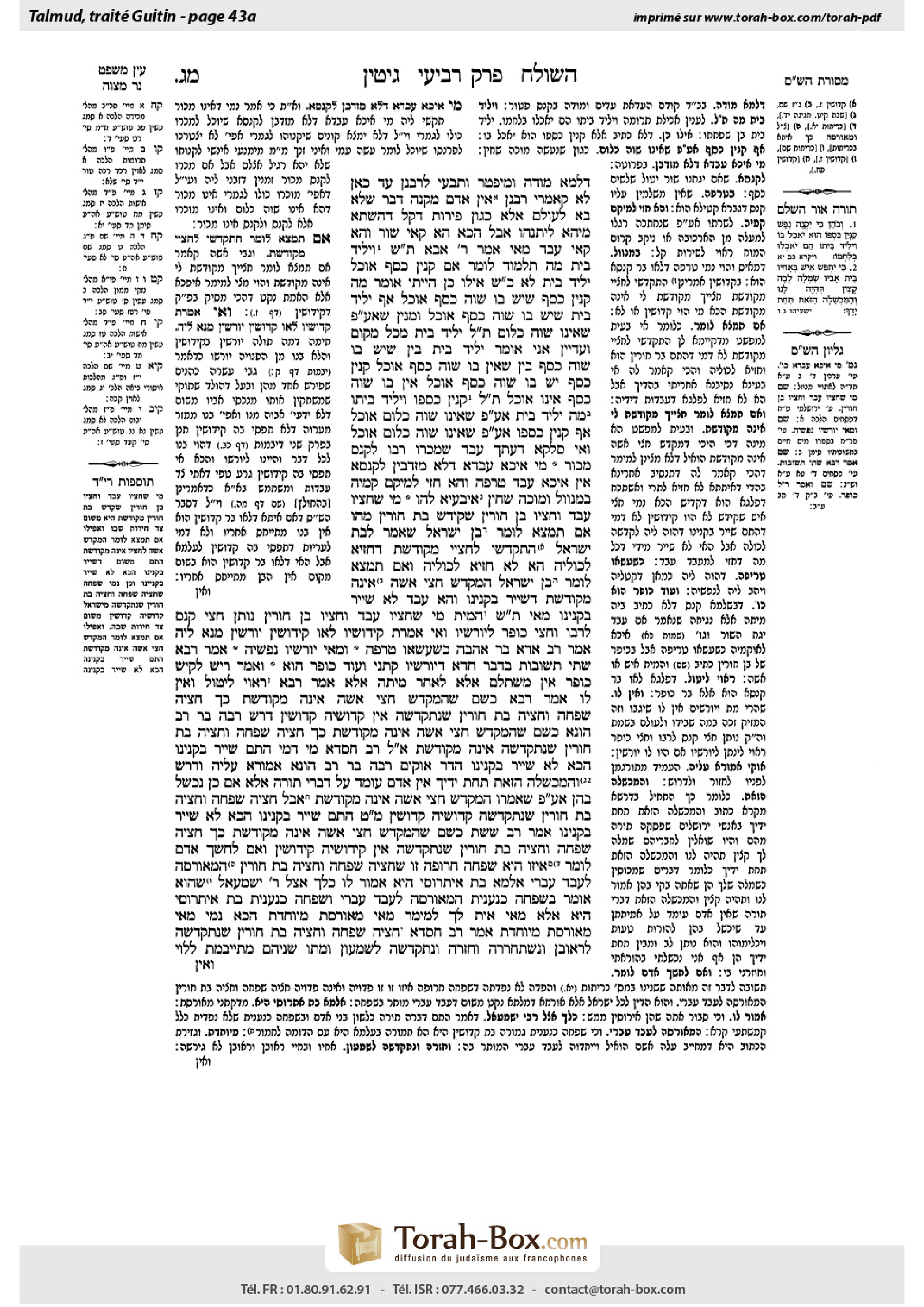
Gittin 43a: Talmud study for Daf Yomi
Study the Talmud for Daf Yomi with scanned pages, Hebrew text, English translations from Sefaria and AI-generated French translations.
Passage selection and English or AI-generated French translation are available where the scan has annotations. Daf Study is independent of Torah-Box and Sefaria.
Browse Gittin · גיטין · All tractatesGittin 43a text and translations
This page of Gittin includes the Aramaic text, an English translation and an AI-generated French translation, alongside the scan above.
גיטין מ״ג א · Aramaic and Hebrew text
דִּלְמָא מוֹדֶה וּמִיפְּטַר.
וְתִבְּעֵי לְרַבָּנַן – עַד כָּאן לָא קָאָמְרִי רַבָּנַן אֵין אָדָם מַקְנֶה דָּבָר שֶׁלֹּא בָּא לָעוֹלָם – אֶלָּא כְּגוֹן פֵּירוֹת דֶּקֶל, דְּהַשְׁתָּא מִיהָא לֵיתַנְהוּ; אֲבָל הָכָא – הָא קָאֵי שׁוֹר וְהָא קָאֵי עֶבֶד. מַאי?
אָמַר רַבִּי אַבָּא, תָּא שְׁמַע: ״וִילִיד בַּיִת״ – מָה תַּלְמוּד לוֹמַר? אִם קִנְיַן כֶּסֶף – אוֹכֵל, יְלִיד בַּיִת – לֹא כׇּל שֶׁכֵּן?!
אִילּוּ כֵּן, הָיִיתִי אוֹמֵר: מָה קִנְיַן כֶּסֶף, שֶׁיֵּשׁ בּוֹ שָׁוֶה כֶּסֶף – אוֹכֵל; אַף יְלִיד בַּיִת, שֶׁיֵּשׁ בּוֹ שָׁוֶה כֶּסֶף – אוֹכֵל; וּמִנַּיִן שֶׁאַף עַל פִּי שֶׁאֵינוֹ שָׁוֶה כְּלוּם? תַּלְמוּד לוֹמַר ״יְלִיד בַּיִת״ – מִכׇּל מָקוֹם.
וַעֲדַיִין אֲנִי אוֹמֵר: יְלִיד בַּיִת, בֵּין שֶׁיֵּשׁ בּוֹ שָׁוֶה כֶּסֶף, בֵּין שֶׁאֵין בּוֹ שָׁוֶה כֶּסֶף – אוֹכֵל; קִנְיַן כֶּסֶף, יֵשׁ בּוֹ שָׁוֶה כֶּסֶף – אוֹכֵל, אֵין בּוֹ שָׁוֶה כֶּסֶף – אֵינוֹ אוֹכֵל; תַּלְמוּד לוֹמַר: ״קִנְיַן כַּסְפּוֹ וִילִיד בֵּיתוֹ״ – מָה יְלִיד בַּיִת, אַף עַל פִּי שֶׁאֵינוֹ שָׁוֶה כְּלוּם – אוֹכֵל; אַף קִנְיַן כַּסְפּוֹ, אַף עַל פִּי שֶׁאֵינוֹ שָׁוֶה כְּלוּם – אוֹכֵל.
וְאִי סָלְקָא דַעְתָּךְ, עֶבֶד שֶׁמְּכָרוֹ רַבּוֹ לִקְנָס – מָכוּר; מִי אִיכָּא עַבְדָּא דְּלָא מִזְדַּבַּן לִקְנָסָא?! אִין, אִיכָּא עֶבֶד טְרֵפָה.
וְהָא חֲזֵי לְמֵיקַם קַמֵּיהּ! בִּמְנֻוּוֹל וּמוּכֵּה שְׁחִין.
אִיבַּעְיָא לְהוּ: מִי שֶׁחֶצְיוֹ עֶבֶד וְחֶצְיוֹ בֶּן חוֹרִין, שֶׁקִּידֵּשׁ בַּת חוֹרִין, מַהוּ? אִם תִּמְצָא לוֹמַר: ״בֶּן יִשְׂרָאֵל שֶׁאָמַר לְבַת יִשְׂרָאֵל: ׳הִתְקַדְּשִׁי לְחֶצְיִי׳ – מְקוּדֶּשֶׁת״ – דְּחַזְיָא לְכוּלֵּיהּ; הָא – לָא חַזְיָא לְכוּלֵּיהּ.
וְאִם תִּמְצָא לוֹמַר: ״בֶּן יִשְׂרָאֵל הַמְקַדֵּשׁ חֲצִי אִשָּׁה – אֵינָהּ מְקוּדֶּשֶׁת״ – דְּשִׁיֵּיר בְּקִנְיָנוֹ; וְהָא עֶבֶד – לֹא שִׁיֵּיר בְּקִנְיָנוֹ. מַאי?
תָּא שְׁמַע: הֵמִית מִי שֶׁחֶצְיוֹ עֶבֶד וְחֶצְיוֹ בֶּן חוֹרִין – נוֹתֵן חֲצִי קְנָס לְרַבּוֹ, וַחֲצִי כוֹפֶר לְיוֹרְשָׁיו. וְאִי אָמְרַתְּ קִידּוּשָׁיו לָאו קִידּוּשִׁין, יוֹרְשִׁין מְנָא לֵיהּ?
אָמַר רַב אַדָּא בַּר אַהֲבָה: כְּשֶׁעֲשָׂאוֹ טְרֵפָה; וּמַאי ״יוֹרְשָׁיו״ – נַפְשֵׁיהּ.
אָמַר רָבָא, שְׁתֵּי תְּשׁוּבוֹת בַּדָּבָר: חֲדָא – דְּ״יוֹרְשָׁיו״ קָתָנֵי; וְעוֹד – כּוֹפֶר הוּא, וְאָמַר רֵישׁ לָקִישׁ: כּוֹפֶר אֵין מִשְׁתַּלֵּם אֶלָּא לְאַחַר מִיתָה! אֶלָּא אָמַר רָבָא: רָאוּי לִיטּוֹל, וְאֵין לוֹ.
אָמַר רָבָא: כְּשֵׁם שֶׁהַמְקַדֵּשׁ חֲצִי אִשָּׁה – אֵינָהּ מְקוּדֶּשֶׁת, כָּךְ חֶצְיָהּ שִׁפְחָה וְחֶצְיָהּ בַּת חוֹרִין שֶׁנִּתְקַדְּשָׁה – אֵין קִדּוּשֶׁיהָ קִדּוּשִׁין.
דָּרֵשׁ רַבָּה בַּר רַב הוּנָא: כְּשֵׁם שֶׁהַמְקַדֵּשׁ חֲצִי אִשָּׁה – אֵינָהּ מְקוּדֶּשֶׁת, כָּךְ חֶצְיָהּ שִׁפְחָה וְחֶצְיָהּ בַּת חוֹרִין שֶׁנִּתְקַדְּשָׁה – אֵינָהּ מְקוּדֶּשֶׁת. אֲמַר לֵיהּ רַב חִסְדָּא: מִי דָּמֵי? הָתָם שִׁיֵּיר בְּקִנְיָנוֹ, הָכָא לֹא שִׁיֵּיר בְּקִנְיָנוֹ!
הֲדַר אוֹקֵים רַבָּה בַּר רַב הוּנָא אָמוֹרָא עֲלֵיהּ, וּדְרַשׁ: ״וְהַמַּכְשֵׁלָה הַזֹּאת תַּחַת יָדֶיךָ״ – אֵין אָדָם עוֹמֵד עַל דִּבְרֵי תוֹרָה, אֶלָּא אִם כֵּן נִכְשָׁל בָּהֶן; אַף עַל פִּי שֶׁאָמְרוּ הַמְקַדֵּשׁ חֲצִי אִשָּׁה – אֵינָהּ מְקוּדֶּשֶׁת, אֲבָל חֶצְיָהּ שִׁפְחָה וְחֶצְיָהּ בַּת חוֹרִין שֶׁנִּתְקַדְּשָׁה – קִדּוּשֶׁיהָ קִדּוּשִׁין. מַאי טַעְמָא? הָתָם שִׁיֵּיר בְּקִנְיָנוֹ, הָכָא לֹא שִׁיֵּיר בְּקִנְיָנוֹ.
אָמַר רַב שֵׁשֶׁת: כְּשֵׁם שֶׁהַמְקַדֵּשׁ חֲצִי אִשָּׁה – אֵינָהּ מְקוּדֶּשֶׁת, כָּךְ חֶצְיָהּ שִׁפְחָה וְחֶצְיָהּ בַּת חוֹרִין שֶׁנִּתְקַדְּשָׁה – אֵין קִידּוּשֶׁיהָ קִידּוּשִׁין. וְאִם לְחָשְׁךָ אָדָם לוֹמַר: אֵיזוֹ הִיא שִׁפְחָה חֲרוּפָה – זוֹ שֶׁחֶצְיָהּ שִׁפְחָה וְחֶצְיָהּ בַּת חוֹרִין הַמְאוֹרֶסֶת לְעֶבֶד עִבְרִי; אַלְמָא בַּת אִיתְּרוֹסֵי הִיא! אֱמוֹר לוֹ: כְּלָךְ אֵצֶל רַבִּי יִשְׁמָעֵאל, שֶׁהוּא אוֹמֵר – בְּשִׁפְחָה כְּנַעֲנִית הַמְאוֹרֶסֶת לְעֶבֶד עִבְרִי.
וְשִׁפְחָה כְּנַעֲנִית בַּת אִיתְּרוֹסֵי הִיא?! אֶלָּא מַאי אִית לָךְ לְמֵימַר, מַאי ״מְאוֹרֶסֶת״ – מְיוּחֶדֶת; הָכָא נָמֵי, מַאי ״מְאוֹרֶסֶת״ – מְיוּחֶדֶת.
אָמַר רַב חִסְדָּא: חֶצְיָהּ שִׁפְחָה וְחֶצְיָהּ בַּת חוֹרִין שֶׁנִּתְקַדְּשָׁה לִרְאוּבֵן, וְנִשְׁתַּחְרְרָה, וְחָזְרָה וְנִתְקַדְּשָׁה לְשִׁמְעוֹן, וּמֵתוּ שְׁנֵיהֶם – מִתְיַיבֶּמֶת לְלֵוִי,
Gittin 43a · English translation
Perhaps he will admit his obligation and become exempt from his obligation to pay, for one who admits that he is required to pay a penalty before the court obligates him to pay it is exempt.
And you could raise this dilemma according to the opinion of the Rabbis as well, as the Rabbis state that a person cannot transfer ownership of an entity that has not yet come into the world only in a case such as the produce of a date palm, which now, at least, is not in the world. However, here, the ox is standing and the slave is standing, and there is no need for any change in the reality. What is the halakha in this case?
Rabbi Abba said: Come and hear a proof based on a halakhic exposition of the verse that details those who may partake of teruma. The verse states: “But if a priest buys any person, the purchase of his money, he may eat of it; and those who are born in his house, they may eat of his bread” (Leviticus 22:11), and the Sages expound as follows: What is the meaning when the verse states: “And those who are born in his house”? If a slave, who is the purchase of his money, may partake of teruma, then in the case of those slaves who are born to the priest in his house, is it not all the more so that they should be able to partake of teruma?
The baraita continues: If so, if the halakha that a born slave may partake of teruma is derived only due to this a fortiori inference, I would have said: Just as with regard to the purchase of his money it is only one who has monetary value that partakes, so too, with regard to one born in his house, only one who has monetary value partakes. And from where is it derived that the same halakha applies when a born slave is not worth anything, e.g., in the case of a newborn, who cannot perform any labor? The verse states: “Those who are born in his house,” in any case, regardless of their present monetary value.
The baraita continues: And I still say that perhaps one born in the priest’s house may partake of teruma whether he has monetary value or whether he does not have monetary value. But with regard to a slave purchased of the priest’s money, when he has monetary value, he may partake; when he does not have monetary value, he may not partake. The verse states: “The purchase of his money…and those who are born in his house, they may eat of his bread” (Leviticus 22:11). The verse compares the two, indicating: Just as one born in the priest’s house may partake of teruma although he is not worth anything, so too, the purchase of his money may partake of teruma although he is not worth anything. In any event, it is clear from this baraita that it is possible for a slave to have no monetary value.
Rabbi Abba now states his proof. And if it enters your mind to say that a slave whose master sold him to another person only with regard to the penalty is sold, is there a slave that cannot be sold with regard to the penalty? Even if he cannot perform any labor, he still has value in that he can be sold with regard to the penalty. The Gemara answers: Yes, there is the case of a slave who has a wound that will cause him to die within twelve months [tereifa]. Since he will die from an injury that is already present, one would not be required to pay a penalty if one’s ox gored him.
The Gemara challenges: But isn’t he fit to stand before his master in honor, even if he cannot perform any other service, so he has some value as a slave? The Gemara answers: This baraita is referring to a slave who is not only a tereifa and for whom there is no penalty, but is also disgusting [menuvval] or afflicted with boils [mukeh sheḥin]. It would not be a display of honor for the slave to stand before the master, and therefore he is worthless. This question of the Gemara remains unresolved.
§ A dilemma was raised before the Sages: In the case of one who is a half-slave half-freeman who betrothed a free woman, what is the halakha? The Gemara discusses the elements of this question: If you say that this should be compared to a Jewish man who said to a Jewish woman: Become betrothed to half of me, and the halakha is that she is betrothed, this is because she is fit to marry all of him. However, in this case one could say that she is not fit to marry all of him because he is a half-slave, so it is not a valid betrothal.
However, if you say that this should be compared to the case of a Jewish man who betroths half a woman, where the halakha is that she is not betrothed because he left a portion of the woman out of his acquisition, as betrothal acquires a complete woman and not half of a woman, but this slave did not leave any part of her out of his acquisition, as his Jewish half betrothed her fully. What is the halakha in this case?
The Gemara suggests: Come and hear a proof based on that which is taught in a baraita: If an ox killed a half-slave half-freeman, then the owner of the ox gives half of a penalty, i.e., fifteen shekels, to his master and half of a ransom, i.e., half of the value of the deceased, to his heirs. And if you say that his betrothal is not a valid betrothal, and the half-slave half-freeman may not marry a woman, then from where does he have heirs? It must be that he may betroth and marry a woman, and as a result he can have heirs.
Rav Adda bar Ahava says: This is referring to a case where the ox did not actually kill him. Rather, it made him a tereifa, and a tereifa is like a dead person. And what is the meaning of: His heirs? It means the half-slave half-freeman himself.
Rava said that there are two refutations of your statement: One is that it teaches: His heirs, and it is not reasonable to say that this is referring to the victim himself. And furthermore, it is referring to ransom here, and Reish Lakish says: Ransom is paid only after the death of the victim but not while he is still alive, even if he is a tereifa. Rather, Rava says: When the baraita states that half of the ransom is given to his heirs, it means that it is fitting for heirs to take the ransom, but he does not actually have heirs.
§ Rava says: Just as the halakha is that in the case of one who betroths half a woman, she is not betrothed, so too, if there is a half-maidservant half-free woman who was betrothed, then her betrothal is not a valid betrothal.
The Gemara says: Rabba bar Rav Huna taught this halakha in public: Just as the halakha is that in the case of one who betroths half a woman, she is not betrothed, so too, if there is a half-maidservant half-free woman who was betrothed, then her betrothal is not a valid betrothal. Rav Ḥisda said to him as a question: Are the cases comparable? There, where he betroths half a woman, he leaves a portion of the woman out of his acquisition. That is why the betrothal does not take effect. However, here, she was a half-maidservant half-free woman when he betrothed her, and he did not leave a portion of the woman out of his acquisition, so the betrothal should take effect.
Rabba bar Rav Huna went back and placed an interpreter before him so that he could tell the public that he had been wrong, and he interpreted a verse homiletically. The verse states: “And let this stumbling-block be under your hand” (Isaiah 3:6). A person does not understand statements of Torah unless he stumbles in them. Therefore, I retract my previous statement and say that although the Sages said that in the case of one who betroths half a woman, she is not betrothed, however, if there was a half-maidservant half-free woman who was betrothed, then her betrothal is a valid betrothal. What is the reason for the distinction? There, he left a portion of the woman out of his acquisition; here, he did not leave a portion of the woman out of his acquisition.
Rav Sheshet said in response to this: Just as the halakha is that in the case of one who betroths half a woman, she is not betrothed, so too, if there is a half-maidservant half-free woman who was betrothed, then her betrothal is not a valid betrothal. And if a person whispers to you [leḥashekha], saying, based on what was taught in a baraita: Who is the designated maidservant mentioned in the Torah? This is a woman who is a half-maidservant half-free woman who is betrothed to a Hebrew slave, apparently indicating that she can be betrothed, then say to him: Go to the opinion of Rabbi Yishmael, for he says that this is not referring to a woman who is a half-slave, but rather to a Canaanite maidservant betrothed to a Hebrew slave.
Rav Sheshet questions his own statement: But can a Canaanite maidservant be betrothed? Rather, what have you to say: What is the meaning of the word betrothed in the statement of Rabbi Yishmael? It means that she is designated for him, and it is not actual betrothal. Here, also, in the baraita, what does it mean that the Canaanite maidservant is betrothed to a Hebrew slave? It means that she is designated to cohabit with him, but they are not in fact betrothed.
Rav Ḥisda says: If there was a half-maidservant half-free woman who was betrothed to Reuven, and afterward she was emancipated entirely, and she went back and was betrothed to Shimon his brother, and both brothers died without children, then she enters into levirate marriage with Levi, the third brother, because she was considered to be the complete wife of only one of the brothers,
Gittin 43a · Traduction française (IA)
Peut-être qu'il reconnaîtra son obligation et sera exempt de son obligation de payer, car celui qui reconnaît qu'il est tenu de payer une amende devant la cour est exempt.
Et vous pourriez soulever ce dilemme selon l'opinion des Rabbins également, car les Rabbins affirment qu'une personne ne peut transférer la propriété d'une entité qui n'a pas encore été mise au monde qu'en cas tel que les produits d'un palmier dattier, qui, du moins, n'est pas encore dans le monde. Cependant, ici, l'âne est debout et l'esclave est debout, et il n'y a pas besoin de changement dans la réalité. Quelle est la halakha dans ce cas ?
Rabbi Abba dit : Approchez-vous et écoutez une preuve tirée d'une explication halakhique du verset qui précise ceux qui peuvent consommer la terouma. Le verset dit : « Mais si un prêtre achète une personne, l'achat de son argent, il peut manger de cela ; et ceux qui sont nés dans sa maison, ils peuvent manger de son pain » (Lévitique 22:11), et les Sages expliquent ainsi : Qu'entend-on par « et ceux qui sont nés dans sa maison » ? Si un esclave, qui est l'achat de son argent, peut consommer la terouma, alors dans le cas des esclaves nés du prêtre dans sa maison, n'est-ce pas encore davantage qu'ils devraient pouvoir consommer la terouma ?
La baraïta continue : Si tel est le cas, si la halakha selon laquelle un esclave né peut consommer la terouma est dérivée uniquement grâce à cette inférence a fortiori, je dirais : Tout comme, concernant l'achat de son argent, c'est seulement celui qui a de la valeur monétaire qui peut consommer, de même, concernant celui né dans sa maison, seul celui qui a de la valeur monétaire peut consommer. D'où cette halakha est-elle dérivée dans le cas d'un esclave né qui n'a pas de valeur monétaire, par exemple dans le cas d'un nouveau-né, qui ne peut pas accomplir de travail ? Le verset dit : « ceux qui sont nés dans sa maison », en tout cas, indépendamment de leur valeur monétaire actuelle.
La baraïta continue : Et je dis encore que peut-être un né dans la maison du prêtre peut consommer la terouma, qu'il ait de la valeur monétaire ou non. Cependant, concernant un esclave acheté avec l'argent du prêtre, lorsqu'il a de la valeur monétaire, il peut consommer ; lorsqu'il n'en a pas, il ne peut pas consommer. Le verset dit : « L'achat de son argent… et ceux qui sont nés dans sa maison, ils peuvent manger de son pain » (Lévitique 22:11). Le verset compare les deux, indiquant : Tout comme celui né dans la maison du prêtre peut consommer la terouma même s'il n'a pas de valeur, de même, l'achat de son argent peut consommer la terouma même s'il n'a pas de valeur. En tout cas, il est clair de cette baraïta que l'esclave peut avoir une valeur monétaire nulle.
Rabbi Abba énonce maintenant sa preuve. Et si vous pensez que l'esclave que son maître a vendu à un autre homme uniquement concernant l'amende est vendu, y a-t-il un esclave qui ne puisse être vendu concernant l'amende ? Même s'il ne peut pas accomplir de travail, il a encore de la valeur car il peut être vendu concernant l'amende. La Guemara répond : Oui, il y a le cas d'un esclave qui a une plaie qui le fera mourir dans les douze mois [tereifa]. Puisqu'il mourra d'une blessure déjà présente, on ne serait pas tenu de payer une amende si son bœuf l'avait blessé.
La Guemara conteste : Mais n'est-il pas digne de se tenir en honneur devant son maître, même s'il ne peut accomplir aucun autre service, donc il a une valeur en tant qu'esclave ? La Guemara répond : Cette baraïta fait référence à un esclave qui n'est pas seulement un tereifa et pour lequel il n'y a pas d'amende, mais qui est aussi répugnant [menuvval] ou souffrant de vésicules [mukeh sheḥin]. Il ne serait pas un spectacle d'honneur pour l'esclave de se tenir devant le maître, et par conséquent il est sans valeur. Cette question de la Guemara reste sans résolution.
§ Un dilemme a été soulevé devant les Sages : Dans le cas d'une personne qui est demi-esclave et demi-libre qui a contracté un mariage avec une femme libre, quelle est la halakha ? La Guemara discute des éléments de cette question : Si vous dites que cela doit être comparé à un homme juif qui a dit à une femme juive : « Deviens mon épouse à moitié », et la halakha est que celle-ci est épousée, c'est parce qu'elle est digne de mariage avec tout lui. Cependant, dans ce cas, on pourrait dire qu'elle n'est pas digne de mariage avec tout lui car il est demi-esclave, donc ce n'est pas un mariage valide.
Cependant, si vous dites que cela doit être comparé au cas d'un homme juif qui épouse la moitié d'une femme, où la halakha est que celle-ci n'est pas épousée car il a laissé une partie de la femme hors de son acquisition, car le mariage acquis une femme complète et non la moitié d'une femme, mais cet esclave n'a pas laissé une partie de sa femme hors de son acquisition, car sa moitié juive a épousé pleinement. Quelle est la halakha dans ce cas ?
La Guemara suggère : Approchez-vous et écoutez une preuve tirée de ce qui est enseigné dans une baraïta : Si un bœuf a tué un demi-esclave et demi-libre, alors l'propriétaire du bœuf donne la moitié d'une amende, c'est-à-dire quinze sicles, à son maître et la moitié d'une rançon, c'est-à-dire la moitié de la valeur du défunt, à ses héritiers. Et si vous dites que son mariage n'est pas un mariage valide, et que le demi-esclave et demi-libre ne peut pas épouser une femme, alors d'où vient-il qu'il ait des héritiers ? Il doit être que celui-ci peut épouser et marier une femme, et par conséquent il peut avoir des héritiers.
Rav Adda bar Ahava dit : Cela fait référence à un cas où le bœuf n'a pas réellement tué. Plutôt, il l'a rendu tereifa, et un tereifa est comme un mort. Et qu'entend-on par « ses héritiers » ? Cela signifie le demi-esclave et demi-libre lui-même.
Rava dit qu'il y a deux réfutations à votre déclaration : l'une est que cela enseigne : « ses héritiers », et il n'est pas raisonnable de dire que cela fait référence à la victime elle-même. Et de plus, cela fait référence à la rançon ici, et Reish Lakish dit : la rançon est payée seulement après la mort de la victime, mais pas pendant qu'elle est encore vivante, même si elle est tereifa. Plutôt, Rava dit : lorsque la baraïta dit que la moitié de la rançon est donnée à ses héritiers, cela signifie que c'est approprié que les héritiers prennent la rançon, mais il n'a pas d'héritiers en réalité.
§ Rava dit : Comme la halakha est que dans le cas d'un homme qui contracte un mariage avec une femme en demi, elle n'est pas mariée, de même, si c'est une femme demi-maîtresse et demi-libre qui a été mariée, alors son mariage n'est pas un mariage valide.
La Guemara dit : Rabba bar Rav Huna a enseigné cette halakha en public : Comme la halakha est que dans le cas d'un homme qui contracte un mariage avec une femme en demi, elle n'est pas mariée, de même, si c'est une femme demi-maîtresse et demi-libre qui a été mariée, alors son mariage n'est pas un mariage valide. Rav Ḥisda lui a posé une question : Les cas sont-ils comparables ? Là, où il contracte un mariage avec une femme en demi, il exclut une partie de la femme de son acquisition. C'est pourquoi le mariage ne prend pas effet. Cependant, ici, elle était une femme demi-maîtresse et demi-libre lorsqu'il l'a mariée, et il n'a pas exclu une partie de la femme de son acquisition, donc le mariage devrait prendre effet.
Rabba bar Rav Huna est revenu et a fait appel à un interprète devant lui afin qu'il puisse dire au public qu'il avait tort, et il a interprété un verset de manière allégorique. Le verset dit : « Et ce trébuchant sera sous ta main » (Yachout 3:6). Une personne ne comprend pas les paroles de la Torah sans trébucher dessus. Par conséquent, je retire ma déclaration précédente et dis que bien que les Sages aient dit que dans le cas d'un homme qui contracte un mariage avec une femme en demi, elle n'est pas mariée, cependant, si c'était une femme demi-maîtresse et demi-libre qui a été mariée, alors son mariage est un mariage valide. Quelle est la raison de cette distinction ? Là, il a exclu une partie de la femme de son acquisition ; ici, il n'a pas exclu une partie de la femme de son acquisition.
Rav Sheshet a répondu à cela : Comme la halakha est que dans le cas d'un homme qui épouse une femme en demi, elle n'est pas épousée, de même, si c'est une femme demi-maîtresse et demi-libre qui a été épousée, alors son épousage n'est pas un épousage valide. Et si un homme murmure à toi [leḥashekha], disant, selon ce qui a été enseigné dans une baraïta : Qui est la maîtresse désignée mentionnée dans la Torah ? C'est une femme qui est une demi-maîtresse et demi-libre qui est épousée à un serviteur hébreu, semblant indiquer qu'elle peut être épousée, alors dis-lui : Va à l'opinion de Rabbi Yishmael, car il dit que cela ne se réfère pas à une femme qui est une demi-esclave, mais plutôt à une maîtresse cananéenne épousée à un serviteur hébreu.
Rav Sheshet questionne sa propre déclaration : Mais peut-on épouser une maîtresse cananéenne ? Plutôt, que dois-tu dire : Quelle est la signification du mot épousé dans la déclaration de Rabbi Yishmael ? Cela signifie qu'elle est désignée pour lui, et ce n'est pas un épousage réel. Ici aussi, dans la baraïta, que signifie que la maîtresse cananéenne est épousée à un serviteur hébreu ? Cela signifie qu'elle est désignée pour cohabiter avec lui, mais ils ne sont pas réellement épousés.
Rav Ḥisda dit : Si c'était une femme demi-maîtresse et demi-libre qui a été épousée à Réouven, et ensuite elle a été entièrement libérée, et elle est revenue et a été épousée à Shim'on, son frère, et les deux frères sont décédés sans enfants, alors elle entre en mariage levirat avec Lévi, le troisième frère, car elle a été considérée comme la femme complète de seulement l'un des frères,
Traduction française générée par IA à partir de l’édition anglaise de Sefaria. Vérifie toujours un passage avec le texte source.
Text from Sefaria: William Davidson Edition - Vocalized Aramaic (CC BY NC); William Davidson Edition - English (CC BY NC).