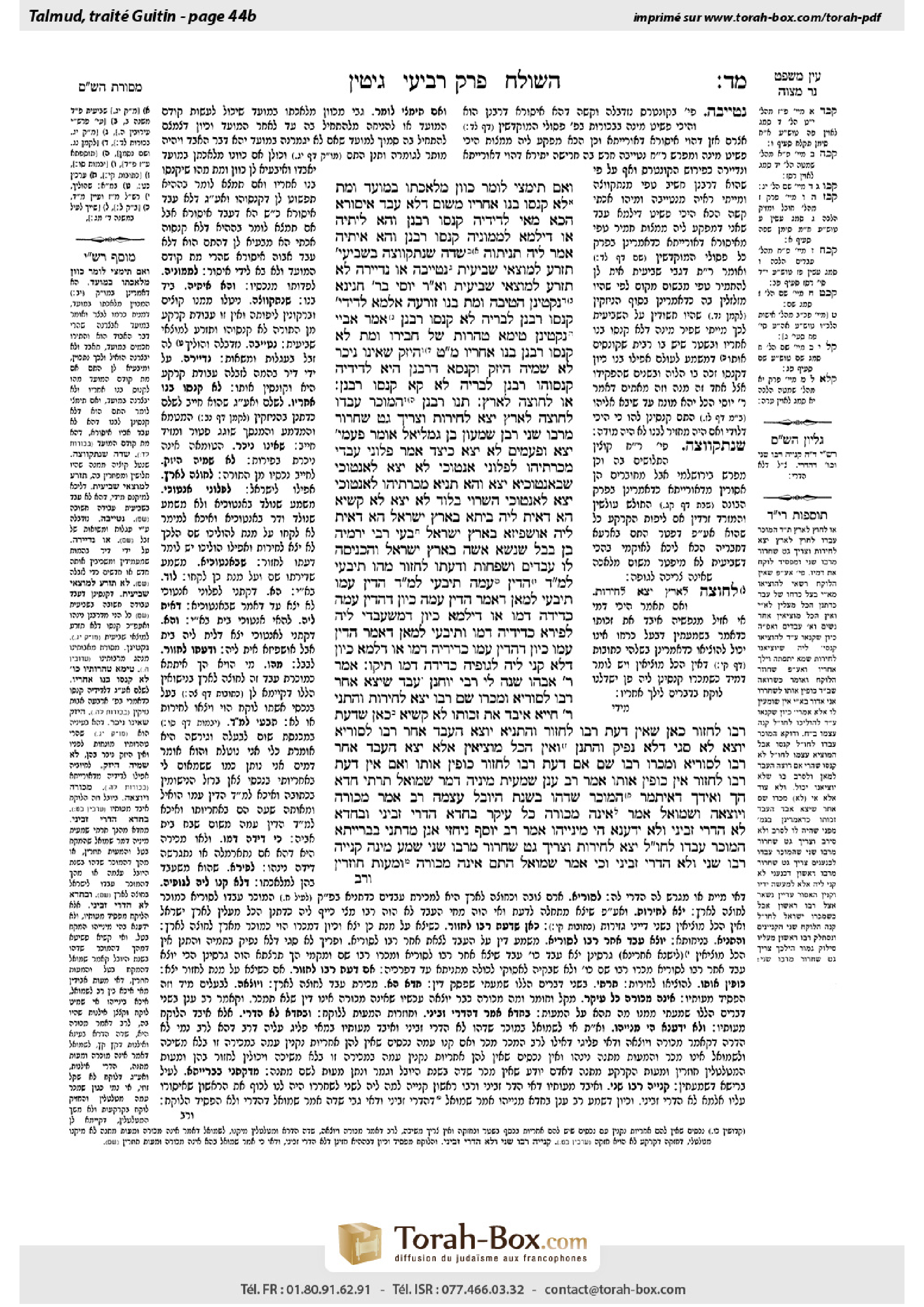
Gittin 44b: Talmud study for Daf Yomi
Study the Talmud for Daf Yomi with scanned pages, Hebrew text, English translations from Sefaria and AI-generated French translations.
Passage selection and English or AI-generated French translation are available where the scan has annotations. Daf Study is independent of Torah-Box and Sefaria.
Browse Gittin · גיטין · All tractatesGittin 44b text and translations
This page of Gittin includes the Aramaic text, an English translation and an AI-generated French translation, alongside the scan above.
גיטין מ״ד ב · Aramaic and Hebrew text
וְאִם תִּימְצֵי לוֹמַר: ״כִּוֵּון מְלַאכְתּוֹ בַּמּוֹעֵד, וָמֵת – לֹא קָנְסוּ בְּנוֹ אַחֲרָיו״ – מִשּׁוּם דְּלָא עֲבַד אִיסּוּרָא, הָכָא מַאי? לְדִידֵיהּ קְנַסוּ רַבָּנַן – וְהָא לֵיתֵיהּ; אוֹ דִילְמָא לְמָמוֹנֵיהּ קְנַסוּ רַבָּנַן – וְהָא אִיתֵיהּ?
אֲמַר לֵיהּ, תְּנֵיתוּהָ: שָׂדֶה שֶׁנִּתְקַוְּוצָה בַּשְּׁבִיעִית, תִּזָּרַע לְמוֹצָאֵי שְׁבִיעִית. נִטַּיְּיבָה אוֹ נִדַּיְּירָה – לֹא תִּזָּרַע לְמוֹצָאֵי שְׁבִיעִית.
וְאָמַר רַבִּי יוֹסֵי בְּרַבִּי חֲנִינָא, נָקְטִינַן: הֱטִיבָהּ וָמֵת – בְּנוֹ זוֹרְעָהּ. אַלְמָא לְדִידֵיהּ קְנַסוּ רַבָּנַן, לִבְרֵיהּ לָא קְנַסוּ רַבָּנַן.
אָמַר אַבָּיֵי, נָקְטִינַן: טִימֵּא טְהָרוֹת שֶׁל חֲבֵירוֹ, וָמֵת – לָא קְנַסוּ רַבָּנַן בְּנוֹ אַחֲרָיו. מַאי טַעְמָא? הֶיזֵּק שֶׁאֵינוֹ נִיכָּר לָא שְׁמֵיהּ הֶיזֵּק, וּקְנָסָא דְּרַבָּנַן הִיא – לְדִידֵיהּ קַנְסוּהוּ רַבָּנַן, לִבְרֵיהּ לָא קָא קְנַסוּ רַבָּנַן.
אוֹ לְחוּצָה לָאָרֶץ: תָּנוּ רַבָּנַן: הַמּוֹכֵר עַבְדּוֹ לְחוּצָה לָאָרֶץ – יָצָא לְחֵירוּת, וְצָרִיךְ גֵּט שִׁחְרוּר מֵרַבּוֹ שֵׁנִי. רַבָּן שִׁמְעוֹן בֶּן גַּמְלִיאֵל אוֹמֵר: פְּעָמִים יָצָא, וּפְעָמִים לֹא יָצָא. כֵּיצַד? אָמַר: ״פְּלוֹנִי עַבְדִּי מְכַרְתִּיהוּ לִפְלוֹנִי אַנְטוֹכִי״ – לֹא יָצָא. ״לְאַנְטוֹכִי שֶׁבְּאַנְטוֹכְיָא״ – יָצָא.
וְהָא תַּנְיָא: ״מְכַרְתִּיהוּ לְאַנְטוֹכִי״ – יָצָא, ״לְאַנְטוֹכִי הַשָּׁרוּי בְּלוֹד״ – לֹא יָצָא!
לָא קַשְׁיָא, הָא דְּאִית לֵיהּ בֵּיתָא בְּאֶרֶץ יִשְׂרָאֵל, הָא דְּאִית לֵיהּ אוּשְׁפִּיזָא בְּאֶרֶץ יִשְׂרָאֵל.
בָּעֵי רַבִּי יִרְמְיָה: בֶּן בָּבֶל שֶׁנָּשָׂא אִשָּׁה בְּאֶרֶץ יִשְׂרָאֵל, וְהִכְנִיסָה לוֹ עֲבָדִים וּשְׁפָחוֹת, וְדַעְתּוֹ לַחֲזוֹר, מַהוּ?
תִּיבְּעֵי לְמַאן דְּאָמַר הַדִּין עִמָּהּ, תִּיבְּעֵי לְמַאן דְּאָמַר הַדִּין עִמּוֹ.
תִּיבְּעֵי לְמַאן דְּאָמַר הַדִּין עִמָּהּ – כֵּיוָן דְּהַדִּין עִמָּהּ, כְּדִידֵהּ דָּמוּ; אוֹ דִילְמָא, כֵּיוָן דִּמְשַׁעְבְּדִי לֵיהּ לְפֵירָא, כְּדִידֵיהּ דָּמוּ?
וְתִיבְּעֵי לְמַאן דְּאָמַר הַדִּין עִמּוֹ – כֵּיוָן דְּהַדִּין עִמּוֹ, כְּדִידֵיהּ דָּמוּ; אוֹ דִלְמָא, כֵּיוָן דְּלָא קָנֵי לֵיהּ לְגוּפֵיהּ – כְּדִידֵהּ דָּמוּ? תֵּיקוּ.
אָמַר רַבִּי אֲבָהוּ, שָׁנָה לִי רַבִּי יוֹחָנָן: עֶבֶד שֶׁיָּצָא אַחַר רַבּוֹ לְסוּרְיָא, וּמְכָרוֹ שָׁם רַבּוֹ – יָצָא לְחֵירוּת. וְהָתָנֵי רַבִּי חִיָּיא: אִיבֵּד אֶת זְכוּתוֹ!
לָא קַשְׁיָא, כָּאן שֶׁדַּעַת רַבּוֹ לַחְזוֹר, כָּאן שֶׁאֵין דַּעַת רַבּוֹ לַחְזוֹר.
וְהָתַנְיָא: יוֹצֵא הָעֶבֶד אַחַר רַבּוֹ לְסוּרְיָא – ״יוֹצֵא״?! לָא סַגִּי דְּלָא נָפֵיק?! וְהָתְנַן: וְאֵין הַכֹּל מוֹצִיאִין!
אֶלָּא יָצָא הָעֶבֶד אַחַר רַבּוֹ לְסוּרְיָא, וּמְכָרוֹ רַבּוֹ שָׁם; אִם דַּעַת רַבּוֹ לַחְזוֹר – כּוֹפִין אוֹתוֹ, וְאִם אֵין דַּעַת רַבּוֹ לַחְזוֹר – אֵין כּוֹפִין אוֹתוֹ.
אָמַר רַב עָנָן, שְׁמַעִית מִינֵּיהּ דְּמָר שְׁמוּאֵל תַּרְתֵּי: חֲדָא – הָךְ; וְאִידָּךְ – דְּאִיתְּמַר: הַמּוֹכֵר שָׂדֵהוּ בִּשְׁנַת הַיּוֹבֵל עַצְמָהּ; רַב אָמַר: מְכוּרָה, וְיוֹצְאָה. וּשְׁמוּאֵל אָמַר: אֵינָהּ מְכוּרָה כׇּל עִיקָּר.
בַּחֲדָא – הָדְרִי זְבִינֵי, וּבַחֲדָא – לָא הָדְרִי זְבִינֵי; וְלָא יָדַעְנָא הֵי מִינַּיְיהוּ.
אָמַר רַב יוֹסֵף: נִיחְזֵי אֲנַן, מִדְּתָנֵי בְּבָרַיְיתָא: הַמּוֹכֵר עַבְדּוֹ לְחוּצָה לָאָרֶץ – יָצָא לְחֵירוּת, וְצָרִיךְ גֵּט שִׁחְרוּר מֵרַבּוֹ שֵׁנִי. שְׁמַע מִינַּהּ קַנְיֵיהּ רַבּוֹ שֵׁנִי, וְלָא הָדְרִי זְבִינֵי; וְכִי אָמַר שְׁמוּאֵל הָתָם אֵינָהּ מְכוּרָה – וּמָעוֹת חוֹזְרִין.
Gittin 44b · English translation
And if you say that there is a different comparison: The halakha is that while there are types of labor that one is permitted to perform on the intermediate days of Passover and Sukkot, one may not intentionally schedule the labor to be performed at those times. One who does so is penalized and must forfeit the profits of that labor. The halakha is that if one planned to perform his labor on the intermediate days of the Festival, and he died, then his child is not penalized after him, because the son did not perform a prohibited act. Here, what is the halakha? Did the Sages penalize only him, and he is no longer alive, or perhaps the Sages penalized his property, by saying that he should lose it, and his property still exists?
Rabbi Asi said to him: You already learned in a mishna (Shevi’it 4:2): A field whose thorns were removed during the Sabbatical Year may be sown after the conclusion of the Sabbatical Year, since removing thorns is not full-fledged labor that renders the produce of the field prohibited. And it is taught in a baraita (Tosefta, Shevi’it 3:6): If it had been improved with fertilizer, or if it had been populated by the owner’s herd in order to fertilize the field with their manure, it may not be sown after the conclusion of the Sabbatical Year, for the Sages imposed a penalty to prevent one from benefiting from prohibited labor.
And Rabbi Yosei, son of Rabbi Ḥanina, says: We have a tradition that if one improved his field in a forbidden manner, and then died, his son may sow it. Apparently, we should infer that the general principle with regard to penalties is that the Sages applied the penalty to the one who committed the transgression himself, but the Sages did not penalize his son.
Abaye said: We have a tradition that if someone defiled his friend’s ritually pure items, thereby incurring liability to pay for the damage that he caused, and died before paying, the Sages did not penalize his son after him to pay for the damage. What is the reason for this? Damage that is not evident, i.e., that does not involve any physical change to the goods that is visible to the eye, is not considered damage by Torah law; but since the other party did suffer a loss, there is a penalty of the Sages. The Sages applied the penalty only to the one who caused the damage himself, but the Sages did not apply the penalty to his son.
§ The mishna taught that if one sells his slave to a gentile or to a Jew outside of Eretz Yisrael then the slave is emancipated. The Sages taught (Tosefta, Avoda Zara 3:18): With regard to one who sells his slave to a Jew outside of Eretz Yisrael, the slave is emancipated, but he nevertheless requires a bill of manumission from his second master. Rabban Shimon ben Gamliel says: Sometimes he is emancipated and sometimes he is not emancipated. How so? If the master said: So-and-so my slave, I sold him to so-and-so of Antioch, then he is not emancipated, because it is possible that he describes the purchaser this way because he was born in Antioch, and now he lives in Eretz Yisrael. However, if he said: I sold him to so-and-so of Antioch who is in Antioch, then he is emancipated, as his statement clarifies that he is selling his slave to one who lives outside of Eretz Yisrael.
The Gemara challenges: But isn’t it taught in that same baraita: If he said: I sold him to so-and-so of Antioch, then the slave is emancipated, but if he said: I sold him to so-and-so of Antioch who dwells in Lod, a city in Eretz Yisrael, then the slave is not emancipated. This indicates that if he states that he sold the slave to so-and-so of Antioch, without further comment, the slave is emancipated; this is not in accordance with the statement of Rabban Shimon ben Gamliel.
The Gemara answers: It is not difficult. This case, when he is not emancipated, is referring to when the purchaser from Antioch has a house in Eretz Yisrael, and it may be that he purchased the slave to serve in his house in Eretz Yisrael. That case, in which the slave is emancipated, is referring to when he has only an inn [ushpiza] where he is staying in Eretz Yisrael, and the only home belonging to the purchaser is outside of Eretz Yisrael.
Rabbi Yirmeya raises a dilemma: If there was a resident of Babylonia who married a woman in Eretz Yisrael, and she brought in to the marriage slaves and maidservants for him, and he intends to return to Babylonia, then what is the halakha? Is marrying him akin to selling the slaves to her husband? Since he plans to take them out of Eretz Yisrael, will they be emancipated?
Let the dilemma be raised according to the one who said: The law is with her, that in the event of a divorce the slaves remain in her possession, and her husband cannot pay her for them in order to maintain possession of them; and let the dilemma be raised according to the one who said: The law is with him, and he may pay her and retain possession of the slaves.
The Gemara explains: Let the dilemma be raised according to the one who says that the law is with her, and since the law is with her, the slaves are therefore considered as hers. It is not considered as if she sold them, and consequently they are not emancipated; or perhaps since they are liened to the husband for him to keep the profits of the slaves’ labor, as the profits from their labor belong to the husband like the revenue from other property that a woman brings into the marriage, the slaves are considered as his, and it is as though he purchased her slaves.
And let the dilemma be raised according to the one who says: The law is with him, and since the law is with him, the slaves are therefore considered as his, and they should be emancipated; or perhaps since the husband did not acquire the slave himself, but only the rights to his labor, the slaves are considered as hers. No answer was found, and the Gemara concludes that the dilemma shall stand unresolved.
Rabbi Abbahu says: Rabbi Yoḥanan taught me: If there was a slave who willingly followed his master to Syria, which is considered to be outside of Eretz Yisrael with regard to the sale of slaves, and his master sold him there, then the slave is emancipated. The Gemara challenges: But didn’t Rabbi Ḥiyya teach: If a slave left Eretz Yisrael willingly, he lost his right to be emancipated if he is then sold outside of Eretz Yisrael?
The Gemara answers: It is not difficult. Here, where he is emancipated, it is referring to a case where his master’s intention upon traveling to Syria was to return, and the slave followed him under that assumption. Therefore, when the master sold the slave in Syria, it is as though he sold him from Eretz Yisrael to outside of Eretz Yisrael. There, where he is not emancipated, is referring to a case where his master does not intend to return, and the slave followed him under that assumption. Since the slave willingly left Eretz Yisrael permanently, he lost his right to be emancipated if he is then sold outside of Eretz Yisrael.
And the Gemara notes that this distinction is taught in a baraita (Tosefta, Avoda Zara 3:18): The slave follows his master to Syria. The Gemara asks: Must he follow him? Is it not possible for him not to follow his master? But didn’t we learn in a mishna (Ketubot 110b): All may ascend to Eretz Yisrael, i.e., a woman or slave can say that he or she wishes to ascend, and they may do so against the wishes of their husbands or masters; but all may not remove, i.e., one cannot force his slave to leave Eretz Yisrael with him.
Rather, the baraita should be understood as speaking after the fact: If a slave willingly followed his master to Syria, and his master sold him there, then if his master’s intention when he traveled to Syria was to return to Eretz Yisrael, then he is forced to emancipate the slave; but if his master did not intend to return to Eretz Yisrael, and the slave willingly left with him, then he is not forced to emancipate the slave, as the slave has lost his right to be emancipated if he is then sold outside of Eretz Yisrael.
Rav Anan said: I learned two halakhot from Mar Shmuel. One was this halakha, that a slave is emancipated after being sold to someone outside of Eretz Yisrael; and the other halakha I learned is as it was stated that there was a dispute with regard to the following issue: Certain types of fields that were sold before the Jubilee Year are returned to their original owners in the Jubilee Year. What is the halakha with regard to one who sells his field in the Jubilee Year itself? Rav says: It is sold in principle. However, it leaves the possession of the purchaser immediately, and the purchaser is not refunded his money. And Shmuel says: It is not sold at all.
Rav Anan continues his statement with regard to the two halakhot he was taught by Mar Shmuel: In one of the two sales the money received from the sale is returned, and in one of the two sales the money received from the sale is not returned, and the purchaser loses his money, but I do not know in which of the cases the money is returned and in which of the cases it is not returned.
Rav Yosef said: Let us see if it could be determined which case involves which halakha. From what is taught in the baraita: One who sells his slave to a Jew outside of Eretz Yisrael, then he is emancipated, but he nevertheless requires a bill of manumission from his second master. Learn from the baraita that his second master acquired him, and the money of the sale is not returned. In other words, from the fact that there is the need for the second master to emancipate him, it is clear that the sale took effect. Therefore, it stands to reason that the purchaser is not refunded the money of the sale. And if so, when Shmuel said there that the field is not sold, he meant that the sale does not take effect at all and the money returns to the purchaser.
Gittin 44b · Traduction française (IA)
Et si vous dites qu'il existe une comparaison différente : la halakha est que, bien qu'il y ait des types de travaux que l'on est autorisé à accomplir les jours intermédiaires de Pessah et de la fête des Tabernacles, on ne peut pas volontairement planifier de réaliser ces travaux à ces moments. Celui qui le fait est puni et doit renoncer aux profits de ce travail. La halakha est que si l'on avait prévu de réaliser son travail les jours intermédiaires de la fête, et qu'il est mort, alors son fils n'est pas puni après lui, car le fils n'a pas accompli un acte interdit. Ici, quelle est la halakha ? Les Sages ont-ils puni uniquement lui, et il n'est plus vivant, ou peut-être les Sages ont-ils puni ses biens, en disant qu'il doit les perdre, et ses biens existent encore ?
Rabbi Asi dit à lui : Vous avez déjà appris dans une mitsva (Shevi’it 4:2) : Un champ dont les épines ont été enlevées pendant l'année sabbatique peut être semé après la fin de l'année sabbatique, car l'enlèvement des épines n'est pas un travail complet qui rend la production du champ interdite. Et il est enseigné dans une baraïta (Tosefta, Shevi’it 3:6) : Si le champ avait été amélioré avec un engrais, ou si le propriétaire avait fait paître son troupeau dans le champ pour en enrichir le sol avec leurs déjections, il ne peut pas être semé après la fin de l'année sabbatique, car les Sages ont imposé une sanction pour empêcher quelqu'un de profiter d'un travail interdit.
Et Rabbi Yosei, fils de Rabbi Ḥanina, dit : Nous avons une tradition que si l'on a amélioré son champ de manière interdite, et qu'il est mort, son fils peut le semer. Apparemment, nous devons en déduire que le principe général concernant les sanctions est que les Sages ont appliqué la sanction à celui qui a commis l'acte transgressoire lui-même, mais les Sages n'ont pas sanctionné son fils.
Abaye dit : Nous avons une tradition que si quelqu'un a souillé les objets rituellement purs de son ami, entraînant ainsi une responsabilité de réparer le préjudice qu'il a causé, et qu'il est mort avant de payer, les Sages n'ont pas sanctionné son fils après lui pour payer le préjudice. Quelle est la raison de cela ? Le préjudice qui n'est pas évident, c'est-à-dire celui qui ne comprend pas de changement physique visible aux biens, n'est pas considéré comme un préjudice selon la loi divine ; mais puisque l'autre partie a subi une perte, il y a une sanction des Sages. Les Sages ont appliqué la sanction uniquement à celui qui a causé le préjudice lui-même, mais les Sages n'ont pas appliqué la sanction à son fils.
§ La mitsva enseigne que si l'on vend son serviteur à un non-Juif ou à un Juif hors de la Terre d'Israël, alors le serviteur est libéré. Les Sages enseignent (Tosefta, Avoda Zara 3:18) : En ce qui concerne celui qui vend son serviteur à un Juif hors de la Terre d'Israël, le serviteur est libéré, mais il nécessite tout de même un acte de libération de la part de son second maître. Rabban Shimon ben Gamliel dit : Parfois il est libéré et parfois il ne l'est pas. Comment cela ? Si le maître dit : Mon serviteur tel et tel, je l'ai vendu à tel et tel d'Antioche, alors il n'est pas libéré, car il est possible qu'il décrive l'acheteur ainsi parce qu'il est né à Antioche, et qu'il vit maintenant en Terre d'Israël. Cependant, si il dit : J'ai vendu mon serviteur tel et tel à tel et tel d'Antioche qui vit à Antioche, alors il est libéré, car sa déclaration clarifie qu'il vend son serviteur à quelqu'un qui vit hors de la Terre d'Israël.
La Guemara conteste : Mais n'est-il pas enseigné dans cette même baraïta : Si l'on dit : J'ai vendu mon serviteur à tel et tel d'Antioche, alors le serviteur est libéré, mais si l'on dit : J'ai vendu mon serviteur à tel et tel d'Antioche qui habite à Lod, une ville en Terre d'Israël, alors le serviteur n'est pas libéré. Cela indique que si l'on déclare avoir vendu le serviteur à tel et tel d'Antioche sans précision supplémentaire, le serviteur est libéré ; cela ne correspond pas à l'affirmation de Rabban Shimon ben Gamliel.
La Guemara répond : Ce n'est pas difficile. Ce cas, lorsqu'il n'est pas libéré, fait référence à celui où l'acheteur d'Antioche a une maison en Terre d'Israël, et il est possible qu'il ait acheté le serviteur pour le servir dans sa maison en Terre d'Israël. Ce cas, lorsqu'il est libéré, fait référence à celui où il n'a que un hôtel [ushpiza] où il séjourne en Terre d'Israël, et la seule maison appartenant à l'acheteur est hors de la Terre d'Israël.
Rabbi Yirmeya soulève un dilemme : Si un résident de Babylone a épousé une femme en Terre d'Israël, et elle a apporté des serviteurs et des servantes pour lui, et il prévoit de retourner à Babylone, alors quelle est la halakha ? L'épousage est-il comparable à la vente des serviteurs à son épouse ? Puisqu'il prévoit de les emmener hors de la Terre d'Israël, seront-ils libérés ?
Le dilemme doit être soulevé selon celui qui dit que la loi est avec elle, c'est-à-dire que, en cas de divorce, les serviteurs restent en son possession, et son époux ne peut pas lui payer pour les garder ; et le dilemme doit être soulevé selon celui qui dit que la loi est avec lui, et qu'il peut payer et garder les serviteurs.
La Guemara explique : Le dilemme doit être soulevé selon celui qui dit que la loi est avec elle, et puisque la loi est avec elle, les serviteurs sont donc considérés comme étant à elle. Il n'est pas considéré comme si elle les avait vendus, et par conséquent ils ne sont pas libérés ; ou peut-être, puisque les serviteurs sont liés au mari pour qu'il garde les profits du travail des serviteurs, comme les profits de leur travail appartiennent au mari comme les revenus d'autres biens que la femme apporte dans le mariage, les serviteurs sont considérés comme étant à lui, et c'est comme s'il avait acheté ses serviteurs.
Et le dilemme doit être soulevé selon celui qui dit que la loi est avec lui, et puisque la loi est avec lui, les serviteurs sont donc considérés comme étant à lui, et ils devraient être libérés ; ou peut-être, puisque le mari n'a pas acquis le serviteur lui-même, mais seulement les droits à son travail, les serviteurs sont considérés comme étant à elle. Aucune réponse n'a été trouvée, et la Guemara conclut que le dilemme restera sans réponse.
Rabbi Abbahu dit : Rabbi Yoḥanan m'a appris : Si un esclave a volontairement suivi son maître en Syrie, qui est considéré comme étant en dehors de la Terre d'Israël en ce qui concerne la vente d'esclaves, et que son maître l'y a vendu, alors l'esclave est emancipé. La Guemara conteste : Mais n'avait-il pas enseigné Rabbi Ḥiyya : Si un esclave quitte volontairement la Terre d'Israël, il perd son droit d'être emancipé s'il est ensuite vendu en dehors de la Terre d'Israël ?
La Guemara répond : Ce n'est pas difficile. Ici, où il est emancipé, il s'agit d'un cas où l'intention du maître lors de son voyage en Syrie était de revenir, et l'esclave l'a suivi sous cet entendement. Ainsi, lorsque le maître a vendu l'esclave en Syrie, cela équivaut à ce qu'il le vende de la Terre d'Israël vers l'extérieur. Là où il n'est pas emancipé, il s'agit d'un cas où l'intention du maître n'était pas de revenir, et l'esclave l'a suivi sous cet entendement. Puisque l'esclave a volontairement quitté la Terre d'Israël de façon permanente, il a perdu son droit d'être emancipé s'il est ensuite vendu en dehors de la Terre d'Israël.
Et la Guemara note que cette distinction est enseignée dans une baraïta (Tosefta, Avoda Zara 3:18) : L'esclave suit son maître en Syrie. La Guemara demande : Faut-il qu'il le suive ? N'est-il pas possible qu'il ne le suive pas ? Mais n'avons-nous pas appris dans une mishna (Ketubot 110b) : Tous peuvent monter en Terre d'Israël, c'est-à-dire qu'une femme ou un esclave peut dire qu'il ou elle souhaite monter, et ils peuvent le faire contre la volonté de leur mari ou de leur maître ; mais tous ne peuvent pas partir, c'est-à-dire qu'on ne peut pas forcer son esclave à partir avec lui.
Plutôt, la baraïta devrait être comprise après l'événement : Si un esclave a volontairement suivi son maître en Syrie, et que son maître l'y a vendu, alors si l'intention du maître lors de son voyage en Syrie était de revenir en Terre d'Israël, alors il est contraint d'émanciper l'esclave ; mais si le maître n'avait pas l'intention de revenir en Terre d'Israël, et que l'esclave a volontairement quitté avec lui, alors il n'est pas contraint d'émanciper l'esclave, car l'esclave a perdu son droit d'être emancipé s'il est ensuite vendu en dehors de la Terre d'Israël.
Rav Anan dit : J'ai appris deux halakhot de Mar Shmuel. L'une est celle-ci, que l'esclave est emancipé après avoir été vendu à quelqu'un en dehors de la Terre d'Israël ; et l'autre halakha que j'ai apprise est celle qui a été évoquée, que l'on avait une dispute concernant le problème suivant : Certains types de champs vendus avant l'année du Jubilé sont rendus à leurs propriétaires originels lors de l'année du Jubilé. Quelle est la halakha concernant celui qui vend son champ durant l'année du Jubilé elle-même ? Rav dit : Il est vendu en principe. Cependant, il quitte la possession de l'acheteur immédiatement, et l'acheteur n'est pas remboursé de l'argent. Et Shmuel dit : Il n'est pas vendu du tout.
Rav Anan continue son discours concernant les deux halakhot qu'il a apprises de Mar Shmuel : Dans l'une des deux ventes, l'argent reçu de la vente est rendu, et dans l'autre vente, l'argent reçu de la vente n'est pas rendu, et l'acheteur perd son argent, mais je ne sais pas dans quel cas l'argent est rendu et dans quel cas il ne l'est pas.
Rav Yosef dit : Voyons si l'on peut déterminer quel cas correspond à quelle halakha. À partir de ce qui est enseigné dans la baraïta : Celui qui vend son esclave à un Juif en dehors de la Terre d'Israël, il est emancipé, mais il a toutefois besoin d'un acte de manumission de son second maître. Apprends de la baraïta que le second maître l'a acquis, et que l'argent de la vente n'est pas rendu. En d'autres termes, du fait qu'il y a besoin du second maître pour l'émanciper, il est clair que la vente a eu effet. Ainsi, il est logique que l'acheteur ne soit pas remboursé de l'argent de la vente. Et si c'est ainsi, lorsque Shmuel a dit cela que le champ n'est pas vendu, il voulait dire que la vente n'a pas d'effet du tout et que l'argent revient à l'acheteur.
Traduction française générée par IA à partir de l’édition anglaise de Sefaria. Vérifie toujours un passage avec le texte source.
Text from Sefaria: William Davidson Edition - Vocalized Aramaic (CC BY NC); William Davidson Edition - English (CC BY NC).