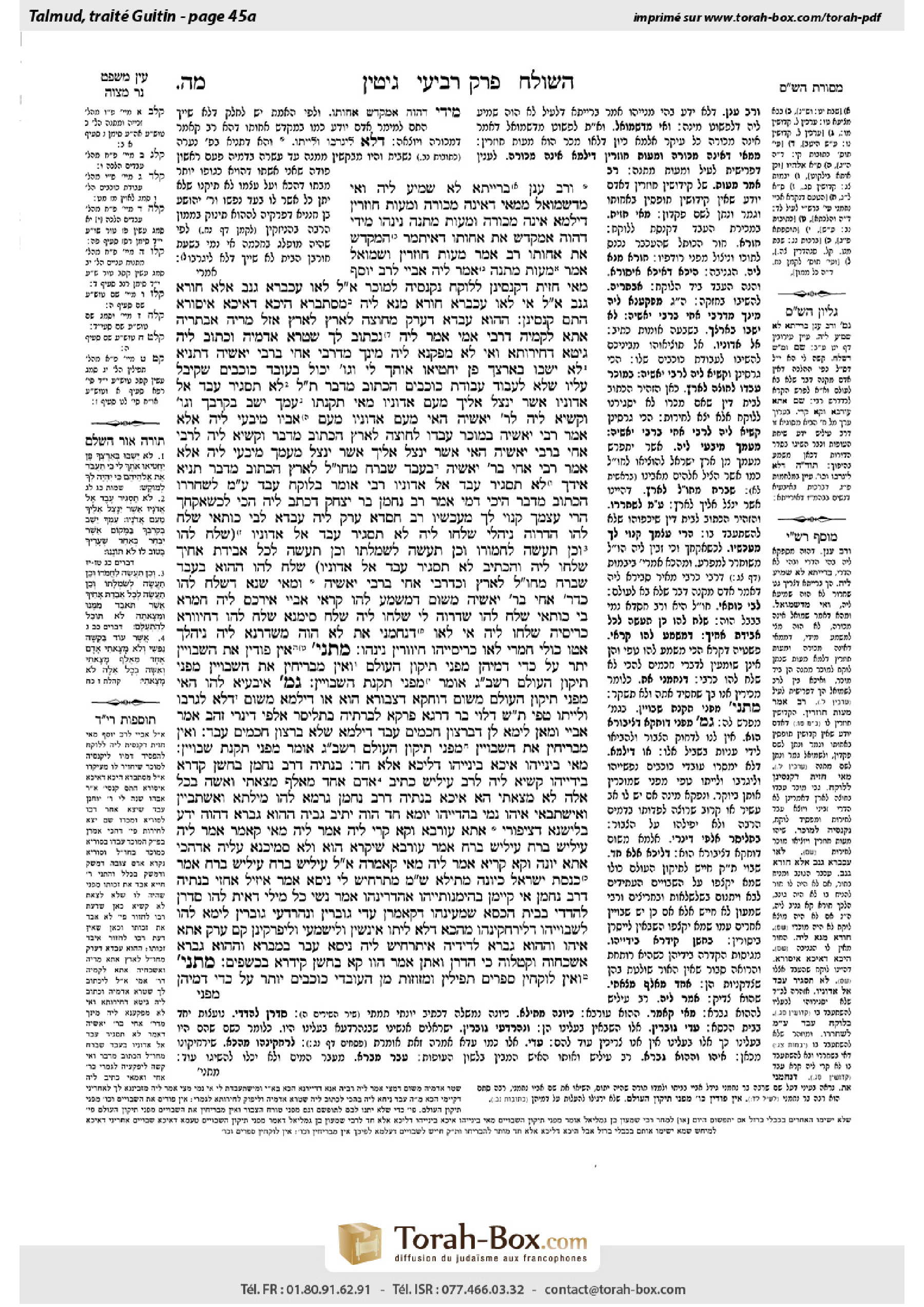
Gittin 45a: Talmud study for Daf Yomi
Study the Talmud for Daf Yomi with scanned pages, Hebrew text, English translations from Sefaria and AI-generated French translations.
Passage selection and English or AI-generated French translation are available where the scan has annotations. Daf Study is independent of Torah-Box and Sefaria.
Browse Gittin · גיטין · All tractatesGittin 45a text and translations
This page of Gittin includes the Aramaic text, an English translation and an AI-generated French translation, alongside the scan above.
גיטין מ״ה א · Aramaic and Hebrew text
וְרַב עָנָן – בָּרַיְיתָא לָא שְׁמִיעַ לֵיהּ;
וְאִי מִדִּשְׁמוּאֵל – מִמַּאי דְּאֵינָהּ מְכוּרָה וּמָעוֹת חוֹזְרִין, דִּילְמָא אֵינָהּ מְכוּרָה וּמָעוֹת מַתָּנָה נִינְהוּ – מִידֵּי דְּהָוֵה אַמְּקַדֵּשׁ אֶת אֲחוֹתוֹ, דְּאִיתְּמַר: הַמְקַדֵּשׁ אֶת אֲחוֹתוֹ, רַב אָמַר: מָעוֹת – חוֹזְרִין, וּשְׁמוּאֵל אָמַר: מָעוֹת מַתָּנָה.
אֲמַר לֵיהּ אַבָּיֵי לְרַב יוֹסֵף: מַאי חָזֵית דְּקָנְסִינַן לְלוֹקֵחַ? נִקְנְסֵיהּ לְמוֹכֵר! אֲמַר לֵיהּ: לָאו עַכְבְּרָא גַּנָּב אֶלָּא חוֹרָא גַּנָּב. אֲמַר לֵיהּ: אִי לָאו עַכְבְּרָא, חוֹרָא מְנָא לֵיהּ?
מִסְתַּבְּרָא, הֵיכָא דְּאִיכָּא אִיסּוּרָא הָתָם קָנְסִינַן.
הָהוּא עַבְדָּא דַּעֲרַק מֵחוּצָה לָאָרֶץ לָאָרֶץ. אֲזַל מָרֵיהּ אַבָּתְרֵיהּ, אֲתָא לְקַמֵּיהּ דְּרַבִּי אַמֵּי, אֲמַר לֵיהּ: נִכְתּוֹב לָךְ שְׁטָרָא אַדְּמֵיהּ, וּכְתוֹב לֵיהּ גִּיטָּא דְחֵירוּתָא. וְאִי לָא, מַפְקַעְנָא לֵיהּ מִינָּךְ מִדְּרַבִּי אַחַי בְּרַבִּי יֹאשִׁיָּה.
דְּתַנְיָא: ״לֹא יֵשְׁבוּ בְּאַרְצְךָ פֶּן יַחֲטִיאוּ אוֹתְךָ לִי״ – יָכוֹל בְּגוֹי שֶׁקִּיבֵּל עָלָיו שֶׁלֹּא לַעֲבוֹד עֲבוֹדָה זָרָה הַכָּתוּב מְדַבֵּר, תַּלְמוּד לוֹמַר: ״לֹא תַסְגִּיר עֶבֶד אֶל אֲדוֹנָיו אֲשֶׁר יִנָּצֵל אֵלֶיךָ מֵעִם אֲדוֹנָיו״, מַאי תַּקָּנָתוֹ? ״עִמְּךָ יֵשֵׁב בְּקִרְבְּךָ וְגוֹ׳״.
וְקַשְׁיָא לֵיהּ לְרַבִּי יֹאשִׁיָּה: הַאי ״מֵעִם אֲדוֹנָיו״?! ״מֵעִם אָבִיו״ מִיבְּעֵי לֵיהּ! אֶלָּא אָמַר רַבִּי יֹאשִׁיָּה: בְּמוֹכֵר עַבְדּוֹ לְחוּצָה לָאָרֶץ הַכָּתוּב מְדַבֵּר.
וְקַשְׁיָא לֵיהּ לְרַבִּי אַחַי בְּרַבִּי יֹאשִׁיָּה: הַאי ״אֲשֶׁר יִנָּצֵל אֵלֶיךָ״?! ״אֲשֶׁר יִנָּצֵל מֵעִמְּךָ״ מִיבְּעֵי לֵיהּ! אֶלָּא אָמַר רַבִּי אַחַי בְּרַבִּי יֹאשִׁיָּה: בְּעֶבֶד שֶׁבָּרַח מֵחוּצָה לָאָרֶץ לָאָרֶץ הַכָּתוּב מְדַבֵּר.
תַּנְיָא אִידַּךְ: ״לֹא תַסְגִּיר עֶבֶד אֶל אֲדוֹנָיו״ – רַבִּי אוֹמֵר: בְּלוֹקֵחַ עֶבֶד עַל מְנָת לְשַׁחְרְרוֹ הַכָּתוּב מְדַבֵּר. הֵיכִי דָּמֵי? אָמַר רַב נַחְמָן בַּר יִצְחָק: דִּכְתַב לֵיהּ הָכִי: ״לִכְשֶׁאֶקָּחֲךָ, הֲרֵי עַצְמְךָ קָנוּי לְךָ מֵעַכְשָׁיו״.
רַב חִסְדָּא עֲרַק לֵיהּ עַבְדָּא לְבֵי כוּתָאֵי, שְׁלַח לְהוּ: [אַ]הְדְּרוּהּ נִיהֲלִי. שְׁלַחוּ לֵיהּ: ״לֹא תַסְגִּיר עֶבֶד אֶל אֲדוֹנָיו״. שְׁלַח לְהוּ: וְכֵן תַּעֲשֶׂה לַחֲמוֹרוֹ וְכֵן תַּעֲשֶׂה לְשִׂמְלָתוֹ וְכֵן תַּעֲשֶׂה לְכׇל אֲבֵידַת אָחִיךָ״. שְׁלַחוּ לֵיהּ: וְהָכְתִיב: ״לֹא תַסְגִּיר עֶבֶד אֶל אֲדוֹנָיו״, שְׁלַח לְהוּ: הַהוּא, בְּעֶבֶד שֶׁבָּרַח מֵחוּצָה לָאָרֶץ לָאָרֶץ, וְכִדְרַבִּי אַחַי בְּרַבִּי יֹאשִׁיָּה.
וּמַאי שְׁנָא דִּשְׁלַח לְהוּ כִּדְרַבִּי אַחַי בְּרַבִּי יֹאשִׁיָּה? מִשּׁוּם דְּמַשְׁמַע לְהוּ קְרָאֵי.
אַבָּיֵי אִירְכַס לֵיהּ חֲמָרָא בֵּי כוּתָאֵי, שְׁלַח לְהוּ: שַׁדְּרוּהּ לִי. שְׁלַחוּ לֵיהּ: שְׁלַח סִימָנָא. שְׁלַח לְהוּ: דְּחִיוּוֹרָא כְּרֵיסֵיהּ. שְׁלַחוּ לֵיהּ: אִי לָאו דְּנַחְמָנִי אַתְּ, לָא הֲוָה מְשַׁדַּרְנָא לֵיהּ נִיהֲלָךְ; אַטּוּ כּוּלֵּי חֲמָרֵי לָאו כְּרֵיסַיְיהוּ חִיוָּורֵי נִינְהוּ?!
מַתְנִי׳ אֵין פּוֹדִין אֶת הַשְּׁבוּיִין יָתֵר עַל כְּדֵי דְּמֵיהֶן, מִפְּנֵי תִּיקּוּן הָעוֹלָם. וְאֵין מַבְרִיחִין אֶת הַשְּׁבוּיִין, מִפְּנֵי תִּיקּוּן הָעוֹלָם. רַבָּן שִׁמְעוֹן בֶּן גַּמְלִיאֵל אוֹמֵר: מִפְּנֵי תַּקָּנַת הַשְּׁבוּיִין.
גְּמָ׳ אִיבַּעְיָא לְהוּ: הַאי ״מִפְּנֵי תִּיקּוּן הָעוֹלָם״ – מִשּׁוּם דּוּחְקָא דְצִבּוּרָא הוּא, אוֹ דִילְמָא מִשּׁוּם דְּלָא לִגְרְבוּ וְלַיְיתוֹ טְפֵי?
תָּא שְׁמַע: דְּלֵוִי בַּר דַּרְגָּא פַּרְקַהּ לִבְרַתֵּיהּ בִּתְלֵיסַר אַלְפֵי דִּינְרֵי זָהָב.
אָמַר אַבָּיֵי: וּמַאן לֵימָא לַן דְּבִרְצוֹן חֲכָמִים עֲבַד? דִּילְמָא שֶׁלֹּא בִּרְצוֹן חֲכָמִים עֲבַד.
וְאֵין מַבְרִיחִין אֶת הַשְּׁבוּיִין מִפְּנֵי תִּיקּוּן הָעוֹלָם. רַבָּן שִׁמְעוֹן בֶּן גַּמְלִיאֵל אוֹמֵר: מִפְּנֵי תַּקָּנַת שְׁבוּיִין: מַאי בֵּינַיְיהוּ? אִיכָּא בֵּינַיְיהוּ, דְּלֵיכָּא אֶלָּא חַד.
בְּנָתֵיהּ דְּרַב נַחְמָן בָּחֲשָׁן קִדְרָא בִּידַיְיהוּ. קַשְׁיָא לֵיהּ לְרַב עִילִישׁ, כְּתִיב: ״אָדָם אֶחָד מֵאֶלֶף מָצָאתִי וְאִשָּׁה בְכׇל אֵלֶּה לֹא מָצָאתִי״, הָא אִיכָּא בְּנָתֵיהּ דְּרַב נַחְמָן! גְּרַמָא לְהוּ מִילְּתָא וְאִשְׁתַּבְיָין, וְאִישְׁתְּבִאי אִיהוּ נָמֵי בַּהֲדַיְיהוּ.
יוֹמָא חַד הֲוָה יָתֵיב גַּבֵּיהּ הָהוּא גַּבְרָא, דַּהֲוָה יָדַע בְּלִישָּׁנָא דְצִיפּוֹרֵי. אֲתָא עוֹרְבָא וְקָא קָרֵי לֵיהּ. אֲמַר לֵיהּ: מַאי קָאָמַר? אֲמַר לֵיהּ: ״עִילִישׁ בְּרַח, עִילִישׁ בְּרַח״. אָמַר: עוֹרְבָא שַׁקָּרָא הוּא וְלָא סָמֵיכְנָא עֲלֵיהּ.
אַדְּהָכִי אֲתָא יוֹנָה וְקָא קָרְיָא. אֲמַר לֵיהּ: מַאי קָאָמְרָה? אֲמַר לֵיהּ: ״עִילִישׁ בְּרַח, עִילִישׁ בְּרַח״. אָמַר: כְּנֶסֶת יִשְׂרָאֵל כְּיוֹנָה מְתִילָא, שְׁמַע מִינַּהּ מִתְרְחִישׁ לִי נִיסָּא. אָמַר: אֵיזִיל אֶחְזֵי בְּנָתֵיהּ דְּרַב נַחְמָן, אִי קָיְימָן בְּהֵימָנוּתַיְיהוּ – אַהְדְּרִינְהוּ.
אֲמַר: נְשֵׁי, כׇּל מִילֵּי דְּאִית לְהוּ סָדְרָן לַהֲדָדֵי בְּבֵית הַכִּסֵּא. שַׁמְעִינְהוּ דְּקָאָמְרָן: עָדֵי גּוּבְרִין וּנְהַרְדָּעֵי גּוּבְרִין, לֵימָא לְהוּ לְשָׁבוֹיַיְהוּ דְּלִירַחֲקִינְהוּ מֵהָכָא, דְּלָא לֵיתוֹ אִינָשִׁין וְלִישְׁמְעִי וְלִיפְרְקִינַן.
קָם, עֲרַק, אֲתָא אִיהוּ וְהָהוּא גַּבְרָא. לְדִידֵיהּ אִיתְרְחִישׁ לֵיהּ נִיסָּא עֲבַר בְּמַבָּרָא, וְהָהוּא גַּבְרָא אַשְׁכְּחוּהּ וְקַטְלוּהּ. כִּי הָדְרָן וְאָתָן, אֲמַר: הֲווֹ קָא בָחֲשָׁן קִידְרָא בִּכְשָׁפִים.
מַתְנִי׳ וְאֵין לוֹקְחִין סְפָרִים, תְּפִילִּין וּמְזוּזוֹת מִן הַגּוֹיִם יוֹתֵר עַל כְּדֵי דְמֵיהֶן,
Gittin 45a · English translation
The Gemara says: And as for Rav Anan, who could not determine in which case the money of the sale is returned, the baraita was not known to him, so he was not able to use it in order to resolve his dilemma.
And if Rav Anan would attempt to resolve his dilemma from the statement of Shmuel, who said that the sale does not take effect at all, this should mean that the money used in the sale is returned, and it is possible to say: From where can you assume that it is not sold, and therefore the money is returned? Perhaps it is not sold and the money is considered to be a gift, just as it is according to the opinion of Shmuel in the case of one who betroths his sister. As it was stated with regard to one who betroths his sister, Rav said: The money he gave for the betrothal is returned, since the betrothal does not take effect; and Shmuel said: This money is a gift, meaning that he wished to give a gift to his sister and he did so in this manner. Therefore, Rav Anan remained uncertain as to when Shmuel required the money to be returned.
With regard to the halakha that if one sells his slave to a Jew outside of Eretz Yisrael it is the purchaser who loses his money, Abaye said to Rav Yosef: What did you see to cause you to say that we apply the penalty to the purchaser, in that he is required to emancipate the slave and loses his money; we should apply the penalty to the seller, and he should be required to return the money. Rav Yosef answered Abaye with a parable and said to him: It is not the mouse that steals, but the hole that steals. In other words, a mouse cannot steal anything unless he has a hole for hiding the stolen items. Here too, the slave would not have been sold without the help of the purchaser. The Gemara questions this logic: But if not for the mouse, from where would the hole have the stolen item; since they both contribute to the prohibited act, each of them is deserving of being penalized.
Rav Yosef responded to him: It stands to reason that anywhere that the forbidden item, i.e., the slave, is, in this case, with the purchaser, there we should penalize.
§ The Gemara relates: There was a certain slave who fled from his master from outside of Eretz Yisrael to Eretz Yisrael. His master followed him to Eretz Yisrael and came before Rabbi Ami. Rabbi Ami said to the master: We will write a promissory note for his value for you, and you should write a bill of manumission for him. And if you do not do this, I will remove him from you entirely, since he does not have to return to outside of Eretz Yisrael, based on the statement of Rabbi Aḥai, son of Rabbi Yoshiya.
As it is taught in a baraita: The verse states with regard to the residents of the Land of Canaan: “They shall not dwell in your land lest they make you to sin against Me, for you will serve their gods; for they will be a snare to you” (Exodus 23:33). One might have thought that the verse is also speaking of a gentile who accepted upon himself not to engage in idol worship, and is teaching that such a gentile may not dwell in Eretz Yisrael as well; therefore the verse states: “You shall not deliver to his master a slave who escaped to you from his master” (Deuteronomy 23:16). The baraita understands that the verse is speaking in metaphoric terms about a gentile who has come to Eretz Yisrael, escaping his idolatrous past. The baraita continues: What is this gentile’s remedy? “He shall dwell with you in your midst” (Deuteronomy 23:17). This teaches that as long as he accepts upon himself not to engage in idol worship, he may remain in Eretz Yisrael.
And the explanation of the verse in the baraita is difficult for Rabbi Yoshiya: This expression employed in the verse: “From his master,” is imprecise if it is speaking about a gentile who abandons idol worship, as it should have stated: From his father, as a father is a more apt metaphor for the religion in which one was raised. Rather, Rabbi Yoshiya explains differently and says: The verse is speaking of one who sells his slave to a Jew who lives outside of Eretz Yisrael, and the continuation of the verse: “He shall dwell with you,” means that he does not go to his new master outside of Eretz Yisrael, but is emancipated and remains in Eretz Yisrael.
And the explanation of Rabbi Yoshiya is difficult for Rabbi Aḥai, son of Rabbi Yoshiya: If it is referring to a slave who is sold to one outside of Eretz Yisrael, then this expression: “Who escaped to you,” is not accurate, as he is leaving from Eretz Yisrael, not escaping to Eretz Yisrael. According to Rabbi Yoshiya’s explanation, it should have stated: Who escaped from you. Rather, Rabbi Aḥai, son of Rabbi Yoshiya, said: The verse is speaking of a slave who escaped from outside of Eretz Yisrael to Eretz Yisrael, which indicates that in such a case he may dwell there and is not returned to his master. Based on this statement of Rabbi Aḥai, son of Rabbi Yoshiya, Rabbi Ami told the master that the slave will in any case be emancipated.
It is taught in another baraita: The verse states: “You shall not deliver to his master a slave” (Deuteronomy 23:16); Rabbi Yehuda HaNasi says: The verse is speaking of one who acquires a slave in order to emancipate him. The court may not deliver him to this master, because he is not his slave and he may not treat him as such. The Gemara asks: What are the circumstances of this case? Rav Naḥman bar Yitzḥak said: For example, when he wrote to the slave like this: When I will purchase you, you are hereby acquired to yourself from now. The new master does not take possession of the slave, as he is emancipated immediately upon being purchased.
The Gemara relates that Rav Ḥisda’s slave escaped to Bei Kutai, a place where Samaritans lived. He sent a request to the residents of that place: Return him to me. They sent a response to him: The verse states: “You shall not deliver to his master a slave,” so we will not return this slave to you. He sent a response to them: The verse also states with regard to lost items: “And you shall restore it to him…and so you shall do for his donkey and so you shall do for his garment and so you shall do for anything your brother has lost” (Deuteronomy 22:2–3). They sent a response to him again: But isn’t it written: “You shall not deliver to his master a slave”? Rav Ḥisda sent a response to them: That verse is referring to a slave who escaped from outside of Eretz Yisrael to Eretz Yisrael, and in accordance with the explanation of Rabbi Aḥai, son of Rabbi Yoshiya, and my slave escaped from one location outside of Eretz Yisrael to another location outside of Eretz Yisrael.
The Gemara asks: And what is different about this case that led him to send a response to them specifically in accordance with the explanation of Rabbi Aḥai, son of Rabbi Yoshiya, and not in accordance with any other interpretation of the verse? The Gemara answers: Because that is how the Samaritans would understand the verse. Samaritans did not generally accept the explanations of the Sages, and this explanation accords with the straightforward reading of the verse, while the other explanations do not.
The Gemara relates that Abaye lost a donkey among the Samaritans in Bei Kutai. He sent a request to them: Send it to me. They sent a response to him: Send a distinguishing mark and we will return it to you. He sent the following distinguishing mark to them: That its belly is white. They sent a response to him: If not for the fact that you are Naḥmani, meaning that we know that you are a trustworthy man, we would not send it to you. Is that to say that bellies of all donkeys aren’t white? Therefore, it is not a true distinguishing mark.
MISHNA: The captives are not redeemed for more than their actual monetary value, for the betterment of the world; and one may not aid the captives in their attempt to escape from their captors for the betterment of the world, so that kidnappers will not be more restrictive with their captives to prevent them from escaping. Rabban Shimon ben Gamliel says: For the betterment of the captives, so that kidnappers will not avenge the escape of the captives by treating other captives with cruelty.
GEMARA: A dilemma was raised before the Sages: With regard to this expression: For the betterment of the world, is it due to the financial pressure of the community? Is the concern that the increase in price will lead to the community assuming financial pressures it will not be able to manage? Or perhaps it is because the result of this will be that they will not seize and bring additional captives, as they will see that it is not worthwhile for them to take Jews captive?
The Gemara suggests: Come and hear an answer based on the fact that Levi bar Darga redeemed his daughter who was taken captive with thirteen thousand gold dinars. This indicates that private citizens may pay excessive sums to redeem a captive if they so choose. Therefore, it must be that the reason for the ordinance was to avoid an excessive burden being placed upon the community. If the ordinance was instituted to remove the incentive for kidnappers to capture Jews, a private citizen would also not be permitted to pay an excessive sum.
Abaye said: And who told us that he acted in accordance with the wishes of the Sages? Perhaps he acted against the wishes of the Sages, and this anecdote cannot serve as a proof.
The mishna taught: And one may not aid the captives in their attempt to escape from their captors, for the betterment of the world. Rabban Shimon ben Gamliel says: For the betterment of the captives. The Gemara asks: What is the difference between the two reasons given? The Gemara answers: There is a difference between them when there is only one captive. If this ordinance was instituted for the benefit of the other captives, so that the kidnappers should not avenge a captive’s escape by treating the others with cruelty, then if there is only one captive to begin with, one may help him to escape. If it was instituted so that kidnappers in general will not act restrictively with their captives, it would be prohibited in this case as well.
§ The Gemara relates that Rav Naḥman’s daughters would stir a boiling pot with their bare hands, and people thought that the heat did not harm them due to their righteousness. Rav Ilish had a difficulty with a verse, as it is written: “A man one of a thousand I have found, and a woman among all those have I not found” (Ecclesiastes 7:28). Aren’t there Rav Naḥman’s daughters, who were exceptionally righteous? These words caused them to be taken captive, due to the evil eye, and Rav Ilish was also taken captive with them.
One day a certain man was sitting with him in captivity who knew the language of birds. A raven came and called to Rav Ilish. Rav Ilish said to the man: What is the raven saying? He said to him that it is saying: Ilish, escape; Ilish, escape. Rav Ilish said: It is a lying raven, and I do not rely on it.
In the meantime, a dove came and was calling out. Rav Ilish said to the man: What is it saying? He said to him that the dove said: Ilish, escape; Ilish, escape. Ilish said: The Congregation of Israel is compared to a dove; I conclude from the dove’s words that a miracle will happen for me, and I can attempt to escape. Rav Ilish said: Before I leave, I will go and I will see Rav Naḥman’s daughters. If they remained steadfast in their faith and are acting appropriately, then I will take them with me and I will return them to their home.
He said: Women tell all of their secret matters to each other in the bathroom, so he went there to eavesdrop on them. He heard them saying: These captors are now our husbands, and the men of Neharde’a to whom we are married are our husbands. We should tell our captors to distance us from here so that our husbands should not come to this area and hear that we are here, and redeem us, and take us home. They preferred to remain with their captors.
Upon hearing this Rav Ilish arose and escaped. He and that man who knew the language of the birds came to a river crossing. A miracle happened for him and he crossed the river on a ferry, and the captors found that man and killed him. When Rav Naḥman’s daughters were returned and they came back from their captivity, Rav Ilish said: They would stir the pot with witchcraft, and that is why they were not burned by the boiling pot, but it was not due to their righteousness.
MISHNA: And Torah scrolls, phylacteries, or mezuzot are not purchased from the gentiles when they acquire these objects, if they request more than their actual monetary value,
Gittin 45a · Traduction française (IA)
La Guemara dit : Et quant à Rav Anan, qui ne pouvait pas déterminer dans quel cas l'argent de la vente est rendu, la baraïta ne lui était pas connue, donc il ne pouvait pas l'utiliser pour résoudre son dilemme.
Et si Rav Anan tentait de résoudre son dilemme à partir de la déclaration de Shmuel, qui disait que la vente ne prend effet du tout, cela signifierait que l'argent utilisé dans la vente est rendu, et il est possible de dire : D'où peut-on supposer qu'il n'est pas vendu, et donc l'argent est rendu ? Peut-être qu'il n'est pas vendu et l'argent est considéré comme un don, tout comme c'est selon l'opinion de Shmuel dans le cas d'un homme qui fiance sa sœur. Comme il a été dit concernant l'homme qui fiance sa sœur, Rav a dit : L'argent qu'il a donné pour la fiancée est rendu, puisque la fiancée ne prend pas effet ; et Shmuel a dit : Cet argent est un don, c'est-à-dire qu'il voulait offrir un don à sa sœur et il l'a fait ainsi. Ainsi, Rav Anan restait incertain quant à l'époque où Shmuel exigeait que l'argent soit rendu.
Concernant la halakha qui stipule que si l'on vend son esclave à un Juif en dehors de la Terre d'Israël, c'est l'acheteur qui perd son argent, Abaye a dit à Rav Yosef : Qu'est-ce que tu as vu pour te faire dire que nous appliquons la sanction à l'acheteur, puisqu'il est tenu d'émanciper l'esclave et perd son argent ; nous devrions appliquer la sanction à la vendeur, et il devrait être tenu de rendre l'argent. Rav Yosef a répondu à Abaye avec une comparaison et a dit : Ce n'est pas la souris qui vole, mais le trou qui vole. En d'autres termes, une souris ne peut voler quelque chose sans avoir un trou pour cacher les objets volés. Ici aussi, l'esclave n'aurait pas été vendu sans l'aide de l'acheteur. La Guemara questionne cette logique : Mais si non pour la souris, d'où viendrait le trou avoir l'objet volé ; puisque tous deux contribuent à l'acte interdit, chacun est digne d'être sanctionné.
Rav Yosef a répondu à lui : Il est logique que partout où l'objet interdit, c'est-à-dire l'esclave, se trouve, dans ce cas, avec l'acheteur, là nous devons sanctionner.
§ La Guemara relate : Il y avait un esclave qui s'était enfui de son maître en dehors de la Terre d'Israël pour la Terre d'Israël. Son maître l'a suivi en Terre d'Israël et s'est présenté devant Rabbi Ami. Rabbi Ami a dit au maître : Nous écrirons un titre de créance pour sa valeur pour vous, et vous devriez écrire un acte d'émancipation pour lui. Et si vous ne le faites pas, je vous enlèverai entièrement, puisqu'il ne doit pas retourner en dehors de la Terre d'Israël, selon la déclaration de Rabbi Aḥai, fils de Rabbi Yoshiya.
Comme il est enseigné dans une baraïta : La parole stipule concernant les habitants de la Terre de Canaan : « Ils ne doivent pas habiter dans votre terre de peur qu'ils vous fassent pécher contre Moi, car vous servirez leurs dieux ; car ils seront une pièce de bois pour vous » (Exode 23:33). On aurait pu penser que la parole est aussi parlée d'un non-Juif qui s'est engagé à ne pas pratiquer l'idolâtrie, et qui enseigne que ce non-Juif ne doit pas habiter en Terre d'Israël non plus ; donc la parole stipule : « Vous ne donnerez pas à son maître un esclave qui s'est enfui à vous de son maître » (Deutéronome 23:16). La baraïta comprend que la parole est parlée de manière métaphorique concernant un non-Juif qui est venu en Terre d'Israël, s'échappant de son passé idolâtre. La baraïta continue : Quel est le remède de ce non-Juif ? « Il habitera avec vous en votre milieu » (Deutéronome 23:17). Cela enseigne que tant qu'il s'engage à ne pas pratiquer l'idolâtrie, il peut rester en Terre d'Israël.
Et l'explication de la parole dans la baraïta est difficile pour Rabbi Yoshiya : Cette expression employée dans la parole : « De son maître », est imprecise si elle parle d'un non-Juif qui abdique de l'idolâtrie, car elle devrait avoir dit : De son père, car le père est une métaphore plus appropriée pour la religion dans laquelle on a été élevé. Plutôt, Rabbi Yoshiya explique différemment et dit : La parole parle d'un homme qui vend son esclave à un Juif qui vit en dehors de la Terre d'Israël, et la continuation de la parole : « Il habitera avec vous », signifie qu'il ne retourne pas à son nouveau maître en dehors de la Terre d'Israël, mais est émancipé et reste en Terre d'Israël.
Et l'explication de Rabbi Yoshiya est difficile pour Rabbi Aḥai, fils de Rabbi Yoshiya : Si elle parle d'un esclave vendu à un Juif en dehors de la Terre d'Israël, alors cette expression : « Qui s'est enfui à vous », n'est pas précise, car il quitte la Terre d'Israël, pas s'échappe en Terre d'Israël. Selon l'explication de Rabbi Yoshiya, il devrait avoir dit : Qui s'est enfui de vous. Plutôt, Rabbi Aḥai, fils de Rabbi Yoshiya, a dit : La parole parle d'un esclave qui s'est enfui en dehors de la Terre d'Israël pour la Terre d'Israël, ce qui indique que dans ce cas il peut habiter là et n'est pas renvoyé à son maître. Selon cette déclaration de Rabbi Aḥai, fils de Rabbi Yoshiya, Rabbi Ami a dit au maître que l'esclave sera en tout cas émancipé.
Il est enseigné dans une autre baraïta : La parole stipule : « Vous ne donnerez pas à son maître un esclave » (Deutéronome 23:16) ; Rabbi Yehuda HaNasi dit : La parole parle d’un homme qui acquiert un esclave afin de l’émanciper. Le tribunal ne doit pas lui rendre cet esclave à ce maître, car il n’est pas son esclave et il ne peut pas le traiter ainsi. La Guemara demande : Quelles sont les circonstances de ce cas ? Rav Naḥman bar Yitzḥak a dit : Par exemple, lorsqu’il a écrit à l’esclave comme suit : Lorsque je vais t’acheter, tu es désormais acquis à toi-même à partir de maintenant. Le nouveau maître ne prend pas possession de l’esclave, car il est émancipé immédiatement lors de l’achat.
La Guemara rapporte que le serviteur de Rav Ḥisda s'était enfui vers Bei Kutai, un lieu où vivaient des Samaritains. Il envoya une demande aux habitants de ce lieu : Rendez-moi mon serviteur. Ils répondirent à son message : La Parashah dit : « Tu ne livreras point à son maître un serviteur », donc nous ne rendrons pas ce serviteur à toi. Il répondit à leur message : La Parashah dit aussi concernant les objets perdus : « Et tu rendras à lui, et ainsi tu feras pour son âne, et ainsi tu feras pour sa robe, et ainsi tu feras pour tout ce que ton frère a perdu » (Deutéronome 22 : 2-3). Ils répondirent à son message à nouveau : Mais n'est-il pas écrit : « Tu ne livreras point à son maître un serviteur » ? Rav Ḥisda répondit à leur message : Cette Parashah fait référence à un serviteur qui s'est enfui de l'extérieur de la Terre d'Israël vers la Terre d'Israël, et selon l'explication du Rabbi Aḥai, fils du Rabbi Yoshiya, et mon serviteur s'est enfui d'un lieu de l'extérieur de la Terre d'Israël vers un autre lieu de l'extérieur de la Terre d'Israël.
La Guemara pose la question : Et qu'est-ce qui diffère dans ce cas qui a conduit à ce que Rav Ḥisda ait répondu spécifiquement selon l'explication du Rabbi Aḥai, fils du Rabbi Yoshiya, et non selon toute autre interprétation de la Parashah ? La Guemara répond : Parce que c'est ainsi que les Samaritains comprendraient la Parashah. Les Samaritains ne rejetaient généralement pas les explications des Sages, et cette explication correspond à la lecture littérale de la Parashah, tandis que les autres explications ne le font pas.
La Guemara rapporte que Abaye avait perdu un âne parmi les Samaritains à Bei Kutai. Il envoya une demande à eux : Envoie-le-moi. Ils répondirent à son message : Envoie-nous un signe distinctif et nous te le rendrons. Il envoya le suivant comme signe distinctif à eux : Que son ventre est blanc. Ils répondirent à son message : Si ce n'était pas pour le fait que tu es Naḥmani, c'est-à-dire que nous savons que tu es un homme de bonne foi, nous ne t'envoyerions pas l'âne. Est-ce que cela signifie que les ventres de tous les ânes ne sont pas blancs ? Donc, ce n'est pas un signe distinctif véritable.
MICHNA : Les captifs ne sont pas rachetés pour plus que leur valeur monétaire réelle, pour le bien du monde ; et on ne doit pas aider les captifs dans leur tentative d'évasion de leurs ravisseurs pour le bien du monde, afin que les ravisseurs ne soient pas plus restrictifs avec leurs captifs pour les empêcher d'échapper. Rabban Shimon ben Gamliel dit : Pour le bien des captifs, afin que les ravisseurs ne vengent pas l'évasion d'un captif en traitant les autres captifs avec cruauté.
GUEMARA : Un dilemme a été soulevé devant les Sages : Concernant cette expression : Pour le bien du monde, est-ce en raison de la pression financière de la communauté ? Est-ce la crainte que l'augmentation des prix entraîne la communauté à assumer une pression financière qu'elle ne pourra pas gérer ? Ou peut-être est-ce parce que le résultat sera que les ravisseurs ne prendront pas de nouveaux captifs, car ils verront que cela n'est pas rentable ?
La Guemara suggère : Viens entendre une réponse basée sur le fait que Levi bar Darga a racheté sa fille, qui avait été capturée, avec treize mille dinars d'or. Cela indique que les citoyens privés peuvent payer des sommes excessives pour racheter un captif s'ils le souhaitent. Donc, il doit être que la raison de l'ordonnance est d'éviter de mettre une charge excessive sur la communauté. Si l'ordonnance avait été instituée pour éliminer l'incentif aux ravisseurs de capturer des Juifs, un citoyen privé ne serait pas non plus autorisé à payer une somme excessive.
Abaye dit : Et qui nous a dit qu'il agissait selon les souhaits des Sages ? Peut-être qu'il agissait contre les souhaits des Sages, et cet anecdote ne peut pas servir de preuve.
La Michna enseigne : Et on ne doit pas aider les captifs dans leur tentative d'évasion de leurs ravisseurs, pour le bien du monde. Rabban Shimon ben Gamliel dit : Pour le bien des captifs. La Guemara pose la question : Quelle est la différence entre les deux raisons données ? La Guemara répond : Il y a une différence entre eux lorsqu'il n'y a qu'un seul captif. Si cette ordonnance a été instituée pour le bénéfice des autres captifs, afin que les ravisseurs ne vengent pas l'évasion d'un captif en traitant les autres avec cruauté, alors si il n'y a qu'un seul captif à commencer, on peut aider à son évasion. Si elle a été instituée afin que les ravisseurs en général ne soient pas restrictifs avec leurs captifs, il serait interdit dans ce cas également.
§ La Guemara rapporte que les filles de Rav Naḥman faisaient bouillir une marmite avec leurs mains nues, et les gens pensaient que la chaleur ne les faisait pas souffrir en raison de leur piété. Rav Ilish avait une difficulté avec un verset, car il est écrit : « Un homme d'un millier j'ai trouvé, et une femme parmi tous ceux-ci je n'ai pas trouvé » (Ecclésiaste 7 : 28). Ne sont-ce pas les filles de Rav Naḥman, qui étaient exceptionnellement pieuses ? Ces mots les firent capturer, à cause du regard mauvais, et Rav Ilish fut également capturé avec elles.
Un jour, un certain homme était assis avec lui en captivité, qui connaissait la langue des oiseaux. Un corbeau vint et appela Rav Ilish. Rav Ilish dit à l'homme : Qu'est-ce que le corbeau dit ? Il dit à lui que c'est qui dit : Ilish, échappe ; Ilish, échappe. Rav Ilish dit : C'est un corbeau menteur, et je ne fais pas confiance à cela.
En même temps, un pigeon vint et appelait. Rav Ilish dit à l'homme : Qu'est-ce qu'il dit ? Il dit à lui que le pigeon dit : Ilish, échappe ; Ilish, échappe. Ilish dit : La Congrégation d'Israël est comparée à un pigeon ; j'en conclus des paroles du pigeon qu'un miracle se produira pour moi, et je peux tenter d'échapper. Rav Ilish dit : Avant de partir, je vais aller et je vais voir les filles de Rav Naḥman. Si elles restent fermes dans leur foi et agissent correctement, alors je les prendrai avec moi et je les ramènerai chez elles.
Il dit : Les femmes racontent toutes leurs affaires secrètes les unes aux autres dans la salle de bain, donc il est allé là pour espionner. Il entendit qu'elles disaient : Ces captifs sont maintenant nos époux, et les hommes de Neharde’a auxquels nous sommes mariées sont nos époux. Nous devrions demander à nos captifs de nous éloigner d'ici afin que nos époux ne viennent pas dans cette région et n'entendent pas que nous sommes ici, et nous rachètent, et nous ramènent chez nous. Elles préféraient rester avec leurs captifs.
En entendant cela, Rav Ilish se leva et s'échappa. Il et cet homme qui connaissait la langue des oiseaux arrivèrent à un passage de rivière. Un miracle advint pour lui et il traversa la rivière sur un bateau, et les captifs trouvèrent cet homme et le tuèrent. Quand les filles de Rav Naḥman furent rendues et qu'elles revinrent de leur captivité, Rav Ilish dit : Elles auraient fait bouillir le pot avec la sorcellerie, et c'est pourquoi elles n'ont pas été brûlées par le pot bouillant, mais ce n'était pas à cause de leur piété.
MICHNA : Et les scrolls de la Torah, les phylactères ou les mezuzot ne sont pas achetés des non-Juifs lorsqu'ils acquièrent ces objets, si ils demandent plus que leur valeur réelle,
Traduction française générée par IA à partir de l’édition anglaise de Sefaria. Vérifie toujours un passage avec le texte source.
Text from Sefaria: William Davidson Edition - Vocalized Aramaic (CC BY NC); William Davidson Edition - English (CC BY NC).