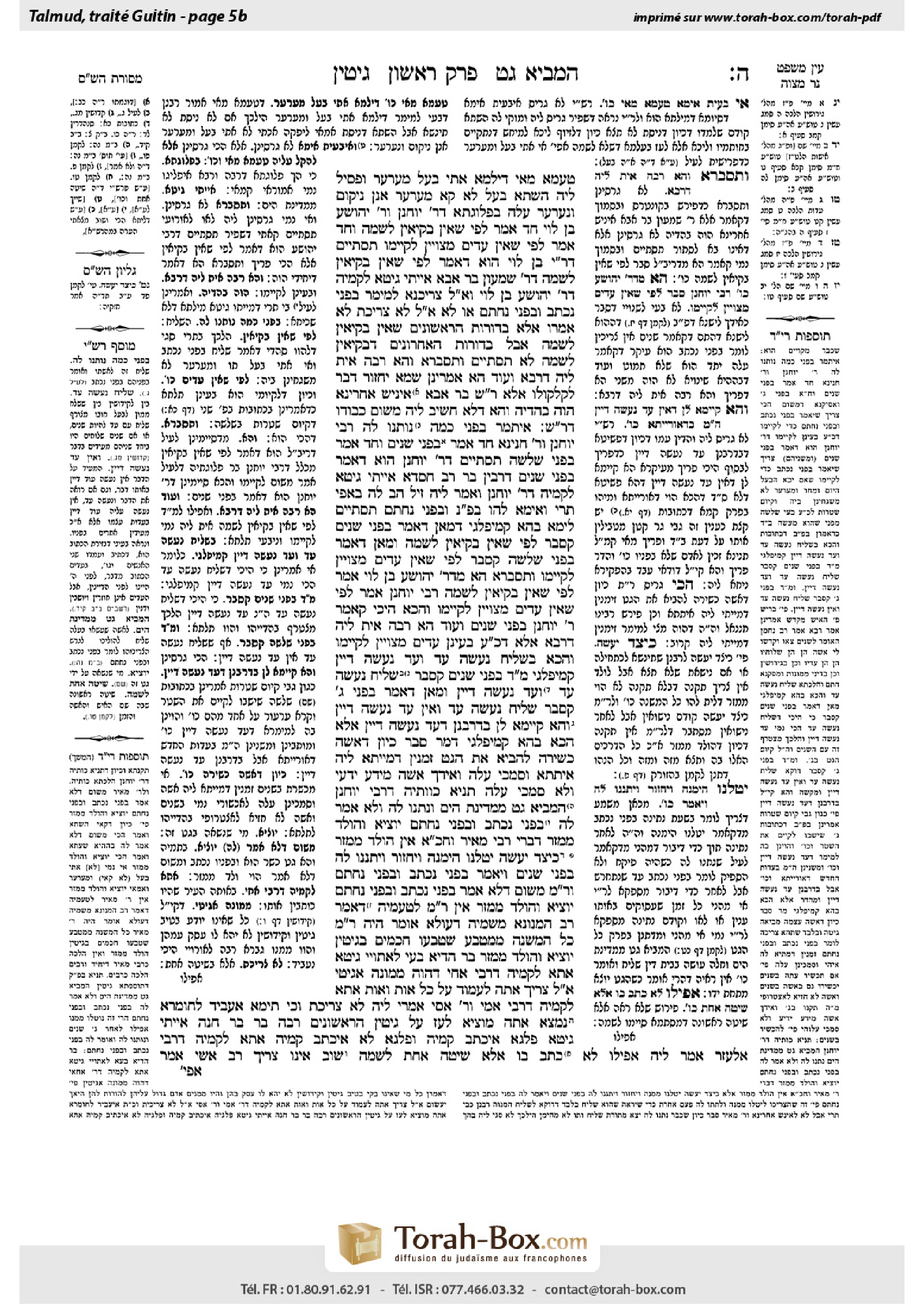
Gittin 5b: Talmud study for Daf Yomi
Study the Talmud for Daf Yomi with scanned pages, Hebrew text, English translations from Sefaria and AI-generated French translations.
Passage selection and English or AI-generated French translation are available where the scan has annotations. Daf Study is independent of Torah-Box and Sefaria.
Browse Gittin · גיטין · All tractatesGittin 5b text and translations
This page of Gittin includes the Aramaic text, an English translation and an AI-generated French translation, alongside the scan above.
גיטין ה׳ ב · Aramaic and Hebrew text
טַעְמָא מַאי – דִּילְמָא אָתֵי בַּעַל מְעַרְעַר וּפָסֵיל לֵיהּ; הַשְׁתָּא בַּעַל לָא קָא מְעַרְעַר, אֲנַן נֵיקוּם וּנְעַרְעַר עֲלַהּ?!
בִּפְלוּגְתָּא דְּרַבִּי יוֹחָנָן וְרַבִּי יְהוֹשֻׁעַ בֶּן לֵוִי, חַד אָמַר: לְפִי שֶׁאֵין בְּקִיאִין לִשְׁמָהּ, וְחַד אָמַר: לְפִי שֶׁאֵין עֵדִים מְצוּיִין לְקַיְּימוֹ.
תִּסְתַּיֵּים דְּרַבִּי יְהוֹשֻׁעַ בֶּן לֵוִי הוּא דְּאָמַר לְפִי שֶׁאֵין בְּקִיאִין לִשְׁמָהּ, דְּרַבִּי שִׁמְעוֹן בַּר אַבָּא אַיְיתִי גִּיטָּא לְקַמֵּיהּ דְּרַבִּי יְהוֹשֻׁעַ בֶּן לֵוִי, וַאֲמַר לֵיהּ: צְרִיכְנָא לְמֵימַר ״בְּפָנַי נִכְתַּב וּבְפָנַי נֶחְתַּם״, אוֹ לָא?
אֲמַר לֵיהּ: לָא צְרִיכַתְּ, לֹא אָמְרוּ אֶלָּא בְּדוֹרוֹת הָרִאשׁוֹנִים, שֶׁאֵין בְּקִיאִין לִשְׁמָהּ, אֲבָל בְּדוֹרוֹת הָאַחֲרוֹנִים דִּבְקִיאִין לִשְׁמָהּ – לֹא. תִּסְתַּיֵּים.
וְתִסְבְּרָא?! וְהָא רַבָּה אִית לֵיהּ דְּרָבָא! וְעוֹד, הָא אָמְרִינַן שֶׁמָּא יַחְזוֹר דָּבָר לְקִלְקוּלוֹ!
אֶלָּא רַבִּי שִׁמְעוֹן בַּר אַבָּא אִינִישׁ אַחֲרִינָא הֲוָה בַּהֲדֵיהּ, וְהָא דְּלָא חָשֵׁיב לֵיהּ – מִשּׁוּם כְּבוֹדוֹ דְרַבִּי שִׁמְעוֹן.
אִיתְּמַר: בִּפְנֵי כַּמָּה נוֹתְנוֹ לָהּ? רַבִּי יוֹחָנָן וְרַבִּי חֲנִינָא; חַד אָמַר: בִּפְנֵי שְׁנַיִם, וְחַד אָמַר: בִּפְנֵי שְׁלֹשָׁה.
תִּסְתַּיֵּים דְּרַבִּי יוֹחָנָן הוּא דְּאָמַר בִּפְנֵי שְׁנַיִם, דְּרָבִין בַּר רַב חִסְדָּא אַיְיתִי גִּיטָּא לְקַמֵּיהּ דְּרַבִּי יוֹחָנָן, וַאֲמַר לֵיהּ: זִיל הַב לָהּ בְּאַפֵּי תְּרֵי, וְאֵימָא לְהוּ ״בְּפָנַי נִכְתַּב וּבְפָנַי נֶחְתַּם״. תִּסְתַּיֵּים.
לֵימָא בְּהָא קָמִיפַּלְגִי, דְּמַאן דְּאָמַר בִּפְנֵי שְׁנַיִם, קָסָבַר: לְפִי שֶׁאֵין בְּקִיאִין לִשְׁמָהּ; וּמַאן דְּאָמַר בִּפְנֵי שְׁלֹשָׁה, קָסָבַר: לְפִי שֶׁאֵין עֵדִים מְצוּיִין לְקַיְּימוֹ?
וְתִסְבְּרָא?! הָא מִדְּרַבִּי יְהוֹשֻׁעַ בֶּן לֵוִי אָמַר לְפִי שֶׁאֵין בְּקִיאִין לִשְׁמָהּ, רַבִּי יוֹחָנָן אָמַר לְפִי שֶׁאֵין עֵדִים מְצוּיִין לְקַיְּימוֹ, וְהָכָא הֵיכִי קָאָמַר רַבִּי יוֹחָנָן בִּפְנֵי שְׁנַיִם?
וְעוֹד, הָא רַבָּה אִית לֵיהּ דְּרָבָא!
אֶלָּא, דְּכוּלֵּי עָלְמָא בָּעֵינַן עֵדִים מְצוּיִין לְקַיְּימוֹ, וְהָכָא בְּשָׁלִיחַ נַעֲשֶׂה עֵד וְעֵד נַעֲשֶׂה דַּיָּין קָמִיפַּלְגִי: מַאן דְּאָמַר בִּפְנֵי שְׁנַיִם, קָסָבַר: שָׁלִיחַ נַעֲשֶׂה עֵד, וְעֵד נַעֲשֶׂה דַּיָּין. וּמַאן דְּאָמַר בִּפְנֵי שְׁלֹשָׁה, קָסָבַר: שָׁלִיחַ נַעֲשֶׂה עֵד, וְאֵין עֵד נַעֲשֶׂה דַּיָּין.
וְהָא קַיְימָא לַן בִּדְרַבָּנַן דְּעֵד נַעֲשֶׂה דַּיָּין!
אֶלָּא הָכָא בְּהָא קָמִיפַּלְגִי, דְּמָר סָבַר: כֵּיוָן דְּאִשָּׁה כְּשֵׁירָה לְהָבִיא אֶת הַגֵּט, זִמְנִין דְּמַיְיתָא לֵיהּ אִיתְּתָא וְסָמְכִי עֲלַהּ.
וְאִידַּךְ: אִשָּׁה – מִידָּע יָדְעִי וְלָא סָמְכִי עֲלַהּ.
תַּנְיָא כְּווֹתֵיהּ דְּרַבִּי יוֹחָנָן: הַמֵּבִיא גֵּט מִמְּדִינַת הַיָּם, וּנְתָנוֹ לָהּ וְלֹא אָמַר לָהּ ״בְּפָנַי נִכְתַּב וּבְפָנַי נֶחְתַּם״ – יוֹצִיא, וְהַוָּלָד מַמְזֵר, דִּבְרֵי רַבִּי מֵאִיר.
וַחֲכָמִים אוֹמְרִים: אֵין הַוָּלָד מַמְזֵר. כֵּיצַד יַעֲשֶׂה? יִטְּלֶנּוּ הֵימֶנָּה, וְיַחֲזוֹר וְיִתְּנֶנּוּ לָהּ בִּפְנֵי שְׁנַיִם, וְיֹאמַר ״בְּפָנַי נִכְתַּב וּבְפָנַי נֶחְתַּם״.
וְרַבִּי מֵאִיר, מִשּׁוּם דְּלֹא אָמַר ״בְּפָנַי נִכְתַּב וּבְפָנַי נֶחְתַּם״, יוֹצִיא וְהַוָּלָד מַמְזֵר?
אִין, רַבִּי מֵאִיר לְטַעְמֵיהּ. דְּאָמַר רַב הַמְנוּנָא מִשְּׁמֵיהּ דְּעוּלָּא: אוֹמֵר הָיָה רַבִּי מֵאִיר: כָּל הַמְשַׁנֶּה מִמַּטְבֵּעַ שֶׁטָּבְעוּ חֲכָמִים בְּגִיטִּין – יוֹצִיא, וְהַוָּלָד מַמְזֵר.
בַּר הֶדְיָא בָּעֵי לְאֵתוֹיֵי גִּיטָּא, אֲתָא לְקַמֵּיהּ דְּרַבִּי אַחַי, דַּהֲוָה מְמוּנֶּה אַגִּיטֵּי, אֲמַר לֵיהּ: צָרִיךְ אַתָּה לַעֲמוֹד עַל כָּל אוֹת וָאוֹת. אֲתָא לְקַמֵּיהּ דְּרַבִּי אַמֵּי וְרַבִּי אַסִּי, אָמְרִי לֵיהּ: לָא צְרִיכַתְּ.
וְכִי תֵּימָא אֶעֱבֵיד לְחוּמְרָא, נִמְצָא אַתָּה מוֹצִיא לַעַז עַל גִּיטִּין הָרִאשׁוֹנִים.
רַבָּה בַּר בַּר חָנָה אַיְיתִי גִּיטָּא, פַּלְגָא אִיכְּתַב קַמֵּיהּ וּפַלְגָא לָא אִיכְּתַב קַמֵּיהּ. אֲתָא לְקַמֵּיהּ דְּרַבִּי אֶלְעָזָר, אֲמַר לֵיהּ: אֲפִילּוּ לֹא כָּתַב בּוֹ אֶלָּא שִׁיטָה אַחַת לִשְׁמָהּ, שׁוּב אֵינוֹ צָרִיךְ. רַב אָשֵׁי אָמַר:
Gittin 5b · English translation
What is the reason that the Sages required this testimony at all? Perhaps the husband will come to contest, and invalidate the bill of divorce. Now, in this case, where the husband is not contesting its validity, will we, the court, arise and contest it?
§ The Gemara comments: Rabba and Rava disagree with regard to the dispute between Rabbi Yoḥanan and Rabbi Yehoshua ben Levi. One said that the reason the Sages required an agent to say: It was written in my presence and it was signed in my presence, is because they are not experts in writing a bill of divorce for her sake. And one said that the reason is because there are no witnesses available to ratify it.
The Gemara suggests: It may be concluded that Rabbi Yehoshua ben Levi is the one who said that the reason is because they are not experts in writing a bill of divorce for her sake, as Rabbi Shimon bar Abba brought a bill of divorce before Rabbi Yehoshua ben Levi, and said to him: Am I required to say: It was written in my presence and it was signed in my presence, or not?
Rabbi Yehoshua ben Levi said to him: You are not required to do so, as they said that one was required to state this declaration only in the earlier generations, when they were not experts in writing a bill of divorce for her sake. However, in the later generations, when they are experts about writing it for her sake, no, this declaration is no longer necessary. The Gemara states: It may be concluded from here that Rabbi Yehoshua ben Levi was of this opinion.
The Gemara asks: And can you understand that an individual agent does not need to say: It was written in my presence and it was signed in my presence? But it was demonstrated earlier that Rabba is of the opinion that the reason is also in accordance with the opinion of Rava, and the issue of the availability of witnesses cannot be resolved by the fact that later generations are knowledgeable about writing a bill of divorce for the woman’s sake. And furthermore, we said that according to the opinion of Rabba an agent must still say that it was written and signed in his presence, lest the matter return to its corrupt state.
Rather, Rabbi Shimon bar Abba had another person with him, who served as a second witness, and the reason that the account of the incident did not mention him was due to the honor of Rabbi Shimon bar Abba, as that man was unlearned. As for the halakha, since there were two witnesses the concern for ratification does not apply in this case. As stated above, in this situation the Sages did not apply their decree due to a concern that the matter would return to its corrupt state.
§ It was stated that the amora’im disagreed with regard to the following question: In the presence of how many people must an agent who delivers a bill of divorce from overseas give it to the woman? Rabbi Yoḥanan and Rabbi Ḥanina disagreed with regard to this matter. One says that he must give it in the presence of at least two witnesses, and one says that he must give it in the presence of at least three witnesses.
The Gemara suggests: It may be concluded that Rabbi Yoḥanan is the one who said that the agent must give the bill of divorce in the presence of two witnesses, as Ravin bar Rav Ḥisda brought a bill of divorce before Rabbi Yoḥanan, and Rabbi Yoḥanan said to him: Go and give the bill of divorce to her in the presence of two witnesses, and say to them: It was written in my presence and it was signed in my presence. The Gemara states: It may be concluded from here that Rabbi Yoḥanan was of this opinion.
The Gemara suggests: Let us say that they disagree about this issue, as the one who said that the agent must deliver the bill of divorce in the presence of two witnesses holds that the reason is: Because they are not experts in writing a bill of divorce for her sake. Therefore, it is sufficient for there to be testimony that it was written for her sake. And the one who said that he must testify in the presence of three people holds that the reason is: Because there are no witnesses available to ratify it. Consequently, he must testify in the presence of three people, who are considered a court, as is the halakha for the ratification of all documents.
The Gemara rejects this argument: And can you understand it that way? But from the fact that Rabbi Yehoshua ben Levi said, as proven above, that the reason for the decree is because they are not experts in writing a bill of divorce for her sake, it follows that Rabbi Yoḥanan, who disagrees with him, said the reason is because there are no witnesses available to ratify it. And if so, here, how can Rabbi Yoḥanan say that it can be delivered in the presence of two people? If a court is needed to ratify the document, Rabbi Yoḥanan should require three people.
And furthermore, it was demonstrated earlier that Rabba is of the opinion that the reason is also in accordance with the opinion of Rava. Consequently, even the one who says that this decree was enacted because they are not experts in writing a bill of divorce for the woman’s sake still requires witnesses to ratify the document. If a court is necessary for this purpose, the presence of two people is not enough.
Rather, everyone agrees that we require witnesses who are available to ratify it, and here they disagree with regard to whether an agent can become a witness to testify about the matter of his agency, and whether a witness can become a judge for the matter about which he testified. The Gemara explains: The one who said that the agent must state the declaration in the presence of two witnesses holds that an agent can become a witness, and a witness can become a judge. Consequently, this agent can join with the other two people to form a court that ratifies the document. And the one who said that it must be delivered in the presence of three holds that an agent can become a witness, but a witness cannot become a judge. Therefore, the agent must issue his statement in the presence of three other people.
The Gemara raises a difficulty: But don’t we maintain with regard to matters of rabbinic law that a witness can become a judge, and the ratification of documents is a requirement by rabbinic law?
Rather, the Gemara suggests that here they disagree with regard to this issue: As one Sage, Rabbi Ḥanina, who rules that a bill of divorce must be given in the presence of three people, holds that since a woman is also fit to bring the bill of divorce there is a concern that sometimes a woman will bring it, and those to whom the bill of divorce is delivered will rely upon her. They will not know that ordinarily an agent can testify in the presence of two people only because the agent himself joins with them. In this situation, as a woman cannot join the court, there is no court to receive the testimony and ratify the bill of divorce. Consequently, the Sages required the presence of three people in all cases.
And the other Sage, Rabbi Yoḥanan, holds that with regard to a woman, people know that a woman cannot serve as a judge and they would not rely on her. Instead they would bring a third person, and therefore there is no need to enact a decree due to this case.
The Gemara comments: It is taught in a baraita in accordance with the opinion of Rabbi Yoḥanan, who says that it is sufficient that the agent state his declaration before an additional two people: With regard to one who brings a bill of divorce from a country overseas, and gave it to the woman but did not say to her: It was written in my presence and it was signed in my presence, and she remarries, her second husband must divorce her, and the offspring of the second marriage is a mamzer. This is the statement of Rabbi Meir.
And the Rabbis say: The offspring is not a mamzer. How should the agent act to remedy the situation? He should return, take the bill of divorce from her, and again give it to her in the presence of two witnesses, and he should say: It was written in my presence and it was signed in my presence. Although the dispute in this baraita is referring to a different issue, it mentions incidentally that the document must be transmitted in the presence of two people, not three.
After citing the baraita the Gemara asks: And Rabbi Meir, does he maintain that merely because the agent did not say: It was written in my presence and it was signed in my presence, the second husband must divorce her and the offspring is a mamzer? Is the halakha so strict that the divorce is invalidated even if the witness actually saw the writing and signing of the bill of divorce, and simply neglected to state the declaration?
The Gemara answers: Yes, as Rabbi Meir conforms to his own line of reasoning with regard to this issue. As Rav Hamnuna said in the name of Ulla: Rabbi Meir would say that in any case where one who deviates from the formula coined by the Sages with regard to bills of divorce, and the woman married despite this, the second husband must divorce the woman who married him on the basis of that bill of divorce, and the offspring is a mamzer.
§ The Gemara relates: Bar Haddaya sought to bring a bill of divorce from one country to another. He came before Rabbi Aḥai, who was appointed over bills of divorce in his location to ask him how to proceed. Rabbi Aḥai said to him: You are required to stand over each and every letter when the scribe writes the bill of divorce, to see that everything is performed in the correct manner. Bar Haddaya came before Rabbi Ami and Rabbi Asi to ask if this is required, and they said to him: You are not required to do this; rather, it is enough for you to be present and oversee in general that it is done in the proper manner.
And if you would say: I will act stringently, in accordance with the opinion of Rabbi Aḥai, then you are casting aspersions on the earlier bills of divorce, i.e., bills of divorce written in previous generations, as the agents who delivered them did not examine them to this extent.
The Gemara further relates: Rabba bar bar Ḥana brought a bill of divorce, half of which was written in his presence and half of which was not written in his presence. He came before Rabbi Elazar to clarify the halakha in this case. Rabbi Elazar said to him: Even if the scribe wrote only one line of it for her sake in the presence of the agent, he is no longer required to observe further, as it can be assumed that he wrote all of it for her sake. Rav Ashi said:
Gittin 5b · Traduction française (IA)
Quelle est la raison pour laquelle les Sages ont exigé ce témoignage ? Peut-être que l'époux viendra contester et annuler le divorce. Maintenant, dans ce cas, où l'époux ne conteste pas la validité, nous, la cour, nous leverons-nous pour le contester ?
§ La Guemara commente : Rabba et Rava s'opposent à la dispute entre Rabbi Yoḥanan et Rabbi Yehoshua ben Levi. L'un dit que la raison pour laquelle les Sages exigent qu'un agent dise : « Il a été écrit devant moi et il a été signé devant moi », c'est parce qu'ils ne sont pas experts pour écrire un divorce à son intention. L'autre dit que la raison est parce qu'il n'y a pas de témoins disponibles pour ratifier cela.
La Guemara suggère : On peut conclure que Rabbi Yehoshua ben Levi est celui qui a dit que la raison est parce qu'ils ne sont pas experts pour écrire un divorce à son intention, comme Rabbi Shimon bar Abba a présenté un divorce devant Rabbi Yehoshua ben Levi et lui a dit : « Ai-je besoin de dire : Il a été écrit devant moi et il a été signé devant moi, ou non ? »
Rabbi Yehoshua ben Levi lui a dit : Tu n'as pas besoin de le faire, car ils ont dit que cette déclaration était nécessaire uniquement dans les générations précédentes, quand ils n'étaient pas experts pour écrire un divorce à son intention. Cependant, dans les générations ultérieures, quand ils sont experts pour écrire un divorce à son intention, non, cette déclaration n'est plus nécessaire. La Guemara dit : On peut conclure de cela que Rabbi Yehoshua ben Levi était de cet avis.
La Guemara pose la question : Et peux-tu comprendre que l'agent individuel n'a pas besoin de dire : « Il a été écrit devant moi et il a été signé devant moi » ? Mais cela a été démontré plus tôt que Rabba est de l'avis que la raison est aussi conforme à l'avis de Rava, et que la question de la disponibilité des témoins ne peut être résolue par le fait que les générations ultérieures sont compétentes pour écrire un divorce à son intention. De plus, nous avons dit que selon l'avis de Rabba, l'agent doit toujours dire que cela a été écrit et signé devant lui, de peur que l'affaire retombe dans un état corrompu.
Plutôt, Rabbi Shimon bar Abba avait une autre personne avec lui, qui servait de témoin second, et la raison pour laquelle le récit de l'incident ne mentionnait pas cet homme était due à l'honneur de Rabbi Shimon bar Abba, car cet homme était peu savant. En ce qui concerne la halakha, puisque deux témoins étaient présents, la préoccupation concernant la ratification ne s'applique pas dans ce cas. Comme mentionné ci-dessus, dans cette situation, les Sages n'ont pas appliqué leur décret en raison de la crainte que l'affaire retombe dans un état corrompu.
§ Il a été dit que les amora’im étaient en désaccord sur la question suivante : Combien de personnes doivent être présentes lorsqu'un agent qui livre un divorce d'outre-mer le donne à la femme ? Rabbi Yoḥanan et Rabbi Ḥanina étaient en désaccord sur cette question. L'un dit qu'il doit le lui donner devant au moins deux témoins, et l'autre dit qu'il doit le lui donner devant au moins trois témoins.
La Guemara suggère : On peut conclure que Rabbi Yoḥanan est celui qui a dit que l'agent doit donner le divorce devant deux témoins, comme Ravin bar Rav Ḥisda a présenté un divorce devant Rabbi Yoḥanan, et Rabbi Yoḥanan lui a dit : « Va donner le divorce à elle devant deux témoins, et dis-leur : Il a été écrit devant moi et il a été signé devant moi. » La Guemara dit : On peut conclure de cela que Rabbi Yoḥanan était de cet avis.
La Guemara suggère : Disons qu'ils sont en désaccord sur cette question, comme celui qui dit que l'agent doit délivrer le divorce devant deux témoins dit que la raison est : Parce qu'ils ne sont pas experts pour écrire un divorce à son intention. Ainsi, il suffit qu'il y ait un témoignage qu'il a été écrit à son intention. Et celui qui dit qu'il doit témoigner devant trois personnes dit que la raison est : Parce qu'il n'y a pas de témoins disponibles pour ratifier cela. Par conséquent, il doit témoigner devant trois personnes, qui sont considérés comme un tribunal, comme c'est la halakha pour la ratification de tous les documents.
La Guemara rejette cet argument : Et peux-tu comprendre cela ainsi ? Mais du fait que Rabbi Yehoshua ben Levi a dit, comme démontré ci-dessus, que la raison du décret est parce qu'ils ne sont pas experts pour écrire un divorce à son intention, il suit que Rabbi Yoḥanan, qui le contredit, a dit que la raison est parce qu'il n'y a pas de témoins disponibles pour ratifier cela. Et si c'est le cas, comment Rabbi Yoḥanan peut-il dire qu'il peut être délivré devant deux personnes ? Si un tribunal est nécessaire pour ratifier le document, Rabbi Yoḥanan devrait exiger trois personnes.
Et de plus, il a été démontré plus tôt que Rabba est d'avis que la raison est également conforme à l'opinion de Rava. Par conséquent, même celui qui affirme que ce décret a été établi parce qu'ils ne sont pas experts pour écrire un divorce à l'intention de la femme exige encore des témoins pour ratifier le document. Si un tribunal est nécessaire à cet effet, la présence de deux personnes n'est pas suffisante.
Plutôt, tout le monde est d'accord sur le fait que nous exigeons des témoins disponibles pour ratifier cela, et ici ils s'entendent sur le fait que l'agent peut devenir un témoin pour témoigner sur la question de son mandat, et si un témoin peut devenir un juge sur la question sur laquelle il a témoigné. La Guemara explique : Celui qui dit que l'agent doit déclarer devant deux témoins considère que l'agent peut devenir un témoin, et un témoin peut devenir un juge. Par conséquent, cet agent peut s'unir aux deux autres personnes pour former un tribunal qui ratifie le document. Et celui qui dit qu'il doit être délivré devant trois personnes considère que l'agent peut devenir un témoin, mais un témoin ne peut pas devenir un juge. Par conséquent, l'agent doit déclarer devant trois autres personnes.
La Guemara soulève une difficulté : Mais ne maintenons-nous pas, concernant les questions de droit rabbinique, que le témoin peut devenir juge, et que la ratification des documents est une exigence du droit rabbinique ?
Plutôt, la Guemara suggère que ici ils divergent sur cette question : Comme un Sage, Rabbi Ḥanina, qui décide qu'un acte de divorce doit être donné en présence de trois personnes, considère que puisque la femme est également apte à apporter l'acte de divorce, il y a une crainte que parfois la femme l'apporte, et ceux à qui l'acte de divorce est remis y fassent confiance. Ils ne sauront pas que d'habitude un agent peut témoigner en présence de deux personnes uniquement parce que l'agent lui-même s'associe à eux. Dans ce cas, comme la femme ne peut pas s'associer au tribunal, il n'y a pas de tribunal pour recevoir le témoignage et ratifier l'acte de divorce. Par conséquent, les Sages ont exigé la présence de trois personnes dans tous les cas.
Et l'autre Sage, Rabbi Yoḥanan, considère que concernant la femme, les gens savent que la femme ne peut pas servir de juge et qu'ils ne feraient pas confiance à elle. Au lieu de cela, ils apporteraient une personne tierce, et par conséquent il n'y a pas besoin d'édicter une loi en raison de ce cas.
La Guemara commente : Il est enseigné dans une baraïta selon l'opinion de Rabbi Yoḥanan, qui dit que c'est suffisant que l'agent déclare sa déclaration devant deux personnes supplémentaires : Concernant celui qui apporte un acte de divorce d'un pays éloigné, et l'a donné à la femme mais n'a pas dit à elle : Il a été écrit en mon présence et il a été signé en mon présence, et elle remarie, son deuxième mari doit divorcer d'elle, et les enfants de ce second mariage sont des mamzerim. C'est l'opinion de Rabbi Meir.
Et les Rabbins disent : Les enfants ne sont pas des mamzerim. Comment l'agent doit-il agir pour résoudre cette situation ? Il doit revenir, prendre l'acte de divorce de chez elle, et le lui redonner en présence de deux témoins, et il doit dire : Il a été écrit en mon présence et il a été signé en mon présence. Bien que le débat dans cette baraïta fasse référence à une question différente, il mentionne incidentellement que le document doit être transmis en présence de deux personnes, pas trois.
Après avoir cité la baraïta, la Guemara pose la question : Et Rabbi Meir, maintient-il que simplement parce que l'agent n'a pas dit : Il a été écrit en mon présence et il a été signé en mon présence, le deuxième mari doit divorcer d'elle et les enfants sont des mamzerim ? La halakha est-elle si stricte que le divorce est annulé même si le témoin a effectivement vu l'écriture et la signature de l'acte de divorce, et qu'il a simplement négligé de déclarer cela ?
La Guemara répond : Oui, car Rabbi Meir suit sa propre ligne de raisonnement concernant cette question. Comme Rav Hamnuna a dit en nom de Ulla : Rabbi Meir affirmerait que dans tout cas où l'on s'écarte de la formule établie par les Sages concernant les actes de divorce, et que la femme s'est mariée malgré cela, le deuxième mari doit divorcer la femme qui s'est mariée sur la base de cet acte de divorce, et les enfants sont des mamzerim.
§ La Guemara rapporte : Bar Haddaya voulait apporter un acte de divorce d'un pays à un autre. Il est venu devant Rabbi Aḥai, qui était chargé des actes de divorce dans sa région, pour demander comment procéder. Rabbi Aḥai a dit à lui : Vous êtes tenu de surveiller chaque lettre lorsque le scribe écrit l'acte de divorce, pour voir que tout est fait correctement. Bar Haddaya est venu devant Rabbi Ami et Rabbi Asi pour demander si cela est requis, et ils ont dit à lui : Vous n'êtes pas tenu de le faire ; plutôt, il suffit que vous soyez présent et surveillez généralement que cela est fait correctement.
Et si vous dites : Je ferai selon la stricte opinion de Rabbi Aḥai, alors vous mettez en doute les actes de divorce antérieurs, c'est-à-dire ceux écrits dans les générations précédentes, car les agents qui les ont délivrés n'ont pas examiné à ce point.
La Guemara rapporte davantage : Rabba bar bar Ḥana a apporté un acte de divorce, la moitié de l'acte ayant été écrite en sa présence et l'autre moitié n'ayant pas été écrite en sa présence. Il est venu devant Rabbi Elazar pour clarifier la halakha dans ce cas. Rabbi Elazar a dit à lui : Même si le scribe a écrit seulement une ligne pour son bénéfice en présence de l'agent, il n'est plus tenu d'observer davantage, car on peut supposer qu'il a écrit toute l'acte pour son bénéfice. Rav Ashi a dit :
Traduction française générée par IA à partir de l’édition anglaise de Sefaria. Vérifie toujours un passage avec le texte source.
Text from Sefaria: William Davidson Edition - Vocalized Aramaic (CC BY NC); William Davidson Edition - English (CC BY NC).