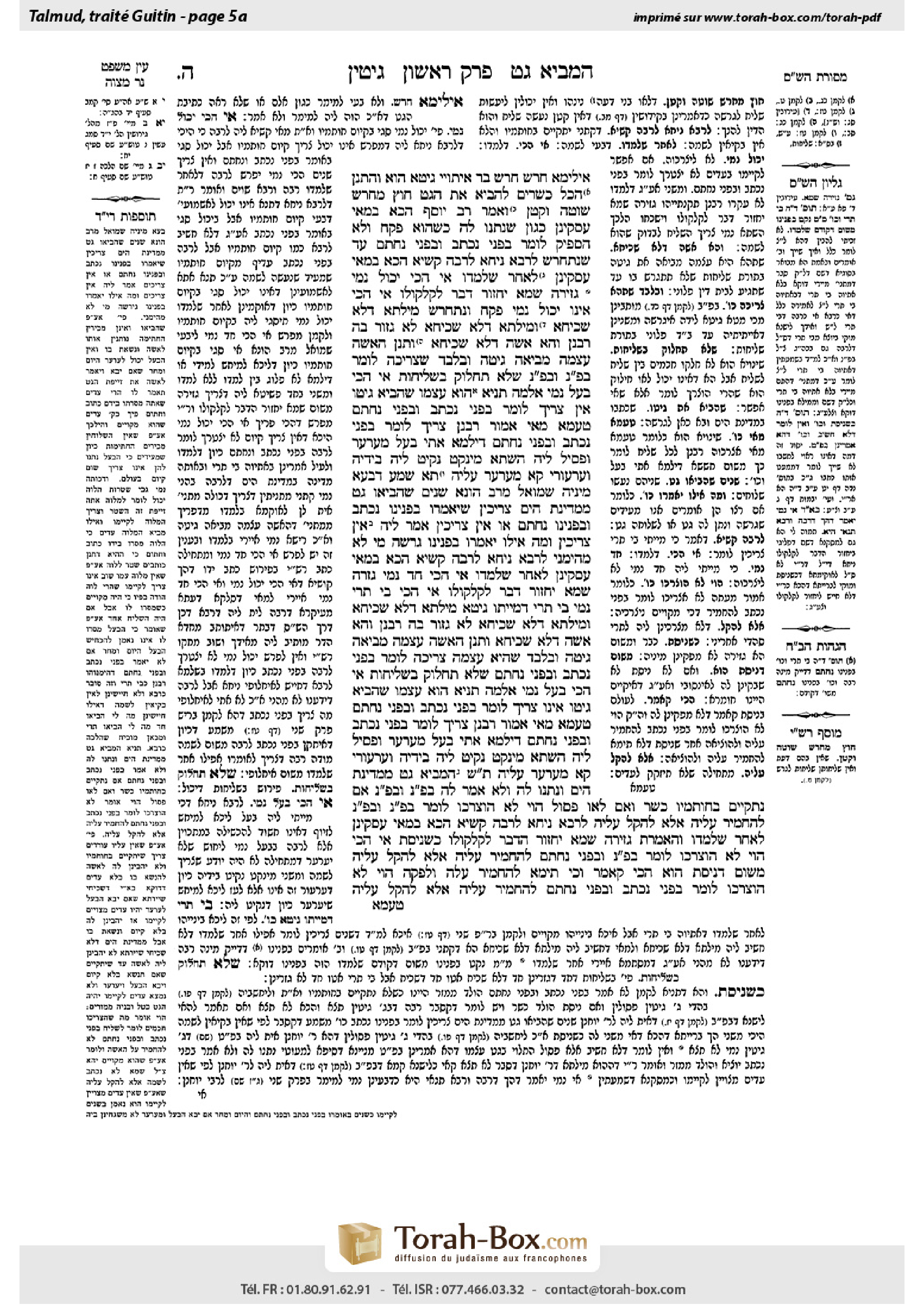
Gittin 5a: Talmud study for Daf Yomi
Study the Talmud for Daf Yomi with scanned pages, Hebrew text, English translations from Sefaria and AI-generated French translations.
Passage selection and English or AI-generated French translation are available where the scan has annotations. Daf Study is independent of Torah-Box and Sefaria.
Browse Gittin · גיטין · All tractatesGittin 5a text and translations
This page of Gittin includes the Aramaic text, an English translation and an AI-generated French translation, alongside the scan above.
גיטין ה׳ א · Aramaic and Hebrew text
אִילֵימָא חֵרֵשׁ, חֵרֵשׁ בַּר אֵיתוֹיֵי גִיטָּא הוּא?! וְהָתְנַן: הַכֹּל כְּשֵׁרִים לְהָבִיא אֶת הַגֵּט, חוּץ מֵחֵרֵשׁ שׁוֹטֶה וְקָטָן!
וְאָמַר רַב יוֹסֵף: הָכָא בְּמַאי עָסְקִינַן – כְּגוֹן שֶׁנְּתָנוֹ לָהּ כְּשֶׁהוּא פִּקֵּחַ, וְלֹא הִסְפִּיק לוֹמַר ״בְּפָנַי נִכְתַּב וּבְפָנַי נֶחְתַּם״ עַד שֶׁנִּתְחָרֵשׁ. לְרָבָא נִיחָא, לְרַבָּה קַשְׁיָא!
הָכָא בְּמַאי עָסְקִינַן – לְאַחַר שֶׁלָּמְדוּ. אִי הָכִי, יָכוֹל נָמֵי! גְּזֵירָה שֶׁמָּא יַחְזוֹר דָּבָר לְקִלְקוּלוֹ.
אִי הָכִי, אֵינוֹ יָכוֹל נָמֵי! פִּקֵּחַ וְנִתְחָרֵשׁ מִילְּתָא דְלָא שְׁכִיחָא, וּמִילְּתָא דְלָא שְׁכִיחָא לָא גְּזוּר בַּהּ רַבָּנַן.
וְהָא אִשָּׁה, דְּלָא שְׁכִיחָא, וּתְנַן: הָאִשָּׁה עַצְמָהּ מְבִיאָה גִּיטָּהּ, וּבִלְבַד שֶׁצְּרִיכָה לוֹמַר ״בְּפָנַי נִכְתַּב וּבְפָנַי נֶחְתַּם״? שֶׁלֹּא תַּחְלוֹק בִּשְׁלִיחוּת.
אִי הָכִי, בַּעַל נָמֵי! אַלְּמָה תַּנְיָא: הוּא עַצְמוֹ שֶׁהֵבִיא גִּיטּוֹ, אֵין צָרִיךְ לוֹמַר ״בְּפָנַי נִכְתַּב וּבְפָנַי נֶחְתַּם״?
טַעְמָא מַאי אֲמוּר רַבָּנַן צָרִיךְ לוֹמַר ״בְּפָנַי נִכְתַּב וּבְפָנַי נֶחְתַּם״, דִּילְמָא אָתֵי בַּעַל מְעַרְעַר וּפָסֵיל לֵיהּ; הַשְׁתָּא מִינְקָט נָקֵיט לֵיהּ בִּידֵיהּ, וְעַרְעוֹרֵי קָא מְעַרְעַר עֲלֵיהּ?!
תָּא שְׁמַע, דִּבְעָא מִינֵּיהּ שְׁמוּאֵל מֵרַב הוּנָא: שְׁנַיִם שֶׁהֵבִיאוּ גֵּט מִמְּדִינַת הַיָּם, צְרִיכִין שֶׁיֹּאמְרוּ ״בְּפָנֵינוּ נִכְתַּב וּבְפָנֵינוּ נֶחְתַּם״ אוֹ אֵין צְרִיכִין? אֲמַר לֵיהּ: אֵין צְרִיכִין. וּמָה אִילּוּ יֹאמְרוּ ״בְּפָנֵינוּ גֵּרְשָׁהּ״, מִי לָא מְהֵימְנִי?!
לְרָבָא נִיחָא, לְרַבָּה קַשְׁיָא! הָכָא בְּמַאי עָסְקִינַן – לְאַחַר שֶׁלָּמְדוּ.
אִי הָכִי, חַד נָמֵי! גְּזֵרָה שֶׁמָּא יַחְזוֹר דָּבָר לְקִלְקוּלוֹ.
אִי הָכִי, בֵּי תְרֵי נָמֵי! בֵּי תְרֵי דְּמַיְיתוּ גִּיטָּא, מִילְּתָא דְלָא שְׁכִיחָא; וּמִילְּתָא דְלָא שְׁכִיחָא לָא גְּזוּר בָּהּ רַבָּנַן.
וְהָא אִשָּׁה, דְּלָא שְׁכִיחָא, וּתְנַן: הָאִשָּׁה עַצְמָהּ מְבִיאָה גִּיטָּהּ, וּבִלְבַד שֶׁהִיא עַצְמָהּ צְרִיכָה לוֹמַר ״בְּפָנַי נִכְתַּב וּבְפָנַי נֶחְתַּם״! שֶׁלֹּא תַּחְלוֹק בִּשְׁלִיחוּת.
אִי הָכִי, בַּעַל נָמֵי! אַלְּמָה תַּנְיָא: הוּא עַצְמוֹ שֶׁהֵבִיא גִּיטּוֹ, אֵינוֹ צָרִיךְ לוֹמַר ״בְּפָנַי נִכְתַּב וּבְפָנַי נֶחְתַּם״? טַעְמָא מַאי אֲמוּר רַבָּנַן צָרִיךְ לוֹמַר ״בְּפָנַי נִכְתַּב וּבְפָנַי נֶחְתַּם״ – דִּילְמָא אָתֵי בַּעַל מְעַרְעַר וּפָסֵיל לֵיהּ; הַשְׁתָּא מִינְקָט נָקֵיט לֵיהּ בִּידֵיהּ, וְעַרְעוֹרֵי קָא מְעַרְעַר עֲלֵיהּ?!
תָּא שְׁמַע: הַמֵּבִיא גֵּט מִמְּדִינַת הַיָּם, וּנְתָנוֹ לָהּ וְלֹא אָמַר לָהּ ״בְּפָנַי נִכְתַּב וּבְפָנַי נֶחְתַּם״, אִם נִתְקַיֵּים בְּחוֹתְמָיו – כָּשֵׁר, וְאִם לָאו – פָּסוּל. הֱוֵי לֹא הוּצְרְכוּ לוֹמַר ״בְּפָנַי נִכְתַּב וּבְפָנַי נֶחְתַּם״ לְהַחֲמִיר עָלֶיהָ, אֶלָּא לְהָקֵל עָלֶיהָ.
לְרָבָא נִיחָא, לְרַבָּה קַשְׁיָא! הָכָא בְּמַאי עָסְקִינַן – לְאַחַר שֶׁלָּמְדוּ.
וְהָאָמְרַתְּ: גְּזֵירָה שֶׁמָּא יַחְזוֹר הַדָּבָר לְקִלְקוּלוֹ! כְּשֶׁנִּיסַת. אִי הָכִי, הֱוֵי לָא הוּצְרְכוּ לוֹמַר ״בְּפָנַי נִכְתַּב וּבְפָנַי נֶחְתַּם״ לְהַחְמִיר עָלֶיהָ אֶלָּא לְהָקֵל עָלֶיהָ?! מִשּׁוּם דְּנִיסַּת הוּא!
הָכִי קָאָמַר: וְכִי תֵּימָא לְהַחֲמִיר עֲלַהּ וְלַפְּקַהּ, הֱוֵי לֹא הוּצְרְכוּ לוֹמַר ״בְּפָנַי נִכְתַּב וּבְפָנַי נֶחְתַּם״ לְהַחְמִיר עָלֶיהָ אֶלָּא לְהָקֵל עָלֶיהָ,
Gittin 5a · English translation
If we say that this is referring to a deaf-mute, is a deaf-mute fit to bring a bill of divorce? But didn’t we learn in a mishna (23a): Anyone is fit to serve as an agent to bring a bill of divorce to a woman except for a deaf-mute, an imbecile, and a minor, all of whom may not be appointed as agents at all, as they are not intellectually competent according to halakha.
And Rav Yosef said: With what are we dealing here? This is a case where the agent gave the bill of divorce to her when he was halakhically competent, but he did not manage to say: It was written in my presence and it was signed in my presence, before he became a deaf-mute. In other words, although at the time he was appointed he was fit to be appointed as an agent, he is currently unable to say anything. This works out well according to the opinion of Rava. However, it is difficult according to the opinion of Rabba, as he requires testimony that the bill of divorce was written for the woman’s sake.
The Gemara answers: With what are we dealing here? This does not refer to the main period of the decree. Rather, it is speaking of later generations, after the residents of countries overseas learned that a bill of divorce must be written for her sake, so there is no need for the declaration. The Gemara raises a difficulty: If so, meaning that this is referring to a situation where everyone is assumed to be knowledgeable, even if the agent is able to testify he should also not be required to say: It was written in my presence, as it should be sufficient to confirm the witnesses’ signatures. The Gemara explains: Nevertheless, Rabba maintains that the agent must testify, due to a rabbinic decree lest the matter return to its corrupt state, i.e., they might forget that a bill of divorce must be written for the woman’s sake.
The Gemara asks: If it is so, that the Sages decreed that the statement must be issued even in this case, then one who is unable to speak should also be obligated to state the declaration, and be disqualified from serving as an agent due to his inability to speak. The Gemara answers: This case of a halakhically competent individual who became a deaf-mute is an uncommon matter, and the Sages did not decree with regard to an uncommon matter.
The Gemara asks: But the case of a woman who brings her own bill of divorce is also an uncommon matter, and yet we learned in a mishna (23a): The woman herself may bring her own bill of divorce, provided that she too is required to say: It was written in my presence and it was signed in my presence. Why do the Sages obligate her to state this declaration when it is uncommon for a woman to be the agent of delivery for her own bill of divorce? The Gemara answers: The Sages instituted this ordinance so that you will not distinguish with regard to different types of agency. To avoid confusion, the Sages decreed that all agents who bring a bill of divorce must state the declaration, even the woman herself.
The Gemara asks: If so, then a husband who brings his wife’s bill of divorce should also be required to say that it was written and signed in his presence, as the Sages do not differentiate between different agents. Why then, is it taught in a baraita: In the case of the husband himself who brought his own bill of divorce, he is not required to say: It was written in my presence and it was signed in my presence?
The Gemara explains: What is the reason that the Sages said that the agent of a bill of divorce is required to say: It was written in my presence and it was signed in my presence? The reason for the decree is that perhaps the husband will come to contest and invalidate the bill of divorce. However, here the husband himself now holds the document in his hand, and yet you are concerned that he will contest it? If he does not wish to give the bill of divorce to the woman he can simply tear it up. Therefore, the Sages did not apply their decree to this case.
§ The Gemara attempts to cite an additional proof: Come and hear, as Shmuel raised a dilemma before Rav Huna: With regard to two people who brought a bill of divorce from a country overseas, are they required to say: It was written in our presence and it was signed in our presence, or are they not required to state this declaration? Rav Huna said to him: They are not required to say it. Rav Huna explained his ruling: And if these two individuals would say, testifying: She was divorced in our presence, even without bringing a bill of divorce, aren’t they deemed credible and isn’t she considered divorced? Therefore, in this case too, they are deemed credible when they claim that the bill of divorce was written correctly.
The Gemara comments: This works out well according to the opinion of Rava, as the matter depends on the availability of witnesses to ratify the bill of divorce, and there are two witnesses in this case. However, according to the opinion of Rabba, it is difficult, as he requires the additional testimony that the document was written for the woman’s sake. The Gemara explains: According to the opinion of Rabba, with what are we dealing here? He maintains that this ruling is referring to the period after the people living overseas learned the halakha that a bill of divorce must be written for the woman’s sake.
The Gemara raises a difficulty: If so, one person who brings a bill of divorce should also not be required to say that it was written and signed in his presence. The Gemara explains: One witness is still required to state the declaration for the aforementioned reason: It is a rabbinic decree lest the matter return to its corrupt state.
The Gemara further asks: If so, two who bring a bill of divorce should also be required to say that it was written and signed in their presence, due to this same decree. The Gemara answers: Two people who bring a bill of divorce is an uncommon matter, and the Sages did not decree with regard to an uncommon matter.
The Gemara asks: But the case of a woman who brings her own bill of divorce is also an uncommon matter, and yet we learned in a mishna (23a): The woman herself may bring her own bill of divorce, provided that she too is required to say: It was written in my presence and it was signed in my presence. Why do the Sages obligate her to state this declaration when it is uncommon for a woman to be the agent of delivery for her own bill of divorce? The Gemara answers: The Sages instituted this decree so that you will not distinguish with regard to different types of agency.
The Gemara asks: If so, then a husband who brings his wife’s bill of divorce should also be required to say that it was written and signed in his presence, as the Sages do not differentiate between different agents. Why then, is it taught in a baraita: If the husband himself brings his own bill of divorce he is not required to say: It was written in my presence and it was signed in my presence? The Gemara explains: What is the reason that the Sages said that the agent of a bill of divorce is required to say: It was written in my presence and it was signed in my presence? The reason for the decree is that perhaps the husband will come to contest and invalidate the bill of divorce. However, here the husband himself now holds the document in his hand, and yet you are concerned that he will contest it?
§ The Gemara suggests: Come and hear a proof from the Tosefta (1:1): With regard to an agent who brings a bill of divorce from a country overseas and gave it to the woman, but did not say to her: It was written in my presence and it was signed in my presence, if the bill of divorce is ratified through its signatories, i.e., other people testify about the witnesses’ signatures, it is valid, but if not it is invalid. This is because the Sages did not require him to say: It was written in my presence and it was signed in my presence, so as to be stringent with her. Rather, they required the agent to state this declaration so as to be lenient with her, to spare the court from having to ratify the bill of divorce.
The Gemara explains the proof: This works out well according to the opinion of Rava, as according to him the statement of the agent is to avoid the need for the court to ratify the bill of divorce, which is a leniency for her. However, according to the opinion of Rabba it is difficult, as he holds that the agent is required to state the declaration due to the concern that the bill of divorce may not have been written for her sake, which is a stringency for her. The Gemara answers: With what are we dealing here? With the period after they learned the halakha that a bill of divorce must be written for the woman’s sake.
The Gemara asks: But didn’t you say that there is a rabbinic decree lest the matter return to its corrupt state? Why didn’t the Sages enforce their decree in this case? The Gemara answers: This is referring to a case where the woman had already married again after having received the bill of divorce, and the Sages did not want to enforce their decree at the expense of forcing her to get divorced. The Gemara questions this explanation: If so, the explanation provided by the Tosefta for the ruling in the mishna, that the reason is because the Sages did not require him to say: It was written in my presence and it was signed in my presence, so as to be stringent with her. Rather, they required the agent to state this declaration so as to be lenient with her, is not accurate. Instead, the true reason for this leniency is because she had already married someone else.
The Gemara answers: This is what the tanna of the baraita is saying: And if you would say that one should be stringent with her and remove her from her new husband, to counter that claim the tanna adds: This is because the Sages did not require him to say: It was written in my presence and it was signed in my presence, so as to be stringent with her. Rather, they required the agent to state this declaration so as to be lenient with her.
Gittin 5a · Traduction française (IA)
Si nous disons que cela fait référence à un sourd-muet, est-ce que le sourd-muet est digne de porter un acte de divorce ? Mais n’avons-nous pas appris dans une mitsva (23a) : Tout le monde est digne de servir en tant qu’agent pour porter un acte de divorce à une femme, sauf le sourd-muet, l’imbélique et l’enfant, qui ne peuvent pas être désignés comme agents du tout, car ils ne sont pas intellectuellement compétents selon la halakha.
Et Rav Yosef a dit : De quoi sommes-nous en train de parler ici ? C’est un cas où l’agent a porté l’acte de divorce à elle lorsqu’il était halakhiquement compétent, mais il n’a pas réussi à dire : Il a été écrit en mon présence et il a été signé en mon présence avant qu’il ne devienne sourd-muet. En d’autres termes, bien qu’à l’époque de son désignation il fût digne d’être désigné comme agent, il est actuellement incapable de dire quelque chose. Cela s’accorde bien selon l’opinion de Rava. Cependant, cela est difficile selon l’opinion de Rabba, car il exige que le témoignage indique que l’acte de divorce a été écrit à l’intention de la femme.
La Guemara répond : De quoi sommes-nous en train de parler ici ? Cela ne fait pas référence à la période principale du décret. C’est plutôt un cas des générations ultérieures, après que les habitants des pays étrangers aient appris que l’acte de divorce doit être écrit à l’intention de la femme, de sorte qu’il n’est plus nécessaire de faire la déclaration. La Guemara soulève une difficulté : Si c’est ainsi, c’est-à-dire s’il s’agit d’un cas où tout le monde est supposé être informé, même si l’agent est capable de témoigner, il ne devrait pas être obligé de dire : Il a été écrit en mon présence, car la signature des témoins devrait suffire. La Guemara explique : Cependant, Rabba maintient que l’agent doit témoigner, en raison d’un décret rabbinique afin que l’affaire ne retombe pas dans un état corrompu, c’est-à-dire qu’ils pourraient oublier que l’acte de divorce doit être écrit à l’intention de la femme.
La Guemara pose une question : Si c’est ainsi, que les Sages ont décrété que la déclaration doit être faite même dans ce cas, alors celui qui ne peut pas parler devrait également être obligé de faire cette déclaration et être disqualifié en tant qu’agent en raison de son incapacité à parler. La Guemara répond : Ce cas d’un individu halakhiquement compétent devenu sourd-muet est une situation rare, et les Sages n’ont pas décrété en ce qui concerne une situation rare.
La Guemara pose une question : Mais le cas d’une femme qui apporte elle-même son acte de divorce est également une situation rare, et pourtant nous avons appris dans une mitsna (23a) : La femme elle-même peut apporter son propre acte de divorce, à condition qu’elle doive également dire : Il a été écrit en mon présence et il a été signé en mon présence. Pourquoi les Sages imposent-ils cette déclaration lorsqu’il s’agit d’une situation rare ? La Guemara répond : Les Sages ont institué cette ordonnance afin que vous ne fassiez pas de distinction selon les différents types d’agent. Pour éviter toute confusion, les Sages ont décrété que tous les agents qui apportent un acte de divorce doivent faire cette déclaration, même la femme elle-même.
La Guemara pose une question : Si c’est ainsi, alors un mari qui apporte l’acte de divorce à sa femme devrait également être obligé de dire que l’acte a été écrit et signé en sa présence, car les Sages n’ont pas de distinction entre différents agents. Pourquoi alors est-il enseigné dans une baraïta : Dans le cas du mari lui-même qui apporte son propre acte de divorce, il n’est pas obligé de dire : Il a été écrit en mon présence et il a été signé en mon présence ?
La Guemara explique : Quelle est la raison pour laquelle les Sages ont dit que l’agent d’un acte de divorce doit dire : Il a été écrit en mon présence et il a été signé en mon présence ? La raison du décret est que peut-être le mari viendra contester et invalider l’acte de divorce. Cependant, ici le mari lui-même tient le document en main, et pourtant vous craignez qu’il conteste l’acte ? S’il ne souhaite pas donner l’acte de divorce à la femme, il peut simplement le déchirer. Par conséquent, les Sages n’ont pas appliqué leur décret à ce cas.
§ La Guemara tente de citer une preuve supplémentaire : Viens écouter, car Shmuel a posé un dilemme devant Rav Huna : Concernant deux personnes qui ont apporté un acte de divorce d’un pays étranger, doivent-ils dire : Il a été écrit en notre présence et il a été signé en notre présence, ou ne sont-ils pas obligés de faire cette déclaration ? Rav Huna a dit à lui : Ils ne sont pas obligés de le dire. Rav Huna a expliqué sa décision : Et si ces deux individus disent, en témoignant : Elle a été divorcée en notre présence, même sans apporter un acte de divorce, ne sont-ils pas considérés comme crédibles et n’est-elle pas considérée comme divorcée ? Par conséquent, dans ce cas également, ils sont considérés comme crédibles lorsqu’ils affirment que l’acte de divorce a été correctement rédigé.
La Guemara commente : Cela s’accorde bien selon l’opinion de Rava, car la question dépend de la disponibilité de témoins pour valider l’acte de divorce, et il y a deux témoins dans ce cas. Cependant, selon l’opinion de Rabba, cela est difficile, car il exige le témoignage supplémentaire que le document a été rédigé à l’intention de la femme. La Guemara explique : Selon l’opinion de Rabba, de quoi sommes-nous en train de parler ici ? Il maintient que cette décision fait référence à la période après que les habitants des pays étrangers aient appris la halakha que l’acte de divorce doit être rédigé à l’intention de la femme.
La Guemara soulève une difficulté : Si c’est ainsi, une personne qui apporte un acte de divorce ne devrait pas non plus être obligée de dire qu’il a été écrit et signé en sa présence. La Guemara explique : Un témoin est encore requis pour faire cette déclaration pour la raison mentionnée : C’est un décret rabbinique afin que l’affaire ne retombe pas dans un état corrompu.
La Guemara pose une question supplémentaire : Si c’est ainsi, deux personnes qui apportent un acte de divorce devraient également être obligées de dire qu’il a été écrit et signé en leur présence, en raison de ce même décret. La Guemara répond : Deux personnes qui apportent un acte de divorce est une situation rare, et les Sages n’ont pas décrété en ce qui concerne une situation rare.
La Guemara pose la question : Mais le cas d’une femme qui présente elle-même son acte de divorce est également une affaire inhabituelle, et pourtant nous avons appris dans une mitsna (23a) : La femme elle-même peut présenter son acte de divorce, à condition qu’elle dise également : Il a été écrit devant moi et il a été signé devant moi. Pourquoi les Sages imposent-ils à elle de prononcer cette déclaration alors qu’il est inhabituel que la femme soit l’agent de livraison de son propre acte de divorce ? La Guemara répond : Les Sages ont institué cette déclaration afin que vous ne fassiez pas de distinction entre différents types d’agents.
La Guemara pose la question : Si c’est ainsi, alors un mari qui présente l’acte de divorce de sa femme devrait également être tenu de dire : Il a été écrit devant moi et il a été signé devant moi, comme les Sages n’ont pas de distinction entre différents agents. Pourquoi alors est-il enseigné dans une baraïta : Si le mari lui-même présente son propre acte de divorce, il n’est pas tenu de dire : Il a été écrit devant moi et il a été signé devant moi ? La Guemara explique : Quelle est la raison pour laquelle les Sages ont dit que l’agent de l’acte de divorce doit dire : Il a été écrit devant moi et il a été signé devant moi ? La raison de cette déclaration est que peut-être le mari viendra contester et invalider l’acte de divorce. Cependant, ici le mari tient lui-même le document, et pourtant vous avez peur qu’il le conteste ?
§ La Guemara suggère : Venez écouter une preuve dans la Tosefta (1:1) : Concernant un agent qui apporte un acte de divorce d’un pays éloigné et le donne à la femme, mais ne lui dit pas : Il a été écrit devant moi et il a été signé devant moi, si l’acte de divorce est validé par les signataires, c’est-à-dire que d’autres personnes témoignent des signatures des témoins, il est valide, mais s’il n’est pas validé, il est invalide. Cela est dû au fait que les Sages n’ont pas exigé qu’il dise : Il a été écrit devant moi et il a été signé devant moi, afin d’être strict avec elle. Plutôt, ils ont exigé que l’agent prononce cette déclaration afin d’être indulgent avec elle, pour éviter à la cour de devoir valider l’acte de divorce.
La Guemara explique la preuve : Cela s’applique bien selon l’opinion de Rava, car selon lui, la déclaration de l’agent vise à éviter la nécessité de la validation par la cour, ce qui est une indulgence pour elle. Cependant, selon l’opinion de Rabba, cela est difficile, car il considère que l’agent doit prononcer cette déclaration en raison de la crainte que l’acte de divorce n’ait pas été écrit à son intention, ce qui est une stricte exigence pour elle. La Guemara répond : Avec quel cas sommes-nous en train de parler ? Avec la période après qu’ils aient appris la halakha selon laquelle un acte de divorce doit être écrit à l’intention de la femme.
La Guemara pose la question : Mais n’avez-vous pas dit que l’on avait institué un décret rabbinique afin que la situation ne retombe pas dans un état corrompu ? Pourquoi les Sages n’ont-ils pas appliqué ce décret dans ce cas ? La Guemara répond : Cela fait référence à un cas où la femme avait déjà épousé quelqu’un d’autre après avoir reçu l’acte de divorce, et les Sages ne voulaient pas appliquer leur décret au détriment de la force de la divorce de la femme. La Guemara questionne cette explication : Si c’est ainsi, l’explication donnée par la Tosefta pour la décision de la mitsna, selon laquelle la raison est que les Sages n’ont pas exigé qu’il dise : Il a été écrit devant moi et il a été signé devant moi, afin d’être strict avec elle. Plutôt, ils ont exigé que l’agent prononce cette déclaration afin d’être indulgent avec elle, n’est pas exacte. Au contraire, la vraie raison de cette indulgence est qu’elle avait déjà épousé quelqu’un d’autre.
La Guemara répond : C’est ce que dit le tanna de la baraïta : Et si vous dites qu’on devrait être strict avec elle et la retirer de son mari nouveau, pour contredire cette affirmation, le tanna ajoute : C’est parce que les Sages n’ont pas exigé qu’il dise : Il a été écrit devant moi et il a été signé devant moi, afin d’être strict avec elle. Plutôt, ils ont exigé que l’agent prononce cette déclaration afin d’être indulgent avec elle.
Traduction française générée par IA à partir de l’édition anglaise de Sefaria. Vérifie toujours un passage avec le texte source.
Text from Sefaria: William Davidson Edition - Vocalized Aramaic (CC BY NC); William Davidson Edition - English (CC BY NC).