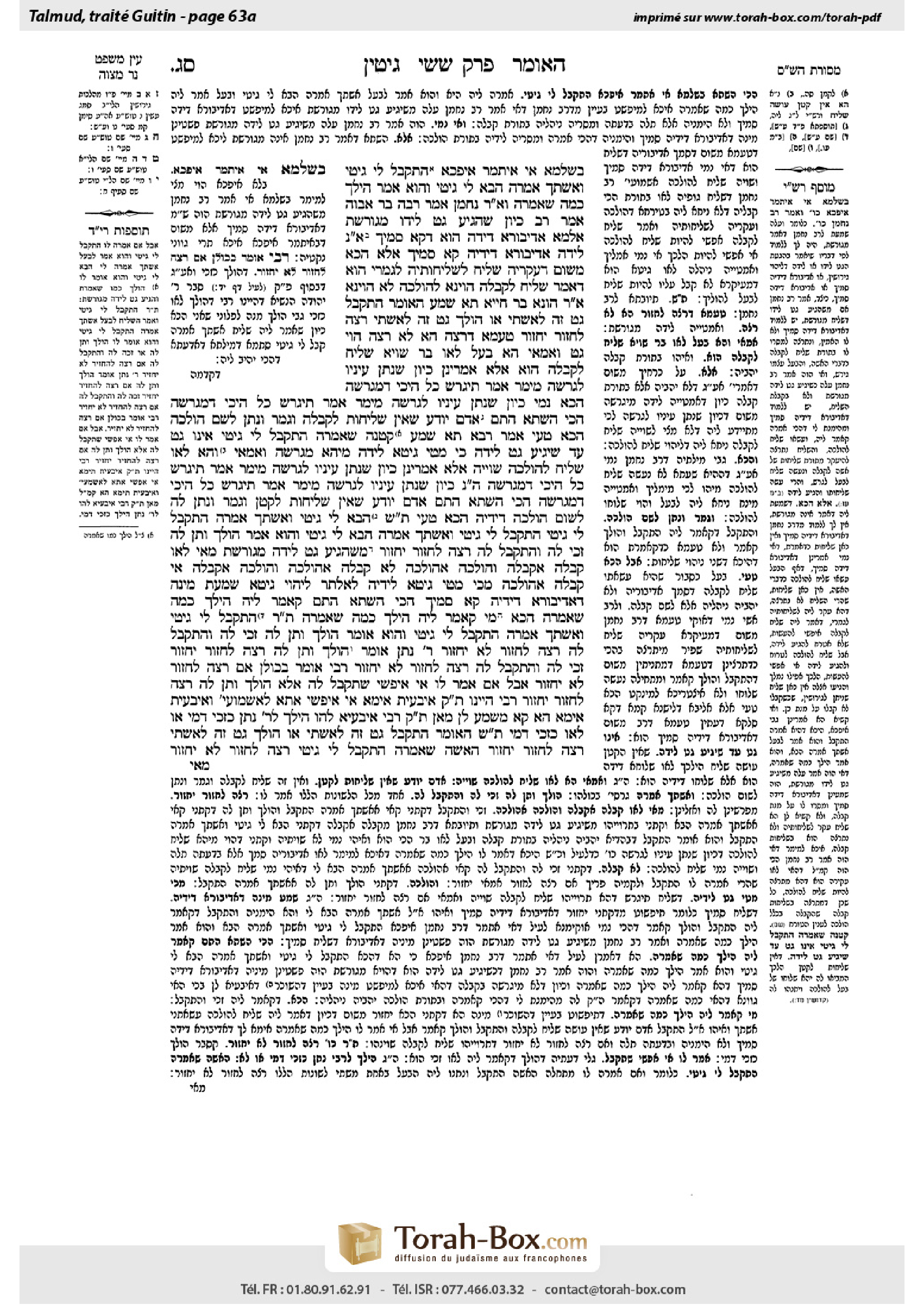
Gittin 63a: Talmud study for Daf Yomi
Study the Talmud for Daf Yomi with scanned pages, Hebrew text, English translations from Sefaria and AI-generated French translations.
Passage selection and English or AI-generated French translation are available where the scan has annotations. Daf Study is independent of Torah-Box and Sefaria.
Browse Gittin · גיטין · All tractatesGittin 63a text and translations
This page of Gittin includes the Aramaic text, an English translation and an AI-generated French translation, alongside the scan above.
גיטין ס״ג א · Aramaic and Hebrew text
בִּשְׁלָמָא אִי אִיתְּמַר אִיפְּכָא: ״הִתְקַבֵּל לִי גִּיטִּי״, וְ״אִשְׁתְּךָ אָמְרָה הָבֵא לִי גִּיטִּי״, וְהוּא אֹמֵר: ״הֵילָךְ כְּמָה שֶׁאָמְרָה״; וְאָמַר רַב נַחְמָן אָמַר רַבָּה בַּר אֲבוּהּ אָמַר רַב: כֵּיוָן שֶׁהִגִּיעַ גֵּט לְיָדוֹ מְגוֹרֶשֶׁת – אַלְמָא אַדִּיבּוּרָא דִידַהּ הוּא דְּקָא סָמֵיךְ;
אִי נָמֵי ״לְיָדָהּ״ – אַדִּיבּוּרָא דִידֵיהּ קָא סָמֵיךְ. אֶלָּא הָכָא – מִשּׁוּם דְּעַקְרַיהּ שָׁלִיחַ לִשְׁלִיחוּתֵיהּ לִגְמָרֵי הוּא; דְּאָמַר: שָׁלִיחַ לְִקַבָּלָה הָוֵינָא, לְהוֹלָכָה לָא הָוֵינָא.
אָמַר רַב הוּנָא בַּר חִיָּיא: תָּא שְׁמַע, הָאוֹמֵר: ״הִתְקַבֵּל גֵּט זֶה לְאִשְׁתִּי״ אוֹ ״הוֹלֵךְ גֵּט זֶה לְאִשְׁתִּי״, רָצָה לַחְזוֹר – יַחְזוֹר. טַעְמָא דְּרָצָה, הָא לֹא רָצָה – הָוֵי גֵּט;
וְאַמַּאי? הָא בַּעַל לָאו בַּר שַׁוּוֹיֵי שָׁלִיחַ לְִקַבָּלָה הוּא! אֶלָּא אָמְרִינַן: כֵּיוָן שֶׁנָּתַן עֵינָיו לְגָרְשָׁהּ, מֵימָר אָמַר: תִּיגָּרַשׁ כֹּל הֵיכִי דְּמִגָּרְשָׁה; הָכָא נָמֵי, כֵּיוָן שֶׁנָּתַן עֵינָיו לְגָרְשָׁהּ, מֵימָר אָמַר: תִּיגָּרַשׁ כֹּל הֵיכִי דְּמִגָּרְשָׁה!
הָכִי הַשְׁתָּא?! הָתָם – אָדָם יוֹדֵעַ שֶׁאֵין שְׁלִיחוּת לְקַבָּלָה, וְגָמַר וְנָתַן לְשֵׁם הוֹלָכָה; הָכָא – טָעֵי.
אָמַר רָבָא: תָּא שְׁמַע, קְטַנָּה שֶׁאָמְרָה: ״הִתְקַבֵּל לִי גִּיטִּי״ – אֵינוֹ גֵּט עַד שֶׁיַּגִּיעַ גֵּט לְיָדָהּ. כִּי מָטֵי גִּיטָּא לִידַהּ – מִיהָא מִגָּרְשָׁה, וְאַמַּאי? וְהָא לָאו שָׁלִיחַ לְהוֹלָכָה שַׁוְּיֵיהּ! אֶלָּא אָמְרִינַן: כֵּיוָן שֶׁנָּתַן עֵינָיו לְגָרְשָׁהּ, מֵימָר אָמַר: תִּיגָּרַשׁ כֹּל הֵיכִי דְּמִגָּרְשָׁה; הָכָא נָמֵי, כֵּיוָן שֶׁנָּתַן עֵינָיו לְגָרְשָׁהּ, מֵימָר אָמַר: תִּיגָּרַשׁ כֹּל הֵיכִי דְּמִגָּרְשָׁה!
הָכִי הַשְׁתָּא?! הָתָם – אָדָם יוֹדֵעַ שֶׁאֵין שְׁלִיחוּת לְקָטָן, וְגָמַר וְנָתַן לָהּ לְשׁוּם הוֹלָכָה דִּידֵיהּ; הָכָא – טָעֵי.
תָּא שְׁמַע: ״הָבֵא לִי גִּיטִּי״, וְ״אִשְׁתְּךָ אָמְרָה הִתְקַבֵּל לִי גִּיטִּי״; ״הִתְקַבֵּל לִי גִּיטִּי״, וְ״אִשְׁתְּךָ אָמְרָה הָבֵא לִי גִּיטִּי״, וְהוּא אֹמֵר: ״הוֹלֵךְ וְתֵן לָהּ״, ״זְכֵי לָהּ״, וְ״הִתְקַבֵּל לָהּ״ – רָצָה לַחְזוֹר, יַחְזוֹר; מִשֶּׁהִגִּיעַ גֵּט לְיָדָהּ – מְגוֹרֶשֶׁת.
מַאי, לָאו קַבָּלָה – אַקַּבָּלָה, וְהוֹלָכָה – אַהוֹלָכָה?
לָא; קַבָּלָה – אַהוֹלָכָה, וְהוֹלָכָה – אַקַּבָּלָה.
אִי קַבָּלָה אַהוֹלָכָה – מִכִּי מָטֵי גִּיטָּא לִידֵיהּ, לְאַלְתַּר לֶיהֱוֵי גִּיטָּא! שָׁמְעַתְּ מִינַּהּ, דְּאַדִּיבּוּרָא דִידֵיהּ קָא סָמֵיךְ!
הָכִי הַשְׁתָּא?! הָתָם קָאָמַר לֵיהּ: ״הֵילָךְ כְּמָה שֶׁאָמְרָה״, הָכָא מִי קָאָמַר לֵיהּ: ״הֵילָךְ כְּמָה שֶׁאָמְרָה״?!
תָּנוּ רַבָּנַן: ״הִתְקַבֵּל לִי גִּיטִּי״, וְ״אִשְׁתְּךָ אָמְרָה הִתְקַבֵּל לִי גִּיטִּי״, וְהוּא אוֹמֵר: ״הוֹלֵךְ״, וְ״תֵן לָהּ״, ״זְכֵי לָהּ״, וְ״הִתְקַבֵּל לָהּ״ – רָצָה לַחְזוֹר, לֹא יַחְזוֹר. רַבִּי נָתָן אוֹמֵר: ״הוֹלֵךְ וְתֵן לָהּ״ – רָצָה לַחְזוֹר, יַחְזוֹר; ״זְכֵי לָהּ״ וְ״הִתְקַבֵּל לָהּ״ – רָצָה לַחְזוֹר, לֹא יַחְזוֹר.
רַבִּי אוֹמֵר: בְּכוּלָּן – אִם רָצָה לַחְזוֹר, לֹא יַחְזוֹר. אֲבָל אִם אָמַר לוֹ: ״אִי אֶיפְשִׁי שֶׁתְּקַבֵּל לָהּ, אֶלָּא הוֹלֵךְ וְתֵן לָהּ״, רָצָה לַחְזוֹר – יַחְזוֹר.
רַבִּי הַיְינוּ תַּנָּא קַמָּא! אִיבָּעֵית אֵימָא: ״אִי אֶיפְשִׁי״ אֲתָא לְאַשְׁמוֹעִינַן; וְאִיבָּעֵית אֵימָא: הָא קָא מַשְׁמַע לַן, מַאן תַּנָּא קַמָּא – רַבִּי.
אִיבַּעְיָא לְהוּ: ״הֵילָךְ״ – לְרַבִּי נָתָן, כִּ״זְכֵי״ דָּמֵי, אוֹ לָאו כִּ״זְכֵי״ דָּמֵי?
תָּא שְׁמַע: הָאוֹמֵר ״הִתְקַבֵּל גֵּט זֶה לְאִשְׁתִּי״ אוֹ ״הוֹלֵךְ גֵּט זֶה לְאִשְׁתִּי״, רָצָה לַחְזוֹר – יַחְזוֹר. הָאִשָּׁה שֶׁאָמְרָה: ״הִתְקַבֵּל לִי גִּיטִּי״, רָצָה לַחְזוֹר – לֹא יַחְזוֹר.
Gittin 63a · English translation
Granted, if the opposite was stated, i.e., a case where the woman said: Receive my bill of divorce for me, and the agent said to the husband: Your wife said: Bring me my bill of divorce, and the husband said: Here you are, as she said, and Rav Naḥman says that Rabba bar Avuh says that Rav says: Once the bill of divorce reaches the agent’s possession, she is divorced, it would be understandable. Apparently, the husband relies upon her statement that the agent is an agent of receipt, and he intended to give the agent the status the wife assigned, not the one the agent says she assigned.
Alternatively, if Rav Naḥman ruled: Once the bill of divorce reaches her possession, she is divorced, one could conclude that the husband relies on the agent’s statement, and based on that statement, the agent is designated as an agent for delivery. However, here, in the case cited, where Rav Naḥman rules that she is not divorced, it is not because the husband relies on one statement or the other. Rather, it is due to the fact that by means of his statement the agent negates his agency entirely, as he said: I am an agent for receipt, meaning: I am not to be an agent for delivery. He is essentially saying that he is not prepared to go to the trouble of delivering the bill of divorce to her. Therefore, even if he does ultimately deliver the bill of divorce to her, he is an agent neither for the woman nor for her husband. No conclusion can be drawn with regard to the question of which statement the husband relies upon.
Rav Huna bar Ḥiyya says: Come and hear an objection to the statement of Rav Naḥman from the mishna: With regard to one who says to another: Receive this bill of divorce for my wife, or: Deliver this bill of divorce to my wife as my agent, if the husband seeks to retract his designation he may retract it. Rav Huna bar Ḥiyya infers: The reason she is not divorced is that he seeks to retract his designation. However, if he did not seek to retract it, it is a valid bill of divorce.
He asks: But why is she divorced when the husband says: Receive this bill of divorce for my wife? Isn’t the husband ineligible to designate an agent for receipt? Rather, we say: Once he decided to divorce her, he said to himself: Let her be divorced any way that she is divorced. His statement: Receive this bill of divorce for my wife, does not prevent the divorce from taking effect. Here too, in the case mentioned by Rav Naḥman, once he decided to divorce her, he says: Let her be divorced any way that she is divorced.
The Gemara rejects this: How can these cases be compared? There, in the case where one says: Receive this bill of divorce for my wife, the principle that a person knows that agency for receipt cannot be designated by the husband is in effect, and he decided to give the bill of divorce to the agent for the sake of delivery. When he told the agent to receive the document, his intent was that the agent should receive the document in order to deliver it to his wife, not that the act of divorce should take effect when the agent receives it. However here, in the case where the agent misrepresented what the woman said, the husband errs and relies upon the statement of the agent, who said that he is the woman’s agent for receipt.
Rava said: Come and hear an objection to the statement of Rav Naḥman from a mishna (65a). In the case of a minor girl who said to an agent: Receive my bill of divorce for me, it is not a bill of divorce that takes effect until it reaches her possession, as a minor is incapable of designating an agent. Rava infers: In any event, once the bill of divorce reaches her possession she is divorced. He asks: But why is that the case? The husband did not designate him an agent for delivery. Rather, we say: Once he decided to divorce her, he said to himself: Let her be divorced any way that she is divorced, and the agent is designated as his agent for delivery. Here too, in the case mentioned by Rav Naḥman, once he decided to divorce her, he says: Let her be divorced any way that she is divorced.
The Gemara rejects this: How can these cases be compared? There, in the case where the minor girl designated the agent, the principle that a person knows that there is no agency for a minor applies, and he decided to give the bill of divorce to the agent as an agent for delivery. However, here, in the case where the agent misrepresented what the woman said, the husband errs and relies upon the statement of the agent, who said that he is the woman’s agent for receipt.
The Gemara states: Come and hear an objection to the statement of Rav Naḥman from a baraita (Tosefta 6:2). With regard to a woman who said to an agent: Bring me my bill of divorce, and the agent said to her husband: Your wife said: Receive my bill of divorce for me; or a woman who said: Receive my bill of divorce for me, and the agent said to her husband: Your wife said: Bring me my bill of divorce, and the husband said to the agent: Deliver and give it to her, or: Acquire it for her, or: Receive it for her, if the husband seeks to retract his designation he may retract it. However, once the bill of divorce reaches her possession, she is divorced.
What, is it not that the reference in the baraita is to a case where the husband responded with an expression of receipt, i.e., acquire it for her, or receive it for her, to the agent’s assertions of receipt, i.e., your wife said: Receive my bill of divorce for me, and where the husband responded with expressions of delivery, i.e., deliver and give it to her, to assertions of delivery, i.e., your wife said: Bring me my bill of divorce? The ruling in the baraita is that the bill of divorce takes effect once it reaches her possession. The case of an assertion of receipt and a response of receipt contradicts Rav Naḥman’s statement, as in a case where the woman spoke of delivery and the agent said to her husband that his wife spoke of receipt, the woman is not divorced even when the bill of divorce reaches her possession.
The Gemara rejects this: No, the reference in the baraita is to a case where the husband responded with expressions of receipt, corresponding to the statement of his wife, to the agent’s assertions of delivery, and where the husband responded with expressions of delivery, corresponding to the statement of his wife, to the agent’s assertions of receipt. That is why the woman is divorced when the bill of divorce reaches her possession.
The Gemara asks: If it is a case where the husband responded with expressions of receipt, corresponding to the statement of his wife, to the agent’s assertions of delivery, then from the moment that the bill of divorce reaches the agent’s possession let it be a bill of divorce that takes effect immediately [le’altar], as the woman’s designation of the agent as an agent of receipt remains in effect. Similar to the conclusion that the Gemara sought to draw from the statement of Rav Naḥman mentioned earlier, the Gemara says: Conclude from the fact that the ruling in the baraita is that the divorce takes effect only once it reaches the woman’s possession, that the husband relies on the agent’s statement and therefore designates the agent as an agent for delivery.
The Gemara rejects this: How can these cases be compared? There, in the case discussed by Rav Naḥman, the husband said to the agent: Here you are, as she said, explicitly tying the designation of the agent to the woman’s statement. Here does the husband say to the agent: Here you are, as she said? Instead he merely hands the bill of divorce to the agent, relying upon the agent’s statement.
The Sages taught in a baraita (Tosefta 6:1) that if the woman says to an agent: Receive my bill of divorce for me, and the agent says to her husband: Your wife said: Receive my bill of divorce for me, and the husband says: Deliver and give it to her, or: Acquire it for her, or: Receive it for her, once the husband hands the bill of divorce to the agent for receipt, if he seeks to retract his decision he cannot retract it, because the divorce has already taken effect. Rabbi Natan says: If the husband said: Deliver and give it to her, and he seeks to retract his designation, then as long as it has not yet reached the woman’s possession he can retract it, because the husband designated him an agent for delivery. However, if the husband said: Acquire it for her, or: Receive it for her, and he seeks to retract his decision he cannot retract it.
Rabbi Yehuda HaNasi says: In all of those cases, if he seeks to retract his decision he cannot retract it, because when he hands the document to the agent, the bill of divorce takes effect immediately. However, if he said to the agent explicitly: I do not want you to receive the bill of divorce for her; rather, deliver and give it to her, then if he seeks to retract his decision he can retract it.
The Gemara asks: The opinion of Rabbi Yehuda HaNasi is apparently identical to that of the first tanna; what is their dispute? The Gemara answers: If you wish, say that Rabbi Yehuda HaNasi comes to teach us that the explicit expression: I do not want you to receive the bill of divorce for her; rather, deliver and give it to her, is effective in negating the agent’s designation as an agent of receipt and designating him as an agent for delivery. And if you wish, say instead that this teaches us: Who is the first tanna of this baraita? It is Rabbi Yehuda HaNasi, and the baraita then clarifies Rabbi Yehuda HaNasi’s statement.
A dilemma was raised before the Sages. If the husband says: Here you are, according to Rabbi Natan is it comparable to a case where the husband said: Acquire, and therefore, he cannot retract his designation, or is it not comparable to a case where he said: Acquire?
The Gemara states: Come and hear a resolution of this dilemma from the mishna. With regard to one who says to another: Receive this bill of divorce for my wife, or: Deliver this bill of divorce to my wife as my agent, if the husband seeks to retract his designation and cancel the agency, he can retract it until it reaches his wife’s hand. However, with regard to a woman who said to an agent: Receive my bill of divorce for me, and the husband handed the bill of divorce to her agent, if the husband seeks to retract his decision to divorce his wife upon receipt of the bill of divorce by the agent, he cannot retract it.
Gittin 63a · Traduction française (IA)
Cela dit, si l'opposé avait été affirmé, c'est-à-dire un cas où la femme disait : Reçois mon acte de divorce pour moi, et l'agent disait au mari : Votre femme dit : Apporte-moi mon acte de divorce, et le mari disait : Ici tu as, comme elle l'a dit, et Rav Naḥman dit que Rabba bar Avuh dit que Rav dit : Une fois que l'acte de divorce est en possession de l'agent, elle est divorcée, cela serait compréhensible. Apparemment, le mari s'appuie sur son déclaration selon laquelle l'agent est un agent de réception, et il avait l'intention de confier à l'agent le statut que la femme avait assigné, pas celui que l'agent disait qu'elle avait assigné.
Une alternative, si Rav Naḥman avait décidé : Une fois que l'acte de divorce est en possession d'elle, elle est divorcée, on pourrait conclure que le mari s'appuie sur la déclaration de l'agent, et sur cette déclaration, l'agent est désigné comme agent de livraison. Cependant, ici, dans le cas cité, où Rav Naḥman décide qu'elle n'est pas divorcée, ce n'est pas parce que le mari s'appuie sur l'une ou l'autre déclaration. C'est plutôt en raison du fait que, par sa déclaration, l'agent nie entièrement son mandat, car il a dit : Je suis un agent de réception, ce qui signifie : Je ne dois pas être un agent de livraison. Il affirme essentiellement qu'il n'est pas prêt à fournir la peine de livrer l'acte de divorce à elle. Par conséquent, même si il finit par livrer l'acte de divorce à elle, il n'est pas un agent ni pour la femme ni pour son mari. Aucune conclusion ne peut être tirée concernant la question de la déclaration sur laquelle le mari s'appuie.
Rav Huna bar Ḥiyya dit : Viens entendre une objection à la déclaration de Rav Naḥman à partir de la mitsna : Concernant celui qui dit à un autre : Reçois ce document de divorce pour ma femme, ou : Livre ce document de divorce à ma femme en tant qu'agent, si le mari veut révoquer son désignation, il peut le faire. Rav Huna bar Ḥiyya infère : La raison pour laquelle elle n'est pas divorcée est qu'il veut révoquer son désignation. Cependant, si il n'avait pas voulu le faire, ce serait un document de divorce valide.
Il demande : Mais pourquoi est-elle divorcée lorsque le mari dit : Reçois ce document de divorce pour ma femme ? N'est-il pas inéligible à désigner un agent de réception ? Plutôt, nous disons : Une fois qu'il a décidé de divorcer d'elle, il s'est dit : Laisse-la être divorcée de la manière dont elle est divorcée. Sa déclaration : Reçois ce document de divorce pour ma femme, ne bloque pas l'effet du divorce. Ici aussi, dans le cas mentionné par Rav Naḥman, une fois qu'il a décidé de divorcer d'elle, il dit : Laisse-la être divorcée de la manière dont elle est divorcée.
La Guemara rejette cela : Comment peuvent ces cas être comparés ? Là, dans le cas où l'on dit : Reçois ce document de divorce pour ma femme, le principe selon lequel une personne sait qu'un mandat de réception ne peut être désigné par le mari est en vigueur, et il a décidé de donner le document de divorce à l'agent à l'intention de la livraison. Lorsqu'il a dit à l'agent de recevoir le document, son intention était que l'agent reçoive le document afin de le livrer à sa femme, pas que l'effet du divorce s'opère lorsque l'agent reçoit le document. Cependant, ici, dans le cas où l'agent a mal interprété ce que la femme avait dit, le mari s'est trompé et s'appuie sur la déclaration de l'agent, qui a dit qu'il était l'agent de réception de la femme.
Rava a dit : Viens entendre une objection à la déclaration de Rav Naḥman à partir d'une mitsna (65a). Dans le cas d'une jeune fille mineure qui a dit à un agent : Reçois mon acte de divorce pour moi, ce n'est pas un acte de divorce qui prend effet jusqu'à ce qu'il atteigne sa possession, car une mineure n'est pas capable de désigner un agent. Rava infère : En tout cas, une fois que l'acte de divorce est en possession d'elle, elle est divorcée. Il demande : Mais pourquoi est-ce le cas ? Le mari n'a pas désigné l'agent comme agent de livraison. Plutôt, nous disons : Une fois qu'il a décidé de divorcer d'elle, il s'est dit : Laisse-la être divorcée de la manière dont elle est divorcée, et l'agent est désigné comme son agent de livraison. Ici aussi, dans le cas mentionné par Rav Naḥman, une fois qu'il a décidé de divorcer d'elle, il dit : Laisse-la être divorcée de la manière dont elle est divorcée.
La Guemara rejette cela : Comment peuvent ces cas être comparés ? Là, dans le cas où la jeune fille mineure a désigné l'agent, le principe selon lequel une personne sait qu'il n'y a pas de mandat pour une mineure s'applique, et il a décidé de donner l'acte de divorce à l'agent en tant qu'agent de livraison. Cependant, ici, dans le cas où l'agent a mal interprété ce que la femme avait dit, le mari s'est trompé et s'appuie sur la déclaration de l'agent, qui a dit qu'il était l'agent de réception de la femme.
La Guemara dit : Viens entendre une objection à la déclaration de Rav Naḥman à partir d'une baraïta (Tosefta 6:2). Concernant une femme qui a dit à un agent : Apporte-moi mon acte de divorce, et l'agent a dit à son mari : Votre femme a dit : Reçois mon acte de divorce pour moi ; ou une femme qui a dit : Reçois mon acte de divorce pour moi, et l'agent a dit à son mari : Votre femme a dit : Apporte-moi mon acte de divorce, et le mari a dit à l'agent : Livre-le et donne-le-lui, ou : Acquière-le pour elle, ou : Reçois-le pour elle, si le mari veut révoquer son désignation, il peut le faire. Cependant, une fois que l'acte de divorce est en possession d'elle, elle est divorcée.
Qu'est-ce que cela signifie, que la référence dans la baraïta est à un cas où le mari a répondu avec une expression de réception, c'est-à-dire : Acquière-le pour elle, ou reçois-le pour elle, aux affirmations de l'agent concernant la réception, c'est-à-dire : Votre femme a dit : Reçois mon acte de divorce pour moi, et où le mari a répondu avec des expressions de livraison, c'est-à-dire : Livre-le et donne-le-lui, aux affirmations de livraison, c'est-à-dire : Votre femme a dit : Apporte-moi mon acte de divorce ? La décision dans la baraïta est que l'acte de divorce prend effet une fois qu'il atteint sa possession. Le cas d'une affirmation de réception et d'une réponse de réception contredit la déclaration de Rav Naḥman, car dans un cas où la femme a parlé de livraison et que l'agent a dit au mari qu'elle avait parlé de réception, la femme n'est pas divorcée même lorsque l'acte de divorce atteint sa possession.
La Guemara rejette cela : Non, la référence dans la baraïta est à un cas où le mari répondait avec des expressions de réception, correspondant à l'affirmation de sa femme, aux déclarations de l'agent concernant la livraison, et où le mari répondait avec des expressions de livraison, correspondant à l'affirmation de sa femme, aux déclarations de l'agent concernant la réception. C'est pourquoi la femme est divorcée lorsque le document de divorce arrive en son possession.
La Guemara pose la question : Si c'est un cas où le mari répondait avec des expressions de réception, correspondant à l'affirmation de sa femme, aux déclarations de l'agent concernant la livraison, alors dès que le document de divorce arrive en possession de l'agent, il est un document de divorce qui prend effet immédiatement [le’altar], car la désignation de l'agent par la femme comme agent de réception reste en vigueur. De la même manière que la conclusion que la Guemara cherchait à établir à partir de la déclaration de Rav Naḥman mentionnée plus tôt, la Guemara dit : Concluez du fait que la décision dans la baraïta est que le divorce prend effet uniquement lorsque le document arrive en possession de la femme, que le mari repose sur la déclaration de l'agent et donc désigne l'agent comme agent de livraison.
La Guemara rejette cela : Comment peuvent ces cas être comparés ? Là, dans le cas discuté par Rav Naḥman, le mari disait à l'agent : Ici tu es, comme elle a dit, en liant explicitement la désignation de l'agent à l'affirmation de la femme. Ici, le mari dit à l'agent : Ici tu es, comme elle a dit ? Au lieu de cela, il remet simplement le document de divorce à l'agent, en se fondant sur la déclaration de l'agent.
Les Sages ont enseigné dans une baraïta (Tosefta 6:1) que si la femme dit à un agent : Reçois mon document de divorce pour moi, et l'agent dit à son mari : Votre femme a dit : Reçois mon document de divorce pour moi, et le mari dit : Livre-le et donne-le-lui, ou : Acquière-le pour elle, ou : Reçois-le pour elle, dès que le mari remet le document de divorce à l'agent pour la réception, s'il cherche à rétracter sa décision, il ne peut pas le faire, car le divorce a déjà pris effet. Rabbi Natan dit : Si le mari a dit : Livre-le et donne-le-lui, et s'il cherche à rétracter sa désignation, alors tant que le document n'a pas encore atteint la possession de la femme, il peut le rétracter, car le mari a désigné l'agent comme agent de livraison. Cependant, si le mari a dit : Acquière-le pour elle, ou : Reçois-le pour elle, et s'il cherche à rétracter sa décision, il ne peut pas le faire.
Rabbi Yehuda HaNasi dit : Dans tous ces cas, si le mari cherche à rétracter sa décision, il ne peut pas le faire, car lorsqu'il remet le document à l'agent, le divorce prend effet immédiatement. Cependant, si le mari a dit explicitement à l'agent : Je ne veux pas que tu reçoives le document de divorce pour elle ; plutôt, livre-le et donne-le-lui, alors si le mari cherche à rétracter sa décision, il peut le faire.
La Guemara pose la question : L'opinion de Rabbi Yehuda HaNasi semble être identique à celle du premier tanna ; quelle est leur divergence ? La Guemara répond : Si vous le souhaitez, dites que Rabbi Yehuda HaNasi vient enseigner que l'expression explicite : Je ne veux pas que tu reçoives le document de divorce pour elle ; plutôt, livre-le et donne-le-lui, est efficace pour négativer la désignation de l'agent comme agent de réception et désigner l'agent comme agent de livraison. Et si vous le souhaitez, dites plutôt que cela nous enseigne : Qui est le premier tanna de cette baraïta ? C'est Rabbi Yehuda HaNasi, et la baraïta clarifie alors la déclaration de Rabbi Yehuda HaNasi.
Un dilemme a été soulevé devant les Sages. Si le mari dit : Ici tu es, selon Rabbi Natan, cela est-il comparable à un cas où le mari a dit : Acquière, et donc, il ne peut pas rétracter sa désignation, ou n'est-il pas comparable à un cas où il a dit : Acquière ?
La Guemara dit : Approchez-vous et entendez la résolution de ce dilemme à partir de la mitsva. Concernant celui qui dit à un autre : Reçois ce document de divorce pour ma femme, ou : Livre ce document de divorce à ma femme en tant qu'agent, si le mari cherche à rétracter sa désignation et à annuler l'agence, il peut le faire jusqu'à ce que le document arrive en main de sa femme. Cependant, concernant une femme qui a dit à un agent : Reçois mon document de divorce pour moi, et le mari a remis le document de divorce à son agent, si le mari cherche à rétracter sa décision de divorcer sa femme après la réception du document de divorce par l'agent, il ne peut pas le faire.
Traduction française générée par IA à partir de l’édition anglaise de Sefaria. Vérifie toujours un passage avec le texte source.
Text from Sefaria: William Davidson Edition - Vocalized Aramaic (CC BY NC); William Davidson Edition - English (CC BY NC).