Gittin 8a: Talmud study for Daf Yomi
Study the Talmud for Daf Yomi with scanned pages, Hebrew text, English translations from Sefaria and AI-generated French translations.
Passage selection and English or AI-generated French translation are available where the scan has annotations. Daf Study is independent of Torah-Box and Sefaria.
Browse Gittin · גיטין · All tractatesGittin 8a text and translations
This page of Gittin includes the Aramaic text, an English translation and an AI-generated French translation, alongside the scan above.
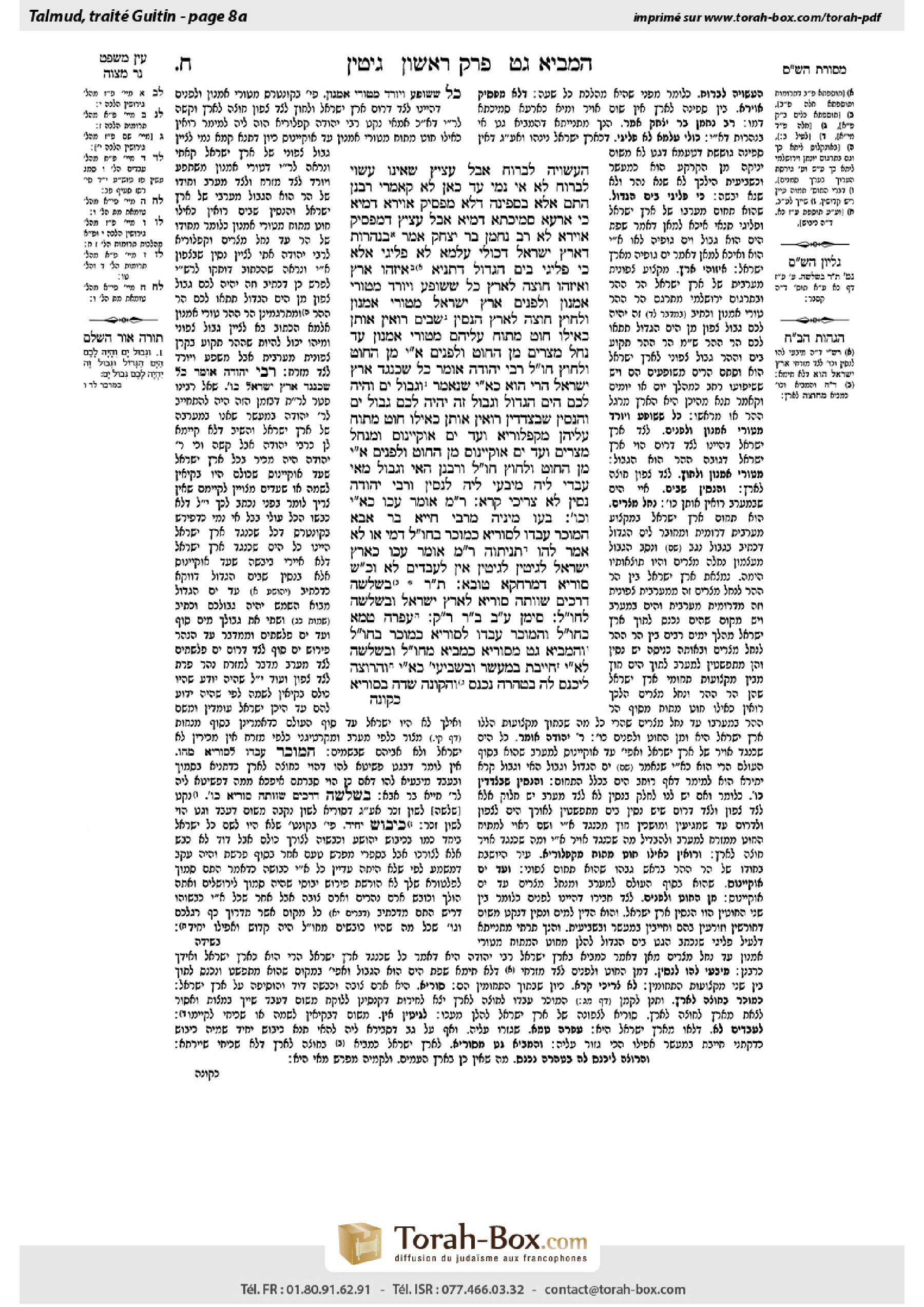
גיטין ח׳ א · Aramaic and Hebrew text
הָעֲשׂוּיָה לִבְרוֹחַ, אֲבָל עָצִיץ, שֶׁאֵינוֹ עָשׂוּי לִבְרוֹחַ – לֹא.
אִי נָמֵי: עַד כָּאן לָא קָאָמְרִי רַבָּנַן הָתָם אֶלָּא בִּסְפִינָה, דְּלָא מַפְסֵיק אַוֵּירָא – דְּמַיָּא כִּי אַרְעָא סְמִיכְתָּא דָּמְיָא; אֲבָל עָצִיץ, דְּמַפְסֵיק אַוֵּירָא – לָא.
רַב נַחְמָן בַּר יִצְחָק אָמַר: בִּנְהָרוֹת דְּאֶרֶץ יִשְׂרָאֵל דְּכוּלֵּי עָלְמָא לָא פְּלִיגִי. אֶלָּא כִּי פְּלִיגִי – בַּיָּם הַגָּדוֹל.
דְּתַנְיָא: אֵיזֶהוּ אֶרֶץ וְאֵיזֶהוּ חוּצָה לָאָרֶץ? כֹּל שֶׁשּׁוֹפֵעַ וְיוֹרֵד מִטּוּרֵי אַמְנוֹן וְלִפְנִים – אֶרֶץ יִשְׂרָאֵל; מִטּוּרֵי אַמְנוֹן וְלַחוּץ – חוּצָה לָאָרֶץ. הַנִּסִּין שֶׁבַּיָּם – רוֹאִין אוֹתָן כְּאִילּוּ חוּט מָתוּחַ עֲלֵיהֶם מִטּוּרֵי אַמְנוֹן עַד נַחַל מִצְרַיִם; מִן הַחוּט וְלִפְנִים – אֶרֶץ יִשְׂרָאֵל; מִן הַחוּט וְלַחוּץ – חוּצָה לָאָרֶץ.
רַבִּי יְהוּדָה אוֹמֵר: כֹּל שֶׁכְּנֶגֶד אֶרֶץ יִשְׂרָאֵל – הֲרֵי הוּא כְּאֶרֶץ יִשְׂרָאֵל, שֶׁנֶּאֱמַר: ״וּגְבוּל יָם, וְהָיָה לָכֶם הַיָּם הַגָּדוֹל וּגְבוּל, זֶה יִהְיֶה לָכֶם גְּבוּל יָם״.
וְהַנִּסִּין שֶׁבַּצְּדָדִין, רוֹאִין אוֹתָן כְּאִילּוּ חוּט מָתוּחַ עֲלֵיהֶן מִקַּפְלוּרְיָא וְעַד יָם אוֹקְיָינוֹס, וּמִנַּחַל מִצְרַיִם וְעַד יָם אוֹקְיָינוֹס; מִן הַחוּט וְלִפְנִים – אֶרֶץ יִשְׂרָאֵל, מִן הַחוּט וְלַחוּץ – חוּצָה לָאָרֶץ.
וְרַבָּנַן, הַאי ״וּגְבוּל״ מַאי עָבְדִי לֵיהּ? מִיבְּעֵי לֵיהּ לְנִסִּין. וְרַבִּי יְהוּדָה, נִסִּין לָא צְרִיכִי קְרָא.
רַבִּי מֵאִיר אוֹמֵר: עַכּוֹ – כְּאֶרֶץ יִשְׂרָאֵל וְכוּ׳: בְּעוֹ מִינֵּיהּ מֵרַבִּי חִיָּיא בַּר אַבָּא: הַמּוֹכֵר עַבְדּוֹ לְסוּרְיָא, כְּמוֹכֵר בְּחוּצָה לָאָרֶץ דָּמֵי, אוֹ לָא?
אֲמַר לְהוּ: תְּנֵיתוּהָ, רַבִּי מֵאִיר אוֹמֵר: עַכּוֹ – כְּאֶרֶץ יִשְׂרָאֵל לְגִיטִּין; לְגִיטִּין – אִין, לַעֲבָדִים – לָא, וְכׇל שֶׁכֵּן סוּרְיָא דִּמְרַחֲקָא טוּבָא.
תָּנוּ רַבָּנַן: בִּשְׁלֹשָׁה דְּרָכִים שָׁוְותָה סוּרְיָא לְאֶרֶץ יִשְׂרָאֵל, וּבִשְׁלֹשָׁה לְחוּצָה לָאָרֶץ. (סִימָן: עָב בַּר רַק). עֲפָרָהּ טָמֵא – כְּחוּצָה לָאָרֶץ, וְהַמּוֹכֵר עַבְדּוֹ לְסוּרְיָא – כְּמוֹכֵר בְּחוּצָה לָאָרֶץ. וְהַמֵּבִיא גֵּט מִסּוּרְיָא – כְּמֵבִיא מֵחוּצָה לָאָרֶץ.
וּבִשְׁלֹשָׁה לְאֶרֶץ יִשְׂרָאֵל: חַיֶּיבֶת בְּמַעֲשֵׂר וּבִשְׁבִיעִית – כְּאֶרֶץ יִשְׂרָאֵל, וְהָרוֹצֶה לִיכָּנֵס לָהּ בְּטׇהֳרָה – נִכְנָס, וְהַקּוֹנֶה שָׂדֶה בְּסוּרְיָא –
Gittin 8a · English translation
which is made to move, i.e., it is not set in one place. Consequently, one can argue that the soil in the boat is not considered attached to the ground. However, with regard to a flowerpot, which is not made to move, as ordinarily a flowerpot remains in one place, no, one cannot reasonably claim that the fixed soil in it is not part of the ground, even when the pot itself is not touching the ground.
Alternatively, one can say the opposite: Perhaps the Rabbis state their opinion, that the soil in the boat is considered to be like the land itself, only there, in the case of a boat, where there is no barrier of airspace between the soil in the boat and the land below, as water is considered to be like solid earth. Therefore, the soil in the boat is viewed as connected to the earth, and has the status of Eretz Yisrael. But in the case of a perforated pot, where there is a barrier of airspace, no, the soil is not connected to the ground.
Rav Naḥman bar Yitzḥak said: With regard to the rivers that are in Eretz Yisrael on which a boat is sailing, everyone agrees that a bill of divorce written on that boat is considered to be written in Eretz Yisrael. However, when they disagree it is with regard to the Great Sea, i.e., the Mediterranean Sea. In other words, is a boat located in the Mediterranean Sea considered to be in Eretz Yisrael or not?
As it is taught in the Tosefta (Terumot 2:12): What is Eretz Yisrael and what is outside of Eretz Yisrael? Any slope that descends at an angle from Turei Amnon in Syria and inward toward Eretz Yisrael is part of Eretz Yisrael. From Turei Amnon and outward, northward, is considered outside of Eretz Yisrael. With regard to the islands [nissin] that are in the sea, one views them as though a string were pulled taut over them from Turei Amnon in the north to the River of Egypt, Wadi el-Arish, in the south. From the string and inward, i.e., east, is Eretz Yisrael; from the string and outward, west, is considered outside of Eretz Yisrael. This is the opinion of the Rabbis.
Rabbi Yehuda says: Any place that is directly across from Eretz Yisrael, including the sea itself, is considered part of Eretz Yisrael, as it is stated: “And for the western border, you shall have the Great Sea for a border, this shall be your west border” (Numbers 34:6). According to this opinion, the entire territory directly across from Eretz Yisrael is considered part of Eretz Yisrael.
And with regard to the islands that are on the sides, which do not exactly line up on the north or the south, one views them as though a string were pulled taut over them in the north from Kefalorya, west of Turei Amnon, to the Atlantic Ocean, and in the south from the River of Egypt westward until the Atlantic Ocean. Those islands that lie from the string and inward are part of Eretz Yisrael, whereas those from the string and outward are outside of Eretz Yisrael.
The Gemara asks: And the Rabbis, what do they do with this verse: “And for the border”? Rabbi Yehuda’s opinion that the border of Eretz Yisrael extends into the sea is apparently supported by this verse. The Gemara answers: They require it to teach that the islands themselves are considered to be within Eretz Yisrael. And Rabbi Yehuda would respond that an additional verse is not required to teach the halakha concerning the islands, as it is clear that they are part of Eretz Yisrael.
§ The mishna teaches that Rabbi Meir says: Akko is like Eretz Yisrael with regard to bills of divorce. The Sages raised a dilemma before Rabbi Ḥiyya bar Abba: One who sells his slave to a master in Syria, is he considered like one who sells his slave outside of Eretz Yisrael, in which case the seller is penalized by the emancipation of his slave, or not?
Rabbi Ḥiyya bar Abba said to them: You learned a resolution for this dilemma from the mishna: Rabbi Meir says that Akko is like Eretz Yisrael with regard to bills of divorce, from which it may be inferred: With regard to bills of divorce, yes, but with regard to slaves, no, it is not considered part of Eretz Yisrael, and all the more so Syria, which is far more distant than Akko from the main areas of Eretz Yisrael. Therefore, this owner has sold his slave outside of Eretz Yisrael.
Having mentioned the status of Syria, the Gemara cites a related halakha. The Sages taught (Tosefta, Kelim 1:5): In three ways Syria is equal to Eretz Yisrael, and in three ways it is similar to outside of Eretz Yisrael. The Gemara inserts a mnemonic device for the ways in which Syria is different than Eretz Yisrael and is similar to Eretz Yisrael: Ayin beit, beit reish, reish kuf. Syria has the status of land that is outside of Eretz Yisrael in the following respects: First, its soil is ritually impure like that of land outside of Eretz Yisrael. And the second is that one who sells his slave to a master in Syria is like one who sells him to a master outside of Eretz Yisrael, and the second master is obligated to emancipate the slave. And third, one who brings a bill of divorce from Syria is like one who brings it from outside of Eretz Yisrael, in that he must say: It was written in my presence and it was signed in my presence.
And in three ways Syria is similar to Eretz Yisrael: Its produce is obligated in tithe and in the mitzvot of the Sabbatical Year like Eretz Yisrael. And one who wishes to enter it while remaining in a state of ritual purity may so enter, as though it were part of Eretz Yisrael. And one who acquires a field in Syria
Gittin 8a · Traduction française (IA)
qui est conçu pour être mobile, c'est-à-dire qu'il n'est pas fixé en un seul lieu. Ainsi, on peut arguer que le sol dans le bateau n'est pas considéré comme attaché au sol. Cependant, concernant un pot à fleurs, qui n'est pas conçu pour être mobile, puisque normalement un pot à fleurs reste en un seul lieu, on ne peut pas raisonnablement affirmer que le sol fixe dans ce pot n'est pas partie du sol, même lorsque le pot lui-même ne touche pas le sol.
Une autre possibilité est de dire le contraire : peut-être que les Sages affirment leur opinion, à savoir que le sol dans le bateau est considéré comme étant comme la terre elle-même, mais là, dans le cas du bateau, où il n'y a pas de barrière d'espace aérien entre le sol du bateau et la terre en dessous, puisque l'eau est considérée comme étant comme la terre ferme. Ainsi, le sol dans le bateau est vu comme étant connecté à la terre, et a le statut d'Éretz Yisrael. Cependant, dans le cas d'un pot percé, où il y a une barrière d'espace aérien, le sol n'est pas connecté au sol.
Rav Naḥman bar Yitzḥak a dit : Concernant les rivières d'Éretz Yisrael sur lesquelles un bateau navigue, tout le monde convient qu'un acte de divorce écrit sur ce bateau est considéré comme étant écrit en Éretz Yisrael. Cependant, lorsqu'ils divergent, c'est concernant la mer Méditerranée, c'est-à-dire, est-ce qu'un bateau situé dans la mer Méditerranée est considéré comme étant en Éretz Yisrael ou non ?
Comme il est enseigné dans la Tosefta (Terumot 2:12) : Qu'est-ce qui est considéré comme Éretz Yisrael et ce qui est en dehors d'Éretz Yisrael ? Toute pente qui descend à un angle depuis Turei Amnon en Syrie et vers l'intérieur d'Éretz Yisrael est partie d'Éretz Yisrael. De Turei Amnon et vers l'extérieur, vers le nord, est considéré comme étant en dehors d'Éretz Yisrael. Concernant les îles [nissin] qui sont dans la mer, on les considère comme si un fil était tiré à travers d'elles depuis Turei Amnon au nord jusqu'au fleuve d'Égypte, Wadi el-Arish, au sud. De ce fil et vers l'intérieur, c'est-à-dire à l'est, est Éretz Yisrael ; de ce fil et vers l'extérieur, à l'ouest, est considéré comme étant en dehors d'Éretz Yisrael. C'est l'opinion des Sages.
Rabbi Yehuda dit : Tout lieu qui est directement en face d'Éretz Yisrael, y compris la mer elle-même, est considéré comme faisant partie d'Éretz Yisrael, car il est dit : « Et pour la frontière occidentale, vous aurez la grande mer pour frontière, cela sera votre frontière occidentale » (Nombres 34:6). Selon cette opinion, toute la zone directement en face d'Éretz Yisrael est considérée comme faisant partie d'Éretz Yisrael.
Et concernant les îles qui sont aux côtés, qui ne s'alignent pas exactement au nord ou au sud, on les considère comme si un fil était tiré à travers d'elles au nord depuis Kefalorya, à l'ouest de Turei Amnon, jusqu'à l'océan Atlantique, et au sud depuis le fleuve d'Égypte vers l'ouest jusqu'à l'océan Atlantique. Ces îles qui sont à l'intérieur du fil sont partie d'Éretz Yisrael, tandis que celles à l'extérieur du fil sont en dehors d'Éretz Yisrael.
La Guemara pose la question : Et les Sages, qu'ont-ils à en faire avec cette verset : « Et pour la frontière » ? L'opinion de Rabbi Yehuda, selon laquelle la frontière d'Éretz Yisrael s'étend jusqu'à la mer, semble être soutenue par ce verset. La Guemara répond : Ils exigent cela pour enseigner que les îles elles-mêmes sont considérées comme faisant partie d'Éretz Yisrael. Et Rabbi Yehuda répondrait que l'on n'a pas besoin d'un autre verset pour enseigner la halakha concernant les îles, car il est clair qu'elles font partie d'Éretz Yisrael.
§ La Michna enseigne que Rabbi Meir dit : Akko est comme Éretz Yisrael concernant les actes de divorce. Les Sages ont posé un dilemme devant Rabbi Ḥiyya bar Abba : Celui qui vend son esclave à un maître en Syrie, est-il considéré comme celui qui vend son esclave en dehors d'Éretz Yisrael, dans lequel cas le vendeur est pénalisé par l'émancipation de son esclave, ou non ?
Rabbi Ḥiyya bar Abba a dit à eux : Vous avez appris une résolution à cette dilemme à partir de la Michna : Rabbi Meir dit que Akko est comme Éretz Yisrael concernant les actes de divorce, d'où il peut être inféré : concernant les actes de divorce, oui, mais concernant les esclaves, non, il n'est pas considéré comme faisant partie d'Éretz Yisrael, et encore plus encore Syrie, qui est plus éloignée que Akko des zones principales d'Éretz Yisrael. Ainsi, ce propriétaire a vendu son esclave en dehors d'Éretz Yisrael.
Ayant mentionné le statut de Syrie, la Guemara cite une halakha liée. Les Sages ont enseigné (Tosefta, Kelim 1:5) : Syrie est égale à Éretz Yisrael en trois façons, et similaire à en dehors d'Éretz Yisrael en trois façons. La Guemara insère un dispositif mnémotechnique pour les façons selon lesquelles Syrie diffère d'Éretz Yisrael et est similaire à Éretz Yisrael : Ayin beit, beit reish, reish kuf. Syrie a le statut de terre en dehors d'Éretz Yisrael dans les aspects suivants : Premièrement, son sol est impur rituellement comme celui de la terre en dehors d'Éretz Yisrael. Deuxièmement, celui qui vend son esclave à un maître en Syrie est comme celui qui le vend à un maître en dehors d'Éretz Yisrael, et le second maître est tenu d'émanciper l'esclave. Troisièmement, celui qui apporte un acte de divorce depuis Syrie est comme celui qui l'apporte depuis en dehors d'Éretz Yisrael, dans le sens où il doit dire : Il a été écrit en mon présence et il a été signé en mon présence.
Et Syrie est similaire à Éretz Yisrael en trois façons : ses produits sont soumis à la dîme et aux mitsvot de l'année sabbatique comme Éretz Yisrael. Et celui qui veut entrer dedans tout en restant dans un état de pureté rituelle peut le faire, comme si c'était partie d'Éretz Yisrael. Et celui qui acquiert un champ en Syrie est tenu de le sanctifier comme un champ d'Éretz Yisrael.
Traduction française générée par IA à partir de l’édition anglaise de Sefaria. Vérifie toujours un passage avec le texte source.
Text from Sefaria: William Davidson Edition - Vocalized Aramaic (CC BY NC); William Davidson Edition - English (CC BY NC).