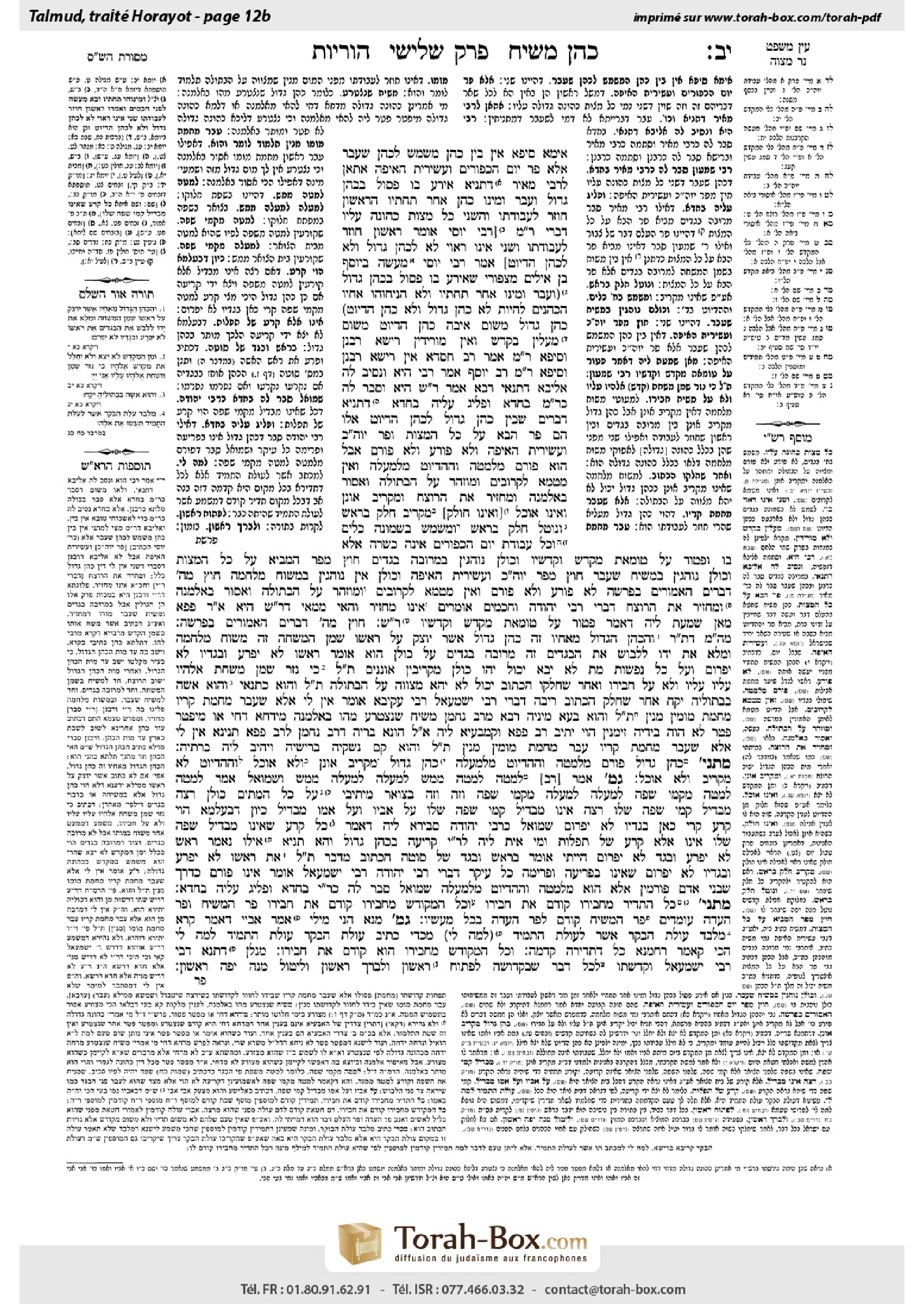
Horayot 12b: Talmud study for Daf Yomi
Study the Talmud for Daf Yomi with scanned pages, Hebrew text, English translations from Sefaria and AI-generated French translations.
Passage selection and English or AI-generated French translation are available where the scan has annotations. Daf Study is independent of Torah-Box and Sefaria.
Browse Horayot · הוריות · All tractatesHorayot 12b text and translations
This page of Horayot includes the Aramaic text, an English translation and an AI-generated French translation, alongside the scan above.
הוריות י״ב ב · Aramaic and Hebrew text
אֵימָא סֵיפָא: אֵין בֵּין כֹּהֵן מְשַׁמֵּשׁ לְכֹהֵן שֶׁעָבַר אֶלָּא פַּר יוֹם הַכִּפּוּרִים וַעֲשִׂירִית הָאֵיפָה. אֲתָאן לְרַבִּי מֵאִיר. דְּתַנְיָא: אֵירַע בּוֹ פְּסוּל בְּכֹהֵן גָּדוֹל וְעָבַר וּמִינּוּ כֹּהֵן אַחֵר תַּחְתָּיו – הָרִאשׁוֹן חוֹזֵר לַעֲבוֹדָתוֹ, וְהַשֵּׁנִי כׇּל מִצְוֹת כְּהוּנָּה עָלָיו, דִּבְרֵי רַבִּי מֵאִיר. [רַבִּי יוֹסֵי אוֹמֵר: רִאשׁוֹן חוֹזֵר לַעֲבוֹדָתוֹ, וְשֵׁנִי אֵינוֹ רָאוּי לֹא לְכֹהֵן גָּדוֹל וְלֹא לְכֹהֵן הֶדְיוֹט].
אָמַר רַבִּי יוֹסֵי: מַעֲשֶׂה בְּיוֹסֵף בֶּן אִילֵּים מִצִּפּוֹרִי שֶׁאֵירַע בּוֹ פְּסוּל בְּכֹהֵן גָּדוֹל, וְעָבַר, וּמִינּוּ אַחֵר תַּחְתָּיו, וְלֹא הֱנִיחוּהוּ אֶחָיו הַכֹּהֲנִים לִהְיוֹת לֹא כֹּהֵן גָּדוֹל וְלֹא כֹּהֵן הֶדְיוֹט. כֹּהֵן גָּדוֹל מִשּׁוּם אֵיבָה, כֹּהֵן הֶדְיוֹט מִשּׁוּם מַעֲלִין בַּקֹּדֶשׁ וְאֵין מוֹרִידִין.
רֵישָׁא רַבָּנַן וְסֵיפָא רַבִּי מֵאִיר? אָמַר רַב חִסְדָּא: אִין, רֵישָׁא רַבָּנַן וְסֵיפָא רַבִּי מֵאִיר. רַב יוֹסֵף אָמַר: רַבִּי הִיא, וְנָסֵיב לַהּ אַלִּיבָּא דְתַנָּאֵי.
רָבָא אָמַר: רַבִּי שִׁמְעוֹן הִיא וְסָבַר לַהּ כְּרַבִּי מֵאִיר בַּחֲדָא, וּפְלִיג עֲלֵיהּ בַּחֲדָא.
דְּתַנְיָא: דְּבָרִים שֶׁבֵּין כֹּהֵן גָּדוֹל לְכֹהֵן הֶדְיוֹט אֵלּוּ הֵם: פַּר הַבָּא עַל כׇּל הַמִּצְוֹת, וּפַר יוֹם הַכִּפּוּרִים, וַעֲשִׂירִית הָאֵיפָה, וְלֹא פּוֹרֵעַ וְלֹא פּוֹרֵם. אֲבָל הוּא פּוֹרֵם מִלְּמַטָּה וְהַהֶדְיוֹט מִלְמַעְלָה. וְאֵין מִטַּמֵּא לִקְרוֹבִים, וּמוּזְהָר עַל הַבְּתוּלָה, וְאָסוּר בָּאַלְמָנָה, וּמַחְזִיר אֶת הָרוֹצֵחַ,
וּמַקְרִיב אוֹנֵן, וְאֵינוֹ אוֹכֵל [וְאֵינוֹ חוֹלֵק]. מַקְרִיב חֵלֶק בָּרֹאשׁ, וְנוֹטֵל חֵלֶק בָּרֹאשׁ, וּמְשַׁמֵּשׁ בִּשְׁמוֹנָה כֵּלִים. וְכׇל עֲבוֹדַת יוֹם הַכִּפּוּרִים אֵינָהּ כְּשֵׁרָה אֶלָּא בּוֹ, וּפָטוּר עַל טוּמְאַת מִקְדָּשׁ וְקָדָשָׁיו.
וְכוּלָּן נוֹהֲגִין בִּמְרוּבֵּה בְגָדִים חוּץ מִפַּר הַמֵּבִיא עַל כׇּל הַמִּצְוֹת, וְכוּלָּן נוֹהֲגִין בְּמָשִׁיחַ שֶׁעָבַר חוּץ מִפַּר יוֹם הַכִּיפּוּרִים וַעֲשִׂירִית הָאֵיפָה, וְכוּלָּן אֵין נוֹהֲגִין בִּמְשׁוּחַ מִלְחָמָה חוּץ מֵחֲמִשָּׁה דְּבָרִים הָאֲמוּרִים בַּפָּרָשָׁה: לֹא פּוֹרֵעַ וְלֹא פּוֹרֵם, וְאֵין מִטַּמֵּא לִקְרוֹבִים, וּמוּזְהָר עַל הַבְּתוּלָה, וְאָסוּר בָּאַלְמָנָה, וּמַחֲזִיר אֶת הָרוֹצֵחַ, דִּבְרֵי רַבִּי יְהוּדָה. וַחֲכָמִים אוֹמְרִים: אֵינוֹ מַחְזִיר.
וְהַאי מִמַּאי דְּרַבִּי שִׁמְעוֹן הִיא? אָמַר רַב פָּפָּא: מַאן שָׁמְעַתְּ לֵיהּ דְּאָמַר פָּטוּר עַל טוּמְאַת מִקְדָּשׁ וְקָדָשָׁיו? רַבִּי שִׁמְעוֹן.
חוּץ מֵחֲמִשָּׁה דְּבָרִים הָאֲמוּרִים בַּפָּרָשָׁה. מְנָא הָנֵי מִילֵּי? דְּתָנוּ רַבָּנַן: ״וְהַכֹּהֵן הַגָּדוֹל מֵאֶחָיו״ – זֶה כֹּהֵן גָּדוֹל, ״אֲשֶׁר יוּצַק עַל רֹאשׁוֹ שֶׁמֶן הַמִּשְׁחָה״ – זֶה מְשׁוּחַ מִלְחָמָה, ״וּמִלֵּא אֶת יָדוֹ לִלְבֹּשׁ אֶת הַבְּגָדִים״ – זֶה מְרוּבֵּה בְגָדִים. עַל כּוּלָּן הוּא אוֹמֵר: ״רֹאשׁוֹ לֹא יִפְרָע וּבְגָדָיו לֹא יִפְרֹם וְעַל כׇּל נַפְשֹׁת מֵת לֹא יָבֹא״.
יָכוֹל יְהוּ כּוּלָּן מַקְרִיבִין אוֹנְנִים? תַּלְמוּד לוֹמַר: ״כִּי נֵזֶר שֶׁמֶן מִשְׁחַת אֱלֹהָיו עָלָיו״ – ״עָלָיו״ וְלֹא עַל חֲבֵירוֹ. וְאַחַר שֶׁחָלְקוּ הַכָּתוּב, יָכוֹל לֹא יְהֵא מְצֻוֶּוה עַל הַבְּתוּלָה? תַּלְמוּד לוֹמַר: ״וְהוּא״.
כְּתַנָּאֵי: ״וְהוּא אִשָּׁה בִבְתוּלֶיהָ יִקָּח״, אַחַר שֶׁחִלֵּק הַכָּתוּב, רִיבָּה. דִּבְרֵי רַבִּי יִשְׁמָעֵאל. רַבִּי עֲקִיבָא אוֹמֵר: אֵין לִי אֶלָּא שֶׁעָבַר מֵחֲמַת קִרְיוֹ, מֵחֲמַת מוּמִין מִנַּיִן? תַּלְמוּד לוֹמַר: ״וְהוּא״.
בְּעָא מִינֵּיהּ רָבָא מֵרַב נַחְמָן: מָשִׁיחַ שֶׁנִּצְטָרַע, מַהוּ בְּאַלְמָנָה? מִידְחָא דָּחֵי, אוֹ מִיפְטָר פָּטַר? לָא הֲוָה בִּידֵיהּ.
זִימְנִין הָוֵי יָתֵיב רַב פָּפָּא וְקָמִבַּעְיָא לֵיהּ. אֲמַר לֵיהּ הוּנָא בְּרֵיהּ דְּרַב נַחְמָן לְרַב פָּפָּא, תְּנֵינָא: אֵין לִי אֶלָּא שֶׁעָבַר מֵחֲמַת קִרְיוֹ, עָבַר מֵחֲמַת מוּמִין מִנַּיִן? תַּלְמוּד לוֹמַר: ״וְהוּא״. קָם נַשְּׁקֵיהּ בְּרֵישֵׁיהּ וִיהַיב לֵיהּ בְּרַתֵּיה.
מַתְנִי׳ כֹּהֵן גָּדוֹל פּוֹרֵם מִלְּמַטָּה, וְהַהֶדְיוֹט מִלְמַעְלָה. כֹּהֵן גָּדוֹל מַקְרִיב אוֹנֵן וְלֹא אוֹכֵל, וְהַהֶדְיוֹט לֹא מַקְרִיב וְלֹא אוֹכֵל.
גְּמָ׳ אָמַר [רַב]: לְמַטָּה – לְמַטָּה מַמָּשׁ, לְמַעְלָה – לְמַעְלָה מַמָּשׁ. וּשְׁמוּאֵל אָמַר: לְמַטָּה – לְמַטָּה מִקַּמֵּי שָׂפָה, לְמַעְלָה – לְמַעְלָה מִקַּמֵּי שָׂפָה. וְזֶה וָזֶה בַּצַּוָּאר.
מֵיתִיבִי: עַל כׇּל הַמֵּתִים כּוּלָּן – רָצָה מַבְדִּיל קַמֵּי שָׂפָה שֶׁלּוֹ, רָצָה אֵינוֹ מַבְדִּיל קַמֵּי שָׂפָה שֶׁלּוֹ. עַל אָבִיו וְעַל אִמּוֹ – מַבְדִּיל, כֵּיוָן דִּבְעָלְמָא הָוֵי קֶרַע, קְרִי כָּאן ״בְּגָדָיו לֹא יִפְרֹם״!
שְׁמוּאֵל כְּרַבִּי יְהוּדָה סְבִירָא לֵיהּ, דְּאָמַר: כׇּל קֶרַע שֶׁאֵינוֹ מַבְדִּיל שָׂפָה שֶׁלּוֹ, אֵינוֹ אֶלָּא קֶרַע שֶׁל תִּפְלוּת. וּמִי אִית לֵיהּ לְרַבִּי יְהוּדָה קְרִיעָה בְּכֹהֵן גָּדוֹל?
וְהָא תַּנְיָא: אִילּוּ נֶאֱמַר ״רֹאשׁ לֹא יִפְרָע וּבֶגֶד לֹא יִפְרֹם״, הָיִיתִי אוֹמֵר: בְּרֹאשׁ וּבֶגֶד שֶׁל סוֹטָה הַכָּתוּב מְדַבֵּר, תַּלְמוּד לוֹמַר: ״אֶת רֹאשׁוֹ לֹא יִפְרָע וּבְגָדָיו לֹא יִפְרֹם״, שֶׁאֵינוֹ בִּפְרִיעָה וּפְרִימָה כׇּל עִיקָּר, דִּבְרֵי רַבִּי יְהוּדָה. רַבִּי יִשְׁמָעֵאל אוֹמֵר: אֵינוֹ פּוֹרֵם כְּדֶרֶךְ שֶׁבְּנֵי אָדָם פּוֹרְמִין, אֶלָּא הוּא מִלְּמַטָּה וְהַהֶדְיוֹט מִלְמַעְלָה.
שְׁמוּאֵל סָבַר לַהּ כְּרַבִּי יְהוּדָה בַּחֲדָא, וּפְלִיג עֲלֵיהּ בַּחֲדָא.
מַתְנִי׳ כׇּל הַתָּדִיר מֵחֲבֵירוֹ קוֹדֵם אֶת חֲבֵירוֹ, וְכׇל הַמְקוּדָּשׁ מֵחֲבֵירוֹ קוֹדֵם אֶת חֲבֵירוֹ. פַּר הַמָּשִׁיחַ וּפַר הָעֵדָה עוֹמְדִים – פַּר הַמָּשִׁיחַ קוֹדֵם לְפַר הָעֵדָה בְּכׇל מַעֲשָׂיו.
גְּמָ׳ מְנָא הָנֵי מִילֵּי? אָמַר אַבָּיֵי, דְּאָמַר קְרָא: ״מִלְּבַד עוֹלַת הַבֹּקֶר אֲשֶׁר לְעוֹלַת הַתָּמִיד״, (לְמָה לִי) מִכְּדֵי כְּתִיב ״עוֹלַת הַבֹּקֶר״ – ״עוֹלַת הַתָּמִיד״ לְמָה לִי? הָכִי קָאָמַר רַחֲמָנָא: כֹּל דִּתְדִירָה קָדְמָה.
וְכׇל הַמְקוּדָּשׁ מֵחֲבֵירוֹ הוּא קוֹדֵם אֶת חֲבֵירוֹ. מְנָלַן? דְּתָנָא דְּבֵי רַבִּי יִשְׁמָעֵאל: ״וְקִדַּשְׁתּוֹ״ – לְכׇל דָּבָר שֶׁבִּקְדוּשָּׁה: לִפְתּוֹחַ רִאשׁוֹן, וּלְבָרֵךְ רִאשׁוֹן, וְלִיטּוֹל מָנָה יָפָה רִאשׁוֹן.
Horayot 12b · English translation
Say the latter clause: The difference between a High Priest currently serving in that capacity and a former High Priest is only with regard to the bull brought by the High Priest on Yom Kippur and the tenth of an ephah meal-offering; but with regard to all other matters the two are equal. In this clause we arrive at the opinion of Rabbi Meir, as it is taught in a baraita: If temporary disqualification befell the High Priest and he left his position and they appointed another priest in his stead, after the cause of his disqualification passes, the first priest returns to his service as High Priest. And with regard to the second priest, all of the mitzvot of the High Priesthood are still incumbent upon him; this is the statement of Rabbi Meir. Rabbi Yosei says: The first returns to his service, and the second is unfit to serve in either position; he may serve neither as a High Priest nor as an ordinary priest.
The baraita continues. Rabbi Yosei said: There was an incident involving the priest Yosef ben Eilim of Tzippori: When disqualification befell a High Priest and he left his position, the priests appointed another, Yosef ben Eilim, in his stead. And after the cause of the disqualification passed, his brethren the priests did not allow Yosef ben Eilim to serve, neither as a High Priest nor as an ordinary priest. The Gemara explains: Neither as a High Priest, due to enmity, jealousy, and bitterness that would be engendered if there were two High Priests with equal standing in the Temple. Nor as an ordinary priest, because the principle is: One elevates to a higher level in matters of sanctity and one does not downgrade. Once he has served as a High Priest he cannot be restored to the position of an ordinary priest.
The Gemara asks: Can it be that the first clause of the mishna is in accordance with the opinion of the Rabbis, who disagree with Rabbi Meir, and the latter clause is in accordance with the opinion of Rabbi Meir? Rav Ḥisda said: Indeed, the first clause of the mishna is in accordance with the opinion of the Rabbis and the latter clause is in accordance with the opinion of Rabbi Meir. Rav Yosef said: The entire mishna is in accordance with the opinion of Rabbi Yehuda HaNasi, and he formulates the mishna according to different tanna’im. It is in accordance with the opinion of the Rabbis with regard to a High Priest consecrated by donning multiple garments, and in accordance with the opinion of Rabbi Meir with regard to a former High Priest.
Rava said: The entire mishna is stating the opinion of Rabbi Shimon, and he holds in accordance with the opinion of Rabbi Meir with regard to one matter and disagrees with him with regard to one matter.
This is as it is taught in a baraita: These are matters with regard to which there are differences between a High Priest and an ordinary priest: The High Priest brings the bull that comes for any of the mitzvot, and the bull of Yom Kippur, and the daily tenth of an ephah meal-offering. And he may not grow his hair long and may not rend his garments as expressions of mourning; but he rends his garment from below in an inconspicuous manner, and the ordinary priest rends his garment from above, in the typical manner. And the High Priest may not render himself impure with impurity imparted by a corpse even in the event that one of his relatives dies, and he is warned to marry a virgin, and it is prohibited for him to marry a widow, and when he dies he restores the unwitting murderer to his home from the city of refuge.
The baraita continues: And the High Priest sacrifices offerings even as an acute mourner on the day that a close relative dies, but he may not partake of the offerings on that day and he does not receive a share of those offerings. He sacrifices a portion at the head of the priests, i.e., whenever he chooses, and takes a portion at the head, i.e., he takes a portion from any offering that he chooses. And he performs the Temple service wearing eight priestly garments, and the entire Yom Kippur service is valid only when performed by him, and he is exempt from bringing a sliding-scale offering for the defiling of the Temple or its sacrificial foods.
The baraita continues: And all these halakhot are in effect with regard to the High Priest who is consecrated by donning multiple garments, except for the bull the High Priest brings for all the mitzvot. And all these halakhot are in effect with regard to a former anointed High Priest, except for the bull of Yom Kippur and the tenth of an ephah. And all these halakhot are not in effect with regard to a priest anointed for war, except for the five matters stated in the portion where the halakhot of the High Priest are enumerated (see Leviticus, chapter 21): He may not grow his hair long and may not rend his garments, and he may not render himself impure with impurity imparted by a corpse even in the event that one of his relatives dies, and he is warned to marry a virgin, and it is prohibited for him to marry a widow, and when he dies he restores the unwitting murderer to his home from the city of refuge; this is the statement of Rabbi Yehuda. And the Rabbis say: He does not restore the unwitting murderer to his home.
The Gemara asks: And with regard to this baraita, from where can it be derived that the tanna is Rabbi Shimon? Rav Pappa said: Whom did you hear who says: A High Priest is exempt from bringing a sliding-scale offering for the defiling of the Temple or its sacrificial foods? It is Rabbi Shimon. He holds in accordance with the opinion of Rabbi Meir with regard to a former High Priest, and in accordance with the opinion of the Rabbis with regard to the High Priest who is consecrated by donning multiple garments, who does not bring a bull for absence of awareness of the matter with the unwitting performance of an action.
§ The baraita teaches: And all these halakhot are not in effect with regard to a priest anointed for war, except for the five matters stated in the portion where the halakhot of the High Priest are enumerated. The Gemara asks: From where are these matters derived? The Gemara answers: It is as the Sages taught: “And the priest who is greater than his brethren” (Leviticus 21:10); this is a High Priest. “Upon whose head the anointing oil is poured”; this is the priest anointed for war. “And who is consecrated to don the garments”; this is the High Priest who is consecrated by donning multiple garments. With regard to all of them, the verse states: “He shall neither let the hair of his head grow, nor rend his garments, neither shall he come upon any dead body” (Leviticus 21:10–11).
One might have thought that all of these priests sacrifice offerings as acute mourners. Therefore, the verse states: “For the consecration of the anointing oil of his God is upon him” (Leviticus 21:12), from which it is derived: “Upon him,” the High Priest, but not upon another priest. And after the verse differentiated the priest anointed for war, one might have thought that he would not be commanded to marry a virgin, a mitzva that appears in the following verse. Therefore, the verse states with the letter vav as a prefix: “And he shall take a wife in her virginity” (Leviticus 21:13), which serves to include the priest anointed for war.
The Gemara comments: This is parallel to a dispute between tanna’im with regard to the verse “And he shall take a wife in her virginity.” Once the verse had distinguished between a priest anointed for war and a High Priest in terms of bringing offerings as an acute mourner, it included the priest anointed for war with regard to the halakhot that follow; this is the statement of Rabbi Yishmael. Rabbi Akiva says: I have derived only that the High Priest who stepped down for a brief period due to his seminal emission is commanded to marry a virgin. From where do I derive that a High Priest who stepped down due to blemishes, who will remain disqualified, is commanded to marry a virgin? Therefore, the verse states: “And he,” to include a High Priest who stepped down due to blemishes. According to Rabbi Akiva, there is no source available to include the priest anointed for war.
Rava raised a dilemma before Rav Naḥman: In the case of an anointed High Priest who was afflicted with leprosy, what is the halakha with regard to marrying a widow? Is he temporarily disqualified from service, i.e., does he remain a High Priest and is it therefore prohibited for him to marry a widow? Or is he totally absolved of his status as High Priest and therefore it is permitted for him to marry a widow? The answer was not available to him.
On another occasion, Rav Pappa was sitting and he raised the same dilemma. Huna, son of Rav Naḥman, said to Rav Pappa: We learn in a baraita: I have derived only that the High Priest who stepped down for a brief period due to his seminal emission is commanded to marry a virgin. From where do I derive that a High Priest who stepped down due to blemishes, who will remain disqualified, is commanded to marry a virgin? The verse states: “And he.” Leprosy is an example of a blemish, so it is prohibited for a High priest afflicted with leprosy to marry a widow. When Rav Pappa heard this baraita, he arose and kissed him on his head and gave him his daughter to marry, due to his appreciation for his expertise in Torah study.
MISHNA: A High Priest rends his garments from below when he is in mourning, and an ordinary priest rends his garments from above like a non-priest. A High Priest sacrifices offerings as an acute mourner, i.e., on the day of the death of one of his close relatives, but he may not eat from those offerings. And an ordinary priest who is an acute mourner neither sacrifices offerings nor eats from those offerings.
GEMARA: Rav says: From below, written with regard to the High Priest, means actually from below, from the bottom of the garment, and from above means actually from above, from the top of the garment. And Shmuel said: From below means from below the neckline, and from above means from above the neckline, i.e., from the neckline itself, and both this High Priest and that ordinary priest rend their garments at the neck of their garment.
The Gemara raises an objection to the opinion of Shmuel from a baraita: For all the dead relatives for whom one rends his garments, if he wishes he rends the neckline of his garment asunder; if he wishes he does not rend the neckline of his garment asunder. If he is rending his garments for his father or for his mother he rends the neckline asunder. Since in general, it is a tear even without rending the neckline asunder, one can read here with regard to the High Priest: “Nor rend his garments” (Leviticus 21:10). This supports the opinion of Rav that the High Priest does not rend his garments from above like others do; rather, he rends his garments from below.
The Gemara answers: Shmuel holds in accordance with the opinion of Rabbi Yehuda, who says: Any tear that does not rend his neckline asunder is only a gratuitous tear that serves no purpose. Since according to Rabbi Yehuda rending of garments involves rending the neckline, the High Priest may rend his garment from above provided that he does not rend the neckline. The Gemara asks: And is Rabbi Yehuda of the opinion that there is rending of garments for a High Priest?
But isn’t it taught in a baraita: Had it been stated: He shall neither let the hair of a head grow, nor rend garments, I would have said: It is with regard to the head and the garment of a woman suspected by her husband of having been unfaithful [sota] that the verse is speaking, and it means that the High Priest must not loosen her hair or rend her garments, in the manner that an ordinary priest does to the sota. Therefore, the verse states: “He shall neither let the hair of his head grow, nor rend his garments” (Leviticus 21:10), indicating that he is not included in the mitzva to grow long hair and rend garments at all; this is the statement of Rabbi Yehuda. Rabbi Yishmael says: He does not rend his garments in the manner that people typically rend their garments. Rather, he rends his garment from below and an ordinary priest rends his garments from above. Apparently, according to the opinion of Rabbi Yehuda, the High Priest does not rend his garments at all.
The Gemara answers: Shmuel holds in accordance with the opinion of Rabbi Yehuda with regard to one matter, i.e., the way in which garments are rent, and disagrees with him with regard to one matter, as Shmuel holds that the High Priest rends his garments.
MISHNA: Any mitzva that is more frequent than another mitzva precedes that other mitzva if the opportunity to fulfill one of them coincides with an opportunity to fulfill the other. And anyone who is more sanctified than another precedes that other person. If the bull of the anointed priest and the bull of the congregation, which are brought for absence of awareness of the matter, are pending, the bull of the anointed priest precedes the bull of the congregation in all its actions, i.e., its sacrificial rites.
GEMARA: The Gemara questions the statement in the mishna that the more frequent matter takes precedence: From where are these matters derived? Abaye said: It is as the verse states concerning the additional offerings brought on Festivals: “Beside the burnt-offering of the morning, which is for a daily burnt-offering” (Numbers 28:23). Once it is written: “The burnt-offering of the morning,” why do I need: “A daily burnt-offering”? Clearly the reference is to the daily burnt-offering of the morning. This is what the Merciful One is saying: Any matter that is more frequent takes precedence. Since it is a daily offering, it is more frequent. Therefore, it precedes other offerings.
The mishna continues: And anyone who is more sanctified than another precedes that other person. The Gemara asks: From where do we derive these matters? It is as the school of Rabbi Yishmael taught, that from the verse written with regard to a priest: “And you shall sanctify him, as he sacrifices the bread of your God, he shall be holy unto you” (Leviticus 21:8), it is derived that a priest should be esteemed and granted precedence with regard to any matter of sanctity. He should be the one to open first in the reading of the Torah, and to recite the blessing of the zimmun first, and to take a fine portion first. The priest who is more sanctified takes precedence.
Horayot 12b · Traduction française (IA)
Disons la clause ultérieure : La différence entre un grand prêtre actuellement en exercice et un ancien grand prêtre concerne uniquement le taureau que le grand prêtre offre le jour de l'Expiation et la dixième partie d'ephah de offrande de pain ; mais concernant toutes les autres questions, les deux sont égaux. Dans cette clause, nous arrivons à l'opinion de Rabbi Meir, comme il est enseigné dans une baraïta : Si un grand prêtre est temporairement disqualifié et quittant son poste, et qu'ils ont désigné un autre prêtre à sa place, après que la cause de sa disqualification ait disparu, le premier prêtre revient à son service en tant que grand prêtre. Et concernant le second prêtre, toutes les obligations des prêtres sont encore applicables à lui ; c'est l'opinion de Rabbi Meir. Rabbi Yosei dit : Le premier revient à son service, et le second n'est pas digne de servir dans aucun des deux postes ; il ne peut servir ni en tant que grand prêtre ni en tant que prêtre ordinaire.
La baraïta continue. Rabbi Yosei dit : Il y avait un cas concernant le prêtre Yosef ben Eilim de Tzippori : Lorsqu'un grand prêtre fut temporairement disqualifié et quitta son poste, les prêtres désignèrent Yosef ben Eilim à sa place. Et après que la cause de la disqualification ait disparu, ses frères les prêtres ne permirent pas à Yosef ben Eilim de servir, ni en tant que grand prêtre ni en tant que prêtre ordinaire. La Guemara explique : Ni en tant que grand prêtre, en raison de l'hostilité, de la jalousie et de la colère qui seraient engendrées s'il y avait deux grands prêtres de rang égal dans le Temple. Ni en tant que prêtre ordinaire, car le principe est : On élève à un niveau supérieur en matière de sainteté et on ne dégrade pas. Une fois qu'il a servi en tant que grand prêtre, il ne peut être restauré à la position de prêtre ordinaire.
La Guemara pose la question : Peut-il être que la première clause de la mitsna soit conforme à l'opinion des Rabbins, qui s'opposent à Rabbi Meir, et que la clause suivante soit conforme à l'opinion de Rabbi Meir ? Rav Ḥisda dit : En effet, la première clause de la mitsna est conforme à l'opinion des Rabbins et la clause suivante est conforme à l'opinion de Rabbi Meir. Rav Yosef dit : L'ensemble de la mitsna est conforme à l'opinion de Rabbi Yehuda HaNasi, et il formule la mitsna selon différents tannaïm. C'est conforme à l'opinion des Rabbins concernant un grand prêtre consacré en revêtant plusieurs vêtements, et conforme à l'opinion de Rabbi Meir concernant un ancien grand prêtre.
Rava dit : L'ensemble de la mitsna énonce l'opinion de Rabbi Shimon, et il suit l'opinion de Rabbi Meir concernant une seule question et s'y oppose concernant une autre question.
C'est ce qui est enseigné dans une baraïta : Ces sont les questions concernant lesquelles il y a des différences entre un grand prêtre et un prêtre ordinaire : Le grand prêtre offre le taureau qui est pour n'importe quelle des obligations, et le taureau du jour de l'Expiation, et la dixième partie d'ephah de offrande de pain. Et il ne peut pas laisser pousser ses cheveux longtemps et ne peut pas déchirer ses vêtements comme expression de deuil ; mais il déchire son vêtement du bas de manière discrète, et le prêtre ordinaire déchire son vêtement du haut, de la manière habituelle. Et le grand prêtre ne peut pas se rendre impur par l'impureté transmise par un cadavre même si l'un de ses parents meurt, et il est averti de se marier à une vierge, et il est interdit de se marier à une veuve, et lorsqu'il meurt, il restaure le meurtrier involontaire à son domicile depuis la ville de refuge.
La baraïta continue : Et le grand prêtre sacrifie des offrandes même en tant que veuf en larmes le jour où un parent proche meurt, mais il ne peut pas consommer les offrandes ce jour-là et ne reçoit pas sa part de ces offrandes. Il sacrifie une portion à la tête des prêtres, c'est-à-dire quand il le souhaite, et prend une portion à la tête, c'est-à-dire il prend une portion de toute offrande qu'il choisit. Et il effectue le service du Temple vêtu de huit vêtements sacrés, et le service du jour de l'Expiation est valide uniquement lorsqu'il est effectué par lui, et il est exempt de présenter une offrande de compensation pour la souillure du Temple ou de ses aliments sacrés.
La baraïta continue : Et toutes ces halakhot s'appliquent concernant le grand prêtre consacré en revêtant plusieurs vêtements, sauf le taureau que le grand prêtre offre pour toutes les obligations. Et toutes ces halakhot s'appliquent concernant un ancien grand prêtre consacré, sauf le taureau du jour de l'Expiation et la dixième partie d'ephah. Et toutes ces halakhot ne s'appliquent pas concernant un prêtre consacré pour la guerre, sauf les cinq points mentionnés dans la portion où les halakhot du grand prêtre sont énumérés (voir Lévitique, chapitre 21) : Il ne peut pas laisser pousser ses cheveux et ne peut pas déchirer ses vêtements, et ne peut pas se rendre impur par l'impureté transmise par un cadavre même si l'un de ses parents meurt, et il est averti de se marier à une vierge, et il est interdit de se marier à une veuve, et lorsqu'il meurt, il restaure le meurtrier involontaire à son domicile depuis la ville de refuge ; c'est l'opinion de Rabbi Yehuda. Et les Rabbins disent : Il ne restaure pas le meurtrier involontaire à son domicile.
La Guemara pose la question : Et concernant cette baraïta, d'où peut-on déduire que le tanna est Rabbi Shimon ? Rav Pappa dit : Qui a-t-on entendu dire que le grand prêtre est exempt de présenter une offrande de compensation pour la souillure du Temple ou de ses aliments sacrés ? C'est Rabbi Shimon. Il suit l'opinion de Rabbi Meir concernant un ancien grand prêtre, et suit l'opinion des Rabbins concernant le grand prêtre consacré en revêtant plusieurs vêtements, qui ne présente pas de taureau en raison de l'ignorance de la question concernant l'accomplissement involontaire d'une action.
§ La baraïta enseigne : Et toutes ces halakhot ne s'appliquent pas concernant un prêtre consacré pour la guerre, sauf les cinq points mentionnés dans la portion où les halakhot du grand prêtre sont énumérés. La Guemara pose la question : D'où ces points sont-ils dérivés ? La Guemara répond : C'est comme les Sages ont enseigné : « Et le prêtre qui est supérieur à ses frères » (Lévitique 21:10) ; c'est le grand prêtre. « Sur la tête duquel l'huile d'immersion est versée » ; c'est le prêtre consacré pour la guerre. « Et qui est consacré pour porter les vêtements » ; c'est le grand prêtre qui est consacré en portant plusieurs vêtements. Concernant tous ceux-ci, la parole dit : « Il ne doit pas laisser pousser ses cheveux ni déchirer ses vêtements, ni approcher un corps mort » (Lévitique 21:10–11).
On aurait pu penser que tous ces prêtres sacrifient des offrandes comme des veufs en deuil. Par conséquent, la parole dit : « Car la consécration de l'huile d'immersion de son Dieu est sur lui » (Lévitique 21:12), d'où on dérive : « Sur lui », le grand prêtre, mais pas sur un autre prêtre. Et après que la parole ait distingué le prêtre consacré pour la guerre, on aurait pu penser qu'il ne serait pas commandé à épouser une vierge, une mitsva qui apparaît dans la parole suivante. Par conséquent, la parole dit avec la lettre vav en début : « Et il prendra une épouse dans sa virginité » (Lévitique 21:13), ce qui sert à inclure le prêtre consacré pour la guerre.
La Guemara commente : Cela est parallèle à un débat entre les tannaïm concernant la parole « Et il prendra une épouse dans sa virginité ». Une fois que la parole avait distingué entre un prêtre consacré pour la guerre et un grand prêtre en termes de sacrifices comme veuf en deuil, elle a inclus le prêtre consacré pour la guerre concernant les halakhot qui suivent ; c'est l'opinion de Rabbi Yishmael. Rabbi Akiva dit : J'ai dérivé seulement que le grand prêtre qui s'est retiré brièvement en raison de son émission sémencière est commandé à épouser une vierge. D'où dérive-t-on que le grand prêtre qui s'est retiré en raison de des taches, qui restera disqualifié, est commandé à épouser une vierge ? Par conséquent, la parole dit : « Et lui », pour inclure le grand prêtre qui s'est retiré en raison de des taches. Selon Rabbi Akiva, il n'y a pas de source pour inclure le prêtre consacré pour la guerre.
Rava a soulevé un dilemme devant Rav Naḥman : Dans le cas d'un grand prêtre consacré qui souffrait de la lèpre, quelle est la halakha concernant l'épousage d'une veuve ? Est-il temporairement disqualifié du service, c'est-à-dire reste-t-il un grand prêtre et est-il donc interdit de se marier avec une veuve ? Ou est-il totalement exempt de son statut de grand prêtre et donc permis de se marier avec une veuve ? La réponse n'était pas disponible pour lui.
Une autre fois, Rav Pappa était assis et il souleva le même dilemme. Huna, fils de Rav Naḥman, dit à Rav Pappa : Nous apprenons dans une baraïta : J'ai dérivé seulement que le grand prêtre qui s'est retiré brièvement en raison de son émission sémencière est commandé à épouser une vierge. D'où dérive-t-on que le grand prêtre qui s'est retiré en raison de des taches, qui restera disqualifié, est commandé à épouser une vierge ? La parole dit : « Et lui ». La lèpre est un exemple de tache, donc il est interdit à un grand prêtre atteint de lèpre de se marier avec une veuve. Lorsque Rav Pappa entendit cette baraïta, il se leva, baisa la tête de Huna et lui donna sa fille à épouser, en raison de son appréciation pour son expertise dans l'étude de la Torah.
MICHNA : Un grand prêtre déchire ses vêtements depuis le bas lorsqu'il est en deuil, et un prêtre ordinaire déchire ses vêtements depuis le haut comme un non-prêtre. Un grand prêtre sacrifie des offrandes comme un veuf en deuil, c'est-à-dire le jour de la mort d'un de ses proches, mais il ne peut pas manger de ces offrandes. Et un prêtre ordinaire qui est un veuf en deuil ne sacrifie pas d'offrandes ni ne mange de ces offrandes.
GUEMARA : Rav dit : « De bas », écrit concernant le grand prêtre, signifie effectivement du bas, du bas des vêtements, et « de haut » signifie effectivement du haut, du haut des vêtements. Et Shmuel dit : « De bas » signifie du bas du col, et « de haut » signifie du haut du col, c'est-à-dire du col lui-même, et à la fois ce grand prêtre et ce prêtre ordinaire déchirent leurs vêtements au col de leurs vêtements.
La Guemara soulève une objection contre l'opinion de Shmuel à partir d'une baraïta : Pour tous les parents décédés pour lesquels on déchire ses vêtements, s'il le souhaite, il déchire le col de ses vêtements ; s'il le souhaite, il ne déchire pas le col de ses vêtements. S'il déchire ses vêtements pour son père ou pour sa mère, il déchire le col. Puisque, en général, c'est un déchirement même sans déchirer le col, on peut lire ici concernant le grand prêtre : « Ni déchirer ses vêtements » (Lévitique 21:10). Cela soutient l'opinion de Rav que le grand prêtre ne déchire pas ses vêtements du haut comme les autres ; plutôt, il déchire ses vêtements du bas.
La Guemara répond : Shmuel suit l'opinion de Rabbi Yehuda, qui dit : Tout déchirement qui ne déchire pas le col est seulement un déchirement gratuit qui n'a pas de but. Puisque selon Rabbi Yehuda, le déchirement des vêtements implique le déchirement du col, le grand prêtre peut déchirer ses vêtements du haut à condition qu'il ne déchire pas le col. La Guemara pose la question : Et Rabbi Yehuda est-il de l'avis que le déchirement des vêtements a lieu pour un grand prêtre ?
Mais n’est-ce pas enseigné dans une baraïta : Si on avait dit : Il ne doit pas laisser pousser les cheveux de la tête ni déchirer ses vêtements, je dirais : cela concerne la tête et la robe d’une femme soupçonnée par son mari d’avoir été infidèle [sota], et cela signifie que le grand prêtre ne doit pas dénouer ses cheveux ni déchirer ses vêtements comme un prêtre ordinaire le fait avec la sota. Ainsi, la Parashia dit : « Il ne doit pas laisser pousser les cheveux de sa tête ni déchirer ses vêtements » (Lévitique 21:10), indiquant qu’il n’est pas inclus dans la Mitsva de laisser pousser les cheveux longs et de déchirer ses vêtements du tout ; c’est la déclaration de Rabbi Yéhuda. Rabbi Yishmaël dit : il ne déchire pas ses vêtements comme les gens le font généralement. Plutôt, il déchire son vêtement du bas, et un prêtre ordinaire déchire ses vêtements du haut. Selon l’opinion de Rabbi Yéhuda, il semble que le grand prêtre ne déchire ses vêtements du tout.
La Guemara répond : Shmuel suit l’opinion de Rabbi Yéhuda concernant une seule question, à savoir la manière dont les vêtements sont déchirés, et s’y oppose concernant une autre question, à savoir que le grand prêtre déchire ses vêtements.
MICHNA : Toute Mitsva qui est plus fréquente qu’une autre Mitsva précède cette autre Mitsva si l’occasion de remplir l’une d’entre elles coïncide avec l’occasion de remplir l’autre. Et celui qui est plus saint que l’autre précède l’autre. Si le taureau du prêtre consacré et le taureau de la communauté, qui sont offerts en raison d’un manque de connaissance du fait, sont en attente, le taureau du prêtre consacré précède le taureau de la communauté dans toutes ses actions, c’est-à-dire ses rites sacrificiels.
GUEMARA : La Guemara question la déclaration de la Michna selon laquelle la chose plus fréquente précède : D’où ces choses sont-elles dérivées ? Abaye dit : C’est comme la Parashia concernant les offrandes supplémentaires des fêtes : « En dehors de l’holocauste du matin, qui est pour l’holocauste quotidien » (Nb 28:23). Une fois qu’il est écrit : « L’holocauste du matin », pourquoi ai-je besoin de : « L’holocauste quotidien » ? Évidemment, la référence est à l’holocauste quotidien du matin. C’est ce que dit le Bienveillant : toute chose qui est plus fréquente précède. Puisque c’est une offrande quotidienne, elle est plus fréquente. Ainsi, elle précède les autres offrandes.
La Michna continue : Et celui qui est plus sanctifié que l’autre précède l’autre. La Guemara demande : D’où dérivons-nous ces choses ? C’est comme l’école de Rabbi Yishmaël a enseigné, que d’après la Parashia concernant un prêtre : « Et tu sanctifieras lui, car il sacrifie le pain de ton Dieu, il sera saint pour toi » (Lévitique 21:8), on dérive que le prêtre doit être estimé et reçu en priorité concernant toute chose de sanctité. Il doit être celui qui ouvre d’abord la lecture de la Torah, et celui qui récite la bénédiction du zimmun d’abord, et celui qui prend une portion fine d’abord. Le prêtre qui est plus sanctifié précède.
Traduction française générée par IA à partir de l’édition anglaise de Sefaria. Vérifie toujours un passage avec le texte source.
Text from Sefaria: William Davidson Edition - Vocalized Aramaic (CC BY NC); William Davidson Edition - English (CC BY NC).