Horayot 12a: Talmud study for Daf Yomi
Study the Talmud for Daf Yomi with scanned pages, Hebrew text, English translations from Sefaria and AI-generated French translations.
Passage selection and English or AI-generated French translation are available where the scan has annotations. Daf Study is independent of Torah-Box and Sefaria.
Browse Horayot · הוריות · All tractatesHorayot 12a text and translations
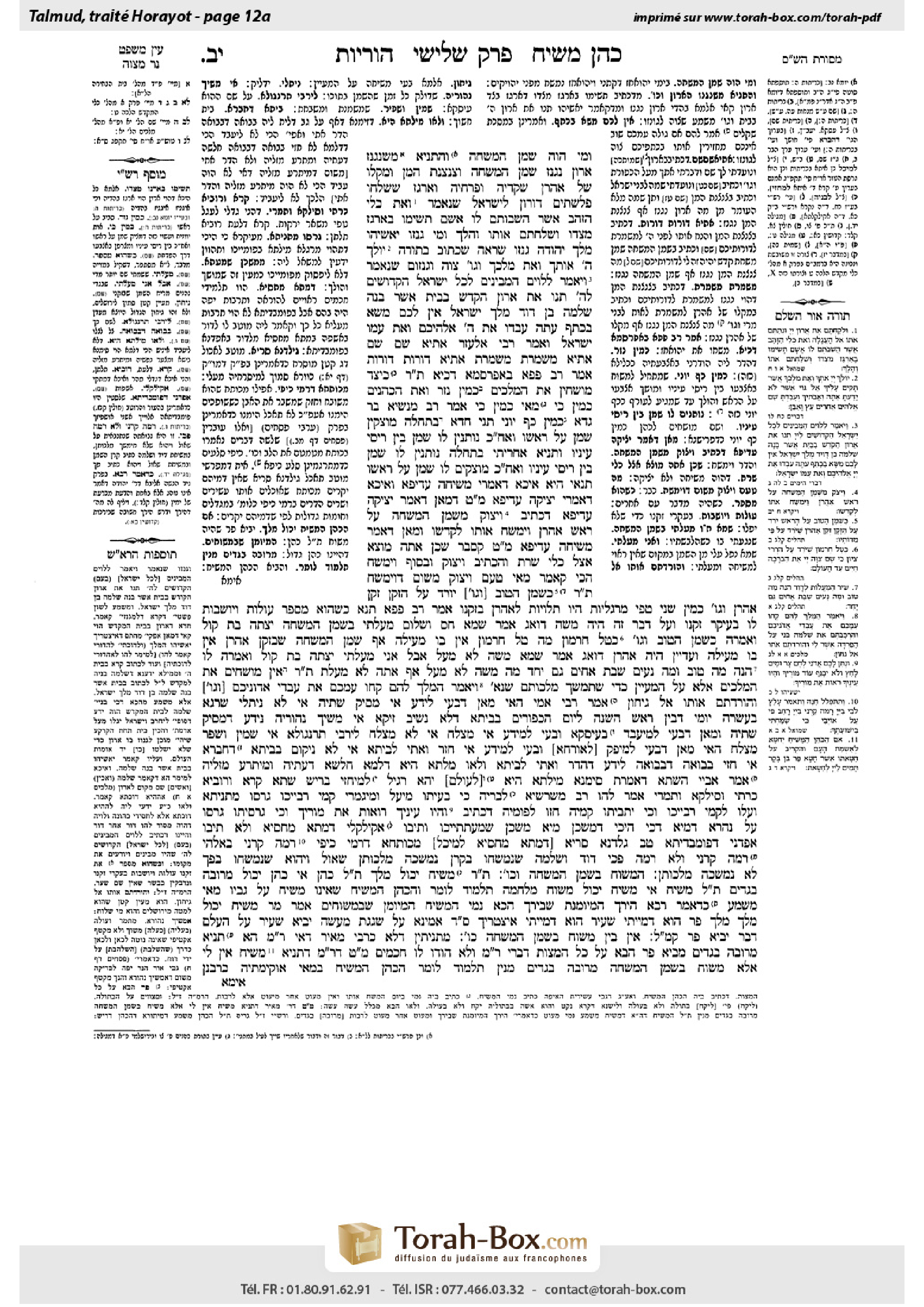
This page of Horayot includes the Aramaic text, an English translation and an AI-generated French translation, alongside the scan above.
הוריות י״ב א · Aramaic and Hebrew text
וּמִי הֲוָה שֶׁמֶן הַמִּשְׁחָה? וְהָתַנְיָא: מִשֶּׁנִּגְנַז אָרוֹן, נִגְנַז שֶׁמֶן הַמִּשְׁחָה וְצִנְצֶנֶת הַמָּן וּמַקְלוֹ שֶׁל אַהֲרֹן שְׁקֵדֶיהָ וּפְרָחֶיהָ וְאַרְגַּז שֶׁשָּׁלְחוּ פְּלִשְׁתִּים דּוֹרוֹן לְיִשְׂרָאֵל, שֶׁנֶּאֱמַר: ״וְאֵת כְּלֵי הַזָּהָב אֲשֶׁר הֲשֵׁבֹתֶם לוֹ אָשָׁם תָּשִׂימוּ בָאַרְגַּז מִצִּדּוֹ וְשִׁלַּחְתֶּם אֹתוֹ וְהָלָךְ״.
וּמִי גְּנָזוֹ? יֹאשִׁיָּהוּ מֶלֶךְ יְהוּדָה גְּנָזוֹ, שֶׁרָאָה שֶׁכָּתוּב בַּתּוֹרָה: ״יוֹלֵךְ ה׳ אֹתְךָ וְאֶת מַלְכְּךָ וְגוֹ׳״, צִוָּה וּגְנָזוּם, שֶׁנֶּאֱמַר: ״וַיֹּאמֶר לַלְוִיִּם הַמְּבִינִים לְכׇל יִשְׂרָאֵל הַקְּדוֹשִׁים לַה׳ תְּנוּ אֶת אֲרוֹן הַקֹּדֶשׁ בַּבַּיִת אֲשֶׁר בָּנָה שְׁלֹמֹה בֶן דָּוִד מֶלֶךְ יִשְׂרָאֵל אֵין לָכֶם מַשָּׂא בַּכָּתֵף עַתָּה עִבְדוּ אֶת ה׳ אֱלֹהֵיכֶם וְאֵת עַמּוֹ יִשְׂרָאֵל״.
וְאָמַר רַבִּי אֶלְעָזָר: אָתְיָא ״שָׁם״ ״שָׁם״, אַתְיָא ״מִשְׁמֶרֶת״ ״מִשְׁמֶרֶת״, אָתְיָא ״דּוֹרוֹת״ ״דּוֹרוֹת״! אָמַר רַב פָּפָּא: בַּאֲפַרְסְמָא דַּכְיָא.
תָּנוּ רַבָּנַן: כֵּיצַד מוֹשְׁחִין אֶת הַמְּלָכִים? כְּמִין נֵזֶר. וְאֶת הַכֹּהֲנִים? כְּמִין כִּי. מַאי ״כְּמִין כִּי״? אָמַר רַב מְנַשְּׁיָא בַּר גַּדָּא: כְּמִין כָּף יְוָנִי.
תָּנֵי חֲדָא: בַּתְּחִלָּה מוֹצְקִין שֶׁמֶן עַל רֹאשׁוֹ, וְאַחַר כָּךְ נוֹתְנִין לוֹ שֶׁמֶן בֵּין רִיסֵי עֵינָיו. וְתַנְיָא אַחֲרִיתִי: בַּתְּחִלָּה נוֹתְנִין לוֹ שֶׁמֶן בֵּין רִיסֵי עֵינָיו, וְאַחַר כָּךְ מוֹצְקִים לוֹ שֶׁמֶן עַל רֹאשׁוֹ! תַּנָּאֵי הִיא, אִיכָּא דְאָמְרִי: מְשִׁיחָה עֲדִיפָא, וְאִיכָּא דְּאָמְרִי: יְצִיקָה עֲדִיפָא.
מַאי טַעְמָא דְּמַאן דְּאָמַר יְצִיקָה עֲדִיפָא? דִּכְתִיב: ״וַיִּצֹק מִשֶּׁמֶן הַמִּשְׁחָה עַל רֹאשׁ אַהֲרֹן וַיִּמְשַׁח אֹתוֹ לְקַדְּשׁוֹ״. וּמַאן דְּאָמַר מְשִׁיחָה עֲדִיפָא, מַאי טַעְמָא? קָסָבַר: שֶׁכֵּן אַתָּה מוֹצֵא אֵצֶל כְּלֵי שָׁרֵת. וְהָכְתִיב ״וַיִּצֹק״, וּבַסּוֹף ״וַיִּמְשַׁח״! הָכִי קָאָמַר: מַאי טַעַם ״וַיִּצֹק״? מִשּׁוּם דְּ״וַיִּמְשַׁח״.
תָּנוּ רַבָּנַן: ״כַּשֶּׁמֶן הַטּוֹב [וְגוֹ׳] יֹרֵד עַל הַזָּקָן זְקַן אַהֲרֹן וְגוֹ׳״ – כְּמִין שְׁנֵי טִפֵּי מַרְגָּלִיּוֹת הָיוּ תְּלוּיוֹת לְאַהֲרֹן בִּזְקָנוֹ. אָמַר רַב פָּפָּא, תָּנָא: כְּשֶׁהוּא מְסַפֵּר, עוֹלוֹת וְיוֹשְׁבוֹת לוֹ בְּעִיקַּר זְקָנוֹ, וְעַל דָּבָר זֶה הָיָה מֹשֶׁה דּוֹאֵג, אָמַר: שֶׁמָּא חַס וְשָׁלוֹם מָעַלְתִּי בְּשֶׁמֶן הַמִּשְׁחָה? יָצְתָה בַּת קוֹל וְאָמְרָה: ״כְּשֶׁמֶן הַטּוֹב וְגוֹ׳ כְּטַל חֶרְמוֹן״, מָה טַל חֶרְמוֹן אֵין בּוֹ מְעִילָה, אַף שֶׁמֶן הַמִּשְׁחָה שֶׁבִּזְקַן אַהֲרֹן אֵין בּוֹ מְעִילָה.
וַעֲדַיִין הָיָה אַהֲרֹן דּוֹאֵג, אָמַר: שֶׁמָּא מֹשֶׁה לֹא מָעַל, אֲבָל אֲנִי מָעַלְתִּי? יָצְתָה בַּת קוֹל וְאָמְרָה לוֹ: ״הִנֵּה מַה טּוֹב וּמַה נָּעִים שֶׁבֶת אַחִים גַּם יָחַד״, מָה מֹשֶׁה לֹא מָעַל, אַף אַתָּה לֹא מָעַלְתָּ.
תָּנוּ רַבָּנַן: אֵין מוֹשְׁחִים אֶת הַמְּלָכִים אֶלָּא עַל הַמַּעְיָין, כְּדֵי שֶׁתִּמָּשֵׁךְ מַלְכוּתָם, שֶׁנֶּאֱמַר: ״וַיֹּאמֶר הַמֶּלֶךְ לָהֶם קְחוּ עִמָּכֶם אֶת עַבְדֵי אֲדֹנֵיכֶם [וְגוֹ׳] וְהוֹרַדְתֶּם אֹתוֹ אֶל גִּחוֹן״.
אָמַר רַבִּי אַמֵּי: הַאי מַאן דְּבָעֵי לִידַּע אִי מַסֵּיק שַׁתֵּיהּ אִי לָא, נִיתְלֵי שְׁרָגָא בַּעֲשָׂרָה יוֹמֵי דְּבֵין רֹאשׁ הַשָּׁנָה לְיוֹם הַכִּפּוּרִים בְּבֵיתָא דְּלָא נָשֵׁיב זִיקָא. אִי מָשֵׁיךְ נְהוֹרֵיהּ – נִידַּע דְּמַסֵּיק שַׁתֵּיהּ.
וּמַאן דְּבָעֵי לְמִיעְבַּד בְּעִיסְקָא, וּבָעֵי לְמִידַּע אִי מַצְלַח אִי לָא מַצְלַח, לִירַבֵּי תַּרְנְגוֹלָא. אִי שָׁמֵין וְשָׁפַר, מַצְלַח.
הַאי מַאן דְּבָעֵי לְמִיפַּק [לְאוֹרְחָא] וּבָעֵי לְמִידַּע אִי (חָזַר) [הָדַר] וְאָתֵי לְבֵיתָא, אִי לָא – נֵיקוּם בְּבֵיתָא דְּחַבָּרָא, אִי חָזֵי בָּבוּאָה דְבָבוּאָה לִידַּע דְּהָדַר וְאָתֵי לְבֵיתֵאּ. וְלָאו מִלְּתָא הִיא, דִּלְמָא חָלְשָׁא דַּעְתֵּיהּ, וּמִיתְּרַע מַזָּלֵיהּ. אָמַר אַבָּיֵי: הַשְׁתָּא דְּאָמְרַתְּ סִימָנָא מִילְּתָא הִיא, [לְעוֹלָם] יְהֵא רָגִיל לְמִיחְזֵי בְּרֵישׁ שַׁתָּא קָרָא וְרוּבְּיָא, כַּרָּתֵי וְסִילְקָא וְתַמְרֵי.
אֲמַר לְהוּ רַב מְשַׁרְשְׁיָא לִבְרֵיהּ: כִּי בָּעֵיתוּ מֵיעַל וּמִיגְמַרי קַמֵּי רַבַּיְיכוּ, גְּרֻסוּ מַתְנִיתָא וְעַלּוּ לְקַמֵּי רַבַּיְיכוּ. וְכִי יָתְבִיתוּ קַמֵּיהּ, חֲזוֹ לְפוּמֵּיהּ, דִּכְתִיב: ״וְהָיוּ עֵינֶיךָ רֹאוֹת אֶת מוֹרֶיךָ״. וְכִי גָרְסִיתוּ, גְּרֻסוּ עַל נַהֲרָא דְּמַיָּא, דְּכִי הֵיכִי דְּמָשְׁכִן מַיָּא מׇשְׁכָן שְׁמַעְתָּתַיְיכוּ. וְתִיבוּ אַקִּילְקְלֵי דְּמָתָא מַחְסֵיָא, וְלָא תִּיבוּ אַפַּדְנֵי דְפוּמְבְּדִיתָא – טָב גִּלְדָּנָא סַרְיָא [דְּמָתָא מַחְסֵיָא לְמֵיכַל], מִכּוּתָּחָא דְּרָמֵי כֵּיפֵי.
״רָמָה קַרְנִי בֵּאלֹהָי״, ״רָמָה קַרְנִי״ וְלֹא רָמָה פַּכִּי, דָּוִד וּשְׁלֹמֹה שֶׁנִּמְשְׁחוּ בְּקֶרֶן – נִמְשְׁכָה מַלְכוּתָן, שָׁאוּל וְיֵהוּא שֶׁנִּמְשְׁחוּ בְּפַךְ – לֹא נִמְשְׁכָה מַלְכוּתָן.
הַמָּשׁוּחַ בְּשֶׁמֶן הַמִּשְׁחָה וְכוּ׳. תָּנוּ רַבָּנַן: ״מָשִׁיחַ״ – יָכוֹל מֶלֶךְ? תַּלְמוּד לוֹמַר: ״כֹּהֵן״. אִי כֹּהֵן, יָכוֹל מְרוּבֵּה בְגָדִים? תַּלְמוּד לוֹמַר: ״מָשִׁיחַ״. אִי מָשִׁיחַ, יָכוֹל מְשׁוּחַ מִלְחָמָה? תַּלְמוּד לוֹמַר: ״וְהַכֹּהֵן הַמָּשִׁיחַ״, שֶׁאֵינוֹ מָשִׁיחַ עַל גַּבָּיו.
מַאי מַשְׁמַע? כִּדְאָמַר רָבָא: ״הַיָּרֵךְ״ – הַמְיוּמֶּנֶת שֶׁבַּיָּרֵךְ, הָכָא נָמֵי: ״הַמָּשִׁיחַ״ – הַמְיוּמָּן שֶׁבַּמְּשׁוּחִים.
אָמַר מָר: ״מָשִׁיחַ״ – יָכוֹל מֶלֶךְ. מֶלֶךְ פַּר הוּא דְּמַיְיתֵי? שָׂעִיר הוּא דְּמַיְיתֵי! אִיצְטְרִיךְ, סָלְקָא דַּעְתָּךְ אָמֵינָא: עַל שִׁגְגַת מַעֲשֶׂה יָבִיא שָׂעִיר, עַל הֶעְלֵם דָּבָר יָבִיא פַּר, קָא מַשְׁמַע לַן.
אֵין בֵּין מָשׁוּחַ בְּשֶׁמֶן הַמִּשְׁחָה כּוּ׳. מַתְנִיתִין דְּלָא כְּרַבִּי מֵאִיר, דְּאִי רַבִּי מֵאִיר, הָא תַּנְיָא: מְרוּבֵּה בְגָדִים מֵבִיא פַּר הַבָּא עַל כׇּל הַמִּצְוֹת, דִּבְרֵי רַבִּי מֵאִיר, וְלֹא הוֹדוּ לוֹ חֲכָמִים.
מַאי טַעְמָא דְּרַבִּי מֵאִיר? דְּתַנְיָא: ״מָשִׁיחַ״ – אֵין לִי אֶלָּא מָשׁוּחַ בְּשֶׁמֶן הַמִּשְׁחָה, מְרוּבֵּה בְגָדִים מִנַּיִן? תַּלְמוּד לוֹמַר: ״הַכֹּהֵן הַמָּשִׁיחַ״.
בְּמַאי אוֹקֵימְתֵּיהּ? כְּרַבָּנַן,
Horayot 12a · English translation
The Gemara asks with regard to the fact that Jehoahaz was anointed: And was there anointing oil during the days of Jehoahaz? But isn’t it taught in a baraita: When the Ark of the Covenant was sequestered, the anointing oil, and the jar of manna (see Exodus 16:33), and Aaron’s staff with its almonds and blossoms (see Numbers 17:23), and the chest that the Philistines sent as a gift to Israel, were all sequestered with it, as it is stated: “And you shall take the Ark of the Lord, and lay it upon the cart, and put the vessels of gold that you return Him as a guilt-offering in a chest by its side and send it away that it may go” (I Samuel 6:8).
And who sequestered the Ark? Josiah, king of Judea, sequestered it, as he saw that it is written in the Torah in the portion of rebuke: “The Lord will lead you, and your king whom you shall establish over you, unto a nation that you have not known” (Deuteronomy 28:36). He commanded and the people sequestered them, as it is stated: “And he said to the Levites who taught all Israel, and who were sacred unto the Lord: Place the sacred Ark in the room that Solomon, son of David, king of Israel built; there shall be no more burden upon your shoulders. Now serve the Lord your God and His people Israel” (II Chronicles 35:3).
And Rabbi Elazar says: One derives a verbal analogy between the term: There, written with regard to the Ark (see Exodus 29:43), and the term: There, written with regard to the jar of manna (see Exodus 16:33); and between the term: Keepsake, written with regard to the jar of manna (see Exodus 16:33), and the term: Keepsake, written with regard to Aaron’s staff (see Numbers 17:25–26); and between the term: Generations, written with regard to the jar of manna (see Exodus 16:33), and the term: Generations, written with regard to the anointing oil (see Exodus 30:31). By means of these verbal analogies it is derived that all of these items were sequestered. Rav Pappa said: They anointed Jehoahaz with pure balsam oil, not with anointing oil.
§ The Sages taught: How does one anoint the kings? One smears the oil in a manner that is similar to the form of a crown around his head. And how does one anoint the priests? One smears the oil in a shape like the Greek letter chi. The Gemara asks: What is the meaning of: Like the Greek letter chi? Rav Menashya bar Gadda said: Like the Greek equivalent of the Hebrew letter kaf.
It is taught in one baraita: Initially, they pour oil on the priest’s head, and thereafter, they place oil for him between the lashes of his eyes. And it is taught in a different baraita: Initially, they place oil for him between the lashes of his eyes, and thereafter, they pour oil on his head. The Gemara explains: It is a dispute between tanna’im. Some say: Anointing with oil between his eyes is preferable and takes precedence, and some say: Pouring oil on his head is preferable and takes precedence.
What is the reason for the opinion of the one who said that pouring oil on his head is preferable? It is as it is written: “And he poured from the anointing oil upon Aaron’s head and anointed him to sanctify him” (Leviticus 8:12), indicating that pouring precedes anointing. And the one who said that anointing is preferable and takes precedence, what is the reason for his opinion? He holds: Anointing takes precedence as that is what you find with regard to service vessels (see Numbers 7:1). They were anointed, but the anointing oil was not poured on them. The Gemara asks: But isn’t it written with regard to the priests: “And he poured,” and ultimately: “And anointed”? The Gemara answers: This is what the verse is saying: What is the reason that he poured the oil? It is due to the fact that he had already anointed them. Anointing is the primary component of the process.
The Sages taught: “It is like the precious oil upon the head coming down upon the beard, Aaron’s beard, that comes down upon the collar of his garments” (Psalms 133:2). Two drops of anointing oil, shaped like pearls, were suspended for Aaron from his beard. Rav Pappa said that it is taught: When Aaron would speak and his beard would move, those drops would miraculously rise and settle on the roots of his beard so that they would not fall. Moses was concerned about this matter. He said: Perhaps, Heaven forfend, I misused the consecrated anointing oil and poured more than necessary, as two additional drops remain? A Divine Voice emerged and said: “It is like the precious oil upon the head coming down upon the beard, Aaron’s beard, that comes down upon the collar of his garments. Like the dew of Hermon” (Psalms 133:2–3). This analogy teaches: Just as there is no misuse of the dew of Hermon, which is not consecrated, so too, with regard to the anointing oil that is on Aaron’s beard, there is no misuse of consecrated property.
And still Aaron was concerned. He said: Perhaps Moses did not misuse consecrated property; but perhaps I misused consecrated property, as the additional oil is on my beard and I enjoy it. A Divine Voice emerged and said: “Behold, how good and how pleasant it is for brothers to dwell together in unity” (Psalms 133:1). Just as your brother Moses did not misuse consecrated property, so too, you did not misuse consecrated property.
The Sages taught: One anoints the kings only upon a spring, as an omen, so that their kingdom will continue like a spring, as it is stated with regard to the coronation of Solomon before the death of David: “And the king said unto them: Take with you the servants of your lord, and let Solomon my son ride upon my own mule, and bring him down to Gihon. And let Tzadok the priest and Nathan the prophet anoint him there king over Israel and sound the shofar and say: Long live King Solomon” (I Kings 1:33–34).
§ Apropos good omens, the Gemara cites a statement that Rabbi Ami said: This person who seeks to know if he will complete his year or if he will not, i.e., whether or not he will remain alive in the coming year, let him light a lamp, during the ten days that are between Rosh HaShana and Yom Kippur, in a house in which wind does not blow. If its light continues to burn, he knows that he will complete his year.
And one who seeks to conduct a business venture and wishes to know if he will succeed or if he will not succeed, let him raise a rooster. If the rooster grows fat and healthy, he will succeed.
One who seeks to embark on a journey and wishes to know if he will return and come to his home or if he will not, let him go to a dark [daḥavara] house. If he sees the shadow of a shadow he shall know that he will return and come home. The Sages reject this: This omen is not a significant matter. Perhaps he will be disheartened if the omen fails to appear, and his fortune will suffer and it is this that causes him to fail. Abaye said: Now that you said that an omen is a significant matter, a person should always be accustomed to seeing these on Rosh HaShana: Squash, and fenugreek, leeks, and chard, and dates, as each of these grows quickly and serves as a positive omen for one’s actions during the coming year.
Apropos good omens, Rav Mesharshiyya said to his son: When you seek to enter and study before your teacher, study the baraita first, and only then enter before your teacher. And when you are sitting before him, look to his mouth, as it is written: “And your eyes shall see your teacher” (Isaiah 30:20). And when you study, study adjacent to a river of water; just as the water flows, your studies will flow unimpeded. He added: And it is preferable for you to sit on the rubbish heaps [akilkelei] of Mata Meḥasya, and do not sit in the palaces [appadnei] of Pumbedita. Better to eat the rotten fish [gildana] of Mata Meḥasya than to eat kutḥa, which displaces rocks, a metaphor for how potent it is.
Apropos good omens for anointing, it is stated in the prayer of Hannah, Samuel’s mother: “My horn is exalted in my God” (I Samuel 2:1). The Gemara infers: My horn is exalted, and my jug is not exalted. David and Solomon were anointed with oil from a horn. This was a good omen for them and their reign endured. Saul and Jehu were anointed with oil from a jug and their reign did not endure.
§ The mishna teaches: And who is the anointed priest? It is the High Priest who is anointed with the anointing oil, not the High Priest consecrated by donning multiple garments. The Sages taught: “Anointed” is written in the verse (Leviticus 6:15). One might have thought that the reference is to a king. Therefore, the verse states: “Priest.” If the reference is to a priest, one might have thought that the reference is to a priest consecrated by donning multiple garments. Therefore, the verse states: “Anointed.” If the reference is to one who is anointed, one might have thought that the reference is even to a priest anointed for war. Therefore, the verse states: “And the anointed priest,” indicating that there is no anointed priest over him; rather, he is the highest-ranking priest.
The Gemara asks: From where is this inferred? The Gemara answers: It is as Rava said with regard to the term “the thigh” in the verse: “The sciatic nerve that is on the hollow of the thigh” (Genesis 32:33); the reference is to the stronger of the thighs. Here too, where the verse states: “The anointed,” the reference is to the most distinguished of those anointed, i.e., the High Priest.
The Gemara analyzes the baraita: The Master said: “Anointed” is written in the verse. One might have thought that the reference is to a king. The Gemara asks: Is it a bull that a king brings for a sin-offering? It is a male goat that he brings, as the Torah states explicitly, later in that passage. The Gemara answers: It was necessary for the tanna to say this, as it may enter your mind to say: It is for the unwitting performance of an action for which all people are liable to bring a sin-offering that a king shall bring a male goat as his offering; but for absence of awareness of the matter with the unwitting performance of an action, a king shall bring a bull. Therefore, the tanna teaches us that it is only the High Priest who brings a bull.
§ The mishna teaches: The difference between a High Priest anointed with the anointing oil and one consecrated by donning multiple garments is only that the latter does not bring the bull that comes for the transgression of any of the mitzvot. The Gemara comments: The mishna is not in accordance with the opinion of Rabbi Meir, as, if it was in accordance with the opinion of Rabbi Meir, isn’t it taught in a baraita: A priest who is consecrated by donning multiple garments brings a bull that comes for the transgression of any of the mitzvot; this is the statement of Rabbi Meir, but the Rabbis did not concede that point to him.
The Gemara asks: What is the reason for the opinion of Rabbi Meir? It is as it is taught in a baraita: “Anointed” is written in the verse. I have derived only a priest anointed with the anointing oil. From where do I derive the halakha of a priest who is consecrated by donning multiple garments? The verse states: “The anointed priest,” from which it is derived that anyone who is appointed as the High Priest is included, even if he was not anointed.
The Gemara asks: In accordance with which opinion did you interpret the mishna? It is in accordance with the opinion of the Rabbis.
Horayot 12a · Traduction française (IA)
La Guemara pose la question concernant le fait que Jéhohaz ait été consacré : Y avait-il de l'huile d'immersion durant les jours de Jéhohaz ? Mais n'est-il pas enseigné dans une baraïta : Lorsque l'Arca du Pacte fut séquestrée, l'huile d'immersion, la jarre de manne (cf. Exode 16:33), le bâton d'Aaron avec ses amandes et ses fleurs (cf. Nombres 17:23), et le coffre que les Philistins envoyèrent en cadeau à Israël, furent tous séquestrés avec elle, comme il est dit : « Et tu prendras l'Arca du Seigneur, et la poseras sur la charrette, et tu placeras les objets d'or que tu lui rends comme sacrifice de culpabilité dans un coffre à côté d'elle et l'envoies, afin qu'elle aille » (I Samuel 6:8).
Et qui a séquestré l'Arca ? Josias, roi de Juda, l'a séquestrée, car il avait vu qu'il était écrit dans la Torah, dans la portion de réprobation : « Le Seigneur vous conduira, et votre roi que vous établirez sur vous, vers un peuple que vous n'avez pas connu » (Deutéronome 28:36). Il a donné l'ordre et le peuple a séquestré ces objets, comme il est dit : « Et il dit aux Lévites qui instruisaient tout Israël et qui étaient saints auprès du Seigneur : Placez l'Arca sainte dans la pièce que Salomon, fils de David, roi d'Israël, a construite ; il n'y aura plus de fardeau sur vos épaules. Servez maintenant le Seigneur votre Dieu et son peuple Israël » (II Chroniques 35:3).
Et le maître Eléazar dit : On tire une analogie verbale entre le terme : Là, écrit concernant l'Arca (cf. Exode 29:43), et le terme : Là, écrit concernant la jarre de manne (cf. Exode 16:33) ; et entre le terme : Réserve, écrit concernant la jarre de manne (cf. Exode 16:33), et le terme : Réserve, écrit concernant le bâton d'Aaron (cf. Nombres 17:25–26) ; et entre le terme : Générations, écrit concernant la jarre de manne (cf. Exode 16:33), et le terme : Générations, écrit concernant l'huile d'immersion (cf. Exode 30:31). Par ces analogies verbales, on déduit que tous ces objets furent séquestrés. Rav Pappa dit : Ils ont consacré Jéhohaz avec de l'huile de balsam pur, pas avec l'huile d'immersion.
§ Les Sages enseignent : Comment on consacre les rois ? On applique l'huile de manière similaire à la forme d'un diadème autour de sa tête. Et comment on consacre les prêtres ? On applique l'huile dans la forme de la lettre grecque chi. La Guemara pose la question : Quelle est la signification de : Comme la lettre grecque chi ? Rav Menachia bar Gadda dit : Comme l'équivalent grec de la lettre hébraïque kaf.
Il est enseigné dans une baraïta : D'abord, on verse l'huile sur la tête du prêtre, puis on place l'huile pour lui entre les paupières de ses yeux. Et il est enseigné dans une autre baraïta : D'abord, on place l'huile pour lui entre les paupières de ses yeux, puis on verse l'huile sur sa tête. La Guemara explique : C'est un débat entre les tannaïm. Certains disent : Le versement d'huile entre ses yeux est préférable et prioritaire, et d'autres disent : Le versement d'huile sur sa tête est préférable et prioritaire.
Quelle est la raison de l'opinion de celui qui dit que le versement d'huile sur sa tête est préférable ? C'est comme il est écrit : « Et il versa l'huile d'immersion sur la tête d'Aaron et le consacra pour le sanctifier » (Lévitique 8:12), indiquant que le versement précède la consécration. Et celui qui dit que la consécration est préférable et prioritaire, quelle est la raison de son opinion ? Il maintient que la consécration est prioritaire, car c'est ce que l'on trouve concernant les objets de service (cf. Nombres 7:1). Ils furent consacrés, mais l'huile d'immersion n'était pas versée sur eux. La Guemara pose la question : Mais n'est-il pas écrit concernant les prêtres : « Et il versa », et finalement : « Et il consacra » ? La Guemara répond : C'est ce que le verset dit : Quelle est la raison qu'il versa l'huile ? C'est à cause qu'il avait déjà consacré ces objets. La consécration est la composante principale du processus.
Les Sages enseignent : « C'est comme l'huile précieuse sur la tête qui descend sur la barbe d'Aaron, la barbe d'Aaron, qui descend sur la ceinture de ses vêtements » (Psaumes 133:2). Deux gouttes d'huile d'immersion, en forme de perles, furent suspendues pour Aaron de sa barbe. Rav Pappa dit qu'il est enseigné : Lorsque Aaron parlait et sa barbe bougeait, ces gouttes montaient miraculeusement et se posaient sur les racines de sa barbe pour ne pas tomber. Moïse s'inquiétait de cette affaire. Il disait : Peut-être, Dieu m'empêche, j'ai abusé de l'huile consacrée et j'ai versé plus que nécessaire, comme deux gouttes supplémentaires restent ? Une Voix divine s'est élevée et a dit : « C'est comme l'huile précieuse sur la tête qui descend sur la barbe d'Aaron, la barbe d'Aaron, qui descend sur la ceinture de ses vêtements. Comme la rosée de Hermon » (Psaumes 133:2–3). Cette analogie enseigne : Comme il n'y a pas d'abus de la rosée de Hermon, qui n'est pas consacrée, de même, concernant l'huile d'immersion sur la barbe d'Aaron, il n'y a pas d'abus de propriété consacrée.
Et encore Aaron s'inquiétait. Il disait : Peut-être Moïse n'a pas abusé de la propriété consacrée ; mais peut-être j'ai abusé de la propriété consacrée, car l'huile supplémentaire est sur ma barbe et j'en profite. Une Voix divine s'est élevée et a dit : « Regarde, comme c'est bon et agréable pour les frères de demeurer ensemble en unité » (Psaumes 133:1). Comme votre frère Moïse n'a pas abusé de la propriété consacrée, de même, vous n'avez pas abusé de la propriété consacrée.
Les Sages enseignent : On consacre les rois seulement sur une source, comme un présage, afin que leur royaume dure comme une source, comme il est dit concernant la couronne de Salomon avant la mort de David : « Et le roi dit aux gens : Apportez les serviteurs de votre maître, et laissez que mon fils Solomon monte sur mon âne, et amenez-le à Gihon. Et laissez que le prêtre Tzadok et le prophète Nathan consacrent là lui comme roi d'Israël et sonnent le cor et disent : Vive le roi Solomon » (I Rois 1:33–34).
§ En ce qui concerne les bons présages, la Guemara cite une déclaration que Rabbi Ami a faite : Ce personne qui veut savoir s'il terminera son année ou non, c'est-à-dire s'il restera vivant dans l'année à venir, qu'il allume une lampe, pendant les dix jours entre Rosh HaShana et Yom Kippur, dans une maison où le vent ne souffle pas. Si sa lumière continue à briller, il sait qu'il terminera son année.
Et celui qui veut entreprendre une affaire commerciale et souhaite savoir s'il réussira ou non, qu'il fasse élever un coq. Si le coq s'élargit et se porte bien, il réussira.
Celui qui veut entreprendre un voyage et souhaite savoir s'il reviendra chez lui ou non, qu'il aille dans une maison sombre. S'il voit l'ombre d'une ombre, il saura qu'il reviendra chez lui. Les Sages rejettent cela : cet omen n'est pas important. Peut-être sera-t-il découragé si l'omen ne se produit pas, et son sort souffrira, et c'est cela qui le fera échouer. Abaye a dit : Maintenant que vous dites que l'omen est important, une personne devrait toujours être habituée à voir ces omen à la fête des Tabernacles : les courges, les fenouils, les oignons et les épinards, et les dattes, car chacun de ces légumes pousse rapidement et sert d'omen positif pour ses actions durant l'année à venir.
En ce qui concerne les bons omen, Rav Mesharshiyya a dit à son fils : Quand tu veux entrer et étudier devant ton maître, étudie d'abord la baraïta, puis entre devant ton maître. Et quand tu es assis devant lui, regarde sa bouche, car il est écrit : « Et tes yeux verront ton maître » (Yachout 30:20). Et quand tu étudies, étudie près d'un cours d'eau ; car l'eau coule, tes études couleront sans entrave. Il a ajouté : Et il est préférable que tu t'asseyes sur les tas de détritus [akilkelei] de Mata Meḥasya, et ne t'assieds pas dans les palais [appadnei] de Pumbedita. Mieux vaut manger les poissons pourris [gildana] de Mata Meḥasya que de manger la kutḥa, qui déplace les rochers, un métaphore de la puissance qu'elle a.
En ce qui concerne les bons présages liés à l'huile d'immersion, il est dit dans la prière de Hannah, mère de Samuel : « Mon cor est exalté en mon Dieu » (I Samuel 2:1). La Guemara déduit : Mon cor est exalté, et mon tonneau n'est pas exalté. David et Salomon ont été huilés avec de l'huile provenant d'un cor. C'était un bon présage pour eux et leur règne a duré. Saül et Jéhu ont été huilés avec de l'huile provenant d'un tonneau et leur règne n'a pas duré.
§ La Michna enseigne : Qui est le prêtre consacré ? C'est le Grand Prêtre qui est huilé avec l'huile d'immersion, pas le Grand Prêtre consacré par l'habillage multiple. Les Sages enseignent : « Huilé » est écrit dans la paracha (Lévitique 6:15). On aurait pu penser que la référence est à un roi. Par conséquent, la paracha dit : « Prêtre ». Si la référence est à un prêtre, on aurait pu penser que la référence est à un prêtre consacré par l'habillage multiple. Par conséquent, la paracha dit : « Huilé ». Si la référence est à celui qui est huilé, on aurait pu penser que la référence est même à un prêtre huilé pour la guerre. Par conséquent, la paracha dit : « Et le prêtre huilé », indiquant qu'il n'y a pas de prêtre huilé au-dessus de lui ; plutôt, il est le prêtre le plus élevé.
La Guemara pose la question : D'où cela est-il déduit ? La Guemara répond : C'est comme Rava a dit concernant le terme « la cuisse » dans la paracha : « La moelle qui est sur la cuisse creuse » (Genèse 32:33) ; la référence est à la cuisse la plus forte. Ici aussi, où la paracha dit : « L'huilé », la référence est à celui qui est le plus distingué parmi ceux qui sont huilés, c'est-à-dire le Grand Prêtre.
La Guemara analyse la baraïta : Le Maître a dit : « Huilé » est écrit dans la Torah. On aurait pu penser que la référence est à un roi. La Guemara pose la question : Est-ce un taureau que le roi apporte pour un sacrifice expiatoire ? Il apporte un bouc mâle, car la Torah le stipule explicitement, plus tard dans ce passage. La Guemara répond : Il était nécessaire que le tanna dise cela, car cela pourrait entrer dans votre esprit de penser : C'est pour l'accomplissement involontaire d'une action pour laquelle tous les gens sont tenus de présenter un sacrifice expiatoire que le roi apporte un bouc mâle comme son sacrifice ; mais pour l'absence de connaissance de l'incident de l'accomplissement involontaire d'une action, le roi apporte un taureau. Par conséquent, le tanna nous enseigne que c'est seulement le Grand Prêtre qui apporte un taureau.
§ La Michna enseigne : La différence entre un Grand Prêtre huilé avec l'huile d'immersion et un autre consacré par l'habillage multiple est seulement que le second ne présente pas le taureau qui vient pour la transgression de toute une des mitsvot. La Guemara commente : La Michna n'est pas en accord avec l'opinion de Rabbi Meir, car, si elle était en accord avec l'opinion de Rabbi Meir, n'est-il pas enseigné dans une baraïta : Un prêtre consacré par l'habillage multiple présente un taureau qui vient pour la transgression de toute une des mitsvot ; c'est l'opinion de Rabbi Meir, mais les Rabbins n'ont pas admis ce point.
La Guemara pose la question : Quelle est la raison de l'opinion de Rabbi Meir ? C'est comme il est enseigné dans une baraïta : « Huilé » est écrit dans la Torah. J'ai déduit seulement un prêtre huilé avec l'huile d'immersion. D'où déduit-on la halakha d'un prêtre consacré par l'habillage multiple ? La Torah dit : « Le prêtre huilé », d'où on déduit que toute personne désignée comme le Grand Prêtre est incluse, même s'il n'était pas huilé.
La Guemara demande : Sur quelle opinion avez-vous interprété la Michna ? C'est sur l'opinion des Rabbins.
Traduction française générée par IA à partir de l’édition anglaise de Sefaria. Vérifie toujours un passage avec le texte source.
Text from Sefaria: William Davidson Edition - Vocalized Aramaic (CC BY NC); William Davidson Edition - English (CC BY NC).