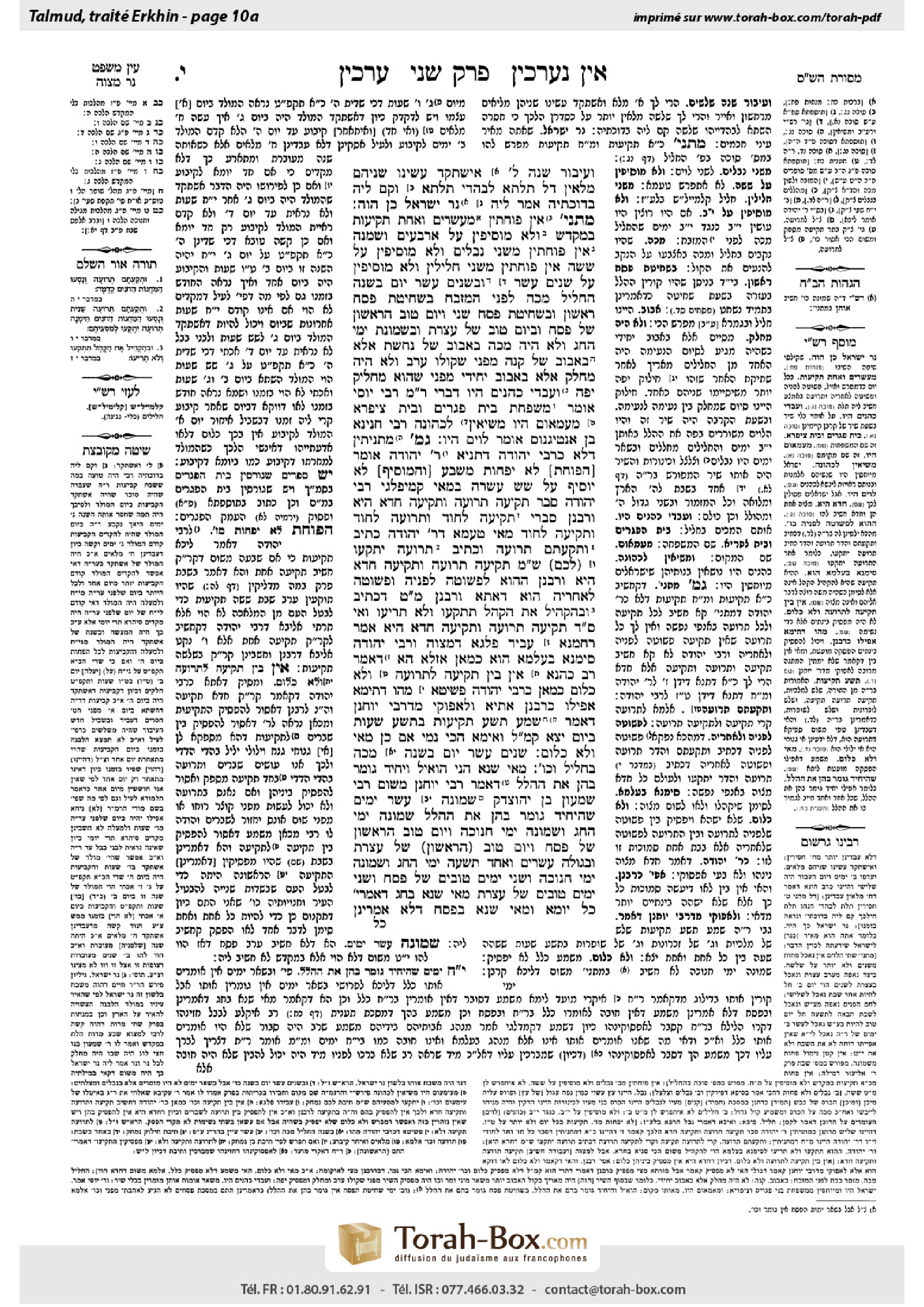
Arakhin 10a: Talmud study for Daf Yomi
Study the Talmud for Daf Yomi with scanned pages, Hebrew text, English translations from Sefaria and AI-generated French translations.
Passage selection and English or AI-generated French translation are available where the scan has annotations. Daf Study is independent of Torah-Box and Sefaria.
Browse Arakhin · ערכין · All tractatesArakhin 10a text and translations
This page of Arakhin includes the Aramaic text, an English translation and an AI-generated French translation, alongside the scan above.
ערכין י׳ א · Aramaic and Hebrew text
וְעִיבּוּר שָׁנָה שְׁלֹשִׁים (אישתקד) [וְאִישְׁתָּקַד] עָשִׂינוּ שְׁנֵיהֶם מְלֵאִין, דַּל תְּלָתָא לְבַהֲדֵי תְּלָתָא וְקָם לֵיהּ בְּדוּכְתֵּיהּ. אֲמַר לֵיהּ: נֵר יִשְׂרָאֵל! כֵּן הָוֵה.
מַתְנִי׳ אֵין פּוֹחֲתִין מֵעֶשְׂרִים וְאַחַת תְּקִיעוֹת בַּמִּקְדָּשׁ, וְלֹא מוֹסִיפִין עַל אַרְבָּעִים וּשְׁמֹנֶה.
אֵין פּוֹחֲתִין מִשְּׁנֵי נְבָלִים, וְלֹא מוֹסִיפִין עַל שִׁשָּׁה. אֵין פּוֹחֲתִין מִשְּׁנֵי חֲלִילִין, וְלֹא מוֹסִיפִין עַל שְׁנֵים עָשָׂר, וּבִשְׁנֵים עָשָׂר יוֹם בַּשָּׁנָה הֶחָלִיל מַכֶּה לִפְנֵי הַמִּזְבֵּחַ: בִּשְׁחִיטַת פֶּסַח רִאשׁוֹן, וּבִשְׁחִיטַת פֶּסַח שֵׁנִי, וְיוֹם טוֹב הָרִאשׁוֹן שֶׁל פֶּסַח, וּבְיוֹם טוֹב שֶׁל עֲצֶרֶת, וּבִשְׁמוֹנַת יְמֵי הֶחָג. וְלֹא הָיָה מַכֶּה בְּאַבּוּב שֶׁל נְחֹשֶׁת, אֶלָּא בְּאַבּוּב שֶׁל קָנֶה, מִפְּנֵי שֶׁקּוֹלוֹ עָרֵב; וְלֹא הָיָה מְחַלֵּק אֶלָּא בְּאַבּוּב יְחִידִי, מִפְּנֵי שֶׁהוּא מְחַלֵּיק יָפֶה.
וְעַבְדֵי כֹּהֲנִים הָיוּ, דִּבְרֵי רַבִּי מֵאִיר; רַבִּי יוֹסֵי אוֹמֵר: מִשְׁפַּחַת בֵּית פְּגָרִים וּבֵית צִיפְּרָא מֵעֶמָּאוּם הָיוּ מַשִּׂיאִין לַכְּהוּנָּה; רַבִּי חֲנִינָא בֶּן אַנְטִיגְנוֹס אוֹמֵר: לְוִיִּם הָיוּ.
גּמ׳: מַתְנִיתִין דְּלָא כְּרַבִּי יְהוּדָה, דְּתַנְיָא: רַבִּי יְהוּדָה אוֹמֵר: לֹא יִפְחוֹת מִשֶּׁבַע, וְלֹא יוֹסִיף עַל שֵׁשׁ עֶשְׂרֵה.
בְּמַאי קָמִיפַּלְגִי? רַבִּי יְהוּדָה סָבַר: תְּקִיעָה תְּרוּעָה וּתְקִיעָה חֲדָא הִיא, וְרַבָּנַן סָבְרִי: תְּקִיעָה לְחוּד, וּתְרוּעָה לְחוּד, וּתְקִיעָה לְחוּד.
מַאי טַעְמָא דְּרַבִּי יְהוּדָה? כְּתִיב ״וּתְקַעְתֶּם תְּרוּעָה״, וּכְתִיב ״תְּרוּעָה יִתְקְעוּ״ (לָכֶם), שְׁמַע מִינַּהּ: תְּקִיעָה תְּרוּעָה וּתְקִיעָה — חֲדָא הִיא. וְרַבָּנַן? הַהוּא לִפְשׁוּטָה לְפָנֶיהָ וּפְשׁוּטָה לְאַחֲרֶיהָ הוּא דַּאֲתָא.
וְרַבָּנַן מַאי טַעְמָא? דִּכְתִיב: ״וּבְהַקְהִיל אֶת הַקָּהָל תִּתְקְעוּ וְלֹא תָרִיעוּ״, וְאִי סָלְקָא דַעְתָּךְ תְּקִיעָה תְּרוּעָה וּתְקִיעָה חֲדָא הִיא, אָמַר רַחֲמָנָא עֲבֵיד פַּלְגָא דְּמִצְוָה? וְרַבִּי יְהוּדָה — סִימָנָא בְּעָלְמָא הוּא.
כְּמַאן אָזְלָא הָא דְּאָמַר רַב כָּהֲנָא: אֵין בֵּין תְּקִיעָה לִתְרוּעָה וְלֹא כְּלוּם? כְּמַאן? כְּרַבִּי יְהוּדָה. פְּשִׁיטָא!
מַהוּ דְּתֵימָא: אֲפִילּוּ כְּרַבָּנַן אָתְיָא, וּלְאַפּוֹקֵי מִדְּרַבִּי יוֹחָנָן דְּאָמַר: שָׁמַע תֵּשַׁע תְּקִיעוֹת בְּתֵשַׁע שָׁעוֹת בַּיּוֹם — יָצָא. קָא מַשְׁמַע לַן.
וְאֵימָא הָכִי נָמֵי! אִם כֵּן, מַאי ״וְלֹא כְּלוּם״?
שְׁנֵים עָשָׂר יוֹם בַּשָּׁנָה מַכֶּה בֶּחָלִיל וְכוּ׳. מַאי שְׁנָא הָנֵי? הוֹאִיל וְיָחִיד גּוֹמֵר בָּהֶן אֶת הַהַלֵּל.
דְּאָמַר רַבִּי יוֹחָנָן מִשּׁוּם רַבִּי שִׁמְעוֹן בֶּן יְהוֹצָדָק: שְׁמוֹנָה עָשָׂר יָמִים שֶׁהַיָּחִיד גּוֹמֵר בָּהֶן אֶת הַהַלֵּל: שְׁמוֹנָה יְמֵי הַחַג, וּשְׁמוֹנָה יְמֵי חֲנוּכָּה, וְיוֹם טוֹב הָרִאשׁוֹן שֶׁל פֶּסַח, וְיוֹם טוֹב (הָרִאשׁוֹן) שֶׁל עֲצֶרֶת; וּבַגּוֹלָה עֶשְׂרִים וְאֶחָד: תִּשְׁעָה יְמֵי הַחַג, וּשְׁמוֹנָה יְמֵי חֲנוּכָּה, וּשְׁנֵי יָמִים טוֹבִים שֶׁל פֶּסַח, וּשְׁנֵי יָמִים טוֹבִים שֶׁל עֲצֶרֶת.
מַאי שְׁנָא בְּחַג דְּאָמְרִינַן כֹּל יוֹמָא, וּמַאי שְׁנָא בְּפֶסַח דְּלָא אָמְרִינַן
Arakhin 10a · English translation
and the month that was intercalated, added for the leap year, was thirty days, and last year we turned two months that are generally deficient into full months, which meant that it had eight full months instead of the usual six. Consequently, remove from consideration the three months that were made deficient this year corresponding to the three extra months that were made full last year, and the moon is restored to its place, i.e., it is properly aligned with the months. Rabbi Yehuda HaNasi said to him: Lamp of Israel! Indeed, so it was.
MISHNA: No fewer than twenty-one trumpet blasts are sounded daily in the Temple, as each day three blasts were sounded for the opening of the gates in the morning, nine for the daily morning offering, and nine for the daily afternoon offering, totaling twenty-one. And no more than forty-eight are ever sounded on a single day. This would occur on the Friday of Sukkot, when they would sound an additional twelve blasts during the ritual of drawing the water for the water libation; nine for the additional offerings; three to signal the population to cease their work before Shabbat; and three more to mark the beginning of Shabbat.
When accompanying their song with instruments, the Levites do not use fewer than two lyres and do not use more than six. When flutes are played, they do not use fewer than two flutes and do not use more than twelve. And there are twelve days during the year when the flute plays before the altar: At the time of the slaughter of the first Paschal offering, on the fourteenth of Nisan; and at the time of the slaughter of the second Paschal offering, on the fourteenth of Iyyar; and on the first festival day of Passover; and on the festival of Shavuot; and on all eight days of the festival of Sukkot. And one would not play with a copper flute; rather, one would play with a flute of reed, because its sound is more pleasant. And one would conclude the music only with a single flute, because it concludes the music nicely.
The Temple musicians were slaves of priests; this is the statement of Rabbi Meir. Rabbi Yosei says: The musicians were not slaves, but Israelites from the family of the house of Pegarim and the family of the house of Tzippara from the city of Emaum, and their lineage was sufficiently pure that they would marry their daughters to members of the priesthood. Rabbi Ḥanina ben Antigonus says: They were Levites.
GEMARA: The mishna teaches that no fewer than twenty-one trumpet blasts are sounded daily in the Temple and no more than forty-eight. The Gemara notes: The mishna is not in accordance with the opinion of Rabbi Yehuda, as it is taught in a baraita that Rabbi Yehuda says: One may not blow fewer than seven blasts, and one may not blow more than sixteen blasts.
The Gemara asks: With regard to what principle do the tanna of the mishna and Rabbi Yehuda disagree? The Gemara explains that Rabbi Yehuda holds: A series of blasts consisting of tekia, terua, tekia is counted as one unit. And the Rabbis hold: A tekia is counted as a discrete unit and a terua is also counted as a discrete unit, and the final tekia is again counted as a discrete unit. They agree with regard to the sequence and the number of the blasts; their disgreement is only with regard to how the blasts are tallied.
The Gemara asks: What is the reasoning of Rabbi Yehuda? As it is written in the verse: “And you shall sound [utkatem] a terua” (Numbers 10:5), and it is written: “A terua they will sound [yitke’u]” (Numbers 10:6). Conclude from the fact that the Torah uses a verb from the root tekia when referring to a terua that a tekia, terua, and tekia together constitute one unit. And how do the Rabbis interpret these verses? They explain that these verses come to teach that each terua blast is accompanied by a plain blast, a tekia, preceding it and another plain blast following it.
The Gemara asks: And what is the reasoning of the Rabbis? As it is written: “And when congregating the people you shall sound a tekia and shall not sound a terua” (Numbers 10:7). And if it enters your mind that a series of tekia, terua, and tekia are considered one unit, would the Merciful One say to perform only half a mitzva? Rather, each sound constitutes a separate mitzva. The Gemara asks: And how does Rabbi Yehuda explain this verse? The Gemara answers: That single tekia mentioned in the context of congregating the people was blown merely as a signal to the people to assemble, not for the purpose of fulfilling a mitzva, which, in Rabbi Yehuda’s opinion, always comes in units of three sounds.
The Gemara asks: In accordance with whose opinion is that which Rav Kahana said? As Rav Kahana said: There is to be no pause between a tekia and a terua at all, but rather they are sounded in one continuous series of blasts. In accordance with whose opinion is this statement? It is in accordance with the opinion of Rabbi Yehuda. The Gemara asks: Isn’t that obvious? Why was it necessary to point this out?
The Gemara answers: It is not obvious that Rav Kahana’s statement is in accordance with the opinion of Rabbi Yehuda. Lest you say that Rav Kahana comes to teach his halakha even in accordance with the opinion of the Rabbis, and that he is coming to exclude only the opinion of Rabbi Yoḥanan, who says: If one heard nine blasts in nine different hours on the day of Rosh HaShana, despite the considerable gap between them, he has fulfilled his obligation. One might have thought that Rav Kahana meant only that there should not be such long gaps between the sounds. Therefore, the Gemara teaches us that Rav Kahana’s ruling is in accordance with the opinion of Rabbi Yehuda, as he does not allow any pause at all between the shofar blasts.
The Gemara asks: And how do you know that this was Rav Kahana’s intent? One can say it is indeed so, that Rav Kahana holds in accordance with the opinion of the Rabbis and he merely excludes the opinion of Rabbi Yoḥanan. The Gemara answers that if so, what is the meaning of the phrase “at all” when Rav Kahana said that there is no pause between a tekia and a terua at all? This phrase indicates that Rav Kahana does not allow even a slight pause between blasts, which is in accordance with the opinion of Rabbi Yehuda.
§ The mishna teaches that there are twelve days during the year when the flute plays before the altar, and it proceeds to list them. The Gemara asks: What is different about these days enumerated in the mishna that the flute is played before the altar specifically on those occasions? The Gemara answers: They are unique, since these are the days on which the individual completes the full hallel.
As Rabbi Yoḥanan says in the name of Rabbi Shimon ben Yehotzadak: There are eighteen days a year on which the individual completes the full hallel: The eight days of the festival of Sukkot, including the Eighth Day of Assembly; and the eight days of Hanukkah; and the first festival day of Passover; and the festival day of Assembly, i.e., Shavuot. And in the Diaspora, where a second day is added to each Festival due to uncertainty over the precise date, there are twenty-one days: The nine days of the festival of Sukkot; and the eight days of Hanukkah; and the first two festival days of Passover; and the two festival days of Assembly, i.e., Shavuot.
The Gemara asks: What is different about the festival of Sukkot, that we say hallel every day, and what is different about Passover, that we do not say hallel
Arakhin 10a · Traduction française (IA)
et le mois qui a été intercalé, ajouté pour l'année bissextile, était de trente jours, et l'année dernière nous avons converti deux mois qui sont généralement déficients en mois complets, ce qui signifiait qu'il y avait huit mois complets au lieu des six habituels. Par conséquent, retirez de considération les trois mois qui ont été rendus déficients cette année correspondant aux trois mois supplémentaires qui ont été rendus complets l'année dernière, et la lune est restaurée à sa place, c'est-à-dire qu'elle est correctement alignée avec les mois. Rabbi Yehuda HaNasi dit à lui : Lampe d'Israël ! En effet, c'était ainsi.
MICHNA : Au moins vingt-et-un sons de trompette sont sonorisés quotidiennement dans le Temple, car chaque jour trois sons étaient sonorisés pour l'ouverture des portes le matin, neuf pour l'offrande matinale quotidienne, et neuf pour l'offrande de l'après-midi quotidienne, ce qui fait un total de vingt-et-un. Et jamais plus de quarante-huit ne sont sonorisés en un seul jour. Cela se produisait le vendredi de la fête des Tabernacles, lorsqu'ils sonnaient douze sons supplémentaires lors de la cérémonie de l'eau pour la libation d'eau ; neuf pour les offrandes supplémentaires ; trois pour signaler la population de cesser leur travail avant le Shabbat ; et trois autres pour marquer le début du Shabbat.
Lorsqu'ils accompagnent leur chant avec des instruments, les Lévites ne utilisent pas moins de deux lyres et ne utilisent pas plus de six. Lorsque des flûtes sont jouées, ils ne utilisent pas moins de deux flûtes et ne utilisent pas plus de douze. Et il y a douze jours par an où la flûte joue devant l'autel : À l'époque de la mise à mort de l'offrande pascal première, le quatorzième de Nisan ; et à l'époque de la mise à mort de l'offrande pascal deuxième, le quatorzième d'Iyyar ; et le premier jour de la fête de Pessah ; et la fête de Shavuot ; et tous les huit jours de la fête de Tabernacles. Et on ne jouait pas avec une flûte en cuivre ; on utilisait plutôt une flûte en roseau, car son son est plus agréable. Et on concluait la musique uniquement avec une seule flûte, car cela concluait la musique agréablement.
Les musiciens du Temple étaient des esclaves des prêtres ; c'est la déclaration de Rabbi Meir. Rabbi Yosei dit : Les musiciens n'étaient pas des esclaves, mais des Israélites de la famille de la maison de Pegarim et de la famille de la maison de Tzippara de la ville d'Emaum, et leur lignage était suffisamment pur qu'ils épousaient leurs filles avec des membres du clergé. Rabbi Ḥanina ben Antigonus dit : Ils étaient des Lévites.
GUEMARA : La mishna enseigne que au moins vingt-et-un sons de trompette sont sonorisés quotidiennement dans le Temple et jamais plus de quarante-huit. La Guemara note : La mishna ne correspond pas à l'opinion de Rabbi Yehuda, car il est enseigné dans une baraïta que Rabbi Yehuda dit : On ne doit pas sonner moins de sept sons, et on ne doit pas sonner plus de seize sons.
La Guemara demande : Sur quel principe les tannaïm de la mishna et Rabbi Yehuda s'opposent-ils ? La Guemara explique que Rabbi Yehuda affirme : Une série de sons composée de tekia, terua, tekia est comptée comme une unité. Et les Rabbins affirment : Une tekia est comptée comme une unité distincte et une terua est également comptée comme une unité distincte, et la finale tekia est à nouveau comptée comme une unité distincte. Ils s'accordent sur la séquence et le nombre des sons ; leur désaccord est seulement sur la manière dont les sons sont comptés.
La Guemara demande : Quel est le raisonnement de Rabbi Yehuda ? Comme il est écrit dans la Torah : « Et vous sonnez [utkatem] un terua » (Nombres 10:5), et il est écrit : « Un terua ils sonneront [yitke’u] » (Nombres 10:6). On conclut du fait que la Torah utilise un verbe du racine tekia lorsqu'elle fait référence à un terua que tekia, terua et tekia ensemble constituent une unité. Et comment les Rabbins interprètent-ils ces versets ? Ils expliquent que ces versets viennent enseigner que chaque son de terua est accompagné d'un son plain, un tekia, précédant celui-ci et un autre son plain suivant celui-ci.
La Guemara demande : Et quel est le raisonnement des Rabbins ? Comme il est écrit : « Et quand vous assemblez le peuple, vous sonnez un tekia et vous ne sonnez pas un terua » (Nombres 10:7). Et si cela entre en votre esprit que une série de tekia, terua et tekia sont considérés comme une unité, dirait le Merciieux que l'on doit accomplir seulement la moitié d'une mitsva ? Plutôt, chaque son constitue une mitsva distincte. La Guemara demande : Et comment Rabbi Yehuda explique-t-il ce verset ? La Guemara répond : Ce seul tekia mentionné dans le contexte d'assembler le peuple a été sonné uniquement comme un signal au peuple pour s'assembler, pas à l'intention d'accomplir une mitsva, ce qui, selon l'opinion de Rabbi Yehuda, est toujours composé de trois sons.
La Guemara demande : Sur quel opinion est-ce que la déclaration de Rav Kahana ? Comme Rav Kahana a dit : Il ne doit pas y avoir de pause entre un tekia et un terua du tout, mais plutôt ils sont sonnés dans une série continue de sons. Sur quel opinion est-ce que cette déclaration ? C'est sur l'opinion de Rabbi Yehuda. La Guemara demande : N'est-ce pas évident ? Pourquoi a-t-il été nécessaire de le préciser ?
La Guemara répond : Ce n'est pas évident que la déclaration de Rav Kahana soit sur l'opinion de Rabbi Yehuda. De peur que vous disiez que la déclaration de Rav Kahana vient enseigner sa halakha même selon l'opinion des Rabbins, et qu'il vient exclure seulement l'opinion de Rabbi Yoḥanan, qui dit : Si l'on a entendu neuf sons en neuf heures différentes le jour de Rosh HaShana, malgré le grand espace entre eux, l'on a accompli son obligation. On pourrait penser que Rav Kahana voulait seulement dire qu'il ne devrait pas y avoir de tels longs intervalles entre les sons. Par conséquent, la Guemara nous enseigne que la déclaration de Rav Kahana est sur l'opinion de Rabbi Yehuda, car il ne permet aucune pause du tout entre les sons de la trompette.
La Guemara pose la question : Et comment sais-tu que c'était l'intention de Rav Kahana ? On peut dire qu'il est effectivement ainsi, que Rav Kahana suit l'opinion des Sages et qu'il exclut simplement celle de Rabbi Yoḥanan. La Guemara répond que si c'est ainsi, quelle est la signification du mot « tout à fait » lorsqu'il dit que l'on ne fait pas de pause entre un tekia et un terua tout à fait ? Ce mot indique que Rav Kahana ne permet même pas une pause légère entre les sons, ce qui correspond à l'opinion de Rabbi Yéhuda.
§ La mitsva enseigne qu'il y a douze jours par an où le flute joue devant l'autel, et elle passe à les énumérer. La Guemara pose la question : Qu'est-ce qui rend ces jours particuliers mentionnés dans la mitsva, pour que le flute joue spécifiquement devant l'autel à ces occasions ? La Guemara répond : Ils sont uniques, car ces sont les jours où l'individu termine le hallel complet.
Comme Rabbi Yoḥanan dit au nom de Rabbi Shimon ben Yéhoutzadak : Il y a dix-huit jours par an où l'individu termine le hallel complet : les huit jours du festival de Tabernacles, y compris le Huitième jour de l'Assemblée ; et les huit jours de Hanouka ; et le premier jour de Pessa'h ; et le jour de l'Assemblée, c'est-à-dire Shavuot. Et dans la Diaspora, où un deuxième jour est ajouté à chaque festival en raison de l'incertitude sur la date exacte, il y a vingt-et-un jours : les neuf jours du festival de Tabernacles ; et les huit jours de Hanouka ; et les deux premiers jours de Pessa'h ; et les deux jours de l'Assemblée, c'est-à-dire Shavuot.
La Guemara pose la question : Qu'est-ce qui rend particulier le festival de Sukkot, pour que l'on dise le hallel chaque jour, et qu'est-ce qui rend particulier la Pessa'h, pour que l'on ne dise pas le hallel
Traduction française générée par IA à partir de l’édition anglaise de Sefaria. Vérifie toujours un passage avec le texte source.
Text from Sefaria: William Davidson Edition - Vocalized Aramaic (CC BY NC); William Davidson Edition - English (CC BY NC).