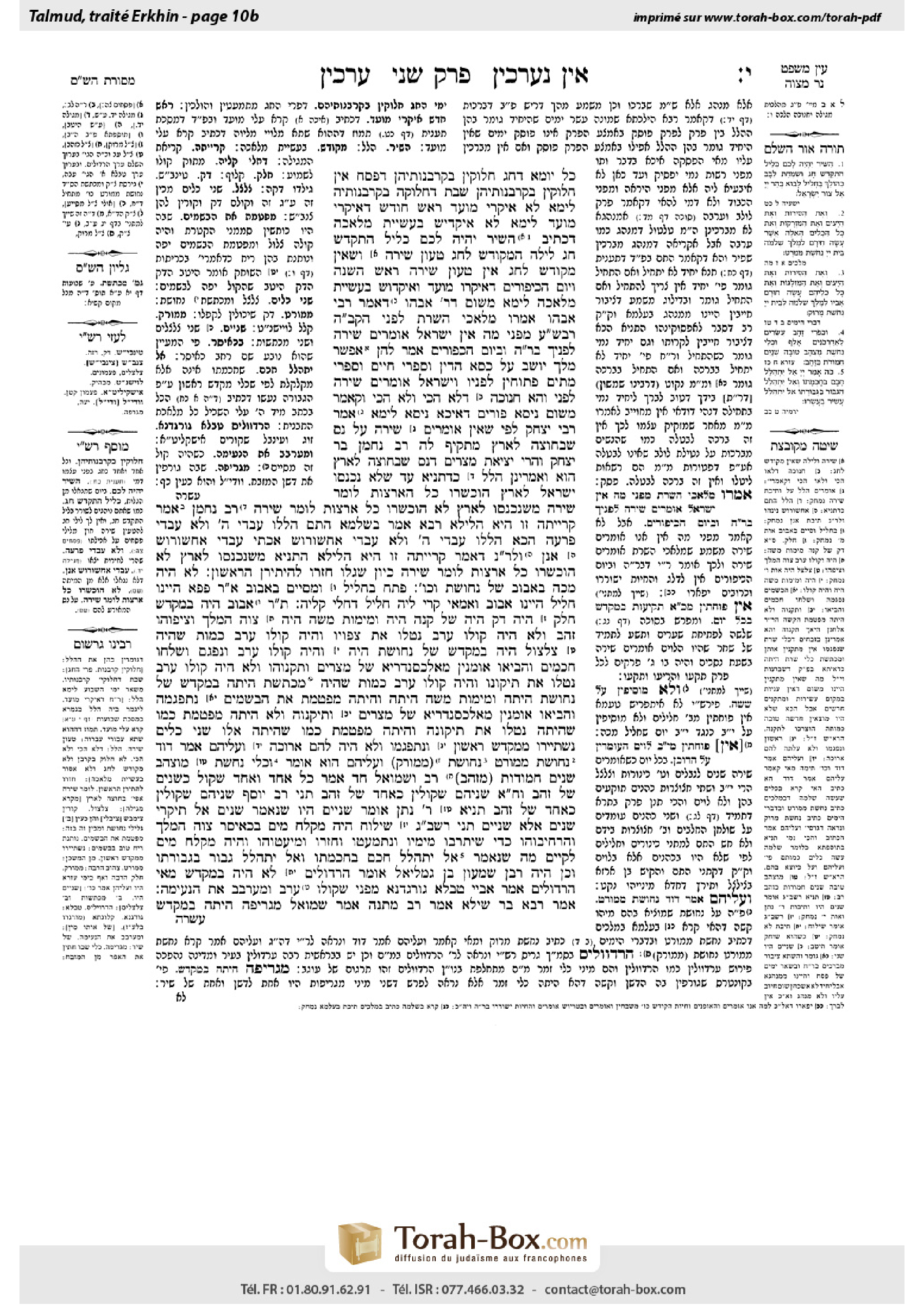
Arakhin 10b: Talmud study for Daf Yomi
Study the Talmud for Daf Yomi with scanned pages, Hebrew text, English translations from Sefaria and AI-generated French translations.
Passage selection and English or AI-generated French translation are available where the scan has annotations. Daf Study is independent of Torah-Box and Sefaria.
Browse Arakhin · ערכין · All tractatesArakhin 10b text and translations
This page of Arakhin includes the Aramaic text, an English translation and an AI-generated French translation, alongside the scan above.
ערכין י׳ ב · Aramaic and Hebrew text
כֹּל יוֹמָא? דְּחַג חֲלוּקִין בְּקׇרְבְּנוֹתֵיהֶן, דְּפֶסַח אֵין חֲלוּקִין בְּקׇרְבְּנוֹתֵיהֶן.
שַׁבָּת דַּחֲלוּקָה בְּקָרְבְּנוֹתֶיהָ, לֵימָא! לָא אִיקְּרִי ״מוֹעֵד״.
רֹאשׁ חוֹדֶשׁ דְּאִיקְּרִי ״מוֹעֵד״, לֵימָא! לָא אִיקַּדַּישׁ בַּעֲשִׂיַּית מְלָאכָה, דִּכְתִיב: ״הַשִּׁיר יִהְיֶה לָכֶם כְּלֵיל הִתְקַדֶּשׁ חָג״ — לַיְלָה הַמְקוּדָּשׁ לֶחָג טָעוּן שִׁירָה, וְשֶׁאֵין מְקוּדָּשׁ לֶחָג אֵין טָעוּן שִׁירָה.
רֹאשׁ הַשָּׁנָה וְיוֹם הַכִּיפּוּרִים, דְּאִיקְּרוֹ ״מוֹעֵד״, וְאִיקַּדּוּשׁ בַּעֲשִׂיַּית מְלָאכָה, לֵימָא! מִשּׁוּם דְּרַבִּי אֲבָהוּ.
דְּאָמַר רַבִּי אֲבָהוּ, אָמְרוּ מַלְאֲכֵי הַשָּׁרֵת לִפְנֵי הַקָּדוֹשׁ בָּרוּךְ הוּא: רִבּוֹנוֹ שֶׁל עוֹלָם, מִפְּנֵי מָה אֵין יִשְׂרָאֵל אוֹמְרִים שִׁירָה לְפָנֶיךָ בְּרֹאשׁ הַשָּׁנָה וּבְיוֹם הַכִּפּוּרִים? אָמַר לָהֶן: אֶפְשָׁר, מֶלֶךְ יוֹשֵׁב עַל כִּסֵּא הַדִּין, וְסִפְרֵי חַיִּים וְסִפְרֵי מֵתִים פְּתוּחִין לְפָנָיו, וְיִשְׂרָאֵל אוֹמְרִים שִׁירָה לְפָנַי?
וְהָא חֲנוּכָּה דְּלָא הָכִי וְלָא הָכִי, וְקָאָמַר! מִשּׁוּם נִיסָּא. פּוּרִים דְּאִיכָּא נִיסָּא, לֵימָא! אָמַר רַבִּי יִצְחָק: לְפִי שֶׁאֵין אוֹמְרִים שִׁירָה עַל נֵס שֶׁבְּחוּצָה לָאָרֶץ.
מַתְקֵיף לַהּ רַב נַחְמָן בַּר יִצְחָק: וַהֲרֵי יְצִיאַת מִצְרַיִם, דְּנֵס שֶׁבְּחוּצָה לָאָרֶץ הוּא, וְאָמְרִינַן הַלֵּל! כִּדְתַנְיָא: עַד שֶׁלֹּא נִכְנְסוּ יִשְׂרָאֵל לָאָרֶץ — הוּכְשְׁרוּ כׇּל הָאֲרָצוֹת לוֹמַר שִׁירָה, מִשֶּׁנִּכְנְסוּ לְאָרֶץ — לֹא הוּכְשְׁרוּ כׇּל אֲרָצוֹת לוֹמַר שִׁירָה.
רַב נַחְמָן אָמַר: קְרִיָּיתָהּ זוֹ הִיא הַלֵּילָאּ. רָבָא אָמַר: בִּשְׁלָמָא הָתָם ״הַלְלוּ עַבְדֵי ה׳״ — וְלֹא עַבְדֵי פַרְעֹה, הָכָא ״הַלְלוּ עַבְדֵי ה׳״ — וְלֹא עַבְדֵי אֲחַשְׁוֵרוֹשׁ? אַכַּתִּי עַבְדֵי אֲחַשְׁוֵרוֹשׁ אֲנַן!
וּלְרַב נַחְמָן דְּאָמַר: קְרִיָּיתָהּ זוֹ הִיא הַלֵּילָאּ, הָתַנְיָא: מִשֶּׁנִּכְנְסוּ לְאָרֶץ לֹא הוּכְשְׁרוּ כׇּל אֲרָצוֹת לוֹמַר שִׁירָה, כֵּיוָן שֶׁגָּלוּ חָזְרוּ לְהֶיתֵּירָן הָרִאשׁוֹן.
לֹא הָיָה מַכֶּה בְּאַבּוּב שֶׁל נְחוֹשֶׁת וְכוּ׳. פָּתַח בְּחָלִיל וּמְסַיֵּים בְּאַבּוּב. אָמַר רַב פָּפָּא: הַיְינוּ חָלִיל הַיְינוּ אַבּוּב, וְאַמַּאי קָרֵי לֵיהּ ״חָלִיל״? דַּחֲלֵי קָלֵיהּ.
תָּנוּ רַבָּנַן: אַבּוּב הָיָה בַּמִּקְדָּשׁ, חָלָק הָיָה, דַּק הָיָה, שֶׁל קָנֶה הָיָה, וּמִימוֹת מֹשֶׁה הָיָה. צִוָּה הַמֶּלֶךְ וְצִיפּוּהוּ זָהָב, וְלֹא הָיָה קוֹלוֹ עָרֵב, נָטְלוּ אֶת צִפּוּיוֹ וְהָיָה קוֹלוֹ עָרֵב כְּמוֹת שֶׁהָיָה. צִלְצוֹל הָיָה בַּמִּקְדָּשׁ, שֶׁל נְחוֹשֶׁת הָיָה, וְהָיָה קוֹלוֹ עָרֵב, וְנִפְגַּם, וְשָׁלְחוּ חֲכָמִים וְהֵבִיאוּ אוּמָּנִין מֵאֲלֶכְּסַנְדְּרִיָּא שֶׁל מִצְרַיִם וְתִקְּנוּהוּ, וְלֹא הָיָה קוֹלוֹ עָרֵב, נָטְלוּ אֶת תִּיקּוּנוֹ וְהָיָה קוֹלוֹ עָרֵב כְּמוֹת שֶׁהָיָה.
מַכְתֶּשֶׁת הָיְתָה בְּמִקְדָּשׁ, שֶׁל נְחוֹשֶׁת הָיְתָה, וּמִימוֹת מֹשֶׁה הָיְתָה, וְהָיְתָה מְפַטֶּמֶת אֶת הַבְּשָׂמִים, נִתְפַּגְּמָה וְהֵבִיאוּ אוּמָּנִין מֵאֲלֶכְּסַנְדְּרִיָּא שֶׁל מִצְרַיִם וְתִיקְנוּהָ, וְלֹא הָיְתָה מְפַטֶּמֶת כְּמוֹ שֶׁהָיְתָה, נָטְלוּ אֶת תִּיקּוּנָהּ וְהָיְתָה מְפַטֶּמֶת כְּמוֹ שֶׁהָיְתָה.
אֵלּוּ שְׁנֵי כֵלִים נִשְׁתַּיְּירוּ מִמִּקְדָּשׁ רִאשׁוֹן, וְנִתְפַּגְּמוּ וְלֹא הָיָה לָהֶם אֲרוּכָה, וַעֲלֵיהֶם אָמַר דָּוִד: ״נְחוֹשֶׁת מְמוֹרָט״, ״נְחוֹשֶׁת מְמוֹרָק״, וַעֲלֵיהֶם הוּא אוֹמֵר: ״וּכְלֵי נְחֹשֶׁת מוּצְהָב שְׁנַיִם חֲמוּדוֹת מִזָּהָב״.
רַב וּשְׁמוּאֵל, חַד אָמַר: כׇּל אֶחָד וְאֶחָד שָׁקוּל כִּשְׁנַיִם שֶׁל זָהָב, וְחַד אָמַר: שְׁנֵיהֶם שְׁקוּלִין כְּאֶחָד שֶׁל זָהָב. תָּנֵי רַב יוֹסֵף: שְׁנֵיהֶם שְׁקוּלִין כְּאֶחָד שֶׁל זָהָב.
תַּנְיָא, רַבִּי נָתָן אוֹמֵר: שְׁנִיִּים הָיוּ, שֶׁנֶּאֱמַר: ״שְׁנַיִם״, אַל תִּיקְרֵי ״שְׁנַיִם״ אֶלָּא ״שְׁנִיִּים״.
תָּנֵי רַבָּן שִׁמְעוֹן בֶּן גַּמְלִיאֵל: שִׁילוֹחַ הָיָה מְקַלֵּחַ מַיִם בִּכְאִיסָּר, צִוָּה הַמֶּלֶךְ וְהִרְחִיבוּהוּ כְּדֵי שֶׁיִּתְרַבּוּ מֵימָיו, וְנִתְמַעֲטוּ, וְחָזְרוּ וּמִיעֲטוּהוּ וְהָיָה מְקַלֵּחַ מַיִם, לְקַיֵּים מַה שֶּׁנֶּאֱמַר: ״אַל יִתְהַלֵּל חָכָם בְּחׇכְמָתוֹ וְאַל יִתְהַלֵּל גִּבּוֹר בִּגְבוּרָתוֹ״.
וְכֵן הָיָה רַבָּן שִׁמְעוֹן בֶּן גַּמְלִיאֵל אוֹמֵר: הִרְדַּוְלִים לֹא הָיָה בְּמִקְדָּשׁ. מַאי הִרְדַּוְלִים? אָמַר אַבָּיֵי: טַבְלָא גּוּרְגְּדָנָא, מִפְּנֵי שֶׁקּוֹלוֹ עָרֵב וּמְעַרְבֵּב אֶת הַנְּעִימָה.
אָמַר רָבָא בַּר שֵׁילָא אָמַר רַב מַתְנָה אָמַר שְׁמוּאֵל: מַגְרֵיפָה הָיְתָה בַּמִּקְדָּשׁ,
Arakhin 10b · English translation
every day, but only on the first day? The Gemara answers: The days of the festival of Sukkot are distinct from one another with regard to their additional offerings, as the number of bulls offered changes each day of Sukkot (see Numbers 29:12–38). Since each day is unique, the full hallel is recited on each day. By contrast, the days of Passover are not distinct from one another with regard to their additional offerings (see Numbers 28:24), and therefore the full hallel is recited only on the first day, which is the first day on which the additional offerings for a Festival are sacrificed.
The Gemara objects: On Shabbat, which is also distinct from the other days of the week with regard to its additional offerings, let us say hallel. The Gemara explains: Shabbat is not called an appointed day in the Torah, and hallel is recited only on days that are referred to in the Torah as appointed days (see Leviticus 23:4), which are days of rejoicing.
The Gemara objects: On the New Moon, which is called an appointed day, let us say hallel. The Gemara explains: The New Moon is not sanctified with regard to the prohibition against the performance of labor, and hallel is recited only on a day that is sanctified, as it is written: “You shall have a song as in the night when a festival is sanctified” (Isaiah 30:29), which indicates that a night that is sanctified as a Festival, which includes a prohibition of labor, requires song, but one that is not sanctified as a Festival does not require song.
The Gemara objects: On Rosh HaShana and Yom Kippur, which are called an appointed day and also are sanctified with regard to the prohibition against the performance of labor, let us say hallel. The Gemara explains: Hallel is not recited on those days due to the statement of Rabbi Abbahu.
As Rabbi Abbahu said that the ministering angels said before the Holy One, Blessed be He: Master of the Universe, for what reason do the Jewish people not recite songs of praise, i.e., hallel, before You on Rosh HaShana and on Yom Kippur? He said to them: Is it possible that while the King is sitting on the throne of judgment and the books of life and the books of death are open before Him, the Jewish people would be reciting joyous songs of praise before Me? Rosh HaShana and Yom Kippur are somber days of judgment whose mood is incompatible with the recitation of hallel.
The Gemara objects: But what about Hanukkah, which has neither this or that, i.e., there is no special offering on it, nor is labor prohibited, and yet one says hallel. The Gemara explains: Hallel is recited on Hanukkah not because of its status as a Festival, but because of the miracle that occurred on those days. The Gemara objects: If so, on Purim, when there is also this factor, i.e., a miracle occurred on that day, let us say hallel. Rabbi Yitzḥak said: Hallel is not recited on Purim because one does not recite a song of praise for a miracle that occurred outside of Eretz Yisrael.
Rav Naḥman bar Yitzḥak objects to this explanation: But there is the exodus from Egypt, which was a miracle that took place outside of Eretz Yisrael, and yet we say hallel on Passover night in commemoration of it? The Gemara responds that this is as it is taught in a baraita: Until the Jewish people entered Eretz Yisrael, all lands were deemed fit for songs of praise to be recited for miracles performed within their borders, as all lands were treated equally. But once the Jewish people entered Eretz Yisrael, that land became endowed with greater sanctity, and all the other lands were no longer deemed fit for songs of praise to be recited for miracles performed within them.
Rav Naḥman says an alternative answer as to why hallel is not recited on Purim: The reading of the Megilla, i.e., the Scroll of Esther, is equivalent to reciting hallel. Rava says a third reason: Granted, hallel is said there, when recalling the exodus from Egypt, as after that salvation one can recite the phrase in hallel: “Give praise, O servants of the Lord” (Psalms 113:1), since after the Israelites’ servitude to Pharaoh ended with their salvation, they were truly servants of the Lord and not servants of Pharaoh. But can it be said here, after the salvation commemorated on Purim: “Give praise, O servants of the Lord,” which would indicate that after the salvation the Jewish people were only servants of the Lord and not servants of Ahasuerus? Not so, as even after the miracle of Purim, we are still the servants of Ahasuerus, since the Jews remained in exile under Persian rule.
The Gemara objects: And according to the opinion of Rav Naḥman, who says that the reading of the Megilla itself is an act of reciting hallel, there is a difficulty: Isn’t it taught in a baraita: Once the Jewish people entered Eretz Yisrael, that land became endowed with greater sanctity, and all the other lands were no longer deemed fit for songs of praise to be recited for miracles performed within them. How, then, may one recite a form of hallel by reading the Megilla? The Gemara answers: He maintains that once the people were exiled from Eretz Yisrael, the other lands returned to their initial suitability, and were once again deemed fit for reciting hallel, in commemoration of miracles performed within them.
§ The mishna teaches: And one would not play a copper flute [abuv]; rather, one would play a flute [abuv] of reed, because its sound is pleasant. The Gemara asks: The mishna opens by referring to flutes and calls them ḥalil and then concludes by referring to playing an abuv. Rav Pappa said: A ḥalil is the same as an abuv. Its original name was abuv; and why does the mishna call it a ḥalil? The reason is that its sound is sweet [ḥali].
The Sages taught in a baraita: There was a flute in the Temple; it was smooth and it was thin, i.e., its sides were thin; it was made from reed, and it was in existence from the days of Moses. The king issued a command and they plated the flute with gold, but then its sound was not as pleasant as it was previously. They therefore removed its plating and its sound was then as pleasant as it was before. Similarly, there was a cymbal in the Temple; it was made from copper and its sound was pleasant. It became damaged and the Sages sent for and brought artisans from Alexandria in Egypt and they repaired it, but its sound was not as pleasant as before. They removed the materials with which the cymbal had been repaired and its sound was then as pleasant as it had been before the repair.
There was a mortar in the Temple; it was made of copper and it was from the days of Moses, and it was used to compound the spices for the incense. It became damaged and they brought artisans from Alexandria in Egypt and they repaired it, but it did not compound the spices as well as it had before. They removed the materials with which the mortar had been repaired and it then compounded the spices as it had before it was repaired.
The baraita concludes: These two copper vessels, the cymbal and the mortar, were remnants from the First Temple and they were damaged and they could not be repaired in an effective manner. And it was with regard to the copper vessels constructed for the First Temple that David said: “All these vessels, which Hiram made for King Solomon, in the House of the Lord, were of burnished brass” (I Kings 7:45), and, in a parallel verse, “bright brass” (II Chronicles 4:16). And with regard to these two items it states in the verse describing the vessels that Ezra brought to Jerusalem: “And vessels of fine golden brass, two, precious as gold” (Ezra 8:27).
Rav and Shmuel disagree as to the meaning of the phrase: Two, precious as gold. One said: Each and every one of these brass vessels was as valuable as two vessels made from gold. And the other one said: The two of them together were as valuable as one vessel made from gold. Similarly, Rav Yosef teaches the following explanation found in a baraita: The two of them together were as valuable as one vessel made from gold.
The Gemara cites another explanation of the verse in Ezra. It is taught in a baraita that Rabbi Natan says: The cymbals and mortars were pairs, i.e., there were two cymbals and two mortars, as it is stated in the aforementioned verse “two”; do not read it as two [shenayim], but as pairs [sheniyyim].
§ Rabban Shimon ben Gamliel teaches in a baraita: The Siloam pool used to spurt forth water through an opening with a diameter like that of an issar coin.The king issued a command and they widened the opening so that its waters would increase, but the waters actually decreased. And they subsequently decreased the size of the opening again and it once again spurted forth water as it had before. All this serves to uphold that which is stated in the verse: “Let not the wise man glory in his wisdom, neither let the mighty man glory in his might” (Jeremiah 9:22), i.e., man should not think that he can accomplish anything he wishes.
And likewise Rabban Shimon ben Gamliel would say, with regard to the musical instruments in the Temple: There was no hirdolim in the Temple. The Gemara asks: What is a hirdolim? Abaye said: It is a hydraulic organ. It was not used in the Temple because its sound is pleasant but it disrupts the melody.
Rava bar Sheila said that Rav Mattana said that Shmuel said: There was an instrument called magreifa in the Temple.
Arakhin 10b · Traduction française (IA)
chaque jour, mais uniquement le premier jour ? La Guemara répond : les jours du festival de la Tabernacle sont distincts les uns des autres en ce qui concerne leurs offrandes supplémentaires, car le nombre de taureaux offerts varie chaque jour du Tabernacle (voir Nombres 29:12–38). Puisque chaque jour est unique, l'hallel complet est récité chaque jour. À l'inverse, les jours de Pessah ne sont pas distincts les uns des autres en ce qui concerne leurs offrandes supplémentaires (voir Nombres 28:24), et par conséquent l'hallel complet est récité uniquement le premier jour, qui est le premier jour où les offrandes supplémentaires d'un festival sont sacrifiées.
La Guemara s'oppose à cela : le Shabbat, qui est également distinct des autres jours de la semaine en ce qui concerne ses offrandes supplémentaires, permettrait de dire l'hallel. La Guemara explique : le Shabbat n'est pas appelé un jour fixe dans la Torah, et l'hallel est récité uniquement sur les jours qui sont désignés dans la Torah comme des jours fixés (voir Lévitique 23:4), qui sont des jours de joie.
La Guemara s'oppose à cela : sur le Nouvel Mois, qui est appelé un jour fixe, permettons de dire l'hallel. La Guemara explique : le Nouvel Mois n'est pas sanctifié en ce qui concerne l'interdiction de l'œuvre, et l'hallel est récité uniquement sur un jour sanctifié, comme il est écrit : « Vous avez un chant comme la nuit où un festival est sanctifié » (Yachout 30:29), ce qui indique qu'une nuit sanctifiée comme un festival, qui inclut une interdiction d'œuvre, exige un chant, mais une nuit qui n'est pas sanctifiée comme un festival n'exige pas de chant.
La Guemara s'oppose à cela : sur Rosh HaShana et Yom Kippur, qui sont appelés un jour fixe et sont également sanctifiés en ce qui concerne l'interdiction de l'œuvre, permettons de dire l'hallel. La Guemara explique : l'hallel n'est pas récité sur ces jours en raison de la déclaration de Rabbi Abbahu.
Comme Rabbi Abbahu a dit que les anges ministraux dirent devant le Saint, béni soit-Il : Seigneur du Monde, pourquoi les Juifs ne récitent-ils pas des chants de louange, c'est-à-dire l'hallel, devant Toi le Rosh HaShana et le Yom Kippur ? Il leur dit : Est-ce possible que pendant que le Roi siège sur le trône de jugement et que les livres de la vie et les livres de la mort sont ouverts devant Lui, les Juifs récitent des chants joyeux de louange devant Moi ? Rosh HaShana et Yom Kippur sont des jours sombres de jugement dont l'ambiance est incompatible avec la récitation de l'hallel.
La Guemara s'oppose à cela : mais que dire de Hanoukka, qui n'a ni cela ni cela, c'est-à-dire qu'il n'y a pas d'offrande spéciale sur ce jour, ni interdiction d'œuvre, et pourtant l'hallel est récité. La Guemara explique : l'hallel est récité sur Hanoukka non en raison de son statut de festival, mais en raison du miracle qui s'est produit à ce jour. La Guemara s'oppose à cela : si c'est ainsi, sur Purim, où il y a aussi ce facteur, c'est-à-dire un miracle s'est produit à ce jour, permettons de dire l'hallel. Rabbi Yitzhak a dit : l'hallel n'est pas récité sur Purim car on ne récite pas un chant de louange pour un miracle qui s'est produit en dehors de la Terre d'Israël.
Rav Naḥman bar Yitzḥak s'oppose à cette explication : mais il y a l'exode d'Égypte, qui a été un miracle qui s'est produit en dehors de la Terre d'Israël, et pourtant l'hallel est récité la nuit de Pessah en commémoration de cela ? La Guemara répond que cela est comme il est enseigné dans une baraïta : jusqu'à ce que le peuple d'Israël ait entré en Terre d'Israël, toutes les terres étaient considérées comme adaptées à la récitation de chants de louange pour les miracles accomplis à l'intérieur de leurs frontières, car toutes les terres étaient traitées de manière égale. Mais une fois que le peuple d'Israël a entré en Terre d'Israël, cette terre est devenue dotée d'une sainteté supérieure, et toutes les autres terres ne sont plus considérées comme adaptées à la récitation de chants de louange pour les miracles accomplis à l'intérieur d'elles.
Rav Naḥman dit une autre réponse à ce sujet : la lecture du Megilla, c'est-à-dire le Livre d'Esther, est équivalente à la récitation de l'hallel. Rava dit une troisième raison : en effet, l'hallel est récité là, lors de la réminiscence de l'exode d'Égypte, car après cette sauvegarde, on peut réciter la phrase de l'hallel : « Louez, ô serviteurs du Seigneur » (Psaumes 113:1), car après que les Israélites ont cessé d'être esclaves de Pharaon avec leur sauvegarde, ils étaient véritablement des serviteurs du Seigneur et non des serviteurs de Pharaon. Mais peut-on dire ici, après la sauvegarde commémorée sur Purim : « Louez, ô serviteurs du Seigneur », ce qui indiquerait que après la sauvegarde, le peuple juif était seulement des serviteurs du Seigneur et non des serviteurs d'Ahasuerus ? Non, car même après le miracle de Purim, nous sommes encore les serviteurs d'Ahasuerus, car les Juifs restaient en exil sous la domination perse.
La Guemara s'oppose à cela : selon l'opinion de Rav Naḥman, qui affirme que la lecture du Megilla elle-même constitue un acte de récitation de l'hallel, il y a une difficulté : n'est-il pas enseigné dans une baraïta : une fois que le peuple d'Israël est entré en Terre d'Israël, cette terre est devenue dotée d'une sainteté supérieure, et toutes les autres terres ne sont plus considérées comme adaptées à la récitation de chants de louange pour les miracles accomplis à l'intérieur d'elles. Comment, alors, peut-on réciter une forme d'hallel en lisant le Megilla ? La Guemara répond : il maintient que, une fois que le peuple a été exilé de la Terre d'Israël, les autres terres sont revenues à leur situation initiale et sont à nouveau considérées comme adaptées à la récitation de l'hallel, en commémoration des miracles accomplis à l'intérieur d'elles.
§ La mitsna enseigne : on ne jouait pas un flute en cuivre [abuv] ; plutôt, on jouait un flute [abuv] en roseau, car son son est agréable. La Guemara pose la question : la mitsna commence par faire référence aux flutes et les appelle ḥalil, puis conclut par parler de jouer un abuv. Rav Pappa a dit : un ḥalil est le même qu'un abuv. Son nom originel était abuv ; et pourquoi la mitsna l'appelle-t-elle un ḥalil ? La raison est que son son est doux [ḥali].
Les Sages enseignèrent dans une baraïta : Il y avait un flûtet dans le Temple ; il était lisse et fin, c'est-à-dire que ses côtés étaient fins ; il était fait de roseau et existait depuis les jours de Moïse. Le roi donna un ordre et ils recouvrirent le flûtet d'or, mais alors son son n'était plus aussi agréable qu'avant. Ils enlevèrent donc le recouvrement d'or et son son fut alors aussi agréable qu'avant. De même, il y avait un tambourin dans le Temple ; il était fait de cuivre et son son était agréable. Il s'était abîmé et les Sages envoyèrent chercher des artisans d'Alexandrie en Égypte et ils le réparèrent, mais son son n'était plus aussi agréable qu'avant. Ils enlevèrent les matériaux utilisés pour la réparation et son son fut alors aussi agréable qu'avant la réparation.
Il y avait un mortier dans le Temple ; il était fait de cuivre et existait depuis les jours de Moïse, et il était utilisé pour mélanger les parfums de l'encens. Il s'était abîmé et ils envoyèrent chercher des artisans d'Alexandrie en Égypte et ils le réparèrent, mais il ne mélangeait plus les parfums aussi bien qu'avant. Ils enlevèrent les matériaux utilisés pour la réparation et il mélangea alors les parfums comme avant la réparation.
La baraïta conclut : Ces deux objets en cuivre, le tambourin et le mortier, étaient des restes du Premier Temple et ils s'étaient abîmés et ils ne pouvaient être réparés efficacement. Et c'est à propos des objets en cuivre construits pour le Premier Temple que David dit : « Tous ces objets, que Hiram fit pour le roi Salomon, dans la Maison du Seigneur, étaient de cuivre brillant » (I Rois 7:45), et, dans un verset parallèle, « cuivre brillant » (II Chroniques 4:16). Et à propos de ces deux objets, il est dit dans le verset décrivant les objets que l'homme apporta à Jérusalem : « Et des objets de cuivre fin, deux, précieux comme l'or » (Esdras 8:27).
Rav et Shmuel s'entendent sur la signification de la phrase : Deux, précieux comme l'or. L'un dit : Chacun de ces objets en cuivre était aussi précieux que deux objets en or. L'autre dit : Les deux ensemble étaient aussi précieux qu'un seul objet en or. De même, Rav Yosef enseigne l'explication suivante trouvée dans une baraïta : Les deux ensemble étaient aussi précieux qu'un seul objet en or.
La Guemara cite une autre interprétation du verset d'Esdras. Il est enseigné dans une baraïta que Rabbi Natan dit : Les tambourins et les mortiers étaient des paires, c'est-à-dire qu'il y avait deux tambourins et deux mortiers, comme il est dit dans le verset mentionné précédemment « deux » ; ne le lis pas comme deux [shenayim], mais comme des paires [sheniyyim].
§ Rabban Shimon ben Gamliel enseigne dans une baraïta : Le bassin de Siloam sortait de l'eau par une ouverture dont le diamètre était celui d'une pièce d'issar. Le roi donna un ordre et ils agrandirent l'ouverture afin que l'eau augmente, mais l'eau diminua en réalité. Et ils réduisirent ensuite la taille de l'ouverture et l'eau sortit à nouveau comme avant. Tout cela sert à soutenir ce qui est dit dans le verset : « Que le sage ne se glorifie pas dans sa sagesse, ni le puissant dans sa force » (Jérémie 9:22), c'est-à-dire que l'homme ne devrait pas penser qu'il peut accomplir tout ce qu'il désire.
Et de même Rabban Shimon ben Gamliel disait, concernant les instruments de musique du Temple : Il n'y avait pas de hirdolim dans le Temple. La Guemara demande : Qu'est-ce qu'un hirdolim ? Abaye dit : C'est un orgue hydraulique. Il n'était pas utilisé dans le Temple car son son est agréable mais il perturbe la mélodie.
Rava bar Sheila dit que Rav Mattana dit que Shmuel dit : Il y avait un instrument appelé magreifa dans le Temple.
Traduction française générée par IA à partir de l’édition anglaise de Sefaria. Vérifie toujours un passage avec le texte source.
Text from Sefaria: William Davidson Edition - Vocalized Aramaic (CC BY NC); William Davidson Edition - English (CC BY NC).