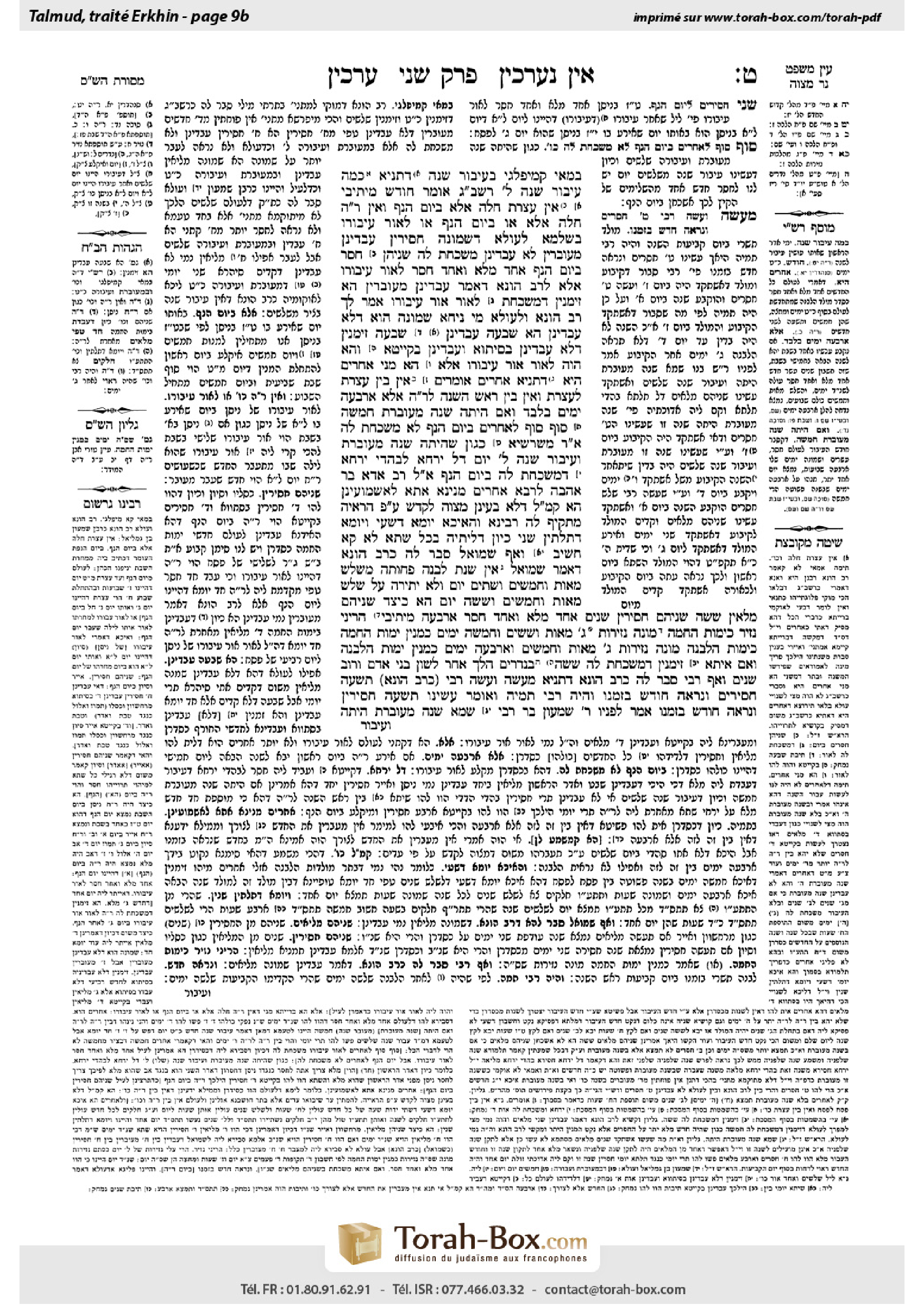
Arakhin 9b: Talmud study for Daf Yomi
Study the Talmud for Daf Yomi with scanned pages, Hebrew text, English translations from Sefaria and AI-generated French translations.
Passage selection and English or AI-generated French translation are available where the scan has annotations. Daf Study is independent of Torah-Box and Sefaria.
Browse Arakhin · ערכין · All tractatesArakhin 9b text and translations
This page of Arakhin includes the Aramaic text, an English translation and an AI-generated French translation, alongside the scan above.
ערכין ט׳ ב · Aramaic and Hebrew text
בְּמַאי קָמִיפַּלְגִי? בְּעִיבּוּר שָׁנָה, דְּתַנְיָא: כַּמָּה עִיבּוּר שָׁנָה — שְׁלֹשִׁים, רַבָּן שִׁמְעוֹן בֶּן גַּמְלִיאֵל אוֹמֵר: חוֹדֶשׁ.
מֵיתִיבִי: אִין עֲצֶרֶת חָלָה אֶלָּא בְּיוֹם הָנֵף, וְאֵין רֹאשׁ הַשָּׁנָה חָלָה אֶלָּא אוֹ בְּיוֹם הָנֵף אוֹ לְאוֹר עִיבּוּרוֹ. בִּשְׁלָמָא לְעוּלָּא, דִּשְׁמוֹנָה חֲסֵירִין עָבְדִינַן, מֵעוּבָּרִין לָא עָבְדִינַן — מַשְׁכַּחַתְּ לַהּ.
שְׁנֵיהֶן חָסֵר — בְּיוֹם הָנֵף.
אֶחָד מָלֵא וְאֶחָד חָסֵר — לְאוֹר עִיבּוּרוֹ.
אֶלָּא לְרַב הוּנָא דְּאָמַר: עָבְדִינַן מְעוּבָּרִין, הָא זִימְנִין דְּמַשְׁכַּחַתְּ לְאוֹר אוֹר עִיבּוּרוֹ!
אָמַר לְךָ רַב הוּנָא: וּלְעוּלָּא מִי נִיחָא? שְׁמוֹנָה הוּא דְּלָא עָבְדִינַן, הָא שִׁבְעָה עָבְדִינַן. שִׁבְעָה זִימְנִין דְּלָא עָבְדִינַן בְּסִיתְוָא וְעָבְדִינַן בְּקַיְיטָא, וְהָא הֲוָה לְאוֹר אוֹר עִיבּוּרוֹ!
אֶלָּא, הָא מַנִּי? אֲחֵרִים הִיא, דְּתַנְיָא: אֲחֵרִים אוֹמְרִים: אֵין בֵּין עֲצֶרֶת לַעֲצֶרֶת, וְאֵין בֵּין רֹאשׁ הַשָּׁנָה לְרֹאשׁ הַשָּׁנָה, אֶלָּא אַרְבָּעָה יָמִים בִּלְבַד, וְאִם הָיְתָה שָׁנָה מְעוּבֶּרֶת — חֲמִשָּׁה.
סוֹף סוֹף, לַאֲחֵרִים, בְּיוֹם הָנֵף — לָא מַשְׁכַּחַתְּ לַהּ!
אָמַר רַב מְשַׁרְשְׁיָא: כְּגוֹן שֶׁהָיְתָה שָׁנָה מְעוּבֶּרֶת, וְעִיבּוּר שָׁנָה שְׁלֹשִׁים יוֹם, דַּל יַרְחָא לְבַהֲדֵי יַרְחָא, דְּמַשְׁכַּחַתְּ לָהּ בְּיוֹם הָנֵף.
אֲמַר לֵיהּ רַב אַדָּא בַּר אַהֲבָה לְרָבָא: ״אֲחֵרִים״, מִנְיָנָא אֲתָא לְאַשְׁמוֹעִינַן? הָא קָא מַשְׁמַע לַן, דְּלָא בָּעֵינַן מִצְוָה לְקַדֵּשׁ עַל פִּי הָרְאָיָה.
מַתְקֵיף לַהּ רָבִינָא וְהָאִיכָּא יוֹמָא דְּשָׁעֵי, וְיוֹמָא דִּתְלָתִין שְׁנֵי, כֵּיוָן דְּלֵיתֵיהּ בְּכֹל שַׁתָּא לָא קָא חָשֵׁיב.
וְאַף שְׁמוּאֵל סָבַר לַהּ כְּרַב הוּנָא, דְּאָמַר שְׁמוּאֵל: אֵין שְׁנַת לְבָנָה פְּחוּתָה מִשְּׁלֹשׁ מֵאוֹת וַחֲמִשִּׁים וּשְׁתַּיִם יוֹם, וְלֹא יְתֵירָה עַל שְׁלֹשׁ מֵאוֹת וַחֲמִשִּׁים וְשִׁשָּׁה יוֹם.
הָא כֵּיצַד? שְׁנֵיהֶם מְלֵאִין — שִׁשָּׁה, שְׁנֵיהֶם חֲסֵירִין — שְׁנַיִם, אֶחָד מָלֵא וְאֶחָד חָסֵר — אַרְבָּעָה.
מֵיתִיבִי: הֲרֵינִי נָזִיר ״כִּימוֹת הַחַמָּה״ — מוֹנֶה נְזִירוּת שְׁלֹשׁ מֵאוֹת וְשִׁשִּׁים וַחֲמִשָּׁה יָמִים, כְּמִנְיַן יְמוֹת הַחַמָּה. ״כִּימוֹת הַלְּבָנָה״ — מוֹנֶה נְזִירוּת שְׁלֹשׁ מֵאוֹת וַחֲמִשִּׁים וְאַרְבָּעָה יָמִים, כְּמִנְיַן יְמוֹת הַלְּבָנָה. וְאִם אִיתָא, זִימְנִין דְּמַשְׁכַּחַתְּ לַהּ שִׁשָּׁה!
בִּנְדָרִים הַלֵּךְ אַחַר לְשׁוֹן בְּנֵי אָדָם, וְרוֹב שָׁנִים.
וְאַף רַבִּי סָבַר לַהּ כְּרַב הוּנָא, דְּתַנְיָא: מַעֲשֶׂה וְעָשָׂה רַבִּי (כְּרַב הוּנָא) תִּשְׁעָה חֲסֵירִים, וְנִרְאָה חוֹדֶשׁ בִּזְמַנּוֹ, וְהָיָה רַבִּי תָּמֵיהַּ וְאוֹמֵר: עָשִׂינוּ תִּשְׁעָה חֲסֵירִין וְנִרְאֶה חוֹדֶשׁ בִּזְמַנּוֹ! אָמַר לְפָנָיו רַבִּי שִׁמְעוֹן בַּר רַבִּי: שֶׁמָּא שָׁנָה מְעוּבֶּרֶת הָיְתָה?
Arakhin 9b · English translation
The Gemara asks: With regard to what principle do Rav Huna and Ulla disagree? The Gemara answers: They disagree about the length of the month added in the intercalation of the year, as it is taught in a baraita: How many days are added in the intercalation of the year? Thirty days. Rabban Shimon ben Gamliel says: A deficient month, i.e., one of twenty-nine days. Rav Huna accepts the opinion of Rabban Shimon ben Gamliel, whereas Ulla accepts the opinion of the first tanna.
The Gemara raises an objection to the opinion of Rav Huna from a baraita: The festival of Shavuot occurs only on the same day of the week as the day of waving the omer offering, i.e., the sixteenth of Nisan, which is the second day of Passover. And Rosh HaShana also occurs only on the same day of the week as the day of waving the omer offering of the preceding year, or on the day of the week that occurs on the night after the waving, i.e., the seventeenth of Nisan, which is the third day of Passover. Granted, according to the opinion of Ulla, who says that we may establish eight deficient months in a year but we may not establish eight full months in a year, you find that Rosh HaShana can occur on either of the two days mentioned in the baraita.
The Gemara elaborates: There are six ends of months between the omer offering and Rosh HaShana. In an ordinary year the months alternate in length, so these six months will comprise three full and three deficient months. If so, Rosh HaShana will occur on the same day of the week as the third day of Passover. If a year has eight deficient months, one of the two extra deficient months will presumably occur in the summer, between the day of waving and Rosh HaShana, which would mean that Rosh HaShana would occur one day earlier, on the same day of the week as the second day of Passover, the day of the waving of the omer offering.
And if no extra deficient months are added that year, but the standard format of alternating lengths of months, one full and one deficient, is applied, Rosh HaShana will occur on the day of the week that occurs on the night after the waving of the omer offering.
But according to Rav Huna, who says: We may establish eight full, thirty-day months in a year, there are also times when you find that Rosh HaShana occurs on the night after the night after the extra day, i.e., the thirtieth of Nisan, two days after the day of the week of the omer offering. This would occur on a Rosh HaShana following a year with eight full months, i.e., two more full months than usual, when one of the extra full months would occur between Passover and Rosh HaShana. In such a case, Rosh HaShana would be delayed from occurring on the same day of the week as the third day of Passover, which is the usual situation, to the same day as the fourth day of Passover.
The Gemara responds with a counter objection. Rav Huna could say to you: And does the baraita really work out well according to Ulla? Even according to Ulla, it is eight full months that we may not establish in one year, but we may establish seven full months in a single year, one more than the usual. Consequently, there may be times when we do not establish the extra full month in the winter, but we establish it in the summer, between Passover and Rosh HaShana. In such a case, Rosh HaShana would be two days after the day of the week of the omer offering. Consequently, even according to Ulla, the baraita should have mentioned this possibility.
Rather, in accordance with whose opinion is this baraita? It is in accordance with Aḥerim, as it is taught in a baraita: Aḥerim say that the difference between Shavuot of one year and Shavuot of the following year, and similarly, the difference between Rosh HaShana of one year and Rosh HaShana of the following year, is only four days of the week. In an ordinary year, when full and deficient months alternate, there are 354 days. Therefore, every year is exactly fifty weeks and four days long, which means that any calendar date one year would occur four days later in the week in the following year. And if it was a leap year, in which case the year contains 383 days, or fifty-four weeks and five days, there is a difference of five days between them.
The Gemara asks: Ultimately, the baraita remains difficult, because according to Aḥerim you do not find that Rosh HaShana ever occurs on the same day of the week as the day of waving the omer offering. This is because Aḥerim maintain that the months always alternate between full and deficient months and therefore there is never an additional full month between Passover and Rosh HaShana.
Rav Mesharshiyya said in response: Rosh HaShana can occur on the same day of the week as the day of the omer offering, in a case where it was a leap year and the intercalated month added to create the leap year was thirty days. This would cause Rosh HaShana to occur six days of the week later than the year before, but Aḥerim maintain that it must occur exactly five days of the week later. Consequently, one of the months after Passover must be changed from a full month to a deficient one: Remove from the calculation one full month after Passover corresponding to the extra full month added before Passover in order to ensure that Rosh HaShana occurs five days of the week later than the previous year. This ensures that you will find a case where Rosh HaShana occurs on the same day of the week as the day of waving the omer offering.
Rav Adda bar Ahava said to Rava: Did Aḥerim come to teach us the number of days between one Rosh HaShana and the next? Why didn’t Aḥerim simply say that the months of the year always alternate between full and deficient months, and the calculation of the number of days between the Festivals in one year and the next would be obvious? Rava answered: This statement of Aḥerim teaches us that we do not need to take into consideration the possibility that it is a mitzva to sanctify the new month according to the sighting of the new moon. Rather, if the order of the months dictates that a new month should be deficient, the start of the following month may be declared despite the fact that the new moon has not been sighted.
Ravina objects to the opinion of Aḥerim for a different reason: But how is it possible that there is always a difference of four weekdays between one Rosh HaShana and the next? The length of a lunar month is not precisely twenty-nine and a half days, but twenty-nine days, twelve hours and 793/1080 of an hour. This extra fraction beyond twenty-nine and a half days is compounded month after month and year after year, and as a result, eventually there is an additional day that must be added to the calendar every three years due to the accumulation of hours, and an additional day that must be added every thirty years due to a further accumulation of the extra parts of an hour. The Gemara answers: Since these days do not appear on the calendar every year, the baraita did not account for them.
§ The Gemara returns to the dispute between Rav Huna and Ulla over the interpretation of the mishna. And Shmuel also holds in accordance with the opinion of Rav Huna, that it is permitted to establish eight full months in a year, as Shmuel says: The year in a lunar calendar has no less than 352 days, and no more than 356 days.
How so? An ordinary year, consisting of alternating full and deficient months, consists of 354 days. If two months that are generally deficient are made full, there are three hundred and fifty-six days in the year. If two months that are generally full are made deficient, there are three hundred and fifty-two days in the year. If the months alternate as usual, one full and one deficient, there are three hundred and fifty-four days in the year. This shows that according to Shmuel it is permitted to change two months from deficient to full months, which leads to a total of eight full months in one year.
The Gemara raises an objection against Shmuel from a baraita. If one says: I am hereby a nazirite for a duration that is like the number of days in a solar year, he counts 365 days for his term of naziriteship, corresponding to the number of days in a solar year. If he says: Like the days in a lunar year, i.e., a year comprising twelve lunar months, he counts 354 days for his term of naziriteship, corresponding to the number of days in a lunar year. The Gemara explains the objection: And if it is so, that there can be eight full months in a year, there are times when you find that a lunar year has three hundred and fifty-six days. Why, then, shouldn’t the period of naziriteship last for 356 days?
The Gemara explains: The halakha is that with regard to vows, you follow the ordinary language of people. The meaning of a vow is understood in accordance with the way its words are used in common speech. And when people speak of a lunar year, they are generally referring to one that is the length of most years, i.e., 354 days.
The Gemara adds: And Rabbi Yehuda HaNasi also holds in accordance with the opinion of Rav Huna, that it is permitted to establish eight full months in one year. As it is taught in a baraita: There was an incident in which Rabbi Yehuda HaNasi established nine deficient months in one year, and nevertheless the new moon was sighted in its proper time, on Rosh HaShana, and not later. And Rabbi Yehuda HaNasi expressed astonishment and said: We made nine months deficient in one year and yet the new moon was sighted in its proper time. How could this be? Rabbi Shimon, son of Rabbi Yehuda HaNasi, said before him: Perhaps last year was a leap year
Arakhin 9b · Traduction française (IA)
La Guemara pose la question : Sur quel principe Rav Huna et Ulla sont-ils en désaccord ? La Guemara répond : Ils s'entendent sur la durée du mois ajouté lors de l'intercalation de l'année, comme il est enseigné dans une baraïta : Combien de jours sont ajoutés lors de l'intercalation de l'année ? Trente jours. Rabban Shimon ben Gamliel dit : Un mois déficient, c'est-à-dire un mois de vingt-neuf jours. Rav Huna accepte l'opinion de Rabban Shimon ben Gamliel, tandis qu'Ulla accepte l'opinion du premier tanna.
La Guemara soulève une objection contre l'opinion de Rav Huna, tirée d'une baraïta : La fête de Shavuot a lieu uniquement le même jour de la semaine que le jour de l'offrande de l'omer, c'est-à-dire le seizième de Nisan, qui est le deuxième jour de Pâque. Et Rosh HaShana a lieu uniquement le même jour de la semaine que le jour de l'offrande de l'omer de l'année précédente, ou le jour de la semaine qui tombe la nuit après l'offrande, c'est-à-dire le dix-septième de Nisan, qui est le troisième jour de Pâque. Admettons, selon l'opinion d'Ulla, qui dit que nous pouvons établir huit mois déficients dans une année mais pas huit mois pleins, vous trouvez que Rosh HaShana peut avoir lieu soit sur l'un des deux jours mentionnés dans la baraïta.
La Guemara développe : Il y a six fins de mois entre l'offrande de l'omer et Rosh HaShana. Dans une année ordinaire, les mois alternent en longueur, donc ces six mois comporteront trois mois pleins et trois mois déficients. Ainsi, Rosh HaShana aura lieu le même jour de la semaine que le troisième jour de Pâque. Si une année comporte huit mois déficients, l'un des deux mois supplémentaires déficients se trouvera probablement en été, entre le jour de l'offrande et Rosh HaShana, ce qui signifierait que Rosh HaShana aura lieu un jour plus tôt, le même jour de la semaine que le deuxième jour de Pâque, le jour de l'offrande de l'omer.
Et si aucun mois déficient supplémentaire n'est ajouté cette année, mais que l'on applique le format standard d'alternance des longueurs des mois, un mois plein et un mois déficient, Rosh HaShana aura lieu le jour de la semaine qui correspond à la nuit suivant la nuit du branle de l'omer.
Mais selon Rav Huna, qui dit : Nous pouvons établir huit mois pleins, de trente jours, dans une année, il y a aussi des moments où vous trouvez que Rosh HaShana a lieu la nuit suivant la nuit suivant le jour supplémentaire, c'est-à-dire le trentième de Nisan, deux jours après le jour de la semaine de l'offrande de l'omer. Cela se produit lors d'un Rosh HaShana suivant une année avec huit mois pleins, c'est-à-dire deux mois pleins de plus que la normale, lorsque l'un des mois pleins supplémentaires se trouvera entre Pâque et Rosh HaShana. Dans ce cas, Rosh HaShana serait reporté du même jour de la semaine que le troisième jour de Pâque, la situation normale, au même jour que le quatrième jour de Pâque.
La Guemara répond avec une objection contraire. Rav Huna pourrait dire à vous : Et la baraïta fonctionne-t-elle bien selon Ulla ? Même selon Ulla, il est huit mois pleins que nous ne pouvons pas établir dans une année, mais nous pouvons établir sept mois pleins dans une seule année, un de plus que la normale. Ainsi, il peut y avoir des moments où nous ne mettons pas l'extra mois plein en hiver, mais nous le mettons en été, entre Pâque et Rosh HaShana. Dans ce cas, Rosh HaShana aurait lieu deux jours après le jour de la semaine de l'offrande de l'omer. Ainsi, même selon Ulla, la baraïta devrait avoir mentionné cette possibilité.
Plutôt, selon l'opinion de qui est cette baraïta ? Elle est selon Aḥerim, comme il est enseigné dans une baraïta : Aḥerim disent que la différence entre Shavuot d'une année et Shavuot de l'année suivante, ainsi que la différence entre Rosh HaShana d'une année et Rosh HaShana de l'année suivante, est seulement quatre jours de la semaine. Dans une année ordinaire, lorsque les mois alternent entre plein et déficient, il y a 354 jours. Ainsi, chaque année est exactement cinquante semaines et quatre jours, ce qui signifie que toute date calendrier d'une année aura lieu quatre jours plus tard dans la semaine l'année suivante. Et si c'était une année bissextile, dans laquelle le nombre de jours est de 383, ou cinquante-quatre semaines et cinq jours, la différence est de cinq jours entre eux.
La Guemara pose la question : Finalement, la baraïta reste difficile, car selon Aḥerim vous ne trouvez jamais que Rosh HaShana ait lieu le même jour de la semaine que le jour de l'offrande de l'omer. Cela est dû au fait que Aḥerim maintiennent que les mois alternent toujours entre plein et déficient, et donc il n'y a jamais un mois plein supplémentaire entre Pâque et Rosh HaShana.
Rav Mesharshiyya répondit en disant : Rosh HaShana peut avoir lieu le même jour de la semaine que le jour de l'offrande de l'omer, dans le cas où c'était une année bissextile et le mois intercalé ajouté pour créer l'année bissextile était de trente jours. Cela provoquerait que Rosh HaShana ait lieu six jours de la semaine plus tard que l'année précédente, mais Aḥerim maintiennent qu'il doit avoir lieu exactement cinq jours de la semaine plus tard. Ainsi, l'un des mois après Pâque doit être changé d'un mois plein à un mois déficient : Retirer d'un mois plein après Pâque correspondant au mois plein supplémentaire ajouté avant Pâque afin d'assurer que Rosh HaShana ait lieu cinq jours de la semaine plus tard que l'année précédente. Cela garantit que vous trouverez un cas où Rosh HaShana ait lieu le même jour de la semaine que le jour de l'offrande de l'omer.
Rav Adda bar Ahava dit à Rava : Aḥerim sont-ils venus nous enseigner le nombre de jours entre un Rosh HaShana et le suivant ? Pourquoi Aḥerim n'ont-ils pas simplement dit que les mois de l'année alternent toujours entre plein et déficient, et que le calcul du nombre de jours entre les fêtes d'une année et la suivante serait évident ? Rava répondit : Cette déclaration d'Aḥerim nous enseigne que nous n'avons pas besoin de prendre en compte la possibilité qu'il s'agisse d'une mitsva de sanctifier le nouveau mois selon le témoignage de la lune nouvelle. Plutôt, si l'ordre des mois détermine qu'un nouveau mois doit être déficient, la date du mois suivant peut être déclarée malgré le fait que la lune nouvelle n'ait pas été vue.
Ravina s'oppose à l'opinion d'Aḥerim pour une raison différente : Mais comment est-il possible qu'il y ait toujours une différence de quatre jours ouvrables entre une Rosh HaShana et la suivante ? La durée d'un mois lunaire n'est pas précisément vingt-neuf et demi jours, mais vingt-neuf jours, douze heures et 793/1080 d'heure. Cette fraction supplémentaire au-delà de vingt-neuf et demi jours s'accumule mois après mois et année après année, et en conséquence, on doit finalement ajouter un jour supplémentaire au calendrier tous les trois ans en raison de l'accumulation des heures, et un autre jour supplémentaire tous les trente ans en raison d'une accumulation supplémentaire des fractions d'heure. La Guemara répond : Puisque ces jours ne figurent pas sur le calendrier chaque année, la baraïta n'en a pas tenu compte.
§ La Guemara reprend le débat entre Rav Huna et Ulla sur l'interprétation de la michna. Et Shmuel adopte également l'opinion de Rav Huna, selon laquelle il est permis d'établir huit mois pleins dans une année, comme dit Shmuel : L'année dans un calendrier lunaire ne comprend pas moins de 352 jours, ni plus de 356 jours.
Comment cela ? Une année ordinaire, composée d'un mois plein et d'un mois déficitaire alternant, compte 354 jours. Si deux mois généralement déficitaires sont rendus pleins, l'année compte 356 jours. Si deux mois généralement pleins sont rendus déficitaires, l'année compte 352 jours. Si les mois alternent comme d'habitude, un plein et un déficitaire, l'année compte 354 jours. Cela montre que selon Shmuel, il est permis de modifier deux mois de déficitaires en mois pleins, ce qui conduit à un total de huit mois pleins dans une année.
La Guemara émet une objection contre Shmuel à partir d'une baraïta. Si l'on dit : Je suis désormais un nazirite pendant une durée égale au nombre de jours d'une année solaire, il compte 365 jours pour sa période de nazirith, correspondant au nombre de jours d'une année solaire. Si l'on dit : Comme les jours d'une année lunaire, c'est-à-dire une année comprenant douze mois lunaires, il compte 354 jours pour sa période de nazirith, correspondant au nombre de jours d'une année lunaire. La Guemara explique l'objection : Et si c'est ainsi, que l'on peut avoir huit mois pleins dans une année, il y a des moments où l'on trouve qu'une année lunaire compte 356 jours. Pourquoi, alors, ne devrait-il pas y avoir 356 jours pour la période de nazirith ?
La Guemara explique : La halakha est que, concernant les vœux, on suit la langue ordinaire des gens. Le sens d'un vœu est compris selon la manière dont ses mots sont utilisés dans la parole courante. Et lorsque les gens parlent d'une année lunaire, ils font généralement référence à celle qui a la durée de la plupart des années, c'est-à-dire 354 jours.
La Guemara ajoute : Et Rabbi Yehuda HaNasi adopte également l'opinion de Rav Huna, selon laquelle il est permis d'établir huit mois pleins dans une année. Comme il est enseigné dans une baraïta : Il y avait un incident où Rabbi Yehuda HaNasi a établi neuf mois déficitaires dans une année, et pourtant la nouvelle lune a été vue à son heure appropriée, le Rosh HaShana, et non plus tard. Et Rabbi Yehuda HaNasi a exprimé son étonnement et a dit : Nous avons fait neuf mois déficitaires dans une année et pourtant la nouvelle lune a été vue à son heure appropriée. Comment cela peut-il être ? Rabbi Shimon, fils de Rabbi Yehuda HaNasi, a dit devant lui : Peut-être que l'année précédente était une année bissextile
Traduction française générée par IA à partir de l’édition anglaise de Sefaria. Vérifie toujours un passage avec le texte source.
Text from Sefaria: William Davidson Edition - Vocalized Aramaic (CC BY NC); William Davidson Edition - English (CC BY NC).