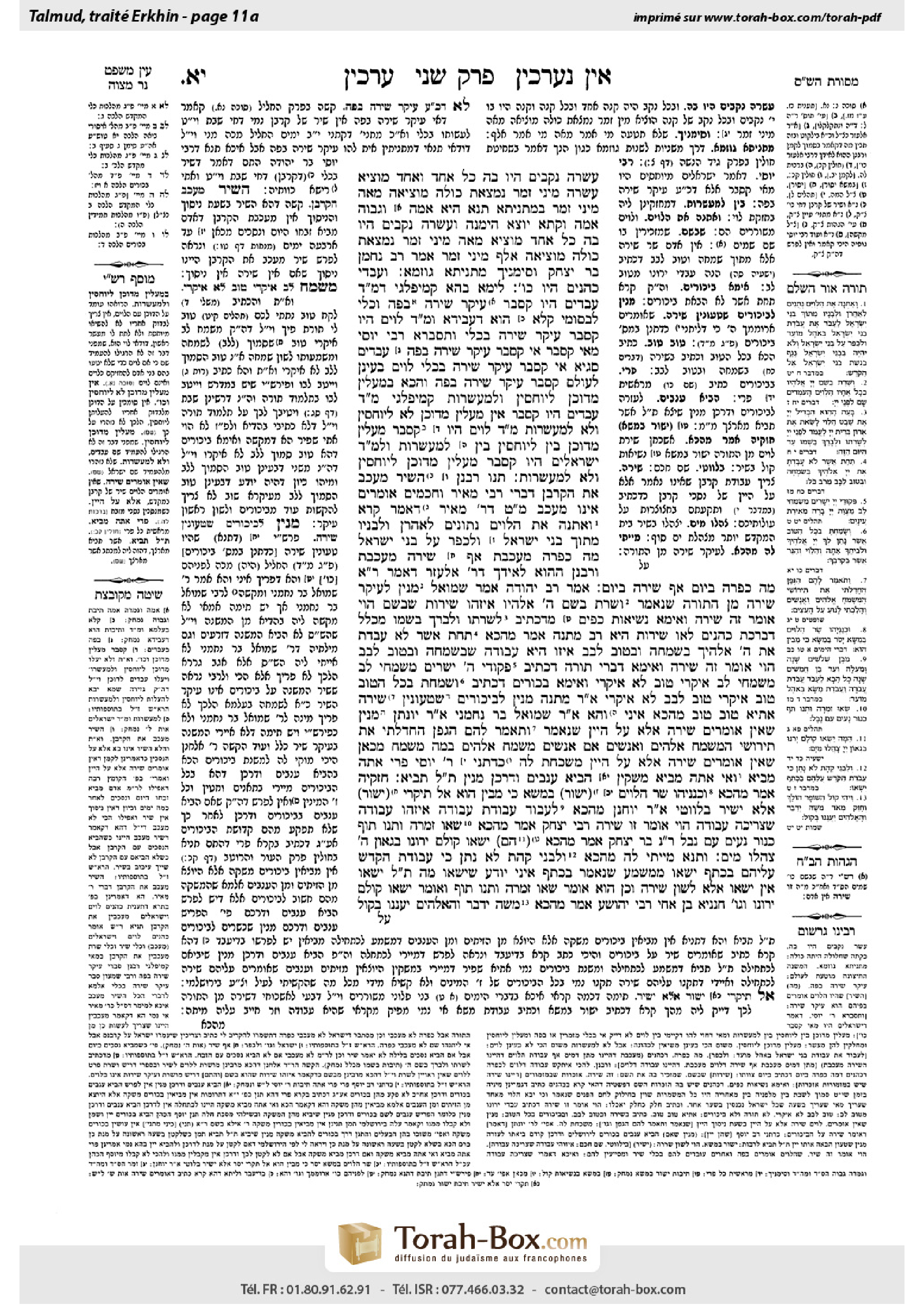
Arakhin 11a: Talmud study for Daf Yomi
Study the Talmud for Daf Yomi with scanned pages, Hebrew text, English translations from Sefaria and AI-generated French translations.
Passage selection and English or AI-generated French translation are available where the scan has annotations. Daf Study is independent of Torah-Box and Sefaria.
Browse Arakhin · ערכין · All tractatesArakhin 11a text and translations
This page of Arakhin includes the Aramaic text, an English translation and an AI-generated French translation, alongside the scan above.
ערכין י״א א · Aramaic and Hebrew text
עֲשָׂרָה נְקָבִים הָיוּ בָּהּ, כׇּל אֶחָד וְאֶחָד מוֹצִיא עֲשָׂרָה מִינֵי זֶמֶר, נִמְצֵאת כּוּלָּהּ מוֹצִיאָה מֵאָה מִינֵי זֶמֶר. בְּמַתְנִיתָא תָּנָא: הִיא אַמָּה וּגְבוֹהָ אַמָּה, וְקַתָּא יוֹצָא הֵימֶנָּה, וַעֲשָׂרָה נְקָבִים הָיוּ בָּהּ, כׇּל אֶחָד מוֹצִיא מֵאָה מִינֵי זֶמֶר, נִמְצֵאת כּוּלָּהּ מוֹצִיאָה אֶלֶף מִינֵי זֶמֶר. אָמַר רַב נַחְמָן בַּר יִצְחָק: וְסִימָנָיךְ מַתְנִיתָא גּוּזְמָא.
וְעַבְדֵי כֹהֲנִים הָיוּ כּוּ׳. לֵימָא בְּהָא קָמִיפַּלְגִי, דְּמַאן דְּאָמַר עֲבָדִים הָיוּ קָסָבַר: עִיקַּר שִׁירָה בַּפֶּה, וּכְלִי לְבַסּוֹמֵי קָלָא הוּא דַּעֲבִידָא, וּמַאן דְּאָמַר לְוִיִּם הָיוּ קָסָבַר: עִיקַּר שִׁירָה בִּכְלִי!
וְתִסְבְּרָא? רַבִּי יוֹסֵי מַאי קָסָבַר? אִי קָסָבַר: עִיקַּר שִׁירָה בַּפֶּה — עֲבָדִים סַגִּיא, אִי קָסָבַר: עִיקַּר שִׁירָה בִּכְלִי — לְוִיִּם בָּעֵינַן!
לְעוֹלָם קָסָבַר: עִיקַּר שִׁירָה בַּפֶּה, וְהָכָא בְּמַעֲלִין מִדּוּכָן לְיוּחֲסִין וּלְמַעַשְׂרוֹת קָמִיפַּלְגִי.
מַאן דְּאָמַר עֲבָדִים הָיוּ, קָסָבַר: אֵין מַעֲלִין מִדּוּכָן לֹא לְיוּחֲסִין וְלֹא לְמַעַשְׂרוֹת. מַאן דְּאָמַר לְוִיִּם הָיוּ, קָסָבַר: מַעֲלִין מִדּוּכָן בֵּין לְיוּחֲסִין בֵּין לְמַעַשְׂרוֹת. וּלְמַאן דְּאָמַר יִשְׂרְאֵלִים הָיוּ, קָסָבַר: מַעֲלִין מִדּוּכָן לְיוּחֲסִין וְלֹא לְמַעַשְׂרוֹת.
תָּנוּ רַבָּנַן: הַשִּׁיר מְעַכֵּב אֶת הַקׇּרְבָּן, דִּבְרֵי רַבִּי מֵאִיר; וַחֲכָמִים אוֹמְרִים: אֵינוֹ מְעַכֵּב.
מַאי טַעְמָא דְּרַבִּי מֵאִיר? דְּאָמַר קְרָא: ״וָאֶתְּנָה אֶת הַלְוִיִּם נְתֻנִים לְאַהֲרֹן וּלְבָנָיו מִתּוֹךְ בְּנֵי יִשְׂרָאֵל... וּלְכַפֵּר עַל בְּנֵי יִשְׂרָאֵל״, מָה כַּפָּרָה מְעַכֶּבֶת, אַף שִׁירָה מְעַכֶּבֶת.
וְרַבָּנַן? הָהוּא לְאִידַּךְ דְּרַבִּי אֶלְעָזָר, דְּאָמַר רַבִּי אֶלְעָזָר: מָה כַּפָּרָה בַּיּוֹם, אַף שִׁירָה בַּיּוֹם.
אָמַר רַב יְהוּדָה אָמַר שְׁמוּאֵל: מִנַּיִן לְעִיקַּר שִׁירָה מִן הַתּוֹרָה? שֶׁנֶּאֱמַר: ״וְשֵׁרֵת בְּשֵׁם ה׳ אֱלֹהָיו״, אֵיזֶהוּ שֵׁירוּת שֶׁבְּשֵׁם? הֱוֵי אוֹמֵר: זֹה שִׁירָה.
וְאֵימָא נְשִׂיאוּת כַּפַּיִם! מִדִּכְתִיב: ״לְשָׁרְתוֹ וּלְבָרֵךְ בִּשְׁמוֹ״, מִכְּלָל דְּבִרְכַּת כֹּהֲנִים לָאו שֵׁירוּת הִיא.
רַב מַתְנָה אָמַר מֵהָכָא: ״תַּחַת אֲשֶׁר לֹא עָבַדְתָּ אֶת ה׳ אֱלֹהֶיךָ בְּשִׂמְחָה וּבְטוּב לֵבָב״, אֵיזוֹ הִיא עֲבוֹדָה שֶׁבְּשִׂמְחָה וּבְטוּב לֵבָב? הֱוֵי אוֹמֵר: זֹה שִׁירָה. וְאֵימָא דִּבְרֵי תוֹרָה, דִּכְתִיב: ״פִּקּוּדֵי ה׳ יְשָׁרִים מְשַׂמְּחֵי לֵב״! ״מְשַׂמְּחֵי לֵב״ אִיקְּרִי, ״טוֹב״ לָא אִיקְּרִי.
וְאֵימָא בִּכּוּרִים, דִּכְתִיב: ״וְשָׂמַחְתָּ בְכׇל הַטּוֹב״! ״טוֹב״ אִיקְּרִי, ״טוּב לֵבָב״ לָא אִיקְּרִי.
אָמַר רַב מַתְנָה: מִנַּיִן לַבִּיכּוּרִים שֶׁטְּעוּנִין שִׁירָה? אָתְיָא ״טוֹב״ ״טוֹב״ מֵהָכָא.
אִינִי? וְהָא אָמַר רַבִּי שְׁמוּאֵל בַּר נַחְמָנִי אָמַר רַבִּי יוֹנָתָן: מִנַּיִן שֶׁאֵין אוֹמְרִים שִׁירָה אֶלָּא עַל הַיַּיִן? שֶׁנֶּאֱמַר: ״וַתֹּאמֶר לָהֶם הַגֶּפֶן הֶחֳדַלְתִּי אֶת תִּירוֹשִׁי הַמְשַׂמֵּחַ אֱלֹהִים וַאֲנָשִׁים״, אִם אֲנָשִׁים מְשַׂמֵּחַ, אֱלֹהִים בַּמֶּה מְשַׂמֵּחַ? מִכָּאן שֶׁאֵין אוֹמְרִים שִׁירָה אֶלָּא עַל הַיַּיִן.
מַשְׁכַּחַתְּ לַהּ, כִּדְתָנֵי רַבִּי יוֹסֵי: ״פְּרִי אַתָּה מֵבִיא, וְאִי אַתָּה מֵבִיא מַשְׁקִין״; הֵבִיא עֲנָבִים וּדְרָכָן, מִנַּיִן? תַּלְמוּד לוֹמַר: ״תָּבִיא״.
חִזְקִיָּה אָמַר מֵהָכָא: ״וּכְנַנְיָהוּ שַׂר הַלְוִיִּם יָשׂוֹר בַּמַּשָּׂא כִּי מֵבִין הוּא״, אַל תִּיקְרֵי ״יָשׂוֹר״ אֶלָּא ״יָשִׁיר״.
בִּלְוָוטֵי אָמַר רַבִּי יוֹחָנָן, מֵהָכָא: ״לַעֲבוֹד עֲבוֹדַת עֲבוֹדָה״, אֵיזֶהוּ עֲבוֹדָה שֶׁצְּרִיכָה עֲבוֹדָה? הֱוֵי אוֹמֵר: זוֹ שִׁירָה.
רַבִּי יִצְחָק אָמַר מֵהָכָא: ״שְׂאוּ זִמְרָה וּתְנוּ תֹף כִּנּוֹר נָעִים עִם נָבֶל״. רַב נַחְמָן בַּר יִצְחָק אָמַר מֵהָכָא: ״הֵם יִשְׂאוּ קוֹלָם יָרֹנּוּ בִּגְאוֹן ה׳ צָהֲלוּ מִיָּם״.
וְתַנָּא מַיְיתֵי לַהּ מֵהָכָא: ״וְלִבְנֵי קְהָת לֹא נָתָן כִּי עֲבוֹדַת הַקֹּדֶשׁ עֲלֵיהֶם בַּכָּתֵף יִשָּׂאוּ״, מִמַּשְׁמָע שֶׁנֶּאֱמַר ״בַּכָּתֵף״ אֵינִי יוֹדֵעַ שֶׁ״יִּשְׂאוּ״? מָה תַּלְמוּד לוֹמַר ״יִשָּׂאוּ״? אֵין ״יִשָּׂאוּ״ אֶלָּא לְשׁוֹן שִׁירָה, וְכֵן הוּא אוֹמֵר: ״שְׂאוּ זִמְרָה וּתְנוּ תֹף״, וְאוֹמֵר: ״יִשְּׂאוּ קוֹלָם יָרוֹנּוּ וְגוֹ׳״.
חֲנַנְיָא בֶּן אֲחִי רַבִּי יְהוֹשֻׁעַ אָמַר, מֵהָכָא: ״מֹשֶׁה יְדַבֵּר וְהָאֱלֹהִים יַעֲנֶנּוּ בְקוֹל״,
Arakhin 11a · English translation
There were ten holes in it and each and every one would emit ten types of tone. It therefore emerges that the entire instrument emitted one hundred types of tone. It was taught in a baraita: The magreifa was one cubit wide and one cubit tall, and a handle protruded from it. It was hollow and there were ten holes in it and each one would produce one hundred types of tone. It therefore emerges that that the entire instrument emitted one thousand types of tone. Rav Naḥman bar Yitzḥak said: And your mnemonic to remember which of these two statements was said by Shmuel and which was taught in a baraita is that the baraita expresses itself with exaggeration, as it is common for baraitot to exaggerate numbers.
§ The mishna teaches that the Temple musicians were slaves of priests according to Rabbi Meir, whereas according to Rabbi Yosei they were Israelites of pure lineage, and according to Rabbi Ḥanina ben Antigonus they were Levites. The Gemara suggests: Let us say that they disagree about this; that the one who says they were slaves holds that the primary component of song in the Temple service is singing with the mouth, and the instrumental music was performed merely to sweeten the sound of the singing. Since the instrumental music is mere accompaniment, it could be performed by slaves. And the one who says that the musicians were Levites holds that the primary component of song in the Temple service is the music played with instruments. Therefore, the musicians had to be Levites, who were tasked with the song that was part of the Temple service.
The Gemara responds: And can you understand the disagreement in this manner? According to this suggestion, what does Rabbi Yosei, who says that the musicians were Israelites of pure lineage, hold? If he holds that the primary component of song in the Temple service is singing with the mouth, then it should be sufficient if slaves play the instruments. Why would he require Israelites of pure lineage? And if he holds that the primary component of song in the Temple service is the music played with instruments, we should require Levites to play the instruments.
The Gemara responds: Actually, Rabbi Yosei holds that the primary component of song in the Temple service is singing with the mouth. And here, the tanna’im disagree about whether the musicians in the Temple may be elevated from the musical platform to the presumptive status of pure lineage with regard to marriage and eligibility to receive Levitical tithes.
The one who says that the musicians were slaves holds that people cannot be elevated from the Temple musical platform to the presumptive status of pure lineage with regard to marriage and eligibility to receive tithes. The one who says that the musicians were Levites holds that one elevates from the platform both to the presumptive status of pure lineage and eligibility to receive tithes. And according to the one who says that the musicians were Israelites, he holds that one elevates from the platform to the presumptive status of pure lineage but not with regard to the eligibility to receive tithes.
§ The Sages taught in a baraita: The song that the Levites sing while a communal offering is being sacrificed is an indispensable component of the offering, which means that if the Levites did not sing, the offering is invalid. This is the statement of Rabbi Meir. And the Rabbis say: It is not indispensable.
The Gemara asks: What is the reasoning of Rabbi Meir, i.e., from where does he derive his opinion? The Gemara answers: It is as the verse states: “And I have given the Levites, they are given to Aaron and to his sons from among the children of Israel, to do the service of the children of Israel in the Tent of Meeting, and to make atonement for the children of Israel” (Numbers 8:19). The verse compares the atonement for the Jewish people, which is caused by the sprinkling of the blood of offerings on the altar, to the service of the Levites, which is their singing. This teaches that just as the atonement caused by the sprinkling of the blood is an indispensable component of the offering, so too the song of the Levites is indispensable.
The Gemara asks: And what do the Rabbis derive from the comparison in this verse? The Gemara answers: That comparison serves to teach another halakha, which was stated by Rabbi Elazar, as Rabbi Elazar says: Just as the atonement achieved by the sprinkling of the blood must take place during the day, so too the song must be sung during the day.
Rav Yehuda said that Shmuel said: From where is it derived that the basic requirement to accompany communal offerings with song applies by Torah law? As it is stated with regard to a Levite who serves in the Temple: “Then he shall serve with the name of the Lord his God” (Deuteronomy 18:7). What is this service that is performed with the name of God? You must say that this is the song, in which the Levites mention and praise the name of God.
The Gemara objects: But you can say that this service with the name of God is referring to the lifting of the hands for the Priestly Benediction, which also includes the mention of the name of God. If so, the verse is referring to priests, not ordinary Levites. The Gemara responds: From the fact that it is written: “At that time the Lord separated the tribe of Levi…to serve Him, and to bless in His name” (Deuteronomy 10:8), it can be derived by inference that the Priestly Benediction is not considered service, as the verse mentions service and the Priestly Benediction as distinct rituals.
Rav Mattana said that the source for the requirement to accompany the Temple offerings with song is derived from here: “Because you did not serve the Lord your God with joyfulness, and with goodness of heart” (Deuteronomy 28:47). What is this service of God that is performed with joyfulness and with goodness of heart? You must say that this is song. The Gemara objects: But you can say that this service is studying the words of Torah, as it is written: “The precepts of the Lord are upright, rejoicing the heart” (Psalms 19:9). The Gemara explains: Torah is indeed called a matter that rejoices the heart, but it is not called “goodness.”
The Gemara objects: But you can say that the joyful service of God referred to above is the bringing of the first fruits, as it is written in that context: “And you shall rejoice in all the goodness that the Lord your God has given you” (Deuteronomy 26:11). The Gemara answers: Bringing the first fruits is indeed called goodness, but it is not called something that involves goodness of heart.
The Gemara discusses a related matter. Rav Mattana says: From where is it derived that bringing the first fruits to the Temple requires the accompaniment of song? The Gemara answers: It is derived from here, i.e., from the requirement to accompany communal offerings with song, by means of a verbal analogy of the word goodness in the verse “And with goodness of heart” and the word goodness in the verse “You shall rejoice in all the goodness.”
The Gemara asks: Is that so? But doesn’t Rabbi Shmuel bar Naḥmani say that Rabbi Yonatan said: From where is it derived that songs of praise in the Temple are recited only over the wine libation accompanying the sacrifice? As it is stated: “And the vine replied: Should I leave my wine, which gladdens God and man, and go and wave above the trees” (Judges 9:13). If it is clear that wine gladdens people, in what way does it gladden God? Rather, derive from here that songs of praise in the Temple are recited only over the wine of libation, and it is this song that gladdens God. This is difficult, as since there is no wine libation associated with the bringing of first fruits, how can it be accompanied by song?
The Gemara answers: You can find cases where the first fruits are brought in the form of wine, as Rabbi Yosei teaches: The verse states with regard to the first fruits: “You shall take of the first of all the fruit of the ground, which you shall bring in from your land” (Deuteronomy 26:2). Since the verse mentions “fruit,” you must bring the actual fruit as your first fruits offering, and you may not bring it in the form of beverages. If one brought grapes and he had already pressed them into wine, from where is it derived that he has fulfilled his obligation of offering his first fruits? The verse states: “You shall bring in from your land.” This apparently superfluous phrase comes to teach that if one brings wine for the mitzva of first fruits, he has fulfilled his obligation.
The Gemara presents another source for the requirement that the song of the Levites must accompany the sacrificial service in the Temple. Ḥizkiyya says that this obligation is derived from here: “And Chenaniah, chief of the Levites…he was master of lifting, because he was skillful” (I Chronicles 15:22). Do not read it as “he was master [yasor] of lifting,” but as: He shall sing [yashir] with the lifting of his voice.
The Sage named Balvatei said that Rabbi Yoḥanan said that the requirement for the Levites to accompany the Temple offerings with song is derived from here: The verse states with regard to the Levites: “Every one that entered in to do the work of service” (Numbers 4:47). What is work that must be performed in conjunction with another service? You must say that this is song.
Rabbi Yitzḥak says that the requirement to accompany the Temple offerings with song is derived from here: “Sing aloud to God…Take up the melody, and sound the timbrel, the sweet harp with the lyre” (Psalms 81:2–3). Rav Naḥman bar Yitzḥak said that the obligation is derived from here: “Those yonder lift up their voice, they sing for joy; for the majesty of the Lord they shout from the sea” (Isaiah 24:14).
And a tanna cites a derivation for the requirement for the Levites to accompany the Temple offerings with song from here: “But unto the sons of Kohath he gave none, because the service of the holy things belonged to them: They bore them [yisa’u] upon their shoulders” (Numbers 7:9). By inference from that which is stated, “upon their shoulders,” don’t I know that they bore them? Why must the verse state “yisa’u”? The term “yisa’u” is not stated here in its meaning of “they bore them,” but rather as an expression of song. And similarly, the verse states: “Take up [se’u] the melody, and sound the timbrel,” and another verse states: “They lift up [yisu] their voice, they sing for joy.”
Ḥananya, son of Rabbi Yehoshua’s brother, says that the requirement for the Levites to sing in the Temple is derived from here: “Moses spoke, and God answered him with a voice” (Exodus 19:19).
Arakhin 11a · Traduction française (IA)
Il y avait dix trous dans cet instrument et chaque trou produisait dix types de sons. Il en ressort donc que l'instrument entier produisait cent types de sons. Il a été enseigné dans une baraïta : Le magreifa était d'un cubit de largeur et d'un cubit de hauteur, et un manche en émergeait. Il était creux et comportait dix trous, et chaque trou produisait mille types de sons. Il en ressort donc que l'instrument entier produisait dix mille types de sons. Rav Naḥman bar Yitzḥak a dit : Et votre mnémonique pour se souvenir de quel des deux proposants a été dit par Shmuel et quel a été enseigné dans une baraïta est que la baraïta s'exprime avec de l'exagération, car il est courant que les baraitot exagèrent les nombres.
§ La mitsva enseigne que les musiciens du Temple étaient des esclaves de prêtres selon Rabbi Meir, tandis que selon Rabbi Yosei, ils étaient des Israélites de pure lignée, et selon Rabbi Ḥanina ben Antigonus, ils étaient des Lévites. La Guemara suggère : Disons qu'ils s'entendent sur cela ; celui qui dit qu'ils étaient des esclaves maintient que la composante principale de la chanson dans le service du Temple est la chanson avec la bouche, et la musique instrumentale était jouée uniquement pour adoucir le son de la chanson. Puisque la musique instrumentale est simplement un accompagnement, elle pouvait être jouée par des esclaves. Et celui qui dit que les musiciens étaient des Lévites maintient que la composante principale de la chanson dans le service du Temple est la musique jouée avec des instruments. Ainsi, les musiciens devaient être des Lévites, chargés de la chanson faisant partie du service du Temple.
La Guemara répond : Et pouvez-vous comprendre le désaccord ainsi ? Selon cette suggestion, que pense Rabbi Yosei, qui dit que les musiciens étaient des Israélites de pure lignée ? Si il maintient que la composante principale de la chanson dans le service du Temple est la chanson avec la bouche, alors il suffirait que des esclaves jouent des instruments. Pourquoi donc exige-t-il des Israélites de pure lignée ? Et si il maintient que la composante principale de la chanson dans le service du Temple est la musique jouée avec des instruments, nous devrions exiger des Lévites pour jouer des instruments.
La Guemara répond : En réalité, Rabbi Yosei maintient que la composante principale de la chanson dans le service du Temple est la chanson avec la bouche. Et ici, les tannaïm s'entendent sur le fait que les musiciens du Temple peuvent être élevés depuis la plateforme musicale au statut de pure lignée en ce qui concerne le mariage et l'éligibilité à recevoir les dîmes levitiques.
Celui qui dit que les musiciens étaient des esclaves maintient que les gens ne peuvent être élevés depuis la plateforme musicale au statut de pure lignée en ce qui concerne le mariage et l'éligibilité à recevoir les dîmes. Celui qui dit que les musiciens étaient des Lévites maintient qu'on élève depuis la plateforme à la fois au statut de pure lignée et à l'éligibilité à recevoir les dîmes. Et selon celui qui dit que les musiciens étaient des Israélites, il maintient qu'on élève depuis la plateforme au statut de pure lignée mais pas en ce qui concerne l'éligibilité à recevoir les dîmes.
§ Les Sages ont enseigné dans une baraïta : La chanson que les Lévites chantent pendant que l'offrande communautaire est sacrifiée est une composante indispensable de l'offrande, ce qui signifie que si les Lévites n'ont pas chanté, l'offrande est invalide. C'est l'opinion de Rabbi Meir. Et les Rabbins disent : Ce n'est pas indispensable.
La Guemara demande : Quel est le raisonnement de Rabbi Meir, c'est-à-dire d'où tire-t-il son opinion ? La Guemara répond : Comme le verset dit : « Et j'ai donné les Lévites, ils sont donnés à Aaron et à ses fils parmi les enfants d'Israël, pour faire le service des enfants d'Israël dans le Tenta de Rencontre, et pour faire l'atonement pour les enfants d'Israël » (Nombres 8:19). Le verset compare l'atonement pour le peuple juif, causé par le verser du sang des offrandes sur l'autel, au service des Lévites, qui est leur chant. Cela enseigne que tout comme l'atonement causé par le verser du sang est une composante indispensable de l'offrande, ainsi le chant des Lévites est indispensable.
La Guemara demande : Et d'où les Rabbins tirent-ils la comparaison dans ce verset ? La Guemara répond : Cette comparaison sert à enseigner une autre halakha, qui a été déclarée par Rabbi Elazar, comme Rabbi Elazar dit : Tout comme l'atonement réalisé par le verser du sang doit avoir lieu pendant la journée, ainsi le chant doit être chanté pendant la journée.
Rav Yehuda a dit que Shmuel a dit : D'où est-il dérivé que la base de la nécessité d'accompagner les offrandes communautaires avec un chant s'applique selon la Loi divine ? Comme il est dit concernant un Lévi qui sert dans le Temple : « Alors il servira avec le nom du Seigneur son Dieu » (Deutéronome 18:7). Quel est ce service qui est effectué avec le nom de Dieu ? Vous devez dire que c'est le chant, dans lequel les Lévites mentionnent et louent le nom de Dieu.
La Guemara s'oppose : Mais vous pouvez dire que ce service avec le nom de Dieu fait référence à la levée des mains pour la Bénédiction Priestes, qui inclut également la mention du nom de Dieu. Si c'est le cas, le verset fait référence aux prêtres, pas aux Lévites ordinaires. La Guemara répond : D'après le fait qu'il est écrit : « À cette époque le Seigneur a séparé la tribu de Lévi… pour servir Lui, et pour bénir en Son nom » (Deutéronome 10:8), on peut déduire par analogie que la Bénédiction Priestes n'est pas considérée comme un service, car le verset mentionne le service et la Bénédiction Priestes comme des rituels distincts.
Rav Mattana a dit que la source de la nécessité d'accompagner les offrandes du Temple par la chanson est tirée d'ici : « Car vous n'avez pas servi l'Éternel votre Dieu avec joie et avec bon cœur » (Deutéronome 28:47). Quel est ce service de Dieu accompli avec joie et avec bon cœur ? Vous devez dire que c'est la chanson. La Guemara s'oppose à cela : Mais vous pouvez dire que ce service est l'étude des paroles de la Torah, car il est écrit : « Les préceptes de l'Éternel sont droits, ils réjouissent le cœur » (Psaumes 19:9). La Guemara explique : la Torah est en effet appelée une chose qui réjouit le cœur, mais elle n'est pas appelée « bon cœur ».
La Guemara s'oppose à cela : Mais vous pouvez dire que le service joyeux de Dieu mentionné ci-dessus est l'apport des premiers fruits, car il est écrit dans ce contexte : « Et vous vous réjouirez de toute la bonté que l'Éternel votre Dieu vous a donnée » (Deutéronome 26:11). La Guemara répond : l'apport des premiers fruits est en effet appelé bonté, mais il n'est pas appelé quelque chose qui implique un bon cœur.
La Guemara discute d'une question connexe. Rav Mattana dit : D'où est tiré le fait que l'apport des premiers fruits au Temple exige l'accompagnement de chants ? La Guemara répond : C'est tiré d'ici, c'est-à-dire de la exigence d'accompagner les offrandes communautaires de chants, par analogie verbale du mot « bien » dans la versette « Et avec un cœur bienfaisant » et du mot « bien » dans la versette « Vous vous réjouirez de toute la bienfaite. »
La Guemara pose la question : C’est ainsi ? Mais ne dit pas Rabbi Šmuel bar Naḥmani que Rabbi Yonatan a dit : D’où tire-t-on que les chants de louange dans le Temple sont récités uniquement sur la libation de vin accompagnant l’offrande ? Comme il est dit : « Et la vigne répondit : Dois-je laisser mon vin, qui réjouit Dieu et l’homme, et aller et agiter au-dessus des arbres » (Juges 9:13). Si on sait que le vin réjouit les gens, en quoi réjouit-il Dieu ? Plutôt, on tire de là que les chants de louange dans le Temple sont récités uniquement sur le vin de libation, et c’est ce chant qui réjouit Dieu. Cela est difficile, car puisqu’il n’y a pas de libation de vin associée à l’offrande des premiers fruits, comment peut-elle être accompagnée de chant ?
La Guemara répond : On peut trouver des cas où les premiers fruits sont offerts sous la forme de vin, comme Rabbi Yosei enseigne : La parole rapporte concernant les premiers fruits : « Tu prendras du premier des fruits de la terre, que tu apporteras de ta terre » (Deutéronome 26:2). Puisque la parole mentionne « fruits », on doit apporter les fruits réels comme offrande des premiers fruits, et on ne peut pas les apporter sous la forme de boissons. Si l’on apporte des raisins et qu’il a déjà pressé les raisins en vin, d’où tire-t-on qu’il a accompli son obligation d’offrande des premiers fruits ? La parole dit : « Tu apporteras de ta terre ». Cette phrase apparemment superflue vient enseigner que si l’on apporte du vin pour la mitsva des premiers fruits, on a accompli son obligation.
La Guemara présente une autre source pour l’obligation que la chanson des Lévites doit accompagner le service des sacrifices dans le Temple. Ḥizkiyya dit que cette obligation est tirée de là : « Et Chenaniah, chef des Lévites… il était maître de porter, car il était habile » (I Chroniques 15:22). Ne le lis pas comme « il était maître [yasor] de porter », mais comme : Il chantera [yashir] avec la portée de sa voix.
Le Sage nommé Balvatei dit que Rabbi Yoḥanan dit que l'obligation des Lévites d'accompagner les offrandes du Temple par la chanson est tirée de là : Le verset parle des Lévites ainsi : « Chacun qui entrerait pour faire le service » (Nombres 4:47). Quel est le service qui doit être accompli en conjonction avec un autre service ? Tu dois dire que c'est la chanson.
Rabbi Yitzḥak dit que l'obligation d'accompagner les offrandes du Temple par la chanson est tirée de là : « Chantez fort à l'Éternel… Prenez la mélodie, et faites résonner la tambourine, la harpe douce avec la lyre » (Psaumes 81:2–3). Rav Naḥman bar Yitzḥak dit que l'obligation est tirée de là : « Ceux-là élèvent leur voix, ils chantent de joie ; pour la splendeur de l'Éternel ils crient depuis la mer » (Isaïe 24:14).
Et un tanna cite une dérivation pour l'obligation des Lévites d'accompagner les offrandes du Temple par la chanson de là : « Mais aux fils de Kéhat il ne donna rien, car le service des choses saintes appartenait à eux : Ils portaient [yisa’u] sur leurs épaules » (Nombres 7:9). Par l'inférence de ce qui est dit, « sur leurs épaules », ne sais-je pas qu'ils portaient ? Pourquoi le verset dit-il « yisa’u » ? Le terme « yisa’u » n'est pas utilisé ici dans le sens de « ils portaient », mais plutôt comme une expression de chanson. De même, le verset dit : « Prenez [se’u] la mélodie, et faites résonner la tambourine », et un autre verset dit : « Ils élèvent [yisu] leur voix, ils chantent de joie. »
Ḥananya, fils du frère de Rabbi Yehoshua, dit que l'obligation des Lévites de chanter dans le Temple est tirée de là : « Moïse parla, et Dieu répondit à lui avec une voix » (Exode 19:19).
Traduction française générée par IA à partir de l’édition anglaise de Sefaria. Vérifie toujours un passage avec le texte source.
Text from Sefaria: William Davidson Edition - Vocalized Aramaic (CC BY NC); William Davidson Edition - English (CC BY NC).