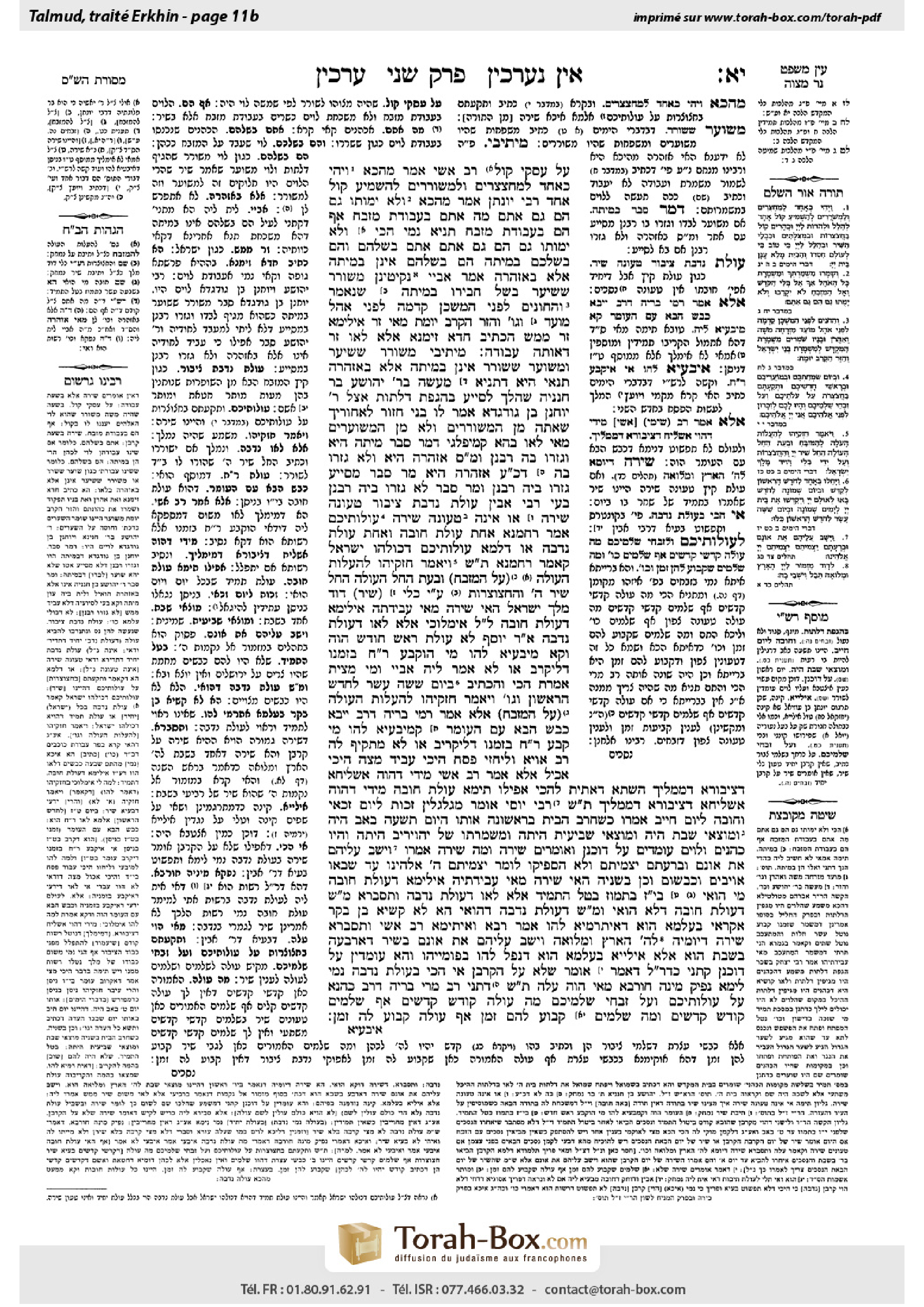
Arakhin 11b: Talmud study for Daf Yomi
Study the Talmud for Daf Yomi with scanned pages, Hebrew text, English translations from Sefaria and AI-generated French translations.
Passage selection and English or AI-generated French translation are available where the scan has annotations. Daf Study is independent of Torah-Box and Sefaria.
Browse Arakhin · ערכין · All tractatesArakhin 11b text and translations
This page of Arakhin includes the Aramaic text, an English translation and an AI-generated French translation, alongside the scan above.
ערכין י״א ב · Aramaic and Hebrew text
עַל עִסְקֵי קוֹל. רַב אָשֵׁי אָמַר, מֵהָכָא: ״וַיְהִי כְאֶחָד לַמְחַצְּצרִים וְלַמְשֹׁרְרִים לְהַשְׁמִיעַ קוֹל אֶחָד״.
רַבִּי יוֹנָתָן אָמַר מֵהָכָא: ״וְלֹא יָמוּתוּ גַם הֵם גַּם אַתֶּם״ — מָה אַתֶּם בַּעֲבוֹדַת מִזְבֵּחַ, אַף הֵם בַּעֲבוֹדַת מִזְבֵּחַ.
תַּנְיָא נָמֵי הָכִי: ״וְלֹא יָמוּתוּ גַם הֵם גַּם אַתֶּם״ — אַתֶּם בְּשֶׁלָּהֶם וְהֵם בְּשֶׁלָּכֶם בְּמִיתָה, הֵם בְּשֶׁלָּהֶם אֵינָן בְּמִיתָה אֶלָּא בְּאַזְהָרָה.
אָמַר אַבָּיֵי: נְקִיטִינַן, מְשׁוֹרֵר שֶׁשִּׁיעֵר בְּשֶׁל חֲבֵירוֹ בְּמִיתָה, שֶׁנֶּאֱמַר: ״וְהַחֹנִים לִפְנֵי הַמִּשְׁכָּן קֵדְמָה לִפְנֵי אֹהֶל מוֹעֵד וְגוֹ׳ וְהַזָּר הַקָּרֵב יוּמָת״. מַאי זָר? אִילֵּימָא זָר מַמָּשׁ — הָכְתִיב חֲדָא זִימְנָא! אֶלָּא לָאו זָר דְּאוֹתָהּ עֲבוֹדָה.
מֵיתִיבִי: מְשׁוֹרֵר שֶׁשִּׁיעֵר וּמְשׁוֹעֵר שֶׁשּׁוֹרֵר, אֵינָן בְּמִיתָה אֶלָּא בְּאַזְהָרָה!
תַּנָּאֵי הִיא, דְּתַנְיָא: מַעֲשֶׂה בְּרַבִּי יְהוֹשֻׁעַ בַּר חֲנַנְיָה שֶׁהָלַךְ לְסַיֵּיעַ בְּהַגָּפַת דְּלָתוֹת אֵצֶל רַבִּי יוֹחָנָן בֶּן גּוּדְגְּדָא, אָמַר לוֹ: בְּנִי, חֲזוֹר לַאֲחוֹרֶיךָ, שֶׁאַתָּה מִן הַמְשׁוֹרְרִים וְלֹא מִן הַמְשׁוֹעֲרִים.
מַאי לָאו בְּהָא קָמִיפַּלְגִי, דְּמָר סָבַר: מִיתָה הִיא, וּגְזַרוּ בַּהּ רַבָּנַן, וּמָר סָבַר: אַזְהָרָה הִיא, וְלָא גְּזַרוּ בַּהּ?
דְּכוּלֵּי עָלְמָא אַזְהָרָה הִיא, מָר סָבַר: מְסַיֵּיעַ גְּזַרוּ בֵּיהּ רַבָּנַן, וּמָר סָבַר: לָא גְּזַרוּ בֵּיהּ רַבָּנַן.
בָּעֵי רַבִּי אָבִין: עוֹלַת נִדְבַת צִיבּוּר טְעוּנָה שִׁירָה אוֹ אֵינָהּ טְעוּנָה שִׁירָה? ״עֹלֹתֵיכֶם״ אָמַר רַחֲמָנָא, אַחַת עוֹלַת חוֹבָה וְאַחַת עוֹלַת נְדָבָה, אוֹ דִלְמָא ״עוֹלוֹתֵיכֶם״ דְּכוּלְּהוּ יִשְׂרָאֵל קָאָמַר רַחֲמָנָא?
תָּא שְׁמַע, וַיֹּאמֶר: ״חִזְקִיָּהוּ לְהַעֲלוֹת הָעוֹלָה עַל הַמִּזְבֵּחַ, וּבְעֵת הֵחֵל הָעוֹלָה הֵחֵל שִׁיר ה׳ וְהַחֲצוֹצְרוֹת עַל יְדֵי כְּלֵי שִׁיר דָּוִד מֶלֶךְ יִשְׂרָאֵל״. הַאי שִׁירָה מַאי עֲבִידְתַּהּ? אִילֵּימָא דְּעוֹלַת חוֹבָה, לְמָה לֵיהּ אִימְּלוֹכֵי? אֶלָּא לָאו דְּעוֹלַת נְדָבָה.
אָמַר רַב יוֹסֵף: לֹא, עוֹלַת רֹאשׁ חוֹדֶשׁ הֲוָה, וְקָא מִיבַּעְיָא לְהוּ מִי הוּקְבַּע רֹאשׁ חֹדֶשׁ בִּזְמַנּוֹ דְּלִיקְרַב אוֹ לָא.
אֲמַר לֵיהּ אַבָּיֵי: וּמִי מָצֵית אָמְרַתְּ הָכִי? וְהָכְתִיב ״בַּיּוֹם שִׁשָּׁה עָשָׂר לַחֹדֶשׁ הָרִאשׁוֹן וְגוֹ׳״, ״וַיֹּאמֶר חִזְקִיָּהוּ לְהַעֲלוֹת הָעוֹלָה עַל הַמִּזְבֵּחַ״!
אֶלָּא אָמַר רָמֵי בְּרֵיהּ דְּרַב יֵיבָא: כֶּבֶשׂ הַבָּא עִם הָעוֹמֶר קָמִיבַּעְיָא לְהוּ, מִי קָבַע רֹאשׁ חֹדֶשׁ בִּזְמַנּוֹ דְּלִיקְרַיב אוֹ לָא?
מַתְקֵיף לַהּ רַב אַוְיָא: וְלִיחְזֵי פֶּסַח הֵיכִי עָבֵיד, מַצָּה הֵיכִי אָכֵיל!
אֶלָּא אָמַר רַב אָשֵׁי: מִידֵּי דְּהָוֵה אַשְּׁלִיחָא דְצִיבּוּרָא דְּמִמְּלִיךְ. הַשְׁתָּא דְּאָתֵית לְהָכִי, אֲפִילּוּ תֵּימָא עוֹלַת חוֹבָה, מִידֵּי דְּהָוֵה אַשְּׁלִיחָא דְצִיבּוּרָא דְּמִמְּלִיךְ.
תָּא שְׁמַע: רַבִּי יוֹסֵי אוֹמֵר: מְגַלְגְּלִין זְכוּת לְיוֹם זַכַּאי, וְחוֹבָה לְיוֹם חַיָּיב.
אָמְרוּ: כְּשֶׁחָרַב הַבַּיִת בָּרִאשׁוֹנָה, אוֹתוֹ הַיּוֹם תִּשְׁעָה בְּאָב הָיָה, וּמוֹצָאֵי שַׁבָּת הָיָה, וּמוֹצָאֵי שְׁבִיעִית הָיְתָה, וּמִשְׁמַרְתּוֹ שֶׁל יְהוֹיָרִיב הָיְתָה, וְהָיוּ כֹּהֲנִים וּלְוִיִּם עוֹמְדִים עַל דּוּכָנָן וְאוֹמְרִים שִׁירָה, וּמָה שִׁירָה אָמְרוּ? ״וַיָּשֶׁב עֲלֵיהֶם אֶת אוֹנָם וּבְרָעָתָם יַצְמִיתֵם״, וְלֹא הִסְפִּיקוּ לוֹמַר ״יַצְמִיתֵם ה׳ אֱלֹהֵינוּ״ עַד שֶׁבָּאוּ גּוֹיִם וּכְבָשׁוּם, וְכֵן בַּשְּׁנִיָּה.
הַאי שִׁירָה מַאי עֲבִידְתַּיהּ? אִילֵּימָא דְּעוֹלַת חוֹבָה, מִי הֲוַאי? בְּשִׁבְעָה עָשָׂר בְּתַמּוּז בָּטַל הַתָּמִיד! אֶלָּא לָאו דְּעוֹלַת נְדָבָה.
וְתִסְבְּרַאּ?! מַאי שְׁנָא דְּעוֹלַת חוֹבָה דְּלָא הֲוַאי, וּמַאי שְׁנָא דְּעוֹלַת נְדָבָה דַּהֲוַאי? הָא לָא קַשְׁיָא: בֶּן בָּקָר אַקְרַאי בְּעָלְמָא הוּא דְּאִיתְרְמִיא לְהוּ.
אָמַר רָבָא, וְאִיתֵּימָא רַב אָשֵׁי: וְתִסְבְּרָא, שִׁירָה דְּיוֹמֵיהּ ״לַה׳ הָאָרֶץ וּמְלוֹאָהּ״, וַיָּשֶׁב עֲלֵיהֶם אֶת אוֹנָם — בְּשִׁיר דְּאַרְבְּעָה בְּשַׁבָּת הוּא! אֶלָּא אִילְיָיא בְּעָלְמָא הוּא דִּנְפַל לְהוּ בְּפוּמַּיְיהוּ.
וְהָא ״עוֹמְדִין עַל דּוּכָנָן״ קָתָנֵי! כִּדְרֵישׁ לָקִישׁ, דְּאָמַר: אוֹמֵר שֶׁלֹּא עַל הַקׇּרְבָּן. אִי הָכִי, בְּעוֹלַת נְדָבָה נָמֵי לֵימָא? נָפֵיק מִינַּהּ חוּרְבָּא.
מַאי הֲוָה עֲלַהּ? תָּא שְׁמַע, דְּתָנֵי רַב מָרִי בְּרֵיהּ דְּרַב כָּהֲנָא: ״עַל עֹלֹתֵיכֶם וְעַל זִבְחֵי שַׁלְמֵיכֶם״.
מָה עוֹלָה קוֹדֶשׁ קָדָשִׁים — אַף שְׁלָמִים קוֹדֶשׁ קֳדָשִׁים, וּמָה שְׁלָמִים קָבוּעַ לָהֶם זְמַן — אַף עוֹלָה קָבוּעַ לָהּ זְמַן.
Arakhin 11b · English translation
This indicates that God responded to Moses, who was a Levite, by commanding him about matters pertaining to the voice, i.e., that the Levites must accompany the sacrifices with song. Rav Ashi says that the obligation for the Levites to sing in the Temple is derived from here: “It came to pass, when the trumpeters and singers were as one, to make one sound to be heard in praising and thanking the Lord” (II Chronicles 5:13). This indicates that just as there is a requirement for trumpets to be sounded during the sacrifice of communal offerings (see Numbers 10:10), there is likewise a requirement for the Levites to sing.
Rabbi Yonatan says that the requirement for the Levites to sing in the Temple is derived from here: The Torah commands the priests with regard to the Levites: “They shall not come near the altar, that they die not, neither they nor you” (Numbers 18:3). The verse equates the Levites with the priests, indicating that just as you, the priests, are obligated to perform the service on the altar, so too they, the Levites, are obligated to perform a service pertaining to the altar, i.e., the song that accompanies the offerings.
A derivation of halakhot based on the comparison between priests and Levites in this verse is also taught in a baraita: It is stated: “That they die not, neither they nor you.” This indicates that if you, the priests, perform their duties, i.e., the Levites’ duties, or they, the Levites, perform yours, e.g., the sacrificial rites, the perpetrator is liable to receive death at the hand of Heaven. But if they, the Levites, perform a function that belongs to a different group of Levites, but is nevertheless a duty of theirs, i.e., the Levites in general, e.g., if Levites assigned to open and close the gates of the Temple decide instead to sing, they are not punished with death; rather, they have merely violated a prohibition.
Abaye said: We hold that a Levite designated to serve as a singer who instead served in another Levite’s position as a gatekeeper is liable to be put to death, as it is stated: “And those that were to pitch tent before the Tabernacle eastward, before the Tent of Meeting toward the sunrising, were Moses and Aaron and his sons, keeping the charge of the Sanctuary, for the charge of the children of Israel; and the stranger that drew near was to be put to death” (Numbers 3:38). What is the meaning of the term “stranger” in this verse? If we say it is referring to an actual stranger, i.e., a non-Levite, isn’t it written already on another occasion that he is liable to be put to death (see Numbers 3:10)? Rather, this is not its meaning; instead, it is referring to one who is a Levite but is a stranger to that service.
The Gemara raises an objection to Abaye’s statement from a baraita: A singer who served as a gatekeeper and a gatekeeper who sang are not punished with death; rather, they have merely violated a prohibition.
The Gemara explains that this matter is a dispute between tanna’im, as it is taught in a baraita: There was an incident involving Rabbi Yehoshua bar Ḥananya, a Levite, who went to Rabbi Yoḥanan ben Gudgeda, also a Levite, in order to assist in closing the doors of the Temple. Rabbi Yoḥanan ben Gudgeda said to him: My son, go back, as you are among the singers and not among the gatekeepers.
The Gemara analyzes the baraita: What, is it not the case that these two Levite Sages disagree about this, that one Sage, Rabbi Yoḥanan ben Gudgeda, holds that if a Levite who is a singer closes the gate by himself, it is a prohibition punishable by death, and therefore the Sages decreed that a Levite who is a singer should not even assist the gatekeepers in closing the gates; and one Sage, Rabbi Yehoshua bar Ḥananya, holds that it is a prohibition that is not punishable by death, and therefore the Sages did not decree that a Levite who is a singer should not assist the gatekeepers in closing the gates?
The Gemara responds: No, that is not necessarily the correct analysis of the baraita. Rather, everyone agrees that one Levite performing another Levite’s task by himself is a prohibition that is not punishable by death. One Sage holds that the Sages nevertheless decreed that a Levite who is a singer should not even assist the gatekeepers, and one Sage holds that the Sages did not decree that a Levite who is a singer should not assist the gatekeepers in closing the gates.
§ Rabbi Avin raises a dilemma: Does a communal voluntary burnt offering require an accompanying song or does it not require song? He explains the two sides of the dilemma: The Merciful One states in the Torah: “You shall blow with the trumpets over your burnt offerings” (Numbers 10:10). Does the term “burnt offerings” include both an obligatory burnt offering and a voluntary burnt offering, or perhaps the Merciful One is saying that the trumpets and song must accompany the burnt offerings of the entire Jewish people, i.e., they must be burnt offerings that are an obligation of the people?
The Gemara suggests: Come and hear a proof from a verse: “And Hezekiah commanded to offer the burnt offering upon the altar, and when the burnt offering began, the song of the Lord began also, and the trumpets, together with the instruments of David king of Israel…And Hezekiah the king and the princes commanded the Levites to sing praises unto the Lord” (II Chronicles 29:27–30). The Gemara analyzes the description of this service: This song, what was its purpose? If we say that it accompanied an obligatory burnt offering that was brought on that day, why did they have to seek authorization from Hezekiah? Why did Hezekiah need to issue a specific command that they should accompany this offering with song? Rather, is it not the case that this song served to accompany the voluntary burnt offering that Hezekiah brought on that day?
Rav Yosef said: No, that day was a New Moon, and it was the additional burnt offering of the New Moon, an obligatory burnt offering, that was accompanied by the song. As for the need for Hezekiah’s approval, the explanation is as follows: It was the thirtieth day following the previous New Moon, and they were asking him if the current New Moon was established in its time, i.e., on that day, so that the burnt offering of the New Moon should be sacrificed, or if the New Moon had not been declared on that day. Hezekiah clarified that the court had declared the New Moon, and therefore they should sacrifice the offering.
Abaye said to Rav Yosef: And how can you say that that day was the New Moon? Isn’t it written: “On the sixteenth day of the first month” (II Chronicles 29:17), and later, in that context, it states: “And Hezekiah commanded to offer the burnt offering upon the altar”?
Rather, Rami, son of Rav Yeiva, said: The question they were asking Hezekiah referred to the obligatory, communal burnt offering lamb that comes with the omer, i.e., the barley offering brought on the sixteenth of the first month, Nisan. They asked: Was the New Moon of Nisan established in its correct time, which means that it is now in fact the sixteenth of Nisan and the omer offering and the lamb brought with it should be sacrificed, or was it not really the sixteenth of Nisan?
Rav Avya objects to this explanation: How is it possible that they were unsure whether it was the sixteenth of Nisan? Let them see how the Paschal offering was performed on the fourteenth of Nisan and how matza was eaten the following night. The day of the sixteenth of Nisan could easily be determined from when those mitzvot were performed.
Rather, Rav Ashi said: They asked permission from Hezekiah before sacrificing the lamb that comes with the omer offering, just as it is with regard to a prayer leader, who, as a gesture of respect, asks permission from the congregation before leading them in prayer. Likewise, the people asked permission from Hezekiah as a formal gesture of respect, not because they required his advice. The Gemara notes: Now that you have arrived at this explanation, you may even say that it was a common obligatory burnt offering, e.g., the daily offering, and they asked permission of Hezekiah before sacrificing it, just as it is with regard to a prayer leader, who asks permission from the congregation before leading it in prayer.
The Gemara has still not proven whether or not a communal voluntary burnt offering must be accompanied with song. The Gemara suggests: Come and hear a proof from the following baraita. Rabbi Yosei says: A fortunate matter is brought about on an auspicious day, and a deleterious matter on an inauspicious day.
As the Sages said: When the Temple was destroyed for the first time, that day was the Ninth of Av, a date on which several calamities had already occurred; and it was the conclusion of Shabbat, i.e., it was on the day after Shabbat, a Sunday; and it was the year after a Sabbatical Year; and it was the week of the priestly watch of Jehoiarib; and the priests and Levites were standing on their platform and singing song. And what song were they singing? They were singing the verse: “And He brought upon them their own iniquity, and He will cut them off in their own evil” (Psalms 94:23). And they did not manage to recite the end of that verse: “The Lord our God will cut them off,” before gentiles came and conquered them. And likewise, the same happened when the Second Temple was destroyed.
The Gemara analyzes the baraita: This song, what was its purpose? If we say that it accompanied an obligatory burnt offering, was there any obligatory communal burnt offering sacrificed at that time? The daily offering had already ceased to be sacrificed, due to a lack of animals, on the seventeenth of Tammuz, three weeks before the Ninth of Av. Rather, is it not correct to say that this song accompanied a voluntary burnt offering?
The Gemara asks: And can you understand this to be the case? What is different about an obligatory burnt offering, which was not sacrificed at this time because they did not have animals to bring, and what is different about a voluntary burnt offering, that it was sacrificed? Just as there were no animals available for obligatory offerings, there were none available for voluntary burnt offerings either. The Gemara answers: That is not difficult. A young bull, which cannot be sacrificed as the daily offering, for which lambs are required, happened to come into their possession merely by coincidence, and they sacrificed it as a voluntary burnt offering. This indicates that the Levites are required to sing as an accompaniment to the sacrifice of a communal voluntary burnt offering.
Rava said, and some say Rav Ashi said: And how can you understand the description of the destruction cited in the baraita? The song of the day for Sunday, which is when the baraita says that the Temple was destroyed, is the psalm that begins: “The earth is the Lord’s, and the fullness thereof” (Psalms 24:1). And yet the verse that the baraita says that the Levites were singing, “And He brought upon them their own iniquity,” is in the song for Wednesday, not the song for Sunday. Rather, it was merely a portentous lamentation [eiliyya] that came into their mouths, not an actual song recited over an offering.
The Gemara asks: But isn’t it taught in the baraita that the Levites were standing on their platform near the altar, which is where they stood when they sang to accompany offerings? The Gemara answers: This can be explained in accordance with the opinion of Reish Lakish, who says: The Levites are permitted to recite songs on the platform even when it is not for an offering. The Gemara asks: If so, if the Levites may recite songs on the platform at will, let them also recite a song for a voluntary burnt offering, even if it is not required. The Gemara answers: That could result in a mishap, as the Levites might assume that just as singing for a voluntary burnt offering is optional, so too singing for an obligatory burnt offering is also optional.
The question of whether a song must be recited for a communal voluntary burnt offering has still not been resolved. The Gemara asks: What came of it, i.e., what is the resolution to that question? The Gemara responds: Come and hear a proof, as Rav Mari, son of Rav Kahana, teaches that the verse: “You shall blow with the trumpets over your burnt offerings, and over the sacrifices of your peace offerings” (Numbers 10:10), juxtaposes burnt offerings to peace offerings, which indicates that there is a relevant comparison between them with regard to the sounding of trumpets, and, by extension, to song.
There are two conclusions that are to be drawn from this comparison: Just as the burnt offering is an offering of the most sacred order, so too, the peace offering that must be accompanied by song is one that is an offering of the most sacred order, and the only peace offering of this kind is the lambs that are brought together with the two loaves on Shavuot. And just as this peace offering has a set time when it must be brought, so too, the burnt offering that must be accompanied by song is one that has a set time, which excludes voluntary burnt offerings. Consequently, voluntary burnt offerings are not accompanied by song.
Arakhin 11b · Traduction française (IA)
Cela montre que Dieu a répondu à Moïse, qui était un Lévite, en lui commandant des choses relatives à la voix, c'est-à-dire que les Lévites doivent accompagner les sacrifices par des chants. Rav Ashi dit que l'obligation des Lévites de chanter dans le Temple est tirée de là : « Il arriva que les trompetteurs et les chanteurs furent un seul, pour faire un son entendu dans l'éloge et la remerciement du Seigneur » (II Chroniques 5:13). Cela montre que tout comme il y a une obligation de sonner des trompettes lors de la sacrifice des offrandes communautaires (voir Nombres 10:10), il y a également une obligation pour les Lévites de chanter.
Rabbi Yonatan dit que l'obligation des Lévites de chanter dans le Temple est tirée de là : La Torah commande les prêtres concernant les Lévites : « Ils ne doivent pas approcher de l'autel, afin qu'ils ne meurent pas, ni eux ni vous » (Nombres 18:3). La verset établit une équivalence entre les Lévites et les prêtres, indiquant que tout comme vous, les prêtres, êtes obligés de faire le service sur l'autel, ainsi les Lévites doivent aussi faire un service relatif à l'autel, c'est-à-dire le chant qui accompagne les offrandes.
Une dérivation des halakhot basée sur la comparaison entre les prêtres et les Lévites dans cette verset est également enseignée dans une baraïta : Il est dit : « Qu'ils ne meurent pas, ni eux ni vous. » Cela montre que si vous, les prêtres, accomplissez leurs tâches, c'est-à-dire les tâches des Lévites, ou s'ils, les Lévites, accomplissent les vôtres, par exemple les rites sacrificiels, le fauteur est puni par la mort à la main du Ciel. Mais si les Lévites accomplissent une fonction qui appartient à un autre groupe de Lévites, mais qui est néanmoins une tâche leur appartenant, c'est-à-dire les Lévites en général, par exemple si les Lévites chargés d'ouvrir et de fermer les portes du Temple décident plutôt de chanter, ils ne sont pas punis par la mort ; ils n'ont simplement pas respecté une interdiction.
Abaye a dit : Nous considérons que le Lévite désigné pour servir comme chanteur, qui au lieu de cela sert dans une autre position de Lévite comme gardien des portes, est punissable de mort, car il est dit : « Et ceux qui étaient chargés de dresser le camp avant le Tabernacle à l'orient, devant la Tente de Rencontre vers l'orient, étaient Moïse et Aaron et ses fils, gardant le commandement du Sanctuaire, pour le commandement des enfants d'Israël ; et l'étranger qui s'approchait était puni de mort » (Nombres 3:38). Quelle est la signification du terme « étranger » dans cette verset ? Si nous disons qu'il s'agit d'un étranger réel, c'est-à-dire un non-Lévite, n'est-il pas déjà écrit ailleurs qu'il est punissable de mort (voir Nombres 3:10) ? Plutôt, cela n'est pas son sens ; au contraire, il s'agit d'une personne qui est un Lévite mais qui est étrangère à ce service.
La Guemara soulève une objection contre l'affirmation d'Abaye à partir d'une baraïta : Un chanteur qui sert comme gardien des portes et un gardien des portes qui chante ne sont pas punis de mort ; ils n'ont simplement pas respecté une interdiction.
La Guemara explique que cette question est un débat entre les tannaïm, car il est enseigné dans une baraïta : Il y avait un incident concernant Rabbi Yéhoshua bar Ḥananya, un Lévite, qui est allé chez Rabbi Yoḥanan ben Gudgeda, un autre Lévite, afin d'aider à fermer les portes du Temple. Rabbi Yoḥanan ben Gudgeda a dit à lui : Mon fils, retourne, car tu es parmi les chanteurs et non parmi les gardiens des portes.
La Guemara analyse la baraïta : Qu'est-ce que cela signifie, n'est-ce pas que ces deux Sages Lévitiques ne s'entendent pas sur cela, que l'un des Sages Lévitiques, Rabbi Yoḥanan ben Gudgeda, considère que si un Lévite qui est un chanteur ferme la porte seul, c'est une interdiction punissable de mort, et donc les Sages ont décrété que le Lévite qui est un chanteur ne devrait même pas aider les gardiens des portes ; et l'autre Sage, Rabbi Yéhoshua bar Ḥananya, considère que c'est une interdiction non punissable de mort, et donc les Sages n'ont pas décrété que le Lévite qui est un chanteur ne devrait pas aider les gardiens des portes à fermer les portes.
La Guemara répond : Non, cela n'est pas nécessairement l'analyse correcte de la baraïta. Plutôt, tout le monde est d'accord sur le fait que l'un Lévite accomplissant une tâche d'un autre Lévite seul est une interdiction non punissable de mort. Un Sage considère que les Sages ont tout de même décrété que le Lévite qui est un chanteur ne devrait même pas aider les gardiens des portes, et un Sage considère que les Sages n'ont pas décrété que le Lévite qui est un chanteur ne devrait pas aider les gardiens des portes à fermer les portes.
§ Rabbi Avin soulève un dilemme : Une offrande volontaire commune exige-t-elle un chant accompagnant ou non ? Il explique les deux côtés du dilemme : Le Miséricordieux dit dans la Torah : « Vous soufflerez avec les trompettes sur vos offrandes brûlantes » (Nombres 10:10). Le terme « offrandes brûlantes » inclut-il à la fois une offrande brûlante obligatoire et une offrande brûlante volontaire, ou bien le Miséricordieux dit qu'il faut que les trompettes et le chant accompagnent les offrandes brûlantes de tout le peuple d'Israël, c'est-à-dire qu'ils doivent être des offrandes brûlantes qui sont une obligation du peuple ?
La Guemara suggère : Venez entendre une preuve tirée d'un verset : « Et Hachézékia commanda d'offrir l'offrande brûlante sur l'autel, et quand l'offrande brûlante commença, le chant du Seigneur commença aussi, et les trompettes, avec les instruments de David roi d'Israël… Et Hachézékia le roi et les princes commandèrent aux Lévites de chanter des louanges au Seigneur » (II Chroniques 29:27–30). La Guemara analyse la description de ce service : Quel était le but de ce chant ? Si nous disons qu'il accompagnait une offrande brûlante obligatoire apportée ce jour-là, pourquoi devaient-ils demander l'autorisation de Hachézékia ? Pourquoi Hachézékia avait-il besoin d'ordonner spécifiquement qu'ils accompagnent cette offrande par un chant ? Plutôt, n'est-ce pas le cas que ce chant servait à accompagner l'offrande brûlante volontaire que Hachézékia apporta ce jour-là ?
Rav Yosef dit : Non, ce jour-là était un Nouveau-Mois, et c'était l'holocauste supplémentaire du Nouveau-Mois, une offrande brûlée obligatoire, qui était accompagnée de la chanson. En ce qui concerne la nécessité de l'approbation de Hachéqia, l'explication est la suivante : C'était le trentième jour suivant le précédent Nouveau-Mois, et ils lui demandaient s'il était établi que ce Nouveau-Mois était établi à son heure, c'est-à-dire ce jour-là, afin que l'holocauste du Nouveau-Mois soit sacrifiée, ou si le Nouveau-Mois n'avait pas été déclaré ce jour-là. Hachéqia clarifia que le tribunal avait déclaré le Nouveau-Mois, et donc ils devaient sacrifier l'offrande.
Abaye dit à Rav Yosef : Et comment peux-tu dire que ce jour-là était le Nouveau-Mois ? N'est-il pas écrit : « Le seizième jour du premier mois » (II Rois 29:17), et plus tard, dans ce contexte, il est dit : « Et Hachéqia commanda de sacrifier l'holocauste sur l'autel » ?
Plutôt, Rami, fils de Rav Yéiva, dit : La question qu'ils posaient à Hachéqia concernait l'holocauste obligatoire, communautaire, qui accompagne l'omer, c'est-à-dire l'offrande de blé apportée le seizième du premier mois, Nisan. Ils demandaient : Le Nouveau-Mois de Nisan était-il établi à son heure, ce qui signifie qu'il est maintenant effectivement le seizième de Nisan et que l'offrande de l'omer et le bélier apporté avec lui devraient être sacrifiés, ou n'était-il pas vraiment le seizième de Nisan ?
Rav Avya s'oppose à cette explication : Comment est-il possible qu'ils fussent incertains sur le fait que ce soit le seizième de Nisan ? Faisons-leur voir comment l'offrande pascal a été sacrifiée le quatorzième de Nisan et comment la matza a été mangée la nuit suivante. La date du seizième de Nisan pouvait facilement être déterminée à partir de la date à laquelle ces mitsvot ont été accomplies.
Plutôt, Rav Ashi dit : Ils demandaient l'autorisation de Hachéqia avant de sacrifier le bélier qui accompagne l'offrande de l'omer, tout comme c'est le cas pour un leader de prière, qui, par geste de respect, demande l'autorisation du congrès avant de les conduire dans la prière. De même, le peuple demandait l'autorisation de Hachéqia comme un geste formel de respect, pas parce qu'ils avaient besoin de son avis. La Guemara note : Maintenant que vous avez atteint cette explication, vous pouvez même dire que c'était une offrande brûlée obligatoire commune, par exemple l'offrande quotidienne, et ils demandaient l'autorisation de Hachéqia avant de la sacrifier, tout comme c'est le cas pour un leader de prière, qui demande l'autorisation du congrès avant de les conduire dans la prière.
La Guemara n'a pas encore prouvé si une offrande brûlée volontaire communautaire doit être accompagnée de chanson. La Guemara suggère : Venez écouter une preuve à partir de la baraïta suivante. Rabbi Yosei dit : Une affaire favorable est accomplie un jour favorable, et une affaire défavorable un jour défavorable.
Comme les Sages dirent : Lorsque le Temple a été détruit la première fois, ce jour-là était le neuvième d'Av, une date où plusieurs calamités avaient déjà eu lieu ; et c'était la fin du Shabbat, c'est-à-dire le jour suivant le Shabbat, un dimanche ; et c'était l'année après une année sabbatique ; et c'était la semaine du service des prêtres de Jéhoiarib ; et les prêtres et les Lévites étaient sur leur plateforme et chantaient. Et quelle chanson chantaient-ils ? Ils chantaient la versette : « Et Il a fait tomber sur eux leur propre iniquité, et Il les coupera en leur propre mal » (Psaumes 94:23). Et ils n'ont pas réussi à réciter la fin de cette versette : « L'Éternel notre Dieu les coupera », avant que les Gentils ne les conquissent. Et de même, cela s'est produit lors de la destruction du Second Temple.
La Guemara analyse la baraïta : Cette chanson, à quoi servait-elle ? Si nous disons qu'elle accompagnait une offrande brûlée obligatoire, y avait-il une offrande brûlée communautaire obligatoire sacrifiée à ce moment-là ? L'offrande quotidienne avait déjà cessé d'être sacrifiée, en raison du manque d'animaux, le dix-septième de Tammuz, trois semaines avant le neuvième d'Av. Plutôt, n'est-il pas correct de dire que cette chanson accompagnait une offrande brûlée volontaire ?
La Guemara demande : Et pouvez-vous comprendre cela ainsi ? Qu'est-ce qui diffère dans une offrande brûlée obligatoire, qui n'a pas été sacrifiée à ce moment-là en raison du manque d'animaux, et qu'est-ce qui diffère dans une offrande brûlée volontaire, qui a été sacrifiée ? Tout comme il n'y avait pas d'animaux disponibles pour les offrandes obligatoires, il n'y en avait pas non plus pour les offrandes volontaires. La Guemara répond : Ce n'est pas difficile. Un taureau jeune, qui ne peut pas être sacrifié comme l'offrande quotidienne, pour laquelle des agneaux sont requis, est venu à leur possession par hasard, et ils l'ont sacrifié comme une offrande volontaire. Cela montre que les Lévites doivent chanter comme accompagnement à la sacrifice d'une offrande brûlée volontaire communautaire.
Rava dit, et certains disent Rav Ashi dit : Et comment pouvez-vous comprendre la description de la destruction citée dans la baraïta ? La chanson du jour, dimanche, qui est le jour où la baraïta dit que le Temple a été détruit, est le psaume qui commence : « La terre est de l'Éternel, et remplie d'elle » (Psaumes 24:1). Et pourtant, le verset que la baraïta dit que les Lévites chantaient, « Et Il a fait tomber sur eux leur propre iniquité », est dans la chanson du mercredi, pas celle du dimanche. Plutôt, c'était simplement une lamentation portentuse [eiliyya] qui est entrée dans leurs bouches, pas une chanson récitée sur une offrande.
La Guemara demande : Mais n'est-il pas enseigné dans la baraïta que les Lévites étaient sur leur plateforme près de l'autel, où ils étaient lorsqu'ils chantaient pour accompagner les offrandes ? La Guemara répond : Cela peut être expliqué selon l'opinion de Réish Lakish, qui dit : Les Lévites sont autorisés à réciter des chansons sur la plateforme même lorsqu'il n'y a pas d'offrande. La Guemara demande : Si tel est le cas, si les Lévites peuvent réciter des chansons sur la plateforme à leur guise, pourquoi ne pas leur permettre de réciter une chanson pour une offrande brûlée volontaire, même si elle n'est pas obligatoire ? La Guemara répond : Cela pourrait entraîner un désastre, car les Lévites pourraient penser que, puisque chanter pour une offrande brûlée volontaire est optionnel, chanter pour une offrande brûlée obligatoire est également optionnel.
La question de savoir si une chanson doit être récitée pour une offrande volontaire de holocauste communautaire n'a pas encore été résolue. La Guemara demande : Qu'en est-il de cela, c'est-à-dire quelle est la résolution à cette question ? La Guemara répond : Viens écouter une preuve, car Rav Mari, fils de Rav Kahana, enseigne que la verset : « Vous soufflerez sur vos holocaustes et sur vos offrandes de paix » (Nombres 10:10), juxtapose les holocaustes aux offrandes de paix, ce qui indique qu'il y a une comparaison pertinente entre eux concernant le son des trompettes, et, par extension, concernant la chanson.
Deux conclusions peuvent être tirées de cette comparaison : Tout comme l'holocauste est une offrande d'ordre le plus sacré, de même l'offrande de paix qui doit être accompagnée de chanson est une offrande d'ordre le plus sacré, et la seule offrande de paix de ce type est celle des agnelons offerts conjointement aux deux pains pendant la fête de Shavuot. Et tout comme cette offrande de paix a un moment déterminé où elle doit être offerte, de même l'holocauste qui doit être accompagné de chanson a un moment déterminé, ce qui exclut les holocaustes volontaires. Ainsi, les holocaustes volontaires ne sont pas accompagnés de chanson.
Traduction française générée par IA à partir de l’édition anglaise de Sefaria. Vérifie toujours un passage avec le texte source.
Text from Sefaria: William Davidson Edition - Vocalized Aramaic (CC BY NC); William Davidson Edition - English (CC BY NC).