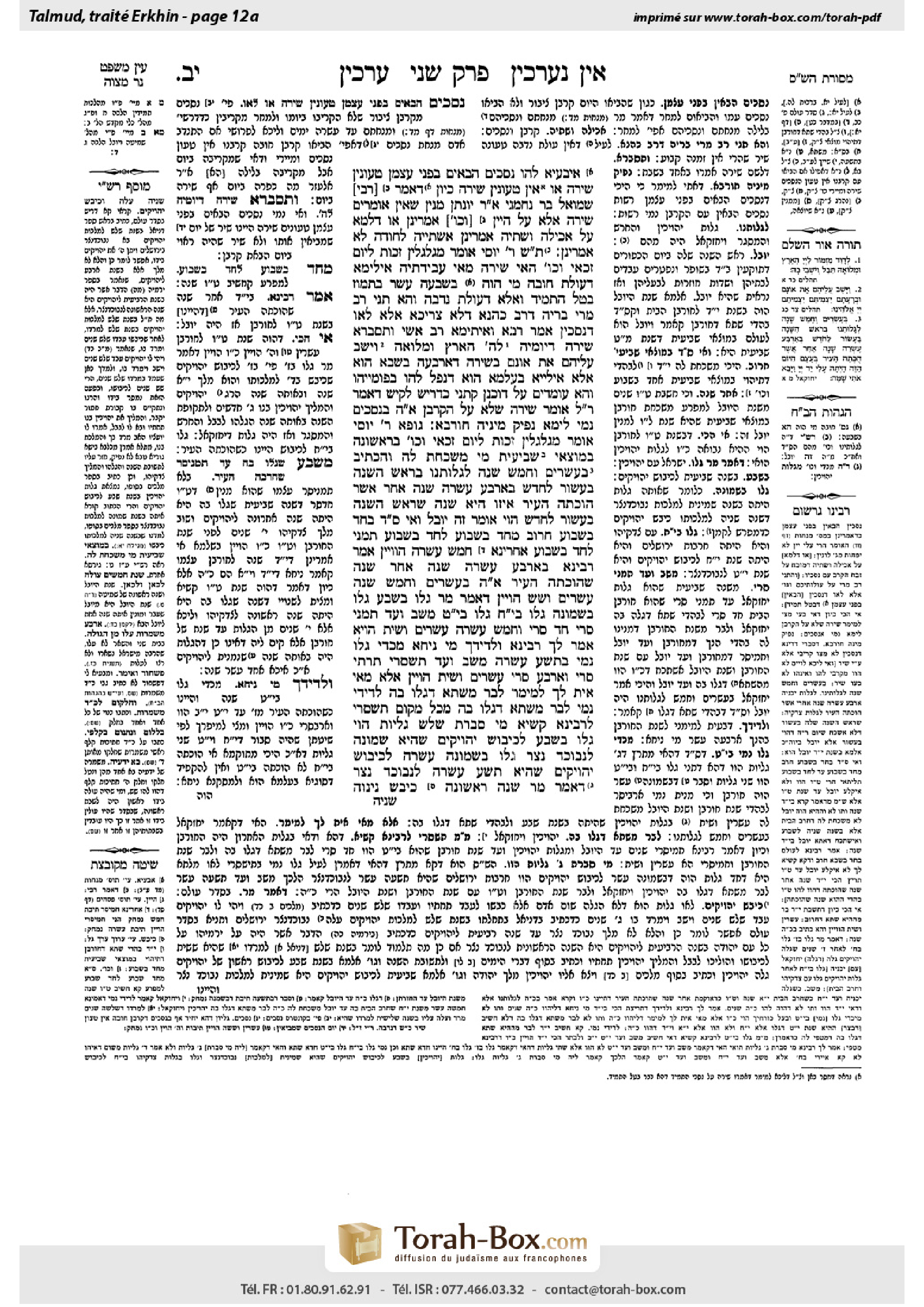
Arakhin 12a: Talmud study for Daf Yomi
Study the Talmud for Daf Yomi with scanned pages, Hebrew text, English translations from Sefaria and AI-generated French translations.
Passage selection and English or AI-generated French translation are available where the scan has annotations. Daf Study is independent of Torah-Box and Sefaria.
Browse Arakhin · ערכין · All tractatesArakhin 12a text and translations
This page of Arakhin includes the Aramaic text, an English translation and an AI-generated French translation, alongside the scan above.
ערכין י״ב א · Aramaic and Hebrew text
אִיבַּעְיָא לְהוּ: נְסָכִים הַבָּאִים בִּפְנֵי עַצְמָן טְעוּנִין שִׁירָה אוֹ אֵין טְעוּנִין שִׁירָה? כֵּיוָן דְּאָמַר שְׁמוּאֵל בַּר נַחְמָנִי אָמַר רַבִּי יוֹנָתָן: ״מִנַּיִן שֶׁאֵין אוֹמְרִים שִׁירָה אֶלָּא עַל הַיַּיִן״ — אָמְרִינַן, אוֹ דִלְמָא עַל אֲכִילָה וּשְׁתִיָּה אָמְרִינַן, אַשְּׁתִיָּיה לְחוֹדַהּ לָא אָמְרִינַן?
תָּא שְׁמַע: רַבִּי יוֹסֵי אוֹמֵר: מְגַלְגְּלִין זְכוּת לְיוֹם זַכַּאי וְכוּ׳.
הַאי שִׁירָה מַאי עֲבִידְתַּיהּ? אִילֵּימָא דְּעוֹלַת חוֹבָה, מִי הֲוָה? בְּשִׁבְעָה עָשָׂר בְּתַמּוּז בָּטַל הַתָּמִיד! וְאֶלָּא דְּעוֹלַת נְדָבָה — וְהָא תָּנֵי רַב מָרִי בְּרֵיהּ דְּרַב כָּהֲנָא דְּלָא צְרִיכָא! אֶלָּא לָאו דִּנְסָכִין.
אָמַר רָבָא, וְאִיתֵּימָא רַב אָשֵׁי: וְתִסְבְּרָא?! שִׁירָה דְּיוֹמֵיהּ ״לַה׳ הָאָרֶץ וּמְלוֹאָהּ״, ״וַיָּשֶׁב עֲלֵיהֶם אֶת אוֹנָם״ בְּשִׁירָה דְּאַרְבְּעָה בְּשַׁבָּא הוּא! אֶלָּא אִילְיָיא בְּעָלְמָא הוּא דִּנְפַל לְהוּ בְּפוּמַּיְיהוּ.
וְהָא ״עוֹמְדִים עַל דּוּכָנָן״ קָתָנֵי! כִּדְרֵישׁ לָקִישׁ, דְּאָמַר רֵישׁ לָקִישׁ: אוֹמֵר שִׁירָה שֶׁלֹּא עַל הַקׇּרְבָּן. אִי הָכִי, בִּנְסָכִים נָמֵי לֵימָא! נָפֵיק מִינֵּיהּ חוּרְבָּא.
גּוּפָא, רַבִּי יוֹסֵי אוֹמֵר: מְגַלְגְּלִין זְכוּת לְיוֹם זַכַּאי וְכוּ׳.
בָּרִאשׁוֹנָה, בְּמוֹצָאֵי שְׁבִיעִית מִי מַשְׁכַּחַתְּ לַהּ? וְהָכְתִיב: ״בְּעֶשְׂרִים וְחָמֵשׁ שָׁנָה לְגָלוּתֵנוּ, בְּרֹאשׁ הַשָּׁנָה בֶּעָשׂוֹר לַחֹדֶשׁ, בְּאַרְבַּע עֶשְׂרֵה שָׁנָה אַחַר אֲשֶׁר הוּכְּתָה הָעִיר״! אֵיזוֹ הִיא שָׁנָה שֶׁרֹאשׁ הַשָּׁנָה בֶּעָשׂוֹר לַחֹדֶשׁ? הֱוֵי אוֹמֵר: זֶה יוֹבֵל.
וְאִי סָלְקָא דַעְתָּךְ בְּחַד בְּשָׁבוּעַ חֲרוּב, מֵחַד בְּשָׁבוּעַ לְחַד בְּשָׁבוּעַ — תַּמְנֵי, לְחַד בְּשָׁבוּעַ אַחֲרִינָא — חֲמֵשׁ עֶשְׂרֵה הָוְויָין.
אָמַר רָבִינָא: בְּאַרְבַּע עֶשְׂרֵה שָׁנָה אַחַר שָׁנָה שֶׁהוּכְּתָה הָעִיר.
אִי הָכִי, ״בְּעֶשְׂרִים וְחָמֵשׁ שָׁנָה״? עֶשְׂרִים וָשֵׁשׁ הָוְיָין! דְּאָמַר מָר: גָּלוּ בְּשֶׁבַע, גָּלוּ בִּשְׁמוֹנֶה.
גָּלוּ בִּשְׁמוֹנֶה עֶשְׂרֵה, גָּלוּ בִּתְשַׁע עֶשְׂרֵה.
מִשַּׁב וְעַד תַּמְנֵי סְרֵי — חַד סְרֵי, וַחֲמֵשׁ עֶשְׂרֵה — עֶשְׂרִים וְשֵׁית הָוְיָא!
אָמַר לָךְ רָבִינָא: וּלְדִידָךְ מִי נִיחָא? מִכְּדֵי גָּלוּ נָמֵי בִּתְשַׁע עֶשְׂרֵה, מִשַּׁב וְעַד תְּשַׁסְרֵי — תַּרְתֵּי סְרֵי, וְאַרְבַּע סְרֵי — עֶשְׂרִים וְשֵׁית הָוְיָין! אֶלָּא מַאי אִית לָךְ לְמֵימַר? לְבַר מִשַּׁתָּא דִּגְלוֹ בַּהּ. לְדִידִי נָמֵי — לְבַר מִשַּׁתָּא דִּגְלוֹ בַּהּ.
מִכׇּל מָקוֹם, תְּשַׁסְרֵי לְרָבִינָא קַשְׁיָא!
מִי סָבְרַתְּ שָׁלֹשׁ גָּלִיּוֹת הֲוַי? גָּלוּ בְּשֶׁבַע לְכִיבּוּשׁ יְהוֹיָקִים, שֶׁהִיא שְׁמוֹנֶה לִנְבוּכַדְנֶצַּר, גָּלוּ בִּשְׁמוֹנֶה עֶשְׂרֵה לְכִיבּוּשׁ יְהוֹיָקִים, שֶׁהִיא תְּשַׁע עֶשְׂרֵה לִנְבוּכַדְנֶצַּר.
דְּאָמַר מָר: שָׁנָה רִאשׁוֹנָה כִּיבֵּשׁ נִינְוֵה,
Arakhin 12a · English translation
§ A dilemma was raised before the Sages: With regard to libations that are brought by themselves, without an animal offering, do they require song on the part of the Levites as the libations are poured on the altar, or do they not require song? The Gemara explains the sides of the dilemma: Should it be assumed that since Shmuel bar Naḥmani says that Rabbi Yonatan says: From where is it derived that one recites a song of praise in the Temple only over wine, it can be inferred that we recite songs whenever wine is poured on the altar? Or perhaps we recite songs only upon the eating and drinking of the altar, i.e., when both an animal offering is burnt and a libation is also poured upon the altar, but upon the drinking of the altar alone, we do not recite songs.
The Gemara seeks to resolve the dilemma through a baraita cited earlier. Come and hear: Rabbi Yosei says that a fortunate matter is brought about on an auspicious day, and a deleterious matter on an inauspicious day, e.g., the Ninth of Av, on which several tragedies have already occurred. As the Sages said: When the Temple was destroyed for the first time, that day was the Ninth of Av; and it was the conclusion of Shabbat; and it was the year after a Sabbatical Year; and it was the week of the priestly watch of Jehoiarib; and the priests and Levites were standing on their platform and singing the verse: “And He brought upon them their own iniquity, and He will cut them off in their own evil” (Psalms 94:23).
The Gemara analyzes the baraita: This song, what was its purpose? If we say that it accompanied an obligatory burnt offering, was there any obligatory communal burnt offering sacrificed at that time? The daily offering had ceased to be brought on the seventeenth of Tammuz, three weeks before the Ninth of Av. Rather, it would seem that this song accompanied a voluntary burnt offering. The Gemara asks: But didn’t Rav Mari, son of Rav Kahana, teach that a voluntary burnt offering does not require song? Rather, is it not the case that the song accompanied libations brought without an animal offering? This would prove that the Levites sing when a wine libation is brought, even without an animal offering.
Rava said, and some say it was Rav Ashi who said: And can you understand that this song was recited over any offering? The song of the day for Sunday, which is when the baraita says that the Temple was destroyed, is the psalm beginning with the verse: “A psalm of David. The earth is the Lord’s, and the fullness thereof” (Psalms 24:1). And yet the verse that the baraita says that the Levites were singing: “And He brought upon them their own iniquity,” is in the song for Wednesday, not the song for Sunday. Rather, it was merely a portentous lamentation that came into their mouths, not a song recited over an offering. Consequently, no proof can be offered from this baraita.
The Gemara asks: But isn’t it taught in the baraita that the Levites were standing on their platform near the altar, which is the place where they sing to accompany offerings? The Gemara answers: This can be explained in accordance with the opinion of Reish Lakish. As Reish Lakish says: The Levites are permitted to recite a song on the platform even when it is not for an offering. The Gemara asks: If so, let them also recite a song for libations that are brought without an animal offering, even if that is not required. The Gemara answers: This could result in a mishap, as the Levites might assume that just as singing for libations which are brought without an animal offering is optional, so too, singing for libations that accompany an animal offering is also optional.
§ The Gemara discusses the matter itself cited in the baraita. Rabbi Yosei says: A fortunate matter is brought about on an auspicious day, and a deleterious matter on an inauspicious day. As the Sages said: When the Temple was destroyed for the first time, that day was the Ninth of Av; and it was the conclusion of Shabbat; and it was the year after a Sabbatical Year.
The Gemara asks: Can you find such a possibility, that when the Temple was destroyed for the first time it was in the year after a Sabbatical Year? But isn’t it written in a verse that Ezekiel experienced a prophecy “in the twenty-fifth year of our captivity, at the beginning of the year, on the tenth day of the month, in the fourteenth year after the city was smitten” (Ezekiel 40:1)? Which is the year when the beginning of the year is on the tenth of the month? You must say that this is referring to the Jubilee, which begins on Yom Kippur, the tenth of Tishrei.
But if it enters your mind to say that the Temple was destroyed in the first year of the Sabbatical cycle, it is impossible that the Jubilee, which follows a Sabbatical Year, occurred on the fourteenth year after the destruction of the Temple: Counting from the first year of the Sabbatical cycle to the next first year of the Sabbatical cycle, one arrives at year eight. If one continues to count to the first year of yet another Sabbatical cycle, it is the fifteenth year after the year of the destruction of the Temple, not the fourteenth year.
The Gemara answers: Ravina said: The meaning of the verse is that it was in the fourteenth year after the year that the city was smitten. The year of the destruction is not counted as year one of the fourteen years; rather, year one was the following year. The destruction took place in the thirty-sixth year of the Jubilee cycle, and therefore the Jubilee occurred fourteen years later.
The Gemara objects: If so, when the verse states that Ezekiel’s prophecy fourteen years after the destruction of the Temple was in the twenty-fifth year of captivity, that is not precise; it was actually the twenty-sixth year of captivity. As the Master says in a baraita: The Jews were exiled first in Nebuchadnezzar’s seventh year, and they were also exiled first in Nebuchadnezzar’s eighth year. This first exile took place during Nebuchadnezzar’s eighth year counting from the beginning of his reign; it was Nebuchadnezzar’s seventh year counting from the year he subjugated Jehoiakim, king of Judah.
The baraita continues: They were then exiled a second time in Nebuchadnezzar’s eighteenth year, and they were exiled in Nebuchadnezzar’s nineteenth year, when the Temple was destroyed. This statement will be explained later.
The Gemara explains the objection: Now, from the seventh year, when the first exile occurred, until the eighteenth year, when the second exile occurred, in conjunction with the Temple’s destruction, is eleven years, not counting the year of the destruction, and an additional fifteen years, until the date mentioned in the verse in Ezekiel, equals twenty-six years from the first exile, not twenty-five.
The Gemara explains that Ravina could have said to you: And according to you, who maintains that the fourteen years mentioned in the verse include the year of the destruction of the Temple, does it work out well? Now, they were also exiled in the nineteenth year, and it was then that the Temple was destroyed. From the seventh year until the nineteenth year is twelve years, and an additional fourteen years until the date mentioned in the verse in Ezekiel equals twenty-six years from the first exile, not twenty-five. Rather, what have you to say? That the twenty-five years are counted separate from the year when they were exiled for the first time. According to my opinion also, I can say that the twenty-five years are separate from the year when they were exiled for the first time.
The Gemara objects: In any case, the assertion of the baraita that the destruction of the Temple occurred in the nineteenth year is difficult for Ravina, because there are eleven years from the first exile until the year of the destruction, not counting the year of the exile or the year of the destruction, and then an additional fifteen years, including the year of the destruction, until the date mentioned in the verse in Ezekiel, which is a total of twenty-six years, not twenty-five.
The Gemara explains: Do you hold that there were three separate exiles, one in the seventh or eighth year, a second one in the eighteenth year, and a third one in the nineteenth year? In truth there were only two exiles: They were exiled in the seventh year from Nebuchadnezzar’s subjugation of Jehoiakim, which was the eighth year of Nebuchadnezzar’s reign. They were then exiled a second time, when the Temple was destroyed, in the eighteenth year from the subjugation of Jehoiakim, which was actually in the nineteenth year of Nebuchadnezzar’s reign. Consequently, there were eleven years from the first exile to the destruction of the Temple, not counting the year of the exile, and another fourteen years until the verse in Ezekiel, which equals a total of twenty-five years.
The Gemara corroborates its interpretation of the baraita. As the Master says: In the first year of his reign, Nebuchadnezzar conquered Nineveh;
Arakhin 12a · Traduction française (IA)
§ Un dilemme a été soulevé devant les Sages : concernant les libations qui sont offertes par elles-mêmes, sans un sacrifice animal, exige-t-on que les Lévites chantent pendant que les libations sont versées sur l'autel, ou ne l'exige-t-on pas ? La Guemara explique les deux côtés du dilemme : devons-nous supposer que puisque Shmuel bar Naḥmani dit que Rabbi Yonatan dit : d'où est tiré que l'on récite un chant de louange dans le Temple uniquement sur le vin, peut-on en déduire que l'on récite des chants chaque fois que du vin est versé sur l'autel ? Ou peut-être l'on récite des chants uniquement lors de la consommation et de la boisson sur l'autel, c'est-à-dire lorsque un sacrifice animal est brûlé et une libation est également versée sur l'autel, mais lors de la consommation de l'autel seul, l'on ne récite pas de chants.
La Guemara cherche à résoudre ce dilemme grâce à une baraïta citée plus tôt. Viens écouter : Rabbi Yosei dit qu'un bon événement est accompli un jour favorable, et un mauvais événement un jour défavorable, par exemple, le neuvième d'Av, où plusieurs tragédies ont déjà eu lieu. Comme les Sages dirent : lorsque le Temple a été détruit la première fois, ce jour était le neuvième d'Av ; et c'était la fin du Shabbat ; et c'était l'année après une année sabbatique ; et c'était la semaine de la garde des prêtres de Jehoiarib ; et les prêtres et les Lévites étaient debout sur leur plateforme et chantaient la verset : « Et Il a fait peser sur eux leur propre iniquité, et Il les coupera en leur propre mal » (Psaumes 94:23).
La Guemara examine la baraïta : Quel était le but de ce chant ? Si nous disons qu'il accompagnait un sacrifice de holocauste obligatoire, y avait-il un sacrifice de holocauste obligatoire offert à ce moment ? Le sacrifice quotidien avait cessé d'être offert le dix-septième de Tammuz, trois semaines avant le neuvième d'Av. Plutôt, il semble que ce chant accompagnait un sacrifice de holocauste volontaire. La Guemara demande : Mais n'a-t-il pas été enseigné par Rav Mari, fils de Rav Kahana, que le sacrifice de holocauste volontaire ne nécessite pas de chant ? Plutôt, n'est-ce pas le cas que ce chant accompagnait les libations offertes sans un sacrifice animal ? Cela prouverait que les Lévites chantent lorsque une libation de vin est offerte, même sans un sacrifice animal.
Rava a dit, et certains disent que c'était Rav Ashi qui a dit : Et pouvez-vous comprendre que ce chant a été récité sur tout sacrifice ? Le chant du jour pour le dimanche, qui est le jour où la baraïta dit que le Temple a été détruit, est le psaume commençant par la verset : « Psaume de David. La terre est du Seigneur, et sa plénitude » (Psaumes 24:1). Et pourtant, la verset que la baraïta dit que les Lévites chantaient : « Et Il a fait peser sur eux leur propre iniquité », est dans le chant du mercredi, pas celui du dimanche. Plutôt, c'était simplement une lamentation portentuse qui est entrée dans leurs bouches, pas un chant récité sur un sacrifice. Ainsi, aucun témoignage ne peut être tiré de cette baraïta.
La Guemara demande : Mais n'est-il pas enseigné dans la baraïta que les Lévites étaient debout sur leur plateforme près de l'autel, qui est la place où ils chantent pour accompagner les sacrifices ? La Guemara répond : cela peut être expliqué selon l'opinion de Reish Lakish. Comme Reish Lakish dit : les Lévites sont autorisés à réciter un chant sur la plateforme même s'il n'est pas pour un sacrifice. La Guemara demande : Si c'est ainsi, pourquoi ne pas permettre également aux Lévites de réciter un chant pour les libations offertes sans un sacrifice animal, même si cela n'est pas requis ? La Guemara répond : cela pourrait entraîner un désastre, car les Lévites pourraient penser que justement comme le chant pour les libations offertes sans un sacrifice animal est facultatif, ainsi aussi le chant pour les libations accompagnant un sacrifice animal est facultatif.
§ La Guemara discute de la question elle-même citée dans la baraïta. Rabbi Yosei dit : une bonne affaire est accomplie un jour favorable, et une mauvaise affaire un jour défavorable. Comme les Sages dirent : lorsque le Temple a été détruit la première fois, ce jour était le neuvième d'Av ; et c'était la fin du Shabbat ; et c'était l'année après une année sabbatique.
La Guemara demande : pouvez-vous trouver une telle possibilité, que lorsque le Temple a été détruit la première fois, c'était l'année après une année sabbatique ? Mais n'est-il pas écrit dans un verset que Ezéchiel a eu une prophétie « dans le vingt-cinquième année de notre captivité, au début de l'année, le dixième jour du mois, dans le quatorzième année après que la ville avait été détruite » (Ezéchiel 40:1) ? Qui est l'année où le début de l'année est le dixième du mois ? Vous devez dire que cela fait référence au jubilé, qui commence le Yom Kippour, le dixième de Tishrei.
Mais si l'on pense que le Temple a été détruit dans la première année du cycle sabbatique, il est impossible que le jubilé, qui suit une année sabbatique, ait eu lieu au quatorzième année après la destruction du Temple : en comptant de la première année du cycle sabbatique à la prochaine première année du cycle sabbatique, on arrive à l'année huit. Si l'on continue à compter jusqu'à la première année d'un autre cycle sabbatique, c'est l'année quinze après l'année de la destruction du Temple, pas la quatorzième année.
La Guemara répond : Ravina dit : le sens de la versette est que c'était dans le quatorzième année après l'année où la ville avait été détruite. L'année de la destruction n'est pas comptée comme l'année un des quatorze ans ; plutôt, l'année un était l'année suivante. La destruction a eu lieu dans la trente-sixième année du cycle jubilé, et donc le jubilé est survenu quatorze ans plus tard.
La Guemara s'oppose : si c'est ainsi, lorsque la versette dit que la prophétie d'Ezéchiel quatorze ans après la destruction du Temple était dans le vingt-cinquième année de la captivité, cela n'est pas précis ; c'était en réalité la vingt-sixième année de la captivité. Comme le Maître dit dans une baraïta : les Juifs ont été exilés d'abord en la septième année de Nebuchadnezzar, et ils ont aussi été exilés d'abord en la huitième année de Nebuchadnezzar. Ce premier exil a eu lieu durant la huitième année de Nebuchadnezzar en comptant depuis le début de son règne ; c'était la septième année en comptant depuis l'année où il a soumis Jéhoiakim, roi de Juda.
La baraïta continue : Ils furent ensuite exilés une deuxième fois en dix-huitième année de Nabuchodolonos, et ils furent exilés en dix-neuvième année de Nabuchodolonos, lorsque le Temple fut détruit. Cette déclaration sera expliquée plus tard.
La Guemara explique l'objection : Maintenant, du septième année, lorsque l'exil initial eut lieu, jusqu'au dix-huitième année, lorsque l'exil secondaire eut lieu, en association avec la destruction du Temple, il s'écoula onze ans, sans compter l'année de la destruction, et quinze ans supplémentaires, jusqu'à la date mentionnée dans le verset d'Ézéchiel, ce qui équivaut à vingt-six ans depuis l'exil initial, et non vingt-cinq.
La Guemara explique que Ravina aurait pu dire à vous : Et selon vous, qui maintient que les quatorze ans mentionnés dans le verset incluent l'année de la destruction du Temple, cela s'aligne-t-il bien ? Maintenant, ils furent également exilés en dix-neuvième année, et c'est à cette époque que le Temple fut détruit. Du septième année jusqu'au dix-neuvième année, il s'écoula douze ans, et quatorze ans supplémentaires jusqu'à la date mentionnée dans le verset d'Ézéchiel, ce qui équivaut à vingt-six ans depuis l'exil initial, et non vingt-cinq. Plutôt, que dites-vous ? Que les vingt-cinq ans sont comptés séparément de l'année où ils furent exilés la première fois. Selon mon avis également, je pourrais dire que les vingt-cinq ans sont séparés de l'année où ils furent exilés la première fois.
La Guemara s'oppose en disant : En tout cas, l'affirmation de la baraïta que la destruction du Temple eut lieu en dix-neuvième année est difficile pour Ravina, car il y a onze ans depuis l'exil initial jusqu'à l'année de la destruction, sans compter l'année de l'exil ou l'année de la destruction, et ensuite quinze ans supplémentaires, incluant l'année de la destruction, jusqu'à la date mentionnée dans le verset d'Ézéchiel, ce qui équivaut à vingt-six ans, et non vingt-cinq.
La Guemara explique : Vous maintenez-vous que trois exils distincts existaient, un en septième ou huitième année, un deuxième en dix-huitième année, et un troisième en dix-neuvième année ? En réalité, il n'y avait que deux exils : Ils furent exilés en septième année de la soumission de Jéhoiakim, qui était la huitième année du règne de Nabuchodolonos. Ils furent ensuite exilés une deuxième fois, lorsque le Temple fut détruit, en dix-huitième année de la soumission de Jéhoiakim, qui était en réalité la dix-neuvième année du règne de Nabuchodolonos. Ainsi, il s'écoula onze ans depuis l'exil initial jusqu'à la destruction du Temple, sans compter l'année de l'exil, et quatorze ans supplémentaires jusqu'au verset d'Ézéchiel, ce qui équivaut à un total de vingt-cinq ans.
La Guemara confirme son interprétation de la baraïta. Comme le Maître dit : En première année de son règne, Nabuchodolonos conquit Ninive ;
Traduction française générée par IA à partir de l’édition anglaise de Sefaria. Vérifie toujours un passage avec le texte source.
Text from Sefaria: William Davidson Edition - Vocalized Aramaic (CC BY NC); William Davidson Edition - English (CC BY NC).