Arakhin 12b: Talmud study for Daf Yomi
Study the Talmud for Daf Yomi with scanned pages, Hebrew text, English translations from Sefaria and AI-generated French translations.
Passage selection and English or AI-generated French translation are available where the scan has annotations. Daf Study is independent of Torah-Box and Sefaria.
Browse Arakhin · ערכין · All tractatesArakhin 12b text and translations
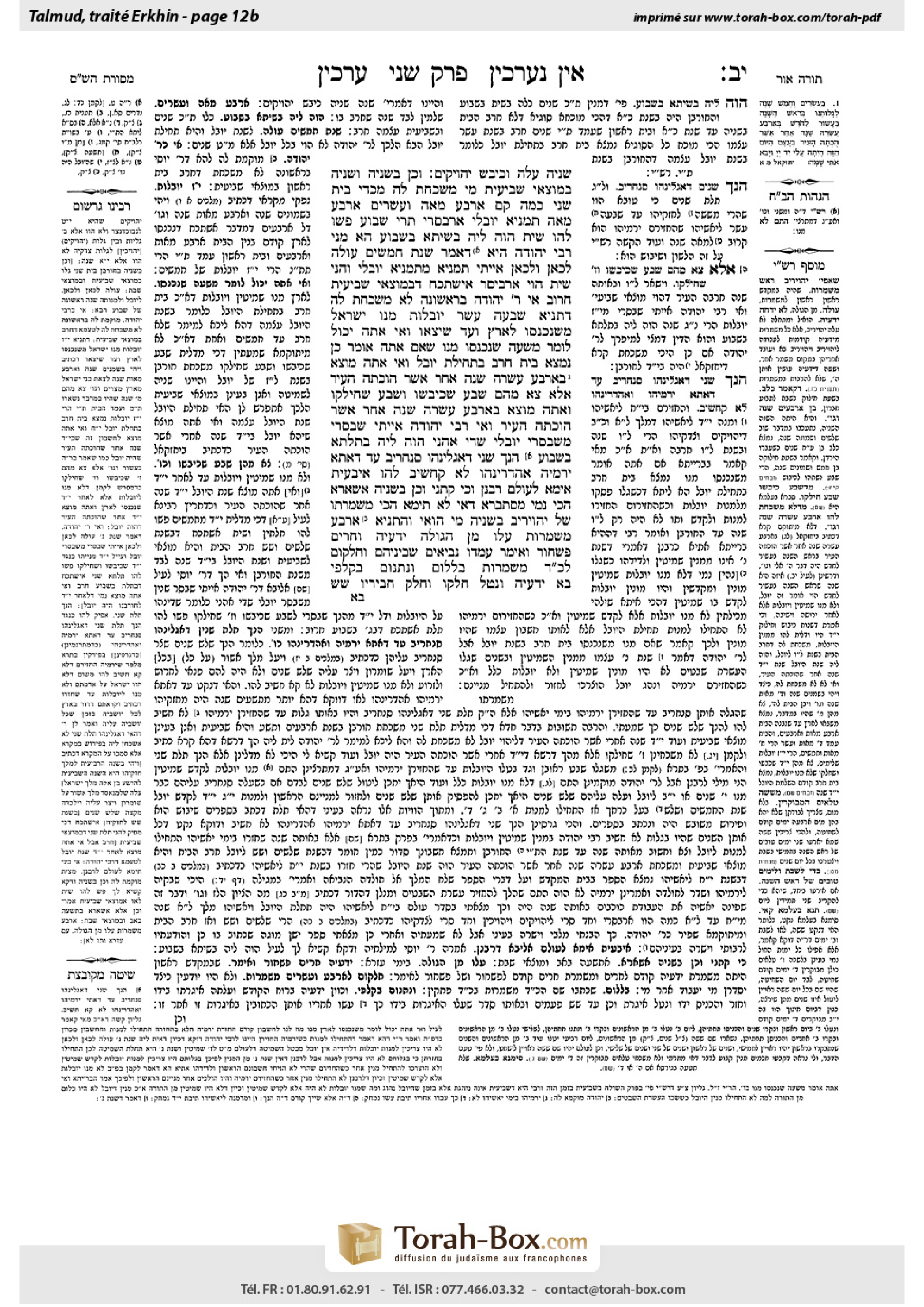
This page of Arakhin includes the Aramaic text, an English translation and an AI-generated French translation, alongside the scan above.
ערכין י״ב ב · Aramaic and Hebrew text
שְׁנִיָּה עָלָה וְכִיבֵּשׁ יְהוֹיָקִים.
וְכֵן בַּשְּׁנִיָּה.
וּשְׁנִיָּה בְּמוֹצָאֵי שְׁבִיעִית מִי מַשְׁכַּחַתְּ לַהּ? מִכְּדִי בַּיִת שֵׁנִי כַּמָּה קָם? אַרְבַּע מְאָה וְעֶשְׂרִים. אַרְבַּע מְאָה — תְּמָנְיָא יוֹבֵלֵי, אַרְבֵּסְרֵי — תְּרֵי שָׁבוּעַ, פָּשׁוּ לְהוּ שֵׁית, הָוֵה לֵיהּ בְּשִׁיתָּא בַּשָּׁבוּעַ.
הָא מַנִּי? רַבִּי יְהוּדָה הִיא, דְּאָמַר: ״שְׁנַת חֲמִשִּׁים עוֹלָה לְכָאן וּלְכָאן״, אַיְיתִי תְּמָנְיָא מִתְּמָנְיָא יוֹבֵלֵי, וְהָנֵי שֵׁית — הָוֵי אַרְבֵּיסַר, אִישְׁתְּכַח דִּבְמוֹצָאֵי שְׁבִיעִית חֲרוּב.
אִי רַבִּי יְהוּדָה, בָּרִאשׁוֹנָה לָא מַשְׁכַּחַתְּ לַהּ! דְּתַנְיָא: שִׁבְעָה עָשָׂר יוֹבֵלוֹת מָנוּ יִשְׂרָאֵל מִשֶּׁנִּכְנְסוּ לָאָרֶץ וְעַד שֶׁיָּצְאוּ, וְאִי אַתָּה יָכוֹל לוֹמַר מִשָּׁעָה שֶׁנִּכְנְסוּ מָנוּ, שֶׁאִם אַתָּה אוֹמֵר כֵּן — נִמְצָא בַּיִת חָרֵב בִּתְחִילַּת יוֹבֵל, וְאִי אַתָּה מוֹצֵא ״בְּאַרְבַּע עֶשְׂרֵה שָׁנָה אַחַר אֲשֶׁר הֻכְּתָה הָעִיר״.
אֶלָּא צֵא מֵהֶם שֶׁבַע שֶׁכִּיבְּשׁוּ, וְשֶׁבַע שֶׁחִילְּקוּ, וְאַתָּה מוֹצֵא ״בְּאַרְבַּע עֶשְׂרֵה שָׁנָה אַחַר אֲשֶׁר הֻכְּתָה הָעִיר״.
וְאִי רַבִּי יְהוּדָה, אַיְיתִי שַׁבְסְרֵי מִשַּׁבְסְרֵי יוֹבֵלֵי, שְׁדִי אַהָנֵי — הֲוָה לֵיהּ בִּתְלָתָא בַּשָּׁבוּעַ!
הָנָךְ שְׁנֵי דְּאַגְלִינְהוּ סַנְחֵרִיב, עַד דַּאֲתָא יִרְמְיָה אַהְדְּרִינְהוּ — לָא קָחָשֵׁיב לְהוּ.
אִיבָּעֵית אֵימָא: לְעוֹלָם רַבָּנַן, וְכִי קָתָנֵי ״וְכֵן בַּשְּׁנִיָּה״ — אַשְּׁאָרָא.
הָכִי נָמֵי מִסְתַּבְּרָא, דְּאִי לָא תֵּימָא הָכִי, מִשְׁמַרְתּוֹ שֶׁל יְהוֹיָרִיב בַּשְּׁנִיָּה מִי הֲוַאי?
וְהָתַנְיָא: אַרְבַּע מִשְׁמָרוֹת עָלוּ מִן הַגּוֹלָה — יְדַעְיָה וְחָרִים פַּשְׁחוּר וְאִימֵּר, עָמְדוּ נְבִיאִים שֶׁבֵּינֵיהֶם וְחִלְּקוּם לְעֶשְׂרִים וְאַרְבַּע מִשְׁמָרוֹת, בְּלָלוּם וּנְתָנוּם בַּקַּלְפִּי, בָּא יְדַעְיָה וְנָטַל חֶלְקוֹ וְחֵלֶק חֲבֵירָיו שֵׁשׁ,
Arakhin 12b · English translation
in his second year he ascended to Eretz Yisrael and conquered Jehoiakim.
§ The Gemara continues its discussion of the baraita, which teaches: When the Temple was destroyed for the first time, that day was the Ninth of Av; and it was the conclusion of Shabbat; and it was the year after a Sabbatical Year; and likewise, the same happened when the Second Temple was destroyed.
The Gemara asks: Can you find such a possibility, that the Second Temple was destroyed in the year after a Sabbatical Year? Now, for how many years did the Second Temple stand? It stood for 420 years. Four hundred years include exactly eight Jubilees, as the Jubilee cycle is fifty years. An additional fourteen years consist of two Sabbatical cycles. There are six years remaining during which the Temple stood, which means that the last year was the sixth year of the Sabbatical cycle, and therefore when the Temple was destroyed the following year it was a Sabbatical Year, not the year after the Sabbatical Year.
The Gemara answers: In accordance with whose opinion is this baraita stated? It is in accordance with the opinion of Rabbi Yehuda, who says that the fiftieth year is counted for here and for there, i.e., it is both the Jubilee Year and the first year of the next Sabbatical cycle and Jubilee cycle, and therefore each Jubilee cycle is only forty-nine years rather than fifty years. Consequently, when calculating the number of years of the Sabbatical and Jubilee cycles until the destruction of the Second Temple, bring an additional eight years from the eight complete Jubilee cycles during which the Temple stood. The eight years and those six years that remained according to the previous calculation equal fourteen years, which are two complete Sabbatical cycles. Therefore, it is found that the Second Temple was destroyed in the year following the Sabbatical Year.
The Gemara objects: But if one explains the baraita in accordance with the opinion of Rabbi Yehuda, the first clause of the baraita is problematic, as you do not find that the first time the Temple was destroyed was in the year after the Sabbatical Year. As it is taught in a baraita: The Jewish people counted seventeen Jubilees from when they entered Eretz Yisrael until they left, when the First Temple was destroyed. And you cannot say that they counted from the time they entered, because if you say this, the result is that the Temple was destroyed at the beginning of the Jubilee cycle, and you do not find that the Jubilee Year was “in the fourteenth year after the city was smitten” (Ezekiel 40:1).
Rather, remove from them the seven years when they conquered the land and the seven years when they divided the land, as they did not start counting the first Jubilee cycle until after those events. And you then find that the Jubilee Year was “in the fourteenth year after the city was smitten.”
The Gemara explains the difficulty from this baraita: But if one holds in accordance with the opinion of Rabbi Yehuda, that each Jubilee cycle is forty-nine years rather than fifty years, you must bring an additional seventeen years, one from each of the seventeen Jubilee cycles and add them to these seventeen cycles, and it turns out that the destruction of the Temple was in the third year of the Sabbatical cycle.
The Gemara answers: Throughout those years from when Sennacherib exiled the ten tribes until Jeremiah came and returned them to their land, they did not count the Jubilee cycle, as the Jubilee applies only when all twelve tribes are in their ancestral lands. When the exiles returned, a new Jubilee cycle was started, and the Temple was destroyed thirty-six years later, in the year after a Sabbatical Year.
The Gemara suggests a second answer to its question about the statement of the baraita which equates the destructions of the First Temple and the Second Temple. And if you wish, say instead: Actually, the baraita is in accordance with the opinion of the Rabbis, and when it teaches: And likewise, the same happened when the Second Temple was destroyed, it is not asserting that the Temple was destroyed in a year after a Sabbatical Year, because in fact the Second Temple was destroyed during a Sabbatical Year. Rather, it is referring to the other details the baraita provides with regard to the timing of the destruction, i.e., that it occurred on the Ninth of Av and on a Sunday.
The Gemara comments: So too, it is reasonable to conclude that not all of the details pertaining to the destruction of the First Temple also apply to the destruction of the Second Temple. As, if you do not say so, then with regard to the statement that the destruction occurred during the week of the priestly watch of Jehoiarib, was the priestly watch of Jehoiarib present during the time of the Second Temple?
But isn’t it taught in a baraita that the watch of Jehoiarib did not exist during the Second Temple era? As it is taught: Only four priestly watches ascended from the Babylonian exile, while the other twenty stayed in Babylonia. And these are the watches who returned: The descendants of Jedaiah, Harim, Pashḥur, and Immer. The prophets among those who returned arose and divided these four families into twenty-four watches. They achieved this as follows: They wrote the names of these new twenty-four watches on pieces of paper, mixed them up, and put them in a receptacle [kalpi] from which lots were drawn. A representative from the family of Jedaiah came and drew his portion and the lot of five other watches, for a total of six.
Arakhin 12b · Traduction française (IA)
Au deuxième an, il monta en Eretz Yisrael et conquit Jéhoïakim.
§ La Guemara continue sa discussion sur la baraïta, qui enseigne : Lorsque le Temple fut détruit la première fois, ce jour-là fut le neuvième d'Av ; et c'était la fin du Shabbat ; et c'était l'année après une année sabbatique ; et de même, la même chose arriva lorsque le Second Temple fut détruit.
La Guemara pose la question : Est-ce que l'on peut trouver une telle possibilité, que le Second Temple fut détruit dans l'année suivant une année sabbatique ? Maintenant, combien d'années le Second Temple a-t-il subsisté ? Il subsista pendant quatre cents vingt ans. Quatre cents ans comprennent exactement huit jubiles, car le cycle du jubile est de cinquante ans. Quatorze ans supplémentaires constituent deux cycles sabbatiques. Il reste six ans durant lesquels le Temple subsista, ce qui signifie que l'année dernière fut la sixième année du cycle sabbatique, et donc lorsque le Temple fut détruit l'année suivante, il s'agissait d'une année sabbatique, pas de l'année après l'année sabbatique.
La Guemara répond : Selon l'opinion de qui est formulée cette baraïta ? C'est selon l'opinion de Rabbi Yéhuda, qui dit que le cinquantième année est comptée ici et là, c'est-à-dire qu'elle est à la fois l'année jubilaire et la première année du prochain cycle sabbatique et jubilaire, et donc chaque cycle jubilaire n'est que quarante-neuf ans plutôt que cinquante ans. Ainsi, lors du calcul du nombre d'années des cycles sabbatiques et jubilaires jusqu'à la destruction du Second Temple, on ajoute huit ans provenant des huit cycles jubilaires complets durant lesquels le Temple subsista. Les huit ans et ces six ans restants selon le calcul précédent font quatorze ans, soit deux cycles sabbatiques complets. Ainsi, on trouve que le Second Temple fut détruit dans l'année suivant l'année sabbatique.
La Guemara s'oppose : Mais si l'on explique la baraïta selon l'opinion de Rabbi Yéhuda, la première clause de la baraïta est problématique, car on ne trouve pas que la première fois que le Temple fut détruit fut dans l'année après l'année sabbatique. Comme il est enseigné dans une baraïta : Le peuple juif compta dix-sept jubiles depuis qu'ils entrèrent en Eretz Yisrael jusqu'à ce qu'ils en partirent, lorsque le Premier Temple fut détruit. Et on ne peut pas dire qu'ils comptaient à partir du moment où ils entrèrent, car si l'on dit cela, le résultat est que le Temple fut détruit au début du cycle jubilaire, et on ne trouve pas que le cycle jubilaire fut « au quatorzième an après que la ville fut détruite » (Ezéchiel 40:1).
Plutôt, retirez les sept ans durant lesquels ils conquérrent la terre et les sept ans durant lesquels ils divisèrent la terre, car ils ne commencèrent pas à compter le premier cycle jubilaire jusqu'après ces événements. Et alors on trouve que le cycle jubilaire fut « au quatorzième an après que la ville fut détruite. »
La Guemara explique la difficulté à partir de cette baraïta : Mais si l'on suit l'opinion de Rabbi Yéhuda, que chaque cycle jubilaire est quarante-neuf ans plutôt que cinquante ans, on doit ajouter dix-sept ans, un par chaque cycle jubilaire des dix-sept cycles, et les ajouter à ces dix-sept cycles, et on trouve que la destruction du Temple fut au troisième an du cycle sabbatique.
La Guemara répond : Durant ces années, depuis que Sénécherib exila les dix tribus jusqu'à ce que Jérémie les ramena à leur terre, ils ne comptèrent pas le cycle jubilaire, car le jubile s'applique uniquement lorsque les douze tribus sont dans leurs terres ancestrales. Lorsque les exilés revinrent, un nouveau cycle jubilaire commença, et le Temple fut détruit trente-six ans plus tard, dans l'année suivant une année sabbatique.
La Guemara suggère une deuxième réponse à sa question concernant l'affirmation de la baraïta qui égale la destruction du Premier Temple et du Second Temple. Et si l'on veut, on peut dire plutôt : En réalité, la baraïta est selon l'opinion des Rabbins, et lorsqu'elle enseigne : Et de même, la même chose arriva lorsque le Second Temple fut détruit, elle ne prétend pas que le Temple fut détruit dans l'année suivant une année sabbatique, car en réalité le Second Temple fut détruit durant une année sabbatique. Plutôt, elle fait référence aux autres détails que la baraïta fournit concernant le moment de la destruction, c'est-à-dire qu'il eut lieu le neuvième d'Av et un dimanche.
La Guemara commente : De même, il est raisonnable de conclure que tous les détails concernant la destruction du Premier Temple ne s'appliquent pas à la destruction du Second Temple. Car, si l'on ne dit pas cela, alors concernant l'affirmation que la destruction eut lieu durant la semaine de la garde des prêtres de Jéhoïarib, la garde des prêtres de Jéhoïarib était-elle présente durant l'époque du Second Temple ?
Mais n'est-il pas enseigné dans une baraïta que la garde de Jéhoïarib n'exista pas durant l'époque du Second Temple ? Comme il est enseigné : Seulement quatre gardes de prêtres montèrent depuis l'exil babylonien, tandis que les autres vingt restèrent en Babylone. Et ces gardes sont ceux qui revinrent : les descendants de Jédaiah, d'Haram, de Pashchur et d'Immer. Les prophètes parmi ceux qui revinrent s'élèverent et divisèrent ces quatre familles en vingt-quatre gardes. Ils y parvinrent ainsi : ils écrivirent les noms de ces nouvelles vingt-quatre gardes sur des morceaux de papier, les mélangeèrent, et les placèrent dans un récipient [kalpi] d'où l'on tirait des lots. Un représentant de la famille de Jédaiah vint et tira sa part ainsi que celle de cinq autres gardes, pour un total de six.
Traduction française générée par IA à partir de l’édition anglaise de Sefaria. Vérifie toujours un passage avec le texte source.
Text from Sefaria: William Davidson Edition - Vocalized Aramaic (CC BY NC); William Davidson Edition - English (CC BY NC).