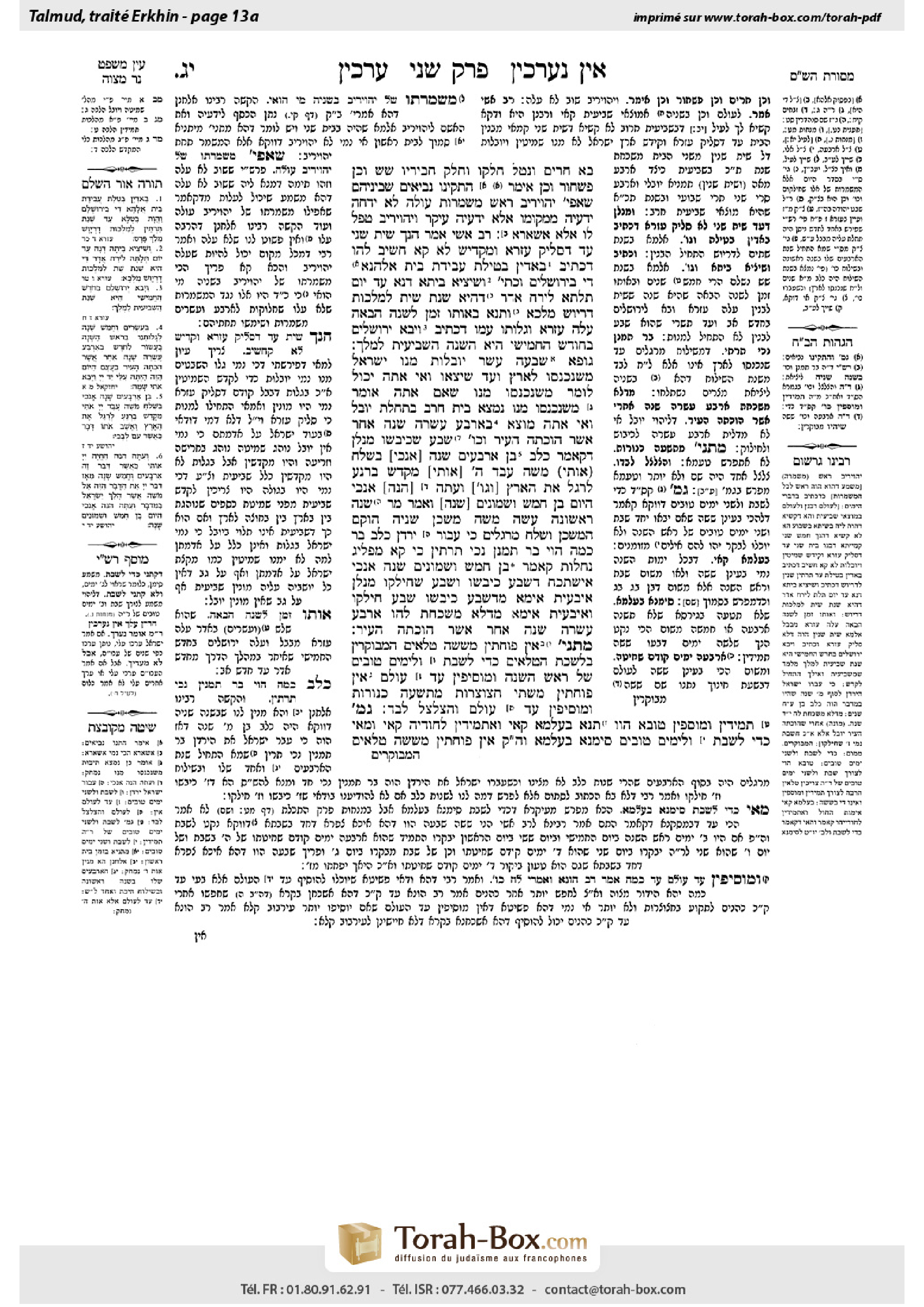
Arakhin 13a: Talmud study for Daf Yomi
Study the Talmud for Daf Yomi with scanned pages, Hebrew text, English translations from Sefaria and AI-generated French translations.
Passage selection and English or AI-generated French translation are available where the scan has annotations. Daf Study is independent of Torah-Box and Sefaria.
Browse Arakhin · ערכין · All tractatesArakhin 13a text and translations
This page of Arakhin includes the Aramaic text, an English translation and an AI-generated French translation, alongside the scan above.
ערכין י״ג א · Aramaic and Hebrew text
בָּא חָרִים וְנָטַל חֶלְקוֹ וְחֵלֶק חֲבֵירָיו שֵׁשׁ, וְכֵן פַּשְׁחוּר וְכֵן אִימֵּר. הִתְקִינוּ נְבִיאִים שֶׁבֵּינֵיהֶם שֶׁאֲפִילּוּ יְהוֹיָרִיב רֹאשׁ מִשְׁמָרוֹת עוֹלֶה — לֹא יִדָּחֶה יְדַעְיָה מִמְּקוֹמוֹ, אֶלָּא יְדַעְיָה עִיקָּר וִיהוֹיָרִיב טָפֵל לוֹ, אֶלָּא אַשְּׁאָרָא.
רַב אָשֵׁי אָמַר: הָנָךְ שֵׁית שְׁנֵי עַד דְּסָלֵיק עֶזְרָא וּמְקַדֵּישׁ לָא קָא חָשֵׁיב לְהוּ,
דִּכְתִיב: ״בֵּאדַיִן בְּטֵלַת עֲבִידַת בֵּית אֱלָהָא דִּי בִּירוּשְׁלֶם״, וּכְתִיב: ״וְשֵׁיצִיא בַּיְתָא דְּנָא עַד יוֹם תְּלָתָא לִירַח אֲדָר דְּהִיא שְׁנַת שֵׁית לְמַלְכוּת דָּרְיָוֶשׁ מַלְכָּא״.
וְתָנָא: בְּאוֹתוֹ זְמַן לְשָׁנָה הַבָּאָה עָלָה עֶזְרָא וְגָלוּתוֹ עִמּוֹ, דִּכְתִיב: ״וַיָּבֹא יְרוּשָׁלִַם בַּחֹדֶשׁ הַחֲמִישִׁי הִיא הַשָּׁנָה הַשְּׁבִיעִית לַמֶּלֶךְ״.
גּוּפָא: שִׁבְעָה עָשָׂר יוֹבֵלוֹת מָנוּ יִשְׂרָאֵל מִשֶּׁנִּכְנְסוּ לָאָרֶץ וְעַד שֶׁיָּצְאוּ, וְאִי אַתָּה יָכוֹל לוֹמַר מִשֶּׁנִּכְנְסוּ מָנוּ, שֶׁאִם אַתָּה אוֹמֵר מִשֶּׁנִּכְנְסוּ מָנוּ, נִמְצָא בַּיִת חָרֵב בִּתְחִלַּת יוֹבֵל, וְאִי אַתָּה מוֹצֵא ״בְּאַרְבַּע עֶשְׂרֵה שָׁנָה אַחַר אֲשֶׁר הֻכְּתָה הָעִיר״ וְכוּ׳.
שֶׁבַע שֶׁכִּיבְּשׁוּ מְנָלַן? דְּקָאָמַר כָּלֵב: ״בֶּן אַרְבָּעִים שָׁנָה [אָנֹכִי] בִּשְׁלוֹחַ אוֹתִי מֹשֶׁה עֶבֶד ה׳ מִקָּדֵשׁ בַּרְנֵעַ לְרַגֵּל אֶת הָאָרֶץ, וְעַתָּה אָנֹכִי הַיּוֹם בֶּן חָמֵשׁ וּשְׁמוֹנִים״.
וְאָמַר מָר: שָׁנָה רִאשׁוֹנָה עָשָׂה מֹשֶׁה מִשְׁכָּן, שְׁנִיָּה הוּקַם הַמִּשְׁכָּן וְשָׁלַח מְרַגְּלִים, כִּי עֲבוּר יַרְדֵּן כָּלֵב בַּר כַּמָּה הָוֵי? בַּר תְּמָנַן נְכֵי תַּרְתֵּין, כִּי קָא מְפַלֵּיג נַחֲלוֹת קָאָמַר: ״בֶּן חָמֵשׁ וּשְׁמוֹנִים שָׁנָה אָנֹכִי״, אִישְׁתְּכַח דְּשֶׁבַע כִּיבְּשׁוּ.
וְשֶׁבַע שֶׁחִילְּקוּ מְנָלַן? אִיבָּעֵית אֵימָא: מִדְּשֶׁבַע כִּיבְּשׁוּ שֶׁבַע חִילְּקוּ, וְאִיבָּעֵית אֵימָא: מִדְּלָא מַשְׁכַּחַתְּ לְהוּ ״אַרְבַּע עֶשְׂרֵה שָׁנָה אַחַר אֲשֶׁר הֻכְּתָה הָעִיר״.
מַתְנִי׳ אֵין פּוֹחֲתִין מִשִּׁשָּׁה טְלָאִים הַמְבוּקָּרִין בְּלִשְׁכַּת הַטְּלָאִים, כְּדֵי לַשַּׁבָּת וּלְיָמִים טוֹבִים שֶׁל רֹאשׁ הַשָּׁנָה, וּמוֹסִיפִין עַד עוֹלָם. אֵין פּוֹחֲתִין מִשְּׁתֵּי חֲצוֹצְרוֹת, מִתִּשְׁעָה כִּנּוֹרוֹת, וּמוֹסִיפִין עַד עוֹלָם, וְהַצִּלְצָל לְבַד.
גְּמָ׳ תְּמִידִין וּמוּסָפִין טוּבָא הֲווֹ!
תַּנָּא בְּעָלְמָא קָאֵי, וְאַתְּמִידִין לְחוֹדֵיהּ קָאֵי, וּמַאי ״כְּדֵי לַשַּׁבָּת וּלְיָמִים טוֹבִים״ — סִימָנָא בְּעָלְמָא, וְהָכִי קָאָמַר: אֵין פּוֹחֲתִין מִשִּׁשָּׁה טְלָאִים
Arakhin 13a · English translation
Harim came and also drew his portion and the lot of five other watches, for a total of six. And likewise Pashḥur, and likewise Immer. The prophets among them stipulated that even if the descendants of Jehoiarib, who originally headed the priestly watches, would ascend to Eretz Yisrael, Jedaiah would not be demoted from its place as the first of the watches. Rather, the watch of Jedaiah would retain precedence, and Jehoiarib would be subordinate to it. The Gemara concludes: Rather, when the baraita equates the details pertaining to the destruction of the two Temples, it is referring to other details, i.e., that both were destroyed on the Ninth of Av and on a Sunday, but it is not equating them with regard to all the details.
The Gemara cites a third answer to its question about how the baraita can claim that the Second Temple was destroyed in a year following a Sabbatical Year, when a calculation of the number of years that it stood indicates that it was destroyed in a Sabbatical Year. Rav Ashi said: Those six years from the time the Second Temple was built until Ezra ascended to Eretz Yisrael and sanctified the land are not counted, as the Sabbatical cycle was not in effect during that period. Consequently, the Second Temple was destroyed in a year following a Sabbatical Year.
It is known that Ezra ascended to Eretz Yisrael six years after the beginning of the construction of the Second Temple, as it is written: “Then ceased the work of the House of God, which is at Jerusalem; and it ceased until the second year of the reign of Darius, king of Persia” (Ezra 4:24). This proves that construction on the Temple started in the second year of the reign of Darius. And it is written: “And this house was finished on the third day of the month Adar, which was in the sixth year of the reign of Darius the king” (Ezra 6:15), which was the fifth year from when they started building.
And the Sages taught in a baraita: At that same time in the following year Ezra ascended from Babylonia together with his company of exiles, as it is written, “And he came to Jerusalem in the fifth month, which was in the seventh year of the king” (Ezra 7:8). Accordingly, Ezra came to Eretz Yisrael six years after the beginning of the construction of the Temple. It was at that time that the counting of the Sabbatical and Jubilee cycles began. The counting continued for 414 years until the destruction of the Temple, which means that the Temple was destroyed in a Sabbatical Year.
§ The Gemara discusses the matter itself that is taught in the baraita cited earlier (12b): The Jewish people counted seventeen Jubilees from when they entered Eretz Yisrael until they left when the Temple was destroyed. And you cannot say that they counted from when they entered, because if you say they counted from when they entered, the result is that the Temple was destroyed at the beginning of the Jubilee cycle, and you do not find that the Jubilee Year was “in the fourteenth year after the city was smitten” (Ezekiel 40:1). Rather, remove from them the seven years when they conquered Eretz Yisrael and the seven years when they divided Eretz Yisrael, as the first Jubilee cycle began after the Jewish people conquered and divided Eretz Yisrael.
The Gemara asks: From where do we derive that there were seven years during which the Jewish people conquered Eretz Yisrael? The Gemara answers: As Caleb said to Joshua, when it came time to divide Eretz Yisrael at the conclusion of part of the conquest: “Forty years old was I when Moses the servant of the Lord sent me from Kadesh-Barnea to spy out the land…and now, behold, I am this day eighty-five years old” (Joshua 14:7, 10).
And the Master says in a baraita: During the first year after the exodus, Moses constructed the Tabernacle; during the second year, the Tabernacle was erected and Moses sent the spies. Consequently, how old was Caleb when the Jewish people crossed the Jordan? He was eighty less two, i.e., seventy-eight years old. When Joshua was dividing Eretz Yisrael into inheritances, Caleb said to him: I am eighty-five years old. It is therefore found that they conquered the land for seven years.
The Gemara asks: And from where do we derive that there were seven years during which the Jewish people divided up Eretz Yisrael into ancestral portions? The Gemara answers: If you wish, say that from the fact that they conquered the land for seven years, it is reasonable to assume that they divided the land for seven years. And if you wish, say instead: It can be derived from the fact that you do not find that “the fourteenth year after the city was smitten” (Ezekiel 40:1) was a Jubilee Year (see 12a) unless the Jewish people divided Eretz Yisrael for seven years.
MISHNA: One maintains no fewer than six lambs that have been inspected for blemishes in the Chamber of the Lambs, which are sufficient for the offerings of Shabbat and for the two Festival days of Rosh HaShana that may occur adjacent to it. And one may add inspected lambs up to an infinite number. One plays no fewer than two trumpets and no fewer than nine harps in the Temple, and one may add up to an infinite number. And the cymbal was played alone, and none may be added to it.
GEMARA: The Gemara assumes that the mishna means that there must be at least six inspected lambs in the Chamber of the Lambs, so that if Rosh HaShana occurs on the two days adjacent to Shabbat, there will be enough lambs available for all the communal offerings that are sacrificed on those days. The Gemara therefore objects: But there are more than six lambs which are required for the daily offerings and additional offerings of a Shabbat and Rosh HaShana that are adjacent to one another, as one day of Rosh HaShana alone requires sixteen lambs.
The Gemara explains: The tanna is referring to the general policy for the entire year, and he is referring only to the number of lambs necessary for the daily offerings sacrificed over the course of three ordinary days. And what is the meaning of the phrase: Sufficient for Shabbat and for the two Festival days of Rosh HaShana? It is merely a mnemonic device, and this is what he is saying: One maintains no fewer than six lambs
Arakhin 13a · Traduction française (IA)
Harim vint et tira également sa part ainsi que le sort de cinq autres veilles, pour un total de six. De même, Pashḥur et Immer. Les prophètes parmi eux stipulèrent que même si les descendants de Jéhoiarib, qui présidait initialement aux veilles sacerdotales, montaient en Terre d'Israël, Jédahya ne serait pas abaissé de sa place en tant que premier des veilles. Au contraire, la veille de Jédahya conserverait la priorité, et Jéhoiarib serait subordonné à celle-ci. La Guemara conclut : En réalité, lorsque la baraïta évoque les détails concernant la destruction des deux Temples, elle fait référence à d'autres détails, c'est-à-dire que les deux ont été détruits le neuvième d'Av et un dimanche, mais elle ne les équilibre pas par rapport à tous les détails.
La Guemara cite une troisième réponse à sa question sur la manière dont la baraïta peut affirmer que le Second Temple a été détruit dans une année suivant une année sabbatique, alors qu'un calcul du nombre d'années pendant lesquelles il a été dressé indique qu'il a été détruit dans une année sabbatique. Rav Ashi dit : Ces six années depuis la construction du Second Temple jusqu'à l'arrivée d'Esra en Terre d'Israël et la sanctification du pays ne sont pas comptées, car le cycle sabbatique n'était pas en vigueur durant cette période. Ainsi, le Second Temple a été détruit dans une année suivant une année sabbatique.
On sait que Esra est monté en Terre d'Israël six ans après le début de la construction du Second Temple, comme il est écrit : « Alors cessa le travail de la Maison de Dieu, qui est à Jérusalem ; et il cessa jusqu'au deuxième année du règne de Darius, roi de Perse » (Esdras 4:24). Cela prouve que la construction du Temple a commencé en deuxième année du règne de Darius. Et il est écrit : « Et cette maison fut achevée le troisième jour du mois d'Adar, qui était en sixième année du règne de Darius, roi » (Esdras 6:15), ce qui était la cinquième année à partir du début de la construction.
Et les Sages ont enseigné dans une baraïta : À la même époque de l'année suivante, Esra est monté de Babylone avec sa compagnie d'exilés, comme il est écrit : « Et il vint à Jérusalem en cinquième mois, qui était en septième année du roi » (Esdras 7:8). Ainsi, Esra est arrivé en Terre d'Israël six ans après le début de la construction du Temple. C'est à cette époque que le décompte des cycles sabbatiques et de jubilé a commencé. Le décompte a duré 414 ans jusqu'à la destruction du Temple, ce qui signifie que le Temple a été détruit dans une année sabbatique.
§ La Guemara discute de la question elle-même enseignée dans la baraïta citée précédemment (12b) : le peuple juif a compté dix-sept jubilés depuis qu'ils sont entrés en Terre d'Israël jusqu'à ce qu'ils partent lors de la destruction du Temple. Et on ne peut pas dire qu'ils ont compté depuis leur entrée, car si on dit qu'ils ont compté depuis leur entrée, le résultat est que le Temple a été détruit au début du cycle jubilé, et on ne trouve pas que l'année jubilé était « en quatorzième année après que la ville fut détruite » (Ezéchiel 40:1). Au contraire, retirez de leur compte les sept années durant lesquelles le peuple juif a conquis la Terre d'Israël et les sept années durant lesquelles il a divisé la Terre d'Israël, car le premier cycle jubilé a commencé après que le peuple juif ait conquis et divisé la Terre d'Israël.
La Guemara demande : D'où dérive-t-on que le peuple juif a conquis la Terre d'Israël pendant sept ans ? La Guemara répond : Comme Caleb a dit à Josué, lorsqu'il était temps de diviser la Terre d'Israël à la fin de la conquête : « J'avais quarante ans lorsque Moïse, serviteur du Seigneur, m'a envoyé de Kadesh-Barnee pour espionner la terre… et maintenant, voici que j'ai aujourd'hui quatre-vingt-cinq ans » (Josué 14:7, 10).
Et le Maître dit dans une baraïta : Durant la première année après l'Exode, Moïse a construit le Tabernacle ; durant la deuxième année, le Tabernacle a été dressé et Moïse a envoyé les espions. Ainsi, combien Caleb avait-il d'années lorsqu'il traversa le Jourdain ? Il avait soixante-dix-huit ans. Lorsque Josué divisait la Terre d'Israël en portions héréditaires, Caleb dit à lui : J'ai quatre-vingt-cinq ans. On en déduit donc qu'ils ont conquis la terre pendant sept ans.
La Guemara demande : Et d'où dérive-t-on que le peuple juif a divisé la Terre d'Israël pendant sept ans ? La Guemara répond : Si vous le souhaitez, dites que cela découle du fait qu'ils ont conquis la terre pendant sept ans, il est donc raisonnable de supposer qu'ils ont divisé la terre pendant sept ans. Et si vous le souhaitez, dites plutôt : On peut le déduire du fait que l'on ne trouve pas que « la quatorzième année après que la ville fut détruite » (Ezéchiel 40:1) était une année jubilé (voir 12a) à moins que le peuple juif ait divisé la Terre d'Israël pendant sept ans.
MICHNA : On affirme qu'il ne faut pas moins de six agnels inspectés pour les défauts dans la Chambre des Agnels, suffisants pour les offrandes du Sabbat et pour les deux jours de Rosh HaShana qui peuvent être adjacents. Et on peut ajouter des agnels inspectés jusqu'à un nombre infini. On ne joue pas moins de deux trompettes et pas moins de neuf harpes dans le Temple, et on peut ajouter jusqu'à un nombre infini. Et le cymbale était joué seul, et aucun ne peut être ajouté à celui-ci.
GUEMARA : La Guemara suppose que la michna signifie qu'il faut au moins six agnels inspectés dans la Chambre des Agnels, afin que si Rosh HaShana a lieu sur les deux jours adjacents au Sabbat, il y ait suffisamment d'agnels pour toutes les offrandes communes sacrifiées ces jours-là. La Guemara s'oppose donc à cela en disant : Mais il y a plus de six agnels requis pour les offrandes quotidiennes et les offrandes supplémentaires du Sabbat et de Rosh HaShana qui sont adjacents, car un seul jour de Rosh HaShana exige seize agnels.
La Guemara explique : Le tanna fait référence à la politique générale pour l'année entière, et il parle uniquement au nombre d'agnelles nécessaires pour les offrandes quotidiennes sacrifiées sur une période de trois jours ordinaires. Et quelle est la signification de la phrase : « Suffisant pour le sabbat et pour les deux jours festifs de Rosh HaShana ? » C'est simplement un dispositif mnémotechnique, et c'est ce que l'on dit : on maintient au moins six agnelles
Traduction française générée par IA à partir de l’édition anglaise de Sefaria. Vérifie toujours un passage avec le texte source.
Text from Sefaria: William Davidson Edition - Vocalized Aramaic (CC BY NC); William Davidson Edition - English (CC BY NC).