Arakhin 13b: Talmud study for Daf Yomi
Study the Talmud for Daf Yomi with scanned pages, Hebrew text, English translations from Sefaria and AI-generated French translations.
Passage selection and English or AI-generated French translation are available where the scan has annotations. Daf Study is independent of Torah-Box and Sefaria.
Browse Arakhin · ערכין · All tractatesArakhin 13b text and translations
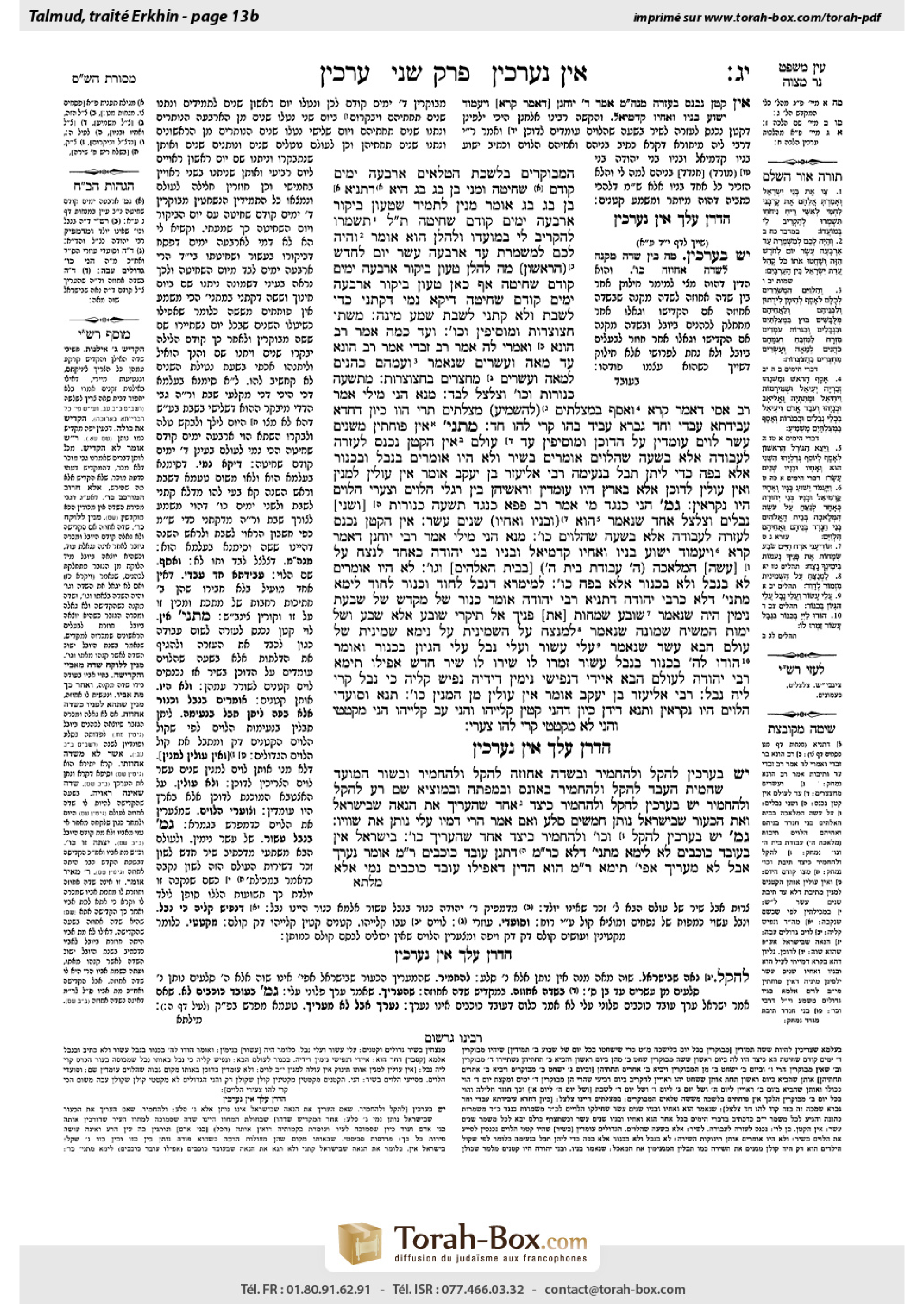
This page of Arakhin includes the Aramaic text, an English translation and an AI-generated French translation, alongside the scan above.
ערכין י״ג ב · Aramaic and Hebrew text
הַמְבוּקָּרִים בְּלִשְׁכַּת הַטְּלָאִים אַרְבָּעָה יָמִים קוֹדֶם שְׁחִיטָה, וּמַנִּי — בֶּן בַּג בַּג הִיא, דְּתַנְיָא: בֶּן בַּג בַּג אוֹמֵר, מִנַּיִן לַתָּמִיד שֶׁטָּעוּן בִּיקּוּר אַרְבָּעָה יָמִים קוֹדֶם שְׁחִיטָה?
תַּלְמוּד לוֹמַר: ״תִּשְׁמְרוּ לְהַקְרִיב לִי בְּמוֹעֲדוֹ״, וּלְהַלָּן הוּא אוֹמֵר: ״וְהָיָה לָכֶם לְמִשְׁמֶרֶת עַד אַרְבָּעָה עָשָׂר יוֹם לַחֹדֶשׁ הָרִאשׁוֹן״, מָה לְהַלָּן טָעוּן בִּיקּוּר אַרְבָּעָה יָמִים קוֹדֶם שְׁחִיטָה, אַף כָּאן טָעוּן בִּיקּוּר אַרְבָּעָה יָמִים קוֹדֶם שְׁחִיטָה.
דַּיְקָא נָמֵי, דְּקָתָנֵי ״כְּדֵי לַשַּׁבָּת״, וְלָא קָתָנֵי ״לַשַּׁבָּת״, שְׁמַע מִינַּהּ.
מִשְּׁתֵּי חֲצוֹצְרוֹת וּמוֹסִיפִין וְכוּ׳. וְעַד כַּמָּה? אָמַר רַב הוּנָא, וְאָמְרִי לַהּ אָמַר רַב זַבְדִּי אָמַר רַב הוּנָא: עַד מֵאָה וְעֶשְׂרִים, שֶׁנֶּאֱמַר: ״וְעִמָּהֶם כֹּהֲנִים לְמֵאָה וְעֶשְׂרִים מַחְצְרִים בַּחֲצוֹצְרוֹת״.
מִתִּשְׁעָה כִּנּוֹרוֹת וְכוּ׳ וְצִלְצָל לְבָד. מְנָא הָנֵי מִילֵּי? אָמַר רַב אַסִּי, דְּאָמַר קְרָא: ״וְאָסָף בַּמְצִלְתַּיִם לְהַשְׁמִיעַ״. מְצִלְתַּיִם תְּרֵי הָווּ! כֵּיוָן דַּחֲדָא עֲבִידְתָּא עָבְדִי, וְחַד גַּבְרָא עָבֵיד בְּהוּ — קָרֵי לְהוּ חַד.
מַתְנִי׳ אֵין פּוֹחֲתִין מִשְּׁנֵים עָשָׂר לְוִיִּם עוֹמְדִין עַל הַדּוּכָן, וּמוֹסִיפִין עַד עוֹלָם. אֵין הַקָּטָן נִכְנָס לָעֲזָרָה לַעֲבוֹדָה, אֶלָּא בְּשָׁעָה שֶׁהַלְּוִיִּם אוֹמְרִים בַּשִּׁיר, וְלֹא הָיוּ אוֹמְרִים בְּנֵבֶל וּבְכִנּוֹר, אֶלָּא בַּפֶּה, כְּדֵי לִיתֵּן תֶּבֶל בַּנְּעִימָה.
רַבִּי אֱלִיעֶזֶר בֶּן יַעֲקֹב אוֹמֵר: אֵין עוֹלִין לַמִּנְיָן, וְאֵין עוֹלִין לַדּוּכָן, אֶלָּא בָּאָרֶץ הָיוּ עוֹמְדִין, וְרָאשֵׁיהֶן בֵּין רַגְלֵי הַלְוִיִּם, וְצֹעֲרֵי הַלְוִיִּם הָיוּ נִקְרָאִין.
גְּמָ׳ הָנֵי כְּנֶגֶד מִי? אָמַר רַב פָּפָּא: כְּנֶגֶד תִּשְׁעָה כִּנּוֹרוֹת [וּשְׁנֵי] נְבָלִים וְצִלְצָל אֶחָד, שֶׁנֶּאֱמַר: ״הוּא וּבָנָיו וְאֶחָיו שְׁנֵים עָשָׂר״.
אֵין הַקָּטָן נִכְנָס לָעֲזָרָה לַעֲבוֹדָה אֶלָּא בְּשָׁעָה שֶׁהַלְּוִיִּם כּוּ׳. מְנָא הָנֵי מִילֵּי? אָמַר רַבִּי יוֹחָנָן, דְּאָמַר קְרָא: ״וַיַּעֲמֹד יֵשׁוּעַ בָּנָיו וְאֶחָיו קַדְמִיאֵל וּבָנָיו בְּנֵי יְהוּדָה כְּאֶחָד לְנַצֵּחַ עַל עֹשֵׂה הַמְּלָאכָה בְּבֵית הָאֱלֹהִים וְגוֹ׳״.
לֹא הָיוּ אוֹמְרִים לֹא בְּנֵבֶל וְלֹא בְּכִנּוֹר, אֶלָּא בַּפֶּה כּוּ׳. לְמֵימְרָא דְּנֵבֶל לְחוּד וְכִנּוֹר לְחוּד? לֵימָא מַתְנִיתִין דְּלָא כְּרַבִּי יְהוּדָה, דְּתַנְיָא: רַבִּי יְהוּדָה אוֹמֵר: כִּנּוֹר שֶׁל מִקְדָּשׁ שֶׁל שִׁבְעַת נִימִין הָיָה, שֶׁנֶּאֱמַר: ״שׂבַע שְׂמָחוֹת פָּנֶיךָ״, אַל תִּיקְרֵי ״שׂוֹבַע״ אֶלָּא ״שֶׁבַע״.
וְשֶׁל יְמוֹת הַמָּשִׁיחַ שְׁמוֹנָה, שֶׁנֶּאֱמַר: ״לִמְנַצֵּחַ עַל הַשְּׁמִינִית״, עַל נִימָא שְׁמִינִית.
שֶׁל עוֹלָם הַבָּא עֶשֶׂר, שֶׁנֶּאֱמַר: ״עֲלֵי עָשׂוֹר וַעֲלֵי נָבֶל עֲלֵי הִגָּיוֹן בְּכִנּוֹר״.
וְאוֹמֵר: ״הוֹדוּ לַה׳ בְּכִנּוֹר בְּנֵבֶל עָשׂוֹר זַמְּרוּ לוֹ שִׁירוּ לוֹ שִׁיר חָדָשׁ״!
אֲפִילּוּ תֵּימָא רַבִּי יְהוּדָה, לָעוֹלָם הַבָּא, אַיְּידֵי דִּנְפִישִׁי נִימִין דִּידֵיהּ, נְפִישׁ קָלֵיהּ כִּי נֵבֶל, קָרֵי לֵיהּ ״נֵבֶל״.
רַבִּי אֱלִיעֶזֶר בֶּן יַעֲקֹב אוֹמֵר: אֵין עוֹלִין מִן הַמִּנְיָן כּוּ׳. תָּנָא: וְסוֹעֲדֵי הַלְוִיִּם הָיוּ נִקְרָאִין. וְתַנָּא דִּידַן? כֵּיוָן דְּהַנֵּי קָטִין קָלַיְיהוּ, וְהָנֵי עָב קָלַיְיהוּ, הָנֵי מְקַטְּטִי וְהָנֵי לָא מְקַטְּטִי, קָרֵי לְהוּ ״צֹעֲרֵי״.
הֲדַרַן עֲלָךְ אֵין נֶעֱרָכִין.
מַתְנִי׳ יֵשׁ בַּעֲרָכִין לְהָקֵל וּלְהַחְמִיר, וּבִשְׂדֵה אֲחוּזָּה לְהָקֵל וּלְהַחְמִיר, וּבְשׁוֹר הַמּוּעָד שֶׁהֵמִית הָעֶבֶד לְהָקֵל וּלְהַחְמִיר, בָּאוֹנֵס וּבַמְפַתֶּה וּבַמּוֹצִיא שֵׁם רַע לְהָקֵל וּלְהַחְמִיר.
יֵשׁ בַּעֲרָכִין לְהָקֵל וּלְהַחְמִיר, כֵּיצַד? אֶחָד שֶׁהֶעֱרִיךְ אֶת הַנָּאֶה שֶׁבְּיִשְׂרָאֵל וְאֶת הַכָּעוּר שֶׁבְּיִשְׂרָאֵל, נוֹתֵן חֲמִשִּׁים סֶלַע, וְאִם אָמַר: ״הֲרֵי דָּמָיו עָלַי״, נוֹתֵן אֶת שׇׁוְויוֹ.
גְּמָ׳ יֵשׁ בַּעֲרָכִין לְהָקֵל וְכוּ׳ וּלְהַחְמִיר כֵּיצַד אֶחָד שֶׁהֶעֱרִיךְ כּוּ׳. בְּיִשְׂרָאֵל — אִין, בַּגּוֹיִם — לָא.
לֵימָא מַתְנִיתִין דְּלָא כְּרַבִּי מֵאִיר, דִּתְנַן: גּוֹי, רַבִּי מֵאִיר אוֹמֵר: נֶעֱרָךְ, אֲבָל לֹא מַעֲרִיךְ?
אֲפִילּוּ תֵּימָא רַבִּי מֵאִיר, הוּא הַדִּין דַּאֲפִילּוּ גּוֹי נָמֵי, אֶלָּא
Arakhin 13b · English translation
that have been inspected in the Chamber of the Lambs for four days prior to the time of their slaughter. The reserve of six lambs ensured that each lamb would be available for inspection for three days prior to the day of its sacrifice, for a total of four. And whose opinion is this? It is the opinion of ben Bag Bag, as it is taught in a baraita that ben Bag Bag says: From where is it derived that the daily offering requires examination four days prior to its slaughter?
The verse states with regard to the daily offering: “My food that is presented unto Me for offerings made by fire, of a pleasing aroma unto Me, shall you safeguard to offer unto Me in its due season” (Numbers 28:2); and it states there, with regard to the Paschal offering: “In the tenth day of this month they shall take to them every man a lamb…and it shall be for you as a safeguard until the fourteenth day of this month” (Exodus 12:3–6), i.e., the first month. Since the word “safeguard” appears in both verses, it is derived that just as in the verse there, the Paschal offering requires examination four days prior to its slaughter, so too here, the daily offering requires examination four days prior to its slaughter.
The Gemara notes: The language of the mishna is also precise, according to the explanation that the mishna is referring to Shabbat and Rosh HaShana merely as a mnemonic device, as it teaches that the six lambs are sufficient for Shabbat and the two Festival days of Rosh HaShana, and it does not teach that the six lambs are for use on Shabbat and the two days of Rosh HaShana. The Gemara concludes: Learn from the language of the mishna that this explanation is correct.
§ The mishna teaches that one plays no fewer than two trumpets, and one may add to that number. The Gemara asks: Until how many trumpets may these additions be made? The Gemara answers that Rav Huna says, and some say Rav Zavdi says that Rav Huna says: They may play up to 120 trumpets, as it is stated: “And with them one hundred and twenty priests sounding with trumpets” (II Chronicles 5:12).
The mishna teaches that one plays no fewer than nine harps and one may add up to an infinite number, and the cymbal was played alone and none may be added to it. The Gemara asks: From where is this matter derived? Rav Asi says that it is as the verse states: “And Asaph with the cymbals, sounding aloud” (I Chronicles 16:5), which indicates that only one Levite played the cymbals. The Gemara asks: The word cymbals is in the plural, indicating that there were two; why, then, does the mishna say that there is only one cymbal? The Gemara answers: Since two cymbals perform one act and one person plays them by banging them together, the mishna calls them one instrument.
MISHNA: In the Temple, there are no fewer than twelve Levites standing on the platform adjacent to the altar and singing, and one may add Levites on the platform up to an infinite number. A minor Levite may enter the Temple courtyard for service only at a time when the Levites are engaging in song, so that he may accompany them. And minors would not engage in playing a lyre and in playing a harp; rather, they would engage in singing with the mouth, in order to provide flavor to the music with their pure, high voices.
Rabbi Eliezer ben Ya’akov says: Minors are not tallied in the minimum total of twelve Levites, and they do not ascend to the platform; rather, they would stand on the ground and their heads would reach to between the legs of the Levites, and they were called cadets [tzoarei] of the Levites.
GEMARA: The mishna states that a minimum of twelve Levites would stand on the platform and sing. The Gemara asks: To what does this number correspond? Rav Pappa says: It corresponds to the minimum number of instruments that were played: Nine harps and two lyres and one cymbal. This number is also alluded to in the Bible, as it is stated: “Instructed in singing unto the Lord…he and his brethren and sons were twelve” (I Chronicles 25:7–9).
§ The mishna teaches: A minor Levite may enter the Temple courtyard for service only at a time when the Levites are engaging in song. The Gemara asks: From where is this matter derived? Rabbi Yoḥanan says: As the verse states: “Then stood Jeshua with his sons and his brethren, and Kadmiel and his sons, the sons of Judah, together, to make music for the workmen in the House of God” (Ezra 3:9). This verse shows that in making music it is preferable to have one’s sons, i.e., minors, as accompaniment.
The mishna teaches: The minors would not engage in playing a lyre and in playing a harp; rather, in singing with the mouth in order to provide flavor to the music with their pure, high voices. The Gemara notes: That is to say that a lyre and a harp are two distinct instruments. Let us say that the mishna is not in accordance with the opinion of Rabbi Yehuda, as it is taught in a baraita that Rabbi Yehuda says: The harp used in the Temple was an instrument of seven strings, as it is stated: “In your presence is fullness [sova] of joy, in your right hand sweetness for evermore” (Psalms 16:11). Do not read the word as “fullness [sova]” but as seven [sheva]. This indicates that the “sweet harp” (see Psalms 81:3) played in the presence of God, i.e., in the Temple, has seven strings.
Rabbi Yehuda continues: And the harp that will be played in the days of the Messiah will have eight strings, as it is stated: “For the Leader, on the eighth: A Psalm of David” (Psalms 12:1). This indicates that the psalms that will be recited in the time of the Messiah, son of David, will be played on the eighth string that will be added to the harp.
And the harp that will be played in the World-to-Come will have ten strings, as it is stated: “A Psalm, a song. For the Shabbat…With an instrument of ten strings and with the lyre, with a solemn sound upon the harp” (Psalms 92:1–4). This indicates that in the World-to-Come, which is comparable to Shabbat, songs of praise to God will be played on a ten-stringed instrument, identified here as both a lyre and a harp.
And similarly, another verse states: “Give thanks unto the Lord with the harp; sing praises unto Him with the lyre of ten strings. Sing unto Him a new song” (Psalms 33:2–3), which is referring to the new song that will be sung only in the World-to-Come. This proof in support of Rabbi Yehuda’s claim that the harp used in the World-to-Come will have ten strings is from a verse that is referring to a ten-stringed lyre, which shows that according to Rabbi Yehuda, the lyre and harp are the same instrument. Therefore, his opinion apparently contradicts the mishna.
The Gemara answers: You may even say the mishna is in accordance with the opinion of Rabbi Yehuda, as even he agrees that the harp and lyre are essentially two different instruments. But in the World-to-Come, since the strings of the harp will be increased, its sound will be increased like that of the lyre, and therefore he calls the harp a lyre.
The mishna teaches that Rabbi Eliezer ben Ya’akov says: The minors are not tallied in the minimum total of twelve Levites…and they were called cadets [tzoarei] of the Levites. The Sages taught in a baraita: And they were called the helpers [soadei] of the Levites. The Gemara asks: And the tanna of our mishna, why is he referring to them as tzoarei? The Gemara answers: Since these minors had high voices and those adults had deep voices, and these minors would sing in a high voice [mekateti], and those adults could not sing in such a high voice, they were called tzoarei, as they caused the adult Levites anguish [tza’ar] due to the fact that they could not produce the same pleasant sounds as the minors.
MISHNA: There are halakhot with regard to valuations that are lenient and others that are stringent; and there are halakhot with regard to an ancestral field that are lenient and others that are stringent; and there are halakhot with regard to a forewarned ox that killed a Canaanite slave that are lenient and others that are stringent; and there are halakhot with regard to a rapist, and a seducer, and a defamer that are lenient and others that are stringent.
There are halakhot with regard to valuations that are lenient and others that are stringent; how so? Both in the case of one who took a vow of valuation to donate the fixed value of the most attractive among the Jewish people and in the case of one who took a vow of valuation to donate the fixed value of the most unsightly among the Jewish people, he gives the fixed payment of fifty sela, shekels, to the Temple treasury (see Leviticus 27:3). And if one said: It is incumbent upon me to donate the assessment of another to the Temple treasury, he gives the price for that person if sold as a slave, a sum that can be more or less than fifty shekels.
GEMARA: The mishna states: There are halakhot with regard to valuations that are lenient and others that are stringent; how so? Both in the case of one who took a vow of valuation to donate the fixed value of the most attractive among the Jewish people and in the case of one who took a vow of valuation to donate the fixed value of the most unsightly among the Jewish people, he gives the fixed payment of fifty sela to the Temple treasury. The Gemara infers from this that if the vow of valuation referred to a Jew, yes, he pays the fixed value; but if one took a vow of valuation to donate the fixed value of gentiles, he does not pay the fixed value.
The Gemara asks: If so, let us say that the mishna is not in accordance with the opinion of Rabbi Meir, as we learned in a mishna (5b): With regard to a gentile, Rabbi Meir says: He is valuated in a case where a Jew says: It is incumbent upon me to donate the fixed value of this gentile; but a gentile does not take a vow of valuation to donate his fixed value or the value of others.
The Gemara answers: You can even say that the mishna is in accordance with the opinion of Rabbi Meir, as it can be claimed that the same is true, i.e. that even if one took a vow of valuation to donate the fixed value of a gentile, he also pays the fixed amount. But
Arakhin 13b · Traduction française (IA)
qui ont été examinés dans la Chambre des Agneaux pendant quatre jours avant leur sacrifice. La réserve de six agneaux garantissait que chaque agneau serait disponible pour l'examen pendant trois jours avant la journée de son sacrifice, ce qui fait un total de quatre jours. Et quel est l'avis de celui-ci ? C'est l'avis de Ben Bag Bag, comme il est enseigné dans une baraïta que Ben Bag Bag dit : D'où est tiré le fait que l'offrande quotidienne nécessite un examen quatre jours avant son sacrifice ?
La Sainte Écriture dit concernant l'offrande quotidienne : « Mon aliment qui est présenté à Moi pour les offrandes faites par le feu, d'un parfum agréable à Moi, tu le garderas pour Me offrir en son temps » (Nombres 28:2) ; et elle dit aussi concernant l'agneau pascal : « Le dixième jour de ce mois, ils prendront chacun un agneau… et il sera pour vous comme un garde jusqu'au quatorzième jour de ce mois » (Exode 12:3–6), c'est-à-dire le premier mois. Puisque le mot « garde » apparaît dans les deux versets, on en déduit que tout comme l'agneau pascal exige un examen quatre jours avant son sacrifice, ainsi l'offrande quotidienne exige également un examen quatre jours avant son sacrifice.
Le Guemara note : La formulation de la Michna est aussi précise, selon l'explication qui indique que la Michna fait référence à la Shabbat et à Rosh HaShana uniquement comme un dispositif mnémotechnique, car elle enseigne que les six agneaux sont suffisants pour la Shabbat et les deux jours de Rosh HaShana, et elle ne prétend pas que les six agneaux sont utilisés pour la Shabbat et les deux jours de Rosh HaShana. Le Guemara conclut : Apprenez de la formulation de la Michna que cette explication est correcte.
§ La Michna enseigne que l'on ne joue pas moins de deux trompettes, et l'on peut ajouter à ce nombre. Le Guemara demande : Jusqu'à combien de trompettes peut-on faire ces additions ? Le Guemara répond que Rav Huna dit, et certains disent que Rav Zavdi dit que Rav Huna dit : On peut jouer jusqu'à 120 trompettes, comme il est dit : « Et avec eux cent vingt prêtres sonnant avec des trompettes » (II Chroniques 5:12).
La Michna enseigne que l'on ne joue pas moins de neuf harpes et l'on peut ajouter jusqu'à un nombre infini, et le cymbale était joué seul et l'on ne peut pas y ajouter quoi que ce soit. Le Guemara demande : D'où est tiré ce sujet ? Rav Asi dit que c'est comme le verset dit : « Et Asaph avec les cymbales, sonnant fort » (I Chroniques 16:5), ce qui indique que seul un Lévite jouait les cymbales. Le Guemara demande : Le mot « cymbales » est au pluriel, indiquant qu'il y en avait deux ; pourquoi alors la Michna dit-elle qu'il n'y a qu'un seul cymbale ? Le Guemara répond : Puisque deux cymbales accomplissent une seule action et qu'un seul homme les joue en les frappant ensemble, la Michna les appelle un seul instrument.
MICHNA : Dans le Temple, il n'y a pas moins de douze Lévitiques debout sur la plateforme adjacente à l'autel et chantant, et l'on peut ajouter des Lévitiques sur la plateforme jusqu'à un nombre infini. Un mineur peut entrer dans le cour de l'Autel pour le service uniquement à un moment où les Lévitiques chantent, afin de les accompagner. Et les mineurs ne participaient pas à jouer la lyre et la harpe ; plutôt, ils chantaient avec la bouche afin de donner du goût à la musique avec leurs voix pures et hautes.
Rabbi Eliezer ben Ya’akov dit : Les mineurs ne sont pas comptés dans le total minimum de douze Lévitiques, et ils ne montent pas sur la plateforme ; plutôt, ils se tenaient au sol et leurs têtes atteignaient entre les jambes des Lévitiques, et ils étaient appelés des cadets [tzoarei] des Lévitiques.
GUEMARA : La Michna dit qu'il y a au minimum douze Lévitiques debout sur la plateforme et chantant. Le Guemara demande : À quoi cela correspond-il ? Rav Pappa dit : Cela correspond au nombre minimum d'instruments joués : neuf harpes, deux lyres et un cymbale. Ce nombre est également évoqué dans la Bible, comme il est dit : « Enseigné à chanter à l'Éternel… il et ses frères et ses fils étaient douze » (I Chroniques 25:7–9).
§ La Michna enseigne : Un mineur peut entrer dans le cour de l'Autel pour le service uniquement à un moment où les Lévitiques chantent. Le Guemara demande : D'où est tiré ce sujet ? Rabbi Yoḥanan dit : Comme le verset dit : « Alors Jéhousa avec ses fils et ses frères, et Kadmiel avec ses fils, les fils de Juda, ensemble, pour faire la musique aux ouvriers dans la Maison de Dieu » (Esdras 3:9). Ce verset montre que dans la musique, il est préférable d'avoir ses fils, c'est-à-dire les mineurs, comme accompagnateurs.
La Michna enseigne : Les mineurs ne participaient pas à jouer la lyre et la harpe ; plutôt, ils chantaient avec la bouche afin de donner du goût à la musique avec leurs voix pures et hautes. Le Guemara note : Cela signifie que la lyre et la harpe sont deux instruments distincts. Disons que la Michna n'est pas en accord avec l'opinion de Rabbi Yehuda, comme il est enseigné dans une baraïta que Rabbi Yehuda dit : La harpe utilisée dans le Temple était un instrument à sept cordes, comme il est dit : « En votre présence est la plénitude [sova] de joie, en votre main droite la douceur pour toujours » (Psaumes 16:11). Ne lisez pas le mot comme « plénitude [sova] » mais comme sept [sheva]. Cela indique que la « harpe douce » (voir Psaumes 81:3) jouée en présence de Dieu, c'est-à-dire dans le Temple, a sept cordes.
Rabbi Yehuda continue : Et la harpe qui sera jouée aux jours du Messie aura huit cordes, comme il est dit : « Pour le chef, sur l'huitième : un Psaume de David » (Psaumes 12:1). Cela indique que les psaumes qui seront récités à l'époque du Messie, fils de David, seront joués sur la huitième corde ajoutée à la harpe.
Et la harpe qui sera jouée dans le Monde à Venir aura dix cordes, comme il est dit : « Un Psaume, une chanson. Pour le Shabbat… Avec un instrument de dix cordes et avec la lyre, avec un son solennel sur la harpe » (Psaumes 92:1–4). Cela indique que dans le Monde à Venir, comparable au Shabbat, des chants d'éloge à Dieu seront joués sur un instrument à dix cordes, identifié ici à la fois comme une lyre et une harpe.
Et de même, un autre verset dit : « Dites grâce au Seigneur avec la harpe ; chantez des louanges à Lui avec la lyre à dix cordes. Chantez à Lui un nouveau chant » (Psaumes 33:2–3), ce qui fait référence au nouveau chant qui sera chanté uniquement dans le Monde à Venir. Cette preuve en faveur de la déclaration de Rabbi Yéhuda selon laquelle la harpe utilisée dans le Monde à Venir aura dix cordes provient d’un verset faisant référence à une lyre à dix cordes, ce qui montre que selon Rabbi Yéhuda, la lyre et la harpe sont le même instrument. Ainsi, son opinion semble contredire la mitsva.
Le Guemara répond : On peut même dire que la mitsva est selon l'opinion de Rabbi Yéhuda, car même lui admet que la harpe et la lyre sont essentiellement deux instruments différents. Mais dans le Monde à Venir, puisque les cordes de la harpe seront augmentées, son son sera augmenté comme celui de la lyre, et donc il appelle la harpe une lyre.
La mitsva enseigne que Rabbi Eliezer ben Ya’akov dit : Les mineurs ne sont pas comptés dans le minimum total de douze Lévites… et ils furent appelés tzoarei des Lévites. Les Sages enseignèrent dans une baraïta : Et ils furent appelés les assistants [soadei] des Lévites. Le Guemara pose la question : Et le tanna de notre mitsva, pourquoi fait-il référence à eux comme tzoarei ? Le Guemara répond : Puisque ces mineurs avaient des voix aiguës et que les adultes avaient des voix graves, et que ces mineurs chantaient avec une voix aiguë [mekateti], et que les adultes ne pouvaient pas chanter avec une telle voix aiguë, ils furent appelés tzoarei, car ils causaient à los Lévites adultes de la souffrance [tza’ar] en raison du fait qu'ils ne pouvaient pas produire les mêmes sons agréables que les mineurs.
MICHNA : Il y a des halakhot concernant les évaluations qui sont lenientes et d'autres qui sont strictes ; et il y a des halakhot concernant un champ ancestral qui sont lenientes et d'autres qui sont strictes ; et il y a des halakhot concernant un bœuf averti qui a tué un esclave cananéen qui sont lenientes et d'autres qui sont strictes ; et il y a des halakhot concernant un violateur, un séducteur et un calomniateur qui sont lenientes et d'autres qui sont strictes.
Il y a des halakhot concernant les évaluations qui sont lenientes et d'autres qui sont strictes ; comment cela ? Dans le cas d'une personne qui a pris un vœu d'évaluation pour donner la valeur fixe du plus attrayant parmi le peuple juif et dans le cas d'une personne qui a pris un vœu d'évaluation pour donner la valeur fixe du moins attrayant parmi le peuple juif, il donne le paiement fixe de cinquante sela, siclo, au trésor du Temple (voir Lévitique 27:3). Et si l'on dit : Il est obligatoire pour moi de donner l'évaluation d'un autre au trésor du Temple, il donne le prix de cette personne si elle était vendue comme esclave, une somme qui peut être plus ou moins de cinquante siclo.
GUEMARA : La mitsva dit : Il y a des halakhot concernant les évaluations qui sont lenientes et d'autres qui sont strictes ; comment cela ? Dans le cas d'une personne qui a pris un vœu d'évaluation pour donner la valeur fixe du plus attrayant parmi le peuple juif et dans le cas d'une personne qui a pris un vœu d'évaluation pour donner la valeur fixe du moins attrayant parmi le peuple juif, il donne le paiement fixe de cinquante sela au trésor du Temple. Le Guemara déduit de cela que si le vœu d'évaluation faisait référence à un Juif, oui, il paie la valeur fixe ; mais si l'on a pris un vœu d'évaluation pour donner la valeur fixe des Gentils, il ne paie pas la valeur fixe.
Le Guemara pose la question : Si c'est ainsi, disons que la mitsna n'est pas selon l'opinion de Rabbi Meïr, comme nous avons appris dans une mitsna (5b) : Concernant un Gentil, Rabbi Meïr dit : Il est évalué dans le cas où un Juif dit : Il m'est impératif de donner la valeur fixe de ce Gentil ; mais un Gentil ne prend pas un vœu d'évaluation pour donner sa valeur fixe ou la valeur d'autrui.
Le Guemara répond : On peut même dire que la mitsna est selon l'opinion de Rabbi Meïr, car on peut affirmer que c'est pareil, c'est-à-dire que même si l'on a pris un vœu d'évaluation pour donner la valeur fixe d'un Gentil, il paie la somme fixe.
Traduction française générée par IA à partir de l’édition anglaise de Sefaria. Vérifie toujours un passage avec le texte source.
Text from Sefaria: William Davidson Edition - Vocalized Aramaic (CC BY NC); William Davidson Edition - English (CC BY NC).