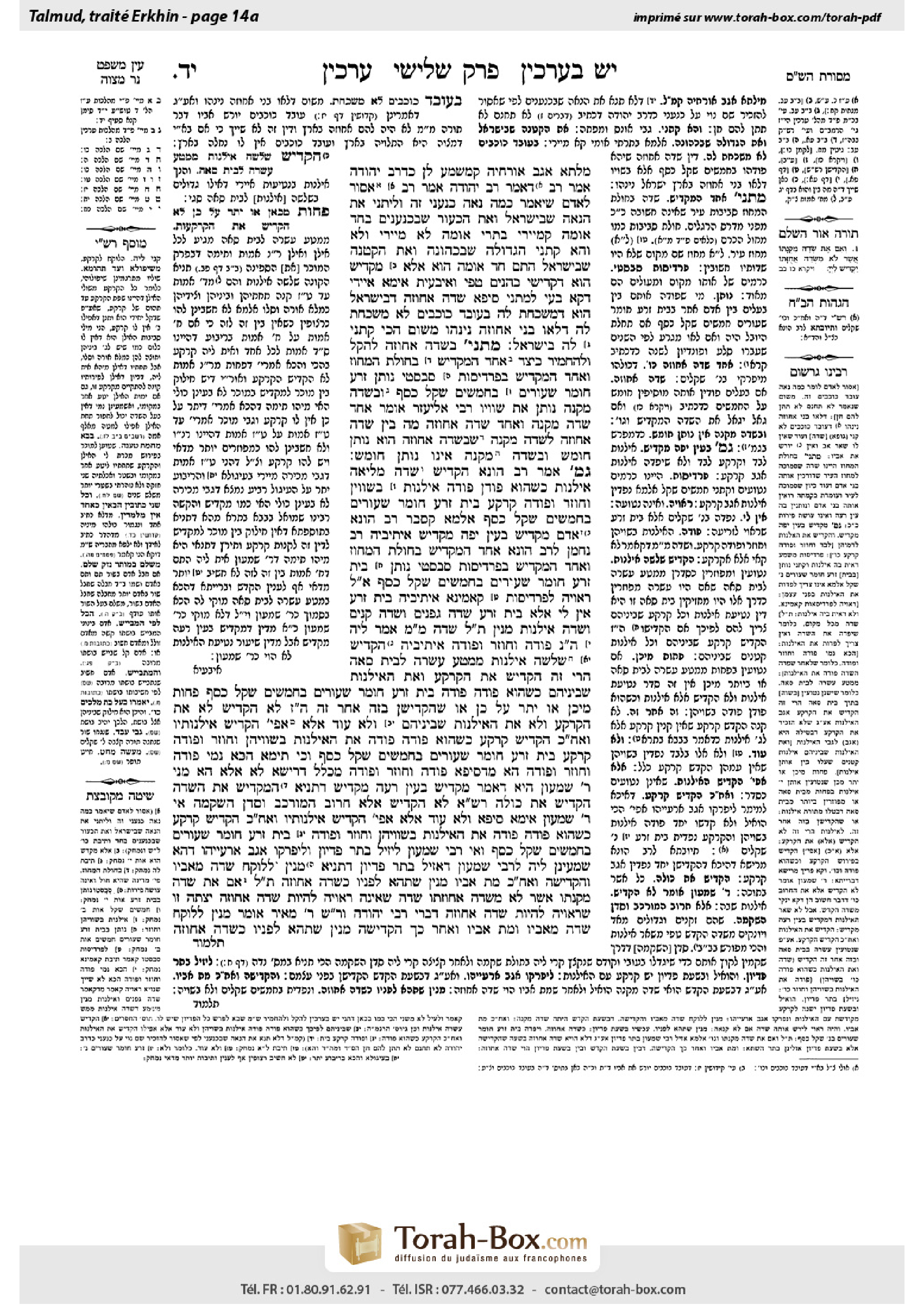
Arakhin 14a: Talmud study for Daf Yomi
Study the Talmud for Daf Yomi with scanned pages, Hebrew text, English translations from Sefaria and AI-generated French translations.
Passage selection and English or AI-generated French translation are available where the scan has annotations. Daf Study is independent of Torah-Box and Sefaria.
Browse Arakhin · ערכין · All tractatesArakhin 14a text and translations
This page of Arakhin includes the Aramaic text, an English translation and an AI-generated French translation, alongside the scan above.
ערכין י״ד א · Aramaic and Hebrew text
מִלְּתָא אַגַּב אוֹרְחֵיהּ קָמַשְׁמַע לַן, כִּדְרַב יְהוּדָה אָמַר רַב, דְּאָמַר רַב יְהוּדָה אָמַר רַב: אָסוּר לָאָדָם שֶׁיֹּאמַר ״כַּמָּה נָאֶה גּוֹי זֶה״.
וְלִיתְנֵי ״אֶת הַנָּאֶה שֶׁבְּיִשְׂרָאֵל וְאֶת הַכָּעוּר שֶׁבַּגּוֹיִם״! בְּחַד אוּמָּה קָמַיְירֵי, בִּתְרֵי אוּמֵּי לָא מַיְירֵי.
וְלָא? וְהָא קָתָנֵי: הַגְּדוֹלָה שֶׁבַּכְּהוּנָּה וְאֶת הַקְּטַנָּה שֶׁבְּיִשְׂרָאֵל! הָתָם חַד אוּמָּה הוּא, אֶלָּא מִקְדָּישׁ הוּא דְּקַדִּישִׁי כֹּהֲנִים טְפֵי.
וְאִיבָּעֵית אֵימָא, אַיְּידֵי דְּקָא בָּעֵי לְמִתְנֵי סֵיפָא ״שְׂדֵה אֲחוּזָּה״, דִּבְיִשְׂרָאֵל הוּא דְּמַשְׁכַּחַתְּ לַהּ, בְּגוֹי לָא מַשְׁכַּחַתְּ לַהּ, דְּלָאו בְּנֵי אֲחוּזָּה נִינְהוּ, מִשּׁוּם הָכִי קָתָנֵי לַהּ בְּיִשְׂרָאֵל.
מַתְנִי׳ בִּשְׂדֵה אֲחוּזָּה לְהָקֵל וּלְהַחֲמִיר, כֵּיצַד? אֶחָד הַמַּקְדִּישׁ בְּחוֹלַת הַמָּחוֹז, וְאֶחָד הַמַּקְדִּישׁ בַּפַּרְדֵּיסוֹת סְבַסְטֵי, נוֹתֵן זֶרַע חוֹמֶר שְׂעוֹרִים בַּחֲמִשִּׁים שֶׁקֶל כָּסֶף, וּבִשְׂדֵה מִקְנָה נוֹתֵן אֶת שׇׁוְויוֹ.
רַבִּי אֱלִיעֶזֶר אוֹמֵר: אֶחָד שְׂדֵה מִקְנָה וְאֶחָד שְׂדֵה אֲחוּזָּה, מָה בֵּין שְׂדֵה אֲחוּזָּה לִשְׂדֵה מִקְנָה? שֶׁבִּשְׂדֵה אֲחוּזָּה הוּא נוֹתֵן חוֹמֶשׁ, וּבִשְׂדֵה מִקְנָה אֵינוֹ נוֹתֵן חוֹמֶשׁ.
גְּמָ׳ אָמַר רַב הוּנָא: הִקְדִּישׁ שָׂדֶה מְלֵיאָה אִילָנוֹת, כְּשֶׁהוּא פּוֹדָן — פּוֹדֶה אִילָנוֹת בְּשׇׁוְויָן, וְחוֹזֵר וּפוֹדֶה קַרְקַע בֵּית זֶרַע חוֹמֶר שְׂעוֹרִים בַּחֲמִשִּׁים שֶׁקֶל כָּסֶף. אַלְמָא קָסָבַר רַב הוּנָא: אָדָם מַקְדִּישׁ — בְּעַיִן יָפָה מַקְדִּישׁ.
אֵיתִיבֵיהּ רַב נַחְמָן לְרַב הוּנָא: אֶחָד הַמַּקְדִּישׁ בְּחוֹלַת הַמָּחוֹז, וְאֶחָד הַמַּקְדִּישׁ בְּפַרְדֵּיסוֹת סְבַסְטֵי, נוֹתֵן בֵּית זֶרַע חוֹמֶר שְׂעוֹרִים בַּחֲמִשִּׁים שֶׁקֶל כָּסֶף! אֲמַר לֵיהּ: רְאוּיָה לְפַרְדֵּיסוֹת קָאָמֵינָא.
אֵיתִיבֵיהּ: ״בֵּית זֶרַע״ — אֵין לִי אֶלָּא בֵּית זֶרַע, שְׂדֵה גְּפָנִים וּשְׂדֵה קָנִים וּשְׂדֵה אִילָנוֹת מִנַּיִן?
תַּלְמוּד לוֹמַר ״שָׂדֶה״ מִכׇּל מָקוֹם, אֲמַר לֵיהּ: הָכָא נָמֵי פּוֹדֶה וְחוֹזֵר וּפוֹדֶה.
אֵיתִיבֵיהּ: הִקְדִּישׁ שְׁלֹשָׁה אִילָנוֹת מִמַּטַּע עֲשָׂרָה לְבֵית סְאָה — הֲרֵי זֶה הִקְדִּישׁ אֶת הַקַּרְקַע וְאֶת הָאִילָנוֹת שֶׁבֵּינֵיהֶם, כְּשֶׁהוּא פּוֹדֶה — פּוֹדֶה בֵּית זֶרַע חוֹמֶר שְׂעוֹרִים בַּחֲמִשִּׁים שֶׁקֶל כָּסֶף.
פָּחוֹת מִיכֵּן, אוֹ יָתֵר עַל כֵּן, אוֹ שֶׁהִקְדִּישָׁן בְּזֶה אַחַר זֶה — הֲרֵי זֶה לֹא הִקְדִּישׁ לֹא אֶת הַקַּרְקַע וְלֹא אֶת הָאִילָנוֹת שֶׁבֵּינֵיהֶם.
וְלֹא עוֹד, אֶלָּא אֲפִילּוּ הִקְדִּישׁ אִילָנוֹתָיו, וְאַחַר כָּךְ הִקְדִּישׁ קַרְקַע, כְּשֶׁהוּא פּוֹדֶה — פּוֹדֶה אֶת הָאִילָנוֹת בְּשׇׁוְויֵהֶן, וְחוֹזֵר וּפוֹדֶה קַרְקַע: בֵּית זֶרַע חוֹמֶר שְׂעוֹרִים בַּחֲמִשִּׁים שֶׁקֶל כָּסֶף!
וְכִי תֵּימָא: הָכָא נָמֵי פּוֹדֶה וְחוֹזֵר וּפוֹדֶה, הָא מִדְּסֵיפָא פּוֹדֶה וְחוֹזֵר וּפוֹדֶה, מִכְּלָל דְּרֵישָׁא לָא!
אֶלָּא, הָא מַנִּי? רַבִּי שִׁמְעוֹן הִיא, דְּאָמַר: מַקְדִּישׁ בְּעַיִן רָעָה מַקְדִּישׁ. דְּתַנְיָא: הַמַּקְדִּישׁ אֶת הַשָּׂדֶה — הִקְדִּישׁ אֶת כּוּלָּהּ. רַבִּי שִׁמְעוֹן אוֹמֵר: לֹא הִקְדִּישׁ אֶלָּא חָרוּב הַמּוּרְכָּב וְסַדַּן הַשִּׁקְמָה.
אִי רַבִּי שִׁמְעוֹן, אֵימָא סֵיפָא: וְלֹא עוֹד, אֶלָּא אֲפִילּוּ הִקְדִּישׁ אִילָנוֹתָיו וְאַחַר כָּךְ הִקְדִּישׁ קַרְקַע, כְּשֶׁהוּא פּוֹדֶה — פּוֹדֶה אֶת הָאִילָנוֹת בְּשׇׁוְויֵהֶן, וְחוֹזֵר וּפוֹדֶה בֵּית זֶרַע חוֹמֶר שְׂעוֹרִים בַּחֲמִשִּׁים שֶׁקֶל כָּסֶף.
וְאִי רַבִּי שִׁמְעוֹן — לֵיזִיל בָּתַר פִּדְיוֹן, וְלִיפְרְקוּ אַגַּב אַרְעַיְיהוּ, דְּהָא שָׁמְעִינַן לֵיהּ לְרַבִּי שִׁמְעוֹן דְּאָזֵיל בָּתַר פִּדְיוֹן!
דְּתַנְיָא: מִנַּיִן לְלוֹקֵחַ שָׂדֶה מֵאָבִיו וְהִקְדִּישָׁהּ, וְאַחַר כָּךְ מֵת אָבִיו, מִנַּיִן שֶׁתְּהֵא לְפָנָיו כִּשְׂדֵה אֲחוּזָּה? תַּלְמוּד לוֹמַר: ״אִם אֶת שְׂדֵה מִקְנָתוֹ אֲשֶׁר לֹא מִשְּׂדֵה אֲחֻזָּתוֹ״.
שָׂדֶה שֶׁאֵינָהּ רְאוּיָה לִהְיוֹת שְׂדֵה אֲחוּזָּה, יָצְתָה זוֹ שֶׁרְאוּיָה לִהְיוֹת שְׂדֵה אֲחוּזָּה, דִּבְרֵי רַבִּי יְהוּדָה וְרַבִּי שִׁמְעוֹן.
רַבִּי מֵאִיר אוֹמֵר: מִנַּיִן לַלּוֹקֵחַ שָׂדֶה מֵאָבִיו, וּמֵת אָבִיו, וְאַחַר כָּךְ הִקְדִּישָׁהּ, מִנַּיִן שֶׁתְּהֵא לְפָנָיו כִּשְׂדֵה אֲחוּזָּה?
Arakhin 14a · English translation
by not mentioning gentiles, the mishna teaches us another matter in passing, in accordance with the statement that Rav Yehuda says that Rav says. As Rav Yehuda says that Rav says: It is prohibited for a person to say: How beautiful is this gentile.
The Gemara asks: But if this is the only reason that a gentile is not mentioned, let the mishna teach: In the case of one who took a vow of valuation to donate the fixed value of the most attractive among the Jewish people and the most unsightly among the gentiles, he gives the fixed payment of fifty sela to the Temple treasury. The Gemara answers: The tanna prefers to deal with one nation, i.e., Jews, and does not wish to deal with two nations, Jews and gentiles.
The Gemara challenges this answer: And does the mishna not deal with two nations? But isn’t it taught in a mishna (14b): One who raped or seduced a young woman, whether she is the most prominent in the priesthood or the lowliest among the Israelites, gives the payment of fifty sela, the fine stated in the Torah. Priests and Israelites are two distinct groups of people, analogous to Jews and gentiles. The Gemara answers: In that mishna there it is one nation, as although there are two groups they are both part of the Jewish people. It is only that the priests have greater sanctity than Israelites.
And if you wish, say instead that since the mishna wants to teach the case of an ancestral field in the latter clause, which you find in the case of Jews, but you do not find with regard to gentiles, as they are unfit to have ancestral land in Eretz Yisrael, it is due to this reason that the mishna teaches only cases that involve the Jewish people.
MISHNA: There are halakhot with regard to an ancestral field that are lenient and others that are stringent. How so? Both one who consecrates an ancestral field in the low-quality sands of the areas surrounding the city and one who consecrates the high-quality orchards of Sebastia gives a redemption payment of fifty silver shekels for every area that he consecrated that is fit for sowing a kor of barley (Leviticus 27:16). And with regard to a purchased field that one consecrates, he gives its value as redemption, a sum that can be more or less than fifty shekels for every area required for sowing one kor of barley.
Rabbi Eliezer says: With regard to both a purchased field and an ancestral field, one gives a redemption payment of fifty silver shekels for every area required for sowing a kor of barley that he consecrated. What, then, is the difference between an ancestral field and a purchased field? The difference is that in the case of an ancestral field one gives an additional payment of one-fifth, but in the case of a purchased field one does not give an additional payment of one-fifth.
GEMARA: Rav Huna says: In a case where one consecrated a field full of trees, when he redeems the trees and field, he redeems the trees according to their value, and then redeems the land according to the fixed formula, by which an area required for the sowing of a kor of barley seed is redeemed for fifty silver shekels. The Gemara notes that evidently Rav Huna holds that when a person consecrates, he consecrates generously. In this case he consecrated the trees and the land separately, so that he would have to redeem them each separately, rather than the trees being redeemed as part of the land.
Rav Naḥman raised an objection to Rav Huna from the mishna: Both one who consecrates an ancestral field in the low-quality sands of the areas surrounding the city and one who consecrates the high-quality orchards of Sebastia gives a redemption payment of fifty silver shekels for every area required for sowing a kor of barley that he consecrated. This indicates that when one consecrates orchards he does not redeem the land and the trees separately. Rav Huna said to Rav Naḥman: The mishna is speaking of land that is suitable for orchards but does not actually have trees planted on it.
Rav Naḥman raised another objection to Rav Huna from a baraita: When discussing a consecrated ancestral field the Torah states: “An area fit for sowing” (Leviticus 27:16). I have derived only an area fit for sowing; from where do I derive that the same is true for a field of vines and a field of reeds and a field of trees?
The verse states: “And if a man shall consecrate to the Lord part of the field of his possession, then your valuation shall be according to an area fit for sowing; the sowing of a ḥomer of barley shall be valued at fifty silver shekels” (Leviticus 27:16). The word “field” teaches that this halakha applies in any case, regardless of the type of field. It can be inferred from here that if one consecrates an orchard, the redemption of the trees is not valued separately from the land. Rav Huna said to Rav Naḥman: Here too, the baraita means that he first redeems the trees and afterward redeems the field, according to the formula of the Torah.
Rav Naḥman again raised an objection to Rav Huna from a baraita: If one consecrated three trees in a field where ten trees are planted in an area required for sowing one se’a of seed [beit se’a], he has consecrated not only those trees, but also the land and the young trees between them. Therefore, if this is his ancestral field, when he redeems it, he redeems the land and everything contained within it according to the standard rate established by the Torah, where an area required for the sowing of a kor of barley seed is redeemed for fifty silver shekels.
But if the ratio of land to trees was less than that, i.e., the trees were planted more densely, or if the ratio of land to trees was more than that, i.e., the trees were planted less densely, or if he consecrated each of the trees separately, one after the other, this person has consecrated neither the land nor the young trees between them. Therefore, when he redeems, he redeems the trees in accordance with their worth.
And moreover, even if one consecrated its trees when they are planted more densely, or less densely, or one after the other, and then afterward he consecrated the land, so that at this point everything belongs to the Temple treasury, when he redeems them, he redeems the trees separately in accordance with their worth, and afterward he redeems the land according to the standard rate, where an area required for the sowing of a ḥomer, i.e., a kor, of barley seed is redeemed for fifty silver shekels.
The Gemara explains the objection: And if you would say that here too, in the first part of the baraita, it means that he redeems the field and afterward redeems the trees, from the fact that the latter clause of the baraita states that he redeems and afterward redeems, by inference the first clause is not referring to a case where he redeems the field and afterward redeems the trees.
Rather, in accordance with whose opinion is this baraita? It is in accordance with the opinion of Rabbi Shimon, who says that when one consecrates, he consecrates sparingly. As it is taught in a baraita: One who consecrates a field has consecrated all of it. Rabbi Shimon says: He only consecrated a grafted carob tree and a sycamore stump.
The Gemara raises a difficulty: If the baraita is in accordance with the opinion of Rabbi Shimon, say the latter clause: And moreover, even if one consecrates its trees and then afterward he consecrated the land, when he redeems them he redeems the trees separately in accordance with their worth, and afterward he redeems the land according to the standard rate, where an area required for the sowing of a ḥomer of barley seed is redeemed for fifty silver shekels.
And if the baraita is according to the opinion of Rabbi Shimon, let one follow the status of the field at the time of its redemption, and let the trees be redeemed along with their land, as at the time of its redemption both the trees and the land are consecrated. As we have heard that Rabbi Shimon follows the time of the redemption, i.e., he determines the price at which a field is redeemed based on the time it is being redeemed.
As it is taught in a baraita: From where is it derived with regard to one who purchases a field from his father and consecrated it, and afterward his father dies, which means that the field would now be his as an inheritance, from where is it derived that it should be considered before him as an ancestral field, rather than a field that he purchased, with respect to its redemption? The verse states with regard to a field that was purchased: “And if he sanctifies to the Lord a field that he has bought, which is not of his ancestral fields” (Leviticus 27:22).
The verse speaks specifically of a field that is not fit at the time of its consecration to be an ancestral field, i.e., one that he could never have inherited in the future. This specification excludes this field that was fit to be an ancestral field from this halakha, since eventually it would have become his through inheritance, even had he not purchased it. This is the statement of Rabbi Yehuda and Rabbi Shimon.
The baraita continues: Rabbi Meir learns a different halakha from this verse and says: From where is it derived that in a case of one who purchases a field from his father and his father dies, and only afterward he consecrated the field, from where is it derived that it should be considered before him like an ancestral field?
Arakhin 14a · Traduction française (IA)
En ne mentionnant pas les Gentils, la Michna nous enseigne une autre chose de manière indirecte, conformément à la déclaration que Rav Yéhuda rapporte que Rav dit. Comme Rav Yéhuda rapporte que Rav dit : Il est interdit à une personne de dire : Quel est ce Gentil.
La Guemara pose la question : Mais si c'est la seule raison pour laquelle les Gentils ne sont pas mentionnés, la Michna devrait enseigner : Dans le cas d'une personne qui a pris un vœu de valeur pour donner la valeur fixe du plus attrayant parmi le peuple juif et du plus laid parmi les Gentils, il donne la somme fixe de cinquante sela au trésor du Temple. La Guemara répond : Le tanna préfère traiter d'une seule nation, c'est-à-dire les Juifs, et ne souhaite pas traiter de deux nations, les Juifs et les Gentils.
La Guemara conteste cette réponse : Et la Michna ne traite-t-elle pas de deux nations ? Mais n'est-il pas enseigné dans une Michna (14b) : Celui qui a violé ou séduit une jeune femme, qu'elle soit la plus illustre du clergé ou la plus basse parmi les Israélites, paie la somme de cinquante sela, la peine mentionnée dans la Torah. Les prêtres et les Israélites sont deux groupes distincts de personnes, analogues aux Juifs et aux Gentils. La Guemara répond : Dans cette Michna, il s'agit d'une seule nation, car bien que deux groupes soient mentionnés, ils font tous partie du peuple juif. Il n'est que les prêtres qui ont une sainteté supérieure aux Israélites.
Et si vous le souhaitez, dites plutôt que la Michna veut enseigner le cas d'un champ ancestral dans la partie finale, que vous trouvez dans le cas des Juifs, mais que vous ne trouvez pas concernant les Gentils, car ils ne sont pas dignes d'avoir un champ ancestral en Terre d'Israël, c'est pour cette raison que la Michna enseigne uniquement les cas impliquant le peuple juif.
MICHNA : Il y a des halakhot concernant un champ ancestral qui sont favorables et d'autres qui sont strictes. Comment cela se passe-t-il ? Quiconque consacre un champ ancestral dans les sables de basse qualité des zones autour de la ville et quiconque consacre les vergers de haute qualité de Sébastie paie une somme de cinquante sela d'argent pour chaque surface qu'il a consacrée, adaptée à la culture d'un kor de blé (Lévitique 27:16). Et concernant un champ acheté que l'on consacre, il paie sa valeur comme prix de rachat, une somme qui peut être plus ou moins de cinquante sela pour chaque surface nécessaire à la culture d'un kor de blé.
Rabbi Eliezer dit : Concernant à la fois un champ acheté et un champ ancestral, on paie un prix de rachat de cinquante sela d'argent pour chaque surface nécessaire à la culture d'un kor de blé que l'on a consacrée. Quelle est alors la différence entre un champ ancestral et un champ acheté ? La différence est que dans le cas d'un champ ancestral, on paie une somme supplémentaire de un cinquième, mais dans le cas d'un champ acheté, on ne paie pas cette somme supplémentaire de un cinquième.
GUEMARA : Rav Huna dit : Dans le cas où l'on consacre un champ rempli d'arbres, lorsqu'on rachète les arbres et le champ, on rachète les arbres selon leur valeur, puis on rachète le terrain selon la formule fixe, par laquelle une surface nécessaire à la culture d'un kor de blé est rachetée pour cinquante sela d'argent. La Guemara note que manifestement Rav Huna considère que lorsqu'une personne consacre, elle consacre généreusement. Dans ce cas, il a consacré les arbres et le terrain séparément, de sorte qu'il devrait les racheter séparément, plutôt que les arbres étant rachetés comme partie du terrain.
Rav Naḥman a soulevé un objet contre Rav Huna à partir de la Michna : Quiconque consacre un champ ancestral dans les sables de basse qualité des zones autour de la ville et quiconque consacre les vergers de haute qualité de Sébastie paie une somme de cinquante sela d'argent pour chaque surface qu'il a consacrée, adaptée à la culture d'un kor de blé. Cela indique que lorsqu'on consacre des vergers, on ne rachète pas le terrain et les arbres séparément. Rav Huna a dit à Rav Naḥman : La Michna parle d'un terrain adapté aux vergers mais qui ne contient pas d'arbres plantés.
Rav Naḥman a soulevé une autre objection contre Rav Huna à partir d'une baraïta : Lorsqu'on discute d'un champ consacré, la Torah dit : « Une surface adaptée à la culture » (Lévitique 27:16). J'ai déduit seulement une surface adaptée à la culture ; d'où déduis-je que c'est aussi le cas pour un champ de vigne, un champ de roseau et un champ d'arbres ?
Le verset dit : « Et si un homme consacre à l'Éternel une partie de son champ, alors ta valeur sera selon une surface adaptée à la culture ; la culture d'un ḥomer de blé sera valorisée à cinquante sela d'argent » (Lévitique 27:16). Le mot « champ » enseigne que cette halakha s'applique à tout cas, indépendamment du type de champ. On peut en déduire ici que si l'on consacre un verger, le rachat des arbres n'est pas valorisé séparément du terrain. Rav Huna a dit à Rav Naḥman : Ici aussi, la baraïta signifie qu'il rachète d'abord les arbres, puis le champ selon la formule de la Torah.
Rav Naḥman a encore soulevé une objection contre Rav Huna à partir d'une baraïta : Si l'on a consacré trois arbres dans un champ où dix arbres sont plantés dans une surface nécessaire à la culture d'un se'a de grain [beit se'a], il a consacré non seulement ces arbres, mais aussi le terrain et les jeunes arbres entre eux. Ainsi, si c'est son champ ancestral, lorsqu'il rachète, il rachète le terrain et tout ce qu'il contient selon le taux standard établi par la Torah, où une surface nécessaire à la culture d'un kor de blé est rachetée pour cinquante sela d'argent.
Mais si le rapport terrain-arbres était inférieur à celui-ci, c'est-à-dire que les arbres étaient plantés plus denses, ou si le rapport terrain-arbres était supérieur à celui-ci, c'est-à-dire que les arbres étaient plantés moins denses, ou si l'on a consacré chaque arbre séparément, l'un après l'autre, cette personne a consacré ni le terrain ni les jeunes arbres entre eux. Ainsi, lorsqu'il rachète, il rachète les arbres selon leur valeur.
Et de plus, même si l'on a consacré ses arbres lorsqu'ils étaient plantés plus denses, ou moins denses, ou l'un après l'autre, et ensuite, après cela, l'on a consacré la terre, de sorte que tout appartient à la trésorerie du Temple, lorsqu'on les rachète, on rachète les arbres séparément selon leur valeur, et ensuite on rachète la terre selon le taux standard, où une surface nécessaire pour semer un ḥomer, c'est-à-dire un kor, de grain de blé est rachetée pour cinquante sicles d'argent.
La Guemara explique l'objection : Et si l'on disait que c'est pareil ici aussi, dans la première partie de la baraïta, c'est-à-dire qu'on rachète la terre et ensuite les arbres, à partir du fait que la clause ultérieure de la baraïta dit qu'on rachète et ensuite on rachète, par déduction, la première clause ne fait pas référence à un cas où on rachète la terre et ensuite les arbres.
Au contraire, selon quel avis est cette baraïta ? C'est selon l'avis de Rabbi Shimon, qui dit que lorsqu'on consacre, on consacre avec parcimonie. Comme il est enseigné dans une baraïta : Celui qui consacre un champ a consacré tout le champ. Rabbi Shimon dit : Il a seulement consacré un carob greffé et un tronc de sycomore.
La Guemara soulève une difficulté : Si la baraïta est selon l'avis de Rabbi Shimon, disons la clause ultérieure : Et de plus, même si l'on consacre ses arbres et ensuite l'on consacre la terre, lorsqu'on les rachète, on rachète les arbres séparément selon leur valeur, et ensuite on rachète la terre selon le taux standard, où une surface nécessaire pour semer un ḥomer de grain de blé est rachetée pour cinquante sicles d'argent.
Et si la baraïta est selon l'avis de Rabbi Shimon, qu'on suive le statut du champ au moment de sa rédemption, et qu'on rédempte les arbres avec leur terre, car au moment de sa rédemption, les arbres et la terre sont consacrés. Comme nous avons entendu que Rabbi Shimon suit le moment de la rédemption, c'est-à-dire qu'il détermine le prix auquel un champ est réduit en fonction du moment où il est réduit.
Comme il est enseigné dans une baraïta : D'où est tiré le fait qu'un homme qui achète un champ de son père et le consacre, et ensuite son père meurt, ce qui signifie que le champ serait désormais sien comme héritage, d'où est tiré qu'il doit être considéré avant lui comme un champ ancestral, plutôt qu'un champ qu'il a acheté, en ce qui concerne sa rédemption ? La Sainte Écriture dit concernant un champ acheté : « Et s'il sanctifie au Seigneur un champ qu'il a acheté, qui n'est pas de ses champs ancestraux » (Lévitique 27:22).
La Sainte Écriture parle spécifiquement d'un champ qui n'était pas adapté au moment de sa consécration à être un champ ancestral, c'est-à-dire un champ qu'il ne pourrait jamais hériter à l'avenir. Cette spécification exclut ce champ qui était adapté à être un champ ancestral de cette halakha, puisque finalement il serait devenu sien par héritage, même s'il ne l'avait pas acheté. C'est l'opinion de Rabbi Yéhuda et Rabbi Shimon.
La baraïta continue : Rabbi Méir tire une halakha différente de cette verset et dit : D'où est tiré que dans le cas d'un homme qui achète un champ de son père et que son père meurt, et seulement après cela il consacre le champ, d'où est tiré qu'il doit être considéré avant lui comme un champ ancestral ?
Traduction française générée par IA à partir de l’édition anglaise de Sefaria. Vérifie toujours un passage avec le texte source.
Text from Sefaria: William Davidson Edition - Vocalized Aramaic (CC BY NC); William Davidson Edition - English (CC BY NC).