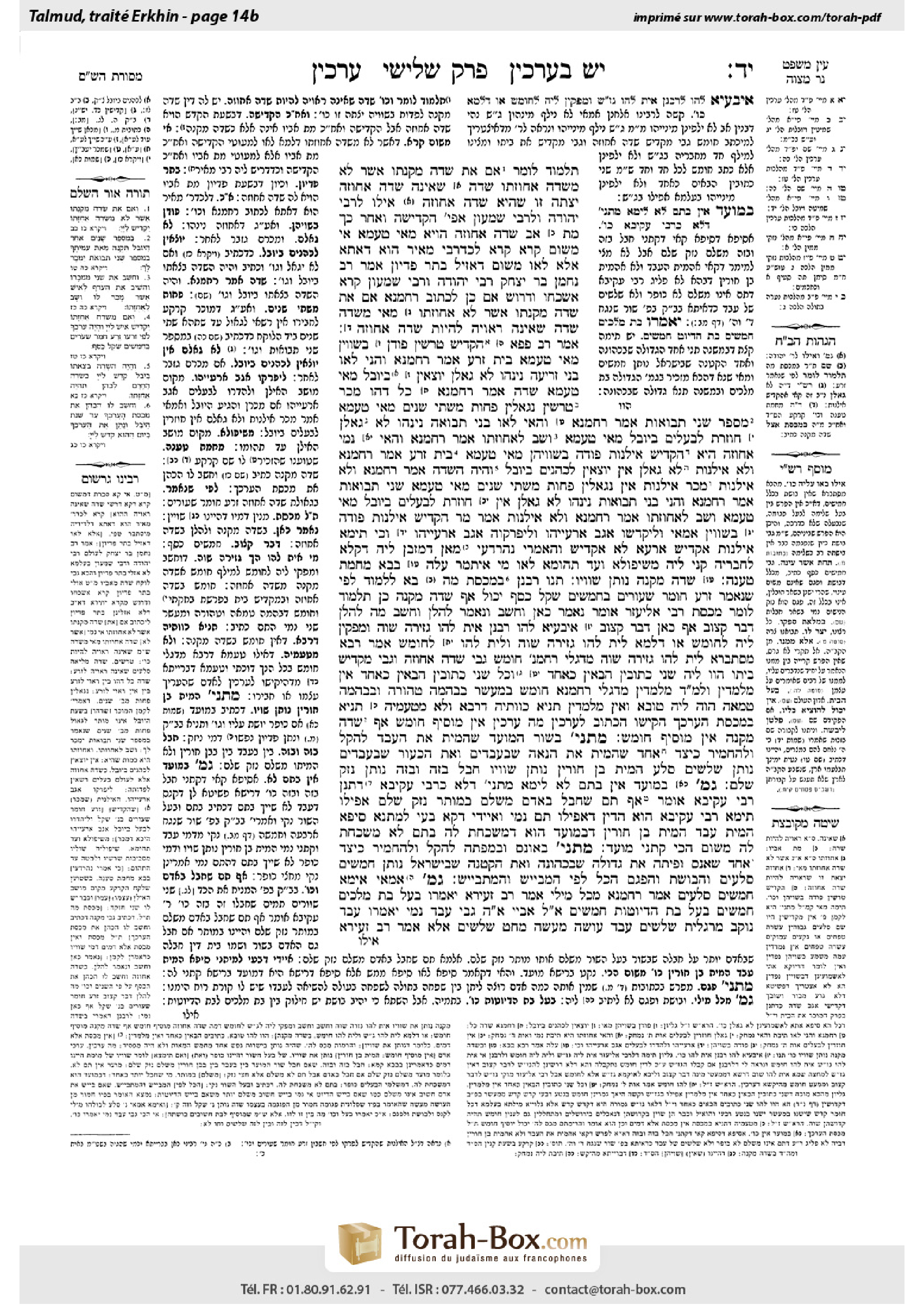
Arakhin 14b: Talmud study for Daf Yomi
Study the Talmud for Daf Yomi with scanned pages, Hebrew text, English translations from Sefaria and AI-generated French translations.
Passage selection and English or AI-generated French translation are available where the scan has annotations. Daf Study is independent of Torah-Box and Sefaria.
Browse Arakhin · ערכין · All tractatesArakhin 14b text and translations
This page of Arakhin includes the Aramaic text, an English translation and an AI-generated French translation, alongside the scan above.
ערכין י״ד ב · Aramaic and Hebrew text
תַּלְמוּד לוֹמַר: ״אִם אֶת שְׂדֵה מִקְנָתוֹ אֲשֶׁר לֹא מִשְּׂדֵה אֲחוּזָּתוֹ״ — שָׂדֶה שֶׁאֵינָהּ שְׂדֵה אֲחוּזָּה, יָצְתָה זוֹ שֶׁהִיא שְׂדֵה אֲחוּזָּה.
אִילּוּ לְרַבִּי יְהוּדָה וּלְרַבִּי שִׁמְעוֹן, אֲפִילּוּ הִקְדִּישָׁהּ וְאַחַר כָּךְ מֵת אָב — שְׂדֵה אֲחוּזָּה הָוְיָא. מַאי טַעְמָא? אִי מִשּׁוּם קְרָא — קְרָא לְכִדְרַבִּי מֵאִיר הוּא דַּאֲתָא!
אֶלָּא לָאו מִשּׁוּם דְּאָזֵיל בָּתַר פִּדְיוֹן?
אָמַר רַב נַחְמָן בַּר יִצְחָק: רַבִּי יְהוּדָה וְרַבִּי שִׁמְעוֹן קְרָא אַשְׁכַּחוּ וּדְרוּשׁ.
אִם כֵּן, לִכְתּוֹב רַחֲמָנָא: ״אִם אֶת שְׂדֵה מִקְנָתוֹ אֲשֶׁר לֹא אֲחֻזָּתוֹ״, מַאי ״מִשְּׂדֵה״ — שָׂדֶה שֶׁאֵינָהּ רְאוּיָה לִהְיוֹת שְׂדֵה אֲחוּזָּה.
אָמַר רַב פָּפָּא: הִקְדִּישׁ טְרָשִׁין — פּוֹדָן בְּשׇׁוְויָן, מַאי טַעְמָא? ״בֵּית זֶרַע״ אָמַר רַחֲמָנָא, וְהָנֵי לָאו בְּנֵי זְרִיעָה נִינְהוּ.
לֹא גְּאָלָן — יוֹצְאִין [לַכֹּהֲנִים] בַּיּוֹבֵל, מַאי טַעְמָא? ״שָׂדֶה״ אָמַר רַחֲמָנָא, כֹּל דְּהוּ.
מָכַר טְרָשִׁין — נִגְאָלִין פָּחוֹת מִשְׁתֵּי שָׁנִים, מַאי טַעְמָא? ״מִסְפַּר שְׁנֵי תְבוּאוֹת״ אָמַר רַחֲמָנָא, וְהַאי לָאו בְּנֵי תְבוּאָה נִינְהוּ. לֹא גְּאָלָן — (חוֹזֶרֶת) [חוֹזְרִין] לַבְּעָלִים בַּיּוֹבֵל, מַאי טַעְמָא? ״וְשָׁב לַאֲחוּזָּתוֹ״ אָמַר רַחֲמָנָא, וְהַאי נָמֵי אֲחוּזָּה הִיא.
הִקְדִּישׁ אִילָנוֹת — (פּוֹדֶה) [פּוֹדָן] בְּשׇׁוְויֵהֶן, מַאי טַעְמָא? ״בֵּית זֶרַע״ אָמַר רַחֲמָנָא, וְלֹא אִילָנוֹת. לֹא גְּאָלָן — אֵין יוֹצְאִין לַכֹּהֲנִים בַּיּוֹבֵל, ״וְהָיָה הַשָּׂדֶה״ אָמַר רַחֲמָנָא, וְלֹא אִילָנוֹת.
מָכַר אִילָנוֹת — אֵין נִגְאָלִין פָּחוֹת מִשְׁתֵּי שָׁנִים, מַאי טַעְמָא? ״שְׁנֵי תְבוּאוֹת״ אָמַר רַחֲמָנָא, וְהָנֵי בְּנֵי תְבוּאוֹת נִינְהוּ. לֹא גְּאָלָן — אֵין חוֹזֶרֶת לַבְּעָלִים בְּיוֹבֵל, מַאי טַעְמָא? ״וְשָׁב לַאֲחוּזָּתוֹ״ אָמַר רַחֲמָנָא, וְלֹא אִילָנוֹת.
אָמַר מָר: הִקְדִּישׁ אִילָנוֹת — (פּוֹדֶה) [פּוֹדָן] בְּשׇׁוְויָן. אַמַּאי? וְלִיקְדְּשׁוּ אַגַּב אַרְעַיְיהוּ, וְלִיפְרְקוּהָ אַגַּב אַרְעַיְיהוּ!
וְכִי תֵּימָא: אִילָנוֹת אַקְדֵּישׁ, אַרְעָא לָא אַקְדֵּישׁ — וְהָאָמְרִי נְהַרְדָּעֵי: מַאן דִּמְזַבֵּן לֵיהּ דִּקְלָא לְחַבְרֵיהּ, קָנֵי לֵיהּ מִשִּׁיפּוּלָא וְעַד תְּהוֹמָא! לָאו מִי אִיתְּמַר עֲלַהּ: בְּבָא מֵחֲמַת טַעֲנָה!
שְׂדֵה מִקְנָה נוֹתֵן שׇׁוְויוֹ. תָּנוּ רַבָּנַן: ״בְּמִכְסַת״ — מַה בָּא לִלְמוֹד? לְפִי שֶׁנֶּאֱמַר: ״זֶרַע חֹמֶר שְׂעוֹרִים בַּחֲמִשִּׁים שֶׁקֶל כָּסֶף״, יָכוֹל אַף שְׂדֵה מִקְנָה כֵּן? תַּלְמוּד לוֹמַר: ״מִכְסַת״.
רַבִּי אֱלִיעֶזֶר אוֹמֵר: נֶאֱמַר כָּאן ״וְחִשַּׁב״, וְנֶאֱמַר לְהַלָּן ״וְחִשַּׁב״, מָה לְהַלָּן דָּבָר קָצוּב, אַף כָּאן דָּבָר קָצוּב.
אִיבַּעְיָא לְהוּ: רַבָּנַן אִית לְהוּ גְּזֵירָה שָׁוָה, וּמַפְּקִין לֵיהּ לְחוֹמֶשׁ, אוֹ דִלְמָא לֵית לְהוּ גְּזֵירָה שָׁוָה, וְלֵית לְהוּ לְחוֹמֶשׁ?
אָמַר רָבָא: מִסְתַּבְּרָא לֵית לְהוּ גְּזֵירָה שָׁוָה, מִדְּגַלִּי רַחֲמָנָא חוֹמֶשׁ גַּבֵּי שְׂדֵה אֲחוּזָּה וְגַבֵּי מַקְדִּישׁ בֵּיתוֹ, הָווּ לֵיהּ שְׁנֵי כְּתוּבִין הַבָּאִין כְּאֶחָד, וְכׇל שְׁנֵי כְּתוּבִין הַבָּאִין כְּאֶחָד אֵין מְלַמְּדִין.
וּלְמַאן דְּאָמַר מְלַמְּדִין, מִדְּגַלִּי רַחֲמָנָא חוֹמֶשׁ בְּמַעֲשֵׂר, בִּבְהֵמָה טְהוֹרָה, וּבִבְהֵמָה טְמֵאָה — הָוֵה לֵיהּ טוּבָא, וְאֵין מְלַמְּדִין.
תַּנְיָא כְּוָותֵיהּ דְּרָבָא, וְלָא מִטַּעְמֵיהּ. תַּנְיָא: ״בְּמִכְסַת הָעֶרְכְּךָ״ — הִקִּישׁוֹ הַכָּתוּב לַעֲרָכִין, מָה עֲרָכִין אֵין מוֹסִיף חוֹמֶשׁ, אַף שְׂדֵה מִקְנָה אֵין מוֹסִיף חוֹמֶשׁ.
מַתְנִי׳ בְּשׁוֹר הַמּוּעָד שֶׁהֵמִית אֶת הָעֶבֶד לְהָקֵל וּלְהַחֲמִיר, כֵּיצַד? אֶחָד שֶׁהֵמִית אֶת הַנָּאֶה שֶׁבַּעֲבָדִים וְאֶת הַכָּעוּר שֶׁבָּעֲבָדִים — נוֹתֵן שְׁלֹשִׁים סֶלַע. הֵמִית בֶּן חוֹרִין — נוֹתֵן שׇׁוְויוֹ. חָבַל בָּזֶה וּבָזֶה — נוֹתֵן נֶזֶק שָׁלֵם.
גְּמָ׳ בְּמוּעָד — אִין, בְּתָם — לָא. לֵימָא מַתְנִיתִין דְּלָא כְּרַבִּי עֲקִיבָא, דִּתְנַן: רַבִּי עֲקִיבָא אוֹמֵר: אַף תָּם שֶׁחָבַל בָּאָדָם מְשַׁלֵּם בַּמּוֹתָר נֶזֶק שָׁלֵם.
אֲפִילּוּ תֵּימָא רַבִּי עֲקִיבָא, הוּא הַדִּין דַּאֲפִילּוּ תָּם נָמֵי, וְאַיְּידֵי דְּקָא בָּעֵי לְמִתְנֵי סֵיפָא ״הֵמִית עֶבֶד״ ״הֵמִית בֶּן חוֹרִין״, דִּבְמוּעָד הוּא דְּמַשְׁכַּחַתְּ לַהּ, בְּתָם לָא מַשְׁכַּחַתְּ לַהּ, מִשּׁוּם הָכִי קָתָנֵי מוּעָד.
מַתְנִי׳ בָּאוֹנֵס וּבַמְפַתֶּה לְהָקֵל וּלְהַחֲמִיר, כֵּיצַד? אֶחָד שֶׁאָנַס וּפִיתָּה אֶת גְּדוֹלָה שֶׁבַּכְּהוּנָּה וְאֶת הַקְּטַנָּה שֶׁבְּיִשְׂרָאֵל — נוֹתֵן חֲמִשִּׁים סְלָעִים, וְהַבּוֹשֶׁת וְהַפְּגָם — הַכֹּל לְפִי הַמְבַיֵּישׁ וְהַמִּתְבַּיֵּישׁ.
גְּמָ׳ אַמַּאי? אֵימָא: ״חֲמִשִּׁים סְלָעִים״ אָמַר רַחֲמָנָא מִכֹּל מִילֵּי!
אָמַר רַב זְעֵירָא: יֹאמְרוּ, בָּעַל בַּת מְלָכִים חֲמִשִּׁים, בָּעַל בַּת הֶדְיוֹטוֹת חֲמִשִּׁים?
אֲמַר לֵיהּ אַבָּיֵי: אִי הָכִי, גַּבֵּי עֶבֶד נָמֵי, יֹאמְרוּ: עֶבֶד נוֹקֵב מַרְגָּלִית — שְׁלֹשִׁים, עֶבֶד עוֹשֶׂה מַעֲשֵׂה מַחַט — שְׁלֹשִׁים? אֶלָּא אָמַר רַב זְעֵירָא:
Arakhin 14b · English translation
The verse states with regard to a purchased field: “And if he sanctifies to the Lord a field that he has bought, which is not of his ancestral field” (Leviticus 27:22). The verse is referring specifically to a field that is not an ancestral field at the time of its consecration. This requirement excludes this field, as currently, after the death of the father, it is an ancestral field.
The Gemara analyzes the baraita. That is the opinion of Rabbi Meir, whereas according to Rabbi Yehuda and according to Rabbi Shimon it is considered an ancestral field even if he consecrated the field and afterward his father dies. What is the reason for this opinion? If you suggest it is due to the verse, that cannot be, as the verse comes to teach the halakha that was stated in accordance with the opinion of Rabbi Meir, i.e., it is referring to a case where the father died before he consecrated the field, as Rabbi Meir explained.
Rather, is it not due to the fact that he follows the status of the field at the time of the redemption? Since the father died before the son redeemed the field it is considered an ancestral field in the possession of the Temple treasury. Similarly, if one first consecrates the trees and afterward the field, he should redeem them both together, since at the time of the redemption they are both consecrated. Since this ruling is not in accordance with the baraita that states that the trees and field are redeemed separately, evidently the baraita cannot be in accordance with the opinion of Rabbi Shimon.
Rav Naḥman bar Yitzḥak said that this source does not contradict Rav Huna’s claim that the baraita is in accordance with the opinion of Rabbi Shimon. The reason is that Rabbi Yehuda and Rabbi Shimon do not, in fact, maintain that one follows the status of the field at the time of the redemption. Rather, they found a verse and expounded it.
Rav Naḥman bar Yitzḥak explains Rabbi Yehuda and Rabbi Shimon’s reasoning: If so, that when one consecrated the field and his father died afterward, it is not considered an ancestral field, let the Merciful One write in the Torah: And if he sanctifies to the Lord a field that he has bought, which is not his ancestral, i.e., the verse could have omitted the repetition of the phrase “of his field.” What does the Torah mean by stressing “of his field”? This teaches that only a field that is not fit to be an ancestral field at the time he consecrated it is redeemed for its value. But if he consecrated a field that he would inherit in the future, it is redeemed in the manner of an ancestral field.
§ Rav Pappa says: If one consecrated fields that are rocky [terashin] and unsuitable for planting, he redeems them by their value, not as ancestral fields. The Gemara asks: What is the reason? The Merciful One states that one redeems an area fit for sowing of a ḥomer of barley seed for fifty silver shekels (see Leviticus 27:16), and these fields are not fit for sowing.
But if he did not redeem these fields before the Jubilee Year, they go to the priests in the Jubilee Year, like ancestral fields. What is the reason? The Merciful One states: “And if he will not redeem the field, or if he has sold the field to another man, it shall not be redeemed anymore. But the field, when it goes out in the Jubilee, shall be holy to the Lord, as a field devoted; it shall belong to the priest” (Leviticus 27:20–21). This indicates that any kind of ancestral field at all, regardless of quality, goes to the priests if it is not redeemed by the Jubilee Year.
Furthermore, Rav Pappa says: If one sold fields that are rocky and unsuitable for planting, they may be redeemed from the purchaser in even less than two years, despite the fact that normally land must be left in the hands of the purchaser for at least two years (see 29b), as derived from the plural term “years of the crops” cited below. What is the reason? The Merciful One states: “According to the number of years after the Jubilee you shall buy from your neighbor, and according to the number of years of the crops he shall sell it to you” (Leviticus 25:15), and these rocky fields are not fit for crops. But if he did not redeem them from the purchaser, they return to the owner in the Jubilee Year, like ancestral fields. What is the reason? The Merciful One states: “Then let him count the years of its sale, and restore the extra to the man to whom he sold it; and it shall return to its ancestral heritage” (Leviticus 25:27), and this rocky field is also part of his ancestral heritage.
Rav Pappa further says: If one consecrated trees in his ancestral field, he redeems them according to their value. What is the reason? The Merciful One states that one redeems an area fit for sowing of a ḥomer of barley seed for fifty silver shekels. This is referring specifically to land fit for sowing grain, and not trees. Furthermore, if he did not redeem the trees, they do not go to the priests in the Jubilee Year, unlike an ancestral field. The reason is that the Merciful One states: “But the field, when it goes out in the Jubilee, shall be holy to the Lord, as a field devoted; it shall belong to the priest” (Leviticus 27:21). This too is referring specifically to a field, and not trees.
Rav Pappa also says: If one sold trees of his ancestral field, they may not be redeemed from the purchaser if less than two years passed. What is the reason? The Merciful One states: “According to the number of years after the Jubilee you shall buy it from your neighbor, and according to the number of years of the crops he shall sell it to you” (Leviticus 25:15), and these trees are fit for crops, as they produce fruit. But if he did not redeem them from the purchaser, the trees do not return to the owner in the Jubilee Year. What is the reason? The Merciful One states: “Then let him count the years of its sale, and restore the extra to the man to whom he sold it; and it shall return to its ancestral heritage” (Leviticus 25:27). This includes only land, which remains forever, and not trees, which have a limited lifespan.
The Gemara asks: The Master, i.e., Rav Pappa, says that if one consecrated trees in his ancestral field he redeems them according to their value. The Gemara asks: Why is that so? But let them be consecrated on account of their land and let them be redeemed on account of their land, according to the valuation of fifty silver shekels for each area required for sowing a kor of barley seed.
And if you would say that he consecrated the trees and did not consecrate land, but didn’t the Sages of Neharde’a say: If one sells a date palm to another, the purchaser acquires it from the bottom of the palm until the depths of the earth, i.e., including its land. The Gemara answers: Wasn’t it stated with regard to this ruling that it is referring only to a case where the purchaser comes due to a specific claim that he purchased the land under the date palm. But if he does not claim to have explicitly purchased the land, the seller or the one who consecrates does not intend to include land with the date palm.
§ The mishna teaches: And with regard to a purchased field that one consecrates, he gives its value as redemption, a sum that can be more or less than fifty silver shekels for an area required for the sowing of a kor of barley seed. The Sages taught in a baraita: The verse states: “Then the priest shall reckon for him the worth of your valuation until the Jubilee Year; and he shall give your valuation in that day, as a holy thing to the Lord” (Leviticus 27:23). What does this word “worth” come to teach? Since it is stated with regard to an ancestral field: “An area fit for the sowing of a ḥomer of barley seed is redeemed for fifty silver shekels” (Leviticus 27:16), one might have thought that a purchased field is also redeemed using this formula. Therefore, the verse states “worth,” which means the market value of the field.
Rabbi Eliezer says: It is stated here, with regard to purchased fields: “Then the priest shall reckon for him the worth of your valuation until the Jubilee Year; and he shall give your valuation in that day, as a holy thing to the Lord” (Leviticus 27:23). And it is stated there, with regard to an ancestral field: “But if he sanctifies his field after the Jubilee, then the priest shall reckon for him the money according to the years that remain until the Jubilee Year, and it shall be deducted from your valuation” (Leviticus 27:18). Just as there, in the case of an ancestral field, it is referring to a fixed amount, so too here, with regard to a purchased field, it means a fixed amount.
A dilemma was raised before the students: Do the Rabbis, who disagree with Rabbi Eliezer, accept that one derives the verbal analogy of “shall reckon,” but they use it to derive that one who redeems a consecrated purchased field must also add one-fifth? Or perhaps they do not accept the verbal analogy at all, and they do not hold that one who redeems a purchased field must add one-fifth?
Rava said: It is reasonable to assume that the Rabbis do not accept the verbal analogy. The reasoning is as follows: From the fact that the Merciful One revealed in the Torah that one must add one-fifth in the case of one who redeems an ancestral field and in the case of one who consecrates his house, these are two verses that come as one, i.e., to teach the same matter. And any two verses that come as one do not teach their common aspect, in this case, adding one-fifth, to apply to other cases. Therefore, it can be assumed that the Rabbis maintain that one who redeems his purchased field does not have to pay an additional fifth.
Rava continues: And even according to the one who says that two verses that come as one do teach their common aspect, from the fact that the Merciful One revealed in the Torah that one must add one-fifth when he redeems his second tithe, and when he redeems his kosher animal that he consecrated and became blemished, and when he redeems his non-kosher animal that he consecrated, these are many verses that come at one, and everyone agrees that multiple verses do not teach their common aspect to other cases.
It is taught in a baraita in accordance with the ruling of Rava, but not for his reason. It is taught in a baraita: “Then the priest shall reckon for him the worth of your valuation until the Jubilee Year; and he shall give your valuation in that day, as a holy thing to the Lord” (Leviticus 27:23). The verse juxtaposes this estimation to fixed valuations. Just as with regard to fixed valuations one does not add one-fifth, so too when redeeming a purchased field one does not add one-fifth.
MISHNA: There are halakhot with regard to a forewarned ox that killed a Canaanite slave that are lenient and others that are stringent; how so? Both in the case of an ox that killed the most attractive among the slaves, whose value is great, and likewise in the case of one that killed the most unsightly among the slaves, whose value is minimal, its owner gives payment of thirty sela, the fine stated in the Torah (Exodus 21:32), to the owner of the slave. If the ox killed a freeman, its owner gives his price as payment to his heirs. This sum can be more or less than thirty shekels. If the ox injured this slave or that freeman, he gives payment of the full cost of the damage as compensation.
GEMARA: As the mishna first specifies that it is speaking of a forewarned ox, this indicates that with regard to a forewarned ox that injured a freeman, yes, one is liable for full payment, but with regard to an innocuous ox that injured a freeman one does not make full restitution, but pays only half the value of the victim. The Gemara asks: Let us say that the mishna is not in accordance with the opinion of Rabbi Akiva. As we learned in a mishna (Bava Kamma 33a) that Rabbi Akiva says: The owner of an innocuous ox that injured a person also pays the full cost of the damage with regard to the difference between the damage the person inflicted on the ox and the damage the ox inflicted on the person. Evidently, Rabbi Akiva does not distinguish between an innocuous and a forewarned ox in a case where an ox injured a person.
The Gemara answers: You may even say that the mishna is in accordance with the opinion of Rabbi Akiva, and explain it as follows: The same is true that even the owner of an innocuous ox must make full restitution, but since the tanna wants to teach in the first part of the latter clause of the mishna: An ox that killed a slave and an ox that killed a freeman, which you find in the case of forewarned ox but in the case of an innocuous ox you do not find it, as the penalty for killing a person does not apply to an innocuous ox, it is for this reason that the mishna teaches only the case of a forewarned ox.
MISHNA: There are halakhot with regard to a rapist and with regard to a seducer that are lenient and others that are stringent; how so? Both one who raped or seduced a young woman who is the most prominent in the priesthood and one who raped or seduced a young woman who is the lowliest among the Israelites gives the payment of fifty sela, the fine stated in the Torah (see Deuteronomy 22:29). And the payments for humiliation and for degradation resulting from being raped or seduced are assessed differentially; it is all based on the one who humiliates and the one who is humiliated.
GEMARA: The Gemara asks: Why must the rapist or seducer also pay for her humiliation and degradation? One can say that the Merciful One states in the verse: “Then the man that lay with her shall give to the young woman’s father fifty shekels of silver” (Deuteronomy 22:29), that he is to pay a total of fifty sela for all matters associated with this act, i.e., the fine, degradation, humiliation, and pain.
Rav Zeira says: It cannot be that he pays a total of only fifty sela, as people will say: Does it make sense that one who engaged in forced intercourse with, i.e., raped, a daughter of kings pays a sum of fifty sela, when she suffers great humiliation, and one who engaged in forced intercourse with the daughter of ordinary people [hedyotot] also pays fifty sela?
Abaye said to Rav Zeira: If so, the same claim can be applied with regard to a slave killed by an ox. People will also say: Does it make sense that a slave who pierces pearls [margalit] is worth thirty sela, and a slave who performs needlecraft is also worth thirty sela? Nevertheless, the mishna clearly indicates that there is no distinction between the two slaves, as the Torah states a fixed payment. Rather, Rav Zeira says that there is a different proof:
Arakhin 14b · Traduction française (IA)
La parabole mentionne un champ acheté : « Et s'il sanctifie à l'Éternel un champ qu'il a acheté, qui n'est pas un champ de sa famille » (Lévitique 27,22). La parabole fait référence spécifiquement à un champ qui n'est pas un champ familial au moment de sa consécration. Cette exigence exclut ce champ, car actuellement, après la mort du père, il est considéré comme un champ familial.
Le Guemara analyse la baraïta. C'est l'opinion de Rabbi Meïr, tandis que selon Rabbi Yéhouda et selon Rabbi Shimon, le champ est considéré comme un champ familial même s'il a été consacré et que le père est mort après. Quelle est la raison de cette opinion ? Si l'on suggère qu'elle provient de la parabole, cela ne peut pas être, car la parabole vient enseigner la halakha telle que formulée selon l'opinion de Rabbi Meïr, c'est-à-dire qu'elle fait référence à un cas où le père est mort avant la consécration du champ, comme expliqué par Rabbi Meïr.
Plutôt, n'est-ce pas en raison du fait qu'il suit le statut du champ au moment de la restitution ? Puisque le père est mort avant que le fils ne restitue le champ, il est considéré comme un champ familial au sein des fonds du Temple. De même, si l'on consacre d'abord les arbres et ensuite le champ, il faut les restituer ensemble, car au moment de la restitution ils sont tous deux consacrés. Puisque cette décision ne correspond pas à la baraïta qui stipule que les arbres et le champ sont restitués séparément, il est évident que la baraïta ne peut pas correspondre à l'opinion de Rabbi Shimon.
Rav Naḥman bar Yitzḥak dit que cette source ne contredit pas la déclaration de Rav Huna selon laquelle la baraïta correspond à l'opinion de Rabbi Shimon. La raison est que Rabbi Yéhouda et Rabbi Shimon ne maintiennent pas, en fait, que l'on suit le statut du champ au moment de la restitution. Ils ont plutôt trouvé un verset et l'ont interprété.
Rav Naḥman bar Yitzḥak explique la raisonnement de Rabbi Yéhouda et Rabbi Shimon : Si tel est le cas, c'est-à-dire que lorsqu'on a consacré le champ et que son père est mort après, il n'est pas considéré comme un champ familial, laissez le Très Miséricordieux écrire dans la Torah : « Et s'il sanctifie à l'Éternel un champ qu'il a acheté, qui n'est pas son champ familial », c'est-à-dire que le verset aurait pu omettre la répétition de la phrase « de son champ ». Que signifie la Torah en insistant sur « de son champ » ? Cela enseigne que seul un champ qui n'est pas adapté à être un champ familial au moment de sa consécration est restitué selon sa valeur. Mais si l'on a consacré un champ qu'on héritera plus tard, il est restitué comme un champ familial.
§ Rav Pappa dit : Si l'on a consacré des champs rocheux et inadaptés à la culture, on les restitue selon leur valeur, pas comme des champs familiaux. Le Guemara pose la question : Quelle est la raison ? Le Très Miséricordieux dit que l'on restitue une surface adaptée à la culture d'un ḥomer de grain de blé pour cinquante sicles d'argent (cf Lévitique 27:16), et ces champs ne sont pas adaptés à la culture.
Mais si l'on n'a pas racheté ces champs avant l'année sainte, ils reviennent aux prêtres en année sainte, comme des champs familiaux. Quelle est la raison ? Le Très Miséricordieux dit : « Et s'il ne rachète pas le champ, ou s'il a vendu le champ à un autre homme, il ne sera plus racheté. Mais le champ, lorsqu'il sort en année sainte, sera saint à l'Éternel, comme un champ consacré ; il appartiendra au prêtre » (Lévitique 27,20-21). Cela indique que tout genre de champ familial, indépendamment de sa qualité, revient aux prêtres si l'on ne le rachète pas avant l'année sainte.
De plus, Rav Pappa dit : Si l'on a vendu des champs rocheux et inadaptés à la culture, ils peuvent être rachetés par l'acheteur même en moins de deux ans, malgré le fait que normalement la terre doit rester entre les mains de l'acheteur pendant au moins deux ans (cf 29b), comme dérivé du terme pluriel « années des récoltes » mentionné ci-dessous. Quelle est la raison ? Le Très Miséricordieux dit : « Selon le nombre d'années après l'année sainte tu achèteras de ton voisin, et selon le nombre d'années des récoltes tu le lui vendras » (Lévitique 25,15), et ces champs rocheux ne sont pas adaptés aux récoltes. Mais si l'on n'a pas racheté ces champs à l'acheteur, ils reviennent à l'propriétaire en année sainte, comme des champs familiaux. Quelle est la raison ? Le Très Miséricordieux dit : « Puis compte le nombre d'années de la vente, et restaure l'excédent à l'homme à qui tu as vendu ; et il reviendra à son héritage familial » (Lévitique 25,27), et ce champ rocheux est aussi partie de son héritage familial.
Rav Pappa ajoute : Si l'on a consacré des arbres dans son champ familial, on les restitue selon leur valeur. Quelle est la raison ? Le Très Miséricordieux dit que l'on restitue une surface adaptée à la culture d'un ḥomer de grain de blé pour cinquante sicles d'argent. Cela fait référence spécifiquement à un terrain adapté à la culture du grain, pas aux arbres. De plus, si l'on n'a pas restitué ces arbres, ils ne reviennent pas aux prêtres en année sainte, contrairement à un champ familial. La raison est que le Très Miséricordieux dit : « Mais le champ, lorsqu'il sort en année sainte, sera saint à l'Éternel, comme un champ consacré ; il appartiendra au prêtre » (Lévitique 27,21). Cela fait également référence spécifiquement à un champ, pas aux arbres.
Rav Pappa dit aussi : Si l'on a vendu des arbres de son champ familial, ils ne peuvent pas être restitués à l'acheteur si moins de deux ans se sont écoulés. Quelle est la raison ? Le Très Miséricordieux dit : « Selon le nombre d'années après l'année sainte tu achèteras de ton voisin, et selon le nombre d'années des récoltes tu le lui vendras » (Lévitique 25,15), et ces arbres sont adaptés aux récoltes, car ils produisent des fruits. Mais si l'on n'a pas restitué ces arbres à l'acheteur, les arbres ne reviennent pas à l'propriétaire en année sainte. Quelle est la raison ? Le Très Miséricordieux dit : « Puis compte le nombre d'années de la vente, et restaure l'excédent à l'homme à qui tu as vendu ; et il reviendra à son héritage familial » (Lévitique 25,27). Cela inclut uniquement la terre, qui reste éternellement, et non les arbres, dont la durée de vie est limitée.
La Guemara pose la question : Le Maître, c'est-à-dire Rav Pappa, dit que si l'on consacre des arbres dans son champ ancestral, on les rachète selon leur valeur. La Guemara pose la question : Pourquoi est-ce ainsi ? Mais qu'ils soient consacrés en raison de leur terre et qu'ils soient rachetés en raison de leur terre, selon la valeur de cinquante sicles d'argent pour chaque surface nécessaire pour semer un kor de grain de blé.
Et si l'on disait que l'on a consacré les arbres et non la terre, mais n'a-t-on pas dit les Sages de Neharde’a : Si l'on vend un palmier à un autre, l'acheteur acquiert celui-ci du bas du palmier jusqu'aux profondeurs de la terre, c'est-à-dire en incluant sa terre. La Guemara répond : N'était-ce pas dit à propos de cette décision qu'il s'agit d'un cas où l'acheteur a une revendication spécifique qu'il a acheté la terre sous le palmier ? Mais si l'on ne fait pas cette revendication, le vendeur ou celui qui consacre ne veut pas inclure la terre avec le palmier.
§ La mitsva enseigne : Et concernant un champ acheté que l'on consacre, on lui donne sa valeur comme rachat, une somme qui peut être plus ou moins que cinquante sicles d'argent pour une surface nécessaire pour semer un kor de grain de blé. Les Sages ont enseigné dans une baraïta : Le verset dit : « Alors le prêtre calculera pour lui la valeur de votre estimation jusqu'à l'année du Jubilé ; et il donnera votre estimation ce jour-là, comme chose sainte à l'Éternel » (Lévitique 27:23). Quel est le sens de ce mot « valeur » ? Puisque cela est dit concernant un champ ancestral : « Une surface adaptée pour semer un ḥomer de grain de blé est rachetée pour cinquante sicles d'argent » (Lévitique 27:16), on aurait pu penser qu'un champ acheté est aussi racheté selon cette formule. Ainsi, le verset dit « valeur », ce qui signifie la valeur marchande du champ.
Rabbi Eliezer dit : Il est dit ici, concernant les champs achetés : « Alors le prêtre calculera pour lui la valeur de votre estimation jusqu'à l'année du Jubilé ; et il donnera votre estimation ce jour-là, comme chose sainte à l'Éternel » (Lévitique 27:23). Et il est dit là, concernant un champ ancestral : « Mais s'il sanctifie son champ après le Jubilé, alors le prêtre calculera pour lui l'argent selon les années restantes jusqu'au Jubilé, et cela sera déduit de votre estimation » (Lévitique 27:18). Tout comme là, dans le cas d'un champ ancestral, il s'agit d'une somme fixe, ainsi ici, concernant un champ acheté, cela signifie une somme fixe.
Un dilemme a été soulevé devant les étudiants : Les Rabbins, qui s'opposent à Rabbi Eliezer, acceptent-ils que l'analogie verbale de « il calculera » soit utilisée, mais qu'ils l'utilisent pour déduire que celui qui rachète un champ consacré acheté doit aussi ajouter un cinquième ? Ou peut-être ne l'acceptent-ils pas du tout, et ne considèrent-ils pas que celui qui rachète un champ acheté doit ajouter un cinquième ?
Rava dit : Il est raisonnable d'assumer que les Rabbins ne acceptent pas l'analogie verbale. La raison est la suivante : Du fait que l'Éternel Miséricordieux a révélé dans la Torah que l'on doit ajouter un cinquième dans le cas de celui qui rachète un champ ancestral et dans le cas de celui qui consacre sa maison, ces deux versets qui viennent ensemble, c'est-à-dire pour enseigner la même chose. Et tout deux versets qui viennent ensemble ne transmettent pas leur aspect commun, dans ce cas, l'ajout d'un cinquième, à d'autres cas. Ainsi, on peut supposer que les Rabbins maintiennent que celui qui rachète son champ acheté ne doit pas payer un cinquième supplémentaire.
Rava continue : Et même selon celui qui dit que deux versets qui viennent ensemble transmettent leur aspect commun, du fait que l'Éternel Miséricordieux a révélé dans la Torah que l'on doit ajouter un cinquième lorsqu'on rachète sa deuxième tithe, et lorsqu'on rachète son animal kasher qui a été consacré et est devenu déficient, et lorsqu'on rachète son animal non-kasher qui a été consacré, ces versets sont nombreux et viennent ensemble, et tout le monde convient que plusieurs versets ne transmettent pas leur aspect commun à d'autres cas.
Il est enseigné dans une baraïta conformément à la décision de Rava, mais pas pour sa raison. Il est enseigné dans une baraïta : « Alors le prêtre calculera pour lui la valeur de votre estimation jusqu'à l'année du Jubilé ; et il donnera votre estimation ce jour-là, comme chose sainte à l'Éternel » (Lévitique 27:23). Le verset juxtapose cette estimation aux valeurs fixes. Tout comme concernant les valeurs fixes on ne rajoute pas un cinquième, ainsi lors du rachat d'un champ acheté on ne rajoute pas un cinquième.
MICHNA : Il y a des halakhot concernant un bœuf averti qui a tué un esclave cananéen qui sont lenis et d'autres qui sont strictes ; comment cela est-il ? À la fois dans le cas d'un bœuf qui a tué le plus attrayant des esclaves, dont la valeur est grande, et de même dans le cas d'un bœuf qui a tué le moins attrayant des esclaves, dont la valeur est minimale, son propriétaire paie trente sela, la peine mentionnée dans la Torah (Exode 21:32), à l'propriétaire de l'esclave. Si le bœuf a tué un homme libre, son propriétaire paie le prix de l'homme comme réparation à ses héritiers. Cette somme peut être plus ou moins que trente sicles. Si le bœuf a blessé cet esclave ou cet homme libre, il paie la totalité du coût des dommages comme réparation.
GUÉMARA : Comme la mitsna précise d'abord qu'il s'agit d'un bœuf averti, cela indique que concernant un bœuf averti qui a blessé un homme libre, oui, l'on est tenu de payer la totalité, mais concernant un bœuf inoffensif qui a blessé un homme libre, l'on ne fait pas de réparation totale, mais on paie seulement la moitié de la valeur de la victime. La Guemara pose la question : Disons que la mitsna ne suit pas l'opinion de Rabbi Akiva. Comme nous avons appris dans une mitsna (Bava Kamma 33a) que Rabbi Akiva dit : Le propriétaire d'un bœuf inoffensif qui a blessé une personne paie aussi le coût total des dommages concernant la différence entre le dommage que la personne a infligé au bœuf et le dommage que le bœuf a infligé à la personne. Évidemment, Rabbi Akiva ne distingue pas entre un bœuf inoffensif et un bœuf averti dans un cas où un bœuf a blessé une personne.
La Guemara répond : On peut même dire que la mitsva est selon l'opinion de Rabbi Akiva, et l'expliquer ainsi : C'est pareil pour celui qui possède un bœuf inoffensif, il doit faire une réparation complète, mais puisque le tanna veut enseigner dans la première partie de la deuxième clause de la mitsva : Un bœuf qui a tué un esclave et un bœuf qui a tué un homme libre, que l'on trouve dans le cas du bœuf averti, mais dans le cas du bœuf inoffensif on ne le trouve pas, car la peine pour avoir tué une personne ne s'applique pas à un bœuf inoffensif, c'est pour cela que la mitsva enseigne seulement le cas du bœuf averti.
MITSVA : Il y a des halakhot concernant un violeur et un séducteur qui sont favorables et d'autres qui sont strictes ; comment cela se passe-t-il ? Celui qui viole ou séduit une jeune fille qui est la plus illustre du clergé et celui qui viole ou séduit une jeune fille qui est la plus basse parmi les Israélites paie cinquante sela, la peine indiquée dans la Torah (cf. Deutéronome 22:29). Et les paiements pour l'humiliation et la dégradation résultant d'un viol ou d'une séduction sont évalués différemment ; tout est basé sur celui qui humilie et celui qui est humilié.
GUEMARA : La Guemara demande : Pourquoi le violeur ou le séducteur paie-t-il aussi pour son humiliation et sa dégradation ? On peut dire que l'Éternel dit dans la parole : « Alors l'homme qui a couché avec elle donnera à la mère de la jeune fille cinquante sicles d'argent » (Deutéronome 22:29), qu'il paie un total de cinquante sela pour toutes les choses liées à cet acte, c'est-à-dire la peine, la dégradation, l'humiliation et la douleur.
Rav Zéira dit : On ne peut pas dire qu'il paie un total de seulement cinquante sela, car les gens diront : A-t-on du sens à ce qu'un homme qui a violé une fille royale paie une somme de cinquante sela, alors qu'elle souffre d'une grande humiliation, et un homme qui a violé la fille d'hommes ordinaires [hedyotot] paie aussi cinquante sela ?
Abaye dit à Rav Zéira : Si c'est ainsi, la même critique peut s'appliquer au cas d'un esclave tué par un bœuf. Les gens diront aussi : A-t-on du sens à ce qu'un esclave qui pique des perles [margalit] vaut trente sela, et un esclave qui fait des travaux de couture vaut aussi trente sela ? Cependant, la mitsva indique clairement qu'il n'y a pas de distinction entre les deux esclaves, car la Torah fixe un paiement déterminé. Plutôt, Rav Zéira dit qu'il y a une preuve différente :
Traduction française générée par IA à partir de l’édition anglaise de Sefaria. Vérifie toujours un passage avec le texte source.
Text from Sefaria: William Davidson Edition - Vocalized Aramaic (CC BY NC); William Davidson Edition - English (CC BY NC).