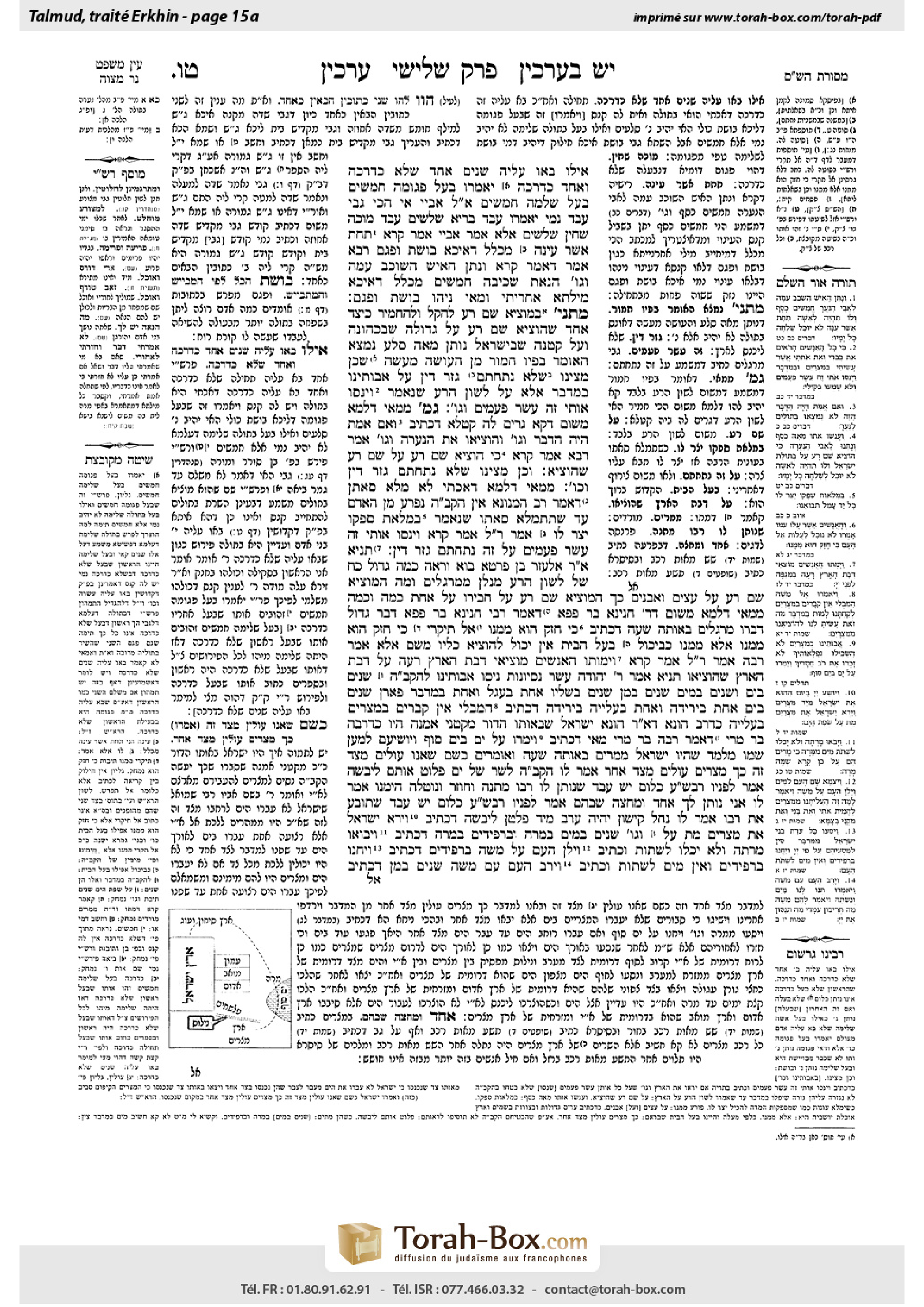
Arakhin 15a: Talmud study for Daf Yomi
Study the Talmud for Daf Yomi with scanned pages, Hebrew text, English translations from Sefaria and AI-generated French translations.
Passage selection and English or AI-generated French translation are available where the scan has annotations. Daf Study is independent of Torah-Box and Sefaria.
Browse Arakhin · ערכין · All tractatesArakhin 15a text and translations
This page of Arakhin includes the Aramaic text, an English translation and an AI-generated French translation, alongside the scan above.
ערכין י״ה א · Aramaic and Hebrew text
אִילּוּ בָּאוּ עָלֶיהָ שְׁנַיִם, אֶחָד שֶׁלֹּא כְּדַרְכָּהּ וְאֶחָד כְּדַרְכָּהּ, יֹאמְרוּ: בָּעַל פְּגוּמָה — חֲמִשִּׁים, בָּעַל שְׁלֵמָה — חֲמִשִּׁים?
אֲמַר לֵיהּ אַבָּיֵי: אִי הָכִי, גַּבֵּי עֶבֶד נָמֵי יֹאמְרוּ: עֶבֶד בָּרִיא — שְׁלֹשִׁים, עֶבֶד מוּכֵּה שְׁחִין — שְׁלֹשִׁים!
אֶלָּא אָמַר אַבָּיֵי, אָמַר קְרָא ״תַּחַת אֲשֶׁר עִנָּהּ״, מִכְּלָל דְּאִיכָּא בּוֹשֶׁת וּפְגָם.
רָבָא אָמַר, דְּאָמַר קְרָא: ״וְנָתַן הָאִישׁ הַשֹּׁכֵב עִמָּהּ וְגוֹ׳״, הֲנָאַת שְׁכִיבָה חֲמִשִּׁים, מִכְּלָל דְּאִיכָּא מִילְּתָא אַחֲרִיתִי, וּמַאי נִיהוּ? בּוֹשֶׁת וּפְגָם.
מַתְנִי׳ בְּמוֹצִיא שֵׁם רַע לְהָקֵל וּלְהַחֲמִיר, כֵּיצַד? אֶחָד שֶׁהוֹצִיא שֵׁם רַע עַל גְּדוֹלָה שֶׁבַּכְּהוּנָּה וְעַל קְטַנָּה שֶׁבְּיִשְׂרָאֵל — נוֹתֵן מֵאָה סֶלַע.
נִמְצָא הָאוֹמֵר בְּפִיו חָמוּר מִן הָעוֹשֶׂה מַעֲשֶׂה, שֶׁכֵּן מָצִינוּ שֶׁלֹּא נִתְחַתֵּם גְּזַר דִּין עַל אֲבוֹתֵינוּ בַּמִּדְבָּר אֶלָּא עַל לָשׁוֹן הָרָע, שֶׁנֶּאֱמַר ״וַיְנַסּוּ אוֹתִי זֶה עֶשֶׂר פְּעָמִים וְגוֹ׳״.
גְּמָ׳ מִמַּאי? דִּלְמָא מִשּׁוּם דְּקָא גָרֵים לַהּ קְטָלָא, דִּכְתִיב: ״וְאִם אֱמֶת הָיָה הַדָּבָר וְגוֹ׳ וְהוֹצִיאוּ אֶת הַנַּעֲרָה וְגוֹ׳״!
אָמַר רָבָא, אָמַר קְרָא: ״כִּי הוֹצִיא שֵׁם רָע״, עַל שֵׁם רַע שֶׁהוֹצִיא.
וְכֵן מָצִינוּ שֶׁלֹּא נִתְחַתֵּם גְּזַר דִּין וְכוּ׳. מִמַּאי דִּלְמָא דְּאַכַּתִּי לָא מְלָא סְאָתָן, דְּאָמַר רַב הַמְנוּנָא: אֵין הַקָּדוֹשׁ בָּרוּךְ הוּא נִפְרָע מִן הָאָדָם עַד שֶׁתִּתְמַלֵּא סְאָתוֹ, שֶׁנֶּאֱמַר: ״בִּמְלֹאת סִפְקוֹ יֵצֶר לוֹ״.
אָמַר רֵישׁ לָקִישׁ, אָמַר קְרָא: ״וַיְנַסּוּ אוֹתִי זֶה עֶשֶׂר פְּעָמִים״, עַל זֶה נִתְחַתֵּם גְּזַר דִּין.
תַּנְיָא, אָמַר רַבִּי אֶלְעָזָר בֶּן פַּרְטָא: בּוֹא וּרְאֵה כַּמָּה גָּדוֹל כֹּחַ שֶׁל לָשׁוֹן הָרָע, מְנָלַן? מִמְּרַגְּלִים; וּמָה הַמּוֹצִיא שֵׁם רַע עַל עֵצִים וַאֲבָנִים כָּךְ, הַמּוֹצִיא שֵׁם רַע עַל חֲבֵירוֹ עַל אַחַת כַּמָּה וְכַמָּה!
מִמַּאי? דִּלְמָא מִשּׁוּם דְּרַבִּי חֲנִינָא בַּר פָּפָּא, דְּאָמַר רַבִּי חֲנִינָא בַּר פָּפָּא: דָּבָר גָּדוֹל דִּבְּרוּ מְרַגְּלִים בְּאוֹתָהּ שָׁעָה, דִּכְתִיב: ״כִּי חָזָק הוּא מִמֶּנוּ״, אַל תִּיקְרֵי ״כִּי חָזָק הוּא מִמֶּנוּ״ אֶלָּא ״מִמֶּנּוּ״, כִּבְיָכוֹל, בַּעַל הַבַּיִת אֵין יָכוֹל לְהוֹצִיא כֵּלָיו מִשָּׁם.
אֶלָּא אָמַר רַבָּה אָמַר רֵישׁ לָקִישׁ, אָמַר קְרָא: ״וַיָּמוּתוּ הָאֲנָשִׁים מוֹצִאֵי דִבַּת הָאָרֶץ רָעָה״, עַל דִּבַּת הָאָרֶץ שֶׁהוֹצִיאוּ.
תַּנְיָא: אָמַר רַבִּי יְהוּדָה, עֶשֶׂר נִסְיוֹנוֹת נִיסּוּ אֲבוֹתֵינוּ לְהַקָּדוֹשׁ בָּרוּךְ הוּא: שְׁנַיִם בַּיָּם, וּשְׁנַיִם בַּמַּיִם, שְׁנַיִם בַּמָּן, שְׁנַיִם בַּשְּׂלָיו, אַחַת בָּעֵגֶל, וְאַחַת בְּמִדְבַּר פָּארָן.
שְׁנַיִם בַּיָּם: אַחַת בַּיְּרִידָה וְאַחַת בָּעֲלִיָּיה. בַּיְּרִידָה — דִּכְתִיב ״הַמִבְּלִי אֵין קְבָרִים בְּמִצְרַיִם״.
בָּעֲלִיָּיה — כִּדְרַב הוּנָא, דְּאָמַר רַב הוּנָא: יִשְׂרָאֵל שֶׁבְּאוֹתוֹ הַדּוֹר מִקְּטַנֵּי אֲמָנָה הָיוּ, כִּדְרַבָּה בַּר מָרִי, דְּאָמַר רַבָּה בַּר מָרִי: מַאי דִּכְתִיב ״וַיַּמְרוּ עַל יָם בְּיַם סוּף וַיּוֹשִׁיעֵם לְמַעַן שְׁמוֹ״? מְלַמֵּד שֶׁהָיוּ יִשְׂרָאֵל מַמְרִים בְּאוֹתָהּ שָׁעָה, וְאוֹמְרִים: כְּשֵׁם שֶׁאָנוּ עוֹלִים מִצַּד זֶה כָּךְ מִצְרַיִם עוֹלִים מִצַּד אַחֵר.
אָמַר לוֹ הַקָּדוֹשׁ בָּרוּךְ הוּא לְשַׂר שֶׁל יָם: פְּלוֹט אוֹתָם לַיַּבָּשָׁה! אָמַר לְפָנָיו: רִבּוֹנוֹ שֶׁל עוֹלָם, כְּלוּם יֵשׁ עֶבֶד שֶׁנּוֹתֵן לוֹ רַבּוֹ מַתָּנָה וְחוֹזֵר וְנוֹטְלָהּ הֵימֶנּוּ? אָמַר לוֹ: אֲנִי נוֹתֵן לְךָ אֶחָד וּמֶחֱצָה שֶׁבָּהֶם.
אָמַר לְפָנָיו: רִבּוֹנוֹ שֶׁל עוֹלָם, כְּלוּם יֵשׁ עֶבֶד שֶׁתּוֹבֵעַ אֶת רַבּוֹ? אָמַר לוֹ: נַחַל קִישׁוֹן יִהְיֶה עָרֵב, מִיָּד פְּלָטָן לַיַּבָּשָׁה, דִּכְתִיב: ״וַיַּרְא יִשְׂרָאֵל אֶת מִצְרַיִם מֵת עַל וְגוֹ׳״
שְׁנַיִם בַּמַּיִם — בְּמָרָה וּבִרְפִידִים. בְּמָרָה, דִּכְתִיב: ״וַיָּבוֹאוּ מָרָתָה וְלֹא יָכְלוּ לִשְׁתּוֹת״, וּכְתִיב: ״וַיָּלֶן הָעָם עַל מֹשֶׁה״.
בִּרְפִידִים — דִּכְתִיב: ״וַיַּחֲנוּ בִּרְפִידִים וְאֵין מַיִם לִשְׁתּוֹת״, וּכְתִיב: ״וַיָּרֶב הָעָם עִם מֹשֶׁה״.
שְׁנַיִם בַּמָּן — דִּכְתִיב:
Arakhin 15a · English translation
Had two men engaged in forced intercourse with her, one in an atypical manner, i.e., anal intercourse, leaving her hymen untouched, and one in a typical manner, vaginal intercourse, in which case the second man pays the fine, people will say: Does it make sense that one who engaged in forced intercourse with a tainted woman, who has had anal intercourse, pays fifty sela, and one who engaged in forced intercourse with an untainted virgin also pays fifty sela? Apparently, the fifty sela is the fixed sum of the fine, while the rest of the payment varies on a case-by-case basis.
Abaye again said to Rav Zeira: If so, the same claim can be applied with regard to a slave who is killed by an ox. People will say: Does it make sense that a healthy slave is worth thirty sela and a slave afflicted with boils is also worth thirty sela? Yet the mishna clearly indicates that there is no distinction, as the Torah states a fixed amount.
Rather, Abaye said that the reason the payment of fifty sela does not cover all forms of damage is that the verse states: “Then the man that lay with her shall give to the young woman’s father fifty silver shekels, and she shall be his wife, because he tormented her; he may not send her away all his days” (Deuteronomy 22:29). This means that the payment is only for the torment, i.e., the rape. It may be inferred that there are additional payments for humiliation and degradation, beyond payment of the fine.
Rava says a different answer, that the verse states: “Then the man that lay with her shall give to the young woman’s father fifty silver shekels” (Deuteronomy 22:29). Rava infers from here that payment for the pleasure of lying with the woman is fifty shekel. It may be inferred from here that there are other matters that must be paid by the rapist. And what are they? Compensation for humiliation and degradation.
MISHNA: There are halakhot with regard to a defamer, who falsely claims that his bride was not a virgin, that are lenient and others that are stringent. How so? Both one who defamed a young woman who is the most prominent in the priesthood and one who defamed a young woman who is the lowliest among the Israelites gives payment of one hundred sela, the fine stated in the Torah (Deuteronomy 22:19).
Based on the relative scope of the fines, with the defamer paying twice the sum of the rapist and the seducer, it is apparent that one who utters malicious speech with his mouth is a more severe transgressor than one who performs an action. And this is corroborated, as we found that the sentence imposed on our ancestors in the wilderness was sealed only due to the malicious speech disseminated by the spies, as it is stated at that time: “All those men that have seen My glory, and My signs, which I wrought in Egypt and in the wilderness, yet they have tried Me these ten times and have not listened to My voice” (Numbers 14:22).
GEMARA: The mishna teaches that one who utters malicious speech with his mouth is a more severe sinner than one who performs an action. The Gemara asks: From where is this proven? Perhaps the punishment for the one who defames is more severe because the defamation has the potential to cause his wife’s death. As it is written: “But if this thing be true, that the signs of virginity were not found in the young woman, then they shall bring out the young woman to the door of her father’s house, and the men of her city shall stone her with stones that she die” (Deuteronomy 22:20–21).
Rava said that the verse states: “And they shall fine him a hundred shekels of silver, and give them unto the father of the young woman, because he has defamed a virgin of Israel; and she shall be his wife; he may not send her away all his days” (Deuteronomy 22:19). This indicates that he is punished severely for his words, for the defamation, not because she might be put to death.
§ The mishna teaches: As we found that the sentence imposed on our ancestors in the wilderness was sealed only due to the malicious speech disseminated by the spies. The Gemara asks: From where is known that their punishment was due to the malicious speech of the spies? Perhaps until that time their se’a, the measure of their sins warranting punishment, was not yet filled, as Rav Hamnuna says: The Holy One, Blessed be He, does not punish a person until his se’a is filled, as it is stated: “In the fullness of his sufficiency he shall be in straits” (Job 20:22). In other words, one is punished only when he has committed a sufficient number of sins, and the malicious speech of the spies was simply the last of a series of transgressions.
Reish Lakish said that the verse states: “All those men who have seen My glory, and My signs, which I wrought in Egypt and in the wilderness, yet they have tried Me now [zeh] ten times and have not listened to My voice” (Numbers 14:22). The extra word “now [zeh]” teaches that their sentence was sealed for this specific sin, i.e., the malicious speech of the spies.
It is taught in a baraita that Rabbi Elazar ben Perata says: Come and see how great the power of malicious speech is. From where do we derive this? From the punishment received by the spies. And if one who defames the wood and rocks of Eretz Yisrael received such a severe punishment, then with regard to one who defames another person, all the more so will he be punished severely.
The Gemara asks: From where is it known that the punishment of the spies was for malicious speech? Perhaps their punishment was due to the sin explained by Rabbi Ḥanina bar Pappa. As Rabbi Ḥanina bar Pappa says: The spies uttered a great statement of blasphemy at that time. As it is written: “But the men that went up with him said: We are not able to go up against the people; for they are stronger than us [mimmennu]” (Numbers 13:31). Do not read this as “for they are stronger than us [mimmennu]” but rather read it as: For they are stronger than Him [mimmennu]. i.e., stronger than God. They were saying, as it were, that the owner, i.e., God, cannot remove His utensils, the inhabitants of Eretz Yisrael, from there. If so, one can explain that the spies were punished for their blasphemy rather than for their malicious speech.
Rather, Rabba says that Reish Lakish says that the verse states: “Those men that brought up an evil report of the land died by the plague before the Lord” (Numbers 14:37). This teaches that they were punished not for their blasphemy but for the evil report of the land that they brought.
It is taught in a baraita that Rabbi Yehuda says: Our ancestors tried the Holy One, Blessed be He with ten trials: Two at the sea, and two with water, two with the manna, two with the quail, one with the golden calf, and one in the wilderness of Paran.
The Gemara lists the ten trials in detail. Two at the sea: One when the Jews descended into the sea, and one when they ascended from the sea. The Jews tried God when they descended into the sea, as it is written: “And they said to Moses: Because there were no graves in Egypt, have you taken us away to die in the wilderness? What is this you have done to us, to take us out of Egypt” (Exodus 14:11).
And they also tried God when they ascended from the sea, in accordance with the opinion of Rav Huna, as Rav Huna says: The Jewish people of that generation, during the Exodus, were of little faith. This is in accordance with a statement of Rabba bar Mari. As Rabba bar Mari says: What is the meaning of that which is written: “But they were rebellious at the sea, even at the Red Sea. Nevertheless, He saved them for His Name’s sake” (Psalms 106:7–8)? This teaches that the Jews were rebellious at that time, and they said: Just as we are ascending from one side, so too perhaps the Egyptians are ascending from the other side, and we will not be saved.
The Holy One, Blessed be He, said to the ministering angel of the sea: Spew out the dead Egyptians onto dry land. The ministering angel said before Him: Master of the Universe, is there a servant whose master gives him a gift and then takes it from him? Since the dead Egyptians were given to me for my fish to eat, how can You retract Your gift? God said to the sea: I will give you one and a half times their number. Although I am taking them back now, later I will give you one and a half times as many people. In the case of the Egyptians it is stated: “Six hundred chosen chariots” (Exodus 14:7), whereas with regard to Sisera, who was defeated at the Kishon Brook, it is written: “Nine hundred chariots of iron” (Judges 4:13).
The ministering angel said before Him: Master of the Universe, is there a servant who issues a claim against his master for a gift promised to him? Who will be the guarantor? God said to the ministering angel: The Kishon Brook will be a guarantor for Me. Immediately, the sea spewed the Egyptians out onto the land, and the Jewish people came and saw that they were dead. As it is written: “And Israel saw the Egyptians dead upon the seashore” (Exodus 14:30).
The Gemara continues its list of the Jewish people’s trials of God: Two with water: One in Mara and one in Rephidim. The Jewish people tested God in Mara as it is written: “And when they came to Mara, they could not drink of the waters of Mara, for they were bitter. Therefore the name of it was called Mara” (Exodus 15:23), as Mara means bitter. And it is written: “And the people murmured against Moses, saying: What shall we drink?” (Exodus 15:24).
The Jewish people also tested God in Rephidim, as it is written: “And all the congregation of the children of Israel journeyed from the wilderness of Sin, by their stages, according to the commandment of the Lord, and encamped in Rephidim; and there was no water for the people to drink” (Exodus 17:1). And it is written: “And the people fought with Moses, and said: Give us water that we may drink. And Moses said to them: Why do you fight with me? Why do you test the Lord?” (Exodus 17:2).
The Gemara continues: Two with manna, as it is written:
Arakhin 15a · Traduction française (IA)
Si deux hommes ont eu des relations sexuelles non consensuelles avec elle, l'un de manière atypique, c'est-à-dire par l'anus, sans toucher son hymen, et l'autre de manière typique, c'est-à-dire par la voie vaginale, dans ce cas le second homme paie la somme fixe. Les gens diront : A-t-on du sens à ce que celui qui a eu des relations sexuelles non consensuelles avec une femme souillée, qui a eu des relations par l'anus, paie cinquante sela, et celui qui a eu des relations sexuelles non consensuelles avec une vierge pure paie aussi cinquante sela ? Apparemment, la somme de cinquante sela est la somme fixe de la peine, tandis que le reste du paiement varie selon le cas spécifique.
Abaye a encore dit à Rav Zeira : Si c'est ainsi, la même argumentation peut s'appliquer à un esclave tué par un bœuf. Les gens diront : A-t-on du sens à ce que l'esclave en bonne santé vaut trente sela et l'esclave souffrant de vésicule vaut aussi trente sela ? Cependant la mitsva indique clairement qu'il n'y a pas de distinction, car la Torah stipule une somme fixe.
Plutôt, Abaye a dit que la raison pour laquelle le paiement de cinquante sela ne couvre pas tous les types de dommages est que la verset dit : « Alors l'homme qui aura couché avec elle donnera à son père cinquante pièces d'argent, et elle sera sa femme, car il l'a tourmentée ; il ne la renverra pas de toute sa vie » (Deutéronome 22:29). Cela signifie que le paiement est uniquement pour la tourmente, c'est-à-dire l'agression sexuelle. On peut en déduire qu'il y a d'autres paiements pour l'humiliation et la dégradation, au-delà du paiement de la somme fixe.
Rava dit une autre réponse, que le verset dit : « Alors l'homme qui aura couché avec elle donnera à son père cinquante pièces d'argent » (Deutéronome 22:29). Rava en déduit ici que le paiement pour le plaisir de coucher avec la femme est de cinquante pièces. On peut en déduire ici qu'il y a d'autres choses à payer par le violeur. Et quels sont-ils ? La compensation pour l'humiliation et la dégradation.
MICHNA: Il y a des halakhot concernant un calomniateur, qui affirme faussement que sa fiancée n'était pas vierge, qui sont lenientes et d'autres qui sont strictes. Comment cela se passe-t-il ? Que ce soit celui qui a calomnié une jeune femme qui est la plus prestigieuse du clergé ou celui qui a calomnié une jeune femme qui est la plus basse parmi les Israélites, il paie cent sela, la peine mentionnée dans la Torah (Deutéronome 22:19).
En se basant sur l'étendue des peines, avec le calomniateur payant le double de la somme du violeur et du séducteur, il est évident que celui qui parle mal avec sa bouche est un transgresseur plus grave que celui qui commet une action. Et cela est corroboré, car nous avons trouvé que la sentence infligée à nos ancêtres dans le désert fut scellée uniquement à cause du discours malveillant diffusé par les espions, comme il est dit à ce moment : « Tous ceux qui ont vu ma gloire et mes signes, que j'ai faits en Égypte et dans le désert, et qui ont tenté moi dix fois et n'ont pas écouté ma voix » (Nombres 14:22).
GUEMARA : La mitsva enseigne que celui qui parle mal avec sa bouche est un pécheur plus grave que celui qui commet une action. La Guemara pose la question : D'où cela est-il prouvé ? Peut-être la peine pour celui qui calomnie est plus grave parce que la calomnie a le potentiel de causer la mort de sa femme. Comme il est écrit : « Mais si cela est vrai, que les signes de vierginité n'ont pas été trouvés chez la jeune femme, alors on sortira la jeune femme à la porte de la maison de son père, et les hommes de sa ville la lapideront avec des pierres afin qu'elle meure » (Deutéronome 22:20–21).
Rava a dit que le verset dit : « Et il paiera cent pièces d'argent, et il donnera cela au père de la jeune femme, car il a calomnié une vierge d'Israël ; et elle sera sa femme ; il ne la renverra pas de toute sa vie » (Deutéronome 22:19). Cela indique qu'il est puni sévèrement pour ses paroles, pour la calomnie, pas parce qu'elle pourrait être mise à mort.
§ La mitsva enseigne : Comme nous avons trouvé que la sentence infligée à nos ancêtres dans le désert fut scellée uniquement à cause du discours malveillant diffusé par les espions. La Guemara pose la question : D'où sait-on que leur punition était due au discours malveillant des espions ? Peut-être jusqu'à ce moment leur se'a, la mesure de leurs péchés méritant la punition, n'était pas encore remplie, comme Rav Hamnuna dit : L'Éternel, béni soit Son Nom, ne puni pas une personne jusqu'à ce que son se'a soit rempli, comme il est dit : « En la pleine mesure de sa suffisance, il sera en détresse » (Job 20:22). En d'autres termes, on est puni seulement quand on a commis un nombre suffisant de péchés, et le discours malveillant des espions était simplement le dernier d'une série de transgressions.
Reish Lakish a dit que le verset dit : « Tous ceux qui ont vu ma gloire et mes signes, que j'ai faits en Égypte et dans le désert, et qui ont tenté moi dix fois et n'ont pas écouté ma voix » (Nombres 14:22). Le mot supplémentaire « maintenant [zeh] » enseigne que leur sentence était scellée pour ce péché spécifique, c'est-à-dire le discours malveillant des espions.
Il est enseigné dans une baraïta que Rabbi Elazar ben Perata dit : Viens voir à quel point la puissance du discours malveillant est grande. D'où déduit-on cela ? Du châtiment subi par les espions. Et si celui qui calomnie les bois et les roches de la Terre d'Israël a reçu une punition aussi sévère, alors celui qui calomnie une autre personne sera puni encore plus sévèrement.
La Guemara pose la question : D'où sait-on que la punition des espions était due à leur parole malveillante ? Peut-être leur punition était-elle due au péché expliqué par Rabbi Ḥanina bar Pappa. Comme dit Rabbi Ḥanina bar Pappa : Les espions ont prononcé une grande déclaration d'impiété à cette époque. Comme il est écrit : « Mais les hommes qui étaient montés avec lui dirent : Nous ne sommes pas capables de monter contre le peuple ; car ils sont plus forts que nous [mimmennu] » (Nombres 13:31). Ne lis pas cela comme « car ils sont plus forts que nous [mimmennu] », mais plutôt comme : « car ils sont plus forts que Lui [mimmennu] », c'est-à-dire plus forts que Dieu. Ils disaient, en quelque sorte, que le propriétaire, c'est-à-dire Dieu, ne peut pas enlever Ses ustensiles, les habitants de la Terre d'Israël, d'où ils sont. Si c'est ainsi, on peut expliquer que les espions furent punis pour leur blasphème plutôt que pour leur parole malveillante.
Au contraire, Rabba dit que Reish Lakish dit que la versette dit : « Ces hommes qui avaient rapporté une mauvaise nouvelle du pays moururent par la peste devant l'Éternel » (Nombres 14:37). Cela enseigne qu'ils furent punis non pour leur blasphème mais pour le mauvais rapport du pays qu'ils avaient rapporté.
Il est enseigné dans une baraïta que Rabbi Yéhuda dit : Nos ancêtres ont tenté l'Éternel, béni soit-Il, avec dix épreuves : deux à la mer, et deux avec l'eau, deux avec le manna, deux avec les moineaux, une avec le bœuf d'or, et une dans le désert de Paran.
La Guemara liste les dix épreuves en détail. Deux à la mer : une lorsque les Juifs descendaient dans la mer, et une lorsque ils remontaient de la mer. Les Juifs ont tenté Dieu lorsqu'ils descendaient dans la mer, comme il est écrit : « Et ils dirent à Moïse : Parce qu'il n'y avait pas de cimetières en Égypte, avez-vous pris nous loin pour mourir dans le désert ? Qu'est-ce que vous avez fait à nous, de nous sortir d'Égypte ? » (Exode 14:11).
Et ils ont également tenté Dieu lorsqu'ils remontaient de la mer, selon l'opinion de Rav Huna, comme dit Rav Huna : Le peuple juif de cette génération, lors de l'Exode, avait peu de foi. Cela est selon la déclaration de Rabba bar Mari. Comme dit Rabba bar Mari : Quelle est la signification de ce qui est écrit : « Mais ils furent rebelles à la mer, même à la mer Rouge. Cependant, Il les sauva pour Son nom » (Psaumes 106:7–8) ? Cela enseigne que les Juifs étaient rebelles à cette époque, et ils dirent : Comme nous montons d'un côté, peut-être les Égyptiens montent-ils de l'autre côté, et nous ne serons pas sauvés.
L'Éternel, béni soit-Il, dit au ministre de la mer : Éjecte les Égyptiens morts sur la terre ferme. Le ministre dit devant Lui : Seigneur du Monde, y a-t-il un serviteur dont le maître lui donne un cadeau et puis le lui retire ? Puisque les Égyptiens morts m'ont été donnés pour mes poissons à manger, comment pouvez-vous retirer votre cadeau ? Dieu dit à la mer : Je vous donnerai un et demi fois leur nombre. Bien que je les prenne maintenant, plus tard je vous donnerai un et demi fois plus de personnes. En ce qui concerne les Égyptiens, il est dit : « Six cents chars choisis » (Exode 14:7), tandis qu'en ce qui concerne Sisera, qui fut battu à la rivière Kishon, il est écrit : « Neuf cents chars d'acier » (Juges 4:13).
L'ange ministre dit devant Lui : Seigneur du Monde, y a-t-il un serviteur qui formule une réclamation contre son maître pour un cadeau promis à lui ? Qui sera le garant ? Dieu dit à l'ange ministre : La rivière Kishon sera le garant pour Moi. Aussitôt, la mer expulsa les Égyptiens sur la terre, et le peuple juif vint et vit qu'ils étaient morts. Comme il est écrit : « Et Israël vit les Égyptiens morts sur la côte de la mer » (Exode 14:30).
La Guemara continue sa liste des épreuves du peuple juif contre Dieu : deux avec l'eau : une à Mara et une à Rephidim. Le peuple juif a tenté Dieu à Mara, comme il est écrit : « Et lorsqu'ils arrivèrent à Mara, ils ne purent boire les eaux de Mara, car elles étaient amères. Aussi le nom de ce lieu fut appelé Mara » (Exode 15:23), car Mara signifie amère. Et il est écrit : « Et le peuple murmura contre Moïse, disant : Qu'aurons-nous à boire ? » (Exode 15:24).
Le peuple juif a également tenté Dieu à Rephidim, comme il est écrit : « Et toute la congrégation des enfants d'Israël marcha du désert de Sin, par leurs étapes, selon la commande de l'Éternel, et s'installa à Rephidim ; et il n'y avait pas d'eau pour le peuple boire » (Exode 17:1). Et il est écrit : « Et le peuple s'engagea contre Moïse, et dit : Donne-nous de l'eau que nous puissions boire. Et Moïse leur dit : Pourquoi te battes-tu contre moi ? Pourquoi tests-tu l'Éternel ? » (Exode 17:2).
La Guemara continue : deux avec le manna, comme il est écrit :
Traduction française générée par IA à partir de l’édition anglaise de Sefaria. Vérifie toujours un passage avec le texte source.
Text from Sefaria: William Davidson Edition - Vocalized Aramaic (CC BY NC); William Davidson Edition - English (CC BY NC).