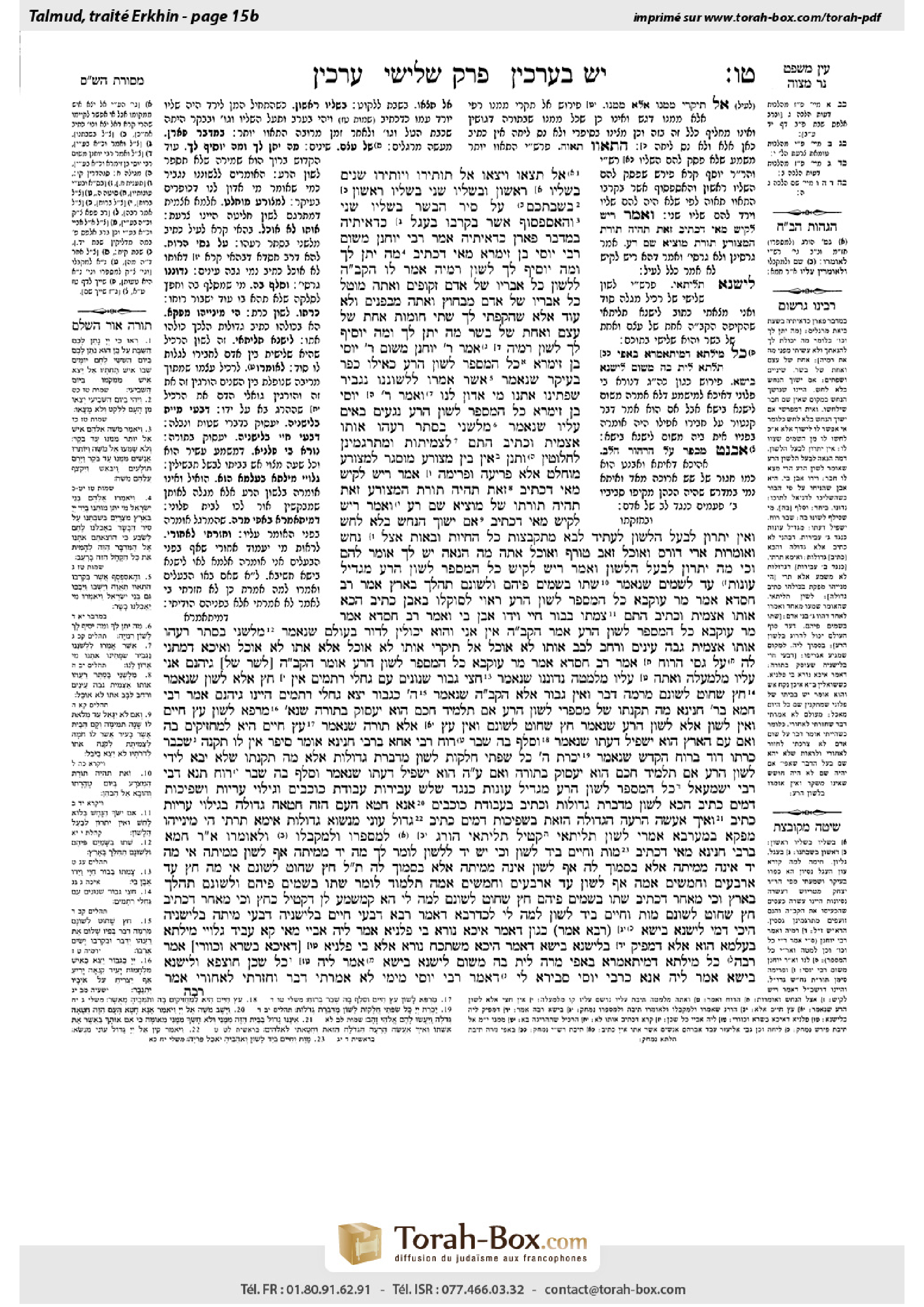
Arakhin 15b: Talmud study for Daf Yomi
Study the Talmud for Daf Yomi with scanned pages, Hebrew text, English translations from Sefaria and AI-generated French translations.
Passage selection and English or AI-generated French translation are available where the scan has annotations. Daf Study is independent of Torah-Box and Sefaria.
Browse Arakhin · ערכין · All tractatesArakhin 15b text and translations
This page of Arakhin includes the Aramaic text, an English translation and an AI-generated French translation, alongside the scan above.
ערכין י״ה ב · Aramaic and Hebrew text
״אַל תֵּצֵאוּ״ וַיֵּצְאוּ, ״אַל תּוֹתִירוּ״ וַיּוֹתִירוּ.
שְׁנַיִם בַּשְּׂלָיו [בִּשְׂלָיו] — רִאשׁוֹן וּבִשְׂלָיו שֵׁנִי. בִּשְׂלָיו רִאשׁוֹן — ״בְּשִׁבְתְּכֶם עַל סִיר הַבָּשָׂר״.
בִּשְׂלָיו שֵׁנִי — ״וְהָאסַפְסֻף אֲשֶׁר בְּקִרְבּוֹ״.
בָּעֵגֶל — כִּדְאִיתֵיהּ, בְּמִדְבַּר פָּארָן — כִּדְאִיתֵיהּ.
אָמַר רַבִּי יוֹחָנָן מִשּׁוּם רַבִּי יוֹסֵי בֶּן זִימְרָא: מַאי דִּכְתִיב ״מַה יִּתֵּן לְךָ וּמַה יֹּסִיף לָךְ לָשׁוֹן רְמִיָּה״? אָמַר לוֹ הַקָּדוֹשׁ בָּרוּךְ הוּא לַלָּשׁוֹן: כׇּל אֵבָרָיו שֶׁל אָדָם זְקוּפִים וְאַתָּה מוּטָל, כׇּל אֵבָרָיו שֶׁל אָדָם מִבַּחוּץ וְאַתָּה מִבִּפְנִים, וְלֹא עוֹד אֶלָּא שֶׁהִקַּפְתִּי לְךָ שְׁתֵּי חוֹמוֹת, אַחַת שֶׁל עֶצֶם וְאַחַת שֶׁל בָּשָׂר, ״מַה יִּתֵּן לְךָ וּמַה יֹּסִיף לָךְ לָשׁוֹן רְמִיָּה״?
אָמַר רַבִּי יוֹחָנָן מִשּׁוּם רַבִּי יוֹסֵי בֶּן זִימְרָא: כׇּל הַמְסַפֵּר לָשׁוֹן הָרָע כְּאִילּוּ כָּפַר בָּעִיקָּר, שֶׁנֶּאֱמַר: ״אֲשֶׁר אָמְרוּ לִלְשֹׁנֵנוּ נַגְבִּיר שְׂפָתֵינוּ אִתָּנוּ מִי אָדוֹן לָנוּ״.
וְאָמַר רַבִּי יוֹסֵי בֶּן זִימְרָא: כׇּל הַמְסַפֵּר לָשׁוֹן הָרָע, נְגָעִים בָּאִים עָלָיו, שֶׁנֶּאֱמַר: ״מְלׇשְׁנִי בַסֵּתֶר רֵעֵהוּ אוֹתוֹ אַצְמִית״, וּכְתִיב הָתָם: ״לַצְּמִיתֻת״, וּמְתַרְגְּמִינַן: לַחֲלוּטִין.
וּתְנַן: אֵין בֵּין מְצוֹרָע מוּסְגָּר לִמְצוֹרָע מוּחְלָט אֶלָּא פְּרִיעָה וּפְרִימָה.
אָמַר רֵישׁ לָקִישׁ: מַאי דִּכְתִיב ״זֹאת תִּהְיֶה תּוֹרַת הַמְּצוֹרָע״? זֹאת תִּהְיֶה תּוֹרָתוֹ שֶׁל מוֹצִיא שֵׁם רַע.
וְאָמַר רֵישׁ לָקִישׁ: מַאי דִּכְתִיב ״אִם יִשֹּׁךְ הַנָּחָשׁ בְּלֹא לָחַשׁ וְאֵין יִתְרוֹן לְבַעַל הַלָּשׁוֹן״? לֶעָתִיד לָבֹא מִתְקַבְּצוֹת כׇּל הַחַיּוֹת וּבָאוֹת אֵצֶל נָחָשׁ, וְאוֹמְרוֹת: אֲרִי דּוֹרֵס וְאוֹכֵל, זְאֵב טוֹרֵף וְאוֹכֵל, אַתָּה מָה הֲנָאָה יֵשׁ לְךָ? אוֹמֵר לָהֶם: וְכִי מָה יִתְרוֹן לְבַעַל הַלָּשׁוֹן?
וְאָמַר רֵישׁ לָקִישׁ: כׇּל הַמְסַפֵּר לָשׁוֹן הָרָע מַגְדִּיל עֲוֹנוֹת עַד לַשָּׁמַיִם, שֶׁנֶּאֱמַר: ״שַׁתּוּ בַשָּׁמַיִם פִּיהֶם וּלְשׁוֹנָם תִּהֲלַךְ בָּאָרֶץ״.
אָמַר רַב חִסְדָּא אָמַר מָר עוּקְבָא: כׇּל הַמְסַפֵּר לָשׁוֹן הָרָע רָאוּי לְסוֹקְלוֹ בְּאֶבֶן, כְּתִיב הָכָא ״אוֹתוֹ אַצְמִית״, וּכְתִיב הָתָם ״צָמְתוּ בַבּוֹר חַיָּי וַיַּדּוּ אֶבֶן בִּי״.
וְאָמַר רַב חִסְדָּא אָמַר מָר עוּקְבָא: כׇּל הַמְסַפֵּר לָשׁוֹן הָרָע, אֹמֵר הַקָּדוֹשׁ בָּרוּךְ הוּא: אֵין אֲנִי וְהוּא יְכוֹלִין לָדוּר בָּעוֹלָם, שֶׁנֶּאֱמַר: ״מְלׇשְׁנִי בַסֵּתֶר רֵעֵהוּ אוֹתוֹ אַצְמִית גְּבַהּ עֵינַיִם וּרְחַב לֵבָב אֹתוֹ לֹא אוּכָל״, אַל תִּיקְרֵי ״אוֹתוֹ לֹא אוּכָל״ אֶלָּא ״אִתּוֹ לֹא אוּכָל״, וְאִיכָּא דְּמַתְנֵי לַהּ עַל גַּסֵּי הָרוּחַ.
אָמַר רַב חִסְדָּא אָמַר מָר עוּקְבָא: כׇּל הַמְסַפֵּר לָשׁוֹן הָרָע, אוֹמֵר הַקָּדוֹשׁ בָּרוּךְ הוּא לְגֵיהִנָּם: אֲנִי עָלָיו מִלְּמַעְלָה וְאַתָּה עָלָיו מִלְּמַטָּה נְדוּנֶנּוּ, שֶׁנֶּאֱמַר: ״חִצֵּי גִבּוֹר שְׁנוּנִים עִם גַּחֲלֵי רְתָמִים״, אֵין חֵץ אֶלָּא לָשׁוֹן, שֶׁנֶּאֱמַר: ״חֵץ שָׁחוּט לְשׁוֹנָם מִרְמָה דִבֵּר״.
וְאֵין גִּבּוֹר אֶלָּא הַקָּדוֹשׁ בָּרוּךְ הוּא, שֶׁנֶּאֱמַר: ״ה׳ כְּגִבּוֹר יֵצֵא״, גַּחֲלֵי רְתָמִים הַיְינוּ גֵּיהִנָּם.
אָמַר רַבִּי חָמָא בְּרַבִּי חֲנִינָא: מָה תַּקָּנָתוֹ שֶׁל מְסַפֵּרי לָשׁוֹן הָרָע? אִם תַּלְמִיד חָכָם הוּא — יַעֲסוֹק בַּתּוֹרָה, שֶׁנֶּאֱמַר: ״מַרְפֵּא לָשׁוֹן עֵץ חַיִּים״, וְאֵין לָשׁוֹן אֶלָּא לָשׁוֹן הָרָע, שֶׁנֶּאֱמַר: ״חֵץ שָׁחוּט לְשׁוֹנָם״, וְאֵין עֵץ אֶלָּא תּוֹרָה, שֶׁנֶּאֱמַר: ״עֵץ חַיִּים הִיא לַמַּחֲזִיקִים בָּהּ״, וְאִם עַם הָאָרֶץ הוּא יַשְׁפִּיל דַּעְתּוֹ, שֶׁנֶּאֱמַר: ״וְסֶלֶף בָּהּ שֶׁבֶר (רוח) [בְּרוּחַ]״.
רַבִּי אַחָא בְּרַבִּי חֲנִינָא אוֹמֵר: סִיפֵּר אֵין לוֹ תַּקָּנָה, שֶׁכְּבָר כְּרָתוֹ דָּוִד בְּרוּחַ הַקֹּדֶשׁ, שֶׁנֶּאֱמַר: ״יַכְרֵת ה׳ כׇּל שִׂפְתֵי חֲלָקוֹת לָשׁוֹן מְדַבֶּרֶת גְּדֹלוֹת״. אֶלָּא מָה תַּקָּנָתוֹ שֶׁלֹּא יָבֹא לִידֵי לָשׁוֹן הָרָע? אִם תַּלְמִיד חָכָם הוּא יַעֲסוֹק בַּתּוֹרָה, וְאִם עַם הָאָרֶץ הוּא יַשְׁפִּיל דַּעְתּוֹ, שֶׁנֶּאֱמַר: ״וְסֶלֶף בָּהּ שֶׁבֶר (רוח) [בְּרוּחַ]״.
תָּנָא דְּבֵי רַבִּי יִשְׁמָעֵאל: כׇּל הַמְסַפֵּר לָשׁוֹן הָרָע מַגְדִּיל עֲוֹנוֹת כְּנֶגֶד שָׁלֹשׁ עֲבֵירוֹת, עֲבוֹדָה זָרָה וְגִילּוּי עֲרָיוֹת וּשְׁפִיכוּת דָּמִים. כְּתִיב הָכָא ״לָשׁוֹן מְדַבֶּרֶת גְּדוֹלוֹת״, וּכְתִיב בַּעֲבוֹדָה זָרָה ״אָנָּא חָטָא הָעָם הַזֶּה חֲטָאָה גְדֹלָה״.
בְּגִילּוּי עֲרָיוֹת כְּתִיב: ״וְאֵיךְ אֶעֱשֶׂה הָרָעָה הַגְּדֹלָה הַזֹּאת״, בִּשְׁפִיכוּת דָּמִים כְּתִיב: ״גָּדוֹל עֲוֹנִי מִנְּשֹׂא״.
״גְּדוֹלוֹת״ אֵימָא תַּרְתֵּי! הֵי מִינַּיְיהוּ מַפְּקָא?
בְּמַעְרְבָא אָמְרִי: לָשׁוֹן תְּלִיתַאי קָטֵיל תְּלִיתַאי, הוֹרֵג לַמְסַפְּרוֹ, וְלַמְקַבְּלוֹ, וְלָאוֹמְרִין עָלָיו.
אָמַר רַבִּי חָמָא בְּרַבִּי חֲנִינָא: מַאי דִּכְתִיב ״מָוֶת וְחַיִּים בְּיַד לָשׁוֹן״, וְכִי יֵשׁ יָד לַלָּשׁוֹן? לוֹמַר לָךְ: מָה יָד מְמִיתָה — אַף לָשׁוֹן מְמִיתָה. אִי מָה יָד אֵינָהּ מְמִיתָה אֶלָּא בְּסָמוּךְ לָהּ — אַף לָשׁוֹן אֵינָהּ מְמִיתָה אֶלָּא בְּסָמוּךְ לָהּ? תַּלְמוּד לוֹמַר: ״חֵץ שָׁחוּט לְשׁוֹנָם״.
אִי מָה חֵץ עַד אַרְבָּעִים וַחֲמִשִּׁים אַמָּה, אַף לָשׁוֹן עַד אַרְבָּעִים וַחֲמִשִּׁים אַמָּה? תַּלְמוּד לוֹמַר: ״שַׁתּוּ בַשָּׁמַיִם פִּיהֶם וּלְשׁוֹנָם תִּהֲלַךְ בָּאָרֶץ״.
וְכִי מֵאַחַר דִּכְתִיב ״שַׁתּוּ בַּשָּׁמַיִם פִּיהֶם״, ״חֵץ שָׁחוּט לְשׁוֹנָם״ לְמָה לִי? הָא קָמַשְׁמַע לַן, דְּקָטֵיל כְּחֵץ.
וְכִי מֵאַחַר דִּכְתִיב ״חֵץ שָׁחוּט לְשׁוֹנָם״, ״מָוֶת וְחַיִּים בְּיַד לָשׁוֹן״ לְמָה לִי? לְכִדְרָבָא, דְּאָמַר רָבָא: דְּבָעֵי חַיִּים — בְּלִישָּׁנֵיהּ, דְּבָעֵי מִיתָה — בְּלִישָּׁנֵיהּ.
הֵיכִי דָּמֵי לִישָּׁנָא בִּישָׁא? רָבָא אָמַר: כְּגוֹן דְּאָמַר ״אִיכָּא נוּרָא בֵּי פְלָנְיָא״. אֲמַר לֵיהּ אַבָּיֵי: מַאי קָא עָבֵיד? גַּלּוֹיֵי מִילְּתָא בְּעָלְמָא הוּא! אֶלָּא דְּמַפֵּיק בְּלִישָּׁנָא בִּישָׁא, דְּאָמַר: ״הֵיכָא מִשְׁתְּכַח נוּרָא אֶלָּא בֵּי פְלָנְיָא״.
אָמַר רַבָּה: כֹּל מִילְּתָא דְּמִיתְאַמְרָא בְּאַפֵּי מָרַהּ, לֵית בַּהּ מִשּׁוּם לִישָּׁנָא בִּישָׁא. אֲמַר לֵיהּ: כׇּל שֶׁכֵּן חוּצְפָּא וְלִישָּׁנָא בִּישָׁא! אֲמַר לֵיהּ: אֲנָא כְּרַבִּי יוֹסֵי סְבִירָא לִי, דְּאָמַר רַבִּי יוֹסֵי: מִיָּמַי לֹא אָמַרְתִּי דָּבָר וְחָזַרְתִּי לַאֲחוֹרַי. אָמַר
Arakhin 15b · English translation
Do not go out, as indicated in the verse: “And Moses said: Eat that today; for today is a Sabbath for the Lord; today you will not find it in the field” (Exodus 16:25). But nevertheless there were people who went out to look for manna, as it is written: “And it came to pass on the seventh day that some of the people went out to gather, and they found none” (Exodus 16:27). The verse also states: “And Moses said to them: Let no man leave any of it until the morning” (Exodus 16:19), and there were people who left it until morning, as it states: “But they did not listen to Moses; and some of them left of it until the morning, and it bred worms, and rotted; and Moses was angry with them” (Exodus 16:20).
The Gemara continues its elucidation of the baraita: There were two trials relating to the quail, one was on the first occasion when the quail appeared, and the other on the second occasion the quail appeared. The Gemara clarifies: The trial of the first quail is described in the verse: “And the children of Israel said to them: Would that we had died by the hand of the Lord in the land of Egypt, when we sat by the meat pots, when we ate bread to the full; for you have brought us into this wilderness, to kill this whole assembly with hunger” (Exodus 16:3). Immediately afterward the quail arrived, as the verse states: “And it came to pass in the evening, that the quail came up, and covered the camp; and in the morning there was a layer of dew round about the camp” (Exodus 16:13).
The second trial of the quail is described in the verse: “And the mixed multitude that was among them desired; and the children of Israel also wept on their part, and said: Would that we were given meat to eat” (Numbers 11:4). Later the verse states: “And there went forth a wind from the Lord, and brought across quails from the sea and let them fall by the camp, about a day’s journey on this side and a day’s journey on the other side, round about the camp, and about two cubits above the face of the earth” (Numbers 11:31).
The Gemara concludes its detailing of the Jewish people’s ten trials of God: The trial of the golden calf is as it is described in the Torah (Exodus, chapter 32), and the trial in the wilderness of Paran is as it is described in the Torah (Numbers, chapter 13).
§ The Gemara returns to the topic of malicious speech. Rabbi Yoḥanan says in the name of Rabbi Yosei ben Zimra: What is the meaning of that which is written: “What shall be given to you, and what more shall be done for you, you deceitful tongue” (Psalms 120:3)? The Holy One, Blessed be He said to the tongue: All the other limbs of a person are upright, but you are lying horizontally. All the other limbs of a person are external, but you are internal. And moreover, I have surrounded you with two walls, one of bone, i.e., the teeth, and one of flesh, the lips. What shall be given to you and what more shall be done for you, to prevent you from speaking in a deceitful manner, tongue?
Furthermore, Rabbi Yoḥanan says in the name of Rabbi Yosei ben Zimra: Anyone who speaks malicious speech is considered as though he denied the fundamental belief in God. As it is stated: “Who have said: We will make our tongue mighty; our lips are with us: Who is lord over us” (Psalms 12:5).
And Rabbi Yosei ben Zimra says: Anyone who speaks malicious speech will be afflicted by leprous marks coming upon him, as it is stated: “Whoever defames his neighbor in secret, I will destroy him [atzmit]; whoever is haughty of eye and proud of heart, I will not suffer him” (Psalms 101:5). And it is written there: “And the land shall not be sold in perpetuity [letzmitut]; for the land is Mine; for you are strangers and settlers with Me” (Leviticus 25:23). And we translate this term letzmitut as laḥalutin, in perpetuity or confirmed.
Rabbi Yosei ben Zimra continues: And we learned in a mishna (Megilla 8b): The difference between a quarantined leper, i.e., one examined by a priest who found his symptoms inconclusive, and who must therefore remain in isolation for a period of up to two weeks to see if conclusive symptoms develop, and a confirmed [muḥlat] leper, one whose symptoms were conclusive and the priest declared him a definite leper, is only with regard to letting the hair on one’s head grow wild and rending one’s garments. A confirmed leper is obligated to let the hair on his head grow wild and rend his garments; a quarantined leper is not. The similarity in the terms teaches that one who speaks malicious speech will be afflicted with leprous marks.
Reish Lakish says: What is the meaning of that which is written: “This shall be the law of the leper [metzora] in the day of his cleansing: He shall be brought to the priest” (Leviticus 14:2)? This means that this shall be the law of a defamer [motzi shem ra].
And Reish Lakish says: What is the meaning of that which is written: “If the serpent bites before it is charmed, then what advantage is there to the master of the tongue” (Ecclesiastes 10:11). What is the connection between the serpent and the master of the tongue? In the future, all the animals will gather and come to the serpent and will say to it: A lion tramples with its paws to kill its prey and eats; a wolf tears with its teeth to kill its prey and eats. But you, what benefit do you have when you bite, as you cannot eat every animal that you kill? The serpent will say to them: And what is the benefit to the master of the tongue that speaks malicious speech?
And Reish Lakish says: Anyone who speaks malicious speech increases his sins until the heavens, as it is stated: “They have set their mouth against the heavens, and their tongue walks through the earth” (Psalms 73:9). In other words, while his tongue walks on the earth, his sin reaches the heavens.
Rav Ḥisda says that Mar Ukva says: Anyone who speaks malicious speech, it is appropriate to stone him with stones. It is written here: “Whoever defames his neighbor in secret, I will destroy him [atzmit]” (Psalms 101:5), and it is written there: “They have destroyed [tzamtu] my life in the dungeon, and have cast stones upon me” (Lamentations 3:53).
And Rav Ḥisda says that Mar Ukva says: With regard to anyone who speaks malicious speech, the Holy One, Blessed be He says about him: He and I cannot dwell together in the world. As it is stated in the verse: “Whoever slanders his neighbor in secret, I will destroy him; whoever is haughty of eye and proud of heart, I will not suffer him” (Psalms 101:5). Do not read the phrase as: “I will not suffer him [oto],” but as: With him [ito] I cannot bear to dwell. God is saying that He cannot bear having this person in the world with Him. And there are those who teach this notion of God’s not being able to tolerate a certain type of person in reference to the arrogant, i.e., they apply it to the last part of the verse: Proud of heart.
Rav Ḥisda further says that Mar Ukva says: With regard to anyone who speaks malicious speech, the Holy One Blessed be He says about him to Gehenna: I will be on him from above, and you will be on him from below, and together we will judge him and punish him. As it is stated: “Sharp arrows of the mighty, with coals of broom” (Psalms 120:4), and the word “arrow” means nothing other than the tongue, as it is stated: “Their tongue is a sharpened arrow; it speaks deceit. One speaks peaceably to his neighbor with his mouth, but in his heart he lies in wait for him” (Jeremiah 9:7).
Mar Ukva continued: And the word “mighty” in Psalms 120:4 means nothing other than the Holy One, Blessed be He, as it is stated: “The Lord will go forth as a mighty man, He will stir up jealousy like a man of war; He will cry; He will shout aloud, He will prove Himself mighty against His enemies” (Isaiah 42:13). And as for the coals of the broom tree [gaḥalei retamim] that burn for a long time, this is an allusion to Gehenna.
Rabbi Ḥama, son of Rabbi Ḥanina says: What is the remedy for those who speak malicious speech? If he is a Torah scholar, let him study Torah, as it is stated: “A soothing tongue is a tree of life, but its perverseness is a broken spirit” (Proverbs 15:4). And the word “tongue” means nothing other than malicious speech, as it is stated: “Their tongue is a sharpened arrow; it speaks deceit” (Jeremiah 9:7). And the word “tree” means nothing other than Torah, as it is stated: “It is a tree of life to them that lay hold of it” (Proverbs 3:18). And if he is an ignoramus, let him humble his mind, as it is stated: “Its perverseness is a broken spirit” (Proverbs 15:4). In other words, one who perverts his tongue with malicious speech should remedy his behavior by cultivating a broken and humble spirit.
Rabbi Aḥa, son of Rabbi Ḥanina says: If one has already spoken malicious speech, he has no remedy, as King David, inspired by Divine Spirit, has already cut him off with the punishment of karet, as it is stated: “May the Lord cut off [yakhret] all flattering lips, the tongue that speaks great things” (Psalms 12:4). Rather, what is his remedy beforehand, so that he does not come to speak malicious speech? If he is a Torah scholar, let him study Torah; and if he is an ignoramus let him humble his mind, as it is stated: “A soothing tongue is a tree of life, but its perverseness is a broken spirit” (Proverbs 15:4). One who is humble will not come to speak badly about another.
The school of Rabbi Yishmael taught: Anyone who speaks malicious speech increases his sins to the degree that they correspond to the three cardinal transgressions: Idol worship, and forbidden sexual relations, and bloodshed. This can be derived from a verbal analogy based on the word “great.” It is written here: “May the Lord cut off all flattering lips, the tongue that speaks great things” (Psalms 12:4). And it is written with regard to idol worship: “And Moses returned to the Lord, and said: Oh, this people have sinned a great sin, and have made for themselves a god of gold” (Exodus 32:31).
With regard to forbidden sexual relations it is written that when Potiphar’s wife attempted to seduce Joseph he responded: “How can I do this great wickedness, and sin against God” (Genesis 39:9). With regard to bloodshed it is written, after Cain murdered his brother: “And Cain said to the Lord: My punishment is greater than I can bear” (Genesis 4:13). The Torah describes each of these three cardinal sins with the word “great” in the singular, whereas malicious speech is described with the plural term “great things,” indicating that it is equivalent to all three of the other transgressions together.
The Gemara asks: Granted that with regard to malicious speech the verse uses the plural: “Great things,” but the plural indicates a minimum of two. If so, one can only say that malicious speech is equivalent to two of the cardinal transgressions. The Gemara responds: Which of them could be taken out as less than the other two? All three are equal. Therefore malicious speech must be equivalent to all three.
In the West, Eretz Yisrael, they say: Third speech, i.e., malicious speech about a third party, kills three people. It kills the one who speaks malicious speech, and the one who accepts the malicious speech when he hears it, and the one about whom the malicious speech is said.
Rabbi Ḥama, son of Rabbi Ḥanina, says: What is the meaning of that which is written: “Death and life are in the hand of the tongue” (Proverbs 18:21). Does the tongue have a hand? Rather the verse comes to tell you that just as a hand can kill, so too a tongue can kill. If you were to claim that just as the hand kills only from close by, so too the tongue kills only from close by, therefore the verse states: “Their tongue is a sharpened arrow” (Jeremiah 9:7). The tongue kills like an arrow that is fired from a bow, at a great distance.
If you say that just as an arrow can kill only within the distance it can be shot, which is up to about forty or fifty cubits, so too a tongue can kill only from up to forty or fifty cubits, therefore the verse teaches: “They have set their mouth against the heavens, and their tongue walks through the earth” (Psalms 73:9). This teaches that malicious speech can reach great distances, even the distance between heaven and earth.
The Gemara asks: But since it is written: “They have set their mouth against the heavens, and their tongue walks through the earth” (Psalms 73:9), which teaches that malicious speech reaches between heaven and earth, why do I need that which we derived from the verse: “Their tongue is a sharpened arrow” (Jeremiah 9:7), i.e. that a tongue can kill from the distance an arrow flies? The Gemara answers: This teaches us that a tongue kills in the same manner that an arrow kills.
The Gemara further asks: But since it is written: “Their tongue is a sharpened arrow” (Jeremiah 9:7), why do I need the verse: “Death and life are in the hand of the tongue” (Proverbs 18:21), which merely teaches that a tongue can kill? The Gemara answers: This verse is necessary for a statement of Rava, as Rava says: One who wants life can attain it by means of his tongue, which he can use for speaking appropriately and studying Torah. One who wants death can also attain it by means of his tongue, by using it for inappropriate and malicious speech.
The Gemara asks: What is considered malicious speech? In other words, how is malicious speech defined and what are the limits of the prohibition? Rava said: For example, if one says: There is always fire at so-and-so’s home, indicating that they are always cooking food there. Abaye said to Rava: What did this person do wrong by saying that there is always fire in that home? His statement is merely revealing the true facts, and is not malicious speech. Rather, it is considered malicious speech if he expressed this in a slanderous manner. For example, if he says: Where else can one find fire except at so-and-so’s home, because they are always cooking food there.
Rabba says: Any statement that is said in the presence of its master, i.e., if the subject of the statement was there, does not have any prohibition due to malicious speech. Abaye said to him: All the more so it is proscribed speech, as it is both impudence and malicious speech. Rabba said to Abaye: I hold in accordance with the opinion of Rabbi Yosei, as Rabbi Yosei says: In all my days I never said something and then turned around to see if the person I was speaking about was standing behind me listening, as I would say it even to the person involved. He says,
Arakhin 15b · Traduction française (IA)
Ne sortez pas, comme indiqué dans la parole : « Et Moïse dit : mangez cela aujourd'hui, car aujourd'hui est un sabbat pour l'Éternel, aujourd'hui vous ne le trouverez pas dans le champ » (Exode 16:25). Cependant, malgré cela, il y avait des gens qui sont sortis chercher du manna, comme il est écrit : « Et il advint le septième jour que quelques-uns du peuple sortirent pour ramasser, et ils ne trouvèrent rien » (Exode 16:27). La parole dit aussi : « Et Moïse dit à eux : qu'aucun d'entre eux ne laisse rien de cela jusqu'au matin » (Exode 16:19), et il y avait des gens qui laissèrent cela jusqu'au matin, comme il est dit : « Mais ils n'écouterent pas Moïse, et quelques-uns laissèrent de cela jusqu'au matin, et cela engendra des vers et putréfia, et Moïse fut en colère contre eux » (Exode 16:20).
La Guemara continue son éclaircissement de la baraïta : Il y avait deux épreuves concernant les moineaux, l'une était lors de la première apparition des moineaux, et l'autre lors de la seconde apparition des moineaux. La Guemara précise : L'épreuve des premiers moineaux est décrite dans la parole : « Et les enfants d'Israël dirent à eux : Ainsi eût été mieux de mourir par la main de l'Éternel dans la terre d'Égypte, quand nous étions assis près des récipients, quand nous avions mangé du pain en abondance, car vous avez conduit nous dans ce désert, pour tuer cette assemblée toute entière de faim » (Exode 16:3). Immédiatement après, les moineaux arrivèrent, comme la parole dit : « Et il advint en l'après-midi que les moineaux vinrent et couvrirent le camp, et en l'aube il y avait une couche de rosée autour du camp » (Exode 16:13).
L'épreuve secondaire des moineaux est décrite dans la parole : « Et la multitude mélangée qui était parmi eux convoitait, et les enfants d'Israël aussi pleurèrent de leur côté, et dirent : Ainsi eût été mieux de nous donner de la viande à manger » (Nombres 11:4). Plus tard, la parole dit : « Et un vent vint de l'Éternel, et apporta des moineaux de la mer et les fit tomber au camp, environ une journée de marche de ce côté et une journée de marche de l'autre côté, autour du camp, et environ deux coudées au-dessus du visage de la terre » (Nombres 11:31).
La Guemara conclut son exposé sur les dix épreuves du peuple d'Israël : L'épreuve du bœuf d'or est telle que décrite dans la Torah (Exode, chapitre 32), et l'épreuve dans le désert de Paran est telle que décrite dans la Torah (Nombres, chapitre 13).
§ La Guemara reprend le sujet de la parole malveillante. Rabbi Yoḥanan dit au nom de Rabbi Yosei ben Zimra : Quelle est la signification de ce qui est écrit : « Qu'est-ce qui sera donné à toi, et qu'est-ce qui sera fait de plus pour toi, langue trompeuse » (Psaumes 120:3) ? L'Éternel, béni soit-Il, dit à la langue : Tous les autres membres d'un homme sont droits, mais toi tu es allongé. Tous les autres membres d'un homme sont externes, mais toi tu es interne. Et de plus, j'ai entouré toi de deux murs, l'un d'os, c'est-à-dire les dents, et l'autre de chair, les lèvres. Qu'est-ce qui sera donné à toi et qu'est-ce qui sera fait de plus pour toi, pour t'empêcher de parler de manière trompeuse, langue ?
De plus, Rabbi Yoḥanan dit au nom de Rabbi Yosei ben Zimra : Celui qui parle malveillamment est considéré comme s'il avait nié la croyance fondamentale en Dieu. Comme il est dit : « Qui ont dit : Nous ferons notre langue forte, nos lèvres sont avec nous : Qui est maître sur nous » (Psaumes 12:5).
Et Rabbi Yosei ben Zimra dit : Celui qui parle malveillamment sera affligé de taches de leprosie, comme il est dit : « Celui qui diffame son prochain en secret, je le détruirai [atzmit] ; celui qui est hautain d'œil et fier de cœur, je ne le supporterai pas » (Psaumes 101:5). Et il est écrit là : « Et la terre ne sera pas vendue en perpetuité [letzmitut] ; car la terre est mienne ; car vous êtes des étrangers et des habitants avec moi » (Lévitique 25:23). Et nous traduisons ce terme letzmitut comme laḥalutin, en perpetuité ou confirmé.
Rabbi Yosei ben Zimra continue : Et nous avons appris dans une mishna (Megilla 8b) : La différence entre un lépreux quarantainé, c'est-à-dire celui examiné par un prêtre qui a trouvé ses symptômes indéterminés, et qui doit donc rester en isolement pendant une période d'au plus deux semaines pour voir si des symptômes déterminés se développent, et un lépreux confirmé, celui dont les symptômes étaient déterminés et le prêtre l'a déclaré lépreux définitif, est seulement concernant laisser pousser les cheveux de la tête et déchirer ses vêtements. Un lépreux confirmé est tenu de laisser pousser les cheveux de sa tête et de déchirer ses vêtements ; un lépreux quarantainé ne l'est pas. La similitude des termes enseigne que celui qui parle malveillamment sera affligé de taches de leprosie.
Reish Lakish dit : Quelle est la signification de ce qui est écrit : « Cela sera la loi du lépreux [metzora] le jour de sa purification : il sera amené au prêtre » (Lévitique 14:2) ? Cela signifie que cela sera la loi d'un diffamateur [motzi shem ra].
Et Reish Lakish dit : Quelle est la signification de ce qui est écrit : « Si le serpent mord avant qu'il ne soit charmé, alors qu'avantage y a-t-il pour le maître de la langue » (Ecclésiaste 10:11). Quel est le lien entre le serpent et le maître de la langue ? À l'avenir, tous les animaux se réuniront et viendront au serpent et diront à lui : Un lion écrase avec ses pattes pour tuer sa proie et mange ; un loup déchire avec ses dents pour tuer sa proie et mange. Mais toi, quel avantage as-tu quand tu mords, puisque tu ne peux manger chaque animal que tu tues ? Le serpent dira à eux : Et quel avantage y a-t-il pour le maître de la langue qui parle malveillamment ?
Et Reish Lakish dit : Celui qui parle malveillamment accroît ses péchés jusqu'aux cieux, comme il est dit : « Ils ont mis leur bouche contre les cieux, et leur langue marche sur la terre » (Psaumes 73:9). En d'autres termes, tandis que sa langue marche sur la terre, son péché atteint les cieux.
Rav Ḥisda dit que Mar Ukva dit : Celui qui parle de manière malveillante mérite d'être lapidé. Il est écrit ici : « Celui qui calomnie son prochain en secret, je le détruirai [atzmit] » (Psaumes 101:5), et il est écrit là : « Ils ont détruit [tzamtu] ma vie dans la prison, et ils ont jeté des pierres sur moi » (Lamentations 3:53).
Et Rav Ḥisda dit que Mar Ukva dit : En ce qui concerne celui qui parle de manière malveillante, le Saint, le Très Haut dit à son sujet : Lui et moi ne pouvons pas habiter ensemble dans le monde. Il est dit dans la Parole : « Celui qui calomnie son prochain en secret, je le détruirai ; celui qui est orgueilleux d'œil et fier de cœur, je ne le supporterai pas » (Psaumes 101:5). Ne lisez pas la phrase comme : « Je ne le supporterai pas [oto] », mais comme : Avec lui [ito] je ne peux pas supporter de vivre. Dieu dit qu'Il ne peut pas supporter d'avoir cette personne dans le monde avec Lui. Et il y a ceux qui enseignent cette notion de la part de Dieu ne pouvant pas tolérer un certain type de personne, à propos des orgueilleux, c'est-à-dire qu'ils l'appliquent à la dernière partie de la Parole : Fier de cœur.
Rav Ḥisda ajoute que Mar Ukva dit : En ce qui concerne celui qui parle de manière malveillante, le Saint, le Très Haut dit à son sujet à l'Enfer : Je serai sur lui du haut, et vous serez sur lui du bas, et ensemble nous jugerons et punirons. Il est dit : « Des flèches aiguisées des puissants, avec des braises de buissons » (Psaumes 120:4), et le mot « flèche » ne signifie rien d'autre que la langue, comme il est dit : « Leur langue est une flèche aiguisée ; elle parle de la tromperie. L'un parle paisiblement à son prochain avec sa bouche, mais dans son cœur il attend pour le tromper » (Jérémie 9:7).
Mar Ukva continua : Et le mot « puissant » dans Psaumes 120:4 ne signifie rien d'autre que le Saint, le Très Haut, comme il est dit : « L'Éternel sortira comme un puissant, Il éveillera la jalousie comme un homme de guerre ; Il criera ; Il hurlera haut, Il prouvera Sa puissance contre Ses ennemis » (Isaïe 42:13). Et quant aux braises du buisson [gaḥalei retamim] qui brûlent longtemps, c'est une allusion à l'Enfer.
Rabbi Ḥama, fils de Rabbi Ḥanina, dit : Quel est le remède pour ceux qui parlent de manière malveillante ? Si c'est un savant de la Torah, qu'il étudie la Torah, comme il est dit : « Une langue apaisante est un arbre de vie, mais sa perversité est un esprit brisé » (Proverbes 15:4). Et le mot « langue » ne signifie rien d'autre que le discours malveillant, comme il est dit : « Leur langue est une flèche aiguisée ; elle parle de la tromperie » (Jérémie 9:7). Et le mot « arbre » ne signifie rien d'autre que la Torah, comme il est dit : « C'est un arbre de vie pour ceux qui s'en saisissent » (Proverbes 3:18). Et si c'est un ignorant, qu'il humilie son esprit, comme il est dit : « Sa perversité est un esprit brisé » (Proverbes 15:4). En d'autres termes, celui qui pervertit sa langue avec des paroles malveillantes doit réparer son comportement en cultivant un esprit brisé et humble.
Rabbi Aḥa, fils de Rabbi Ḥanina, dit : Si l'on a déjà parlé de manière malveillante, il n'y a plus de remède, comme le roi David, inspiré par l'Esprit divin, a déjà coupé ce dernier avec la punition de karet, comme il est dit : « Que l'Éternel coupe [yakhret] toutes les lèvres flatteuses, la langue qui parle de grandes choses » (Psaumes 12:4). Plutôt, quel est son remède avant qu'il ne vienne à parler de manière malveillante ? Si c'est un savant de la Torah, qu'il étudie la Torah ; et si c'est un ignorant, qu'il humilie son esprit, comme il est dit : « Une langue apaisante est un arbre de vie, mais sa perversité est un esprit brisé » (Proverbes 15:4). Celui qui est humble ne viendra pas à parler mal de son prochain.
L'école de Rabbi Yishmael enseigna : Celui qui parle de manière malveillante augmente ses péchés jusqu'à ce qu'ils correspondent aux trois grands péchés : l'idolâtrie, les relations sexuelles interdites, et le meurtre. Cela peut être déduit d'une analogie verbale basée sur le mot « grand ». Il est écrit ici : « Que l'Éternel coupe toutes les lèvres flatteuses, la langue qui parle de grandes choses » (Psaumes 12:4). Et il est écrit à propos de l'idolâtrie : « Et Moïse retourna auprès de l'Éternel, et dit : Oh, ce peuple a commis un grand péché, et a fait pour lui un dieu d'or » (Exode 32:31).
À propos des relations sexuelles interdites, il est écrit que lorsque la femme de Potiphar tenta de séduire Joseph, il répondit : « Comment puis-je faire ce grand mal, et pécher contre l'Éternel » (Genèse 39:9). À propos du meurtre, il est écrit après que Caïn tua son frère : « Et Caïn dit à l'Éternel : Ma punition est plus grande que je ne peux la supporter » (Genèse 4:13). La Torah décrit chacun de ces trois grands péchés avec le mot « grand » au singulier, tandis que le discours malveillant est décrit avec le terme pluriel « grandes choses », indiquant qu'il est équivalent aux trois autres péchés ensemble.
La Guemara demande : D'accord que, concernant le discours malveillant, la Parole utilise le pluriel : « Grandes choses », mais le pluriel indique au moins deux. Si c'est le cas, on ne peut que dire que le discours malveillant est équivalent à deux des grands péchés. La Guemara répond : Quel est celui parmi eux qui pourrait être retiré comme moins que les autres deux ? Tous les trois sont égaux. Par conséquent, le discours malveillant doit être équivalent à tous les trois.
Au West, en Terre d'Israël, ils disent : Le troisième discours, c'est-à-dire le discours malveillant à propos d'une tierce personne, tue trois personnes. Il tue celui qui parle malveillamment, celui qui accepte le discours malveillant lorsqu'il l'entend, et celui à propos duquel le discours malveillant est dit.
Rabbi Ḥama, fils de Rabbi Ḥanina, dit : Quelle est la signification de ce qui est écrit : « La mort et la vie sont entre la langue » (Proverbes 18:21). La langue a une main ? Plutôt, la Parole vient vous dire que tout comme une main peut tuer, ainsi aussi une langue peut tuer. Si vous affirmiez que tout comme la main tue seulement de près, ainsi aussi la langue tue seulement de près, alors la Parole dit : « Leur langue est une flèche aiguisée » (Jérémie 9:7). La langue tue comme une flèche tirée d'un arc, à grande distance.
Si vous dites que tout comme une flèche ne peut tuer qu'à la distance qu'elle peut parcourir, c'est-à-dire jusqu'à quarante ou cinquante coudées, de même une langue ne peut tuer qu'à une distance similaire, donc la Sainte Écriture enseigne : « Ils ont mis leur bouche contre les cieux, et leur langue marche sur la terre » (Psaumes 73:9). Cela montre que la parole malveillante peut atteindre des distances considérables, même la distance entre le ciel et la terre.
Le Guemara demande : Mais puisque cela est écrit : « Ils ont mis leur bouche contre les cieux, et leur langue marche sur la terre » (Psaumes 73:9), qui enseigne que la parole malveillante atteint de la terre au ciel, pourquoi ai-je besoin de ce que nous avons tiré de la Sainte Écriture : « Leur langue est une flèche aiguë » (Jérémie 9:7), c'est-à-dire que la langue peut tuer à la distance qu'une flèche parcourt ? Le Guemara répond : cela nous enseigne que la langue tue de la même manière qu'une flèche.
Le Guemara demande encore : Mais puisque cela est écrit : « Leur langue est une flèche aiguë » (Jérémie 9:7), pourquoi ai-je besoin de la Sainte Écriture : « La mort et la vie sont entre la langue » (Proverbes 18:21), qui enseigne simplement que la langue peut tuer ? Le Guemara répond : cette Sainte Écriture est nécessaire pour la déclaration de Rava, car Rava dit : celui qui veut la vie peut l'atteindre par sa langue, qu'il utilise pour parler correctement et étudier la Torah. Celui qui veut la mort peut aussi l'atteindre par sa langue, en l'utilisant pour la parole inappropriée et malveillante.
Le Guemara demande : Qu'est-ce qui constitue une parole malveillante ? En d'autres termes, comment est définie la parole malveillante et quelles sont les limites de l'interdiction ? Rava dit : par exemple, si l'on dit : Il y a toujours du feu chez tel ou tel, indiquant qu'ils cuisinent toujours là-bas. Abaye dit à Rava : Quel mal ce homme a-t-il fait en disant qu'il y a toujours du feu chez cette personne ? Sa déclaration est simplement la révélation de faits vrais, et n'est pas une parole malveillante. En revanche, cela constitue une parole malveillante s'il l'exprime de manière calomniant. Par exemple, s'il dit : Où peut-on trouver du feu à part chez tel ou tel, car ils cuisinent toujours là-bas.
Rabba dit : toute déclaration faite en présence de son maître, c'est-à-dire si la personne concernée était là, ne constitue pas une interdiction en raison de la parole malveillante. Abaye dit à lui : Tout autant, c'est une parole interdite, car c'est à la fois une impudeur et une parole malveillante. Rabba dit à Abaye : je suis d'avec l'opinion de Rabbi Yosei, car Rabbi Yosei dit : pendant toute ma vie, je n'ai jamais dit quelque chose et puis tourné la tête pour voir si la personne dont je parlais était derrière moi à écouter, car je disais cela même à la personne concernée. Il dit,
Traduction française générée par IA à partir de l’édition anglaise de Sefaria. Vérifie toujours un passage avec le texte source.
Text from Sefaria: William Davidson Edition - Vocalized Aramaic (CC BY NC); William Davidson Edition - English (CC BY NC).