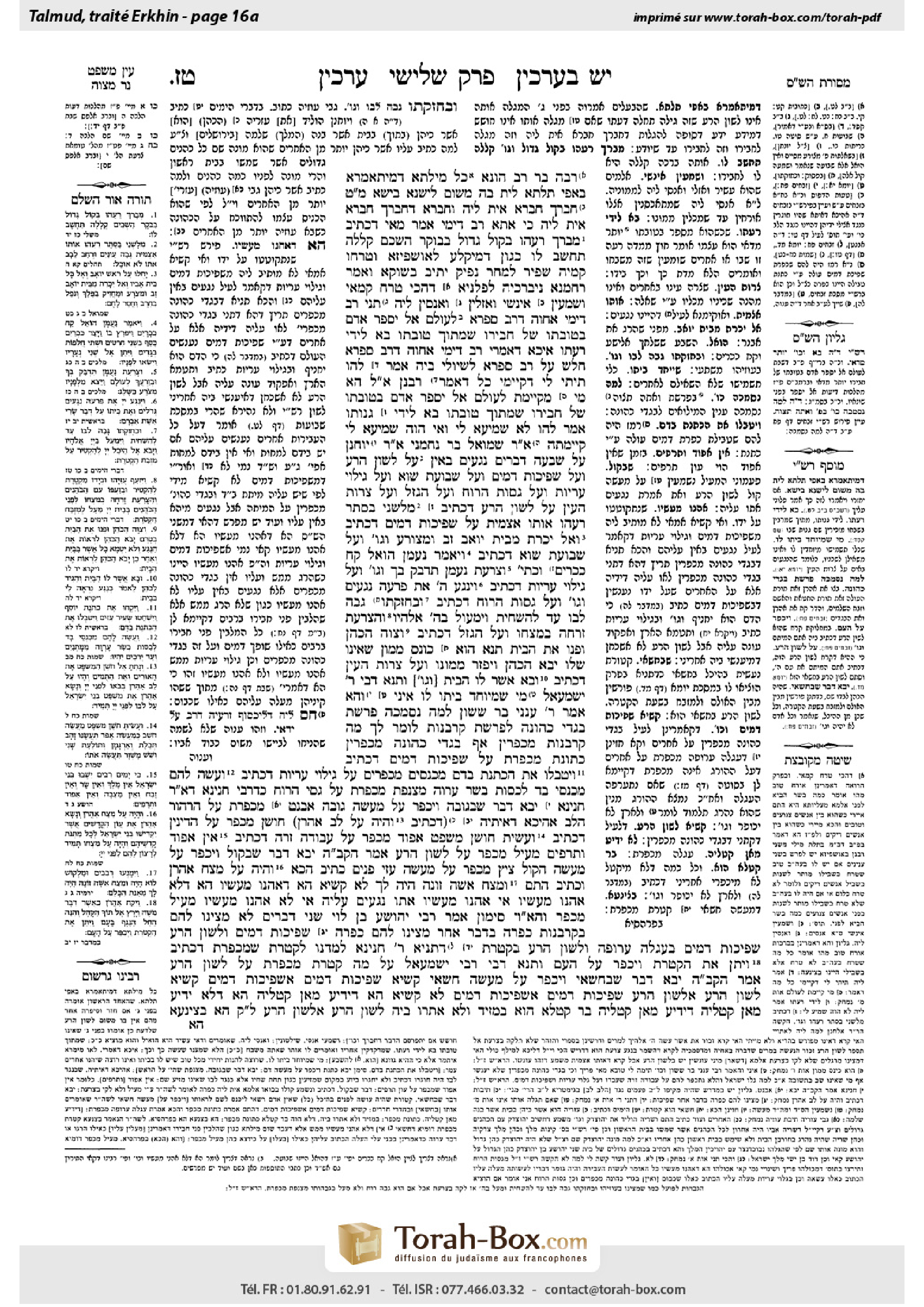
Arakhin 16a: Talmud study for Daf Yomi
Study the Talmud for Daf Yomi with scanned pages, Hebrew text, English translations from Sefaria and AI-generated French translations.
Passage selection and English or AI-generated French translation are available where the scan has annotations. Daf Study is independent of Torah-Box and Sefaria.
Browse Arakhin · ערכין · All tractatesArakhin 16a text and translations
This page of Arakhin includes the Aramaic text, an English translation and an AI-generated French translation, alongside the scan above.
ערכין י״ו א · Aramaic and Hebrew text
רַבָּה בַּר רַב הוּנָא: כֹּל מִילְּתָא דְּמִיתְאַמְרָא בְּאַפֵּי תְּלָתָא, לֵית בָּהּ מִשּׁוּם לִישָּׁנָא בִּישָׁא. מַאי טַעְמָא? חַבְרָךְ חַבְרָא אִית לֵיהּ, וְחַבְרָא דְּחַבְרָךְ חַבְרָא אִית לֵיהּ.
כִּי אֲתָא רַב דִּימִי אָמַר: מַאי דִּכְתִיב ״מְבָרֵךְ רֵעֵהוּ בְּקוֹל גָּדוֹל בַּבּוֹקֶר הַשְׁכֵּם קְלָלָה תֵּחָשֵׁב לוֹ״? כְּגוֹן דְּמִיקְּלַע לְאוּשְׁפִּיזָא וְטָרְחוּ קַמֵּיהּ שַׁפִּיר, לִמְחַר נָפֵיק יָתֵיב בְּשׁוּקָא וְאָמַר: רַחֲמָנָא נִיבָרְכֵיהּ לִפְלָנְיָא דְּהָכִי טְרַח קַמַּאי, וְשָׁמְעִין אִינָשֵׁי וְאָזְלִין וְאָנְסִין לֵיהּ.
תָּנֵי רַב דִּימִי אֲחוּהּ דְּרַב סָפְרָא: לְעוֹלָם אַל יְסַפֵּר אָדָם בְּטוֹבָתוֹ שֶׁל חֲבֵירוֹ, שֶׁמִּתּוֹךְ טוֹבָתוֹ בָּא לִידֵי רָעָתוֹ.
אִיכָּא דְּאָמְרִי: רַב דִּימִי אֲחוּהּ דְּרַב סָפְרָא חֲלַשׁ, עָל רַב סָפְרָא לְשַׁיּוֹלֵי בֵּיהּ. אֲמַר לְהוּ: תֵּיתֵי לִי דְּקַיֵּימִי כֹּל דַּאֲמוּר רַבָּנַן. אֲמַר לֵיהּ: הָא מִי מְקַיְּימַתְּ — לְעוֹלָם אַל יְסַפֵּר אָדָם בְּטוֹבָתוֹ שֶׁל חֲבֵירוֹ שֶׁמִּתּוֹךְ טוֹבָתוֹ בָּא לִידֵי גְּנוּתוֹ? אֲמַר לְהוּ: לָא שְׁמִיעָא לִי, וְאִי הֲוָה שְׁמִיעָא לִי — קַיֵּימְתַּהּ.
אָמַר רַבִּי שְׁמוּאֵל בַּר נַחְמָנִי אָמַר רַבִּי יוֹחָנָן: עַל שִׁבְעָה דְּבָרִים נְגָעִים בָּאִין — עַל לָשׁוֹן הָרָע, וְעַל שְׁפִיכוּת דָּמִים, וְעַל שְׁבוּעַת שָׁוְא, וְעַל גִּילּוּי עֲרָיוֹת, וְעַל גַּסּוּת הָרוּחַ, וְעַל הַגָּזֵל, וְעַל צָרוּת הָעַיִן.
עַל לָשׁוֹן הָרָע — דִּכְתִיב: ״מְלׇשְׁנִי בַסֵּתֶר רֵעֵהוּ אוֹתוֹ אַצְמִית״.
עַל שְׁפִיכוּת דָּמִים — דִּכְתִיב ״וְאַל יִכָּרֵת מִבֵּית יוֹאָב זָב וּמְצֹרָע וְגוֹ׳״.
וְעַל שְׁבוּעַת שָׁוְא — דִּכְתִיב: ״וַיֹּאמֶר נַעֲמָן הוֹאֵל קַח כִּכָּרָיִם״, וּכְתִיב: ״וְצָרַעַת נַעֲמָן תִּדְבַּק בְּךָ וְגוֹ׳״.
וְעַל גִּילּוּי עֲרָיוֹת — דִּכְתִיב: ״וַיְנַגַּע ה׳ אֶת פַּרְעֹה נְגָעִים וְגוֹ׳״.
וְעַל גַּסּוּת הָרוּחַ — דִּכְתִיב: ״וּבְחֶזְקָתוֹ גָּבַהּ לִבּוֹ עַד לְהַשְׁחִית וַיִּמְעוֹל בַּה׳ אֱלֹהָיו״, ״וְהַצָּרַעַת זָרְחָה בְּמִצְחוֹ״.
וְעַל הַגָּזֵל — דִּכְתִיב: ״וְצִוָּה הַכֹּהֵן וּפִנּוּ אֶת הַבַּיִת״. תָּנָא: הוּא כּוֹנֵס מָמוֹן שֶׁאֵינוֹ שֶׁלּוֹ, יָבֹא הַכֹּהֵן וִיפַזֵּר מָמוֹנוֹ.
וְעַל צָרוּת הָעַיִן — דִּכְתִיב: ״וּבָא אֲשֶׁר לוֹ הַבַּיִת״, וְתָנָא דְּבֵי רַבִּי יִשְׁמָעֵאל: מִי שֶׁמְיוּחָד בֵּיתוֹ לוֹ.
אִינִי? וְהָא אָמַר רַבִּי עֲנָנִי בַּר שָׂשׂוֹן: לָמָּה נִסְמְכָה פָּרָשַׁת בִּגְדֵי כְהוּנָּה לְפָרָשַׁת קׇרְבָּנוֹת? לוֹמַר לָךְ: מָה קׇרְבָּנוֹת מְכַפְּרִין — אַף בִּגְדֵי כְהוּנָּה מְכַפְּרִין. כְּתוֹנֶת מְכַפֶּרֶת עַל שְׁפִיכוּת דָּמִים, דִּכְתִיב: ״וַיִּטְבְּלוּ אֶת הַכֻּתֹּנֶת בַּדָּם״. מִכְנָסַיִם מְכַפְּרִים עַל גִּילּוּי עֲרָיוֹת, דִּכְתִיב: ״וַעֲשֵׂה לָהֶם מִכְנְסֵי בָד לְכַסּוֹת בְּשַׂר עֶרְוָה״.
מִצְנֶפֶת מְכַפֶּרֶת עַל גַּסֵּי הָרוּחַ — כִּדְרַבִּי חֲנִינָא, דְּאָמַר רַבִּי חֲנִינָא: יָבֹא דָּבָר שֶׁבַּגּוֹבַהּ וִיכַפֵּר עַל מַעֲשֵׂה גּוֹבַהּ. אַבְנֵט (מכפרת) [מְכַפֵּר] עַל הִרְהוּר הַלֵּב, אַהֵיכָא דְּאִיתֵיהּ, דִּכְתִיב: ״וְהָיָה עַל לֵב אַהֲרֹן״.
חוֹשֶׁן מְכַפֵּר עַל הַדִּינִין — דִּכְתִיב: ״וְעָשִׂיתָ חֹשֶׁן מִשְׁפָּט״. אֵפוֹד מְכַפֵּר עַל עֲבוֹדָה זָרָה, דִּכְתִיב: ״אֵין אֵפוֹד וּתְרָפִים״. מְעִיל מְכַפֵּר עַל לָשׁוֹן הָרָע, אָמַר הַקָּדוֹשׁ בָּרוּךְ הוּא: יָבֹא דָּבָר שֶׁבַּקּוֹל וִיכַפֵּר עַל מַעֲשֵׂה הַקּוֹל.
צִיץ מְכַפֵּר עַל מַעֲשֵׂה עַזֵּי פָנִים — כְּתִיב הָכָא: ״וְהָיָה עַל מֵצַח אַהֲרֹן״, וּכְתִיב הָתָם: ״וּמֵצַח אִשָּׁה זוֹנָה הָיָה לָךְ״.
לָא קַשְׁיָא, הָא דְּאַהֲנוֹ מַעֲשָׂיו, הָא דְּלָא אַהֲנוֹ מַעֲשָׂיו. אִי אַהֲנוֹ מַעֲשָׂיו — אָתוּ נְגָעִים עֲלֵיהּ, אִי לָא אַהֲנוֹ מַעֲשָׂיו — מְעִיל מְכַפֵּר.
וְהָאָמַר רַבִּי סִימוֹן אָמַר רַבִּי יְהוֹשֻׁעַ בֶּן לֵוִי: שְׁנֵי דְבָרִים לֹא מָצִינוּ לָהֶם בַּקׇּרְבָּנוֹת כַּפָּרָה, בְּדָבָר אַחֵר מָצִינוּ לָהֶם כַּפָּרָה, שְׁפִיכוּת דָּמִים וְלָשׁוֹן הָרָע. שְׁפִיכוּת דָּמִים בְּעֶגְלָה עֲרוּפָה.
וְלָשׁוֹן הָרָע — בִּקְטֹרֶת, דְּתַנְיָא רַבִּי חֲנִינָא: לָמַדְנוּ לִקְטֹרֶת שֶׁמְּכַפֶּרֶת, דִּכְתִיב: ״וַיִּתֵּן אֶת הַקְּטֹרֶת וַיְכַפֵּר עַל הָעָם״, וְתָנָא דְּבֵי רַבִּי יִשְׁמָעֵאל: עַל מָה קְטֹרֶת מְכַפֶּרֶת — עַל לָשׁוֹן הָרָע, אָמַר הַקָּדוֹשׁ בָּרוּךְ הוּא: יָבֹא דָּבָר שֶׁבַּחֲשַׁאי וִיכַפֵּר עַל מַעֲשֵׂה חֲשַׁאי.
קַשְׁיָא שְׁפִיכוּת דָּמִים אַשְּׁפִיכוּת דָּמִים, קַשְׁיָא לָשׁוֹן הָרָע אַלָּשׁוֹן הָרָע!
שְׁפִיכוּת דָּמִים אַשְּׁפִיכוּת דָּמִים לָא קַשְׁיָא: הָא דִּידִיעַ מַאן קַטְלֵיהּ, הָא דְּלָא יְדִיעַ מַאן קַטְלֵיהּ.
דִּידִיעַ מַאן קַטְלֵיהּ בַּר קְטָלָא הוּא! בְּמֵזִיד וְלָא אַתְרוֹ בֵּיהּ.
לָשׁוֹן הָרָע אַלָּשׁוֹן הָרָע לָא קַשְׁיָא: הָא בְּצִינְעָא,
Arakhin 16a · English translation
i.e., Rabba bar Rav Huna says: Any matter that was said in the presence of three people does not have the status of malicious speech if one subsequently repeats it. What is the reason? The reason is that your friend has a friend, and your friend’s friend has a friend. Once the information has been stated in the presence of three people, it can be assumed that it will spread and become public knowledge, as each person will tell someone else.
The Gemara continues its discussion of good and bad speech. When Rav Dimi came from Eretz Yisrael to Babylonia he said: What is the meaning of that which is written: “He that blesses his friend with a loud voice, rising early in the morning, it shall be counted a curse to him” (Proverbs 27:14)? For example, when one is invited to a host, and they look after him very well. The following day the guest goes out and sits in the marketplace and says: May the Merciful One bless so-and-so, as this is how well he looked after me. And all the people in the marketplace hear and go to this host and afflict him by expecting him to look after all of them in the same way, and he is compelled to spend his money on them. It turns out that the praise and blessing the guest lavished upon his host brought a curse upon him.
Similarly, Rav Dimi, the brother of Rav Safra, teaches: A person should never speak about the goodness of another in the presence of others, as through speaking about his goodness he will come to speak about him in a derogatory manner, as he will eventually note the exceptions to his goodness, or his listeners will temper his praise by mentioning that individual’s bad qualities.
There are those who say that Rav Dimi did not actually make this statement himself. Rather, the following incident occurred: Rav Dimi, the brother of Rav Safra, was ill. Rav Safra went in to inquire about his condition. Rav Dimi said to those present: I have blessing and merit coming to me, as I have fulfilled all of the statements that the Sages say. Rav Safra said to him: But have you fulfilled the instruction of the Sages that a person should never speak about the goodness of another in the presence of others, as through speaking about his goodness he will come to speak about him in a derogatory manner? Rav Dimi said to them: I never heard this statement of the Sages, but had I heard it, I would have fulfilled it.
§ Rabbi Shmuel bar Naḥmani says that Rabbi Yoḥanan says: Leprous marks come and afflict a person for seven sinful matters: For malicious speech, for bloodshed, for an oath taken in vain, for forbidden sexual relations, for arrogance, for theft, and for stinginess.
The Gemara explains the source for the claim that each of these seven sins is punishable with leprosy. For malicious speech one is punished, as it is written: “Whoever defames his neighbor in secret, I will destroy him; whoever is haughty of eye and proud of heart, I will not suffer him” (Psalms 101:5). The Gemara explained above (15b) that this is referring to leprosy.
For bloodshed, as it is written about Joab, as punishment for murdering Abner: “And let there not fail from the house of Joab a zav, or a leper, or that leans on a staff, or that falls by the sword, or that lacks bread” (II Samuel 3:29).
And for an oath taken in vain, as it is written: “And Naaman said: Be content [ho’el], take two talents. And he urged him, and bound two talents of silver in two bags, with two changes of garment, and laid them upon two of his servants; and they bore them before him” (II Kings 5:23). The Sages maintain that the term ho’el indicates an oath, and that Naaman requested of Gehazi, to whom this was stated, to take an oath that Elisha had sent him to accept gifts, which Elisha had not done, and Gehazi took the oath. When Elisha found out what Gehazi had done he cursed him, and so it is written: “The leprosy of Naaman shall stick to you and to your children forever. And he went out from his presence a leper as white as snow” (II Kings 5:27).
And for forbidden sexual relations, as it is written: “And the Lord afflicted Pharaoh and his house with great afflictions because of Sarai, Abram’s wife” (Genesis 12:17).
And for arrogance, as it is written with regard to King Uzziah: “But when he was strong his heart became arrogant so that he did corruptly, and he trespassed against the Lord his God; for he went into the temple of the Lord to burn incense upon the altar of incense” (II Chronicles 26:16). And it states: “Then Uzziah was angry; and he had a censer in his hand to burn incense; and while he was angry with the priests, the leprosy broke forth in his forehead” (II Chronicles 26:19).
And for theft, as it is written: “And the priest shall command that they empty the house, before the priest go in to see the mark, that all that is in the house not become impure; and afterward the priest shall go in to see the house” (Leviticus 14:36). In explanation of this verse, the Sages taught: He gathered property that is not his, therefore let the priest come and scatter his property.
And for stinginess, as it is written: “Then he that owns the house shall come and tell the priest, saying: There seems to me to be as it were a mark in the house” (Leviticus 14:35). And the school of Rabbi Yishmael taught: The verse calls him the one who owns the house because it is referring to one who was stingy and treated his house as being exclusively his, and did not allow others to share his property.
The Gemara asks: Is that so? Doesn’t Rabbi Anani bar Sason say: Why was the passage in the Torah that discusses the priestly vestments (Leviticus 8) juxtaposed to the passage that discusses offerings (Leviticus, chapters 1–7)? To tell you that just as offerings atone, so too the priestly vestments atone. For what does each garment atone? The tunic [ketonet] atones for bloodshed, as it is written with regard to Joseph’s brothers after they plotted to kill him: “And they killed a goat, and dipped the coat [ketonet] in the blood” (Genesis 37:31). The trousers atone for forbidden sexual relations, as it is written with regard to the priestly vestments: “And you shall make them linen trousers to cover the flesh of their nakedness” (Exodus 28:42).
The mitre atones for the arrogant, in accordance with the opinion of Rabbi Ḥanina, as Rabbi Ḥanina says: It is logical that an item placed at an elevation, i.e., on the head of a priest, shall come and atone for the matter of an elevated heart. The belt atones for thought of the heart. The Gemara elaborates: The belt atones for the sins occurring where it is situated, i.e., over the heart, as it is written: “And you shall put in the breastplate of judgment the Urim and the Tummim; and it shall be upon Aaron’s heart, when he goes in before the Lord; and Aaron shall bear the judgment of the children of Israel upon his heart before the Lord continually” (Exodus 28:30).
The breastplate of the High Priest atones for improper judgments, as it is written: “And you shall make a breastplate of judgment” (Exodus 28:15). The ephod of the High Priest atones for idol worship, as it is written: “And without ephod or teraphim” (Hosea 3:4), that is to say, when there is no ephod, the sin of teraphim, i.e., idol worship, is found. This indicates that if there is an ephod, there is no sin of idol worship. The robe of the High Priest atones for malicious speech, as the Holy One, Blessed be He says: Let an item that produces sound, i.e., the bells of the robe, come and atone for an act of malicious sound, i.e., malicious speech.
Finally, the frontplate of the High Priest atones for an act of brazenness. From where is this derived? Here, with regard to the frontplate, it is written: “And it shall be upon Aaron’s forehead” (Exodus 28:38), and there, with regard to brazenness, it is written: “And you had a prostitute’s forehead” (Jeremiah 3:3). The statement of Rabbi Anani bar Sason indicates that the robe worn by the High Priest atones for malicious speech, which means that one is not punished by leprosy, as claimed by Rabbi Shmuel bar Naḥmani.
The Gemara answers: This is not difficult. Here, the statement of Rabbi Shmuel bar Naḥmani is referring to a case where his actions were effective and caused damage. There, Rabbi Anani bar Sason is referring to a case where his actions were not effective. If his actions were effective and caused harm or quarrels, leprous marks come upon him as punishment. If his actions were not effective and did not cause any damage, the robe atones for his sin.
The Gemara asks: But doesn’t Rabbi Simon say that Rabbi Yehoshua ben Levi says: There are two matters for which we do not find atonement through offerings, but we find atonement for them through another matter, and they are: Bloodshed and malicious speech. With regard to bloodshed, its atonement comes from the heifer whose neck is broken. This is referring to a case where a murdered body is found but the murderer is unknown. In such an instance, the Torah mandates that the town nearest the body must break the neck of a heifer as atonement for the transgression (see Deuteronomy 21:1–9).
And malicious speech is atoned for through incense, as Rabbi Ḥanina taught in a baraita: We have learned that incense atones, as it is written in the incident when the Israelites were afflicted with a plague for speaking slanderously against Moses and Aaron: “And he put on the incense, and made atonement for the people” (Numbers 17:12). And similarly, the school of Rabbi Yishmael taught: For what does incense atone? For malicious speech. It is as though the Holy One, Blessed be He, says: Let an item that is sacrificed in private, i.e., the incense, which is burnt inside the Sanctuary, come and atone for an action generally performed in private, i.e., malicious speech.
The Gemara notes the apparent contradictions: One statement concerning bloodshed is difficult, as it is contradicted by the other statement about bloodshed: According to Rabbi Anani bar Sason the tunic atones for bloodshed, whereas the baraita states that the heifer whose neck is broken atones for this sin. Furthermore, one statement concerning malicious speech is difficult, as it is contradicted by the other statement about malicious speech: Rabbi Anani bar Sason maintains that the robe atones for malicious speech, whereas according to the baraita it is the incense that atones for this transgression.
The Gemara answers: The apparent contradiction between one statement about bloodshed and the other statement about bloodshed is not difficult, as this, the tunic, atones for bloodshed in a case where it is known who killed him, and that, the heifer, atones in a case where it is not known who killed him.
The Gemara asks: If it is known who killed him, the murderer is deserving of death, and there is no atonement for the community until he is put to death, as the verse states: “And no atonement can be made for the land for the blood that is shed within it, but by the blood of him that shed it” (Numbers 35:33). The Gemara responds: There are certain instances where it is impossible to put him to death, e.g., if he murdered intentionally but witnesses did not warn him beforehand of the consequences of committing murder. In such a case, the court may not put the murderer to death, as there is no punishment without prior warning.
The Gemara continues: With regard to the apparent contradiction between one statement dealing with malicious speech and the other statement about malicious speech, it is also not difficult, as this, the incense, atones for malicious speech spoken in private,
Arakhin 16a · Traduction française (IA)
c'est-à-dire, Rabba bar Rav Huna dit : toute affaire dite en présence de trois personnes ne constitue pas un discours malveillant si l'on répète ensuite cette information. Pourquoi ? Parce que ton ami a un ami, et l'ami de ton ami a un ami. Une fois que l'information a été émise en présence de de trois personnes, on peut supposer qu'elle se répandra et deviendra publique, car chacun racontera à quelqu'un d'autre.
La Guemara continue sa discussion sur les paroles bonnes et mauvaises. Lorsque Rav Dimi est venu d'Eretz Yisrael vers Babylone, il a dit : quelle est la signification de ce qui est écrit : « Celui qui bénit son ami à haute voix, se levant de bonne heure, cela sera une malédiction pour lui » (Proverbes 27:14) ? Par exemple, lorsqu'on est invité chez un hôte et qu'on est très bien traité. Le lendemain, le visiteur sort et s'assoit au marché et dit : Que le Bienveillant bénisse tel et tel, car c'est ainsi qu'il m'a bien traité. Et tous les gens du marché l'entendent et vont chez cet hôte et l'importunent en exigeant qu'il traite tous les autres de la même manière, et il est contraint de dépenser son argent pour eux. Il s'avère que les louanges et les bénédictions que le visiteur prodiguait à son hôte ont attiré une malédiction sur lui.
De même, Rav Dimi, frère de Rav Safra, enseigne : une personne ne doit jamais parler des qualités d'un autre devant les autres, car en parlant de ses qualités, il finira par en parler de manière dénigreuse, car il notera les exceptions à ses qualités, ou ses auditeurs modéreront ses louanges en mentionnant les défauts de cette personne.
Certains disent que Rav Dimi n'a pas réellement fait cette déclaration lui-même. Plutôt, l'incident suivant s'est produit : Rav Dimi, frère de Rav Safra, était malade. Rav Safra est entré pour s'informer de son état. Rav Dimi a dit à ceux qui étaient présents : J'ai la bénédiction et la mérite qui viennent vers moi, car j'ai accompli toutes les paroles que les Sages disent. Rav Safra a dit à lui : Mais as-tu accompli l'enseignement des Sages selon lequel une personne ne doit jamais parler des qualités d'un autre devant les autres, car en parlant de ses qualités, il finira par en parler de manière dénigreuse ? Rav Dimi a dit à eux : Je n'ai jamais entendu cette parole des Sages, mais si j'avais entendu, je l'aurais accomplie.
§ Rabbi Shmuel bar Naḥmani dit que Rabbi Yoḥanan dit : les marques de lèpre viennent et affligent une personne pour sept péchés : pour les paroles malveillantes, pour le meurtre, pour un serment pris à vide, pour les relations sexuelles interdites, pour l'arrogance, pour le vol, et pour la mesquinerie.
La Guemara explique la source de l'affirmation selon laquelle chacun de ces sept péchés est puni par la lèpre. Pour les paroles malveillantes, on est puni, car il est écrit : « Celui qui diffame son voisin en secret, je le détruirai ; celui qui est hauteur de l'œil et orgueilleux de cœur, je ne le supporterai pas » (Psaumes 101:5). La Guemara a expliqué ci-dessus (15b) que cela fait référence à la lèpre.
Pour le meurtre, comme il est écrit à propos de Joab, en punition de son meurtre d'Abner : « Et qu'il ne manque pas dans la maison de Joab un zav, ou un lépreux, ou celui qui s'appuie sur un bâton, ou celui qui tombe par l'épée, ou celui qui manque de pain » (II Samuel 3:29).
Et pour un serment pris à vide, comme il est écrit : « Et Naaman dit : Sois content [ho’el], prends deux talents. Et il l'incita, et il mit deux talents d'argent dans deux sacs, avec deux changements de vêtements, et les posa sur deux de ses serviteurs ; et ils les portèrent devant lui » (II Rois 5:23). Les Sages maintiennent que le terme ho’el désigne un serment, et que Naaman demandait à Gehazi, à qui cela était dit, de prendre un serment que Elie avait envoyé lui accepter des présents, ce que Elie n'avait pas fait, et Gehazi prit le serment. Lorsque Elie découvrit ce que Gehazi avait fait, il le maudit, et ainsi il est écrit : « La lèpre de Naaman restera sur toi et sur tes enfants pour toujours. Et il sortit de sa présence un lépreux comme la neige » (II Rois 5:27).
Et pour les relations sexuelles interdites, comme il est écrit : « Et l'Éternel affligea Pharaon et sa maison de grandes afflictions à cause de Sarai, la femme d'Abraham » (Genèse 12:17).
Et pour l'arrogance, comme il est écrit à propos du roi Uzzia : « Mais quand il fut fort, son cœur devint arrogant, de sorte qu'il agit de manière corrompue, et il transgressa contre l'Éternel son Dieu ; car il entra dans le temple de l'Éternel pour brûler des encens sur l'autel des encens » (II Chroniques 26:16). Et il est dit : « Alors Uzzia fut en colère ; et il avait un censer en main pour brûler des encens ; et pendant qu'il était en colère contre les prêtres, la lèpre éclata sur son front » (II Chroniques 26:19).
Et pour le vol, comme il est écrit : « Et le prêtre commandera qu'ils vident la maison, avant que le prêtre n'entre voir la marque, afin que tout ce qui est dans la maison ne devienne pas impur ; et après cela, le prêtre entrera voir la maison » (Lvïm 14:36). En explication de cette verset, les Sages enseignèrent : Il a réuni des biens qui ne sont pas les siens, donc que le prêtre vienne et dispersent ses biens.
Et pour la mesquinerie, comme il est écrit : « Alors celui qui possède la maison viendra et dira au prêtre, disant : Il me semble qu'il y a une marque dans la maison » (Lvïm 14:35). Et l'école de Rabbi Yishmael enseigna : le verset l'appelle celui qui possède la maison parce qu'il fait référence à celui qui était mesquin et traitait sa maison comme étant exclusivement la sienne, et n'a pas permis aux autres de partager ses biens.
La Guemara pose la question : C’est ainsi ? N’est-ce pas que Rabbi Anani bar Sason ait dit : Pourquoi la paracha dans la Torah qui parle des vêtements sacrés (Lévitique 8) est-elle placée à côté de celle qui parle des offrandes (Lévitique, chapitres 1–7) ? Pour t’indiquer que tout comme les offrandes expiatoires, ainsi les vêtements sacrés expient aussi. Pourquoi chaque vêtement expie ? La tunique [ketonet] expie pour le meurtre, car il est écrit concernant les frères de Joseph après qu’ils eurent combiné pour le tuer : « Et ils tuèrent un bouc, et imbibèrent la tunique [ketonet] du sang » (Genèse 37:31). Les culottes expient pour les relations sexuelles interdites, car il est écrit concernant les vêtements sacrés : « Et tu feras des culottes de lin pour couvrir la chair de leur nudité » (Exode 28:42).
Le mitre expie pour l’arrogance, selon l’opinion de Rabbi Ḥanina, car Rabbi Ḥanina dit : Il est logique qu’un objet placé à une hauteur, c’est-à-dire sur la tête du prêtre, vienne expier la question de l’âme élevée. La ceinture expie pour les pensées du cœur. La Guemara développe : La ceinture expie pour les péchés qui se produisent là où elle est placée, c’est-à-dire sur le cœur, car il est écrit : « Et tu placeras dans la breastplate de jugement les Urim et les Tummim ; et elle sera sur la tête d’Aaron quand il entrera devant l’Éternel ; et Aaron portera le jugement des enfants d’Israël sur sa tête devant l’Éternel continuellement » (Exode 28:30).
La breastplate du grand prêtre expie pour les jugements iniques, car il est écrit : « Et tu feras une breastplate de jugement » (Exode 28:15). L’ephod du grand prêtre expie pour l’idolâtrie, car il est écrit : « Sans ephod ni teraphim » (Osée 3:4), c’est-à-dire que lorsqu’il n’y a pas d’ephod, le péché des teraphim, c’est-à-dire l’idolâtrie, est trouvé. Cela indique que s’il y a un ephod, il n’y a pas de péché d’idolâtrie. La robe du grand prêtre expie pour la parole malveillante, car l’Éternel, béni soit Son Nom, dit : Qu’un objet qui produit du bruit, c’est-à-dire les cloches de la robe, vienne expier un acte de bruit malveillant, c’est-à-dire la parole malveillante.
Enfin, la frontale du grand prêtre expie pour un acte de bravade. D’où cela est-il tiré ? Ici, concernant la frontale, il est écrit : « Et elle sera sur la front de Aaron » (Exode 28:38), et là, concernant la bravade, il est écrit : « Et tu avais la front de prostituée » (Jérémie 3:3). La déclaration de Rabbi Anani bar Sason indique que la robe portée par le grand prêtre expie pour la parole malveillante, ce qui signifie qu’on ne le punit pas par la lèpre, comme le dit Rabbi Shmuel bar Naḥmani.
La Guemara répond : Ce n’est pas difficile. Ici, la déclaration de Rabbi Shmuel bar Naḥmani fait référence à un cas où ses actions étaient efficaces et ont causé des dommages. Là, Rabbi Anani bar Sason fait référence à un cas où ses actions n’étaient pas efficaces. Si ses actions étaient efficaces et ont causé des dommages ou des querelles, des marques de lèpre viennent sur lui en punition. Si ses actions n’étaient pas efficaces et n’ont pas causé de dommages, la robe expie son péché.
La Guemara pose la question : Mais n’est-ce pas que Rabbi Simon ait dit que Rabbi Yehoshua ben Levi dit : Il y a deux choses pour lesquelles nous ne trouvons pas l’expiation par les offrandes, mais nous trouvons l’expiation par un autre moyen, et ce sont : le meurtre et la parole malveillante. Concernant le meurtre, son expiation vient de la bête dont le cou est brisé. Cela fait référence à un cas où un corps meurtri est trouvé mais le meurtrier est inconnu. Dans ce cas, la Torah ordonne que la ville la plus proche du corps brise le cou d’une bête comme expiation pour le péché (voir Deutéronome 21:1–9).
Et la parole malveillante est expiée par l’encens, car Rabbi Ḥanina a enseigné dans une baraïta : Nous avons appris que l’encens expie, car il est écrit dans l’incident où les Israélites furent frappés d’une peste pour avoir parlé mal de Moïse et Aaron : « Et il mit l’encens, et fit l’expiation du peuple » (Nombres 17:12). De même, l’école de Rabbi Yishmael enseigna : Pourquoi l’encens expie-t-il ? Pour la parole malveillante. C’est comme si l’Éternel, béni soit Son Nom, disait : Qu’un objet qui est sacrifié en privé, c’est-à-dire l’encens, qui est brûlé dans le Sanctuaire, vienne expier un acte généralement accompli en privé, c’est-à-dire la parole malveillante.
La Guemara note les contradictions apparentes : Une déclaration concernant le meurtre est difficile, car elle est contredite par l’autre déclaration concernant le meurtre : Selon Rabbi Anani bar Sason, la tunique expie pour le meurtre, alors que la baraïta dit que la bête dont le cou est brisé expie ce péché. De même, une déclaration concernant la parole malveillante est difficile, car elle est contredite par l’autre déclaration concernant la parole malveillante : Rabbi Anani bar Sason maintient que la robe expie pour la parole malveillante, alors que selon la baraïta, c’est l’encens qui expie ce péché.
La Guemara répond : La contradiction apparente entre une déclaration concernant le meurtre et l’autre déclaration concernant le meurtre n’est pas difficile, car celle-ci, la tunique, expie pour le meurtre dans un cas où l’on sait qui a tué, et celle-là, la bête, expie dans un cas où l’on ne sait pas qui a tué.
La Guemara pose la question : Si l’on sait qui a tué, le meurtrier est digne de mort, et il n’y a pas d’expiation pour la communauté jusqu’à ce qu’il soit tué, car la paracha dit : « Et il n’y a pas d’expiation pour le pays pour le sang qui est versé en lui, mais par le sang de celui qui l’a versé » (Nombres 35:33). La Guemara répond : Il y a certains cas où il est impossible de le tuer, par exemple si l’homme a tué intentionnellement mais que les témoins n’ont pas averti auparavant des conséquences de l’acte de meurtre. Dans ce cas, le tribunal ne peut pas tuer le meurtrier, car il n’y a pas de punition sans avertissement préalable.
La Guemara continue : Concernant la contradiction apparente entre une déclaration traitant de la parole malveillante et l’autre déclaration sur la parole malveillante, elle n’est pas difficile non plus, car celle-ci, l’encens, expie la parole malveillante parlée en privé,
Traduction française générée par IA à partir de l’édition anglaise de Sefaria. Vérifie toujours un passage avec le texte source.
Text from Sefaria: William Davidson Edition - Vocalized Aramaic (CC BY NC); William Davidson Edition - English (CC BY NC).