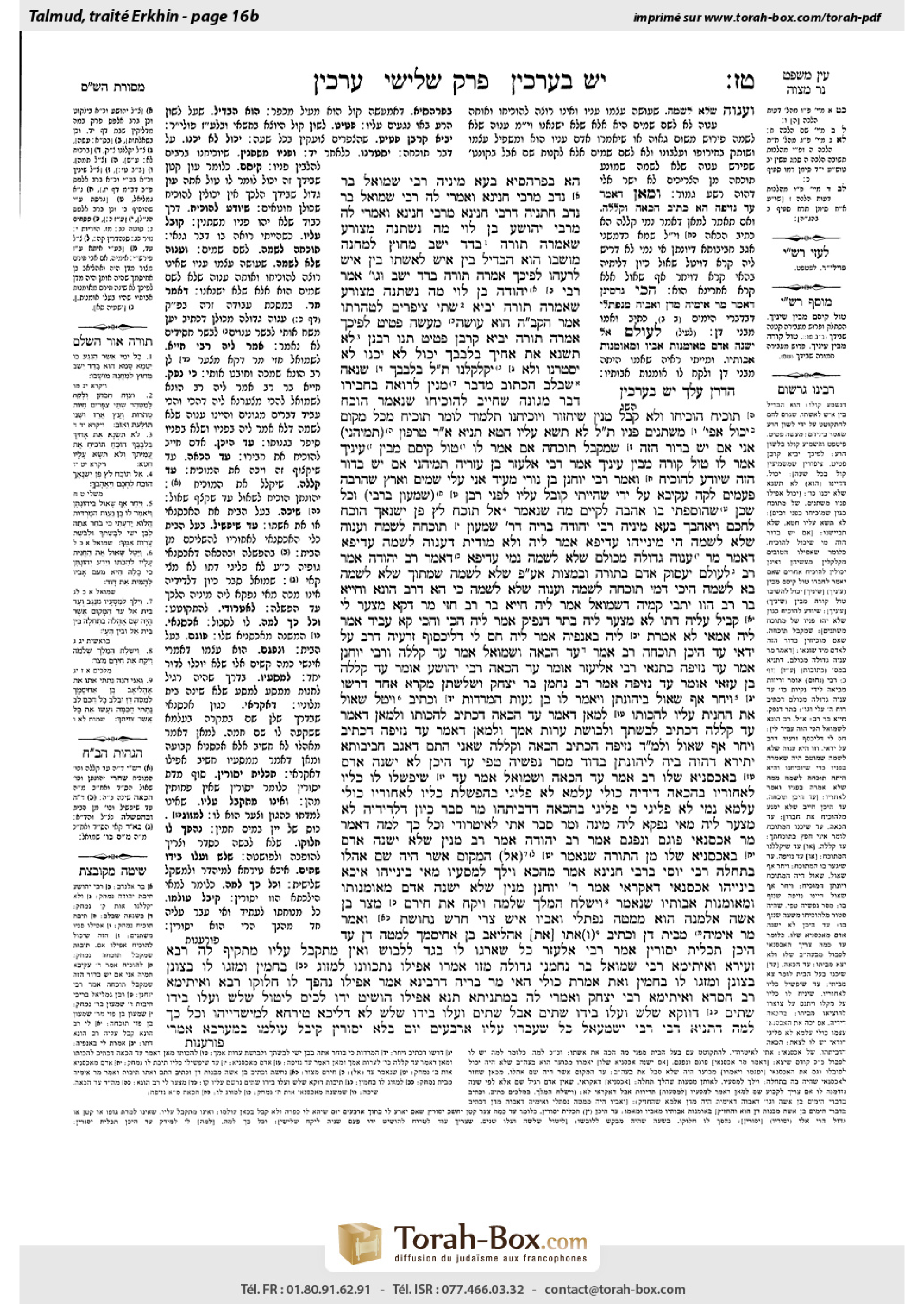
Arakhin 16b: Talmud study for Daf Yomi
Study the Talmud for Daf Yomi with scanned pages, Hebrew text, English translations from Sefaria and AI-generated French translations.
Passage selection and English or AI-generated French translation are available where the scan has annotations. Daf Study is independent of Torah-Box and Sefaria.
Browse Arakhin · ערכין · All tractatesArakhin 16b text and translations
This page of Arakhin includes the Aramaic text, an English translation and an AI-generated French translation, alongside the scan above.
ערכין י״ו ב · Aramaic and Hebrew text
הָא בְּפַרְהֶסְיָא.
בְּעָא מִינֵּיהּ רַבִּי שְׁמוּאֵל בַּר נָדָב מֵרַבִּי חֲנִינָא, וְאָמְרִי לַהּ רַבִּי שְׁמוּאֵל בַּר נָדָב חַתְנֵיהּ דְּרַבִּי חֲנִינָא מֵרַבִּי חֲנִינָא, וְאָמְרִי לַהּ מֵרַבִּי יְהוֹשֻׁעַ בֶּן לֵוִי: מָה נִשְׁתַּנָּה מְצוֹרָע שֶׁאָמְרָה תּוֹרָה ״בָּדָד יֵשֵׁב מִחוּץ לַמַּחֲנֶה מוֹשָׁבוֹ״? הוּא הִבְדִּיל בֵּין אִישׁ לְאִשְׁתּוֹ, בֵּין אִישׁ לְרֵעֵהוּ, לְפִיכָךְ אָמְרָה תּוֹרָה ״בָּדָד יֵשֵׁב וְגוֹ׳״.
אָמַר רַבִּי יְהוּדָה בֶּן לֵוִי: מָה נִשְׁתַּנָּה מְצוֹרָע שֶׁאָמְרָה תּוֹרָה יָבִיא שְׁתֵּי צִיפֳּרִים לְטׇהֳרָתוֹ? אָמַר הַקָּדוֹשׁ בָּרוּךְ הוּא: הוּא עוֹשֶׂה מַעֲשֵׂה פַּטִּיט, לְפִיכָךְ אָמְרָה תּוֹרָה יָבִיא קׇרְבַּן פַּטִּיט.
תָּנוּ רַבָּנַן: ״לֹא תִשְׂנָא אֶת אָחִיךָ בִּלְבָבֶךָ״ — יָכוֹל לֹא יַכֶּנּוּ, לֹא יִסְטְרֶנּוּ, וְלֹא יְקַלְּלֶנּוּ? תַּלְמוּד לוֹמַר: ״בִּלְבָבֶךָ״ — שִׂנְאָה שֶׁבַּלֵּב הַכָּתוּב מְדַבֵּר.
מִנַּיִן לָרוֹאֶה בַּחֲבֵירוֹ דָּבָר מְגוּנֶּה שֶׁחַיָּיב לְהוֹכִיחוֹ? שֶׁנֶּאֱמַר: ״הוֹכֵחַ תּוֹכִיחַ״. הוֹכִיחוֹ וְלֹא קִבֵּל, מִנַּיִן שֶׁיַּחֲזוֹר וְיוֹכִיחֶנּוּ? תַּלְמוּד לוֹמַר: ״תּוֹכִיחַ״, מִכׇּל מָקוֹם. יָכוֹל אֲפִילּוּ מִשְׁתַּנִּים פָּנָיו? תַּלְמוּד לוֹמַר: ״לֹא תִשָּׂא עָלָיו חֵטְא״.
תַּנְיָא, אָמַר רַבִּי טַרְפוֹן: תְּמֵיהַנִי אֲנִי אִם יֵשׁ בַּדּוֹר הַזֶּה שֶׁמְּקַבֵּל תּוֹכֵחָה, אֲפִילּוּ אָמַר לוֹ ״טוֹל קֵיסָם מִבֵּין עֵינֶיךָ״, אוֹמֵר לוֹ ״טוֹל קוֹרָה מִבֵּין עֵינֶיךָ״. אָמַר רַבִּי אֶלְעָזָר בֶּן עֲזַרְיָה: תְּמֵיהַנִי אִם יֵשׁ בְּדוֹר הַזֶּה שֶׁיּוֹדֵעַ לְהוֹכִיחַ.
וְאָמַר רַבִּי יוֹחָנָן בֶּן נוּרִי: מֵעִיד אֲנִי עָלַי שָׁמַיִם וָאָרֶץ שֶׁהַרְבֵּה פְּעָמִים לָקָה עֲקִיבָא עַל יְדֵי, שֶׁהָיִיתִי קוֹבֵל עָלָיו לִפְנֵי רַבָּן שִׁמְעוֹן בְּרִיבִּי, וְכׇל שֶׁכֵּן שֶׁהוֹסַפְתִּי בּוֹ אַהֲבָה, לְקַיֵּים מַה שֶּׁנֶּאֱמַר: ״אַל תּוֹכַח לֵץ פֶּן יִשְׂנָאֶךָּ הוֹכַח לְחָכָם וְיֶאֱהָבֶךָּ״.
בְּעָא מִינֵּיהּ רַבִּי יְהוּדָה בְּרֵיהּ דְּרַבִּי שִׁמְעוֹן: תּוֹכֵחָה לִשְׁמָהּ וַעֲנָוָה שֶׁלֹּא לִשְׁמָהּ, הֵי מִינַּיְיהוּ עֲדִיפָא? אֲמַר לֵיהּ: וְלָא מוֹדֵית דַּעֲנָוָה לִשְׁמָהּ עֲדִיפָא, דְּאָמַר מָר: עֲנָוָה גְּדוֹלָה מִכּוּלָּם? שֶׁלֹּא לִשְׁמָהּ נָמֵי עֲדִיפָא, דְּאָמַר רַב יְהוּדָה אָמַר רַב: לְעוֹלָם יַעֲסוֹק אָדָם בְּתוֹרָה וּבְמִצְוֹת אַף עַל פִּי שֶׁלֹּא לִשְׁמָהּ, שֶׁמִּתּוֹךְ שֶׁלֹּא לִשְׁמָהּ בָּא לִשְׁמָהּ.
הֵיכִי דָּמֵי תּוֹכֵחָה לִשְׁמָהּ וַעֲנָוָה שֶׁלֹּא לִשְׁמָהּ? כִּי הָא דְּרַב הוּנָא וְחִיָּיא בַּר רַב הֲווֹ יָתְבִי קַמֵּיהּ דִּשְׁמוּאֵל, אֲמַר לֵיהּ חִיָּיא בַּר רַב: חֲזִי מָר דְּקָא מְצַעַר לִי. קַבֵּיל עֲלֵיהּ דְּתוּ לָא מְצַעַר לֵיהּ. בָּתַר דְּנָפֵיק, אֲמַר לֵיהּ: הָכִי וְהָכִי קָא עָבֵיד. אֲמַר לֵיהּ: אַמַּאי לָא אֲמַרְתְּ לֵיהּ בְּאַנְפֵּיהּ? אֲמַר לֵיהּ: חַס לִי דְּלִיכְּסִיף זַרְעֵיהּ דְּרַב עַל יְדַאי!
עַד הֵיכָן תּוֹכֵחָה? רַב אָמַר: עַד הַכָּאָה, וּשְׁמוּאֵל אָמַר: עַד קְלָלָה, וְרַבִּי יוֹחָנָן אָמַר: עַד נְזִיפָה. כְּתַנָּאֵי: רַבִּי אֱלִיעֶזֶר אוֹמֵר: עַד הַכָּאָה, רַבִּי יְהוֹשֻׁעַ אוֹמֵר: עַד קְלָלָה, בֶּן עַזַּאי אוֹמֵר: עַד נְזִיפָה.
אָמַר רַב נַחְמָן בַּר יִצְחָק, וּשְׁלׇשְׁתָּן מִקְרָא אֶחָד דָּרְשׁוּ: ״וַיִּחַר אַף שָׁאוּל בִּיהוֹנָתָן וַיֹּאמֶר לוֹ בֶּן נַעֲוַת הַמַּרְדּוּת״, וּכְתִיב: ״וַיָּטֶל שָׁאוּל אֶת הַחֲנִית עָלָיו לְהַכּוֹתוֹ״.
לְמַאן דְּאָמַר עַד הַכָּאָה, דִּכְתִיב: ״לְהַכּוֹתוֹ״, וּלְמַאן דְּאָמַר עַד קְלָלָה, דִּכְתִיב: ״לְבׇשְׁתְּךָ וּלְבֹשֶׁת עֶרְוַת אִמֶּךָ״, וּלְמַאן דְּאָמַר עַד נְזִיפָה, דִּכְתִיב: ״וַיִּחַר אַף שָׁאוּל״.
וּלְמַאן דְּאָמַר נְזִיפָה, הָכְתִיב הַכָּאָה וּקְלָלָה! שָׁאנֵי הָתָם, דְּאַגַּב חַבִּיבוּתָא יַתִּירָא דַּהֲוָה בֵּיהּ לִיהוֹנָתָן בְּדָוִד, מְסַר נַפְשֵׁיהּ טְפֵי.
עַד הֵיכָן לֹא יְשַׁנֶּה אָדָם בָּאַכְסַנְיָא שֶׁלּוֹ? רַב אָמַר: עַד הַכָּאָה, וּשְׁמוּאֵל אָמַר: עַד שֶׁיַּפְשִׁלוּ לוֹ כֵּלָיו לַאֲחוֹרָיו.
בְּהַכָּאָה דִּידֵיהּ — כּוּלֵּי עָלְמָא לָא פְּלִיגִי, בְּהַפְשָׁלַת כֵּלָיו לַאֲחוֹרָיו — כּוּלֵּי עָלְמָא נָמֵי לָא פְּלִיגִי, כִּי פְּלִיגִי — בְּהַכָּאָה דִּדְבֵיתְהוּ, מָר סָבַר: כֵּיוָן דִּלְדִידֵיהּ לָא מְצַעֵר לֵיהּ מַאי נָפְקָא לֵיהּ מִינַּהּ, וּמָר סָבַר: אָתֵי לְאִיטְּרוֹדֵי.
וְכׇל כָּךְ לָמָּה? דְּאָמַר מָר: אַכְסְנַאי פּוֹגֵם וְנִפְגָּם.
אָמַר רַב יְהוּדָה אָמַר רַב: מִנַּיִן שֶׁלֹּא יְשַׁנֶּה אָדָם בָּאַכְסַנְיָא שֶׁלּוֹ מִן הַתּוֹרָה? שֶׁנֶּאֱמַר: ״אֶל הַמָּקוֹם אֲשֶׁר הָיָה שָׁם אׇהֳלוֹ בַּתְּחִלָּה״.
רַבִּי יוֹסֵי בְּרַבִּי חֲנִינָא אָמַר, מֵהָכָא ״וַיֵּלֶךְ לְמַסָּעָיו״. מַאי בֵּינַיְיהוּ? אִיכָּא בֵּינַיְיהוּ אַכְסְנַאי דְּאַקְרַאי.
אָמַר רַבִּי יוֹחָנָן: מִנַּיִן שֶׁלֹּא יְשַׁנֶּה אָדָם מֵאוּמָּנוּתוֹ וּמֵאוּמָּנוּת אֲבוֹתָיו? שֶׁנֶּאֱמַר: ״וַיִּשְׁלַח הַמֶּלֶךְ שְׁלֹמֹה וַיִּקַּח אֶת חִירָם מִצֹּר, בֶּן אִשָּׁה אַלְמָנָה הוּא מִמַּטֵּה נַפְתָּלִי וְאָבִיו אִישׁ צֹרִי חֹרֵשׁ נְחוֹשֶׁת״.
וְאָמַר מָר: אִימֵּיהּ מִבֵּית דָּן, וּכְתִיב: ״וְאִתּוֹ אׇהֳלִיאָב בֶּן אֲחִיסָמָךְ לְמַטֵּה דָן״.
עַד הֵיכָן תַּכְלִית יִסּוּרִין? אָמַר רַבִּי אֶלְעָזָר: כׇּל שֶׁאָרְגוּ לוֹ בֶּגֶד לִלְבּוֹשׁ וְאֵין מִתְקַבֵּל עָלָיו. מַתְקֵיף לַהּ רָבָא זְעֵירָא, וְאִיתֵּימָא רַבִּי שְׁמוּאֵל בַּר נַחְמָנִי: גְּדוֹלָה מִזּוֹ אָמְרוּ, אֲפִילּוּ נִתְכַּוְּונוּ לִמְזוֹג בְּחַמִּין וּמָזְגוּ לוֹ בְּצוֹנֵן, בְּצוֹנֵן וּמָזְגוּ לוֹ בְּחַמִּין, וְאַתְּ אָמְרַתְּ כּוּלֵּי הַאי?
מָר בְּרֵיהּ דְּרָבִינָא אָמַר: אֲפִילּוּ נֶהְפַּךְ לוֹ חֲלוּקוֹ. רָבָא, וְאִיתֵּימָא רַב חִסְדָּא, וְאִיתֵּימָא רַבִּי יִצְחָק, וְאָמְרִי לַהּ בְּמַתְנִיתָא תָּנָא: אֲפִילּוּ הוֹשִׁיט יָדוֹ לַכִּיס לִיטּוֹל שָׁלֹשׁ וְעָלוּ בְּיָדוֹ שְׁתַּיִם.
דַּוְוקָא שָׁלֹשׁ וְעָלוּ בְּיָדוֹ שְׁתַּיִם, אֲבָל שְׁתַּיִם וְעָלוּ בְּיָדוֹ שָׁלֹשׁ — לָא, דְּלֵיכָּא טִירְחָא לְמִישְׁדְּיַיהּוֹ.
וְכׇל כָּךְ לָמָּה? דְּתַנְיָא דְּבֵי רַבִּי יִשְׁמָעֵאל: כֹּל שֶׁעָבְרוּ עָלָיו אַרְבָּעִים יוֹם בְּלֹא יִסּוּרִין קִיבֵּל עוֹלָמוֹ. בְּמַעְרְבָא אָמְרִי:
Arakhin 16b · English translation
whereas that robe atones for malicious speech spoken in public.
Rabbi Shmuel bar Nadav asked Rabbi Ḥanina, and some say that it was Rabbi Shmuel bar Nadav, the son-in-law of Rabbi Ḥanina, who asked of Rabbi Ḥanina, and some say that he asked it of Rabbi Yehoshua ben Levi: What is different and notable about a leper, that the Torah states: “He shall dwell alone; outside of the camp shall be his dwelling” (Leviticus 13:46)? He replied: By speaking malicious speech he separated between husband and wife and between one person and another; therefore he is punished with leprosy, and the Torah says: “He shall dwell alone; outside of the camp shall be his dwelling.”
Rabbi Yehuda ben Levi says: What is different and notable about a leper that the Torah states that he is to bring two birds for his purification (Leviticus 14:4)? The Holy One, Blessed be He says: He acted by speaking malicious speech with an act of chatter; therefore the Torah says that he is to bring an offering of birds, who chirp and chatter all the time.
§ The Sages taught in a baraita: “You shall not hate your brother in your heart; you shall rebuke [hokhe’aḥ tokhiaḥ] your neighbor, and do not bear sin because of him” (Leviticus 19:17). Why does the verse specify “in your heart”? One might have thought that the verse means: Do not hit him, do not slap him, and do not ruin him due to hatred. Therefore the verse states “in your heart.” This teaches that the verse speaks of hatred in the heart.
From where is it derived with regard to one who sees an unseemly matter in another that he is obligated to rebuke him? As it is stated: “You shall rebuke [hokhe’aḥ tokhiaḥ] your neighbor.” If one rebuked him for his action but he did not accept the rebuke, from where is it derived that he must rebuke him again? The verse states: “You shall rebuke [hokhe’aḥ tokhiaḥ],” and the double language indicates he must rebuke in any case. One might have thought that one should continue rebuking him even if his face changes due to humiliation. Therefore, the verse states: “Do not bear sin because of him”; the one giving rebuke may not sin by embarrassing the other person.
It is taught in a baraita that Rabbi Tarfon says: I would be surprised if there is anyone in this generation who can receive rebuke. Why? Because if the one rebuking says to him: Remove the splinter from between your eyes, i.e., rid yourself of a minor infraction, the other says to him: Remove the beam from between your eyes, i.e., you have committed far more severe sins. Rabbi Elazar ben Azaria says: I would be surprised if there is anyone in this generation who knows how to rebuke correctly, without embarrassing the person he is rebuking.
And Rabbi Yoḥanan ben Nuri says: I call the heavens and the earth as witnesses before me that Akiva was lashed, i.e., punished, many times on my account, as I would complain about him before Rabban Shimon ben Gamliel the Great. And all the more so I thereby increased his love for me. This incident serves to affirm that which is stated: “Do not rebuke a scorner lest he hate you; rebuke a wise man and he will love you” (Proverbs 9:8). A wise man wants to improve himself and loves those who assist him in that task.
Rabbi Yehuda, son of Rabbi Shimon, asked his father: If one is faced with the choice of rebuke for its own sake, or humility not for its own sake, which of them is preferable? His father said to him: Do you not concede that humility for its own sake is preferable? As the Master says: Humility is the greatest of all the positive attributes. If so, humility not for its own sake is also preferable, as Rav Yehuda says that Rav says: A person should always engage in Torah and mitzvot even if not for their own sake, i.e., without the proper motivation but for ulterior motives, as through the performance of mitzvot not for their own sake, one will come in the end to do them for their own sake.
The Gemara asks: What is considered rebuke for its own sake and humility not for its own sake? The Gemara answers: It is like this incident that occurred when Rav Huna and Ḥiyya bar Rav were sitting before Shmuel. Ḥiyya bar Rav said to Shmuel: See, Master, that Rav Huna is afflicting me. Rav Huna accepted upon himself that he would not afflict Ḥiyya bar Rav anymore. After Ḥiyya bar Rav left, Rav Huna said to Shmuel: Ḥiyya bar Rav did such-and-such to me, and therefore I was in the right to cause him distress. Shmuel said to him: Why did you not say this in his presence? Rav Huna said to him: Heaven forbid that the son of Rav should be humiliated because of me. This provides an example of rebuke for its own sake, as Rav Huna originally rebuked Ḥiyya bar Rav only when Shmuel was not present, and of humility not for its own sake, as Rav Huna did not forgive Ḥiyya bar Rav but simply did not wish to humiliate him.
§ The Gemara asks: Until where does the obligation of rebuke extend? Rav says: Until his rebuke is met by hitting, i.e., until the person being rebuked hits the person rebuking him.And Shmuel says: Until his rebuke is met by cursing, i.e., he curses the one rebuking him. And Rabbi Yoḥanan says: Until his rebuke is met by reprimand. The Gemara points out that this dispute between these amora’im is like a dispute between tanna’im: Rabbi Eliezer says: Until his rebuke is met by hitting; Rabbi Yehoshua says: Until his rebuke is met by cursing; ben Azzai says: Until his rebuke is met by reprimand.
Rav Naḥman bar Yitzḥak says: And all three of them expounded the same one verse, from which they derived their respective opinions. After Jonathan rebuked his father, Saul, for the way he treated David, the verse states: “Then Saul’s anger was kindled against Jonathan, and he said unto him: You son of perverse rebellion, do not I know that you have chosen the son of Yishai to your own shame, and to the shame of your mother’s nakedness” (I Samuel 20:30). And it is written: “And Saul cast his spear at him to smite him, whereby Jonathan knew that it had been determined by his father to put David to death” (I Samuel 20:33).
According to the one who says: Until his rebuke is met by hitting, it is derived from that which is written: “To smite him.” And according to the one who says: Until his rebuke is met by cursing, it is derived from that which is written: “To the shame of your mother’s nakedness.” And according to the one who says: Until his rebuke is met by reprimand, it is derived from that which is written: “Then Saul’s anger was kindled.”
The Gemara asks: But according to the one who says: Until his rebuke is met by reprimand, aren’t both hitting and cursing written in that verse? The Gemara answers: It is different there, as due to the special fondness that Jonathan had for David, he subjected himself to more abuse than is required by halakha.
Apropos the topic of losing patience and hitting another, the Gemara asks: Until where does the requirement that a person should not change his place of lodging extend, i.e., how much must one suffer before he may move elsewhere? Rav says: Until the point of the host’s hitting him. And Shmuel says: Until the host packs up the guest’s clothes and places them on his back to throw him out.
The Gemara comments: If it is a case where the host hits the guest himself, everyone agrees that the guest may move lodging. Similarly, if the host packs up the guest’s clothes and places them on his back, everyone also agrees that he may leave. When they disagree is in a case where the host hits his wife. One Sage, Rav, holds that since the host does not hurt the guest himself, what difference does it make to him? Therefore, he should not change his lodging on that account. And one Sage, Shmuel, holds that if he continues to stay in that place he will come to fight with his host about this matter.
And why is it so important that one should remain in the same lodging until he is forced to leave? It is as the Master says: A guest has the potential to degrade and to be degraded. If he moves from one place of lodging to another, people will assume that his host is unpleasant to him and that he is not a well-behaved guest, as the two of them cannot get along with one another, and the reputations of both of them will be tarnished.
Rav Yehuda says that Rav says: From where in the Torah is it derived that a person should not change his place of lodging? As it is stated when Abraham returned from Egypt: “And he went on his journeys from the South to Beth El, to the place where his tent had been at the beginning, between Beth El and Ai” (Genesis 13:3). Abraham took pains to revisit the same places he had stayed on his journey to Egypt.
Rabbi Yosei, son of Rabbi Ḥanina says: The source is from here, the beginning of the verse: “And he went on his journeys,” i.e., the same journeys he made on the way down to Egypt. What is the difference between these two explanations? The practical difference between them is with regard to a temporary lodging. According to Rabbi Yosei son of Rabbi Ḥanina, even one who is on a journey must return to stay in the same place where he originally lodged, whereas “his tent” indicates a measure of permanence.
Rabbi Yoḥanan says: From where is it derived that a person should not change from his craft and from the craft of his fathers? As it is stated: “And King Solomon sent and fetched Hiram out of Tyre. He was the son of a widow of the tribe of Naphtali, and his father was a man of Tyre, a worker in brass; and he was filled with wisdom and understanding and skill, to work all works in brass. And he came to King Solomon, and wrought all his work” (I Kings 7:13–14).
And the Master says: Hiram’s mother was also from the house of Dan, as the verse states about him: “The son of a woman of the daughters of Dan” (II Chronicles 2:13). And it is written with regard to those who constructed the Tabernacle: “And with him was Oholiab, the son of Ahisamach, of the tribe of Dan, a craftsman, and a skillful workman, and a weaver in colors, in blue, and in purple, and in scarlet, and fine linen” (Exodus 38:23). This teaches that Hiram continued in the craft of brass work, the craft of his father’s family and also of his mother’s family from Dan.
§ The Gemara asks: Until where is the minimum limit of suffering? What is the least amount pain that is included in the definition of suffering? Rabbi Elazar says: Anyone for whom they wove a garment to wear and the garment does not suit him, i.e., it does not fit him exactly. Rava the Younger objects to this, and some say Rabbi Shmuel bar Naḥmani objects: The Sages said an even greater statement than this, i.e., that even lesser inconvenience is still considered suffering: Even if people intended that they would dilute his wine with hot water, but they accidentally diluted it for him with cold water, it is considered suffering. Similarly, if he wanted it diluted with cold water, but they diluted it for him with hot water, this too is considered suffering. And you say all this, that it is considered suffering, only if the garment one ordered does not fit?
Mar son of Ravina says: Even if one’s cloak turns around as he puts it on, so that he has to take it off and put it on again, this too is considered a form of suffering. Rava said, and some say it was Rav Ḥisda, and some say it was Rabbi Yitzḥak, and some say it was taught in a baraita: Even if one reached his hand into his pocket to take out three coins, but two coins came up in his hand, it is considered a form of suffering.
The Gemara notes that it constitutes suffering specifically in a case where one reached into his pocket to take three coins, and two coins came up in his hand. But if he reached into his pocket to take two, and instead three coins came up in his hand, this is not considered to be suffering, as it is not an exertion to drop the extra coin back into his pocket.
And why is it so important to know the least amount of suffering? As the school of Rabbi Yishmael taught in a baraita: Anyone who passes forty days without suffering has received his World, i.e., his reward, and he will have no further reward in the World-to-Come. In the West, Eretz Yisrael, they say:
Arakhin 16b · Traduction française (IA)
alors que cette robe expie les paroles malveillantes dites en public.
Rabbi Shmuel bar Nadav a interrogé Rabbi Ḥanina, et certains disent que c'était Rabbi Shmuel bar Nadav, le fils de Rabbi Ḥanina, qui a interrogé Rabbi Ḥanina, et certains disent qu'il l'a interrogé auprès de Rabbi Yehoshua ben Levi : Qu'est-ce qui est particulier et remarquable dans le cas d'un lépreux, que la Torah dit : « Il habitera seul ; son demeure sera en dehors du camp » (Lévitique 13:46) ? Il répondit : En parlant de paroles malveillantes, il a séparé un mari d'une femme et une personne d'une autre ; c'est pourquoi il est puni de la lèpre, et la Torah dit : « Il habitera seul ; son demeure sera en dehors du camp ».
Rabbi Yehuda ben Levi dit : Qu'est-ce qui est particulier et remarquable dans le cas d'un lépreux, que la Torah dit qu'il doit apporter deux oiseaux pour sa purification (Lévitique 14:4) ? Le Saint, le Très Haut, dit : Il a agi en parlant de paroles malveillantes avec une action de bavardage ; c'est pourquoi la Torah dit qu'il doit apporter un sacrifice d'oiseaux, qui chantent et bavardent constamment.
§ Les Sages enseignent dans une baraïta : « Tu ne haïras point ton frère en ton cœur ; tu réprimanderas [hokhe’aḥ tokhiaḥ] ton prochain, et tu ne porteras point le péché à cause de lui » (Lévitique 19:17). Pourquoi la Parole spécifie-t-elle « en ton cœur » ? On aurait pu penser que la Parole signifie : Ne le frappe pas, ne le bat pas, et ne le détruis pas à cause de la haine. C'est pourquoi la Parole dit « en ton cœur ». Cela enseigne que la Parole parle de la haine en cœur.
D'où est tiré le fait qu'une personne qui voit une chose inappropriée chez un autre est tenue de le réprimander ? Comme il est dit : « Tu réprimanderas [hokhe’aḥ tokhiaḥ] ton prochain ». Si l'on a réprimandé une personne pour son action mais qu'elle n'a pas accepté la réprimande, d'où est tiré le fait qu'il faut le réprimander à nouveau ? La Parole dit : « Tu réprimanderas [hokhe’aḥ tokhiaḥ] », et le double langage indique qu'il faut le réprimander en tout cas. On aurait pu penser qu'on doit continuer à le réprimander même si son visage change à cause de l'humiliation. C'est pourquoi la Parole dit : « Tu ne porteras point le péché à cause de lui » ; celui qui réprime ne doit pas pécher en humiliant l'autre.
Il est enseigné dans une baraïta que Rabbi Tarfon dit : Je serais étonné s'il y a quelqu'un dans cette génération qui puisse recevoir une réprimande. Pourquoi ? Parce que si celui qui réprime dit à lui : Retire la puce entre tes yeux, c'est-à-dire élimine une infraction mineure, l'autre dit à lui : Retire le pilier entre tes yeux, c'est-à-dire que tu as commis des péchés bien plus graves. Rabbi Elazar ben Azaria dit : Je serais étonné s'il y a quelqu'un dans cette génération qui sait réprimer correctement sans humilier la personne qu'il réprime.
Et Rabbi Yoḥanan ben Nuri dit : Je fais appel au ciel et à la terre comme témoins devant moi que Akiva a été battu, c'est-à-dire puni, plusieurs fois à cause de moi, comme je me plaignais de lui devant Rabban Shimon ben Gamliel le Grand. Et tout autant, j'ai ainsi accru son amour pour moi. Cet incident sert à confirmer ce qui est dit : « Ne réprimande pas le moqueur, de peur qu'il te déteste ; réprimande le sage et il t'aimera » (Proverbes 9:8). Un sage veut s'améliorer et aime ceux qui l'aident à cela.
Rabbi Yehuda, fils de Rabbi Shimon, a interrogé son père : Si l'on est confronté au choix entre réprimer pour sa propre raison ou la modestie sans raison, laquelle est préférable ? Son père lui a dit : Ne reconnais-tu pas que la modestie pour sa propre raison est préférable ? Comme le Maître dit : La modestie est la plus grande des vertus positives. Si tel est le cas, la modestie sans raison est aussi préférable, comme Rav Yehuda dit que Rav dit : Une personne devrait toujours s'engager dans la Torah et les commandements même s'il n'y a pas de raison, c'est-à-dire sans la motivation appropriée mais pour des motifs ulterieurs, car par la performance des commandements sans raison, on finira par les faire pour leur propre raison.
La Guemara demande : Qu'est-ce qui constitue une réprimande pour sa propre raison et une humilité non pour sa propre raison ? La Guemara répond : C'est comme cet incident qui s'est produit lorsque Rav Huna et Ḥiyya bar Rav étaient assis devant Shmuel. Ḥiyya bar Rav a dit à Shmuel : Voyez, Maître, que Rav Huna me tourmente. Rav Huna s'est engagé à ne plus tourmenter Ḥiyya bar Rav. Après que Ḥiyya bar Rav est parti, Rav Huna a dit à Shmuel : Ḥiyya bar Rav m'a fait tel et tel, et donc j'avais le droit de le faire souffrir. Shmuel a dit à lui : Pourquoi ne l'as-tu pas dit en sa présence ? Rav Huna a dit à lui : Dieu m'interdise que le fils de Rav soit humilié à cause de moi. Cela fournit un exemple de réprimande pour sa propre raison, comme Rav Huna a réprimandé Ḥiyya bar Rav seulement lorsque Shmuel n'était pas présent, et d'une humilité non pour sa propre raison, comme Rav Huna n'a pas pardonné Ḥiyya bar Rav mais simplement ne voulait pas l'humilier.
§ La Guemara demande : Jusqu'où s'étend l'obligation de réprimander ? Rav dit : Jusqu'à ce que sa réprimande soit rencontrée par un coup, c'est-à-dire jusqu'à ce que la personne réprimandée frappe la personne qui le réprimande. Et Shmuel dit : Jusqu'à ce que sa réprimande soit rencontrée par une malédiction, c'est-à-dire qu'il maudisse celui qui le réprimande. Et Rabbi Yoḥanan dit : Jusqu'à ce que sa réprimande soit rencontrée par une réprimande. La Guemara souligne que ce débat entre ces amoraïm est comme un débat entre des tannaïm : Rabbi Eliezer dit : Jusqu'à ce que sa réprimande soit rencontrée par un coup ; Rabbi Yehoshua dit : Jusqu'à ce que sa réprimande soit rencontrée par une malédiction ; ben Azzai dit : Jusqu'à ce que sa réprimande soit rencontrée par une réprimande.
Rav Naḥman bar Yitzḥak dit : Et les trois d'entre eux ont expliqué la même versette, d'où ils ont tiré leurs opinions respectives. Après que Jonathan a réprimandé son père, Saül, pour la manière dont il traitait David, la versette dit : « Et la colère de Saül s'alluma contre Jonathan, et il lui dit : Tu es le fils d'une rébellion perverse, ne sais-je pas que tu as choisi le fils de Yishai à ton propre déshonneur, et à la honte de la nudité de ta mère » (1 Rois 20:30). Et il est écrit : « Et Saül lança son javelot contre lui pour le frapper, et Jonathan sut que cela avait été décidé par son père pour tuer David » (1 Rois 20:33).
Selon celui qui dit : Jusqu'à ce que sa réprimande soit rencontrée par un coup, cela est tiré de ce qui est écrit : « Pour le frapper. » Et selon celui qui dit : Jusqu'à ce que sa réprimande soit rencontrée par une malédiction, cela est tiré de ce qui est écrit : « À la honte de la nudité de ta mère. » Et selon celui qui dit : Jusqu'à ce que sa réprimande soit rencontrée par une réprimande, cela est tiré de ce qui est écrit : « L'ire de Saül s'était allumée. »
Le Guemara demande : Mais selon celui qui dit : Jusqu'à ce que sa réprimande soit rencontrée par une réprimande, ne sont-ils pas tous deux écrits dans cette versette ? Le Guemara répond : C'est différent là, car, en raison de l'affection particulière que Jonathan avait pour David, il s'est soumis à un traitement plus rude que ce qui est requis par la halakha.
À propos du sujet de perdre patience et de frapper un autre, le Guemara demande : Jusqu'où s'étend la exigence que l'on ne change pas de lieu de séjour, c'est-à-dire combien doit-on souffrir avant de pouvoir partir ailleurs ? Rav dit : Jusqu'au point où l'hôte frappe le voyageur. Et Shmuel dit : Jusqu'au point où l'hôte emballait les vêtements du voyageur et les mettait sur son dos pour le jeter dehors.
Le Guemara commente : Si c'est un cas où l'hôte frappe lui-même le voyageur, tout le monde convient que le voyageur peut changer de lieu de séjour. De même, si l'hôte emballait les vêtements du voyageur et les mettait sur son dos, tout le monde convient également qu'il peut partir. Le désaccord est dans le cas où l'hôte frappe sa femme. Un Sage, Rav, considère que puisque l'hôte ne fait pas de mal au voyageur, à quoi cela change-t-il pour lui ? Donc, il ne devrait pas changer de lieu de séjour à cause de cela. Et un autre Sage, Shmuel, considère que s'il reste dans ce lieu, il finira par avoir une dispute avec son hôte à ce sujet.
Et pourquoi est-il si important que l'on reste dans le même lieu de séjour jusqu'à ce qu'on soit contraint de partir ? C'est comme le Maître dit : Un hôte a le potentiel de se dégrader et d'être dégradé. Si l'on change de lieu de séjour, les gens supposeront que son hôte lui est désagréable et qu'il n'est pas un hôte bien élevé, car les deux ne peuvent pas s'entendre, et la réputation des deux sera ternie.
Rav Yehuda dit que Rav dit : D'où dans la Torah est tiré que l'on ne doit pas changer de lieu de séjour ? Comme il est dit lorsqu'Abraham revenait d'Égypte : « Et il fit des pérégrinations du Sud à Béth-El, au lieu où son tentérieur avait été au début, entre Béth-El et Aï » (Genèse 13:3). Abraham prenait soin de revisiter les mêmes lieux où il avait séjourné lors de son voyage vers l'Égypte.
Rabbi Yosei, fils de Rabbi Ḥanina, dit : La source est ici, le début de la versette : « Et il fit des pérégrinations », c'est-à-dire les mêmes pérégrinations qu'il avait faites sur le chemin vers l'Égypte. Quelle est la différence entre ces deux explications ? La différence pratique entre elles concerne un logement temporaire. Selon Rabbi Yosei fils de Rabbi Ḥanina, même celui qui est en voyage doit retourner pour séjourner dans le même lieu où il a logé initialement, alors que « son tentérieur » indique une mesure de permanence.
Rabbi Yoḥanan dit : D'où est tiré que l'on ne doit pas changer de métier et du métier de ses pères ? Comme il est dit : « Et le roi Salomon envoya et fit venir Hiram d' Tyr. Il était le fils d'une veuve de la tribu de Naftali, et son père était un homme de Tyr, un ouvrier en bronze ; et il était rempli de sagesse et de compréhension et de savoir-faire, pour travailler toutes les œuvres en bronze. Et il vint au roi Salomon, et fit toutes ses œuvres » (I Rois 7:13–14).
Et le Maître dit : La mère de Hiram était aussi de la maison de Dan, comme la versette le dit à son sujet : « Le fils d'une femme des filles de Dan » (II Chroniques 2:13). Et il est écrit concernant ceux qui construisirent le Tabernacle : « Et avec lui était Oholiab, le fils d'Achisamach, de la tribu de Dan, un artisan, et un travailleur habile, et un tisseur de couleurs, en bleu, et en pourpre, et en rouge, et en lin fin » (Exode 38:23). Cela enseigne que Hiram continua dans le métier du travail en bronze, le métier de sa famille paternelle et aussi de sa famille maternelle de Dan.
§ Le Guemara demande : Jusqu'où s'étend la limite minimale de la souffrance ? Quel est le moindre degré de douleur inclus dans la définition de la souffrance ? Rabbi Elazar dit : Tout celui pour qui on tissait une robe à porter et la robe ne lui convient pas, c'est-à-dire qu'elle ne s'adapte pas exactement à lui. Rava le Jeune s'oppose à cela, et certains disent que Rabbi Shmuel bar Naḥmani s'oppose : Les Sages dirent une déclaration encore plus grande, c'est-à-dire que même une inconvénient mineur est considéré comme une souffrance : Même si les gens avaient l'intention de diluer le vin de la personne avec de l'eau chaude, mais ils l'ont accidentellement dilué avec de l'eau froide, cela est considéré comme une souffrance. De même, si la personne voulait qu'on le dilue avec de l'eau froide, mais on l'a dilué avec de l'eau chaude, cela est aussi considéré comme une souffrance. Et vous dites tout cela, que cela est considéré comme une souffrance, seulement si la robe commandée ne convient pas ?
Mar fils de Ravina dit : Même si la cape de quelqu'un se retourne lorsqu'il la met, de sorte qu'il doit la retirer et la remettre, cela est considéré comme une forme de souffrance. Rava dit, et certains disent que c'était Rav Ḥisda, et d'autres disent que c'était Rabbi Yitzḥak, et d'autres disent qu'il a été enseigné dans une baraïta : Même si quelqu'un a mis la main dans sa poche pour prendre trois pièces, mais deux pièces sont sorties de sa main, cela est considéré comme une forme de souffrance.
Le Guemara note que cela constitue une souffrance spécifiquement dans le cas où quelqu'un a mis la main dans sa poche pour prendre trois pièces, et deux pièces sont sorties de sa main. Mais si il a mis la main dans sa poche pour prendre deux, et que trois pièces sont sorties de sa main, cela n'est pas considéré comme une souffrance, car ce n'est pas un effort de remettre la pièce supplémentaire dans sa poche.
Et pourquoi est-il si important de savoir la quantité minimale de souffrance ? Comme l'a enseigné la maison de Rabbi Yishmael dans une baraïta : Celui qui passe quarante jours sans souffrir a reçu son monde, c'est-à-dire sa récompense, et il n'aura plus de récompense dans le Monde à Venir. Dans l'Ouest, Eretz Yisrael, ils disent :
Traduction française générée par IA à partir de l’édition anglaise de Sefaria. Vérifie toujours un passage avec le texte source.
Text from Sefaria: William Davidson Edition - Vocalized Aramaic (CC BY NC); William Davidson Edition - English (CC BY NC).