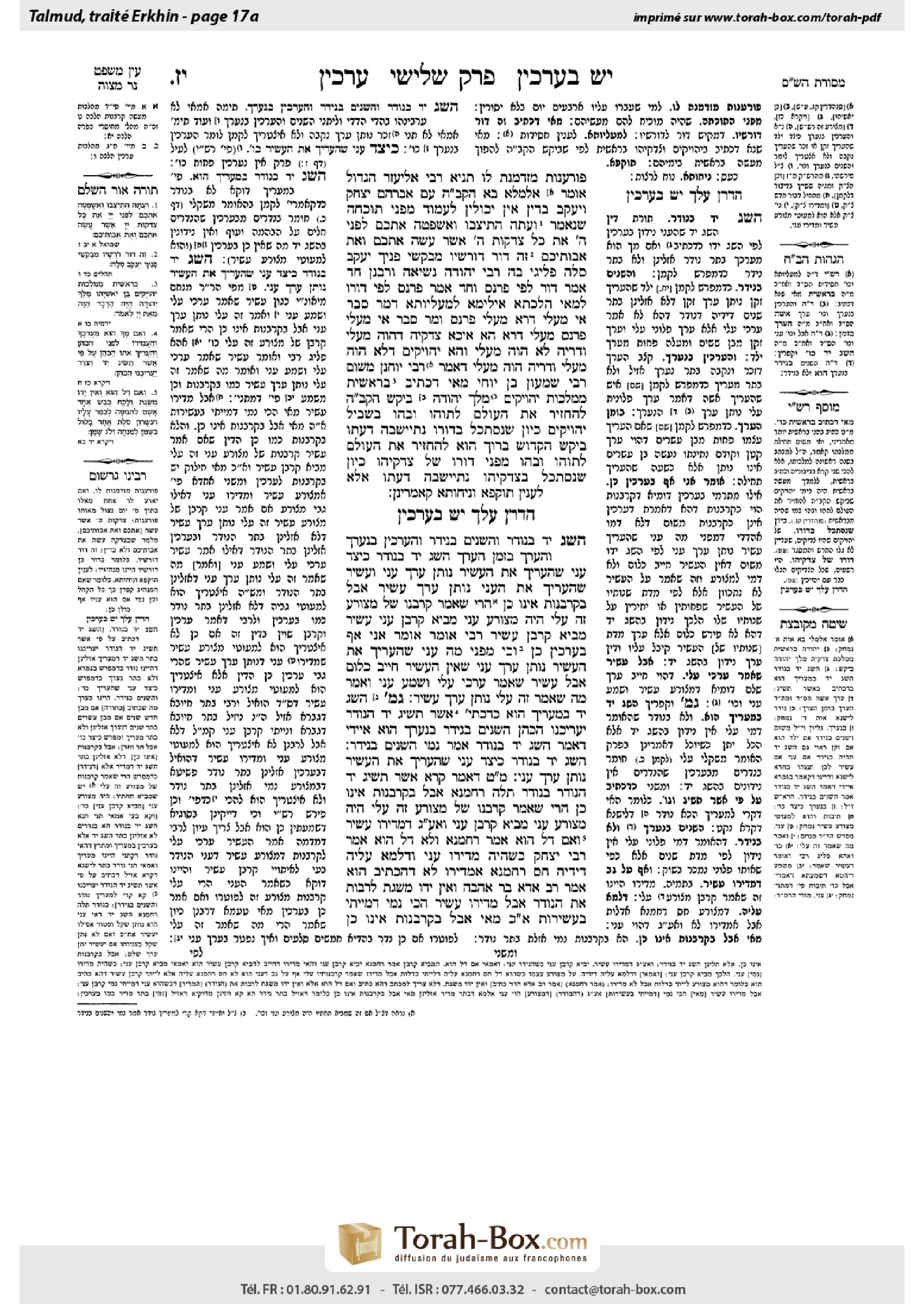
Arakhin 17a: Talmud study for Daf Yomi
Study the Talmud for Daf Yomi with scanned pages, Hebrew text, English translations from Sefaria and AI-generated French translations.
Passage selection and English or AI-generated French translation are available where the scan has annotations. Daf Study is independent of Torah-Box and Sefaria.
Browse Arakhin · ערכין · All tractatesArakhin 17a text and translations
This page of Arakhin includes the Aramaic text, an English translation and an AI-generated French translation, alongside the scan above.
ערכין י״ז א · Aramaic and Hebrew text
פּוּרְעָנוּת מִזְדַּמֶּנֶת לוֹ.
תַּנְיָא, רַבִּי אֱלִיעֶזֶר הַגָּדוֹל אוֹמֵר: אִלְמָלֵא בָּא הַקָּדוֹשׁ בָּרוּךְ הוּא עִם אַבְרָהָם יִצְחָק וְיַעֲקֹב בְּדִין, אֵין יְכוֹלִין לַעֲמוֹד מִפְּנֵי תּוֹכֵחָה, שֶׁנֶּאֱמַר: ״וְעַתָּה הִתְיַצְּבוּ וְאִשָּׁפְטָה אִתְּכֶם לִפְנֵי ה׳ אֵת כׇּל צִדְקוֹת ה׳ אֲשֶׁר עָשָׂה אִתְּכֶם וְאֶת אֲבוֹתֵיכֶם״.
״זֶה דּוֹר דֹּרְשָׁיו מְבַקְשֵׁי פָנֶיךָ יַעֲקֹב סֶלָה״, פְּלִיגִי בַּהּ רַבִּי יְהוּדָה נְשִׂיאָה וְרַבָּנַן, חַד אָמַר: דּוֹר לְפִי פַּרְנָס, וְחַד אָמַר: פַּרְנָס לְפִי דוֹרוֹ.
לְמַאי הִלְכְתָא? אִילֵּימָא לִמְעַלְּיוּתָא, דְּמָר סָבַר: אִי מְעַלֵּי דָּרָא מְעַלֵּי פַּרְנָס, וּמָר סָבַר: אִי מְעַלֵּי פַּרְנָס מְעַלֵּי דָּרָא — הָא אִיכָּא צִדְקִיָּה, דַּהֲוָה מְעַלֵּי וְדָרֵיהּ לָא הֲוָה מְעַלֵּי, וְהָא יְהוֹיָקִים, דְּלָא הֲוָה מְעַלֵּי וְדָרֵיהּ הֲוָה מְעַלֵּי!
דְּאָמַר רַבִּי יוֹחָנָן מִשּׁוּם רַבִּי שִׁמְעוֹן בֶּן יוֹחַי: מַאי דִּכְתִיב ״בְּרֵאשִׁית מַמְלְכוּת יְהוֹיָקִים מֶלֶךְ יְהוּדָה״?
בִּיקֵּשׁ הַקָּדוֹשׁ בָּרוּךְ הוּא לְהַחֲזִיר אֶת הָעוֹלָם לְתוֹהוּ וָבֹהוּ בִּשְׁבִיל יְהוֹיָקִים, כֵּיוָן שֶׁנִּסְתַּכֵּל בְּדוֹרוֹ נִתְיַישְּׁבָה דַּעְתּוֹ. בִּיקֵּשׁ הַקָּדוֹשׁ בָּרוּךְ הוּא לְהַחְזִיר אֶת הָעוֹלָם לְתוֹהוּ וָבֹהוּ מִפְּנֵי דּוֹרוֹ שֶׁל צִדְקִיָּהוּ, כֵּיוָן שֶׁנִּסְתַּכֵּל בְּצִדְקִיָּהוּ נִתְיַישְּׁבָה דַּעְתּוֹ.
אֶלָּא לְעִנְיַן תּוּקְפָּא וְנִיחוּתָא קָאָמְרִינַן.
הֲדַרַן עֲלָךְ יֵשׁ בַּעֲרָכִין.
מַתְנִי׳ הֶשֵּׂג יָד בַּנּוֹדֵר, וְהַשָּׁנִים בַּנִּידָּר, וְהָעֲרָכִין בַּנֶּעֱרָךְ, וְהָעֵרֶךְ בִּזְמַן הָעֵרֶךְ.
הֶשֵּׂג יָד בַּנּוֹדֵר, כֵּיצַד? עָנִי שֶׁהֶעֱרִיךְ אֶת הֶעָשִׁיר — נוֹתֵן עֵרֶךְ עָנִי, וְעָשִׁיר שֶׁהֶעֱרִיךְ אֶת הֶעָנִי — נוֹתֵן עֵרֶךְ עָשִׁיר.
אֲבָל בַּקׇּרְבָּנוֹת אֵינוֹ כֵּן, הֲרֵי שֶׁאָמַר: ״קׇרְבָּנוֹ שֶׁל מְצוֹרָע זֶה עָלַי״, הָיָה מְצוֹרָע עָנִי — מֵבִיא קׇרְבַּן עָנִי, עָשִׁיר — מֵבִיא קׇרְבַּן עָשִׁיר.
רַבִּי אוֹמֵר, אוֹמֵר אֲנִי: אַף בָּעֲרָכִין כֵּן, וְכִי מִפְּנֵי מָה עָנִי שֶׁהֶעֱרִיךְ אֶת הֶעָשִׁיר נוֹתֵן עֵרֶךְ עָנִי, שֶׁאֵין הֶעָשִׁיר חַיָּיב כְּלוּם. אֲבָל עָשִׁיר שֶׁאָמַר: ״עֶרְכִּי עָלַי״, וְשָׁמַע עָנִי וְאָמַר: ״מַה שֶּׁאָמַר זֶה עָלַי״ — נוֹתֵן עֵרֶךְ עָשִׁיר.
גְּמָ׳ הֶשֵּׂג יָד בַּמַּעֲרִיךְ הוּא! כְּדִכְתִיב: ״אֲשֶׁר תַּשִּׂיג יַד הַנּוֹדֵר יַעֲרִיכֶנּוּ הַכֹּהֵן״.
הַשָּׁנִים בַּנִּידָּר? בַּנֶּעֱרָךְ הוּא! אַיְּידֵי דְּאָמַר ״הֶשֵּׂג יָד בַּנּוֹדֵר״, אָמַר נָמֵי ״הַשָּׁנִים בַּנִּידָּר״.
הֶשֵּׂג יָד בַּנּוֹדֵר, כֵּיצַד? עָנִי שֶׁהֶעֱרִיךְ אֶת הֶעָשִׁיר נוֹתֵן עֵרֶךְ עָנִי. מַאי טַעְמָא? דְּאָמַר קְרָא: ״אֲשֶׁר תַּשִּׂיג יַד הַנֹּדֵר״ — בְּנוֹדֵר תְּלָה רַחֲמָנָא.
אֲבָל בַּקׇּרְבָּנוֹת אֵינוֹ כֵּן, הֲרֵי שֶׁאָמַר: ״קׇרְבָּנוֹ שֶׁל מְצוֹרָע זֶה עָלַי׳״, הָיָה מְצוֹרָע עָנִי מֵבִיא קׇרְבַּן עָנִי, וְאַף עַל גַּב דְּמַדִּירוֹ עָשִׁיר? וְאִם דַּל הוּא אָמַר רַחֲמָנָא, וְלֹא דַּל הוּא.
אָמַר רַבִּי יִצְחָק: כְּשֶׁהָיָה מַדִּירוֹ עָנִי, וְדִלְמָא עֲלֵיהּ דִּידֵיהּ חָס רַחֲמָנָא, אַמַּדִּירוֹ לָא, דְּהָכְתִיב: ״הוּא״.
אָמַר רַב אַדָּא בַּר אַהֲבָה: ״וְאֵין יָדוֹ מַשֶּׂגֶת״ לְרַבּוֹת אֶת הַנּוֹדֵר.
אֲבָל מַדִּירוֹ עָשִׁיר, הָכִי נָמֵי דְּמַיְיתֵי בַּעֲשִׁירוּת?
אִם כֵּן, מַאי ״אֲבָל בַּקׇּרְבָּנוֹת אֵינוֹ כֵּן״?
Arakhin 17a · English translation
A calamity awaits him.
§ The Gemara returns to the topic of rebuke. It is taught in a baraita that Rabbi Eliezer the Great says: Were the Holy One, Blessed be He, to have entered into judgment with Abraham, Isaac and Jacob, they would not have been able to stand before the rebuke. As it is stated: “Now therefore stand still, that I may plead with you before the Lord concerning all the righteous acts of the Lord, which He did to you and to your fathers” (I Samuel 12:7). This indicates that God acted towards the patriarchs with righteousness, i.e., mercy, not as they deserved according to the strict letter of the law.
§ The verse states: “This is the generation of them that seek after Him, that seek Your face, Jacob. Selah” (Psalms 24:6). This verse teaches that the level of the generation and those who lead them, i.e., those who seek after Him, are the same. Rabbi Yehuda Nesia and the Rabbis disagree about this. One says: The level of the generation follows the level of the leader, and one says: The level of the leader follows the level of his generation.
The Gemara asks: With regard to what halakha, i.e., matter, is this stated? If we say for good, that one Sage holds that if the generation is good then their leader will be good, and one Sage holds that if the leader is good then his generation will be good, this cannot be correct, as there is the case of King Zedekiah, who was good, but his generation was not good. And conversely, there is the case of Jehoiakim who was not good, but his generation was good.
The Gemara cites proof for these claims. As Rabbi Yoḥanan says in the name of Rabbi Shimon ben Yoḥai: What is the meaning of that which is written: “In the beginning of the reign of Jehoiakim, son of Josiah, king of Judah, came this word from the Lord, saying” (Jeremiah 26:1), and similarly with regard to Zedekiah the verse states: “And it came to pass the same year, in the beginning of the reign of Zedekiah, king of Judah, in the fourth year, in the fifth month, that Hananiah, son of Azzur, the prophet, who was of Gibeon, spoke to me in the house of the Lord, in the presence of the priests and of all the people, saying” (Jeremiah 28:1). Why did the prophet use the term “in the beginning” exclusively with regard to these two kings, as opposed to: During the first year of his reign, or a similar formulation?
This term teaches that the Holy One, Blessed be He, sought to revert the world to chaos and void, as it was in the beginning before Creation (Genesis 1:1–2), on account of Jehoiakim, who did evil in the eyes of God. Once He observed the people of his generation, His mind was settled. Likewise, the Holy One, Blessed be He, sought to revert the world to chaos and void, on account of the generation of Zedekiah, but once He observed Zedekiah, His mind was settled. This shows that the leader and his generation are not necessarily on the same level in terms of righteousness.
The Gemara answers: Rather, we are speaking in terms of harshness and gentleness. One Sage holds that if the leader is harsh, then the generation will be harsh. If the leader is gentle and kind, the generation will be the same. The other Sage holds that if the people of a certain generation are harsh, they will have a harsh leader; if the generation is gentle and kind, the leader will be similar.
MISHNA: Affordability, which is written in the Torah: “According to the means of him who vowed shall the priest valuate him” (Leviticus 27:8), is determined in accordance with the means of the one taking the vow, and the sum fixed by the Torah based on the years of age is in accordance with the age of the subject of the vow. And the distinction based on sex that is written in the halakhot of valuations is stated with regard to the one valuated, and the different valuation based on the age of the one valuated is determined at the time one takes the vow of valuation.
The mishna elaborates: Affordability is in accordance with the means of the one taking the vow; how so? A destitute person who valuated a wealthy person gives the valuation in accordance with the means of a destitute person, as determined by the priest. And a wealthy person who valuated a destitute person gives the valuation in accordance with the means of a wealthy person, the sum of which is fixed in the Torah.
But with regard to offerings that is not so, as one who took a vow and said: It is incumbent upon me to provide the offering of this leper, to a leper who requires it for his purification; if the one undergoing purification was a destitute leper, the one who took the vow brings the offering of a destitute leper, which is one male sheep, a tenth of an ephah of fine flour, and two doves or two pigeons (see Leviticus 14:21–22). If the one undergoing purification was a wealthy leper, the one who took the vow brings the offering of a wealthy leper, which is two male sheep, a ewe, and three-tenths of a ephah of fine flour (see Leviticus 14:10).
Rabbi Yehuda HaNasi says: I say: Even with regard to valuations it is so. He explains: For what reason does a destitute person who valuated a wealthy person give the valuation in accordance with the means of a destitute person? It is due to the fact that the wealthy person is not obligated to pay anything, as the debt was generated by the destitute person who vowed to donate the valuation of a wealthy individual. But in a case similar to that of the offerings of a leper, in the case of a wealthy person who said: It is incumbent upon me to donate my valuation, and a destitute person heard him and said: It is incumbent upon me to donate that which he said, the destitute person gives the valuation of a wealthy person.
GEMARA: The mishna teaches that affordability is determined in accordance with the means of the one taking the vow. The Gemara asks: The halakha of affordability is written in the Torah with regard to the case of one who valuates, i.e., one who says he will give the Temple treasury the set sum assigned to a particular individual’s age and sex. Why, then, is the mishna referring to affordability in the context of one pledging another’s worth by taking a vow, in which the obligation is calculated individually rather than by predetermined assigned values? The Gemara answers: The mishna employs the language of the verse, which uses the word “vow,” as it is written: “According to the means of him who vowed shall the priest valuate him” (Leviticus 27:8).
Similarly, the Gemara asks: Is the mishna’s wording accurate when it states that the sum of the obligation based on the years of age is in accordance with the age of the subject of the vow? The mishna should state that the sum based on years is determined in accordance with the age of the subject of the valuation, not the vow. The Gemara answers: Although it is discussing valuations, since the mishna uses the term vow when it says: Affordability is determined in accordance with the means of the one taking the vow, the mishna also deploys the same term when it says: The sum of the obligation based on the years of age is in accordance with the age of the subject of the vow.
The mishna further teaches: Affordability is in accordance with the one taking the vow; how so? A destitute person who valuated a wealthy person gives the valuation in accordance with the means of the destitute person. The Gemara asks: What is the reason? As the verse states: “According to the means of him who vowed,” which teaches that the Merciful One renders the matter dependent on the one who vows, not upon the subject of the vow.
§ The mishna teaches: But with regard to offerings that is not so, as in the case of one who vowed and said: It is incumbent upon me to provide the offering of this leper, if the one undergoing purification was a destitute leper, the one who vowed brings the offering of a destitute leper. The Gemara asks: And is this the halakha even though it was a wealthy person who takes the vow to provide the offerings for him? But the Merciful One states: “And if he is poor, and his means do not suffice, then he shall take one sheep” (Leviticus 14:21). This indicates that the specified offering is only for the poor, and in this instance the one taking the vow is not poor.
Rabbi Yitzḥak said: The mishna is referring specifically to a case where it was a poor person who was taking the vow to provide the offerings for the leper. The Gemara asks: But what is the basis for this ruling? Perhaps the Merciful One had compassion on him, i.e., the leper, and not on the one taking the vow to provide the offerings for him. As isn’t it written: “And if he is poor”? If so, the leniency that a destitute leper brings less expensive offerings should apply only to an actual leper, and not to one who vows to bring the leper’s offerings, even if he too is poor.
Rav Adda bar Ahava said: The next clause in the verse: “And his means do not suffice,” serves to include the one taking the vow to provide the offering, i.e., if he too is poor he provides the offering mandated for a destitute leper.
The Gemara raises a difficulty with the answer of Rabbi Yitzḥak: But according to this answer, when a wealthy person takes the vow to provide the offering for him, so too, the halakha is that he brings the offering of the leper brought in a situation of wealth.
If so, what is the meaning of the mishna’s statement that valuations are determined based on the means of the one making the commitment, but with regard to offerings, that is not so? This clause seems to indicate that unlike the previous ruling, where a wealthy person who valuated a destitute individual gives the valuation in accordance with the means of a wealthy person, here it all depends on the means of the one undergoing purification. Therefore, in this case a wealthy person brings the offerings of one who is destitute, contrary to the statement of Rabbi Yitzḥak.
Arakhin 17a · Traduction française (IA)
Une calamité l'attend.
§ La Guemara reprend le sujet de la réprobation. Il est enseigné dans une baraïta que Rabbi Eliezer le Grand dit : Si le Saint, le Bienheureux, avait jugé Abraham, Isaac et Jacob, ils n'auraient pas pu résister à la réprobation. Comme il est dit : « Maintenant donc, tenez-vous donc, afin que je puisse prier devant l'Éternel concernant toutes les actions justes de l'Éternel, qu'Il a faites envers vous et envers vos pères » (1 Samuel 12:7). Cela indique que Dieu a agi envers les patriarches avec la justice, c'est-à-dire la miséricorde, et non selon ce qu'ils méritaient selon la lettre stricte de la loi.
§ La versette dit : « C'est la génération de ceux qui cherchent après Lui, qui cherchent Votre visage, Jacob. Selah » (Psaumes 24:6). Cette versette enseigne que le niveau de la génération et ceux qui les dirigent, c'est-à-dire ceux qui cherchent après Lui, sont les mêmes. Rabbi Yehuda Nesia et les Rabbins sont en désaccord à ce sujet. L'un dit : le niveau de la génération suit le niveau du leader, et l'autre dit : le niveau du leader suit le niveau de sa génération.
La Guemara pose la question : à quel halakha, c'est-à-dire à quel sujet, cela est-il dit ? Si nous disons pour le bien, que l'un des Sages affirme que si la génération est bonne alors son leader sera bon, et que l'autre Sage affirme que si le leader est bon alors sa génération sera bonne, cela ne peut pas être correct, car il y a le cas du roi Zédéquias, qui était bon, mais sa génération ne l'était pas. Et inversement, il y a le cas de Jéhoïakim, qui n'était pas bon, mais sa génération était bonne.
La Guemara cite des preuves pour ces affirmations. Comme Rabbi Yoḥanan dit au nom de Rabbi Shimon ben Yoḥai : Quelle est la signification de ce qui est écrit : « Au commencement du règne de Jéhoïakim, fils de Josias, roi de Juda, vint ce mot de l'Éternel, disant » (Jérémie 26:1), et de même concernant Zédéquias, la versette dit : « Et il arriva la même année, au commencement du règne de Zédéquias, roi de Juda, en la quatrième année, en le cinquième mois, que Hananiah, fils d'Azzur, le prophète, qui était de Gibeon, parla à moi dans la maison de l'Éternel, en présence des prêtres et de tout le peuple, disant » (Jérémie 28:1). Pourquoi le prophète a-t-il utilisé le terme « au commencement » uniquement concernant ces deux rois, contrairement à : « Au premier an de son règne », ou une formulation similaire ?
Ce terme enseigne que l'Éternel, le Bienheureux, a cherché à ramener le monde à la confusion et au vide, comme il était au début avant la Création (Genèse 1:1–2), à cause de Jéhoïakim, qui a fait le mal aux yeux de l'Éternel. Une fois qu'Il a observé le peuple de sa génération, Son esprit s'est apaisé. De même, l'Éternel, le Bienheureux, a cherché à ramener le monde à la confusion et au vide à cause de la génération de Zédéquias, mais une fois qu'Il a observé Zédéquias, Son esprit s'est apaisé. Cela montre que le leader et sa génération ne sont pas nécessairement au même niveau en termes de justice.
La Guemara répond : Plutôt, nous parlons en termes de sévérité et de douceur. L'un des Sages affirme que si le leader est sévère, alors la génération sera sévère. Si le leader est doux et bienveillant, la génération sera la même. L'autre Sage affirme que si la génération d'une certaine époque est sévère, elle aura un leader sévère ; si la génération est douce et bienveillante, le leader sera similaire.
MICHNA : L'affordability, qui est écrite dans la Torah : « Selon les moyens de celui qui a fait un vœu, le prêtre évalue » (Lévitique 27:8), est déterminée selon les moyens de celui qui fait le vœu, et la somme fixée par la Torah selon l'âge est déterminée selon l'âge de la personne sur laquelle le vœu est fait. Et la distinction selon le sexe, qui est écrite dans les halakhot des évaluations, est mentionnée concernant la personne évaluée, et l'évaluation différente selon l'âge de la personne évaluée est déterminée au moment où l'on fait le vœu d'évaluation.
La mishna développe : L'affordability est selon les moyens de celui qui fait le vœu ; comment cela se passe-t-il ? Un homme pauvre qui évalue un homme riche donne l'évaluation selon les moyens d'un homme pauvre, comme déterminé par le prêtre. Et un homme riche qui évalue un homme pauvre donne l'évaluation selon les moyens d'un homme riche, la somme étant fixée dans la Torah.
Mais concernant les offrandes, ce n'est pas ainsi, car celui qui a fait un vœu et a dit : Il m'est commandé de fournir l'offrande de ce lépreux, à un lépreux qui en a besoin pour sa purification ; si celui qui subissait la purification était un lépreux pauvre, celui qui a fait le vœu apporte l'offrande d'un lépreux pauvre, qui est un bouc mâle, un dixième d'ephah de farine fine, et deux pigeons ou deux moineaux (voir Lévitique 14:21–22). Si celui qui subissait la purification était un lépreux riche, celui qui a fait le vœu apporte l'offrande d'un lépreux riche, qui est deux boucs mâles, une brebis, et trois dixièmes d'ephah de farine fine (voir Lévitique 14:10).
Rabbi Yehuda HaNasi dit : Je dis : Même concernant les évaluations, cela est ainsi. Il explique : Pour quelle raison un homme pauvre qui évalue un homme riche donne l'évaluation selon les moyens d'un homme pauvre ? C'est en raison du fait que l'homme riche n'est pas tenu de payer quoi que ce soit, car la dette a été générée par l'homme pauvre qui a fait vœu de donner l'évaluation d'un homme riche. Mais dans un cas similaire à celui des offrandes du lépreux, dans le cas d'un homme riche qui a dit : Il m'est commandé de donner mon évaluation, et un homme pauvre a entendu et a dit : Il m'est commandé de donner ce que dit l'autre, l'homme pauvre donne l'évaluation d'un homme riche.
GUEMARA : La Michna enseigne que l'affordabilité est déterminée selon les moyens de celui qui prend le serment. La Guemara pose la question : La halakha de l'affordabilité est écrite dans la Torah concernant le cas d'une personne qui évalue, c'est-à-dire une personne qui dit qu'elle donnera au trésor du Temple la somme fixe assignée à l'âge et au sexe d'une personne donnée. Pourquoi, alors, la Michna mentionne-t-elle l'affordabilité dans le contexte d'une personne qui s'engage à payer la valeur d'une autre en prenant un serment, dans lequel l'obligation est calculée individuellement plutôt que selon des valeurs prédéterminées ? La Guemara répond : La Michna utilise la formulation du verset, qui utilise le mot « serment », comme il est écrit : « Selon les moyens de celui qui a pris le serment, le prêtre évaluera » (Lévitique 27:8).
De même, la Guemara pose la question : La formulation de la Michna est-elle exacte lorsqu'elle affirme que la somme de l'obligation basée sur l'âge est déterminée selon l'âge de la personne concernée par le serment ? La Michna devrait affirmer que la somme basée sur les années est déterminée selon l'âge de la personne évaluée, et non selon le serment. La Guemara répond : Bien qu'il s'agisse d'évaluations, puisque la Michna utilise le terme « serment » lorsqu'elle dit : « L'affordabilité est déterminée selon les moyens de celui qui prend le serment », la Michna utilise également le même terme lorsqu'elle dit : « La somme de l'obligation basée sur l'âge est déterminée selon l'âge de la personne concernée par le serment. »
La Michna enseigne davantage : L'affordabilité est déterminée selon celui qui prend le serment ; comment ? Un pauvre qui évalue un riche donne l'évaluation selon les moyens du pauvre. La Guemara pose la question : Quelle est la raison ? Comme le verset stipule : « Selon les moyens de celui qui a pris le serment », ce qui enseigne que l'Éternel rend la question dépendante de celui qui prend le serment, et non de la personne concernée par le serment.
§ La Michna enseigne : Mais cela n'est pas le cas concernant les offrandes, comme dans le cas d'une personne qui a pris le serment et a dit : Il m'est imposé de fournir l'offrande de ce lépreux, si la personne en purification était un lépreux pauvre, celui qui a pris le serment apporte l'offrande d'un lépreux pauvre. La Guemara pose la question : Et cela est-il ainsi même si c'était une personne riche qui a pris le serment pour fournir les offrandes pour lui ? Mais l'Éternel dit : « Et s'il est pauvre, et ses moyens ne suffisent pas, alors il prendra un seul agneau » (Lévitique 14:21). Cela indique que l'offrande spécifiée est uniquement pour le pauvre, et dans ce cas, celui qui a pris le serment n'est pas pauvre.
Rabbi Yitzḥak a dit : La Michna fait référence spécifiquement à un cas où c'était une personne pauvre qui prenait le serment pour fournir les offrandes pour le lépreux. La Guemara pose la question : Mais quelle est la base de cette décision ? Peut-être que l'Éternel a eu pitié de lui, c'est-à-dire du lépreux, et non de celui qui prenait le serment pour fournir les offrandes pour lui. Ne dit-on pas : « Et s'il est pauvre » ? Si c'est le cas, la leniérance selon laquelle un lépreux pauvre apporte des offrandes moins coûteuses devrait s'appliquer uniquement à un lépreux réel, et non à celui qui prend le serment pour apporter les offrandes du lépreux, même s'il est lui-même pauvre.
Rav Adda bar Ahava a dit : La clause suivante du verset : « Et ses moyens ne suffisent pas », sert à inclure celui qui prend le serment pour fournir l'offrande, c'est-à-dire si lui-même est pauvre, il apporte l'offrande prescrite pour un lépreux pauvre.
La Guemara soulève une difficulté concernant la réponse de Rabbi Yitzḥak : Mais selon cette réponse, lorsque une personne riche prend le serment pour fournir l'offrande pour lui, la halakha est également que celui-ci apporte l'offrande du lépreux dans un cas de richesse.
Si c'est ainsi, quelle est la signification de l'affirmation de la Michna selon laquelle les évaluations sont déterminées selon les moyens de celui qui prend l'engagement, mais concernant les offrandes, cela n'est pas le cas ? Cette clause semble indiquer que contrairement à la précédente décision, où une personne riche qui évalue une personne pauvre donne l'évaluation selon les moyens d'une personne riche, ici tout dépend des moyens de la personne en purification. Ainsi, dans ce cas, une personne riche apporte les offrandes d'une personne pauvre, contrairement à l'affirmation de Rabbi Yitzḥak.
Traduction française générée par IA à partir de l’édition anglaise de Sefaria. Vérifie toujours un passage avec le texte source.
Text from Sefaria: William Davidson Edition - Vocalized Aramaic (CC BY NC); William Davidson Edition - English (CC BY NC).