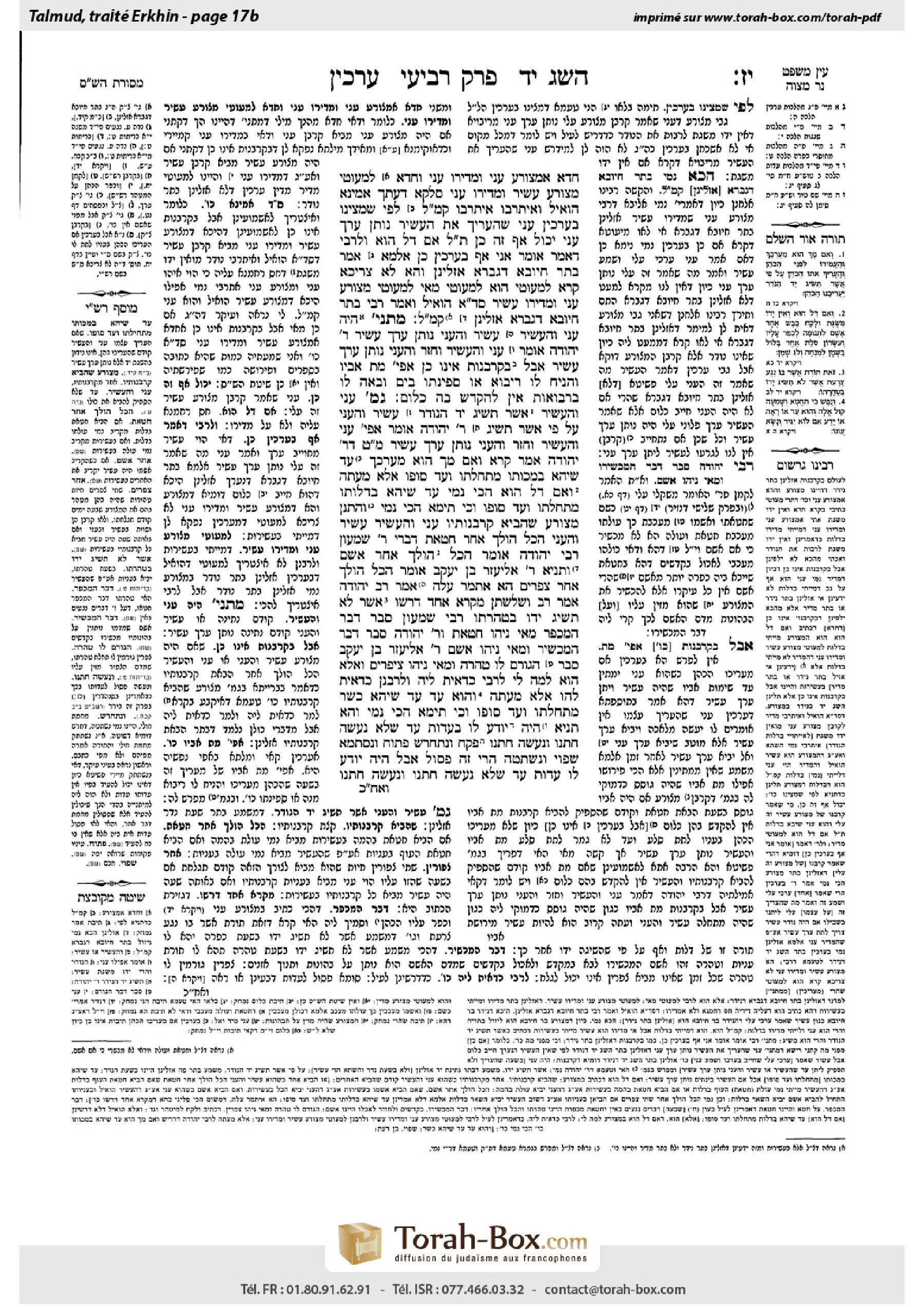
Arakhin 17b: Talmud study for Daf Yomi
Study the Talmud for Daf Yomi with scanned pages, Hebrew text, English translations from Sefaria and AI-generated French translations.
Passage selection and English or AI-generated French translation are available where the scan has annotations. Daf Study is independent of Torah-Box and Sefaria.
Browse Arakhin · ערכין · All tractatesArakhin 17b text and translations
This page of Arakhin includes the Aramaic text, an English translation and an AI-generated French translation, alongside the scan above.
ערכין י״ז ב · Aramaic and Hebrew text
חֲדָא אַמְּצוֹרָע עָנִי וּמַדִּירוֹ עָנִי, וַחֲדָא לְמַעוֹטֵי מְצוֹרָע עָשִׁיר וּמַדִּירוֹ עָנִי.
סָלְקָא דַּעְתָּךְ אָמֵינָא: הוֹאִיל וְאִיתְרַבּוֹ, אִיתְרַבּוֹ, קָא מַשְׁמַע לַן.
לְפִי שֶׁמָּצִינוּ בַּעֲרָכִין, עָנִי שֶׁהֶעֱרִיךְ אֶת הֶעָשִׁיר נוֹתֵן עֵרֶךְ עָנִי, יָכוֹל אַף זֶה כֵּן, תַּלְמוּד לוֹמַר ״אִם דַּל הוּא״.
וּלְרַבִּי, דְּאָמַר: ״אוֹמֵר אֲנִי אַף בַּעֲרָכִין כֵּן״ — אַלְמָא אָמַר: בָּתַר חִיּוּבָא דְּגַבְרָא אָזְלִינַן, וְהָא לָא צְרִיכָא קְרָא לְמַעוֹטֵי הוּא, לְמַעוֹטֵי מַאי?
לְמַעוֹטֵי מְצוֹרָע עָנִי וּמַדִּירוֹ עָשִׁיר, סָלְקָא דַּעְתָּךְ אָמֵינָא: הוֹאִיל וְאָמַר רַבִּי: ״בָּתַר חִיּוּבָא דְּגַבְרָא אָזְלִינַן״, קָא מַשְׁמַע לַן.
מַתְנִי׳ הָיָה עָנִי וְהֶעֱשִׁיר, עָשִׁיר וְהֶעֱנִי — נוֹתֵן עֵרֶךְ עָשִׁיר. רַבִּי יְהוּדָה אוֹמֵר: עָנִי וְהֶעֱשִׁיר וְחָזַר וְהֶעֱנִי — נוֹתֵן עֵרֶךְ עָשִׁיר.
אֲבָל בַּקׇּרְבָּנוֹת אֵינוֹ כֵּן, אֲפִילּוּ מֵת אָבִיו וְהִנִּיחַ לוֹ רִיבּוֹא, אוֹ סְפִינָתוֹ בַּיָּם וּבָאָה לוֹ בְּרִבּוֹאוֹת — אֵין לַהֶקְדֵּשׁ בָּהּ כְּלוּם.
גְּמָ׳ עָנִי וְהֶעֱשִׁיר — ״אֲשֶׁר תַּשִּׂיג יַד הַנֹּדֵר״. עָשִׁיר וְהֶעֱנִי — ״עַל פִּי אֲשֶׁר תַּשִּׂיג״.
רַבִּי יְהוּדָה אוֹמֵר: אֲפִילּוּ עָנִי וְהֶעֱשִׁיר וְחָזַר וְהֶעֱנִי — נוֹתֵן עֵרֶךְ עָשִׁיר. מַאי טַעְמָא דְּרַבִּי יְהוּדָה? אָמַר קְרָא: ״וְאִם מָךְ הוּא מֵעֶרְכֶּךָ״ — עַד שֶׁיְּהֵא בְּמָכוּתוֹ מִתְּחִלָּתוֹ וְעַד סוֹפוֹ.
אֶלָּא מֵעַתָּה, וְאִם ״דַּל הוּא״, הָכִי נָמֵי עַד שֶׁיְּהֵא בְּדַלּוּתוֹ מִתְּחִלָּתוֹ וְעַד סוֹפוֹ!
וְכִי תֵּימָא הָכִי נָמֵי, וְהָתְנַן: מְצוֹרָע שֶׁהֵבִיא קׇרְבְּנוֹתָיו עָנִי וְהֶעֱשִׁיר, עָשִׁיר וְהֶעֱנִי — הַכֹּל הוֹלֵךְ אַחַר חַטָּאת, דִּבְרֵי רַבִּי שִׁמְעוֹן.
רַבִּי יְהוּדָה אוֹמֵר: הַכֹּל הוֹלֵךְ אַחַר אָשָׁם, וְתַנְיָא, רַבִּי אֱלִיעֶזֶר בֶּן יַעֲקֹב אוֹמֵר: הַכֹּל הוֹלֵךְ אַחַר צִפֳּרִים!
הָא אִתְּמַר עֲלַהּ, אָמַר רַב יְהוּדָה אָמַר רַב: וּשְׁלׇשְׁתָּן מִקְרָא אֶחָד דָּרְשׁוּ, ״אֲשֶׁר לֹא תַשִּׂיג יָדוֹ בְּטׇהֳרָתוֹ״. רַבִּי שִׁמְעוֹן סָבַר: דָּבָר הַמְכַפֵּר, מַאי נִיהוּ — חַטָּאת.
וְרַבִּי יְהוּדָה סָבַר: דָּבָר הַמַּכְשִׁיר, וּמַאי נִיהוּ — אָשָׁם. רַבִּי אֱלִיעֶזֶר בֶּן יַעֲקֹב סָבַר: הַגּוֹרֵם לוֹ טׇהֳרָה, וּמַאי נִיהוּ — צִיפֳּרִים.
וְאֶלָּא ״הוּא״ לְמָה לִי? לְרַבִּי — כִּדְאִית לֵיהּ, וּלְרַבָּנַן — כִּדְאִית לְהוּ.
אֶלָּא מֵעַתָּה, ״וְהוּא עֵד״, עַד שֶׁיְּהֵא כָּשֵׁר מִתְּחִלָּתוֹ וְעַד סוֹפוֹ!
וְכִי תֵּימָא הָכִי נָמֵי, וְהָא תַּנְיָא: הָיָה יוֹדֵעַ לוֹ בְּעֵדוּת עַד שֶׁלֹּא נַעֲשָׂה חֲתָנוֹ, וְנַעֲשָׂה חֲתָנוֹ, פִּקֵּחַ וְנִתְחָרֵשׁ, פָּתוּחַ וְנִסְתַּמֵּא, שָׁפוּי וְנִשְׁתַּטָּה — הֲרֵי זֶה פָּסוּל. אֲבָל הָיָה יוֹדֵעַ לוֹ עֵדוּת עַד שֶׁלֹּא נַעֲשָׂה חֲתָנוֹ, וְנַעֲשָׂה חֲתָנוֹ,
Arakhin 17b · English translation
The Gemara explains: The mishna states two different principles with regard to one who vows to provide the offering of a leper on behalf of another. One principle applies to a destitute leper for whom another destitute person takes a vow to provide his offering. In that case, he provides the offering of the destitute. And the one other principle, i.e., the statement that the halakha is different in the case of offerings, serves to exclude the case of a wealthy leper for whom a destitute person takes a vow to provide his offering. In that situation, although the one who took the vow is destitute, he must provide the offering of a wealthy person.
The Gemara explains why this last ruling is necessary. It might enter your mind to say: Since the destitute were included in the verse: “And his means do not suffice,” with regard to the leniency which allows them to bring the offering of the destitute when taking vows to provide for destitute lepers, they should likewise be included in this leniency when providing for all lepers, even wealthy ones. Consequently, the tanna teaches us that this leniency does not apply when the lepers are wealthy.
Similarly, it is taught in a baraita: Since we find with regard to valuations that a destitute person who valuated a wealthy person gives the valuation in accordance with the means of a destitute person, one might have thought that in this case, where one takes a vow to provide the offering of a wealthy leper, the halakha is also so. Consequently, the verse states: “And if he is poor,” from which it is derived that the offering of the destitute leper is brought only when the leper himself is destitute.
The Gemara objects: But according to the opinion of Rabbi Yehuda HaNasi, this is difficult. As he says in the mishna: I say even with regard to valuations it is so, i.e., that if a wealthy person said: It is incumbent upon me to donate my valuation, and a destitute person heard him and said: It is incumbent upon me to donate that which he said, then the destitute person gives the valuation of a wealthy person. Evidently, Rabbi Yehuda HaNasi says: We follow the obligation of the original person valuated, even with regard to valuations. And if so, then the reasoning stated in the aforementioned baraita does not apply, and therefore a verse is not necessary to exclude a destitute person who takes a vow to provide a wealthy leper’s offering from having the leniency of bringing the offering of a destitute leper. Consequently, when the verse specifies: “And if he is poor,” this serves to exclude what?
The Gemara explains: The verse serves to exclude the case of a destitute leper for whom a wealthy person takes a vow. In that case, it might enter your mind to say that since Rabbi Yehuda HaNasi says: We follow the obligation of the original person specified as the subject of the vow, therefore the wealthy person brings only the offering of the destitute leper. Consequently, the exclusion from the verse: “And if he is poor,” teaches us that in this case he brings the offering of a wealthy individual, not that of the destitute leper.
MISHNA: If when one took a vow of valuation he was destitute and he became wealthy, or if he was wealthy and became destitute, he gives the valuation in accordance with the means of a wealthy person. Rabbi Yehuda says: This is the halakha not only in a case where one was wealthy either at the time he took the vow or at the time of payment; even if when one took a vow of valuation he was destitute and he became wealthy and again became destitute, he gives the valuation in accordance with the means of a wealthy person.
But with regard to the offerings of a leper that is not so, as the offerings that one brings are determined by his status at the time he brings them. Even if it is common knowledge that his father died and left him an inheritance of ten thousand dinars, or that his ship is at sea and merchandise valued at ten thousand dinars is coming into his possession, the Temple treasury has no share in it. His payment is determined solely by his present situation.
GEMARA: The mishna teaches: If he was destitute when he took the oath and he became wealthy, he gives the valuation appropriate for a wealthy individual. The Gemara explains that this is derived from the verse: “According to the means of him who vowed shall the priest valuate him” (Leviticus 27:8), and in this case he had the means of a wealthy individual when he was ready to give the donation. The mishna further teaches that one who was wealthy and became destitute also gives the valuation as though he was wealthy. The Gemara explains that this is derived from the beginning of the same verse: “According to [al pi] the means of him who vowed shall the priest valuate him.” The phrase al pi serves to emphasize the moment when the person uttered the vow with his mouth [peh], and at that moment he was wealthy.
§ The mishna teaches that Rabbi Yehuda says: Even if one made a valuation when he was destitute and he became wealthy and again became destitute, he gives the valuation according to the means of a wealthy person. The Gemara asks: What is the reasoning of Rabbi Yehuda? The verse states: “But if he is too poor for your valuation” (Leviticus 27:8). The word order serves to emphasize “he,” which indicates that he is considered poor only if he remains in his state of poverty from his beginning until his end of involvement with the vow.
The Gemara objects: If that is so, then when the verse similarly states with regard to a destitute leper: “And if he is poor” (Leviticus 14:21), so too, Rabbi Yehuda should maintain that he is considered poor only if he is in his state of poverty from his beginning until his end of bringing the leper’s offering, but if he was wealthy in between he should be obligated to bring the offering of a wealthy individual, even if he is now poor.
And if you would say that indeed, this is the halakha, but didn’t we learn in a mishna (Nega’im 14:11): With regard to a leper who brought his offerings when he was destitute, and subsequently became wealthy, or he brought his offerings when he was wealthy and then became destitute, everything follows the sin offering that the leper brings. If he was wealthy when he brought the sin offering he brings the burnt offering of a wealthy individual; if he was destitute when he brought the sin offering he brings the burnt offering of a destitute individual. This is the statement of Rabbi Shimon.
Rabbi Yehuda says: Everything, i.e., the sin offering and the burnt offering, follows his status at the time the leper’s guilt offering is brought. And it is taught in a baraita that Rabbi Eliezer ben Ya’akov says: Everything follows the offering of the birds, which are brought by the leper seven days earlier as part of his purification process. Clearly, everyone agrees that one brings the offerings of the destitute even if he is not destitute from the beginning until the end of the process.
The Gemara explains: It was stated with regard to this dispute that Rav Yehuda says that Rav says: And all three of these tanna’im derived their opinions from one verse, which deals with the destitute leper: “This is the law of him in whom is the mark of leprosy, whose means do not suffice for that which pertains to his purification” (Leviticus 14:32). Rabbi Shimon holds: The individual’s status depends on an item that atones, and what is it? The sin offering.
And Rabbi Yehuda holds: His status depends on an item that renders him fit to enter the Temple and eat consecrated food, and what is it? The guilt offering. Rabbi Eliezer ben Ya’akov holds: His status depends on that which causes him ritual purity, and what is it? The sacrificial birds, as the rite of the birds partially purifies him and enables him to bring the rest of his offerings and to complete his purification process. If so, in the particular case of a leper bringing his own offerings, it is a Torah edict that one does not need to be destitute throughout the entire process, which is why, with regard to one who takes a vow to bring the offerings of a leper, Rabbi Yehuda does not derive from the verse: “And if he is poor,” that he is considered poor only if he is in a state of poverty from the beginning, i.e., when he takes the vow, until the end, i.e., when he fulfills it.
But in that case why do I need the exclusion in the verse: “And if he is poor”? The Gemara answers: According to Rabbi Yehuda HaNasi, it is necessary in accordance with his opinion stated earlier, that it serves to exclude a wealthy individual who vows to provide the offering of a destitute leper, i.e., he must bring the offering of a wealthy individual. And according to the Rabbis, it is necessary in accordance with their opinion, that it serves to exclude a destitute individual who vows to provide the offering of the wealthy leper, and he must bring the offering of a wealthy individual.
The Gemara objects: If that is so, that Rabbi Yehuda maintains that the phrase: “And if he is poor,” teaches that one is classified as destitute only if he is destitute from beginning to end, he should similarly derive from a verse that deals with testimony: “And he is a witness, whether he has seen or known, if he does not utter it, then he shall bear his iniquity” (Leviticus 5:1), that this applies only if the witness is fit to testify from his beginning, when he obtained the information about which he is testifying, until his end, when he testifies.
And if you would say that indeed, that is the halakha with regard to the qualification of a witness, but isn’t it taught in a baraita: If someone knew testimony about another before he, the one who knew the testimony, became the other’s son-in-law, and then he became his son-in-law; or when he was able to hear, and then he became a deaf-mute; or when he could see, and he subsequently became blind; or while he was halakhically competent, and he then became an imbecile; in all these cases, he is disqualified from testifying. But if someone knew testimony about another before he became his son-in-law, and he then became his son-in-law,
Arakhin 17b · Traduction française (IA)
La Guemara explique : La Michna énonce deux principes différents concernant une personne qui jure de fournir l'offrande d'un lépreux pour le compte d'une autre. Un principe s'applique à un lépreux pauvre pour lequel une autre personne pauvre jure de fournir son offrande. Dans ce cas, il fournit l'offrande du pauvre. L'autre principe, c'est-à-dire l'affirmation que la halakha diffère dans le cas des offrandes, sert à exclure le cas d'un lépreux riche pour lequel une personne pauvre jure de fournir son offrande. Dans cette situation, bien que celui qui a pris le serment soit pauvre, il doit fournir l'offrande d'une personne riche.
La Guemara explique pourquoi cette dernière décision est nécessaire. Il pourrait entrer en votre esprit de dire : Puisque les pauvres sont inclus dans la parole : « Et ses moyens ne suffisent pas », concernant la clémence qui permet à ceux-ci de présenter l'offrande du pauvre lorsqu'ils prennent un serment pour les lépreux pauvres, ils devraient également être inclus dans cette clémence lorsqu'ils prennent soin de tous les lépreux, même les riches. Ainsi, le tanna nous enseigne que cette clémence ne s'applique pas lorsque les lépreux sont riches.
De même, il est enseigné dans une baraïta : Puisque nous trouvons concernant les estimations que la personne pauvre qui évalue une personne riche donne l'estimation selon les moyens d'une personne pauvre, on pourrait penser que dans ce cas, où l'on prend un serment pour fournir l'offrande d'un lépreux riche, la halakha est également ainsi. Ainsi, la parole : « Et s'il est pauvre », d'après laquelle on déduit que l'offrande du lépreux pauvre est présentée uniquement lorsque le lépreux lui-même est pauvre.
La Guemara s'oppose : Mais selon l'opinion de Rabbi Yehuda HaNasi, cela est difficile. Comme il le dit dans la Michna : Je dis même concernant les estimations que c'est ainsi, c'est-à-dire que si une personne riche dit : Il est obligatoire pour moi de donner mon estimation, et une personne pauvre l'entend et dit : Il est obligatoire pour moi de donner ce qu'il a dit, alors la personne pauvre donne l'estimation d'une personne riche. Évidemment, Rabbi Yehuda HaNasi dit : Nous suivons l'obligation de la personne originale évaluée, même concernant les estimations. Et si c'est ainsi, alors la raison évoquée dans la baraïta précédente ne s'applique pas, et par conséquent, une parole n'est pas nécessaire pour exclure une personne pauvre qui prend un serment pour fournir l'offrande d'un lépreux riche de bénéficier de la clémence de présenter l'offrande du lépreux pauvre. Ainsi, lorsque la parole spécifie : « Et s'il est pauvre », cela sert à exclure quoi ?
La Guemara explique : La parole sert à exclure le cas d'un lépreux pauvre pour lequel une personne riche prend un serment. Dans ce cas, il pourrait entrer en votre esprit de dire que puisque Rabbi Yehuda HaNasi dit : Nous suivons l'obligation de la personne originale spécifiée comme sujet du serment, donc la personne riche présente uniquement l'offrande du lépreux pauvre. Ainsi, l'exclusion de la parole : « Et s'il est pauvre », nous enseigne que dans ce cas, il présente l'offrande d'une personne riche, pas celle du lépreux pauvre.
MICHNA : Si, lorsqu'une personne a pris un serment d'estimation, elle était pauvre et est devenue riche, ou si elle était riche et est devenue pauvre, elle donne l'estimation selon les moyens d'une personne riche. Rabbi Yehuda dit : C'est la halakha non seulement dans le cas où une personne était riche soit au moment où elle a pris le serment, soit au moment du paiement ; même si une personne, lorsqu'elle a pris un serment d'estimation, était pauvre et est devenue riche et à nouveau pauvre, elle donne l'estimation selon les moyens d'une personne riche.
Mais concernant les offrandes d'un lépreux, cela n'est pas ainsi, car les offrandes que l'on présente sont déterminées par son statut au moment où l'on les présente. Même si c'est communément connu que son père est décédé et lui a laissé une succession de dix mille drachmes, ou que son navire est en mer et que des marchandises valant dix mille drachmes arrivent à sa possession, la trésorerie du Temple n'a pas part à cela. Son paiement est déterminé uniquement par son situation actuelle.
GUEMARA : La Michna enseigne : Si, lorsqu'il a pris le serment, il était pauvre et est devenu riche, il donne l'estimation appropriée pour une personne riche. La Guemara explique que cela est tiré de la parole : « Selon les moyens de celui qui a pris le serment, le prêtre évaluera » (Lévitique 27:8), et dans ce cas, il avait les moyens d'une personne riche lorsqu'il était prêt à donner la donation. La Michna enseigne également que celui qui était riche et est devenu pauvre doit aussi donner l'estimation comme s'il était riche. La Guemara explique que cela est tiré du début de la même parole : « Selon [al pi] les moyens de celui qui a pris le serment, le prêtre évaluera » (Lévitique 27:8). La phrase al pi sert à souligner le moment où la personne a prononcé le serment avec sa bouche [peh], et à ce moment-là, il était riche.
§ La Michna enseigne que Rabbi Yehuda dit : Même si une personne a fait une estimation lorsqu'elle était pauvre et est devenue riche et à nouveau pauvre, elle donne l'estimation selon les moyens d'une personne riche. La Guemara demande : Quel est le raisonnement de Rabbi Yehuda ? La parole dit : « Mais s'il est trop pauvre pour votre estimation » (Lévitique 27:8). L'ordre des mots sert à souligner « lui », ce qui indique qu'il est considéré comme pauvre uniquement s'il reste dans son état de pauvreté de son début jusqu'à la fin de son implication avec le serment.
La Guemara s'oppose : Si c'est ainsi, alors lorsque la Parashah mentionne de même concernant un lépreux pauvre : « Et s'il est pauvre » (Lévitique 14:21), Rabbi Yehuda devrait maintenir qu'il est considéré comme pauvre uniquement s'il est dans son état de pauvreté de son début jusqu'à la fin de l'offrande du lépreux, mais s'il était riche entretemps, il devrait être tenu d'offrir l'offrande d'une personne riche, même s'il est maintenant pauvre.
Et si l'on disait que, en effet, c'est la halakha, n'avons-nous pas appris dans une mitsva (Nega’im 14:11) : Concernant un lépreux qui apportait ses offrandes lorsqu'il était pauvre, et ensuite devint riche, ou qui apportait ses offrandes lorsqu'il était riche et ensuite devint pauvre, tout suit l'offrande expiatoire que le lépreux apporte. Si l'individu était riche lorsqu'il apportait l'offrande expiatoire, il apporte l'holocauste d'un riche ; si l'individu était pauvre lorsqu'il apportait l'offrande expiatoire, il apporte l'holocauste d'un pauvre. C'est la déclaration du Rabbi Shimon.
Le Rabbi Yehuda dit : Tout, c'est-à-dire l'offrande expiatoire et l'holocauste, suit son statut au moment où l'offrande de culpabilité du lépreux est apportée. Et il est enseigné dans une baraïta que le Rabbi Eliezer ben Ya’akov dit : Tout suit l'offrande des oiseaux, qui sont apportées par le lépreux sept jours plus tôt en tant que partie de son processus de purification. Évidemment, tout le monde convient que l'on apporte les offrandes du pauvre même si l'individu n'est pas pauvre du début jusqu'à la fin du processus.
La Guemara explique : Il a été dit concernant ce débat que Rav Yehuda dit que Rav dit : Et les trois tanna’im ont dérivé leurs opinions d'un seul verset, qui traite du lépreux pauvre : « C'est la loi de celui qui a la marque de la lépreuse, dont les moyens ne suffisent pas pour ce qui concerne sa purification » (Lévitique 14:32). Le Rabbi Shimon considère que le statut de l'individu dépend d'un objet qui expie, et quel est-ce ? L'offrande expiatoire.
Et le Rabbi Yehuda affirme que son statut dépend d'un objet qui le rend digne d'entrer dans le Temple et de manger les aliments consacrés, et quel est-ce ? L'offrande de culpabilité. Le Rabbi Eliezer ben Ya’akov affirme que son statut dépend de ce qui lui procure la pureté rituelle, et quel est-ce ? Les oiseaux sacrés, car la cérémonie des oiseaux le purifie partiellement et lui permet de présenter les autres offrandes et d'achever son processus de purification. Si c'est ainsi, dans le cas particulier d'un lépreux qui présente ses propres offrandes, c'est un décret de la Torah qui stipule qu'il n'est pas nécessaire d'être pauvre tout au long du processus, ce qui explique pourquoi, concernant celui qui prend un vœu pour présenter les offrandes d'un lépreux, le Rabbi Yehuda ne dérive pas du verset : « Et s'il est pauvre », que l'individu est considéré comme pauvre uniquement s'il est pauvre du début jusqu'à la fin, c'est-à-dire lorsqu'il prend le vœu jusqu'au moment où il l'exécute.
Mais dans ce cas, pourquoi avons-nous besoin de l'exclusion dans le verset : « Et s'il est pauvre » ? La Guemara répond : Selon le Rabbi Yehuda HaNasi, il est nécessaire selon son opinion précédente, que cela sert à exclure un individu riche qui prend un vœu pour fournir l'offrande d'un lépreux pauvre, c'est-à-dire qu'il doit présenter l'offrande d'un riche. Et selon les Rabbins, il est nécessaire selon leur opinion, que cela sert à exclure un individu pauvre qui prend un vœu pour fournir l'offrande du lépreux riche, et il doit présenter l'offrande d'un riche.
La Guemara s'oppose : Si c'est ainsi, que le Rabbi Yehuda maintient que la phrase : « Et s'il est pauvre », enseigne que l'on est considéré comme pauvre uniquement si l'on est pauvre du début à la fin, il devrait également dériver d'un verset concernant le témoignage : « Et il est un témoin, qu'il ait vu ou connu, s'il ne le dit pas, alors il portera sa iniquité » (Lévitique 5:1), que cela s'applique uniquement si le témoin est digne de témoigner du début, lorsqu'il a obtenu l'information concernant laquelle il témoigne, jusqu'à la fin, lorsqu'il témoigne.
Et si l'on disait que, en effet, c'est la halakha concernant la qualification d'un témoin, mais n'est-ce pas enseigné dans une baraïta : Si quelqu'un connaissait un témoignage concernant un autre avant qu'il ne devienne le fils de sa fille, et ensuite il devint son fils de sa fille ; ou lorsque il pouvait entendre, et ensuite il devint sourd-muet ; ou lorsque il pouvait voir, et ensuite il devint aveugle ; ou lorsqu'il était halakhiquement compétent, et ensuite il devint un imbécile ; dans tous ces cas, il est disqualifié pour témoigner. Mais si quelqu'un connaissait un témoignage concernant un autre avant qu'il ne devienne son fils de sa fille, et ensuite il devint son fils de sa fille,
Traduction française générée par IA à partir de l’édition anglaise de Sefaria. Vérifie toujours un passage avec le texte source.
Text from Sefaria: William Davidson Edition - Vocalized Aramaic (CC BY NC); William Davidson Edition - English (CC BY NC).