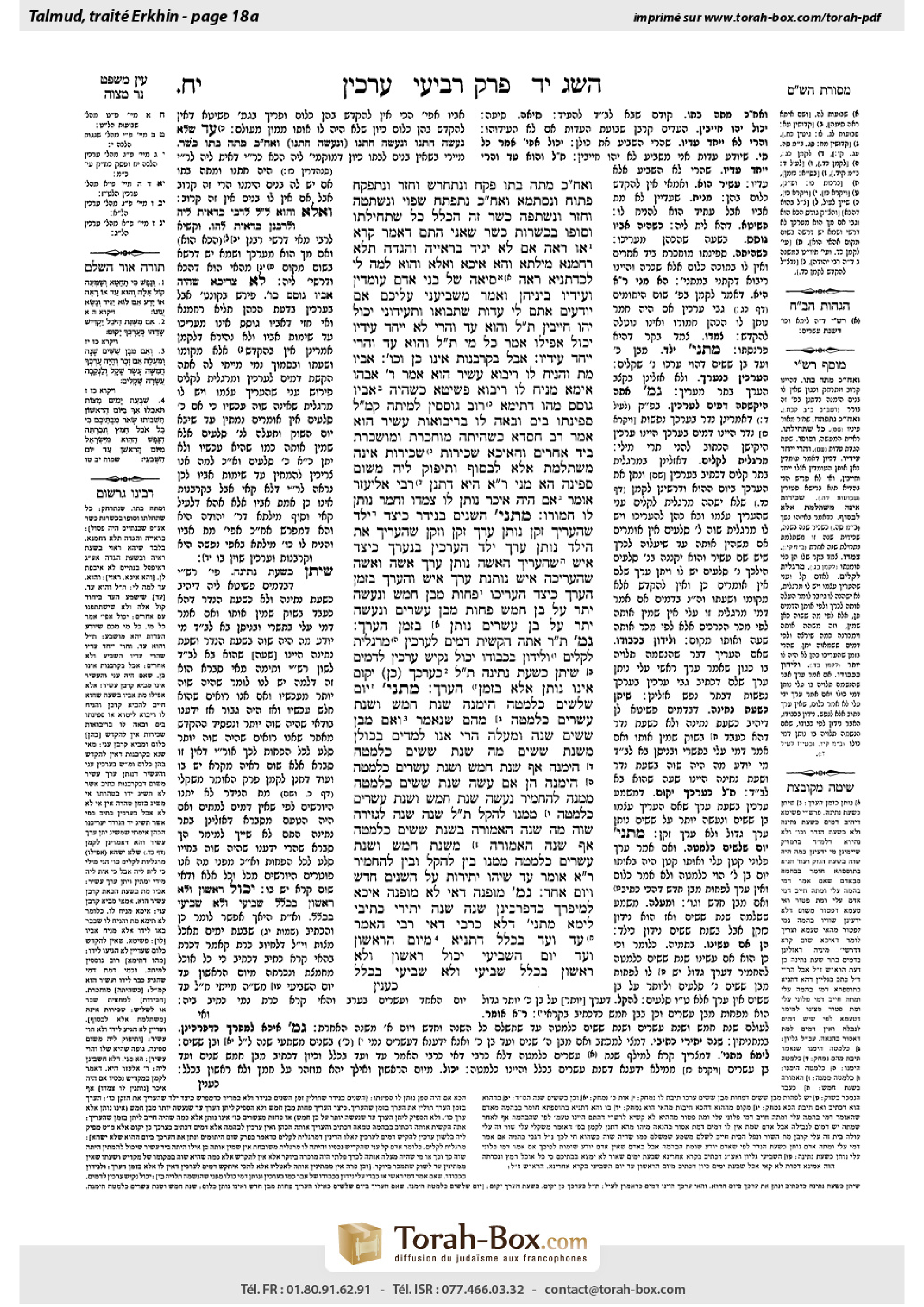
Arakhin 18a: Talmud study for Daf Yomi
Study the Talmud for Daf Yomi with scanned pages, Hebrew text, English translations from Sefaria and AI-generated French translations.
Passage selection and English or AI-generated French translation are available where the scan has annotations. Daf Study is independent of Torah-Box and Sefaria.
Browse Arakhin · ערכין · All tractatesArakhin 18a text and translations
This page of Arakhin includes the Aramaic text, an English translation and an AI-generated French translation, alongside the scan above.
ערכין י״ח א · Aramaic and Hebrew text
וְאַחַר כָּךְ מֵתָה בִּתּוֹ, פִּקֵּחַ וְנִתְחָרֵשׁ וְחָזַר וְנִתְפַּקֵּחַ, פָּתוּחַ וְנִסְתַּמֵּא וְאַחַר כָּךְ נִתְפַּתֵּחַ, שָׁפוּי וְנִשְׁתַּטָּה וְחָזַר וְנִשְׁתַּפָּה — כָּשֵׁר. זֶה הַכְּלָל: כֹּל שֶׁתְּחִילָּתוֹ וְסוֹפוֹ בְּכַשְׁרוּת — כָּשֵׁר.
שָׁאנֵי הָתָם, דְּאָמַר קְרָא: ״אוֹ רָאָה... אִם לֹא יַגִּיד״, בִּרְאִיָּיה וְהַגָּדָה תְּלָא רַחְמָנָא מִילְּתָא, וְהָא אִיכָּא. וְאֶלָּא ״וְהוּא״ לְמָה לִי?
לְכִדְתַנְיָא: רָאָה סִיאָה שֶׁל בְּנֵי אָדָם עוֹמְדִין, וְעֵידָיו בֵּינֵיהֶן, וְאָמַר ״מַשְׁבִּיעַנִי עֲלֵיכֶם אִם יוֹדְעִים אַתֶּם לִי עֵדוּת שֶׁתָּבוֹאוּ וּתְעִידוּנִי״, יָכוֹל יְהוּ חַיָּיבִין? תַּלְמוּד לוֹמַר ״וְהוּא עֵד״, וַהֲרֵי לֹא יִיחֵד עֵידָיו.
יָכוֹל אֲפִילּוּ אָמַר ״כׇּל מִי״? תַּלְמוּד לוֹמַר ״וְהוּא עֵד״, וַהֲרֵי יִיחֵד עֵידָיו.
אֲבָל בַּקׇּרְבָּנוֹת אֵינוֹ כֵּן וְכוּ׳. אָבִיו מֵת וְהִנִּיחַ לוֹ רִיבּוֹא — עָשִׁיר הוּא! אָמַר רַבִּי אֲבָהוּ, אֵימָא: מַנִּיחַ לוֹ רִיבּוֹא.
פְּשִׁיטָא! כְּשֶׁהָיָה אָבִיו גּוֹסֵס. מַהוּ דְּתֵימָא: רוֹב גּוֹסְסִין לְמִיתָה? קָא מַשְׁמַע לַן.
סְפִינָתוֹ בַּיָּם וּבָאָה לוֹ בְּרִיבּוֹאוֹת, עָשִׁיר הוּא! אָמַר רַב חִסְדָּא: כְּשֶׁהָיְתָה מוּחְכֶּרֶת וּמוּשְׂכֶּרֶת בְּיַד אֲחֵרִים. וְהָאִיכָּא שְׂכִירוּת? שְׂכִירוּת אֵינָהּ מִשְׁתַּלֶּמֶת אֶלָּא לְבַסּוֹף.
וְתִיפּוֹק לֵיהּ מִשּׁוּם סְפִינָה! הָא מַנִּי? רַבִּי אֱלִיעֶזֶר הִיא, דִּתְנַן: רַבִּי אֱלִיעֶזֶר אוֹמֵר, אִם הָיָה אִיכָּר — נוֹתֵן לוֹ צִמְדּוֹ, וְחַמָּר — נוֹתֵן לוֹ חֲמוֹרוֹ.
מַתְנִי׳ הַשָּׁנִים בַּנִּידָּר, כֵּיצַד? יֶלֶד שֶׁהֶעֱרִיךְ זָקֵן — נוֹתֵן עֵרֶךְ זָקֵן, וְזָקֵן שֶׁהֶעֱרִיךְ אֶת הַיֶּלֶד — נוֹתֵן עֵרֶךְ יֶלֶד. הָעֲרָכִין בַּנֶּעֱרָךְ, כֵּיצַד? אִישׁ שֶׁהֶעֱרִיךְ הָאִשָּׁה — נוֹתֵן עֵרֶךְ אִשָּׁה, וְאִשָּׁה שֶׁהֶעֱרִיכָה אִישׁ — נוֹתֶנֶת עֵרֶךְ אִישׁ.
וְהָעֵרֶךְ בִּזְמַן הָעֵרֶךְ, כֵּיצַד? הֶעֱרִיכוֹ פָּחוּת מִבֶּן חָמֵשׁ, וְנַעֲשֶׂה יָתֵר עַל בֶּן חָמֵשׁ, פָּחוּת מִבֶּן עֶשְׂרִים, וְנַעֲשָׂה יָתֵר עַל בֶּן עֶשְׂרִים — נוֹתֵן בִּזְמַן הָעֵרֶךְ.
גְּמָ׳ תָּנוּ רַבָּנַן: אַתָּה הִקַּשְׁיתָּ דָּמִים לַעֲרָכִין, מַרְגָּלִית לְקַלִּים, וְלִידּוֹן בִּכְבוֹדוֹ.
יָכוֹל נַקִּישׁ עֲרָכִין לְדָמִים, שֶׁיִּתֵּן כִּשְׁעַת נְתִינָה? תַּלְמוּד לוֹמַר: ״כְּעֶרְכְּךָ כֵּן יָקוּם״, אֵינוֹ נוֹתֵן אֶלָּא בִּזְמַן הָעֵרֶךְ.
מַתְנִי׳ יוֹם שְׁלֹשִׁים כִּלְמַטָּה הֵימֶנּוּ, שְׁנַת חָמֵשׁ וּשְׁנַת עֶשְׂרִים כִּלְמַטָּה מֵהֶם, שֶׁנֶּאֱמַר: ״וְאִם מִבֶּן שִׁשִּׁים שָׁנָה וָמַעְלָה״, הֲרֵי אָנוּ לְמֵדִים בְּכוּלָּן מִשְׁנַת שִׁשִּׁים, מָה שְׁנַת שִׁשִּׁים כִּלְמַטָּה הֵימֶנָּה, אַף שְׁנַת חָמֵשׁ וּשְׁנַת עֶשְׂרִים כִּלְמַטָּה הֵימֶנָּה.
הֵן? אִם עָשָׂה שְׁנַת שִׁשִּׁים כִּלְמַטָּה מִמֶּנָּה לְהַחְמִיר, נַעֲשֶׂה שְׁנַת חָמֵשׁ וּשְׁנַת עֶשְׂרִים כִּלְמַטָּה מִמֶּנָּה לְהָקֵל?
תַּלְמוּד לוֹמַר ״שָׁנָה״ ״שָׁנָה״ לִגְזֵירָה שָׁוָה, מָה שָׁנָה הָאֲמוּרָה בִּשְׁנַת שִׁשִּׁים כִּלְמַטָּה, אַף שָׁנָה הָאֲמוּרָה מִשְׁנַת חָמֵשׁ וּשְׁנַת עֶשְׂרִים כִּלְמַטָּה מִמֶּנּוּ, בֵּין לְהָקֵל וּבֵין לְהַחְמִיר. רַבִּי אֱלִיעֶזֶר אוֹמֵר: עֵד שֶׁיְּהוּ יְתֵירוֹת עַל הַשָּׁנִים חֹדֶשׁ וְיוֹם אֶחָד.
גְּמָ׳ מוּפְנֶה, דְּאִי לָא מוּפְנֶה — אִיכָּא לְמִיפְרַךְ כִּדְפָרְכִינַן. ״שָׁנָה״ ״שָׁנָה״ יַתִּירָא כְּתִיבִי.
לֵימָא מַתְנִיתִין דְּלָא כְּרַבִּי, דְּאִי רַבִּי — הָאָמַר: ״עַד״ ״וְעַד״ בַּכְּלָל.
דְּתַנְיָא: ״מִיּוֹם הָרִאשׁוֹן וְעַד יוֹם הַשְּׁבִיעִי״, יָכוֹל רִאשׁוֹן וְלֹא רִאשׁוֹן בַּכְּלָל, שְׁבִיעִי וְלֹא שְׁבִיעִי בַּכְּלָל,
Arakhin 18a · English translation
and afterward his wife, who was the daughter of the father-in-law, died, which means that the witness is no longer related to the party involved; or when he was able to hear, and then became a deaf-mute, and again became able to hear; or when he could see, and subsequently became blind, and afterward could see again; or when he was halakhically competent, and then became an imbecile, and again became halakhically competent; in all these cases he is fit to testify.This is the principle: Any individual whose beginning and end is in a state of qualification to serve as a witness is qualified to testify, even if he was unfit in the interim. Evidently, it is not derived from the verse: “And he is a witness,” that the witness must be fit from the beginning to the end.
The Gemara explains: The halakha is different there, with regard to testimony, as the verse states: “He is a witness, whether he has seen…if he does not utter” (Leviticus 5:1). This formulation indicates that the Merciful One renders the matter of testimony dependent on seeing and recounting the content of his testimony. And in this instance there is both valid seeing and valid recounting, despite the fact that the witness was disqualified in the interim. The Gemara asks: But if so, why do I need the exclusion of the verse: “And he is a witness”?
The Gemara answers: The limiting clause is necessary for that which is taught in a baraita: If someone saw a crowd of people standing, and his witnesses were among them, and he said: I hereby administer an oath to you, if you know any testimony relating to me, that you will come and testify for me, one might have thought that this form of address suffices to single out the witnesses. This would mean that if the witnesses take a false oath that they do not know testimony with regard to the person who addressed them, they would be obligated to bring an offering of an oath of testimony. Therefore, the verse states: “And he is a witness,” to emphasize that the offering applies only to one who is singled out as a witness, and in this case the individual did not single out his witnesses, as he addressed a whole crowd of people. Consequently, the witnesses are exempt.
The baraita continues: One might have thought that even if this individual said to the crowd: I adjure whoever knows testimony relating to me that he will come and testify for me, that even in the case of this more specific address the witnesses are likewise exempt from the offering of an oath of testimony. Therefore, the verse states: “And he is a witness,” and by clarifying his appeal the individual did single out his witnesses. Consequently, in this situation the witnesses would be obligated to bring the offering.
§ The mishna teaches: But with regard to the offerings of a leper that is not so. If the leper is destitute, even if his father died and left him ten thousand dinars, the Temple treasury has no share in it. The Gemara raises a difficulty: If his father already died and left him ten thousand dinars, he is wealthy. How could he be considered destitute at all? Rabbi Abbahu said that one should say instead: His father is dying and leaving him ten thousand dinars, but he has not yet died.
The Gemara raises a further difficulty: If so, it is obvious that with regard to the Temple treasury he remains destitute, as at the time he is in fact destitute. The Gemara answers: The halakha was stated with regard to a case where his father is moribund. Lest you say that as the majority of moribund people proceed to die the son should be considered wealthy even before the father dies, the mishna therefore teaches us that the son retains his status as destitute until the father actually dies.
The mishna likewise teaches: If his ship is at sea and merchandise valued at ten thousand dinars is coming into his possession, this money is not taken into consideration by the Temple treasury. The Gemara asks: But isn’t he wealthy? Rav Ḥisda said: The mishna is referring to a case where his ship was leased or rented to others, and therefore the merchandise it contains belongs to someone else. The Gemara asks: But isn’t there the rent money that will be paid to the leper? The Gemara answers: Rent is paid only at the end of the rental period, which means that the owner is destitute in the meantime.
The Gemara raises another difficulty: But let the mishna derive and determine that the leper is wealthy due to the fact that he owns a ship. The Gemara answers: In accordance with whose opinion is this statement in the mishna? It is in accordance with the opinion of Rabbi Eliezer, who maintains that with regard to determining one’s obligation to bring an offering as a wealthy or destitute individual, the property that he uses for business is not taken into account. As we learned in a mishna (23b): When someone’s property is repossessed in order to pay his debt to the Temple treasury, Rabbi Eliezer says: If he was a farmer, the treasurer gives him permission to keep his pair of oxen with which he plows the field. If he was a donkey driver, the treasurer gives him permission to keep his donkey.
MISHNA: The sum fixed by the Torah based on the years of age is in accordance with the age of the subject of the vow; how so? A youth who valuated an elder gives the valuation of an elder, and an elder who valuated a youth gives the valuation of a youth. And the distinction based on sex that is written in the halakhot of valuations is stated with regard to the one valuated; how so? A man who valuated a woman gives the valuation of a woman, and a woman who valuated a man gives the valuation of a man.
And the different valuation based on the age of the one valuated is determined at the time one takes the vow of valuation; how so? If one valuated another when he was less than five years old, when his valuation is five shekels, and before payment to the Temple treasury the subject of the vow became more than five years old, when his valuation is ten shekels; or if one valuated another when he was less than twenty years old, when his valuation is ten shekels, and before payment to the Temple treasury the subject of the vow became more than twenty years old, when his valuation is fifty shekels, in all these cases he gives payment according to the age of the subject of the valuation at the time of the valuation.
GEMARA: With regard to the statement of the mishna: And the valuation is determined at the time one takes the vow of valuation, the Sages taught in a baraita: You have compared pledges of assessments for the Temple treasury, i.e., one who takes a vow to donate a certain person’s assessment, to vows of valuations. This comparison applies with regard to a pearl belonging to light people, i.e., the poor. In other words, just as the assessment of a pearl is determined by the pearl’s location in a village of the poor rather than by the potential price of the pearl in the city market, so too, the valuation of a person is determined at the time of the valuation. And similarly, the comparison teaches that the court is required to assess the value of the limb by its significance, i.e., in the case of a limb that is vital to one’s survival, the valuation of the limb is equivalent to the valuation of the whole person.
One might have thought that we should compare valuations to assessments in that the one pledging must give a person’s valuation not corresponding to his value at the time of the pledge but in accordance with his value at the time of giving, as is the case with regard to vows of assessments. To counter this suggestion the verse states: “According to your valuation it shall stand” (Leviticus 27:17), which teaches that the one making the valuation gives his donation only according to the valuation of the person at the time of the valuation, as stated in the mishna.
MISHNA: The Torah provides three age categories that determine the amount of the valuation: From the age of one month until age five, from age five until age twenty, and from age twenty until age sixty. For anyone less than one month old there is no valuation. The halakhic status of the thirtieth day is like that of the period preceding thirty days, and therefore the one who took the vow is exempt. Likewise, the halakhic status of the fifth year and the twentieth year is like that of the period preceding them. As it is stated: “And if it is from sixty years old and upward” (Leviticus 27:7), and we derive all the other age categories from the sixtieth year: Just as the halakhic status of the sixtieth year, where upward is written, is like that of the period preceding it, so too, the halakhic status of the fifth year and the twentieth year is like that of the period preceding them.
The mishna asks: Is that so? Can one derive a halakha in this manner? If the Torah rendered the halakhic status of the sixtieth year like that of the period preceding it in order to be stringent and require one who valuated a sixty-year-old person to pay his valuation to the Temple treasury, shall we render the halakhic status of the fifth year and the twentieth year like that of the period preceding them in order to be lenient and pay a lower sum?
Therefore, the verse states “year” with regard to the fifth and twentieth years (see Leviticus 27:3–6), and “year” with regard to the sixtieth year (Leviticus 27:7), for a verbal analogy. Just as the halakhic status of the year stated with regard to the sixtieth year is like that of the period preceding it, so too, the halakhic status of the year stated with regard to the fifth year and the twentieth year is like that of the period preceding them, both in order to be lenient and in order to be stringent. Rabbi Eliezer says: Their halakhic status remains like that of the period preceding it, until they will be aged one month and one day beyond the fifth, twentieth, and sixtieth years.
GEMARA: The Gemara notes: Evidently, the verbal analogy in the mishna is free, i.e., in each verse the word “year” is superfluous, and therefore can be used in the verbal analogy. This means that the halakha derived from the verbal analogy is considered as though it is written explicitly in the Torah. The significance of this fact is that if a verbal analogy is not free, it can be refuted by logical reasoning. In this case the refutation would be as we refuted it in the mishna, that if the fifth year and the twentieth year are considered the same as the respective periods preceding them, this generates a leniency. The Gemara confirms: The verbal analogy is free, as both the first written mention of “year” and the second written mention of “year” are superfluous.
The Gemara suggests: Let us say that the mishna is not in accordance with the opinion of Rabbi Yehuda HaNasi, as, if it is in accordance with the opinion of Rabbi Yehuda HaNasi, doesn’t he say that the word “until” means until and including? With regard to valuations, the Torah states: “From twenty years old until sixty years old…And if it is from five years old until twenty years old…And if it is from one month old until five years old” (Leviticus 27:3–6). Accordingly, in the opinion of Rabbi Yehuda HaNasi there should be no need for a verbal analogy to include the fifth year and the twentieth year in the periods preceding them.
The Gemara provides the source of Rabbi Yehuda HaNasi’s opinion. As it is taught in a baraita concerning the festival of Passover: The verse states: “For whoever eats leavened bread from the first day until the seventh day” (Exodus 12:15). One might have thought that the prohibition against eating leaven applies from the first day and onward but the first day is not included, and likewise that the prohibition continues until the seventh day but the seventh day is not included.
Arakhin 18a · Traduction française (IA)
et ensuite sa femme, fille du beau-père, mourut, ce qui signifie que le témoin n'est plus lié par le lien familial au partie concernée ; ou lorsqu'il pouvait entendre, puis devint sourd-muet, et à nouveau put entendre ; ou lorsqu'il pouvait voir, puis devint aveugle, et à nouveau put voir ; ou lorsqu'il était halakhiquement compétent, puis devint imbèche, et à nouveau halakhiquement compétent ; dans tous ces cas, il est digne de témoigner. C'est le principe : Tout individu dont le début et la fin sont dans un état de qualification à servir de témoin est qualifié de témoigner, même s'il était incompétent pendant une période. Évidemment, cela ne provient pas de la parole : « Et il est témoin », qui indique que le témoin doit être compétent du début à la fin.
La Guemara explique : La halakha est différente là, concernant le témoignage, car la parole dit : « Il est témoin, qu'il ait vu… s'il ne déclare pas » (Lévitique 5:1). Cette formulation indique que l'Éternel rend la question du témoignage dépendante de la vue et de la narration du contenu de son témoignage. Et dans ce cas, il y a une vue valide et une narration valide, malgré le fait que le témoin ait été disqualifié pendant une période. La Guemara demande : Mais si c'est ainsi, pourquoi ai-je besoin de l'exclusion de la parole : « Et il est témoin » ?
La Guemara répond : La clause limitante est nécessaire pour ce qui est enseigné dans une baraïta : Si quelqu'un a vu une foule de personnes debout, et ses témoins étaient parmi elles, et il a dit : Je jure à vous, si vous connaissez un témoignage concernant moi, que vous viendrez témoigner pour moi, on aurait pu penser que cette forme d'adresse suffisait à identifier les témoins. Cela signifierait que si les témoins prennent un faux serment en disant qu'ils ne connaissent pas de témoignage concernant la personne qui leur a adressé, ils seraient obligés d'apporter un holocauste de serment. Par conséquent, la parole dit : « Et il est témoin », pour souligner que l'offrande s'applique uniquement à celui qui est identifié comme témoin, et dans ce cas, l'individu n'a pas identifié ses témoins, car il s'adressait à une foule entière. Ainsi, les témoins sont exemptés.
La baraïta continue : On aurait pu penser que même si cet individu a dit à la foule : Je jure à celui qui connaît un témoignage concernant moi qu'il viendra témoigner pour moi, même dans ce cas d'adresse plus spécifique, les témoins restent tout de même exemptés de l'offrande de serment. Par conséquent, la parole dit : « Et il est témoin », et en clarifiant son appel, l'individu a identifié ses témoins. Ainsi, dans ce cas, les témoins seraient obligés d'apporter l'offrande.
§ La michna enseigne : Mais cela ne s'applique pas aux offrandes du lépreux. Si le lépreux est pauvre, même si son père est mort et lui a laissé dix mille dinars, la trésorerie du Temple n'a pas part à cela. La Guemara soulève une difficulté : Si son père est déjà mort et lui a laissé dix mille dinars, il est riche. Comment peut-il être considéré comme pauvre ? Rabbi Abbahu a dit qu'on devrait dire plutôt : Son père est mourant et lui laisse dix mille dinars, mais il n'a pas encore mouru.
La Guemara soulève une autre difficulté : Si c'est ainsi, il est évident que concernant la trésorerie du Temple, il reste pauvre, car à ce moment-là il est effectivement pauvre. La Guemara répond : La halakha a été énoncée concernant un cas où son père est mourant. De peur que vous disiez que, comme la plupart des personnes mourantes meurent, le fils devrait être considéré comme riche même avant que le père meure, la michna nous enseigne donc que le fils conserve son statut de pauvre jusqu'à ce que le père meure effectivement.
La michna enseigne également : Si son navire est en mer et que des marchandises valant dix mille dinars lui appartiennent, ces deniers ne sont pas considérés par la trésorerie du Temple. La Guemara demande : Mais n'est-il pas riche ? Rav Ḥisda a dit : La michna fait référence à un cas où son navire était loué ou loué à d'autres, et donc les marchandises qu'il contient appartiennent à quelqu'un d'autre. La Guemara demande : Mais n'y a-t-il pas l'argent de location qui sera payé au lépreux ? La Guemara répond : La location est payée seulement à la fin de la période de location, ce qui signifie que le propriétaire est pauvre pendant ce temps.
La Guemara soulève une autre difficulté : Mais laisse la michna déduire et déterminer que le lépreux est riche en raison du fait qu'il possède un navire. La Guemara répond : Selon l'opinion de qui est-ce que cette déclaration dans la michna ? C'est selon l'opinion de Rabbi Eliezer, qui maintient que concernant la détermination de l'obligation d'apporter une offrande en tant que riche ou pauvre, la propriété utilisée pour l'activité commerciale n'est pas prise en compte. Comme nous avons appris dans une michna (23b) : Lorsque la propriété de quelqu'un est saisie pour payer sa dette à la trésorerie du Temple, Rabbi Eliezer dit : Si c'était un agriculteur, le trésorier lui donne la permission de garder ses deux bœufs avec lesquels il laboure le champ. Si c'était un conducteur de chameau, le trésorier lui donne la permission de garder son chameau.
MICHNA : La somme fixée par la Torah selon l'âge est en fonction de l'âge de la personne soumise au vœu ; comment cela fonctionne-t-il ? Un jeune qui a évalué un vieillard donne l'évaluation d'un vieillard, et un vieillard qui a évalué un jeune donne l'évaluation d'un jeune. Et la distinction selon le sexe qui est écrite dans les halakhot des évaluations est mentionnée concernant la personne évaluée ; comment cela fonctionne-t-il ? Un homme qui a évalué une femme donne l'évaluation d'une femme, et une femme qui a évalué un homme donne l'évaluation d'un homme.
Et la valeur différente basée sur l'âge de celui qui est évalué est déterminée au moment où l'on prend la promesse d'évaluation ; comment cela se passe-t-il ? Si l'on évalue un autre lorsqu'il a moins de cinq ans, et que sa valeur est de cinq sicles, et avant le paiement au trésor du Temple, la personne concernée par la promesse est devenue plus de cinq ans, et que sa valeur est de dix sicles ; ou si l'on évalue un autre lorsqu'il a moins de vingt ans, et que sa valeur est de dix sicles, et avant le paiement au trésor du Temple, la personne concernée par la promesse est devenue plus de vingt ans, et que sa valeur est de cinquante sicles, dans tous ces cas, il paie selon l'âge de la personne concernée par l'évaluation au moment de l'évaluation.
GUEMARA : En ce qui concerne l'affirmation de la Michna : Et la valeur est déterminée au moment où l'on prend la promesse d'évaluation, les Sages ont enseigné dans une baraïta : Vous avez comparé les promesses d'évaluation pour le trésor du Temple, c'est-à-dire celui qui prend une promesse de donner une certaine évaluation d'une personne, aux promesses d'évaluation. Cette comparaison s'applique à une perle appartenant aux pauvres, c'est-à-dire aux personnes pauvres. En d'autres termes, tout comme la valeur d'une perle est déterminée par sa localisation dans un village des pauvres plutôt que par le prix potentiel de la perle sur le marché de la ville, de même, la valeur d'une personne est déterminée au moment de l'évaluation. De même, cette comparaison enseigne que la cour est tenue d'évaluer la valeur d'un membre selon son importance, c'est-à-dire dans le cas d'un membre vital pour la survie, la valeur du membre est équivalente à la valeur de la personne entière.
On aurait pu penser que nous devions comparer les évaluations aux promesses d'évaluation, car celui qui fait la promesse doit donner la valeur de la personne selon sa valeur au moment de la promesse et non selon sa valeur au moment du paiement, comme c'est le cas pour les promesses d'évaluation. Pour contredire cette suggestion, le verset dit : « Selon votre évaluation, il sera établi » (Lévitique 27:17), ce qui enseigne que celui qui fait l'évaluation donne son don uniquement selon l'évaluation de la personne au moment de l'évaluation, comme l'a dit la mitsna.
MITSVA : La Torah établit trois catégories d'âge qui déterminent la quantité de l'évaluation : De l'âge d'un mois jusqu'à l'âge de cinq ans, de l'âge de cinq ans jusqu'à l'âge de vingt ans, et de l'âge de vingt ans jusqu'à l'âge de soixante ans. Pour ceux ayant moins d'un mois, il n'y a pas d'évaluation. Le statut halakhique du trentième jour est comme celui de la période précédant trente jours, et par conséquent, celui qui a pris la promesse est exempt. De même, le statut halakhique du cinquième année et du vingtième année est comme celui de la période précédant ces années. Comme il est dit : « Et si c'est d'un homme de soixante ans et plus » (Lévitique 27:7), et nous dérivons toutes les autres catégories d'âge à partir de la soixantième année : Tout comme le statut halakhique de la soixantième année, où il est dit « et plus », est comme celui de la période précédant cette année, de même, le statut halakhique du cinquième année et du vingtième année est comme celui de la période précédant ces années.
La mitsva pose la question : Est-ce ainsi ? Peut-on dériver une halakha ainsi ? Si la Torah a rendu le statut halakhique de la soixantième année comme celui de la période précédant cette année afin d'être strict et exiger que celui qui a évalué un homme de soixante ans paie son évaluation au trésor du Temple, devons-nous rendre le statut halakhique du cinquième année et du vingtième année comme celui de la période précédant ces années afin d'être clément et payer une somme plus faible ?
Par conséquent, le verset mentionne « année » concernant le cinquième et le vingtième année (voir Lévitique 27:3–6), et « année » concernant la soixantième année (Lévitique 27:7), pour une analogie verbale. Tout comme le statut halakhique de l'année mentionné concernant la soixantième année est comme celui de la période précédant cette année, de même, le statut halakhique de l'année mentionné concernant le cinquième et le vingtième année est comme celui de la période précédant ces années, à la fois pour être clément et pour être strict. Rabbi Eliezer dit : Leur statut halakhique reste comme celui de la période précédant ces années, jusqu'à ce qu'ils aient atteint un mois et un jour au-delà des cinquième, vingtième et soixantième années.
GUEMARA : La Guemara note : Évidemment, l'analogie verbale dans la Michna est libre, c'est-à-dire que dans chaque verset le mot « année » est superflu et donc peut être utilisé dans l'analogie verbale. Cela signifie que la halakha dérivée de l'analogie verbale est considérée comme si elle était explicitement écrite dans la Torah. L'importance de ce fait est que si l'analogie verbale n'est pas libre, elle peut être réfutée par la raison. Dans ce cas, la réfutation serait comme celle que nous avons réfutée dans la Michna, que si les cinquième année et le vingtième année sont considérés comme les mêmes que les périodes précédant ces années, cela génère une clémence. La Guemara confirme : L'analogie verbale est libre, car les deux premières mentions écrites de « année » sont superflues.
La Guemara suggère : Disons que la mitsna n'est pas en accord avec l'opinion de Rabbi Yehuda HaNasi, car, si elle est en accord avec son opinion, ne dit-il pas que le mot « jusqu'à » signifie jusqu'à et y compris ? Concernant les évaluations, la Torah dit : « De vingt ans jusqu'à soixante ans… Et si c'est de cinq ans jusqu'à vingt ans… Et si c'est de un mois jusqu'à cinq ans » (Lévitique 27:3–6). Ainsi, selon l'opinion de Rabbi Yehuda HaNasi, il n'y aurait pas besoin d'une analogie verbale pour inclure la cinquième année et la vingtième année dans les périodes précédant ces années.
La Guemara fournit la source de l'opinion de Rabbi Yehuda HaNasi. Comme il est enseigné dans une baraïta concernant la fête de Pessah : Le verset dit : « Pour celui qui mange du pain levé du premier jour jusqu'au septième jour » (Exode 12:15). On aurait pu penser que l'interdiction de manger du pain levé commence du premier jour et s'étend jusqu'au septième jour, mais le premier jour n'est pas inclus, et de même, l'interdiction continue jusqu'au septième jour mais le septième jour n'est pas inclus.
Traduction française générée par IA à partir de l’édition anglaise de Sefaria. Vérifie toujours un passage avec le texte source.
Text from Sefaria: William Davidson Edition - Vocalized Aramaic (CC BY NC); William Davidson Edition - English (CC BY NC).