Arakhin 18b: Talmud study for Daf Yomi
Study the Talmud for Daf Yomi with scanned pages, Hebrew text, English translations from Sefaria and AI-generated French translations.
Passage selection and English or AI-generated French translation are available where the scan has annotations. Daf Study is independent of Torah-Box and Sefaria.
Browse Arakhin · ערכין · All tractatesArakhin 18b text and translations
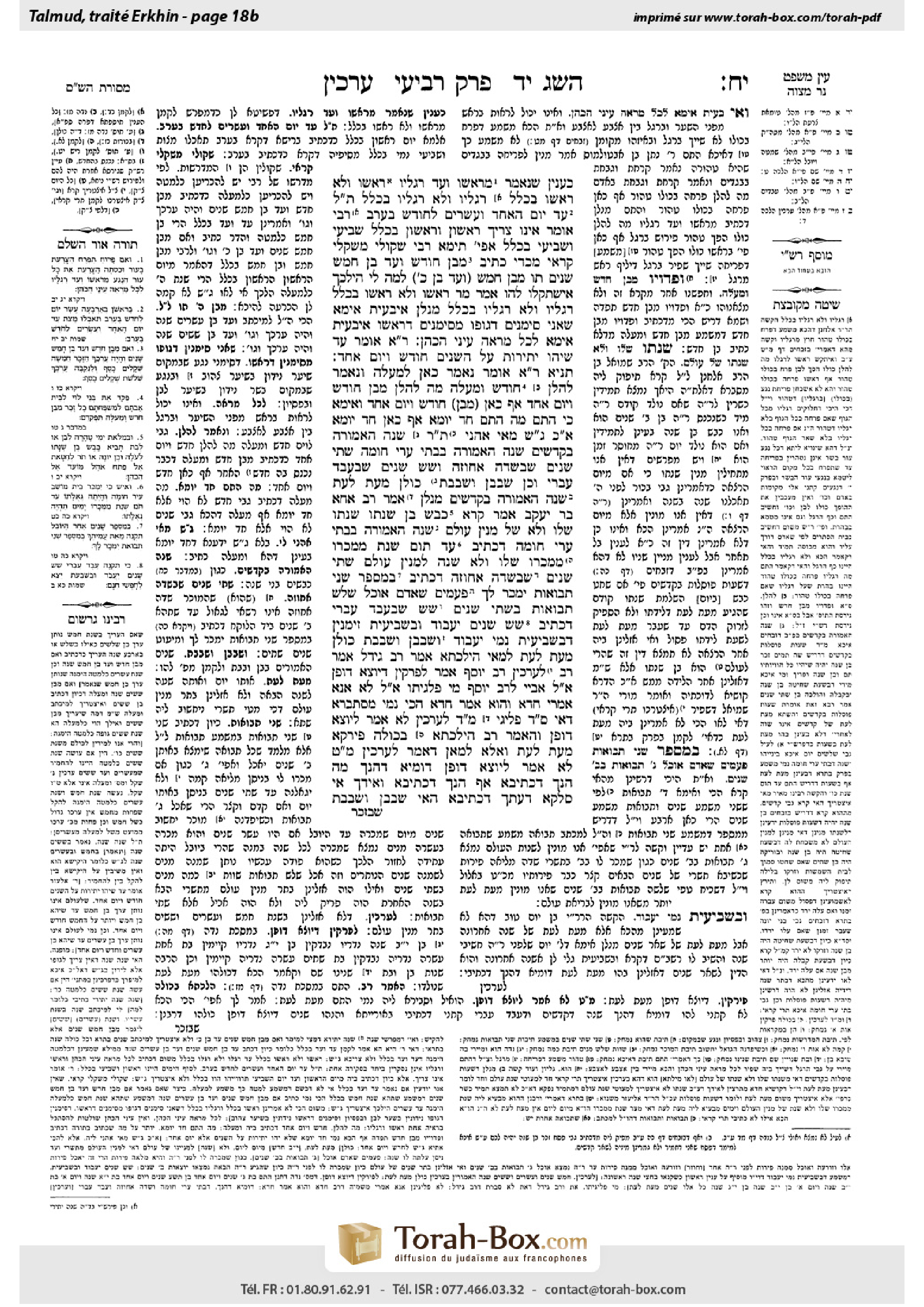
This page of Arakhin includes the Aramaic text, an English translation and an AI-generated French translation, alongside the scan above.
ערכין י״ח ב · Aramaic and Hebrew text
כָּעִנְיָן שֶׁנֶּאֱמַר ״מֵרֹאשׁוֹ וְעַד רַגְלָיו״, רֹאשׁוֹ וְלֹא רֹאשׁוֹ בַּכְּלָל, רַגְלָיו וְלֹא רַגְלָיו בַּכְּלָל?
תַּלְמוּד לוֹמַר: ״עַד יוֹם הָאֶחָד וְעֶשְׂרִים לַחֹדֶשׁ בָּעָרֶב״. רַבִּי אוֹמֵר: אֵינוֹ צָרִיךְ, ״רִאשׁוֹן״ וְ״רִאשׁוֹן״ בַּכְּלָל, ״שְׁבִיעִי״ וּ״שְׁבִיעִי״ בַּכְּלָל!
אֲפִילּוּ תֵּימָא רַבִּי, שַׁקּוֹלֵי מְשַׁקְּלִי קְרָאֵי. מִכְּדֵי כְּתִיב: ״מִבֶּן חֹדֶשׁ וְעַד בֶּן חָמֵשׁ שָׁנִים״, תּוּ ״מִבֶּן חָמֵשׁ וְעַד בֶּן עֶשְׂרִים״ לְמָה לִי? הִילְכָּךְ אִישְׁתְּקִלוּ לְהוּ.
אָמַר מָר: ״רֹאשׁוֹ״ — וְלָא רֹאשׁוֹ בַּכְּלָל, ״רַגְלָיו״ — וְלֹא רַגְלָיו בַּכְּלָל. מְנָלַן? אִיבָּעֵית אֵימָא: שָׁאנֵי סִימָנִים דְּגוּפוֹ מִסִּימָנִים דְּרֹאשׁוֹ. אִיבָּעֵית אֵימָא: ״לְכׇל מַרְאֵה עֵינֵי הַכֹּהֵן״.
רַבִּי אֱלִיעֶזֶר אוֹמֵר: עַד שֶׁיְּהוּ יְתֵירוֹת עַל הַשָּׁנִים חוֹדֶשׁ וְיוֹם אֶחָד. תַּנְיָא, רַבִּי אֱלִיעֶזֶר אוֹמֵר: נֶאֱמַר כָּאן ״לְמַעְלָה״, וְנֶאֱמַר לְהַלָּן ״חֹדֶשׁ וָמַעְלָה״, מָה לְהַלָּן מִבֶּן חוֹדֶשׁ וְיוֹם אֶחָד, אַף כָּאן מִבֶּן חוֹדֶשׁ וְיוֹם אֶחָד.
וְאֵימָא כִּי הָתָם, מָה הָתָם חַד יוֹמָא, אַף כָּאן חַד יוֹמָא? אִם כֵּן, גְּזֵירָה שָׁוָה מַאי אַהֲנִי!
תָּנוּ רַבָּנַן: שָׁנָה הָאֲמוּרָה בְּקָדָשִׁים, שָׁנָה הָאֲמוּרָה בְּבָתֵּי עָרֵי חוֹמָה, שְׁתֵּי שָׁנִים שֶׁבִּשְׂדֵה אֲחוּזָּה, וְשֵׁשׁ שָׁנִים שֶׁבְּעֶבֶד עִבְרִי, וְכֵן שֶׁבַּבֵּן וְשֶׁבַּבַּת — כּוּלָּן מֵעֵת לְעֵת.
שָׁנָה הָאֲמוּרָה בְּקָדָשִׁים, מְנָלַן? אָמַר רַב אַחָא בַּר יַעֲקֹב, אָמַר קְרָא: ״כֶּבֶשׂ בֶּן שְׁנָתוֹ״, שְׁנָתוֹ שֶׁלּוֹ, וְלֹא שֶׁל מִנְיַן עוֹלָם.
שָׁנָה הָאֲמוּרָה בְּבָתֵּי עָרֵי חוֹמָה — דִּכְתִיב: ״עַד תֹּם שְׁנַת מִמְכָּרוֹ״, מִמְכָּרוֹ שֶׁלּוֹ, וְלֹא שָׁנָה לְמִנְיַן עוֹלָם.
שְׁתֵּי שָׁנִים שֶׁבִּשְׂדֵה אֲחוּזָּה, דִּכְתִיב: ״בְּמִסְפַּר שְׁנֵי תְבוּאֹת יִמְכׇּר לָךְ״, פְּעָמִים שֶׁאָדָם אוֹכֵל שָׁלֹשׁ תְּבוּאוֹת בִּשְׁתֵּי שָׁנִים.
שֵׁשׁ שֶׁבְּעֶבֶד עִבְרִי — דִּכְתִיב: ״שֵׁשׁ שָׁנִים יַעֲבֹד וּבַשְּׁבִיעִית״, זִימְנִין דְּבִשְׁבִיעִית נָמֵי יַעֲבוֹד.
וְשֶׁבַּבֵּן וְשֶׁבַּבַּת כּוּלָּן מֵעֵת לְעֵת. לְמַאי הִילְכְתָא? אָמַר רַב גִּידֵּל אָמַר רַב: לַעֲרָכִין. רַב יוֹסֵף אָמַר: לְפִרְקִין דְּ״יוֹצֵא דּוֹפֶן״.
אֲמַר לֵיהּ אַבָּיֵי לְרַב יוֹסֵף: מִי פְּלִיגִיתוּ? אֲמַר לֵיהּ: לָא, אֲנָא אֲמַרִי חֲדָא, וְהוּא אֲמַר חֲדָא. הָכִי נָמֵי מִסְתַּבְּרָא, דְּאִי סָלְקָא דַעְתָּךְ פְּלִיגִי, מַאן דְּאָמַר לַעֲרָכִין לָא אָמַר לְ״יוֹצֵא דּוֹפֶן״? וְהָאָמַר רַב: הִילְכְתָא בְּכוּלֵּהּ פִּירְקָא מֵעֵת לְעֵת.
וְאֶלָּא לְמַאן דְּאָמַר לַעֲרָכִין, מַאי טַעְמָא לָא אָמַר לְ״יוֹצֵא דּוֹפֶן״? דּוּמְיָא דְּהָנָךְ, מָה הָנָךְ דִּכְתִיבָא, אַף הָנָךְ דִּכְתִיבָא.
וְאִידַּךְ, אִי סָלְקָא דַּעְתָּךְ דִּכְתִיבָא, הַאי ״שֶׁבַּבֵּן וְשֶׁבַּבַּת״ —
Arakhin 18b · English translation
This is similar to the matter that is stated with regard to a leper: “And the leprosy covers all the skin of him who has the mark from his head to his feet, as far as the priest can see…it is all turned white: He is pure” (Leviticus 13:12–13). This verse is understood as follows: The mark reaches from his head, but his head is not included; it reaches to his feet, but his feet are not included. Therefore, one might have thought the prohibition against consuming leaven on the festival of Passover likewise does not apply to the endpoints mentioned in the verse.
Therefore, the verse states: “You shall eat unleavened bread, until the twenty-first day of the month in the evening” (Exodus 12:18). This proves that the seventh day of the Festival is included. Rabbi Yehuda HaNasi says: It is not necessary to cite this verse, as the prohibition against consuming leaven is from the first day of Passover, and the first day is included; and the ban continues until the seventh day, and the seventh day is included. Accordingly, with regard to valuations, even without a verbal analogy Rabbi Yehuda HaNasi should maintain that the twentieth year is included in the preceding period.
The Gemara answers: You may even say that the opinion in the mishna is in accordance with that of Rabbi Yehuda HaNasi, as the verses offset each other, and therefore their meaning is unclear without the verbal analogy. The Gemara elaborates: Since it is written: “From one month old until five years old” (Leviticus 27:6), this ostensibly includes the fifth year within the stated category. If so, why do I need this mention of five years as well: “And if it is from five years old until twenty years old, then your valuation shall be for the male twenty shekels” (Leviticus 27:5)? Therefore, with regard to the fifth year, as both verses mention that year, the verses offset each other. Consequently, even according to the opinion of Rabbi Yehuda HaNasi the verbal analogy is necessary.
The Master said above, with regard to a leper: The mark reaches from his head, but his head is not included; it reaches to his feet, but his feet are not included. The Gemara asks: From where do we derive this interpretation? If you wish, say that it is deduced logically: The signs of leprosy of his body are different from the signs of leprosy of his head with regard to the different colors of hair that indicate leprosy. Alternatively, if you wish, say instead that it is derived from the phrase in that verse: “As far as the priest can see.” This excludes a leprous mark on the head, which is obscured from the priest’s view by the hair, as well as leprous marks between the toes.
§ The mishna teaches that Rabbi Eliezer says: Their halakhic status remains like that of the period preceding it, until they will be aged one month and one day beyond the respective years. With regard to this opinion, it is taught in a baraita that Rabbi Eliezer says: It is stated here, with regard to valuations, “upward” (Leviticus 27:7), and it is stated there, with regard to the census of the Levites in the wilderness: “From one month old and upward you shall number them” (Numbers 3:15). Just as there, in the case of the census, the verse means: From one month and one day old, so too here, with regard to valuations, the verse means that each respective category is counted from one month and one day old beyond the stated ages of five years, twenty years, or sixty years.
The Gemara asks: And why doesn’t Rabbi Eliezer say that the verse dealing with valuation should be understood like the verse written there, with regard to the census, in the following manner: Just as there it is one day more than the enumerated age of thirty days, so too here, it should be one day more than the enumerated ages of five years, twenty years, and sixty years. Why does Rabbi Eliezer add a month? The Gemara answers: If so, that only one day should be added, what purpose does this verbal analogy from the census serve? Even without any connection to the verse dealing with the census, it would be understood in the case of valuations that the new period begins from the day after the respective year is fully completed.
§ The Sages taught in a baraita: With regard to the period of one year stated with regard to sacrificial animals, e.g., “sheep in their first year” (Numbers 28:3); and the one year stated with regard to houses of walled cities, during which time it is permitted to redeem a sold house in a walled city (Leviticus 25:29); and the two years stated with regard to an ancestral field, during which one may not yet redeem an ancestral field he has sold (Leviticus 25:15); and the six years stated with regard to a Hebrew slave (Exodus 21:2); and similarly, the years stated with regard to a son and with regard to a daughter, as explained below; all of these are calculated from the time of day at the start of the period to the time of day at the end of the period, i.e., these periods are units of whole years; they do not expire on predetermined dates, such as at the end of the calendar year.
The Gemara asks: With regard to the one year stated with regard to sacrificial animals, from where do we derive that it is calculated by whole years rather than calendar years? Rav Aḥa bar Ya’akov says that the verse states: “A sheep in its first year” (Leviticus 12:6). Since the verse does not state: A sheep in the first year, it means a year based on the calculation of its own life, and not a year based on the counting of the world, i.e., the calendar year.
The Gemara continues clarifying the baraita: The halakha that the one year stated with regard to houses of walled cities is calculated by a whole year and not a calendar year is derived from the fact that it is written: “Then he may redeem it within a whole year after it is sold, for a full year he shall have the right of redemption” (Leviticus 25:29). The verse is referring to a year counted from the day of its own sale, and not the year of the counting of the world.
The Gemara states: Concerning the two years stated with regard to an ancestral field, this is derived from the fact that it is written: “According to the number of years of the crops he shall sell to you” (Leviticus 25:15). The plural form of both “years” and “crops” indicates that the number of years does not necessarily correspond to the quantity of crops. Consequently, there are times when a person might eat three yields of crops in two years. If one purchased a field at the end of the calendar year when its yield had not yet been harvested, and he harvested that yield and subsequently grew and harvested two more crops before the completion of two whole years from the sale, he would have eaten three yields in less than two years. This is not possible if one follows the calendar years, as a new year would start soon after the purchase.
The Gemara states: The halakha that the six years stated with regard to a Hebrew slave is calculated by whole years, not calendar years, is derived from the fact that it is written: “Six years he shall work; and in the seventh he shall go out free for nothing” (Exodus 21:2). The word “and” in the phrase: “And in the seventh,” teaches that sometimes it turns out that he shall also work in the seventh calendar year, if six full years have not passed from when he was sold. For example, if he was sold in the month of Nisan, although five years and six months have passed when Tishrei, the first month of the seventh year, arrives, since he has not yet completed six years of service he must work in this seventh calendar year as well, until the day of the month in which he was sold.
The baraita also teaches: The years stated with regard to a son and with regard to a daughter are among these terms calculated from the time at the start of the period to the time at the end of the period. The Gemara asks: With regard to what halakha is this stated? Rav Giddel said that Rav said: With regard to valuations, i.e., that the age of a valuated male or female is calculated in whole years from the date of their birth, not by calendar years. Rav Yosef said: The halakha is stated with regard to the matters taught in the fifth chapter of tractate Nidda, which is called after its opening words: Yotze Dofen, i.e., an animal born by caesarean section. In other words, when a mishna in that chapter, which deals with various matters related to the ages of sons and daughters, mentions years, it means full years, even when it does not state this explicitly.
Abaye said to Rav Yosef: Do you and Rav dispute this matter, i.e., when you apply the mention of a son and a daughter to different cases, do each of you reject the opinion of the other? Rav Yosef said to Abaye: No, we do not disagree; I said one matter and he said one different matter. The Gemara adds: This too stands to reason, as if it enters your mind that they disagree on this matter, then with regard to the one who says full years are required for determining valuations, does he not also say that full years are used for the halakhot of Yotze Dofen? But doesn’t Rav say, like Rav Yosef, that the halakha in that entire chapter is that the ages of the sons and daughters are determined from the time at the start of the period to the time at the end of the period, not by calendar years?
The Gemara asks: But if that is the case, then according to the one who says that the reference to full years mentioned in the baraita is for determining valuations, i.e., Rav, what is the reason he did not say that the baraita is referring to the halakhot of Yotze Dofen? The Gemara answers: Rav would claim that the years of a son and a daughter in the baraita are similar to these other cases mentioned in the baraita: Just as those numbers of years are explicitly written in the Torah, so too these years of the sons and daughters are referring to matters where the years are written in the Torah, i.e., the years of valuations, unlike the topics discussed in Yotze Dofen, where the years are not mentioned expressly in the Torah.
The Gemara asks: And with regard to the other, Rav Yosef, how would he respond to this contention? He would maintain that if it enters your mind that the baraita is referring to the years of valuations, which are written in the Torah, then this phrase in the baraita: With regard to a son and with regard to a daughter, is unsuitable.
Arakhin 18b · Traduction française (IA)
Cela ressemble à la question abordée concernant le lépreux : « Et la lèpre recouvre toute la peau de celui qui a le signe de la tête à ses pieds, jusqu'à ce que le prêtre puisse le voir… il est tout blanchi : il est pur » (Lévitique 13:12–13). Cette verset est interprété ainsi : le signe s'étend de la tête, mais la tête n'est pas incluse ; il s'étend jusqu'aux pieds, mais les pieds ne sont pas inclus. Ainsi, on pourrait penser que l'interdiction de consommer du levain pendant la fête de Pâque ne s'applique pas non plus aux extrémités mentionnées dans le verset.
Par conséquent, le verset dit : « Vous mangerez du pain aisé jusqu'au vingt-et-unième jour du mois, à la nuit » (Ex 12:18). Cela prouve que le septième jour de la fête est inclus. Rabbi Yehuda HaNasi dit : il n'est pas nécessaire de citer ce verset, car l'interdiction de consommer du levain commence le premier jour de Pâque, et le premier jour est inclus ; et l'interdiction continue jusqu'au septième jour, et le septième jour est inclus. Ainsi, concernant les estimations, même sans un analogie verbale, Rabbi Yehuda HaNasi devrait maintenir que le vingtième année est incluse dans la période précédente.
Le Guemara répond : on peut même dire que l'opinion dans la mitsna est en accord avec celle de Rabbi Yehuda HaNasi, car les versets s'annulent mutuellement, et donc leur sens est ambigu sans l'analogie verbale. Le Guemara développe : puisque cela est écrit : « De l'âge d'un mois jusqu'à cinq ans » (Lévitique 27:6), cela semble inclure la cinquième année dans la catégorie mentionnée. Si c'est le cas, pourquoi avons-nous besoin de cette mention de cinq ans : « Et si c'est d'un âge de cinq ans jusqu'à vingt ans, alors votre estimation sera de vingt sicles pour le mâle » (Lévitique 27:5) ? Ainsi, concernant la cinquième année, puisque les deux versets mentionnent cette année, les versets s'annulent mutuellement. Par conséquent, même selon l'opinion de Rabbi Yehuda HaNasi, l'analogie verbale est nécessaire.
Le Maître a dit ci-dessus concernant le lépreux : le signe s'étend de la tête, mais la tête n'est pas incluse ; il s'étend jusqu'aux pieds, mais les pieds ne sont pas inclus. Le Guemara pose la question : d'où dérivons-nous cette interprétation ? Si tu veux, dis qu'il est déduit logiquement : les signes de la lèpre du corps sont différents des signes de la lèpre de la tête en ce qui concerne les couleurs des cheveux qui indiquent la lèpre. Alternativement, si tu veux, dis plutôt qu'il est dérivé de la phrase dans ce verset : « Jusqu'à ce que le prêtre puisse le voir. » Cela exclut un signe de lèpre sur la tête, qui est masqué par les cheveux, ainsi que les signes de lèpre entre les orteils.
§ La mitsva enseigne que Rabbi Eliezer dit : leur statut halakhique reste comme celui de la période précédente, jusqu'à ce qu'ils soient âgés d'un mois et un jour au-delà des âges respectifs. Concernant cette opinion, il est enseigné dans une baraïta que Rabbi Eliezer dit : il est dit ici, concernant les estimations, « vers le haut » (Lévitique 27:7), et il est dit là, concernant le recensement des Lévites dans le désert : « De l'âge d'un mois et vers le haut, vous compterez ceux-ci » (Nm 3:15). Tout comme là, dans le cas du recensement, le verset signifie : d'un mois et un jour, ainsi ici, concernant les estimations, le verset signifie que chaque catégorie respective est comptée à partir d'un mois et un jour au-delà des âges mentionnés de cinq ans, vingt ans ou soixante ans.
Le Guemara pose la question : et pourquoi Rabbi Eliezer ne dit-il pas que le verset concernant les estimations devrait être compris comme le verset écrit là, concernant le recensement, de la manière suivante : tout comme là, il est un jour de plus que l'âge énuméré de trente jours, ainsi ici, il devrait être un jour de plus que les âges énumérés de cinq ans, vingt ans et soixante ans. Pourquoi Rabbi Eliezer ajoute-t-il un mois ? Le Guemara répond : si c'est ainsi, que seul un jour devrait être ajouté, à quel usage sert cette analogie verbale du recensement ? Même sans aucun lien avec le verset concernant le recensement, il serait compris dans le cas des estimations que la nouvelle période commence le jour suivant la fin respective de l'année.
§ Les Sages ont enseigné dans une baraïta : concernant la période d'un an mentionnée concernant les animaux sacrés, par exemple, « des agneaux de leur premier an » (Nm 28:3) ; et l'un an mentionné concernant les maisons des villes murées, pendant lequel il est permis de racheter une maison vendue dans une ville murée (Lévitique 25:29) ; et les deux ans mentionnés concernant un champ ancestral, pendant lesquels on ne peut pas encore racheter un champ ancestral qu'on a vendu (Lévitique 25:15) ; et les six ans mentionnés concernant un serviteur hébreu (Ex 21:2) ; et de même, les années mentionnées concernant un fils et concernant une fille, comme expliqué ci-dessous ; toutes ces périodes sont calculées du moment de la journée au début de la période au moment de la journée à la fin de la période, c'est-à-dire ces périodes sont des unités d'années entières ; elles ne s'écoulent pas à des dates prédéterminées, comme à la fin de l'année civile.
Le Guemara pose la question : concernant l'un an mentionné concernant les animaux sacrifiés, d'où dérivons-nous que cela est calculé en années entières plutôt qu'en années calendaires ? Rav Aḥa bar Ya’akov dit que le verset dit : « Un agneau de son premier an » (Lévitique 12:6). Puisque le verset ne dit pas : « un agneau de l'année première », cela signifie une année basée sur le calcul de sa propre vie, et non une année basée sur le comptage du monde, c'est-à-dire l'année civile.
Le Guemara continue à clarifier la baraïta : la halakha que l'un an mentionné concernant les maisons des villes murées est calculé en années entières et non en années calendaires est dérivée du fait qu'il est écrit : « Alors il peut le racheter dans un an entier après sa vente, pour un an entier il aura le droit de racheter » (Lévitique 25:29). Le verset fait référence à une année comptée depuis le jour de sa propre vente, et non l'année du comptage du monde.
La Guemara dit : Concernant les deux ans mentionnés en ce qui concerne un champ ancestral, cela découle du fait que cela est écrit : « Selon le nombre d'années des récoltes, il te le vendra » (Lévitique 25:15). La forme plurielle des mots « années » et « récoltes » indique que le nombre d'années ne correspond pas nécessairement à la quantité de récoltes. Ainsi, il arrive parfois qu'une personne mange trois récoltes en deux ans. Si l'on achète un champ à la fin de l'année civile, avant que la récolte ne soit récoltée, et qu'on récolte cette récolte, puis qu'on cultive et récolte deux autres récoltes avant la fin de deux ans entiers depuis l'achat, on aura mangé trois récoltes en moins de deux ans. Cela n'est pas possible si l'on suit les années civiles, car une nouvelle année commencerait peu après l'achat.
La Guemara dit : La halakha selon laquelle les six ans mentionnés en ce qui concerne un serviteur israélite sont calculés en années entières et non en années civiles découle du fait que cela est écrit : « Il travaillera six ans ; et dans le septième, il sortira librement sans rétribution » (Ex 21:2). Le mot « et » dans la phrase : « Et dans le septième », enseigne que parfois il arrive qu'il travaille également dans le septième année civile, si six années entières n'ont pas encore écoulé depuis son achèvement. Par exemple, s'il a été acheté en Nisan, bien que cinq ans et six mois aient écoulé lors de Tishrei, le premier mois de la septième année, puisque six années de service n'ont pas encore été accomplies, il doit travailler dans cette septième année civile également jusqu'au jour du mois où il a été acheté.
La baraïta enseigne également : Les années mentionnées en ce qui concerne un fils et en ce qui concerne une fille sont parmi ces termes calculés du début de la période à la fin de la période. La Guemara pose la question : À quel halakha cette affirmation est-elle faite ? Rav Giddel a dit que Rav a dit : En ce qui concerne les estimations, c'est-à-dire que l'âge d'un homme ou d'une femme estimé est calculé en années entières à partir de leur date de naissance, et non en années civiles. Rav Yosef a dit : La halakha est faite en ce qui concerne les matières enseignées dans le cinquième chapitre du traité Nidda, qui s'appelle après ses premiers mots : Yotze Dofen, c'est-à-dire un animal né par césarienne. En d'autres termes, lorsque une mésorah de ce chapitre, qui traite de diverses matières relatives aux âges des fils et des filles, mentionne des années, cela signifie des années entières, même si cela n'est pas explicitement dit.
Abaye a dit à Rav Yosef : Vous et Rav disputez-vous sur cette question, c'est-à-dire, lorsque vous appliquez la mention d'un fils et d'une fille à des cas différents, chacun de vous rejette-t-il l'opinion de l'autre ? Rav Yosef a dit à Abaye : Non, nous ne sommes pas d'accord ; j'ai dit une question et lui une autre question. La Guemara ajoute : Cela est également logique, car si cela entre dans votre esprit qu'ils débattent sur cette question, alors concernant celui qui dit que des années entières sont nécessaires pour déterminer les estimations, ne dit-il pas aussi que des années entières sont utilisées pour les halakhot de Yotze Dofen ? Mais ne dit-il pas Rav, comme Rav Yosef, que la halakha de tout ce chapitre est que les âges des fils et des filles sont déterminés du début de la période à la fin de la période, et non en années civiles ?
La Guemara pose la question : Mais si c'est le cas, alors selon celui qui dit que la mention des années entières mentionnée dans la baraïta est pour déterminer les estimations, c'est-à-dire Rav, pourquoi n'a-t-il pas dit que la baraïta fait référence aux halakhot de Yotze Dofen ? La Guemara répond : Rav affirmerait que les années d'un fils et d'une fille mentionnées dans la baraïta sont semblables à ces autres cas mentionnés dans la baraïta : Tout comme ces nombres d'années sont explicitement écrits dans la Torah, ainsi ces années des fils et des filles font référence à des matières où les années sont écrites dans la Torah, c'est-à-dire les années des estimations, contrairement aux sujets discutés dans Yotze Dofen, où les années ne sont pas mentionnées explicitement dans la Torah.
La Guemara pose la question : Et concernant l'autre, Rav Yosef, comment répondrait-il à cette contestation ? Il maintiendrait que si cela entre dans votre esprit que la baraïta fait référence aux années des estimations, qui sont écrites dans la Torah, alors cette phrase dans la baraïta : En ce qui concerne un fils et en ce qui concerne une fille, n'est-elle pas inadaptée.
Traduction française générée par IA à partir de l’édition anglaise de Sefaria. Vérifie toujours un passage avec le texte source.
Text from Sefaria: William Davidson Edition - Vocalized Aramaic (CC BY NC); William Davidson Edition - English (CC BY NC).