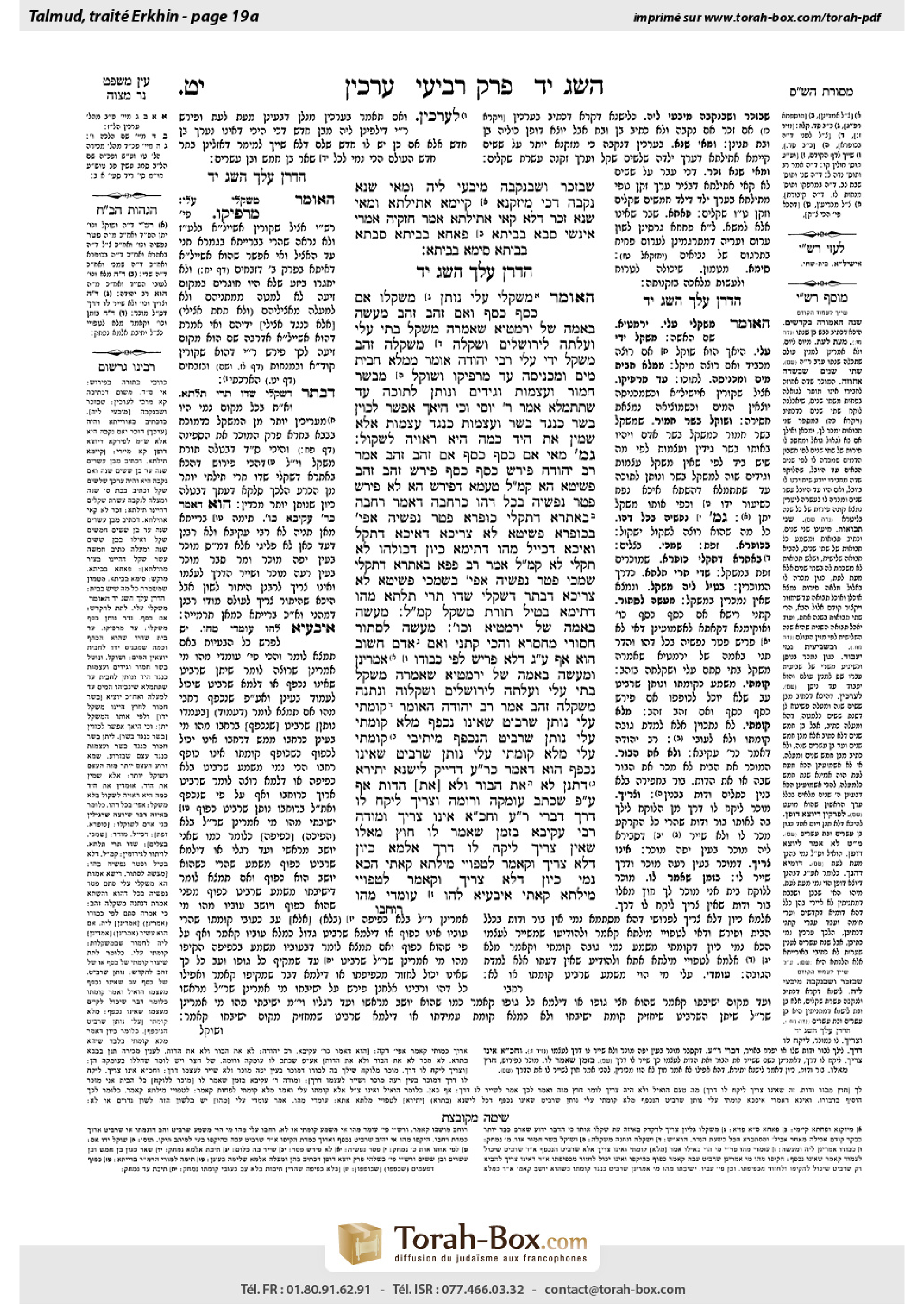
Arakhin 19a: Talmud study for Daf Yomi
Study the Talmud for Daf Yomi with scanned pages, Hebrew text, English translations from Sefaria and AI-generated French translations.
Passage selection and English or AI-generated French translation are available where the scan has annotations. Daf Study is independent of Torah-Box and Sefaria.
Browse Arakhin · ערכין · All tractatesArakhin 19a text and translations
This page of Arakhin includes the Aramaic text, an English translation and an AI-generated French translation, alongside the scan above.
ערכין י״ט א · Aramaic and Hebrew text
״שֶׁבְּזָכָר וְשֶׁבִּנְקֵבָה״ מִיבְּעֵי לֵיהּ.
וּמַאי שְׁנָא נְקֵבָה, דְּכִי מִיזַּקְנָא קָיְימָא אַתִּילְּתָא, וּמַאי שְׁנָא זָכָר דְּלָא קָאֵי אַתִּילְּתָא? אָמַר חִזְקִיָּה: אָמְרִי אִינָשֵׁי: סָבָא בְּבֵיתָא — פָּאחָא בְּבֵיתָא, סָבְתָא בְּבֵיתָא — סִימָא בְּבֵיתָא.
הֲדַרַן עֲלָךְ הֶשֵּׂג יָד.
מַתְנִי׳ הָאוֹמֵר: ״מְשַׁקְּלִי עָלַי״ נוֹתֵן מִשְׁקָלוֹ, אִם כֶּסֶף כָּסֶף, וְאִם זָהָב זָהָב. מַעֲשֶׂה בְּאַמָּה שֶׁל יַרְמַטְיָא שֶׁאָמְרָה: ״מִשְׁקַל בִּתִּי עָלַי״, וְעָלְתָה לִירוּשָׁלַיִם וְשַׁקְלַהּ מִשְׁקָלָהּ זָהָב.
״מִשְׁקַל יְדֵי עָלַי״, רַבִּי יְהוּדָה אוֹמֵר: מְמַלֵּא חָבִית מַיִם, וּמַכְנִיסָהּ עַד מַרְפֵּיקוֹ, וְשׁוֹקֵל מִבְּשַׂר חֲמוֹר וַעֲצָמוֹת וְגִידִים וְנוֹתֵן לְתוֹכָהּ עַד שֶׁתִּתְמַלֵּא. אָמַר רַבִּי יוֹסֵי: וְכִי הֵיאַךְ אֶפְשָׁר לְכַוֵּין בָּשָׂר כְּנֶגֶד בָּשָׂר וַעֲצָמוֹת כְּנֶגֶד עֲצָמוֹת? אֶלָּא שָׁמִין אֶת הַיָּד כַּמָּה הִיא רְאוּיָה לִשְׁקוֹל.
גְּמָ׳ מַאי ״אִם כֶּסֶף כֶּסֶף אִם זָהָב זָהָב״? אָמַר רַב יְהוּדָה: פֵּירַשׁ כֶּסֶף — כֶּסֶף, פֵּירַשׁ זָהָב — זָהָב. פְּשִׁיטָא! הָא קָא מַשְׁמַע לַן: טַעְמָא דְּפֵירַשׁ, הָא לֹא פֵּירֵשׁ — פָּטַר נַפְשֵׁיהּ בְּכֹל דְּהוּ.
כִּרְחָבָה, דְּאָמַר רַחֲבָה: בְּאַתְרָא דְּתִקְלֵי כּוֹפְרָא — פָּטַר נַפְשֵׁיהּ אֲפִילּוּ בַּכּוֹפְרָא. פְּשִׁיטָא! לָא צְרִיכָא, דְּאִיכָּא דִּתְקֵל וְאִיכָּא דְּכָיֵיל. מַהוּ דְּתֵימָא: כֵּיוָן דְּכוּלְּהוּ לָא תִּקְלֵי — לָא, קָא מַשְׁמַע לַן.
אָמַר רַב פָּפָּא: בְּאַתְרָא דְּתִקְלֵי שַׁמְכֵי, פָּטַר נַפְשֵׁיהּ אֲפִילּוּ בְּשַׁמְכֵי. פְּשִׁיטָא! לָא צְרִיכָא, דְּבָתַר דְּשָׁקְלִי שָׁדוּ תְּרֵי תְּלָתָא. מַהוּ דְּתֵימָא: בְּטִיל תּוֹרַת מִשְׁקַל, קָא מַשְׁמַע לַן.
מַעֲשֶׂה בְּאַמָּה שֶׁל יַרְמַטְיָא וְכוּ׳. מַעֲשֶׂה לִסְתּוֹר?!
חַסּוֹרֵי מְחַסְּרָא וְהָכִי קָתָנֵי, וְאִם אָדָם חָשׁוּב הוּא, אַף עַל גַּב דְּלָא פָּרֵישׁ — לְפִי כְּבוֹדוֹ אָמְרִינַן, וּמַעֲשֶׂה בְּאַמָּה שֶׁל יַרְמַטְיָא שֶׁאָמְרָה ״מִשְׁקַל בִּתִּי עָלַי״, וְעָלְתָה לִירוּשָׁלַיִם וְשַׁקְלוּהּ וְנָתְנָה מִשְׁקָלָהּ זָהָב.
אָמַר רַב יְהוּדָה: הָאוֹמֵר ״קוֹמָתִי עָלַי״ נוֹתֵן שַׁרְבִיט שֶׁאֵינוֹ נִכְפָּף, ״מָלֵא קוֹמָתִי עָלַי״ נוֹתֵן שַׁרְבִיט הַנִּכְפָּף. מֵיתִיבִי: ״קוֹמָתִי עָלַי״, ״מָלֵא קוֹמָתִי עָלַי״ — נוֹתֵן שַׁרְבִיט שֶׁאֵינוֹ נִכְפָּף.
הוּא דְּאָמַר כְּרַבִּי עֲקִיבָא, דְּדָיֵיק לִישָּׁנָא יַתִּירָא, דִּתְנַן: לֹא אֶת הַבּוֹר וְלֹא הַדּוּת, אַף עַל פִּי שֶׁכָּתַב עוֹמְקָהּ וְרוּמַהּ, וְצָרִיךְ לִיקַּח לוֹ דֶּרֶךְ, דִּבְרֵי רַבִּי עֲקִיבָא.
וַחֲכָמִים אוֹמְרִים: אֵינוֹ צָרִיךְ, וּמוֹדֶה רַבִּי עֲקִיבָא בִּזְמַן שֶׁאָמַר לוֹ ״חוּץ מֵאֵלּוּ״ שֶׁאֵין צָרִיךְ לִיקַּח לוֹ דֶּרֶךְ. אַלְמָא, כֵּיוָן דְּלָא צְרִיךְ וְקָאָמַר — לְטַפּוֹיֵי מִילְּתָא קָאָתֵי, הָכָא נָמֵי, כֵּיוָן דְּלָא צְרִיךְ וְקָאָמַר — לְטַפּוֹיֵי מִילְּתָא קָאָתֵי.
אִיבַּעְיָא לְהוּ: ״עוֹמְדֵי״ מַהוּ?
Arakhin 19a · English translation
Rather, the baraita should have stated: With regard to the male and with regard to the female, which are the terms the Torah uses with regard to valuations. The terms son and daughter are used in Yotze Dofen.
With regard to valuations, the Gemara asks: And what is different with regard to a female, that when she ages past sixty years she stands at a valuation of ten shekels, one-third of her previous valuation of thirty shekels, and what is different with regard to a male, that when he ages past sixty, at which point he has a valuation of fifteen shekels, he does not stand at even one-third of his previous valuation of fifty shekels? Ḥizkiya said that people say a popular saying: If there is an elderly man in the home, there is a burden [paḥa] in the home, as he does not help with anything; if there is an elderly woman in the home, there is a treasure in the home,as she assists with various domestic labors.
MISHNA: One who says: It is incumbent upon me to donate my weight, gives his weight to the Temple treasury; if he specified silver he donates silver, and if he specified gold he donates gold. There was an incident involving the mother of Yirmatya, who said: It is incumbent upon me to donate the weight of my daughter, and she ascended to Jerusalem and paid her daughter’s weight in gold to the Temple treasury.
In the case of one who says: It is incumbent upon me to donate the weight of my forearm, how does he ascertain the weight of his forearm? Rabbi Yehuda says: He fills a barrel with water and inserts his arm up to his elbow into the water. And in order to measure the displacement, he weighs donkey flesh, and bones, and sinews and places it into the barrel until it fills, and the water level reaches the top of the barrel. He then donates the weight of the meat and the bones to the Temple treasury. Rabbi Yosei said: Displacement is according to volume not according to weight, and how then is it possible to match the amount of the donkey flesh with the flesh of a person and the volume of the donkey’s bones with his bones? Rather, the court appraises how much the forearm is likely to weigh.
GEMARA: What is the meaning of the mishna’s statement: If silver, silver, and if gold, gold? Rav Yehuda said: If one specified that he vows to donate his weight in silver he donates silver, and if he specified gold he donates gold. The Gemara asks: Isn’t that obvious? The Gemara answers: This is what the mishna is teaching us: The reason he donates silver or gold is that he specified silver or gold, from which it may be inferred that if he did not specify the means of payment, he may exempt himself with any material.
The Gemara adds: And this is in accordance with a statement of Raḥava, as Raḥava says: In a place where merchants weigh pitch when selling it, one who vows his weight may exempt himself by donating his weight even in pitch. The Gemara asks: Isn’t that obvious? The Gemara answers: No, the statement of Raḥava is necessary in a place where there are merchants who weigh pitch and there are others who measure its volume. Lest you say: Since not all merchants weigh pitch one may not fulfill his vow by donating his weight in pitch, Raḥava teaches us that as there are merchants there who sell pitch by weight, one can fulfill his vow in that manner.
Rav Pappa says: In a place where merchants weigh onions when selling them, one who vowed his weight may exempt himself by donating his weight even in onions. The Gemara again asks: Isn’t that obvious? The Gemara answers: No, the statement of Rav Pappa is necessary in a place where after they weigh the onions the merchants throw in two or three extra onions to the buyer. Lest you say that its status as a place where onions are sold by weight is void due to the additional onions, Rav Pappa teaches us that it is still considered a place where onions are sold by weight.
§ The mishna teaches: There was an incident involving the mother of Yirmatya, who said: It is incumbent upon me to donate the weight of my daughter, without specifying silver or gold, and she ascended to Jerusalem and paid her daughter’s weight in gold to the Temple treasury. The Gemara asks: Was an incident cited to contradict the previous ruling of the mishna? The mishna had stated: If silver, silver, and if gold, gold, which indicates that if one did not specify the means of payment he may exempt himself with any material that merchants sell by weight, whereas it can be inferred from the incident that one must pay the weight in gold.
The Gemara answers: The mishna is incomplete and this is what it is teaching: And if the one who vowed is a distinguished person, even though he did not specify silver or gold we say he must fulfill his vow in keeping with his socioeconomic status. And likewise, there was an incident involving the mother of Yirmatya, a very wealthy woman, who said: It is incumbent upon me to donate the weight of my daughter, and she ascended to Jerusalem and gave her daughter’s weight in gold to the Temple treasury.
§ Rav Yehuda says that one who says: It is incumbent upon me to donate my height, gives a thick rod that cannot be bent equivalent to his height. One who says: It is incumbent upon me to donate my full height, may give even a thin rod that can be bent, provided it is equivalent to his height. The Gemara raises an objection from a baraita (Tosefta 3:1): With regard to one who says: It is incumbent upon me to donate my height, or: It is incumbent upon me to donate my full height, he gives a thick rod that cannot be bent and that is equivalent to his height.
The Gemara answers: Rav Yehuda says his statement in accordance with the opinion of Rabbi Akiva, who holds that one can draw an inference from superfluous language. As we learned in a mishna (Bava Batra 64a): If one sold his house without specification, he has sold neither the pit nor the cistern [dut] with it, even if he wrote in the document of sale: With its depth and its height. This is because anything that is ancillary to the house, e.g., pits and cisterns, must be mentioned explicitly in the contract. And the seller must purchase for himself a path through to the pit or cistern that he kept back, as he sold his rights to the area surrounding the house along with the house, and therefore he may no longer walk through that area. This is the statement of Rabbi Akiva.
And the Rabbis say: He need not purchase a path, as the seller clearly did not intend to keep the pit or cistern without maintaining access to it. And Rabbi Akiva concedes that when the seller states to the buyer in the document of sale: Excluding these, the pit and the cistern, that he need not purchase for himself a path through to the pit or cistern. Evidently, Rabbi Akiva’s reasoning is that since the seller need not specify that the pit and cistern are excluded from the sale, and yet he says that they were excluded, he is coming with this statement to add an element to the agreement, i.e., the right of access. Here too, when one says: It is incumbent upon me to donate my full height, since it is a case where he need not add the word full, and yet he says it, he is coming to add an element to his vow, i.e., the ability to exempt himself with a thin rod.
A dilemma was raised before the Sages. If one says: It is incumbent upon me to donate my stature, what is the halakha?
Arakhin 19a · Traduction française (IA)
En réalité, la baraïta aurait dû dire : En ce qui concerne le mâle et en ce qui concerne la femelle, qui sont les termes que la Torah utilise en ce qui concerne les estimations. Les termes fils et fille sont utilisés dans Yotze Dofen.
En ce qui concerne les estimations, le Guemara pose la question : Et qu'y a-t-il de particulier en ce qui concerne la femme, que lorsqu'elle a plus de soixante ans, elle est estimée à dix sicles, un tiers de son ancienne estimation de trente sicles, et qu'y a-t-il de particulier en ce qui concerne le mâle, que lorsqu'il a plus de soixante ans, à ce moment-là, il a une estimation de quinze sicles, et il ne se trouve pas même à un tiers de son ancienne estimation de cinquante sicles ? Chizkiya a dit que les gens disent une maxime populaire : S'il y a un vieillard à la maison, il y a un fardeau à la maison, car il ne contribue à rien ; s'il y a une vieille femme à la maison, il y a un trésor à la maison, car elle aide à divers travaux domestiques.
MICHNA : Celui qui dit : Il m'est imposé de donner mon poids, donne son poids au trésor du Temple ; si il spécifie l'argent, il donne de l'argent, et si il spécifie l'or, il donne de l'or. Il y avait un cas concernant la mère de Yirmatya, qui dit : Il m'est imposé de donner le poids de ma fille, et elle est montée à Jérusalem et a payé le poids de sa fille en or au trésor du Temple.
Dans le cas d'une personne qui dit : Il m'est imposé de donner le poids de mon avant-bras, comment détermine-t-il le poids de son avant-bras ? Rabbi Yehuda dit : Il remplit un tonneau d'eau et insère son avant-bras jusqu'au coude dans l'eau. Et afin de mesurer le déplacement, il pèse la viande, les os et les nerfs d'un âne et les place dans le tonneau jusqu'à ce qu'il soit plein, et le niveau de l'eau atteint le bord du tonneau. Il donne alors au trésor du Temple le poids de la viande et des os. Rabbi Yosei dit : Le déplacement est selon le volume et non selon le poids, et comment alors peut-on égaliser la quantité de la viande d'un âne avec celle d'une personne et le volume des os de l'âne avec ceux de la personne ? En réalité, la cour évalue combien l'avant-bras est susceptible de peser.
GUEMARA : Quelle est la signification de la déclaration de la mishna : Si l'argent, l'argent, et si l'or, l'or ? Rav Yehuda dit : Si l'on spécifie qu'on jure de donner son poids en argent, on donne de l'argent, et si l'on spécifie l'or, on donne de l'or. La Guemara pose la question : N'est-ce pas évident ? La Guemara répond : C'est ce que la mishna nous enseigne : La raison pour laquelle on donne de l'argent ou de l'or est que l'on a spécifié l'argent ou l'or, d'où l'on peut déduire que si l'on n'a pas spécifié le moyen de paiement, on peut s'excuser avec n'importe quel matériau.
La Guemara ajoute : Et cela correspond à une déclaration de Raḥava, car Raḥava dit : Dans un lieu où les marchands pèsent la résine lorsqu'ils la vendent, celui qui jure son poids peut s'excuser en donnant son poids même en résine. La Guemara pose la question : N'est-ce pas évident ? La Guemara répond : Non, la déclaration de Raḥava est nécessaire dans un lieu où il y a des marchands qui pèsent la résine et d'autres qui mesurent son volume. De peur que l'on dise : Puisque tous les marchands ne pèsent pas la résine, on ne peut pas remplir son vœu en donnant son poids en résine, Raḥava nous enseigne que puisque certains marchands vendent la résine par poids, on peut remplir son vœu ainsi.
Rav Pappa dit : Dans un lieu où les marchands pèsent les oignons lorsqu'ils les vendent, celui qui a juré son poids peut s'excuser en donnant son poids même en oignons. La Guemara pose à nouveau la question : N'est-ce pas évident ? La Guemara répond : Non, la déclaration de Rav Pappa est nécessaire dans un lieu où, après avoir pesé les oignons, les marchands ajoutent deux ou trois oignons supplémentaires au client. De peur que l'on dise que le statut de ce lieu où les oignons sont vendus par poids est nul en raison des oignons supplémentaires, Rav Pappa nous enseigne que cela reste considéré comme un lieu où les oignons sont vendus par poids.
§ La mishna enseigne : Il y avait un cas concernant la mère de Yirmatya, qui dit : Il m'est imposé de donner le poids de ma fille, sans spécifier l'argent ou l'or, et elle est montée à Jérusalem et a payé le poids de sa fille en or au trésor du Temple. La Guemara pose la question : Un cas a-t-il été cité pour contredire la précédente décision de la mishna ? La mishna avait dit : Si l'argent, l'argent, et si l'or, l'or, ce qui indique que si l'on n'a pas spécifié le moyen de paiement, on peut s'excuser avec n'importe quel matériau que les marchands vendent par poids, tandis que l'on peut en déduire de l'incident que l'on doit payer le poids en or.
La Guemara répond : La mishna est incomplète et c'est ce qu'elle enseigne : Et si celui qui a juré est une personne distinguée, même s'il n'a pas spécifié l'argent ou l'or, nous disons qu'il doit remplir son vœu conformément à son statut socio-économique. De même, il y avait un cas concernant la mère de Yirmatya, une femme très riche, qui dit : Il m'est imposé de donner le poids de ma fille, et elle est montée à Jérusalem et a donné le poids de sa fille en or au trésor du Temple.
§ Rav Yehuda dit que celui qui dit : Il m'est imposé de donner ma hauteur, donne un bâton épais qui ne peut pas être courbé équivalent à sa hauteur. Celui qui dit : Il m'est imposé de donner ma hauteur totale, peut donner même un bâton fin qui peut être courbé, à condition qu'il soit équivalent à sa hauteur. La Guemara soulève une objection à partir d'une baraïta (Tosefta 3:1) : En ce qui concerne celui qui dit : Il m'est imposé de donner ma hauteur, ou : Il m'est imposé de donner ma hauteur totale, il donne un bâton épais qui ne peut pas être courbé et équivalent à sa hauteur.
La Guemara répond : Rav Yéhuda dit que son propos s'inspire de l'opinion de Rabbi Akiva, qui considère qu'on peut tirer une conséquence d'une formulation superflue. Comme nous l'avons appris dans une mitsva (Bava Batra 64a) : Si l'on vend sa maison sans précision, il n'a pas vendu le puits ni la cistern, même s'il a écrit dans le document de vente : Avec sa profondeur et sa hauteur. Cela est dû au fait que tout ce qui est annexé à la maison, par exemple les puits et les cisternes, doit être mentionné explicitement dans le contrat. Et le vendeur doit acheter pour lui-même un chemin jusqu'au puits ou à la cistern, car il a vendu ses droits sur la zone autour de la maison ainsi que la maison elle-même, et par conséquent il ne peut plus marcher dans cette zone. C'est l'opinion de Rabbi Akiva.
Et les Sages disent : Il n'a pas besoin d'acheter un chemin, car le vendeur n'avait clairement pas l'intention de conserver le puits ou la cistern sans maintenir l'accès à ceux-ci. Rabbi Akiva reconnaît que lorsque le vendeur indique au acheteur dans le document de vente : Excluant ces puits et cisternes, il n'a pas besoin d'acheter pour lui-même un chemin jusqu'au puits ou à la cistern. Évidemment, la raison de Rabbi Akiva est que puisque le vendeur n'a pas besoin de préciser que les puits et cisternes sont exclus de la vente, et pourtant il le dit, il ajoute un élément au contrat, c'est-à-dire le droit d'accès. De même, lorsque l'on dit : Il m'est imposé de donner toute ma hauteur, car c'est un cas où il n'a pas besoin d'ajouter le mot « toute », et pourtant il le dit, il vient ajouter un élément à son serment, c'est-à-dire la possibilité de s'excuser avec une verge fine.
Un dilemme a été soulevé devant les Sages. Si l'on dit : Il m'est imposé de donner toute ma stature, quelle est la halakha ?
Traduction française générée par IA à partir de l’édition anglaise de Sefaria. Vérifie toujours un passage avec le texte source.
Text from Sefaria: William Davidson Edition - Vocalized Aramaic (CC BY NC); William Davidson Edition - English (CC BY NC).