Arakhin 19b: Talmud study for Daf Yomi
Study the Talmud for Daf Yomi with scanned pages, Hebrew text, English translations from Sefaria and AI-generated French translations.
Passage selection and English or AI-generated French translation are available where the scan has annotations. Daf Study is independent of Torah-Box and Sefaria.
Browse Arakhin · ערכין · All tractatesArakhin 19b text and translations
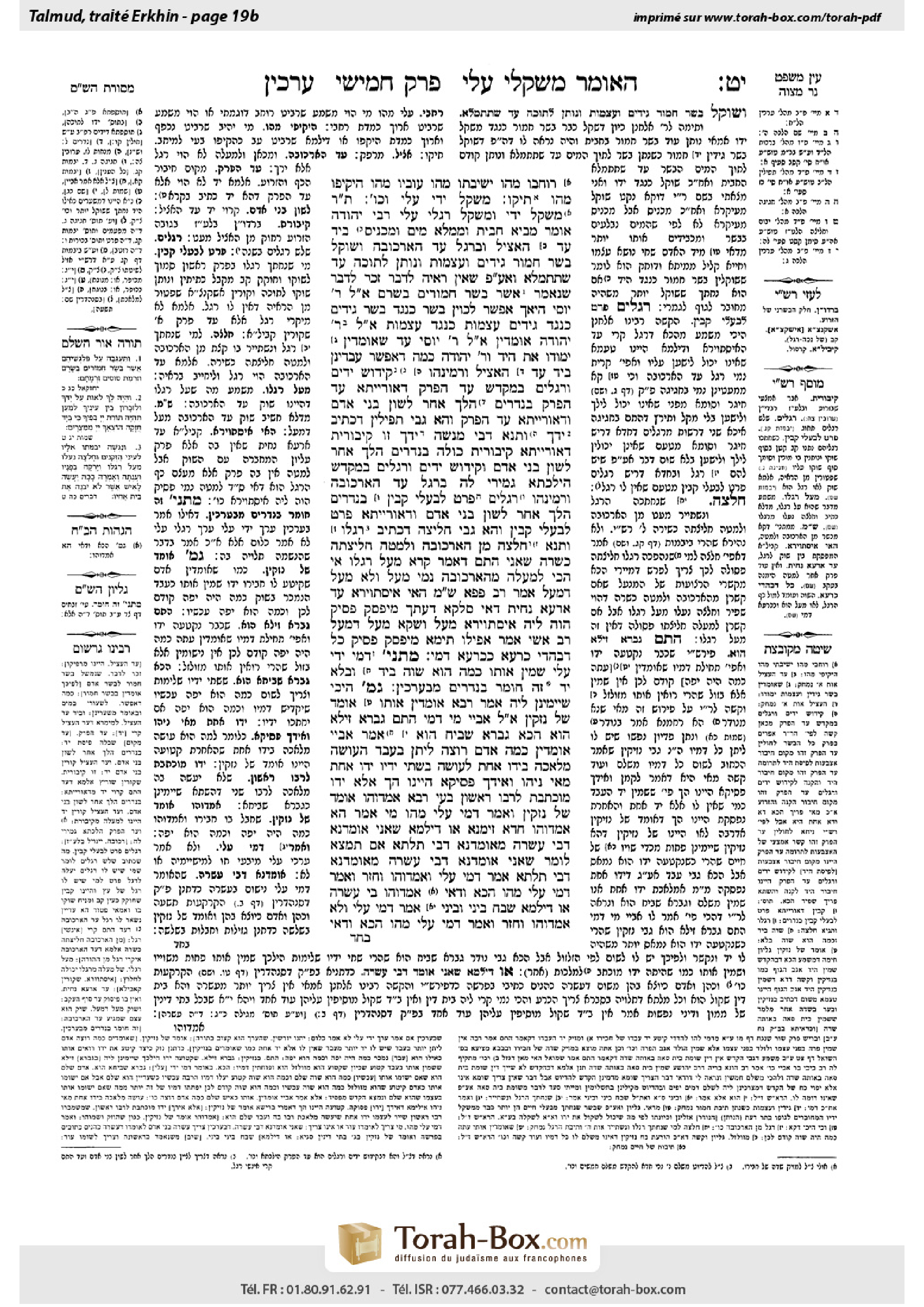
This page of Arakhin includes the Aramaic text, an English translation and an AI-generated French translation, alongside the scan above.
ערכין י״ט ב · Aramaic and Hebrew text
״רוֹחְבּוֹ״ מַהוּ? ״יְשִׁיבָתוֹ״ מַהוּ? ״עוֹבְיוֹ״ מַהוּ? ״הִיקִּיפוּ״ מַהוּ? תֵּיקוּ.
מִשְׁקַל יָדִי עָלַי וְכוּ׳. תָּנוּ רַבָּנַן: ״מִשְׁקָל יְדֵי״ וּ״מִשְׁקַל רַגְלֵי עָלַי״, רַבִּי יְהוּדָה אוֹמֵר: מֵבִיא חָבִית וּמְמַלֵּא מַיִם, וּמַכְנִיס בְּיַד עַד הָאַצִּיל, וּבָרֶגֶל עַד הָאַרְכּוּבָּה.
וְשׁוֹקֵל בְּשַׂר חֲמוֹר גִּידִים וַעֲצָמוֹת, וְנוֹתֵן לְתוֹכָהּ עַד שֶׁתִּתְמַלֵּא, וְאַף עַל פִּי שֶׁאֵין רְאָיָה לְדָבָר, זֵכֶר לַדָּבָר, שֶׁנֶּאֱמַר: ״אֲשֶׁר בְּשַׂר חֲמוֹרִים בְּשָׂרָם״.
אָמַר לוֹ רַבִּי יוֹסֵי: הֵיאַךְ אֶפְשָׁר לְכַוֵּין בָּשָׂר כְּנֶגֶד בְּשַׂר, גִּידִים כְּנֶגֶד גִּידִים, עֲצָמוֹת כְּנֶגֶד עֲצָמוֹת? אָמַר לוֹ רַבִּי יְהוּדָה: אוֹמְדִין. אָמַר לוֹ רַבִּי יוֹסֵי: עַד שֶׁאוֹמְדִין, יָמוֹדּוּ אֶת הַיָּד. וְרַבִּי יְהוּדָה: כַּמָּה דְּאֶפְשָׁר עָבְדִינַן.
בַּיָּד עַד הָאַצִּיל, וּרְמִינְהוּ: קִידּוּשׁ יָדַיִם וְרַגְלַיִם בְּמִקְדָּשׁ עַד הַפֶּרֶק.
דְּאוֹרָיְיתָא עַד הַפֶּרֶק, בִּנְדָרִים הַלֵּךְ אַחַר לְשׁוֹן בְּנֵי אָדָם, וּדְאוֹרָיְיתָא עַד הַפֶּרֶק? וְהָא גַּבֵּי תְּפִילִּין דִּכְתִיב ״יָדְךָ״, וְתַנָּא דְבֵי מְנַשֶּׁה: ״יָדְךָ״ — זוֹ קִיבּוֹרִית!
דְּאוֹרָיְיתָא — קִיבּוּרִית כּוּלַּהּ, בִּנְדָרִים הַלֵּךְ אַחַר לְשׁוֹן בְּנֵי אָדָם, וְקִידּוּשׁ יָדַיִם וְרַגְלַיִם בַּמִּקְדָּשׁ — הִילְכְתָא גְּמִירִי לַהּ.
בָּרֶגֶל עַד הָאַרְכּוּבָּה, וּרְמִינְהוּ: ״רְגָלִים״ — פְּרָט לְבַעֲלֵי קַבִּין!
בִּנְדָרִים הַלֵּךְ אַחַר לְשׁוֹן בְּנֵי אָדָם, וּדְאוֹרָיְיתָא — פְּרָט לְבַעֲלֵי קַבִּין?
וְהָא גַּבֵּי חֲלִיצָה, דִּכְתִיב: ״רַגְלוֹ״, וְתָנָא: חָלְצָה מִן הָאַרְכּוּבָּה וּלְמַטָּה — חֲלִיצָתָהּ כְּשֵׁרָה!
שָׁאנֵי הָתָם, דְּאָמַר קְרָא: ״מֵעַל רַגְלוֹ״. אִי הָכִי, לְמַעְלָה מֵהָאַרְכּוּבָּה נָמֵי? ״מָעַל״, וְלֹא מָעַל דְּמֵעַל.
אָמַר רַב פָּפָּא: שְׁמַע מִינַּהּ, הַאי אִיסְתְּוֵירָא עַד אַרְעָא נָחֵית, דְּאִי סָלְקָא דַעְתָּךְ מִיפְסָק פְּסֵיק, הֲוָה לֵיהּ אִיסְתְּוֵירָא ״מֵעַל״, וְשָׁקָא ״מֵעַל״ דְּ״מֵעַל״. רַב אָשֵׁי אָמַר: אֲפִילּוּ תֵּימָא מִיפְסָק פְּסֵיק, כֹּל דְּבַהֲדֵי כַּרְעָא כְּכַרְעָא דָּמֵי.
מַתְנִי׳ ״דָּמֵי יְדֵי עָלַי״ — שָׁמִין אוֹתוֹ כַּמָּה הוּא שָׁוָה בַּיָּד וּבְלֹא יָד. זֶה חוֹמֶר בַּנְּדָרִים מִבַּעֲרָכִין.
גְּמָ׳ הֵיכִי שָׁיְימִינַן לֵיהּ? אָמַר רָבָא: אוֹמְדִין אוֹתוֹ אוֹמֶד שֶׁל נִזָּקִין.
אֲמַר לֵיהּ אַבָּיֵי: מִי דָּמֵי? הָתָם גַּבְרָא זִילָא הוּא, הָכָא גַּבְרָא שְׁבִיחַ הוּא.
אָמַר אַבָּיֵי: אוֹמְדִין כַּמָּה אָדָם רוֹצֶה לִיתֵּן בְּעֶבֶד הָעוֹשֶׂה מְלָאכָה בְּיָדוֹ אַחַת לָעוֹשֶׂה בִּשְׁתֵּי יָדָיו. יָדוֹ אַחַת מַאי נִיהוּ, וְאִידַּךְ פְּסִיקָא? הַיְינוּ הָךְ! אֶלָּא, יָדוֹ מוּכְתֶּבֶת לְרַבּוֹ רִאשׁוֹן.
בָּעֵי רָבָא: אֲמָדוּהוּ אוֹמֶד שֶׁל נִזָּקִין, וְאָמַר ״דְּמֵי עָלַי״, מַהוּ? מִי אָמַר: הָא אֲמָדוּהוּ חֲדָא זִימְנָא, אוֹ דִילְמָא שָׁאנֵי אוּמְדָּנָא דְּבֵי עַשְׂרָה מֵאוּמְדָּנָא דְּבֵי תְלָתָא?
אִם תִּמְצָא לוֹמַר: שָׁאנֵי אוּמְדָּנָא דְּבֵי עֲשָׂרָה מֵאוּמְדָּנָא דְּבֵי תְּלָתָא, אָמַר: ״דְּמֵי עָלַי״ וַאֲמָדוּהוּ, וְחָזַר וְאָמַר: ״דְּמֵי עָלַי״, מַהוּ? הָכָא וַדַּאי אֲמָדוּהוּ בֵּי עֲשָׂרָה, אוֹ דִילְמָא שָׁבַח בֵּינֵי וּבֵינֵי?
אָמַר: ״דְּמֵי עָלַי״, וְלֹא אֲמָדוּהוּ, וְחָזַר וְאָמַר: ״דְּמֵי עָלַי״, מַהוּ? הָכָא וַדַּאי
Arakhin 19b · English translation
If one vowed that it is incumbent upon him to donate his width, what is the halakha? Likewise, if one vowed to donate his sitting, what is the halakha? If he referred to his thickness, what is the halakha? Finally, if he spoke of his girth, what is the halakha? The Gemara states that these dilemmas shall stand unresolved.
§ The mishna teaches that there is a dispute between Rabbi Yehuda and Rabbi Yosei concerning one who says: It is incumbent upon me to donate the weight of my forearm, as to how he ascertains the weight of his forearm. The Sages taught this dispute in greater detail in a baraita (Tosefta 3:2): With regard to one who says: It is incumbent upon me to donate the weight of my forearm, and with regard to one who says: It is incumbent upon me to donate the weight of my leg, Rabbi Yehuda says: He brings a barrel and fills it with water, and he inserts his forearm up to the elbow or his leg up to the knee, into the water.
And in order to measure the displacement, he weighs donkey flesh, sinews, and bones, and places it into the barrel until it fills, and the water reaches the same level as it was when his arm or leg was inserted. And even though there is no proof for the matter, that donkey flesh weighs the same as human flesh, nevertheless there is an allusion to the matter, as it is stated: “Whose flesh is as the flesh of donkeys” (Ezekiel 23:20).
Rabbi Yosei said to Rabbi Yehuda: Displacement is according to volume, not according to weight, and how then is it possible to match the amount of the donkey flesh with the flesh in one’s forearm, the sinews with the sinews, and the bones with the bones? Rabbi Yehuda said to him: One estimates. Rabbi Yosei said to him: If one estimates, let one estimate the weight of the forearm directly. And how does Rabbi Yehuda respond to Rabbi Yosei? Rabbi Yehuda holds that we do whatever is possible in order to be more precise.
The Tosefta teaches with regard to one who says: It is incumbent upon me to donate the weight of my forearm [yad], that Rabbi Yehuda says: He brings a barrel and fills it with water and inserts his forearm up to the elbow. This indicates that the term yad denotes the forearm until the elbow. And the Gemara raises a contradiction from another baraita (Tosefta, Yadayim 2:1): Since it is written: “And Aaron and his sons shall wash their hands [yedeihem] and their feet” (Exodus 30:19), the priests are obligated to sanctify their hands and feet in the Temple up to the wrist.
The Gemara answers: The term yad written in the Torah indicates up to the wrist, but with regard to vows one follows the ordinary language of people, in which the word yad is referring to the forearm until the elbow. Consequently, the vow is interpreted in this manner. The Gemara asks: And does the word yad that is written in the Torah mean up to the wrist? But with regard to phylacteries it is written: “And it shall be for a sign to you upon your hand [yadkha]” (Exodus 13:9), and the school of Menashe taught: Yadkha; this is referring to the bulge of the biceps [kibborit] on the upper arm.
The Gemara answers: Generally, the term yad that is written in the Torah includes the entire biceps area of the upper arm. But with regard to vows one follows the ordinary language of people, in which the word yad means the forearm until the elbow; and with regard to sanctifying the hands and feet in the Temple the halakha is learned as a tradition that the word yad is referring only to the hand up to the wrist.
It is further taught in the Tosefta cited above: His leg [regel] until the knee, which indicates that the term regel is defined as the foot until the knee. And the Gemara raises a contradiction from a baraita: It is written in the Torah with regard to the obligation to ascend to Jerusalem for the pilgrimage Festivals: “Three times [regalim] you shall keep a feast for Me in the year” (Exodus 23:14). The term regalim, legs, serves to exclude people with artificial legs [ba’alei kabbayin] from this obligation. According to the baraita, one who has a stump in place of his foot is exempt from the pilgrimage. This indicates the term regel is referring to the foot, up to the ankle, not to the entire area below the knee.
The Gemara explains: The term regel that is written in the Torah is referring to the foot below the ankle, but with regard to vows, one follows the ordinary language of people, in which the word regel means the leg until the knee. The Gemara asks: And does regel written in the Torah mean the foot up to the ankle, and therefore it serves to exclude people with artificial legs?
But with regard to the ritual by which the yavam frees the yevama of her levirate bonds [ḥalitza], it is written: “Then his brother’s wife shall approach…and loose his shoe from upon his foot [raglo]” (Deuteronomy 25:9), and the Sages taught in a mishna (Yevamot 101a): In the case of a yavam who was missing part of his leg, if the yevama performed the ḥalitza on any part of the leg from the knee and below her ḥalitza is valid. This indicates that the term regel in the Torah means the leg from the foot up to the knee.
The Gemara answers: The term regel in the Torah actually is referring to the foot, below the ankle, and it is different there, with regard to ḥalitza, as the verse states: From upon his foot [raglo], instead of simply stating: From his foot. This indicates that the area that is upon, i.e., above, the foot is also valid for the performance of ḥalitza. The Gemara asks: If that is so, then if the yevama performed ḥalitza above the knee it should also be valid. The Gemara answers that it is written: From upon, to include only the section directly above the foot, i.e., until the knee, and the area above the knee is considered from upon that area that is from upon the foot.
Rav Pappa said: Conclude from this discussion that the ankle bone [istaveira] descends to the ground and is not separated from the foot. The reason is that if it enters your mind to say it is separated, then the ankle bone is the section of the leg referred to by the phrase: From upon his foot, and the lower leg, i.e., the section of the leg from the ankle up to the knee, is the section of the leg that is called: From upon that which is from upon the foot, and would therefore be invalid for the performance of ḥalitza. Rav Ashi says: Even if you say the ankle is separated from the foot it would still not be referred to as the section that is upon the foot, as anything that is adjacent to the foot is considered like the foot, i.e., it is part of the same section of the leg as the foot.
MISHNA: If one vows: It is incumbent upon me to donate the assessment of my forearm, the court appraises him to determine how much he is worth with a forearm and how much he is worth without a forearm, and he pays the difference. This is a halakha that is more stringent with regard to vows of assessment than with regard to valuations, as one who says: It is incumbent upon me to donate the valuation of my forearm, is exempt from paying.
GEMARA: How do we assess him? Rava said: The court assesses him by means of the same process of assessment used with regard to the halakhot of damages. If one’s hand was severed, the court considers the injured party as though he is a slave being sold in the slave market and appraises how much he was worth before the injury and how much he is worth after the injury. The difference between these two sums is the amount that the guilty party must pay for damages.
Abaye said to Rava: Are these two assessments comparable? There, with regard to damages, the person has depreciated in value because his hand was severed, and therefore the decline in the assessment is greater for someone with a severed hand than for someone who merely lacks the utility of his hand. Here, with regard to one who vowed to donate the assessment of his forearm, the person himself has good value, as his hand is intact, and if the assessment used with regard to damages is applied to him he would be obligated to pay more than that which he vowed.
Rather, Abaye said: One assesses how much less a person is willing to pay for a slave who works with one hand than for a slave who works with two hands. The Gemara asks: What is the case of a slave who works with one hand? Isn’t this a situation where the other hand is severed? If so, then this assessment is identical to that which Rava proposed. Rather, one assesses how much more a person is willing to pay for a slave who belongs exclusively to him than for a case where it is written in his bill of sale that his first owner reserves ownership of one hand of the slave.
§ The mishna in Sanhedrin 2a states that the valuation of a person for the purpose of a vow must be performed by nine judges and one priest. By contrast, the valuation of someone for the purpose of damages is performed by three judges. With this in mind Rava raises a dilemma: If one was damaged by another and the court assesses him by the assessment of damages, i.e., with three judges, and then he says: My assessment is incumbent upon me, what is the halakha? Does one say that as his assessment was already assessed one time for damages, this is the amount he must donate? Or perhaps an assessment performed by ten is different from an assessment performed by three, and therefore it is necessary to repeat the assessment with ten judges.
If you say an assessment performed by ten is different from an assessment performed by three, then in a case where one says: My assessment is incumbent upon me, and the court assessed him, and then he again says: My assessment is incumbent upon me, what is the halakha? Does one say that here he was certainly assessed by ten and there is no need for another assessment, or perhaps there is a concern that in the interim there might have been an enhancement in his assessment?
Furthermore, if you say in that case there is a concern that in the interim his assessment might have increased and it is therefore necessary to assess him a second time, then with regard to one who says: My assessment is incumbent upon me, and the court did not yet assess him, and then before the court assesses him he again says: My assessment is incumbent upon me, what is the halakha? Do we say that here certainly
Arakhin 19b · Traduction française (IA)
Si une personne a juré qu'il lui était imposé de donner sa largeur, quelle est la halakha ? De même, si une personne a juré de donner sa position assise, quelle est la halakha ? Si elle a mentionné sa épaisseur, quelle est la halakha ? Enfin, si elle a parlé de sa circonférence, quelle est la halakha ? La Guemara indique que ces dilemmes restent sans solution.
§ La Michna enseigne qu'il y a un désaccord entre Rabbi Yéhuda et Rabbi Yosei concernant une personne qui dit : Il m'est imposé de donner le poids de mon avant-bras, en ce qui concerne la manière dont il détermine le poids de son avant-bras. Les Sages ont développé ce désaccord plus en détail dans une baraïta (Tosefta 3:2) : En ce qui concerne une personne qui dit : Il m'est imposé de donner le poids de mon avant-bras, et en ce qui concerne une personne qui dit : Il m'est imposé de donner le poids de mon jambe, Rabbi Yéhuda dit : Il apporte un tonneau et le remplit d'eau, puis il insère son avant-bras jusqu'au coude ou sa jambe jusqu'au genou dans l'eau.
Et afin de mesurer le déplacement, il pèse la viande de mule, les nerfs et les os, et les place dans le tonneau jusqu'à ce qu'il soit plein, et l'eau atteint le même niveau qu'avant que son avant-bras ou sa jambe ne soit insérée. Et même si il n'y a pas de preuve pour cela, que la viande de mule pèse autant que la viande humaine, néanmoins il y a une allusion à cela, car il est dit : « Qui a la chair comme la chair des mules » (Ezéchiel 23:20).
Rabbi Yosei a dit à Rabbi Yéhuda : Le déplacement est selon le volume, pas selon le poids, et comment alors peut-on égaler la quantité de la viande de mule avec la viande de son avant-bras, les nerfs avec les nerfs et les os avec les os ? Rabbi Yéhuda a répondu à lui : On estime. Rabbi Yosei a dit à lui : Si on estime, qu'on estime directement le poids de l'avant-bras. Et comment Rabbi Yéhuda répond-il à Rabbi Yosei ? Rabbi Yéhuda considère que nous faisons tout ce qui est possible pour être plus précis.
La Guemara soulève une contradiction à partir d'une autre baraïta (Tosefta, Yadayim 2:1) : Puisqu'il est écrit : « Et Aaron et ses fils doivent laver leurs mains [yedeihem] et leurs pieds » (Exode 30:19), les prêtres sont tenus de sanctifier leurs mains et leurs pieds dans le Temple jusqu'au poignet.
La Guemara demande : Et le terme yad écrit dans la Torah signifie-t-il jusqu'au poignet ? Mais concernant les phylactères, il est écrit : « Et cela sera pour toi un signe sur ta main [yadkha] » (Exode 13:9), et l'école de Menashe enseigne : Yadkha ; cela désigne le gonflement du biceps [kibborit] sur le bras supérieur.
La Guemara répond : Généralement, le terme yad écrit dans la Torah inclut l'ensemble de la zone du biceps du bras supérieur. Mais concernant les vœux, on suit la langue ordinaire des gens, dans laquelle le mot yad signifie l'avant-bras jusqu'au coude ; et concernant la sanctification des mains et des pieds dans le Temple, la halakha est apprise comme une tradition que le terme yad désigne seulement la main jusqu'au poignet.
Il est également enseigné dans la Tosefta citée ci-dessus : Son pied [regel] jusqu'au genou, ce qui indique que le terme regel est défini comme le pied jusqu'au genou. Et la Guemara soulève une contradiction à partir d'une baraïta : Il est écrit dans la Torah concernant l'obligation de monter à Jérusalem pour les fêtes de pèlerinage : « Trois fois [regalim] vous devez célébrer un festin pour Moi dans l'année » (Exode 23:14). Le terme regalim, jambes, sert à exclure les personnes avec des jambes artificielles [ba'alei kabbayin] de cette obligation. Selon la baraïta, une personne qui a un membre artificiel est exemptée du pèlerinage. Cela indique que le terme regel désigne le pied, jusqu'au cheville, pas l'ensemble de la zone en dessous du genou.
La Guemara explique : Le terme regel écrit dans la Torah désigne le pied en dessous de la cheville, mais concernant les vœux, on suit la langue ordinaire des gens, dans laquelle le mot regel signifie la jambe jusqu'au genou. La Guemara demande : Et le terme regel écrit dans la Torah signifie-t-il le pied jusqu'à la cheville, et donc sert-il à exclure les personnes avec des jambes artificielles ?
Mais concernant la cérémonie par laquelle le yavam libère la yevama de ses liens levirats [ḥalitza], il est écrit : « Puis sa femme de levir s'approche… et défait son sandale de sur son pied [raglo] » (Deutéronome 25:9), et les Sages enseignent dans une Michna (Yevamot 101a) : Dans le cas d'un yavam manquant d'une partie de sa jambe, si la yevama a accompli la ḥalitza sur toute la partie de la jambe depuis le genou et en dessous, sa ḥalitza est valide. Cela indique que le terme regel dans la Torah désigne la jambe depuis le pied jusqu'au genou.
La Guemara répond : Le terme regel dans la Torah désigne effectivement le pied, en dessous de la cheville, et il est différent là, concernant la ḥalitza, car le verset dit : « De sur son pied [raglo] », au lieu de simplement dire : « De son pied ». Cela indique que la zone qui est sur, c'est-à-dire au-dessus, du pied est également valide pour l'accomplissement de la ḥalitza. La Guemara demande : Si c'est ainsi, alors si la yevama a accompli la ḥalitza au-dessus du genou, cela devrait également être valide. La Guemara répond que cela est écrit : « De sur », pour inclure seulement la section directement au-dessus du pied, c'est-à-dire jusqu'au genou, et la zone au-dessus du genou est considérée comme étant sur cette zone qui est sur le pied.
Rav Pappa a dit : Concluez de cette discussion que l'os de la cheville [istaveira] descend jusqu'au sol et n'est pas séparé du pied. La raison est que si l'idée vous vient de dire qu'il est séparé, alors l'os de la cheville est la section du membre mentionnée par la phrase : De sur son pied, et la partie du membre inférieure, c'est-à-dire la section du membre de la cheville jusqu'au genou, est la section du membre appelée : De sur ce qui est de sur le pied, et serait donc invalide pour l'accomplissement de la halitza. Rav Ashi dit : Même si vous dites que la cheville est séparée du pied, cela ne l'empêcherait pas d'être considérée comme la section qui est sur le pied, car toute chose adjacente au pied est considérée comme faisant partie du pied, c'est-à-dire qu'elle appartient à la même section du membre que le pied.
MICHNA : Si l'on jure : Il m'est imposé de donner l'évaluation de mon avant-bras, la cour évalue son montant pour déterminer combien il est digne avec un avant-bras et combien il est digne sans un avant-bras, et il paie la différence. C'est une halakha qui est plus stricte concernant les vœux d'évaluation que concernant les évaluations, car celui qui dit : Il m'est imposé de donner l'évaluation de mon avant-bras, est exempt de payer.
GUEMARA : Comment évaluons-nous ? Rava a dit : La cour évalue selon le même processus d'évaluation utilisé concernant les halakhot des dommages. Si la main d'une personne a été tranchée, la cour considère la personne comme un esclave vendu sur le marché des esclaves et évalue combien elle valait avant la blessure et combien elle vaut après la blessure. La différence entre ces deux montants est la somme que le responsable doit payer en dommages.
Abaye a dit à Rava : Ces deux évaluations sont-elles comparables ? Là, concernant les dommages, la personne a perdu de sa valeur car sa main a été tranchée, et donc la baisse de l'évaluation est plus grande pour une personne dont la main a été tranchée qu'une personne qui ne manque que de l'utilité de sa main. Ici, concernant celui qui a juré de donner l'évaluation de son avant-bras, la personne a une valeur bonne, car sa main est intacte, et si l'évaluation utilisée concernant les dommages est appliquée à lui, il serait tenu de payer plus que ce à quoi il a juré.
Plutôt, Abaye a dit : On évalue combien moins une personne est prête à payer pour un esclave qui travaille avec une main que pour un esclave qui travaille avec deux mains. La Guemara pose la question : Quel est le cas d'un esclave qui travaille avec une main ? N'est-ce pas un cas où l'autre main a été tranchée ? Si c'est le cas, alors cette évaluation est identique à celle que Rava a proposée. Plutôt, on évalue combien plus une personne est prête à payer pour un esclave qui lui appartient exclusivement que dans le cas où il est écrit dans son contrat de vente que son premier propriétaire réserve la propriété d'une main de l'esclave.
§ La mishna dans Sanhedrin 2a stipule que l'évaluation d'une personne pour l'effet d'un vœu doit être faite par neuf juges et un prêtre. À l'inverse, l'évaluation d'une personne pour l'effet de dommages est faite par trois juges. Avec cela en tête, Rava soulève un dilemme : Si l'on a subi un dommage causé par un autre et que la cour évalue la personne selon l'évaluation des dommages, c'est-à-dire avec trois juges, et ensuite il dit : Mon évaluation m'est imposée, quelle est la halakha ? Disons-t-on que comme son évaluation a déjà été faite une fois pour les dommages, c'est ce montant qu'il doit donner ? Ou peut-être que l'évaluation faite par dix est différente de celle faite par trois, et donc il est nécessaire de refaire l'évaluation avec dix juges.
Si vous dites que l'évaluation faite par dix est différente de celle faite par trois, alors dans le cas où l'on dit : Mon évaluation m'est imposée, et la cour a évalué la personne, et ensuite il dit à nouveau : Mon évaluation m'est imposée, quelle est la halakha ? Disons-t-on que là il a certainement été évalué par dix et il n'y a pas besoin d'une autre évaluation, ou peut-être y a-t-il une crainte que pendant l'intervalle sa valeur ait pu augmenter ?
De plus, si vous dites que dans ce cas il y a une crainte que pendant l'intervalle sa valeur ait pu augmenter et qu'il est donc nécessaire de l'évaluer une deuxième fois, alors concernant celui qui dit : Mon évaluation m'est imposée, et la cour n'a pas encore évalué la personne, et ensuite avant que la cour n'évalue la personne il dit à nouveau : Mon évaluation m'est imposée, quelle est la halakha ? Disons-t-on que là certainement
Traduction française générée par IA à partir de l’édition anglaise de Sefaria. Vérifie toujours un passage avec le texte source.
Text from Sefaria: William Davidson Edition - Vocalized Aramaic (CC BY NC); William Davidson Edition - English (CC BY NC).