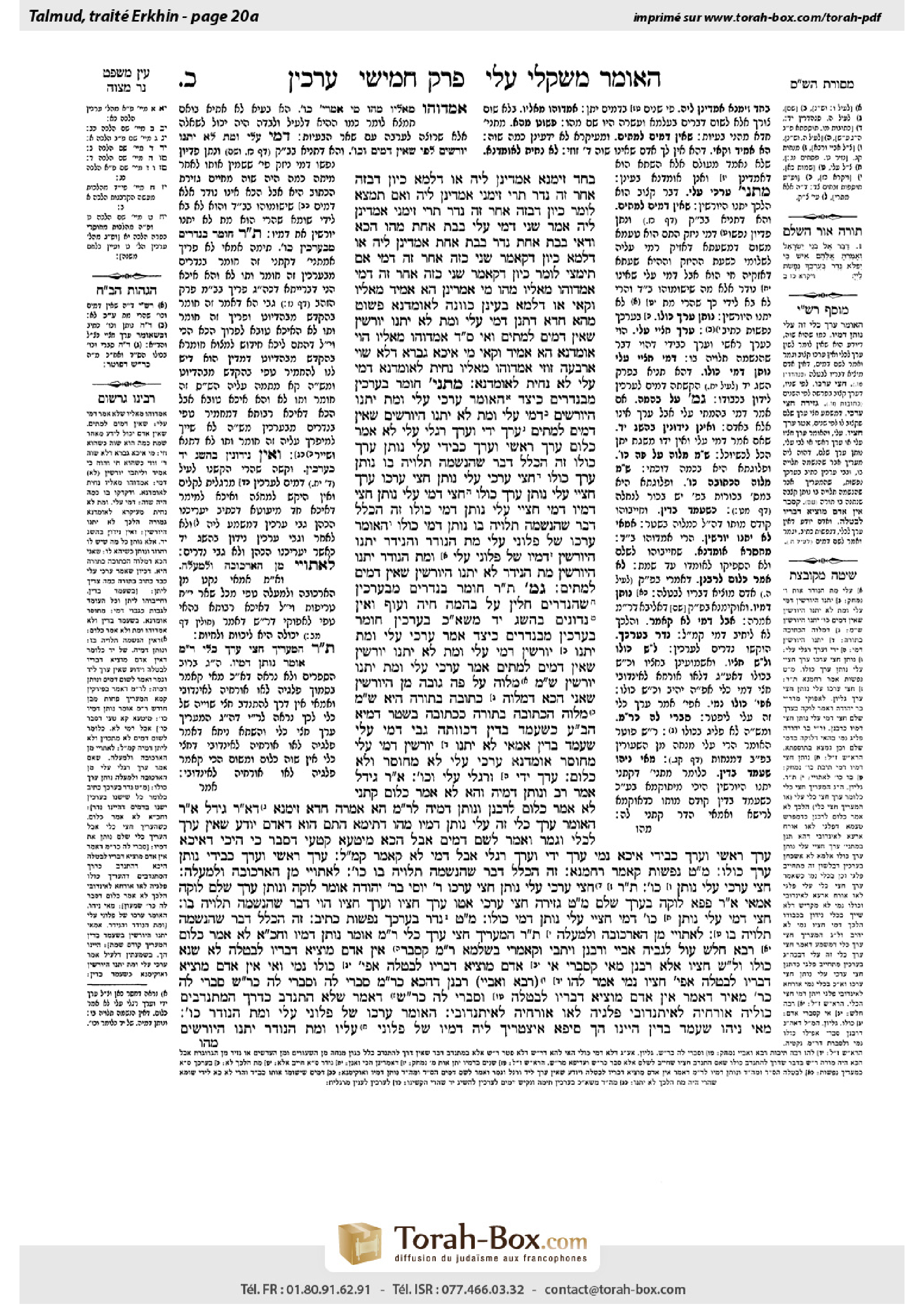
Arakhin 20a: Talmud study for Daf Yomi
Study the Talmud for Daf Yomi with scanned pages, Hebrew text, English translations from Sefaria and AI-generated French translations.
Passage selection and English or AI-generated French translation are available where the scan has annotations. Daf Study is independent of Torah-Box and Sefaria.
Browse Arakhin · ערכין · All tractatesArakhin 20a text and translations
This page of Arakhin includes the Aramaic text, an English translation and an AI-generated French translation, alongside the scan above.
ערכין כ׳ א · Aramaic and Hebrew text
בְּחַד זִימְנָא אָמְדִינַן לֵיהּ, אוֹ דִלְמָא כֵּיוָן דִּבְזֶה אַחַר זֶה נָדַר, תְּרֵי זִימְנֵי אָמְדִינַן לֵיהּ?
וְאִם תִּמְצָא לוֹמַר: כֵּיוָן דִּבְזֶה אַחַר זֶה נָדַר תְּרֵי זִימְנֵי אָמְדִינַן לֵיהּ, אָמַר: ״שְׁנֵי דָּמַי עָלַי״ בְּבַת אַחַת, מַהוּ? הָכָא וַדַּאי בְּבַת אַחַת נָדַר, בְּבַת אַחַת אָמְדִינַן לֵיהּ, אוֹ דִלְמָא כֵּיוָן דְּקָאָמַר ״שְׁנֵי״, כְּזֶה אַחַר זֶה דָּמֵי?
אִם תִּימְצֵי לוֹמַר: כֵּיוָן דְּקָאָמַר ״שְׁנֵי״ כְּזֶה אַחַר זֶה דָּמֵי, אֲמָדוּהוּ מֵאֵלָיו מַהוּ? מִי אָמְרִינַן: הָא אֲמִיד מֵאֵלָיו וְקָאֵי, אוֹ דִלְמָא בָּעֵינַן כַּוָּונָה לְאוּמְדָּנָא?
פְּשׁוֹט מִיהָא חֲדָא, דִּתְנַן: ״דְּמֵי עָלַי״ וּמֵת — לֹא יִתְּנוּ יוֹרְשִׁין, שֶׁאֵין דָּמִים לַמֵּתִים.
וְאִי סָלְקָא דַעְתָּךְ אֲמָדוּהוּ מֵאֵלָיו הָוֵי אוּמְדָּנָא, הָא אֲמִיד וְקָאֵי, מִי אִיכָּא גַּבְרָא דְּלָא שָׁוֵי אַרְבְּעָה זוּזֵי?
אֲמָדוּהוּ מֵאֵלָיו — נְחֵית לְאוּמְדָּנָא, ״דָּמַי עָלַי״ — לָא נְחֵית לְאוּמְדָּנָא.
מַתְנִי׳ חוֹמֶר בָּעֲרָכִין מִבַּנְּדָרִים, כֵּיצַד? הָאוֹמֵר: ״עֶרְכִּי עָלַי״ וָמֵת — יִתְּנוּ הַיּוֹרְשִׁים, ״דָּמַי עָלַי״ וָמֵת — לֹא יִתְּנוּ הַיּוֹרְשִׁים, שֶׁאֵין דָּמִים לַמֵּתִים.
״עֵרֶךְ יָדִי״, וְ״עֵרֶךְ רַגְלִי עָלַי״ — לָא אָמַר כְּלוּם. ״עֵרֶךְ רֹאשִׁי״, וְ״עֵרֶךְ כְּבֵידִי עָלַי״ — נוֹתֵן עֵרֶךְ כּוּלּוֹ. זֶה הַכְּלָל: דָּבָר שֶׁהַנְּשָׁמָה תְּלוּיָה בּוֹ — נוֹתֵן עֵרֶךְ כּוּלּוֹ.
״חֲצִי עֶרְכִּי עָלַי״ — נוֹתֵן חֲצִי עֶרְכּוֹ, ״עֵרֶךְ חֶצְיִי עָלַי״ — נוֹתֵן עֵרֶךְ כּוּלּוֹ, ״חֲצִי דָּמַי עָלַי״ — נוֹתֵן חֲצִי דָּמָיו, ״דְּמֵי חֶצְיִי עָלַי״ — נוֹתֵן דְּמֵי כוּלּוֹ. זֶה הַכְּלָל: דָּבָר שֶׁהַנְּשָׁמָה תְּלוּיָה בּוֹ — נוֹתֵן דְּמֵי כוּלּוֹ.
הָאוֹמֵר: ״עֶרְכּוֹ שֶׁל פְּלוֹנִי עָלַי״, מֵת הַנּוֹדֵר וְהַנִּידָּר — יִתְּנוּ הַיּוֹרְשִׁין. ״דָּמָיו שֶׁל פְּלוֹנִי עָלַי״, וּמֵת הַנּוֹדֵר — יִתְּנוּ הַיּוֹרְשִׁין, מֵת הַנִּידָּר — לֹא יִתְּנוּ הַיּוֹרְשִׁין, שֶׁאֵין דָּמִים לַמֵּתִים.
גְּמָ׳ תָּנוּ רַבָּנַן: חוֹמֶר בַּנְּדָרִים מִבַּעֲרָכִין, שֶׁהַנְּדָרִים חָלִין עַל בְּהֵמָה חַיָּה וָעוֹף, וְאֵין נִדּוֹנִים בְּהֶשֵּׂג יָד, מָה שֶׁאֵין כֵּן בָּעֲרָכִין.
חוֹמֶר בָּעֲרָכִין מִבַּנְּדָרִים, כֵּיצַד? אָמַר: ״עֶרְכִּי עָלַי״ וָמֵת — יִתְּנוּ יוֹרְשִׁין, ״דָּמַי עָלַי״ וָמֵת — לֹא יִתְּנוּ יוֹרְשִׁין, שֶׁאֵין דָּמִים לַמֵּתִים.
אָמַר ״עֶרְכִּי עָלַי״ וָמֵת — יִתְּנוּ יוֹרְשִׁין. שְׁמַע מִינַּהּ מִלְוָה עַל פֶּה גּוֹבֶה מִן הַיּוֹרְשִׁין? שָׁאנֵי הָכָא, דְּמִלְוָה כְּתוּבָה בַּתּוֹרָה הִיא.
שְׁמַע מִינַּהּ: מִלְוָה הַכְּתוּבָה בַּתּוֹרָה כִּכְתוּבָה בִּשְׁטָר דָּמְיָא? הָכָא בְּמַאי עָסְקִינַן — כְּשֶׁעָמַד בַּדִּין.
דִּכְוָותַהּ גַּבֵּי ״דָּמַי עָלַי״ שֶׁעָמַד בַּדִּין, אַמַּאי לֹא יִתְּנוּ יוֹרְשִׁין ״דָּמַי עָלַי״? מְחוּסַּר אוּמְדָּנָא. ״עֶרְכִּי עָלַי״ — לֹא מְחוּסָּר וְלֹא כְלוּם.
עֵרֶךְ יָדִי וְרַגְלִי עָלַי וְכוּ׳. אָמַר רַב גִּידֵּל אָמַר רַב: וְנוֹתֵן דָּמֶיהָ.
וְהָא ״לֹא אָמַר כְּלוּם״ קָתָנֵי! לֹא אָמַר כְּלוּם לְרַבָּנַן, וְנוֹתֵן דָּמֶיהָ לְרַבִּי מֵאִיר.
הָא אַמְרַהּ חֲדָא זִימְנָא, דְּאָמַר רַב גִּידֵּל אָמַר רַב: הָאוֹמֵר ״עֵרֶךְ כְּלִי זֶה עָלַי״ נוֹתֵן דָּמָיו!
מַהוּ דְּתֵימָא: הָתָם הוּא דְּאָדָם יוֹדֵעַ שֶׁאֵין עֵרֶךְ לִכְלִי, וְגָמַר וְאָמַר לְשֵׁם דָּמִים, אֲבָל הָכָא מִיטְעָא קָטָעֵי, דְּסָבַר כִּי הֵיכִי דְּאִיכָּא ״עֵרֶךְ רֹאשִׁי״ וְ״עֵרֶךְ כְּבֵידִי״, אִיכָּא נָמֵי ״עֵרֶךְ יָדִי״ וְ״עֵרֶךְ רַגְלִי״, אֲבָל דְּמֵי לָא קָאָמַר — קָא מַשְׁמַע לַן.
״עֵרֶךְ רֹאשִׁי״ וְ״עֵרֶךְ כְּבֵידִי״ — נוֹתֵן עֵרֶךְ כּוּלּוֹ. מַאי טַעְמָא? ״נְפָשׁוֹת״ קָאָמַר רַחֲמָנָא.
זֶה הַכְּלָל: דָּבָר שֶׁהַנְּשָׁמָה תְּלוּיָה בּוֹ וכו׳. לְאֵתוֹיֵי מִן הָאַרְכּוּבָּה וּלְמַעְלָה.
חֲצִי עֶרְכִּי עָלַי נוֹתֵן כּוּ׳. תָּנוּ רַבָּנַן: ״חֲצִי עֶרְכִּי עָלַי״ — נוֹתֵן חֲצִי עֶרְכּוֹ. רַבִּי יוֹסֵי בְּרַבִּי יְהוּדָה אוֹמֵר: לוֹקֶה וְנוֹתֵן עֵרֶךְ שָׁלֵם.
לוֹקֶה?! אַמַּאי? אָמַר רַב פָּפָּא: לוֹקֶה בְּעֵרֶךְ שָׁלֵם, מַאי טַעְמָא? גְּזֵירָה ״חֲצִי (עֶרְכִּי) [עֶרְכּוֹ]״ אַטּוּ ״עֵרֶךְ חֶצְיוֹ״, וְעֵרֶךְ חֶצְיוֹ הָוֵי דָּבָר שֶׁהַנְּשָׁמָה תְּלוּיָה בּוֹ.
״חֲצִי דָּמַי עָלַי״ — נוֹתֵן כּוּ׳. ״דְּמֵי חֶצְיִי עָלַי״ — נוֹתֵן דְּמֵי כּוּלּוֹ, מַאי טַעְמָא?
״נֶדֶר בְּעֶרְכְּךָ נְפָשׁוֹת״ כְּתִיב.
זֶה הַכְּלָל: דָּבָר שֶׁהַנְּשָׁמָה תְּלוּיָה בּוֹ, לְאֵתוֹיֵי מִן הָאַרְכּוּבָּה וּלְמַעְלָה.
תָּנוּ רַבָּנַן: הַמַּעֲרִיךְ חֲצִי עֵרֶךְ כְּלִי, רַבִּי מֵאִיר אוֹמֵר: נוֹתֵן דָּמָיו, וַחֲכָמִים אוֹמְרִים: לֹא אָמַר כְּלוּם. רָבָא חֲלַשׁ, עוּל לְגַבֵּיהּ אַבָּיֵי וְרַבָּנַן, וְיָתְבִי וְקָאָמְרִי: בִּשְׁלָמָא רַבִּי מֵאִיר קָסָבַר אֵין אָדָם מוֹצִיא דְּבָרָיו לְבַטָּלָה, לָא שְׁנָא כּוּלּוֹ וְלָא שְׁנָא חֶצְיוֹ.
אֶלָּא רַבָּנַן מַאי קָסָבְרִי? אִי אָדָם מוֹצִיא דְּבָרָיו לְבַטָּלָה — אֲפִילּוּ כּוּלּוֹ נָמֵי, וְאִי אֵין אָדָם מוֹצִיא דְּבָרָיו לְבַטָּלָה — אֲפִילּוּ חֶצְיוֹ נָמֵי!
אֲמַר לְהוּ רָבָא וְאַבָּיֵי: רַבָּנַן דְּהָכָא כְּרַבִּי מֵאִיר סָבְרִי לַהּ, וְסָבְרִי לַהּ כְּרַבִּי׳ שִׁמְעוֹן. סָבְרִי לַהּ כְּרַבִּי מֵאִיר, דְּאָמַר: ״אֵין אָדָם מוֹצִיא דְּבָרָיו לְבַטָּלָה״.
וְסָבְרִי לַהּ כְּרַבִּי שִׁמְעוֹן, דְּאָמַר שֶׁלֹּא הִתְנַדֵּב כְּדֶרֶךְ הַמִּתְנַדְּבִים; כּוּלֵּיהּ אוֹרְחֵיהּ לְאִיתְנַדּוֹבֵי, פַּלְגֵיהּ לָאו אוֹרְחֵיהּ לְאִיתְנַדּוֹבֵי.
הָאוֹמֵר ״עֶרְכּוֹ שֶׁל פְּלוֹנִי עָלַי״, וּמֵת הַנּוֹדֵר כּוּ׳. מַאי נִיהוּ? שֶׁעָמַד בַּדִּין.
הַיְינוּ הָךְ! סֵיפָא אִיצְטְרִיךְ לֵיהּ, דָּמָיו שֶׁל פְּלוֹנִי עָלָיו, וּמֵת הַנּוֹדֵר — יִתְּנוּ הַיּוֹרְשִׁים.
Arakhin 20a · English translation
we assess him once and he donates twice the value of that single assessment, or perhaps since he vowed sequentially we assess him twice?
And if you say in that case that since he vowed sequentially we assess him twice, if he says at the same time: My assessment is twice incumbent upon me, what is the halakha? Do we say that here certainly he vowed at the same time, and therefore we assess him once, or perhaps since he says the word: Twice, it is considered as though he vowed sequentially and therefore he must be assessed twice?
Finally, if you say that since he says the word: Twice, it is considered as though he vowed sequentially and he must be assessed twice, if a court of ten assessed him on its own,i.e., not for the purpose of assessing a vow, what is the halakha? Do we say that he has already been assessed on his own and now stands before us, and therefore there is no need for another assessment, or perhaps we require an assessment to be performed with intent for the sake of consecration to the Temple treasury.
The Gemara suggests: Resolve at least one of these dilemmas, as we learned in the mishna below: In the case of one who says: It is incumbent upon me to donate my assessment, and then dies, his heirs need not give his assessment to the Temple treasury, as there is no monetary value for the dead, and his assessment at the time of his vow is unknown.
The Gemara explains the resolution: And if it enters your mind that in a case where a court of ten assessed him on its own it is a valid assessment with regard to his vow, why does the mishna state that his heirs do not have to donate to the Temple treasury? Isn’t he considered as standing assessed from the outset, as is there a person who is not worth at least four zuz? This proves that an assessment is required to be performed with intent for the sake of consecration to the Temple treasury.
The Gemara rejects this resolution: In a case where a court of ten assessed him on its own before he took his vow, he has entered into an assessment, i.e., an assessment has actually been performed. By contrast, in the case of one who says: It is incumbent upon me to donate my assessment, and then dies, he has not entered into an assessment, i.e., no actual assessment has been conducted at all.
MISHNA: There are halakhot that are more stringent with regard to valuations than with regard to vows of assessment. How so? In the case of one who says: It is incumbent upon me to donate my valuation, and then dies, his heirs must give his valuation to the Temple treasury. But one who says: It is incumbent upon me to donate my assessment, and then dies, his heirs need not give his assessment to the Temple treasury, as there is no monetary value for the dead.
One who says: It is incumbent upon me to donate the valuation of my forearm, or: The valuation of my leg, has not said anything, as there are valuations in the Torah only for a complete person. But if one says: It is incumbent upon me to donate the valuation of my head, or: The valuation of my liver, he gives the valuation of his entire self. This is the principle: One who valuates an item upon which the soul is dependent, i.e., without which one will die, gives the valuation of his entire self.
One who says: It is incumbent upon me to donate half of my valuation, gives half of his valuation. But one who says: It is incumbent upon me to donate the valuation of half of me, gives the valuation of his entire self. Likewise, one who says: It is incumbent upon me to donate half of my assessment, gives half of his assessment; one who says: It is incumbent upon me to donate the assessment of half of me, gives the assessment of his entire self. This is the principle: One who takes a vow with regard to an item upon which the soul is dependent gives the assessment of his entire self.
With regard to one who says: It is incumbent upon me to donate the valuation of so-and-so, and both the one who vowed and the object of the vow die, the heirs of the one who vowed must give the valuation of the object of the vow to the Temple treasury. With regard to one who says: It is incumbent upon me to donate the assessment of so-and-so, and the one who vowed dies, his heirs must give his assessment to the Temple treasury. If the object of the vow dies, the heirs of the one who vowed need not give his assessment to the Temple treasury, as there is no monetary value for the dead.
GEMARA: The Sages taught in a baraita: There are halakhot that are more stringent with regard to vows of assessment than with regard to valuations, as vows of assessment take effect with regard to a domesticated animal, an undomesticated animal, and a bird. If one says: It is incumbent upon me to donate the assessment of this bird, he must donate that assessment. This is not the case with regard to valuations, as they do not take effect with regard to animals and birds. And another halakha that is more stringent with regard to vows of assessment than with regard to valuations is that the destitute who take vows of assessment are not assessed based on affordability. This is not the case with regard to valuations, which are assessed based on whether the one who vows can afford to pay what they vowed.
There is a halakha that is more stringent with regard to valuations than with regard to vows of assessment. How so? In the case of one who said: It is incumbent upon me to donate my valuation, and dies, his heirs must give his valuation to the Temple treasury. But one who says: It is incumbent upon me to donate my assessment, and dies, his heirs need not give his assessment to the Temple treasury, as there is no monetary value for the dead.
The baraita taught with regard to a person who said: It is incumbent upon me to donate my valuation, and dies, that his heirs must give his valuation to the Temple treasury. The Gemara suggests one can conclude from this ruling that one collects a loan by oral agreement from the heirs, as no promissory note was written with regard to this obligation. The Gemara rejects this conclusion: Here the heirs’ obligation to pay the valuation of the deceased is different, i.e., it is not the same as a loan by oral agreement, as a valuation is considered a loan, i.e., debt, written in the Torah, in accordance with the deceased’s age and sex at the time of the vow.
The Gemara objects: If so, can one conclude from the baraita that a loan that is written in the Torah, i.e., any financial obligation that applies by Torah law, is considered as though it were written in a document? The Gemara rejects this conclusion: Here we are dealing with a case where he stood in judgment before he died, and the court obligated him to donate his valuation. The court’s ruling is considered like a financial obligation written in a document, and therefore the heirs are required to pay his valuation.
The Gemara asks: If so, then in the corresponding situation, with regard to one who said: It is incumbent upon me to donate my assessment, the baraita must also be referring to one who stood in judgment. But in that case, why don’t the heirs have to donate his assessment? The Gemara answers that in the case of one who said: It is incumbent upon me to donate my assessment, even if he stood in judgment and the court obligated him to pay, the assessment of the precise amount he must pay is still lacking, as that amount is determined only through the assessment of a court. By contrast, with regard to one who said: It is incumbent upon me to donate my valuation, if he stood in judgment and the court obligated him to pay, nothing is lacking, as the amount he pays is fixed by the Torah.
§ The mishna teaches that one who says: It is incumbent upon me to donate the valuation of my forearm, or of my leg, has not said anything, as there are valuations in the Torah only for a complete person. Rav Giddel says that Rav says: And although he is exempt from donating the valuation, he must give the assessment of the forearm or leg.
The Gemara asks: But isn’t it taught in the mishna that he has not said anything? The Gemara answers: The ruling of the mishna that he has not said anything applies according to the opinion of the Rabbis, but he must give the assessment according to the opinion of Rabbi Meir. Rabbi Meir maintains that a person does not utter a statement for naught, and therefore he must have intended to vow to donate the assessment of the limb, as there is no valuation for limbs.
The Gemara asks: But didn’t Rav Giddel already say it once, as Rav Giddel says that Rav says: In the case of one who says: It is incumbent upon me to donate the valuation of this vessel, although he is exempt from donating the valuation of the vessel, according to the opinion of Rabbi Meir he must give the assessment of the vessel.
The Gemara answers: It was necessary for Rav Giddel to repeat that halakha with regard to one who vowed the valuation of his forearm or leg, lest you say this ruling is applicable only there, with regard to a vessel, as a person knows that there is no valuation for a vessel, and he therefore intended and said his vow for the sake of assessments. But here, with regard to his forearm or leg, he erred, as he thought that just as there is an obligation to donate the valuation in a case where one said: It is incumbent upon me to donate the valuation of my head, or: The valuation of my liver, so too, there is an obligation to donate the valuation if one said: It is incumbent upon me to donate the valuation of my forearm or the valuation of my leg. But he did not intend to say a vow of assessments. Therefore, Rav Giddel teaches us that even in the case of one who vowed to donate the valuation of his forearm or leg, he did not speak in error but intended to donate the assessment.
§ The mishna teaches that if one says: It is incumbent upon me to donate the valuation of my head, or: The valuation of my liver, he gives the valuation of his entire self. The Gemara asks: What is the reason? The Gemara answers that the Merciful One states: “A valuation of living people” (Leviticus 27:2), which indicates that in the case of one who valuates an item upon which the soul is dependent and without which one will die, he must give the valuation of his entire self.
The mishna further teaches that this is the principle: One who valuates an item upon which the soul is dependent and without which one will die gives the valuation of his entire self. The Gemara explains that the phrase: This is the principle, serves to include one who vowed to donate the valuation of his leg from the knee and above. Since one would die if his leg were severed above the knee, this is considered an item upon which the soul is dependent, and therefore he gives the valuation of his entire self.
The mishna teaches that one who says: It is incumbent upon me to donate half of my valuation, gives half of his valuation. The Sages taught in a baraita (Tosefta 3:3): One who says: It is incumbent upon me to donate half of my valuation, gives half of his valuation. Rabbi Yosei, son of Rabbi Yehuda, says: He is flogged and must give his full valuation.
The Gemara asks: Since he did not commit a sin, why is he flogged? Rav Pappa said in response: He is flogged, i.e., punished, in that he must donate his full valuation. What is the reason he needs to give his full valuation? A rabbinic decree was issued that one who says: It is incumbent upon me to donate half of my valuation, must give the value of his entire self, due to a concern that this case might become confused with the similar one of a person who vows to donate the valuation of half of himself. And the halakha in such a case is that he must give the value of his entire self, as the valuation of half of him is an item upon which the soul is dependent.
The mishna further teaches that one who says: It is incumbent upon me to donate half of my assessment, gives half of his assessment. But one who says: It is incumbent upon me to donate the assessment of half of me, gives the assessment of his entire self, as one who takes a vow of assessment with regard to an item upon which the soul depends must give the assessment of his entire self. The Gemara asks: What is the reason? After all, it is only with regard to valuations that the Torah states: “A valuation of living people” (Leviticus 27:2), indicating that one who valuates an item upon which the soul depends must give the valuation of his entire self; but this is not stated with regard to assessments.
The Gemara answers that it is written: “When a man shall clearly utter a vow [neder] with regard to a valuation [be’erkekha] of living people” (Leviticus 27:2). The verse juxtaposes vows of assessment [neder] and valuations [erekh], thereby teaching that just as one who takes a vow of valuation with regard to an item upon which the soul depends must give the valuation of his entire self, so too, one who takes a vow of assessment with regard to an item upon which the soul is dependent must give the assessment of his entire self.
The mishna further teaches that this is the principle: One who takes a vow of assessment with regard to an item upon which the soul is dependent gives the assessment of his entire self. The Gemara explains that the phrase: This is the principle, serves to include one who vowed to donate the assessment of his leg from the knee and above. Since one would die if his leg were severed above the knee, this is an item upon which the soul depends, and therefore he gives the assessment of his entire self.
§ The Sages taught in a baraita: With regard to one who valuates in order to donate half the valuation of a vessel, Rabbi Meir says: He gives half the assessment of the vessel, and the Rabbis say: He has not said anything. The Gemara relates: Rava became sick, and Abaye and other Sages came to visit him. As they were sitting and talking, they said: Granted that Rabbi Meir holds that a person does not utter a statement for naught, and therefore there is no difference whether one vowed to donate the entire valuation of a vessel, and there is no difference whether one vowed to donate half its valuation; in either case he must have intended to donate the assessment, as there is no valuation with regard to vessels.
But with regard to the Rabbis in the baraita, what do they hold? If they maintain that a person utters a statement for naught, then even if one vowed to donate the entire valuation of a vessel, he should be exempt and the Rabbis should disagree with regard to that case. And if the Rabbis maintain that a person does not utter a statement for naught, then even one who vowed to donate half the valuation of a vessel should be obligated to give half of the assessment.
Rava and Abaye said to the Sages in response: The Rabbis here in the baraita hold in accordance with the opinion of Rabbi Meir, but they also hold in accordance with the opinion of Rabbi Shimon. Rava and Abaye elaborated: They hold in accordance with the opinion of Rabbi Meir, who says that a person does not utter a statement for naught, and therefore one who vows to donate the valuation of a vessel must give its assessment.
And they also hold in accordance with the opinion of Rabbi Shimon with regard to one who consecrated an item for a purpose for which it was unsuited, e.g., if one sought to bring a barley meal offering even though meal offerings may be brought only from wheat (see Menaḥot 103a). Rabbi Shimon says he is exempt from any obligation, as this person did not donate in the manner typical of donors. So too, with regard to one who vows to donate the valuation of a vessel, it is the typical manner for one to donate an entire vessel, and therefore one who does so is obligated to donate the assessment of the vessel. But it is not the typical manner for one to donate half a vessel, and therefore one who vows in this manner has not said anything and is exempt.
§ The mishna teaches that if one said: It is incumbent upon me to donate the valuation of so-and-so, and both the one who vowed and the object of the vow die, the heirs of the one who vowed must give his valuation to the Temple treasury. The Gemara asks: What is the specific case to which the mishna is referring? It must be referring to a case where he stood in judgment, and the court obligated him to donate his valuation before he died. The court’s ruling is considered like a financial obligation written in a document, and therefore the heirs of the one who vowed are required to pay his valuation.
If so, this clause in the mishna is identical to that previous clause in the mishna, which states that if one said: It is incumbent upon me to donate my valuation, and he dies, his heirs must give his valuation to the Temple treasury. Since it was explained that the earlier clause is also dealing with a case where he stood in judgment, for what purpose was this halakha repeated in the mishna? The Gemara answers: It was necessary to repeat this halakha in order to teach the latter clause of the mishna: With regard to one who says it is incumbent upon him to donate the assessment of so-and-so, and the one who vowed dies, his heirs must give his assessment to the Temple treasury.
Arakhin 20a · Traduction française (IA)
nous évaluons une fois et il donne deux fois la valeur de cette évaluation, ou peut-être, puisque l'homme a fait un vœu successivement, nous évaluons deux fois ?
Et si vous dites dans ce cas que puisque l'homme a fait un vœu successivement nous évaluons deux fois, et s'il dit en même temps : Mon évaluation est double, quelle est la halakha ? Disons-nous que dans ce cas certainement l'homme a fait un vœu en même temps, et donc nous évaluons une fois, ou peut-être, puisque l'homme dit le mot : Double, cela est considéré comme s'il avait fait un vœu successivement et donc il doit être évalué deux fois ?
Enfin, si vous dites que puisque l'homme dit le mot : Double, cela est considéré comme s'il avait fait un vœu successivement et il doit être évalué deux fois, et si un tribunal de dix l'a évalué tout seul, c'est-à-dire sans l'objectif d'évaluer un vœu, quelle est la halakha ? Disons-nous qu'il a déjà été évalué par lui-même et maintenant il se tient devant nous, et donc il n'y a plus besoin d'une autre évaluation, ou peut-être nous exigeons une évaluation faite avec l'intention de consacrer au trésor du Temple ?
La Guemara suggère : Résolvez au moins l'une de ces difficultés, comme nous l'avons appris dans la mitsna ci-dessous : Dans le cas d'une personne qui dit : Il m'est imposé de donner mon évaluation, et ensuite meurt, ses héritiers n'ont pas besoin de donner son évaluation au trésor du Temple, car il n'y a pas de valeur monétaire pour le mort, et son évaluation au moment de son vœu est inconnue.
La Guemara explique la résolution : Et si cela vous vient à l'esprit que dans le cas où un tribunal de dix l'a évalué tout seul, cela constitue une évaluation valide concernant son vœu, pourquoi la mitsna dit-elle que ses héritiers n'ont pas besoin de donner à la fois au trésor du Temple ? N'est-il pas considéré comme ayant été évalué dès le départ, comme s'il y a un homme qui n'est pas d'une valeur minimale de quatre zuz ? Cela prouve que l'évaluation doit être faite avec l'intention de consacrer au trésor du Temple.
La Guemara rejette cette résolution : Dans le cas où un tribunal de dix l'a évalué tout seul avant qu'il ne prenne son vœu, il a entré dans une évaluation, c'est-à-dire une évaluation a effectivement été réalisée. En revanche, dans le cas d'une personne qui dit : Il m'est imposé de donner mon évaluation, et ensuite meurt, il n'a pas entré dans une évaluation, c'est-à-dire aucune évaluation n'a été effectivement réalisée du tout.
MICHNA : Il y a des halakhot qui sont plus strictes concernant les évaluations que concernant les vœux d'évaluation. Comment cela se produit-il ? Dans le cas d'une personne qui dit : Il m'est imposé de donner mon évaluation, et ensuite meurt, ses héritiers doivent donner son évaluation au trésor du Temple. Mais une personne qui dit : Il m'est imposé de donner mon évaluation, et ensuite meurt, ses héritiers n'ont pas besoin de donner son évaluation au trésor du Temple, car il n'y a pas de valeur monétaire pour le mort.
Une personne qui dit : Il m'est imposé de donner l'évaluation de mon avant-bras, ou : L'évaluation de mon pied, n'a pas dit quelque chose, car il n'y a des évaluations dans la Torah que pour une personne complète. Mais si une personne dit : Il m'est imposé de donner l'évaluation de ma tête, ou : L'évaluation de mon foie, elle donne l'évaluation de son entier être. C'est le principe : Une personne qui évalue un objet sur lequel dépend son âme, c'est-à-dire sans lequel elle mourrait, donne l'évaluation de son entier être.
Une personne qui dit : Il m'est imposé de donner la moitié de mon évaluation, donne la moitié de son évaluation. Mais une personne qui dit : Il m'est imposé de donner l'évaluation de la moitié de moi, donne l'évaluation de son entier être. De même, une personne qui dit : Il m'est imposé de donner la moitié de mon évaluation, donne la moitié de son évaluation ; une personne qui dit : Il m'est imposé de donner l'évaluation de la moitié de moi, donne l'évaluation de son entier être. C'est le principe : Une personne qui prend un vœu concernant un objet sur lequel dépend son âme, donne l'évaluation de son entier être.
Concernant un homme qui dit : Il m'est imposé de donner l'évaluation de tel ou tel, et à la fois l'homme qui a fait le vœu et l'objet du vœu meurent, les héritiers de l'homme qui a fait le vœu doivent donner l'évaluation de l'objet du vœu au trésor du Temple. Concernant un homme qui dit : Il m'est imposé de donner l'évaluation de tel ou tel, et l'homme qui a fait le vœu meurt, ses héritiers doivent donner son évaluation au trésor du Temple. Si l'objet du vœu meurt, les héritiers de l'homme qui a fait le vœu n'ont pas besoin de donner son évaluation au trésor du Temple, car il n'y a pas de valeur monétaire pour le mort.
La Guemara : Les Sages ont enseigné dans une baraïta : Il y a des halakhot qui sont plus strictes concernant les vœux d'évaluation que concernant les évaluations, car les vœux d'évaluation prennent effet concernant un animal domestique, un animal sauvage et un oiseau. Si un homme dit : Il m'est imposé de donner l'évaluation de ce oiseau, il doit donner cette évaluation. Cela n'est pas le cas concernant les évaluations, car elles ne prennent effet concernant les animaux et les oiseaux. Et une autre halakha qui est plus strictes concernant les vœux d'évaluation que concernant les évaluations est que les pauvres qui prennent des vœux d'évaluation ne sont pas évalués en fonction de leur capacité à payer. Cela n'est pas le cas concernant les évaluations, qui sont évaluées en fonction de la capacité de l'homme qui fait le vœu à payer ce qu'il a vœu.
Il y a une halakha qui est plus strictes concernant les évaluations que concernant les vœux d'évaluation. Comment cela se produit-il ? Dans le cas d'un homme qui a dit : Il m'est imposé de donner mon évaluation, et meurt, ses héritiers doivent donner son évaluation au trésor du Temple. Mais un homme qui a dit : Il m'est imposé de donner mon évaluation, et meurt, ses héritiers n'ont pas besoin de donner son évaluation au trésor du Temple, car il n'y a pas de valeur monétaire pour le mort.
La baraïta enseigne concernant une personne qui dit : Il m’est imposé de donner ma valeur, et meurt, que ses héritiers doivent donner sa valeur au trésor du Temple. La Guemara suggère qu’on peut en conclure de cette décision que l’on peut récupérer un prêt par un accord oral auprès des héritiers, car aucun contrat n’a été rédigé concernant cette obligation. La Guemara rejette cette conclusion : ici, l’obligation des héritiers de payer la valeur du défunt est différente, c’est-à-dire qu’il ne s’agit pas du même cas qu’un prêt par accord oral, car la valeur est considérée comme un prêt, c’est-à-dire une dette, inscrite dans la Torah, conformément à l’âge et au sexe du défunt au moment du vœu.
La Guemara s’oppose en disant : Si c’est ainsi, peut-on en conclure de la baraïta que tout prêt inscrit dans la Torah, c’est-à-dire toute obligation financière applicable selon la loi divine, est considéré comme s’il était rédigé dans un document ? La Guemara rejette cette conclusion : ici, nous sommes en présence d’un cas où la personne s’est présentée devant un tribunal avant de mourir, et le tribunal a imposé à cette personne de donner sa valeur. Le jugement du tribunal est considéré comme une obligation financière inscrite dans un document, et par conséquent les héritiers sont tenus de payer sa valeur.
La Guemara pose la question : Si c’est ainsi, alors dans le cas correspondant, concernant une personne qui dit : Il m’est imposé de donner ma valeur, la baraïta doit aussi faire référence à une personne qui a présidé à un tribunal. Mais dans ce cas, pourquoi les héritiers ne doivent-ils pas donner sa valeur ? La Guemara répond que dans le cas d’une personne qui dit : Il m’est imposé de donner ma valeur, même si elle a présidé à un tribunal et que le tribunal a imposé à cette personne de payer, la valeur précise qu’elle doit payer est encore manquante, car cette valeur est déterminée uniquement par l’évaluation d’un tribunal. En revanche, concernant une personne qui dit : Il m’est imposé de donner ma valeur, si elle a présidé à un tribunal et que le tribunal a imposé à cette personne de payer, rien n’est manquant, car la somme qu’elle doit payer est fixée par la Torah.
§ La mitsna enseigne que celui qui dit : Il m’est imposé de donner la valeur de mon avant-bras, ou de mon pied, n’a pas dit quelque chose, car il n’y a de valeurs dans la Torah que pour une personne entière. Rav Giddel dit que Rav dit : Et bien qu’il soit exempt de donner la valeur, il doit donner l’évaluation de l’avant-bras ou du pied.
La Guemara pose la question : Mais n’est-ce pas enseigné par la mitsna qu’il n’a pas dit quelque chose ? La Guemara répond : La décision de la mitsna qu’il n’a pas dit quelque chose s’applique selon l’opinion des Rabbins, mais il doit donner l’évaluation selon l’opinion de Rabbi Meir. Rabbi Meir maintient qu’une personne ne prononce pas une déclaration à vide, et par conséquent il doit avoir l’intention de jurer de donner l’évaluation du membre, car il n’y a pas de valeur pour les membres.
La Guemara pose la question : Mais n’a-t-il pas déjà dit cela, Rav Giddel, comme Rav Giddel dit que Rav dit : Dans le cas d’une personne qui dit : Il m’est imposé de donner la valeur de ce vase, bien qu’il soit exempt de donner la valeur du vase, selon l’opinion de Rabbi Meir, il doit donner l’évaluation du vase.
La Guemara répond : Il était nécessaire que Rav Giddel répète cette halakha concernant une personne qui a juré la valeur de son avant-bras ou de son pied, afin que l’on ne dise pas que cette décision s’applique uniquement là, concernant un vase, car une personne sait qu’il n’y a pas de valeur pour un vase, et par conséquent il a l’intention et a dit son vœu à l’effet des évaluations. Mais ici, concernant son avant-bras ou son pied, il s’est trompé, car il pensait que justement comme il y a une obligation de donner la valeur dans le cas où l’on dit : Il m’est imposé de donner la valeur de ma tête, ou : La valeur de mon foie, il y a aussi une obligation de donner la valeur si l’on dit : Il m’est imposé de donner la valeur de mon avant-bras ou de mon pied. Mais il n’avait pas l’intention de dire un vœu d’évaluation. Par conséquent, Rav Giddel nous enseigne que même dans le cas d’une personne qui a juré la valeur de son avant-bras ou de son pied, il n’a pas dit quelque chose à tort mais il avait l’intention de donner l’évaluation.
§ La mitsna enseigne que si l’on dit : Il m’est imposé de donner la valeur de ma tête, ou : La valeur de mon foie, on donne la valeur de son corps entier. La Guemara pose la question : Quelle est la raison ? La Guemara répond que l’Éternel dit : « Une valeur des personnes vivantes » (Lévitique 27:2), ce qui indique que dans le cas d’une personne qui évalue un objet sur lequel l’âme dépend et sans lequel on meurt, il doit donner la valeur de son corps entier.
La mitsna enseigne davantage que ce principe : celui qui évalue un objet sur lequel l’âme dépend et sans lequel on meurt doit donner la valeur de son corps entier. La Guemara explique que la phrase : C’est le principe, sert à inclure celui qui a juré de donner la valeur de sa jambe du genou et au-dessus. Comme une personne mourrait si sa jambe était coupée au-dessus du genou, cela est considéré comme un objet sur lequel l’âme dépend, et par conséquent il doit donner la valeur de son corps entier.
La mitsna enseigne que celui qui dit : Il m’est imposé de donner la moitié de ma valeur, donne la moitié de sa valeur. Les Sages enseignent dans une baraïta (Tosefta 3:3) : Celui qui dit : Il m’est imposé de donner la moitié de ma valeur, donne la moitié de sa valeur. Rabbi Yosei, fils de Rabbi Yéhouda, dit : Il est battu et doit donner sa valeur totale.
La Guemara pose la question : Puisque qu’il n’a pas commis un péché, pourquoi est-il battu ? Rav Pappa répond en disant : Il est battu, c’est-à-dire puni, dans le fait qu’il doit donner sa valeur totale. Quelle est la raison qu’il doit donner sa valeur totale ? Un décret rabbinique a été émis selon lequel celui qui dit : Il m’est imposé de donner la moitié de ma valeur, doit donner la valeur de son corps entier, en raison de la crainte que ce cas puisse être confondu avec le cas similaire d’une personne qui jure de donner la valeur de la moitié de son corps. Et la halakha dans ce cas est qu’il doit donner la valeur de son corps entier, car la valeur de la moitié de lui est un objet sur lequel l’âme dépend.
La Michna enseigne de plus que celui qui dit : « Il m’est imposé de donner la moitié de ma valeur », donne la moitié de sa valeur. Mais celui qui dit : « Il m’est imposé de donner la valeur de la moitié de moi », donne la valeur de son entier, comme celui qui prend un vœu de valeur concernant un objet sur lequel dépend l’âme doit donner la valeur de son entier. La Guemara demande : Quel est le motif ? Après tout, c’est seulement concernant les valeurs que la Torah dit : « Une valeur de personnes vivantes » (Lévitique 27:2), indiquant que celui qui valorise un objet sur lequel dépend l’âme doit donner la valeur de son entier ; mais cela n’est pas dit concernant les évaluations.
La Guemara répond que cela est écrit : « Quand un homme aura clairement prononcé un vœu [neder] concernant une valeur [be’erkekha] de personnes vivantes » (Lévitique 27:2). Le verset juxtapose les vœux d’évaluation [neder] et les valeurs [erekh], enseignant ainsi que tout comme celui qui prend un vœu de valeur concernant un objet sur lequel dépend l’âme doit donner la valeur de son entier, de même celui qui prend un vœu d’évaluation concernant un objet sur lequel dépend l’âme doit donner l’évaluation de son entier.
La Michna enseigne de plus que ce principe est le suivant : celui qui prend un vœu d’évaluation concernant un objet sur lequel dépend l’âme donne l’évaluation de son entier. La Guemara explique que la phrase : « Ce principe est le suivant », sert à inclure celui qui a pris un vœu de donner l’évaluation de sa jambe du genou vers le haut. Puisque l’on mourrait si sa jambe était tranchée au-dessus du genou, c’est un objet sur lequel dépend l’âme, et par conséquent il donne l’évaluation de son entier.
§ Les Sages ont enseigné dans une baraïta : concernant celui qui valorise afin de donner la moitié de la valeur d’un objet, Rabbi Meir dit : il donne la moitié de l’évaluation de l’objet, et les Rabbins disent : il n’a pas dit quelque chose. La Guemara rapporte : Rava est tombé malade, et Abaye et d’autres Sages sont allés le voir. Alors qu’ils étaient assis et discutaient, ils dirent : Admettons que Rabbi Meir maintient que personne ne prononce un vœu à vide, et par conséquent il n’y a pas de différence entre celui qui a pris un vœu de donner l’évaluation entière d’un objet et celui qui a pris un vœu de donner la moitié de son évaluation ; dans les deux cas il doit avoir eu l’intention de donner l’évaluation, car il n’y a pas d’évaluation concernant les objets.
Mais concernant les Rabbins dans la baraïta, qu’en pensent-ils ? Si ils maintiennent que personne ne prononce un vœu à vide, alors même si l’on a pris un vœu de donner l’évaluation entière d’un objet, l’individu devrait être exempt et les Rabbins devraient s’opposer à ce cas. Et si les Rabbins maintiennent que personne ne prononce un vœu à vide, alors même celui qui a pris un vœu de donner la moitié de l’évaluation d’un objet devrait être tenu de donner la moitié de l’évaluation.
Rava et Abaye dirent aux Sages en réponse : les Rabbins ici dans la baraïta suivent l’opinion de Rabbi Meir, mais ils suivent aussi l’opinion de Rabbi Shimon. Rava et Abaye développèrent : ils suivent l’opinion de Rabbi Meir, qui dit que personne ne prononce un vœu à vide, et par conséquent celui qui prend un vœu de donner l’évaluation d’un objet doit donner son évaluation.
Et ils suivent aussi l’opinion de Rabbi Shimon concernant celui qui a consacré un objet à un usage inadapté, par exemple si l’on cherchait à apporter une offrande de blé même si les offrandes de blé peuvent être apportées uniquement à partir de froment (voir Menaḥot 103a). Rabbi Shimon dit qu’il est exempt de toute obligation, car cette personne n’a pas donné de la manière typique des donateurs. De même, concernant celui qui prend un vœu de donner l’évaluation d’un objet, c’est la manière typique de donner un objet entier, et par conséquent celui qui le fait est tenu de donner l’évaluation de l’objet. Mais ce n’est pas la manière typique de donner la moitié d’un objet, et par conséquent celui qui prend un vœu ainsi n’a pas dit quelque chose et est exempt.
§ La Michna enseigne que si l’on dit : « Il m’est imposé de donner la valeur de tel ou tel », et que celui qui a pris le vœu et l’objet du vœu meurent, les héritiers de celui qui a pris le vœu doivent donner sa valeur au trésor du Temple. La Guemara demande : De quel cas spécifique la Michna parle-t-elle ? Il doit s’agir d’un cas où il a été jugé, et le tribunal a imposé de donner sa valeur avant qu’il ne meure. Le jugement du tribunal est considéré comme une obligation financière écrite dans un document, et par conséquent les héritiers de celui qui a pris le vœu doivent payer sa valeur.
Si c’est ainsi, cette clause de la Michna est identique à la clause précédente de la Michna, qui stipule que si l’on dit : « Il m’est imposé de donner ma valeur », et qu’il meurt, ses héritiers doivent donner sa valeur au trésor du Temple. Puisque cela a été expliqué que la clause précédente traite aussi d’un cas où il a été jugé, à quel propos cette halakha a-t-elle été répétée dans la Michna ? La Guemara répond : il était nécessaire de répéter cette halakha afin d’enseigner la clause suivante de la Michna : concernant celui qui dit : « Il m’est imposé de donner l’évaluation de tel ou tel », et que celui qui a pris le vœu meurt, ses héritiers doivent donner son évaluation au trésor du Temple.
Traduction française générée par IA à partir de l’édition anglaise de Sefaria. Vérifie toujours un passage avec le texte source.
Text from Sefaria: William Davidson Edition - Vocalized Aramaic (CC BY NC); William Davidson Edition - English (CC BY NC).