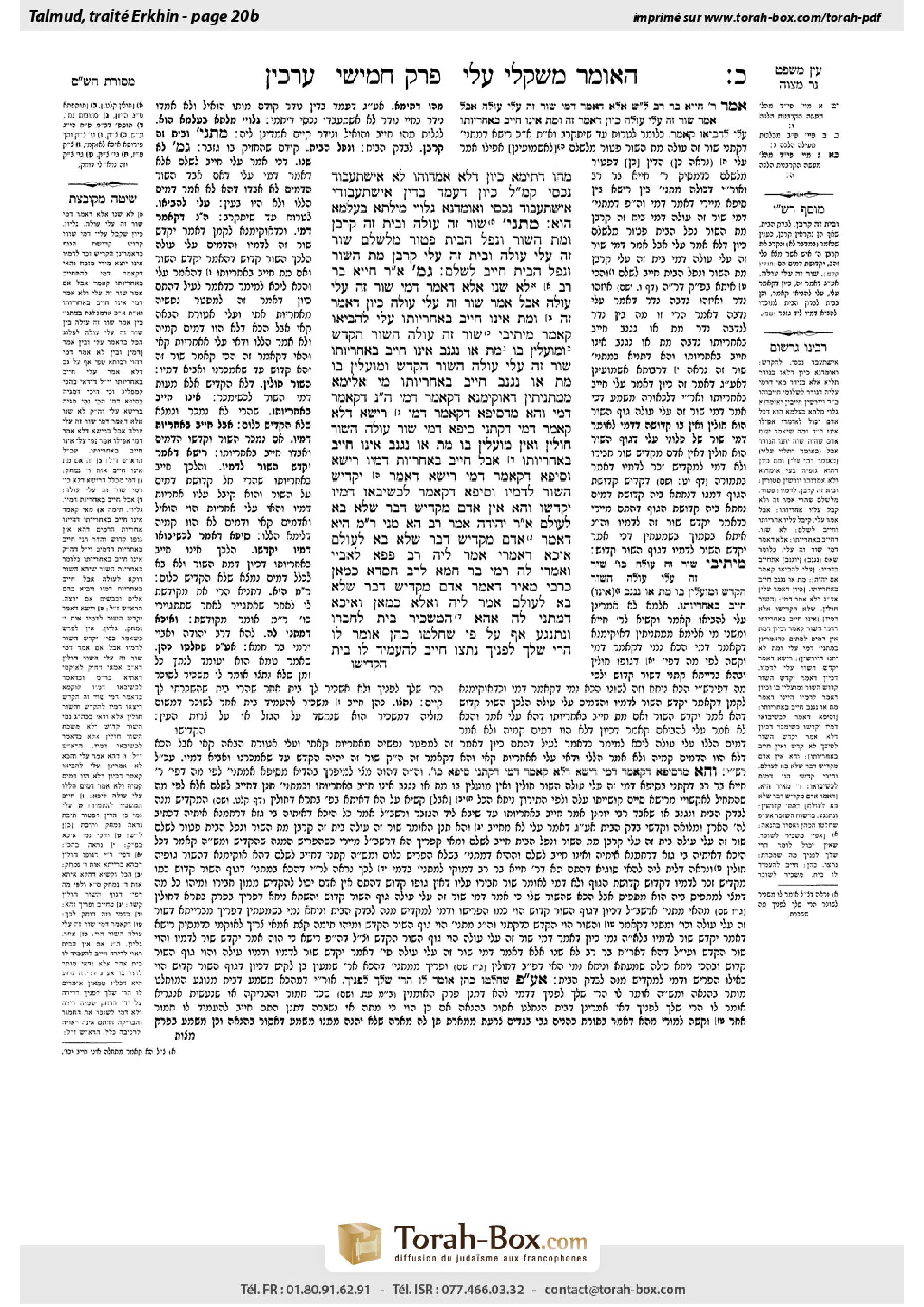
Arakhin 20b: Talmud study for Daf Yomi
Study the Talmud for Daf Yomi with scanned pages, Hebrew text, English translations from Sefaria and AI-generated French translations.
Passage selection and English or AI-generated French translation are available where the scan has annotations. Daf Study is independent of Torah-Box and Sefaria.
Browse Arakhin · ערכין · All tractatesArakhin 20b text and translations
This page of Arakhin includes the Aramaic text, an English translation and an AI-generated French translation, alongside the scan above.
ערכין כ׳ ב · Aramaic and Hebrew text
מַהוּ דְּתֵימָא, כֵּיוָן דְּלָא אֲמָדוּהוּ לָא אִישְׁתַּעְבּוּד נִכְסֵי, קָא מַשְׁמַע לַן: כֵּיוָן דְּעָמַד בַּדִּין אִישְׁתַּעְבּוֹדֵי אִישְׁתַּעְבּוּד נִכְסֵי, וְאוּמְדָּנָא גַּלּוֹיֵי מִילְּתָא בְעָלְמָא הוּא.
מַתְנִי׳ ״שׁוֹר זֶה עוֹלָה״, וּ״בַיִת זֶה קׇרְבָּן״, וּמֵת הַשּׁוֹר וְנָפַל הַבַּיִת — פָּטוּר מִלְּשַׁלֵּם. ״שׁוֹר זֶה עָלַי עוֹלָה״, וּ״בַיִת זֶה עָלַי קׇרְבָּן״, מֵת הַשּׁוֹר וְנָפַל הַבַּיִת — חַיָּיב לְשַׁלֵּם.
גְּמָ׳ אָמַר רַבִּי חִיָּיא בַּר רַב: לֹא שָׁנוּ אֶלָּא דְּאָמַר ״דְּמֵי שׁוֹר זֶה עָלַי עוֹלָה״, אֲבָל אָמַר ״שׁוֹר זֶה עָלַי עוֹלָה״, כֵּיוָן דְּאָמַר ״זֶה״ וָמֵת — אֵינוֹ חַיָּיב בְּאַחְרָיוּתוֹ, ״עָלַי לַהֲבִיאוֹ״ קָאָמַר.
מֵיתִיבִי: שׁוֹר זֶה עוֹלָה — הַשּׁוֹר הֶקְדֵּשׁ וּמוֹעֲלִין בּוֹ, מֵת אוֹ נִגְנַב — אֵינוֹ חַיָּיב בְּאַחְרָיוּתוֹ. ״שׁוֹר זֶה עָלַי עוֹלָה״ — הַשּׁוֹר הֶקְדֵּשׁ וּמוֹעֲלִין בּוֹ, מֵת אוֹ נִגְנַב — חַיָּיב בְּאַחְרָיוּתוֹ.
מִי אַלִּימָא מִמַּתְנִיתִין, דְּאוֹקֵימְנָא דְּקָאָמַר ״דְּמֵי״? הָכָא נָמֵי דְּקָאָמַר ״דְּמֵי״.
וְהָא מִדְּסֵיפָא דְּקָאָמַר ״דְּמֵי״, רֵישָׁא דְּלָא קָאָמַר ״דְּמֵי״! דְּקָתָנֵי סֵיפָא: דְּמֵי שׁוֹר עוֹלָה — הַשּׁוֹר חוּלִּין וְאֵין מוֹעֲלִין בּוֹ, מֵת אוֹ נִגְנַב — אֵינוֹ חַיָּיב בְּאַחְרָיוּתוֹ, אָבֵל חַיָּיב בְּאַחְרָיוּת דָּמָיו!
רֵישָׁא וְסֵיפָא דְּקָאָמַר ״דְּמֵי״, רֵישָׁא דְּאָמַר: ״יִקְדַּישׁ הַשּׁוֹר לְדָמָיו״, וְסֵיפָא דְּקָאָמַר: ״לִכְשֶׁיָּבֹאוּ דָּמָיו יִקְדְּשׁוּ״.
וְהָא אֵין אָדָם מַקְדִּישׁ דָּבָר שֶׁלֹּא בָּא לָעוֹלָם? אָמַר רַב יְהוּדָה אָמַר רַב: הָא מַנִּי? רַבִּי מֵאִיר הִיא, דְּאָמַר: אָדָם מַקְדִּישׁ דָּבָר שֶׁלֹּא בָּא לָעוֹלָם.
אִיכָּא דְּאָמְרִי, אֲמַר לֵיהּ רַב פָּפָּא לְאַבָּיֵי, וְאָמְרִי לַהּ רָמֵי בַּר חָמָא לְרַב חִסְדָּא: כְּמַאן? כְּרַבִּי מֵאִיר, דְּאָמַר: אָדָם מַקְדִּישׁ דָּבָר שֶׁלֹּא בָּא לָעוֹלָם? אֲמַר לֵיהּ: וְאֶלָּא כְּמַאן?
וְאִיכָּא דְּמַתְנֵי לַהּ אַהָא, הַמַּשְׂכִּיר בַּיִת לַחֲבֵרוֹ וְנִתְנַגֵּעַ, אַף עַל פִּי שֶׁחֲלָטוֹ כֹּהֵן, אוֹמֵר לוֹ: ״הֲרֵי שֶׁלְּךָ לְפָנֶיךָ״, נְתָצוֹ — חַיָּיב לְהַעֲמִיד לוֹ בַּיִת.
Arakhin 20b · English translation
This is necessary lest you say: Although the one who took the vow stood in judgment before he died and the court obligated him, since the object of his vow was not assessed before he died, the property of the one who vowed is not liened to the debt, and consequently the heirs are not obligated to pay. Therefore, the mishna teaches us that the property of the one who took the vow was liened, since he stood in judgment while he was still alive, and the assessment of the object of the vow is considered to be a mere disclosure of the matter, which can be performed after the death of the one who vowed.
MISHNA: In the case of one who says: This bull is consecrated as a burnt offering, or: This house is consecrated as an offering, and the bull died or the house collapsed, he is exempt from paying his commitment. But in the case of one who says: It is incumbent upon me to give this bull as a burnt offering, or: It is incumbent upon me to give this house as an offering, if the bull died or the house collapsed, he is obligated to pay its value.
GEMARA: Rabbi Ḥiyya bar Rav says: The Sages taught in the mishna only that one who said: It is incumbent upon me to give the monetary value of this bull as a burnt offering, is obligated to pay its value if it dies. But if he said: It is incumbent upon me to give this bull as a burnt offering, since he said: This, thereby referring specifically to that animal, and then the bull died, he does not bear financial responsibility for its loss. And as for his statement: It is incumbent upon me, he did not intend to accept financial responsibility for the loss of the bull. Rather, he meant to say: It is incumbent upon me to bring this bull as an offering to the Temple.
The Gemara raises an objection from a baraita (Tosefta 3:11): With regard to one who says: This bull is consecrated as a burnt offering, the bull is consecrated property and one who benefits from it is liable for misuse of consecrated property. If the bull dies or is stolen, he does not bear financial responsibility for its loss. If one says: It is incumbent upon me to give this bull as a burnt offering, the bull is consecrated property, and one who benefits from it is liable for misuse of consecrated property. If the bull dies or is stolen, he bears financial responsibility for its loss, despite the fact that he did not vow to give the monetary value of the bull.
The Gemara answers: Is the baraita stronger than the mishna, with regard to which we established that it is referring to a case where he says: The monetary value of the bull? Here too, in the case of the baraita, he says: It is incumbent upon me to give the monetary value of this bull as a burnt offering.
The Gemara objects: But from the fact that the latter clause of the baraita is referring to a case where he says: Monetary value of, it may be inferred that the first clause of the baraita is referring to a case where he does not say monetary value. As it teaches in the latter clause of the baraita (Tosefta 3:12): With regard to one who said: It is incumbent upon me to give the monetary value of this bull as a burnt offering, the bull is non-sacred property and one who benefits from it is not liable for misuse of consecrated property. If the bull dies or is stolen, he does not bear financial responsibility for its loss. But if he sold the bull and received money for the sale, he does bear financial responsibility for that money, since he accepted financial responsibility for the monetary value of the bull in his vow.
The Gemara explains: The first clause and the latter clause of the baraita are both referring to one who says: Monetary value of, in his vow. The difference between them is that the first clause is dealing with one who says: Let the bull be consecrated for its monetary value, and therefore the bull is consecrated and he bears financial responsibility for its value. But the latter clause is referring to one who says: When this bull shall be sold, the money received from the sale shall be consecrated for use as a burnt offering.
The Gemara asks: Can this possibly be the case of the latter clause of the baraita? But a person cannot consecrate an entity that has not yet come into the world, and therefore one cannot consecrate the money he will receive in the future from the sale of the bull. Rav Yehuda says that Rav says: In accordance with whose opinion is this baraita? It is taught in accordance with the opinion of Rabbi Meir, who says: A person can consecrate an entity that has not yet come into the world.
Some say a slightly different version of this discussion, that Rav Pappa said to Abaye, and some say Rami bar Ḥama said to Rav Ḥisda: In accordance with whose opinion is this baraita? Is it in accordance with the opinion of Rabbi Meir, who says that a person can consecrate an entity that has not yet come into the world? Abaye said to him: Rather, in accordance with who else’s opinion could this baraita be? Certainly it is in accordance with the opinion of Rabbi Meir.
And some teach this discussion with regard to this baraita (Tosefta, Bava Metzia 8:30): In the case of one who rents a house to another and the house became ritually impure with leprosy, even though a priest confirmed the house as impure, condemning it to be dismantled, as long as the house is still standing its owner may say to the renter: That which is yours is before you, and the owner is not required to compensate the renter. Nevertheless, in accordance with the halakha of a house afflicted with leprosy, once the priest has dismantled the house the owner is obligated to provide a new house for the renter.
Arakhin 20b · Traduction française (IA)
Cela est nécessaire afin que vous ne disiez pas : Bien que celui qui a pris le vœu ait été jugé avant de mourir et que le tribunal l'ait chargé, puisque l'objet de son vœu n'a pas été évalué avant sa mort, la propriété de celui qui a pris le vœu n'est pas soumise à un emprunt sur la dette, et par conséquent les héritiers ne sont pas obligés de payer. Ainsi, la Michna nous enseigne que la propriété de celui qui a pris le vœu était soumise à un emprunt, puisqu'il a été jugé alors qu'il était encore vivant, et l'évaluation de l'objet du vœu est considérée comme une simple divulgation de la chose, qui peut être accomplie après la mort de celui qui a pris le vœu.
MICHNA : Dans le cas d'une personne qui dit : Ce taureau est consacré comme holocauste, ou : Cette maison est consacrée comme offrande, et le taureau est mort ou la maison s'est effondrée, il est exempt de payer sa promesse. Mais dans le cas d'une personne qui dit : Il m'est imposé de donner ce taureau comme holocauste, ou : Il m'est imposé de donner cette maison comme offrande, si le taureau est mort ou la maison s'est effondrée, il est tenu de payer sa valeur.
GUEMARA : Rabbi Ḥiyya bar Rav dit : Les Sages ont enseigné dans la Michna uniquement que celui qui dit : Il m'est imposé de donner la valeur monétaire de ce taureau comme holocauste, est tenu de payer sa valeur s'il meurt. Mais si il dit : Il m'est imposé de donner ce taureau comme holocauste, puisqu'il dit : Ce, en faisant référence spécifiquement à cet animal, et que le taureau est mort, il ne supporte pas la responsabilité financière de sa perte. Et quant à sa déclaration : Il m'est imposé, il n'avait pas l'intention d'accepter la responsabilité financière de la perte du taureau. Plutôt, il voulait dire : Il m'est imposé de présenter ce taureau comme offrande au Temple.
La Guemara soulève une objection à partir d'une baraïta (Tosefta 3:11) : Concernant celui qui dit : Ce taureau est consacré comme holocauste, le taureau est une propriété consacrée et celui qui en tire profit est tenu responsable de l'usage de la propriété consacrée. Si le taureau meurt ou est volé, il ne supporte pas la responsabilité financière de sa perte. Si l'on dit : Il m'est imposé de donner ce taureau comme holocauste, le taureau est une propriété consacrée, et celui qui en tire profit est tenu responsable de l'usage de la propriété consacrée. Si le taureau meurt ou est volé, il supporte la responsabilité financière de sa perte, malgré le fait qu'il n'ait pas juré de donner la valeur monétaire du taureau.
La Guemara répond : La baraïta est-elle plus forte que la Michna, concernant laquelle nous avons établi qu'il s'agit d'un cas où il dit : La valeur monétaire du taureau ? Ici aussi, dans le cas de la baraïta, il dit : Il m'est imposé de donner la valeur monétaire de ce taureau comme holocauste.
La Guemara s'oppose : Mais à partir du fait que la dernière partie de la baraïta fait référence à un cas où il dit : Valeur monétaire de, il peut être inféré que la première partie de la baraïta fait référence à un cas où il ne dit pas valeur monétaire. Comme il l'enseigne dans la dernière partie de la baraïta (Tosefta 3:12) : Concernant celui qui dit : Il m'est imposé de donner la valeur monétaire de ce taureau comme holocauste, le taureau est une propriété non consacrée et celui qui en tire profit n'est pas tenu responsable de l'usage de la propriété consacrée. Si le taureau meurt ou est volé, il ne supporte pas la responsabilité financière de sa perte. Mais si il vend le taureau et reçoit de l'argent pour la vente, il supporte la responsabilité financière pour cet argent, puisqu'il a accepté la responsabilité financière pour la valeur monétaire du taureau dans son vœu.
La Guemara explique : La première partie et la dernière partie de la baraïta font référence toutes deux à celui qui dit : Valeur monétaire de, dans son vœu. La différence entre elles est que la première partie traite de celui qui dit : Que le taureau soit consacré pour sa valeur monétaire, et donc le taureau est consacré et il supporte la responsabilité financière de sa valeur. Mais la dernière partie fait référence à celui qui dit : Lorsque ce taureau sera vendu, l'argent reçu de la vente sera consacré pour être utilisé comme holocauste.
La Guemara demande : Peut-il s'agir de ce cas de la dernière partie de la baraïta ? Mais une personne ne peut pas consacrer une entité qui n'a pas encore vu le jour, et donc on ne peut pas consacrer l'argent qu'il recevra à l'avenir de la vente du taureau. Rav Yehuda dit que Rav dit : Selon quel avis est-ce cette baraïta ? Il est enseigné selon l'avis de Rabbi Meir, qui dit : Une personne peut consacrer une entité qui n'a pas encore vu le jour.
Certains racontent une version légèrement différente de cette discussion, que Rav Pappa a dit à Abaye, et certains disent que Rami bar Ḥama a dit à Rav Ḥisda : Selon quel avis est-ce cette baraïta ? Est-ce selon l'avis de Rabbi Meir, qui dit qu'une personne peut consacrer une entité qui n'a pas encore vu le jour ? Abaye a dit à lui : Plutôt, selon quel autre avis pourrait-ce être cette baraïta ? Certainement selon l'avis de Rabbi Meir.
Et certains enseignent cette discussion concernant cette baraïta (Tosefta, Bava Metzia 8:30) : Dans le cas d'une personne qui loue une maison à un autre et que la maison est devenue impure par la tineu, même si un prêtre a confirmé que la maison était impure, la condamnant à être démontée, tant que la maison est encore debout, son propriétaire peut dire au locataire : Ce qui est à toi est devant toi, et le propriétaire n'est pas tenu de compenser le locataire. Cependant, selon la halakha d'une maison affectée par la tineu, une fois que le prêtre a démonté la maison, le propriétaire est tenu de fournir une nouvelle maison au locataire.
Traduction française générée par IA à partir de l’édition anglaise de Sefaria. Vérifie toujours un passage avec le texte source.
Text from Sefaria: William Davidson Edition - Vocalized Aramaic (CC BY NC); William Davidson Edition - English (CC BY NC).