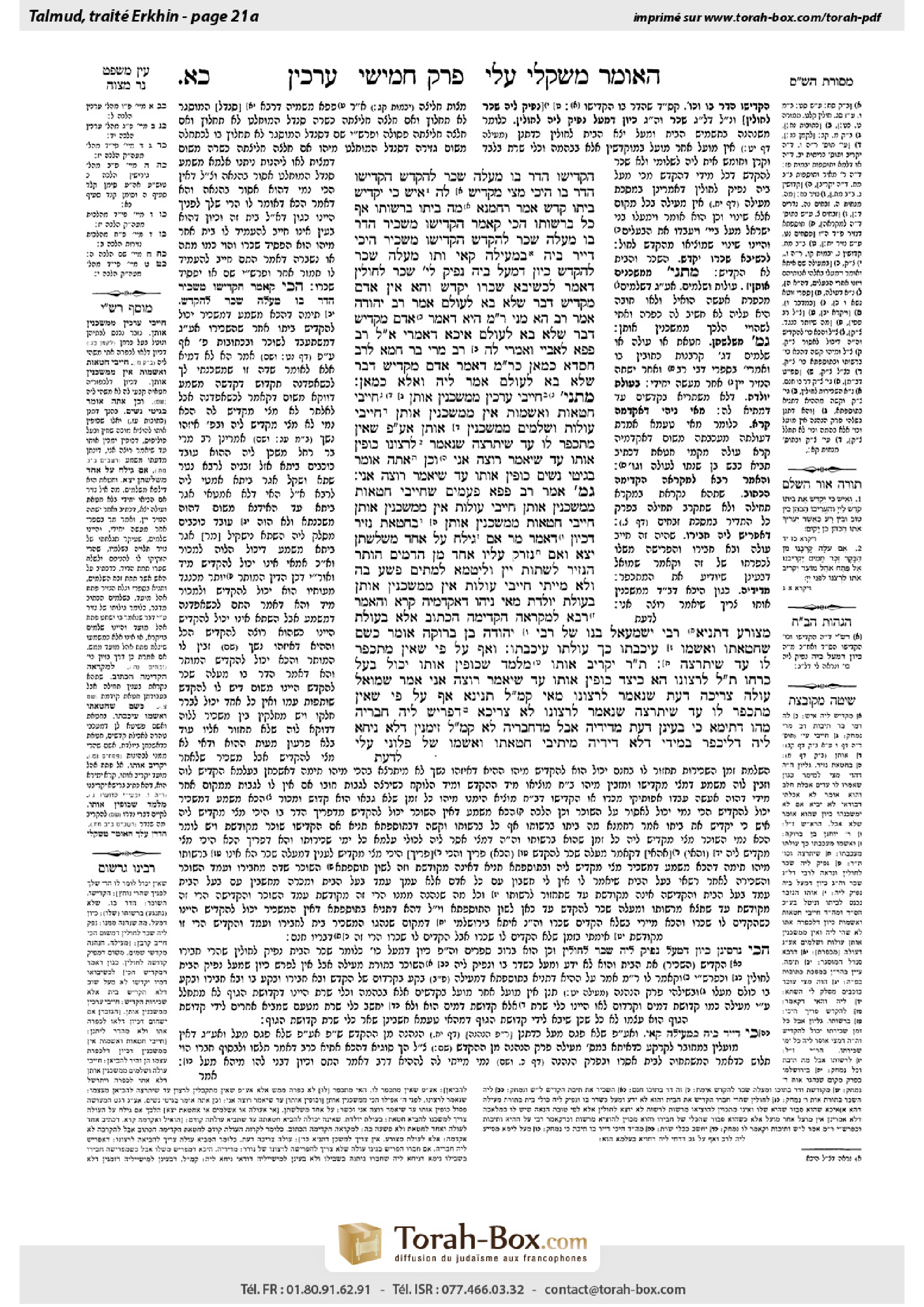
Arakhin 21a: Talmud study for Daf Yomi
Study the Talmud for Daf Yomi with scanned pages, Hebrew text, English translations from Sefaria and AI-generated French translations.
Passage selection and English or AI-generated French translation are available where the scan has annotations. Daf Study is independent of Torah-Box and Sefaria.
Browse Arakhin · ערכין · All tractatesArakhin 21a text and translations
This page of Arakhin includes the Aramaic text, an English translation and an AI-generated French translation, alongside the scan above.
ערכין כ״א א · Aramaic and Hebrew text
הִקְדִּישׁוֹ הַדָּר בּוֹ — מַעֲלֶה שָׂכָר לַהֶקְדֵּשׁ. הִקְדִּישׁוֹ הַדָּר בּוֹ? הֵיכִי מָצֵי מַקְדֵּישׁ לֵהּ? ״אִישׁ כִּי יַקְדִּישׁ בֵּיתוֹ קֹדֶשׁ״ אָמַר רַחֲמָנָא, מָה בֵּיתוֹ בִּרְשׁוּתוֹ — אַף כֹּל בִּרְשׁוּתוֹ! הָכִי קָאָמַר: הִקְדִּישׁוֹ מַשְׂכִּיר — הַדָּר בּוֹ מַעֲלֶה שָׂכָר לַהֶקְדֵּשׁ.
הִקְדִּישׁוֹ מַשְׂכִּיר, הֵיכִי דָּיַיר בֵּיהּ? בִּמְעִילָה קָאֵי! וְתוּ מַעֲלֶה שָׂכָר לַהֶקְדֵּשׁ? כֵּיוָן דִּמְעַל בֵּיהּ, נָפֵיק לֵיהּ שָׂכָר לְחוּלִּין!
דְּאָמַר: ״לִכְשֶׁיָּבֹא שְׂכָרוֹ יִקְדַּשׁ״, וְהָא אֵין אָדָם מַקְדִּישׁ דָּבָר שֶׁלֹּא בָּא לָעוֹלָם!
אָמַר רַב יְהוּדָה אָמַר רַב: הָא מַנִּי? רַבִּי מֵאִיר הִיא, דְּאָמַר: אָדָם מַקְדִּישׁ דָּבָר שֶׁלֹּא בָּא לָעוֹלָם. אִיכָּא דְּאָמְרִי: אֲמַר לֵיהּ רַב פָּפָּא לְאַבָּיֵי, וְאָמְרִי לַהּ רַב מָרִי בַּר חָמָא לְרַב חִסְדָּא: כְּמַאן? כְּרַבִּי מֵאִיר, דְּאָמַר: אָדָם מַקְדִּישׁ דָּבָר שֶׁלֹּא בָּא לָעוֹלָם? אֲמַר לֵיהּ: וְאֶלָּא כְּמַאן?!
מַתְנִי׳ חַיָּיבֵי עֲרָכִין — מְמַשְׁכְּנִין אוֹתָן, חַיָּיבֵי חַטָּאוֹת וַאֲשָׁמוֹת — אֵין מְמַשְׁכְּנִין אוֹתָן, חַיָּיבֵי עוֹלוֹת וּשְׁלָמִים — מְמַשְׁכְּנִין אוֹתָן.
אַף עַל פִּי שֶׁאֵין מִתְכַּפֵּר לוֹ עַד שֶׁיִּתְרַצֶּה, שֶׁנֶּאֱמַר: ״לִרְצוֹנוֹ״, כּוֹפִין אוֹתוֹ עַד שֶׁיֹּאמַר: ״רוֹצֶה אֲנִי״. וְכֵן אַתָּה אוֹמֵר בְּגִיטֵּי נָשִׁים, כּוֹפִין אוֹתוֹ עַד שֶׁיֹּאמַר: ״רוֹצֶה אֲנִי״.
גְּמָ׳ אָמַר רַב פָּפָּא: פְּעָמִים שֶׁחַיָּיבֵי חַטָּאוֹת מְמַשְׁכְּנִין אוֹתָן, חַיָּיבֵי עוֹלוֹת אֵין מְמַשְׁכְּנִין אוֹתָן.
חַיָּיבֵי חַטָּאוֹת מְמַשְׁכְּנִין אוֹתָן בְּחַטַּאת נָזִיר, דְּכֵיוָן דְּאָמַר מָר: ״אִם גִּילַּח עַל אֶחָד מִשְּׁלׇשְׁתָּן יָצָא, וְאִם נִזְרַק עָלָיו אֶחָד מִן הַדָּמִים הוּתַּר הַנָּזִיר לִשְׁתּוֹת יַיִן וְלִיטַמֵּא לְמֵתִים״ — פָּשַׁע בַּהּ וְלָא מַיְיתֵי.
חַיָּיבֵי עוֹלוֹת — אֵין מְמַשְׁכְּנִין אוֹתָן בְּעוֹלַת יוֹלֶדֶת.
מַאי נִיהוּ דְּאַקְדְּמַיהּ קְרָא, וְהָאָמַר רָבָא: לְמִקְרָאָהּ הִקְדִּימָהּ הַכָּתוּב!
אֶלָּא בְּעוֹלַת מְצוֹרָע, דְּתַנְיָא: רַבִּי יִשְׁמָעֵאל בְּנוֹ שֶׁל רַבִּי יְהוּדָה בֶּן בְּרוֹקָה אוֹמֵר: כְּשֵׁם שֶׁחַטָּאתוֹ וַאֲשָׁמוֹ עֹיכַבְתּוֹ, כָּךְ עוֹלָתוֹ עֹיכַבְתּוֹ.
וְאַף עַל פִּי שֶׁאֵין מִתְכַּפֵּר לוֹ עַד שֶׁיִּתְרַצֶּה, תָּנוּ רַבָּנַן: ״יַקְרִיב אוֹתוֹ״ — מְלַמֵּד שֶׁכּוֹפִין אוֹתוֹ, יָכוֹל בְּעַל כׇּרְחוֹ? תַּלְמוּד לוֹמַר: ״לִרְצוֹנוֹ״, הָא כֵּיצַד? כּוֹפִין אוֹתוֹ עַד שֶׁיֹּאמַר ״רוֹצֶה אֲנִי״.
אָמַר שְׁמוּאֵל: עוֹלָה צְרִיכָה דַּעַת, שֶׁנֶּאֱמַר: ״לִרְצוֹנוֹ״. מַאי קָא מַשְׁמַע לַן? תְּנֵינָא: אַף עַל פִּי שֶׁאֵין מִתְכַּפֵּר לוֹ עַד שֶׁיִּתְרַצֶּה, שֶׁנֶּאֱמַר: ״לִרְצוֹנוֹ״!
לָא צְרִיכָא, דְּפָרֵישׁ לֵיהּ חַבְרֵיהּ. מַהוּ דְּתֵימָא: כִּי בָּעֵינַן דַּעַת מִדִּידֵיהּ, אֲבָל מִדְּחַבְרֵיהּ לָא? קָא מַשְׁמַע לַן, זִימְנִין דְּלָא נִיחָא לֵיהּ דְּלִיכַּפַּר בְּמִידֵּי דְּלָא דִּידֵיהּ.
מֵיתִיבִי: ״חַטָּאתוֹ וַאֲשָׁמוֹ שֶׁל פְּלוֹנִי עָלַי״
Arakhin 21a · English translation
If the one living in it, i.e., the renter, consecrates the house, he pays the rent to the Temple treasury. The Gemara express surprise at this last statement of the baraita: If the one living in the house consecrates it? How can the renter consecrate it? The Merciful One states: “When a man shall sanctify his house to be sacred” (Leviticus 27:14), from which it is derived that just as one’s house is in his possession, so too, anything that one consecrates must be in his possession. If so, the renter cannot consecrate the house, as he is not its owner. The Gemara answers that this is what the baraita is saying: If the one renting out the house consecrates it, the one living in it pays the rent to the Temple treasury.
The Gemara asks: If the one renting out the house consecrates it, how is it possible for the renter to live in it? Since the house is consecrated property he is standing liable for the prohibition of misuse of consecrated property by living there. And furthermore, why must he pay the rent to the Temple treasury? Since he misused consecrated property the payment of the rent immediately leaves the state of consecration and becomes non-sacred.
The Gemara answers: The baraita is discussing a case where the one renting out the house says: When the payment of the rent will come to me, the money shall be consecrated. The Gemara asks: But how is it possible for the one renting out the house to consecrate money he will receive in the future? After all, a person cannot consecrate an entity that has not yet come into the world.
Rav Yehuda says that Rav says: In accordance with whose opinion is this baraita? It is in accordance with the opinion of Rabbi Meir, who says: A person can consecrate an entity that has not yet come into the world. Some say that Rav Pappa said to Abaye, and some say that Rav Mari bar Ḥama said to Rav Ḥisda: In accordance with whose opinion is this baraita? Is it in accordance with the opinion of Rabbi Meir, who says that a person can consecrate an entity that has not yet come into the world? He said to him: Rather, in accordance with who else’s opinion could this baraita be? Certainly it is in accordance with the opinion of Rabbi Meir.
MISHNA: With regard to those obligated to pay valuations, the court repossesses their property to pay their debt to the Temple treasury. With regard to those obligated to bring sin offerings and guilt offerings, the court does not repossess their property; since one is obligated to bring them for atonement he would not delay bringing them. But with regard to those obligated to bring burnt offerings and peace offerings, the court repossesses their property;since these offerings are not obligatory for atonement, one might delay bringing them.
Although one obligated to bring burnt offerings and peace offerings does not achieve atonement until he brings the offering of his own volition, as it is stated: “He shall bring it to the entrance of the Tent of Meeting of his volition” (Leviticus 1:3), nevertheless the court coerces him until he says: I want to do so. And likewise, you say the same with regard to women’s bills of divorce. Although one divorces his wife only of his own volition, in any case where the Sages obligated a husband to divorce his wife the court coerces him until he says: I want to do so.
GEMARA: Rav Pappa says: Sometimes with regard to those obligated to bring sin offerings the court does repossess their property, and likewise there are occasions involving those obligated to bring burnt offerings where the court does not repossess their property.
Rav Pappa elaborates: With regard to those obligated to bring sin offerings, the court repossesses their property in the case of the sin offering of a nazirite, since the Master says (Nazir 45a): If a nazirite shaved after the sacrifice of one of the three nazirite offerings, either the burnt offering, the peace offering, or the sin offering, he has fulfilled his obligation of shaving. And if the blood of one of these offerings was sprinkled on his behalf, the nazirite is permitted to drink wine and to become ritually impure from a corpse. Therefore, there is a concern that a nazirite who has already sacrificed his burnt offering or peace offering might be negligent with regard to his sin offering and not bring it, and therefore the court repossesses his property in this particular case.
With regard to those obligated to bring burnt offerings, the court does not repossess their property in the case of a burnt offering of a woman after childbirth. There is no concern that she might delay bringing her burnt offering, as she is required to bring this offering before partaking of sacrificial food.
The Gemara asks: What is the reason for the ruling that a woman after childbirth is required to bring her burnt offering before she can sacrifice her sin offering? Is it that the verse mentions her burnt offering before it mentions her sin offering, as it is written: “And when the days of her purification are fulfilled…she shall bring a lamb of the first year for a burnt offering, and a young pigeon, or a turtle-dove, for a sin offering” (Leviticus 12:6)? But doesn’t Rava say: The verse mentions her burnt offering before her sin offering only with regard to the reading of the verse, but not with regard to the order of the offerings? If so, there should be a concern that she might first sacrifice her sin offering and delay bringing her burnt offering.
Rather, the court does not repossess the property of those obligated to bring burnt offerings in the case of the burnt offering of a leper, as it is taught in a baraita that Rabbi Yishmael, son of Rabbi Yehuda ben Beroka, says: Just as failure to sacrifice his sin offering and his guilt offering prevents the leper from achieving full ritual purity, so too, failure to sacrifice his burnt offering has the same effect and prevents him from achieving full ritual purity. Therefore, the court does not repossess his property, as there is no concern he might delay bringing his burnt offering.
§ The mishna teaches: Although one obligated to bring burnt offerings and peace offerings does not achieve atonement until he brings the offering of his own volition, as it is stated: “He shall bring it to the entrance of the Tent of Meeting of his volition” (Leviticus 1:3), nevertheless, one coerces him until he says: I want to do so. Similarly, the Sages taught in a baraita: It is written with regard to a burnt offering: “He shall sacrifice it” (Leviticus 1:3), which teaches that one coerces him to bring his burnt offering. One might have thought he brings the offering against his will; therefore, the verse states: “Of his volition” (Leviticus 1:3). How can these texts be reconciled? The court coerces him until he says: I want to do so.
Shmuel says: A burnt offering requires the consent of the one receiving atonement, as it is stated: “Of his volition.” The Gemara asks: What is Shmuel teaching us? Didn’t we already learn in the mishna: Although he does not achieve atonement until he brings the offering of his own volition, as it is stated: “He shall bring it to the entrance of the Tent of Meeting of his volition”?
The Gemara answers: No, the statement of Shmuel is necessary with regard to a case where another person separated, i.e., designated, a burnt offering on his behalf. Lest you say: When we require the consent of the one receiving atonement, that is only in a case where an animal from his property is separated as his burnt offering, e.g., the court repossesses his property for the sake of his burnt offering. But we do not need his consent if an animal from the property of another is separated as his burnt offering. Therefore, Shmuel teaches us that the consent of the one receiving atonement is required even in a case where an animal from the property of another was separated as an offering. The reason is that sometimes he is not amenable to achieving atonement with an item that does not belong to him, and in such a case he will not achieve atonement.
The Gemara raises an objection from a baraita: With regard to one who says: It is incumbent upon me to bring the sin offering or the guilt offering of so-and-so,
Arakhin 21a · Traduction française (IA)
Si celui qui habite la maison, c'est-à-dire le locataire, consacre la maison, il paie le loyer au trésor du Temple. La Guemara exprime une surprise face à cette dernière déclaration de la baraïta : Si celui qui habite la maison consacre la maison ? Comment le locataire peut-il la consacrer ? Le Tout-Puissant dit : « Quand un homme sanctifiera sa maison pour être sainte » (Lévitique 27:14), d'où il s'ensuit que tout ce que l'on consacre doit être en possession de celui qui le consacre, comme la maison est en possession de celui qui la possède. Si c'est ainsi, le locataire ne peut pas consacrer la maison, car il n'en est pas le propriétaire. La Guemara répond que c'est ce que la baraïta dit : Si celui qui loue la maison consacre la maison, celui qui habite la maison paie le loyer au trésor du Temple.
La Guemara demande : Si celui qui loue la maison consacre la maison, comment est-il possible que le locataire y demeure ? Puisque la maison est une propriété consacrée, il est tenu responsable de la transgression de l'usage de propriété consacrée en y demeurant. Et de plus, pourquoi doit-il payer le loyer au trésor du Temple ? Puisque l'usage de propriété consacrée est une transgression, le paiement du loyer sort immédiatement de l'état de consécration et devient non sacré.
La Guemara répond : la baraïta parle d'un cas où celui qui loue la maison dit : Quand le paiement du loyer me sera versé, l'argent sera consacré. La Guemara demande : Mais comment celui qui loue la maison peut-il consacrer de l'argent qu'il recevra à l'avenir ? En effet, une personne ne peut pas consacrer une entité qui n'a pas encore été mise au monde.
Rav Yéhuda dit que Rav dit : Selon quel avis est-ce que cette baraïta ? Selon l'avis de Rabbi Meïr, qui dit : une personne peut consacrer une entité qui n'a pas encore été mise au monde. Certains disent que Rav Pappa a dit à Abaye, et d'autres disent que Rav Mari bar Ḥama a dit à Rav Ḥisda : Selon quel avis est-ce que cette baraïta ? Selon l'avis de Rabbi Meïr, qui dit qu'une personne peut consacrer une entité qui n'a pas encore été mise au monde ? Il lui dit : Plutôt, selon quel autre avis pourrait être cette baraïta ? Certainement selon l'avis de Rabbi Meïr.
MICHNA : En ce qui concerne ceux qui doivent payer des évaluations, la cour révoque leur propriété pour payer leur dette au trésor du Temple. En ce qui concerne ceux qui doivent présenter des offrandes de péché et d'expiation, la cour ne révoque pas leur propriété ; puisque l'on est tenu de présenter ces offrandes pour l'at-onement, on ne diffère pas à les présenter. En ce qui concerne ceux qui doivent présenter des offrandes brûlées et de paix, la cour révoque leur propriété ; puisque ces offrandes ne sont pas obligatoires pour l'at-onement, on peut différer à les présenter.
Bien que celui qui doit présenter des offrandes brûlées et de paix ne puisse atteindre l'at-onement qu'en les présentant de son propre gré, comme il est dit : « Il apportera cela à l'entrée du Tenta de Rencontre selon son gré » (Lévitique 1:3), néanmoins la cour le force jusqu'à ce qu'il dise : Je veux le faire. De même, vous dites la même chose concernant les certificats de divorce des femmes. Bien que l'on divorce sa femme seulement selon son gré, dans tout cas où les Sages ont imposé à un mari de divorcer de sa femme, la cour le force jusqu'à ce qu'il dise : Je veux le faire.
GUEMARA : Rav Pappa dit : Parfois, en ce qui concerne ceux qui doivent présenter des offrandes de péché, la cour révoque leur propriété, et de même il y a des occasions concernant ceux qui doivent présenter des offrandes brûlées où la cour ne révoque pas leur propriété.
Rav Pappa développe : En ce qui concerne ceux qui doivent présenter des offrandes de péché, la cour révoque leur propriété dans le cas de l'offrande de péché du nazir, puisque le Maître dit (Nazir 45a) : Si un nazir a rasé après la sacrifice de l'une des trois offrandes de nazir, soit l'holocauste, l'offrande de paix ou l'offrande de péché, il a accompli son obligation de raser. Et si le sang d'une de ces offrandes a été versé à son sujet, le nazir est autorisé à boire du vin et à devenir impur par un cadavre. Ainsi, il y a une crainte qu'un nazir qui a déjà sacrifié son offrande brûlée ou son offrande de paix néglige son offrande de péché et ne la présente pas, et donc la cour révoque sa propriété dans ce cas particulier.
En ce qui concerne ceux qui doivent présenter des offrandes brûlées, la cour ne révoque pas leur propriété dans le cas de l'holocauste d'une femme après l'accouchement. Il n'y a pas de crainte qu'elle diffère à présenter son offrande brûlée, puisqu'elle doit présenter cette offrande avant de consommer les aliments sacrés.
La Guemara demande : Quel est le motif de la décision selon laquelle une femme après l'accouchement doit présenter son holocauste avant de pouvoir présenter son sacrifice expiatoire ? Est-ce que c'est parce que le verset mentionne son holocauste avant son sacrifice expiatoire, comme il est écrit : « Et quand les jours de sa purification sont accomplis… elle apportera un bélier de première année pour holocauste, et une jeune colombe, ou une tourterelle, pour sacrifice expiatoire » (Lévitique 12:6) ? Mais ne dit pas Rava : le verset mentionne son holocauste avant son sacrifice expiatoire seulement en ce qui concerne la lecture du verset, mais pas en ce qui concerne l'ordre des sacrifices ? Si c'est ainsi, il devrait y avoir une crainte qu'elle sacrifie d'abord son sacrifice expiatoire et diffère à présenter son holocauste.
Plutôt, la cour ne révoque pas la propriété de ceux qui doivent présenter des holocaustes dans le cas de l'holocauste d'un lépreux, puisque cela est enseigné dans une baraïta que Rabbi Yishmael, fils de Rabbi Yéhuda ben Beroka, dit : Comme l'échec à sacrifier son sacrifice expiatoire et son sacrifice de culpabilité empêche le lépreux d'atteindre la pureté rituelle complète, ainsi l'échec à sacrifier son holocauste a le même effet et l'empêche d'atteindre la pureté rituelle complète. Ainsi, la cour ne révoque pas sa propriété, puisqu'il n'y a pas de crainte qu'il diffère à présenter son holocauste.
§ La Michna enseigne : Bien que l'individu obligé de présenter des holocaustes et des offrandes de paix ne puisse obtenir l'expiation qu'une fois avoir apporté l'offrande de son propre gré, comme il est dit : « Il apportera cela à l'entrée du Tenta de Rencontre selon son gré » (Lv. 1:3), néanmoins, on le force jusqu'à ce qu'il dise : Je veux le faire. De même, les Sages ont enseigné dans une baraïta : Il est dit concernant un holocauste : « Il offrira cela » (Lv. 1:3), ce qui enseigne que l'on force l'individu à présenter son holocauste. On aurait pu penser qu'il apporte l'offrande contre son gré ; c'est pourquoi la Parole dit : « selon son gré » (Lv. 1:3). Comment ces textes peuvent-ils être conciliés ? Le tribunal force l'individu jusqu'à ce qu'il dise : Je veux le faire.
Shmuel dit : Un holocauste exige le consentement de celui qui obtient l'expiation, comme il est dit : « selon son gré ». La Guemara demande : Qu'enseigne Shmuel ? N'avons-nous pas déjà appris dans la Michna : Bien qu'il ne puisse obtenir l'expiation qu'une fois avoir apporté l'offrande de son propre gré, comme il est dit : « Il apportera cela à l'entrée du Tenta de Rencontre selon son gré » ?
La Guemara répond : Non, l'enseignement de Shmuel est nécessaire dans le cas où une autre personne a désigné, c'est-à-dire a assigné, un holocauste à sa place. De peur que l'on dise : Quand nous exigeons le consentement de celui qui obtient l'expiation, cela n'est valable que dans le cas où un animal de sa propriété est désigné comme son holocauste, par exemple, le tribunal s'empare de sa propriété à l'effet de son holocauste. Mais nous n'avons pas besoin de son consentement si un animal de la propriété d'un autre est désigné comme son holocauste. Ainsi, Shmuel nous enseigne que le consentement de celui qui obtient l'expiation est requis même dans le cas où un animal de la propriété d'un autre est désigné comme offrande. La raison est que parfois il n'est pas enclin à obtenir l'expiation avec un objet qui ne lui appartient pas, et dans ce cas, il ne peut pas obtenir l'expiation.
La Guemara émet une objection à partir d'une baraïta : Concernant celui qui dit : Il m'est imposé de présenter l'offrande expiatoire ou l'offrande de culpabilité de tel ou tel,
Traduction française générée par IA à partir de l’édition anglaise de Sefaria. Vérifie toujours un passage avec le texte source.
Text from Sefaria: William Davidson Edition - Vocalized Aramaic (CC BY NC); William Davidson Edition - English (CC BY NC).