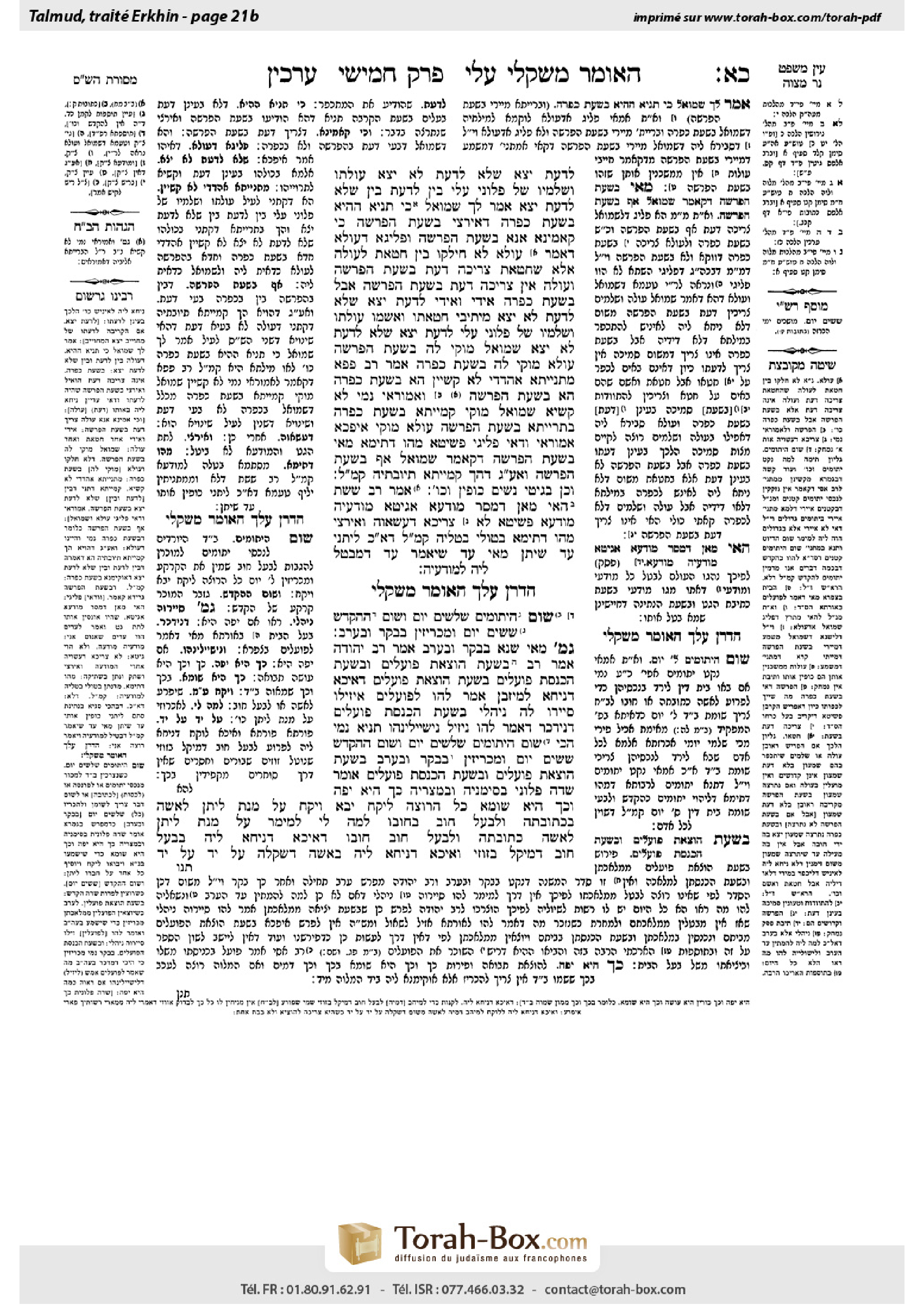
Arakhin 21b: Talmud study for Daf Yomi
Study the Talmud for Daf Yomi with scanned pages, Hebrew text, English translations from Sefaria and AI-generated French translations.
Passage selection and English or AI-generated French translation are available where the scan has annotations. Daf Study is independent of Torah-Box and Sefaria.
Browse Arakhin · ערכין · All tractatesArakhin 21b text and translations
This page of Arakhin includes the Aramaic text, an English translation and an AI-generated French translation, alongside the scan above.
ערכין כ״א ב · Aramaic and Hebrew text
לְדַעַת — יָצָא, שֶׁלֹּא לְדַעַת — לֹא יָצָא.
״עוֹלָתוֹ וּשְׁלָמָיו שֶׁל פְּלוֹנִי עָלַי״, בֵּין לְדַעַת בֵּין שֶׁלֹּא לְדַעַת — יָצָא.
אָמַר לְךָ שְׁמוּאֵל: כִּי תַּנְיָא הָהִיא בִּשְׁעַת כַּפָּרָה, דְּאִירַצִּי בִּשְׁעַת הַפְרָשָׁה, כִּי קָאָמֵינָא אֲנָא בִּשְׁעַת הַפְרָשָׁה.
וּפְלִיגָא דְּעוּלָּא, דְּאָמַר עוּלָּא: לֹא חִילְּקוּ בֵּין חַטָּאת לְעוֹלָה, אֶלָּא שֶׁחַטָּאת צְרִיכָה דַּעַת בִּשְׁעַת הַפְרָשָׁה, וְעוֹלָה אֵין צְרִיכָה דַּעַת בִּשְׁעַת הַפְרָשָׁה, אֲבָל בִּשְׁעַת כַּפָּרָה — אִידֵּי וְאִידֵּי לְדַעַת — יָצָא, שֶׁלֹּא לְדַעַת — לֹא יָצָא.
מֵיתִיבִי: חַטָּאתוֹ וַאֲשָׁמוֹ עוֹלָתוֹ וּשְׁלָמָיו שֶׁל פְּלוֹנִי עָלַי, לְדַעַת — יָצָא, שֶׁלֹּא לְדַעַת — לֹא יָצָא!
שְׁמוּאֵל מוֹקֵי לַהּ בִּשְׁעַת הַפְרָשָׁה, עוּלָּא מוֹקֵי לַהּ בִּשְׁעַת כַּפָּרָה. אָמַר רַב פָּפָּא: מַתְנְיָיתָא אַהֲדָדֵי לָא קַשְׁיָין, הָא בִּשְׁעַת כַּפָּרָה, הָא בִּשְׁעַת הַפְרָשָׁה.
(וְאָמוֹרָאֵי) [לְאָמוֹרָאֵי] נָמֵי לָא קַשְׁיָא: שְׁמוּאֵל מוֹקֵי קַמַּיְיתָא בִּשְׁעַת כַּפָּרָה, בָּתְרָיְיתָא בִּשְׁעַת הַפְרָשָׁה, עוּלָּא מוֹקֵי אִיפְּכָא. אָמוֹרָאֵי וַדַּאי פְּלִיגִי. פְּשִׁיטָא!
מַהוּ דְּתֵימָא: מַאי ״בִּשְׁעַת הַפְרָשָׁה״ דְּקָאָמַר שְׁמוּאֵל? אַף בִּשְׁעַת הַפְרָשָׁה, וְאַף עַל גַּב דְּהָךְ קַמַּיְיתָא תְּיוּבְתֵּיהּ, קָא מַשְׁמַע לַן.
וְכֵן בְּגִיטֵּי נָשִׁים כּוֹפִין וְכוּ׳. אָמַר רַב שֵׁשֶׁת: הַאי מַאן דְּמָסַר מוֹדָעָא אַגִּיטָּא — מוֹדָעֵיהּ מוֹדָעָא. פְּשִׁיטָא?
לָא צְרִיכָא, דְּעַשְּׂאוּהּ וְאִירַצִּי, מַהוּ דְּתֵימָא: בַּטּוֹלֵי בַּטְּלֵיהּ, קָא מַשְׁמַע לַן.
דְּאִם כֵּן, לִיתְנֵי: עַד שֶׁיִּתֵּן! מַאי עַד שֶׁיֹּאמַר? עַד דִּמְבַטֵּל לֵיהּ לְמוֹדָעֵיהּ.
הֲדַרַן עֲלָךְ הָאוֹמֵר מִשְׁקָלִי.
מַתְנִי׳ שׁוּם הַיְּתוֹמִים — שְׁלֹשִׁים יוֹם, וְשׁוּם הַהֶקְדֵּשׁ — שִׁשִּׁים יוֹם, וּמַכְרִיזִין בַּבֹּקֶר וּבָעֶרֶב.
גְּמָ׳ מַאי שְׁנָא בַּבֹּקֶר וּבָעֶרֶב? אָמַר רַב יְהוּדָה אָמַר רַב: בִּשְׁעַת הוֹצָאַת פּוֹעֲלִים וּבִשְׁעַת הַכְנָסַת פּוֹעֲלִים. בִּשְׁעַת הוֹצָאַת פּוֹעֲלִים — דְּאִיכָּא דְּנִיחָא לְמִיזְבַּן, אֲמַר לְהוּ לְפוֹעֲלִים: אֵיזִילוּ סַיְּירוּ לַהּ נִיהֲלַי. בִּשְׁעַת הַכְנָסַת פּוֹעֲלִים — דְּנִידְּכַר דְּאָמַר לְהוּ: נֵיזִיל נִישַׁיְּילִינְהוּ.
תַּנְיָא נָמֵי הָכִי: שׁוּם הַיְּתוֹמִים שְׁלֹשִׁים יוֹם, וְשׁוּם הַהֶקְדֵּשׁ שִׁשִּׁים יוֹם, וּמַכְרִיזִין בַּבֹּקֶר וּבְעָרֵב, בִּשְׁעַת הוֹצָאַת פּוֹעֲלִים וּבִשְׁעַת הַכְנָסַת פּוֹעֲלִים.
אוֹמֵר: שְׂדֵה פְלוֹנִי בְּסִימָנֶיהָ וּבִמְצָרֶיהָ, כָּךְ הִיא יָפָה, וְכָךְ הִיא שׁוּמָא, כׇּל הָרוֹצֶה לִיקַּח יָבֹא וְיִקַּח, עַל מְנָת לִיתֵּן לְאִשָּׁה בִּכְתוּבָּתָהּ, וּלְבַעַל חוֹב בְּחוֹבוֹ.
לְמָה לִי לְמֵימַר ״עַל מְנָת לִיתֵּן לְאִשָּׁה כְּתוּבָּתָהּ וּלְבַעַל חוֹב חוֹבוֹ״? דְּאִיכָּא דְּנִיחָא לֵיהּ בְּבַעַל חוֹב, דְּמֵיקֵל בְּזוּזֵי, וְאִיכָּא דְּנִיחָא לֵיהּ בְּאִשָּׁה, דְּשָׁקְלָה עַל יָד עַל יָד.
Arakhin 21b · English translation
if he does so with the consent of the one obligated to bring the offering he has fulfilled his obligation, but if he does so without the consent of the one obligated to bring the offering he has not fulfilled his obligation.
With regard to one who says: It is incumbent upon me to bring the burnt offering or the peace offering of so-and-so, whether he does so with the latter’s consent or without his consent, the one obligated to bring the offering has fulfilled his obligation. This apparently contradicts the statement of Shmuel, who said the bringing of a burnt offering requires the consent of the one obligated to bring the offering.
Shmuel could have said to you: When that baraita is taught, and states that one fulfills his obligation for his burnt offering without his consent, it is referring to the time of atonement, i.e., the sacrifice. At that stage, his consent is not necessary, as he already consented at the time of separating the animal as an offering. When I said the consent of the one receiving atonement is required, I was speaking of the time of separating the animal as an offering.
And Shmuel disagrees with the opinion of Ulla, as Ulla says: The Sages distinguish between the consent required for a sin offering or a guilt offering and the consent required for a burnt offering or a peace offering only in that a sin offering and a guilt offering require the consent of the one obligated to bring the offering at the time the other person separates the animal for an offering on his behalf, and a burnt offering and a peace offering do not require his consent at the time of separating the animal. But with regard to both this pair of offerings and that pair of offerings at the time of atonement, the requisite consent is the same for all offerings: If the offering was sacrificed with his consent he has fulfilled his obligation; if it was not sacrificed with his consent he has not fulfilled his obligation.
The Gemara raises an objection to the opinions of both Shmuel and Ulla from a baraita: One who says: It is incumbent upon me to bring the sin offering or the guilt offering or the burnt offering or the peace offering of so-and-so, if he does this with the consent of the one who is obligated to bring the offering, then that individual has fulfilled his obligation. If he does so without the consent of the one who is obligated to bring the offering, that person has not fulfilled his obligation. This baraita is difficult for the opinion of Shmuel, who holds that one who brings a burnt offering on behalf of another does not require consent at the time of atonement, and it is also difficult according to the opinion of Ulla, who maintains that one who brings a burnt offering on behalf of another does not need consent when the animal is set aside as an offering.
The Gemara answers: Shmuel establishes the baraita, which requires consent, as referring to the time of separating the animal, and Ulla establishes the baraita as dealing with the required consent at the time of atonement. Rav Pappa says, in summary: The baraitot are not difficult, as they do not contradict each other. This one is referring to consent at the time of atonement, and that one is referring to consent at the time of separating the animal.
And Rav Pappa adds that the baraitot also are not difficult for the opinions of the amora’im. Shmuel establishes the first baraita, which does not require consent for a burnt offering and a peace offering, as referring to the time of atonement, and the last baraita, which requires consent for those offerings, as speaking of the time of separating the animal. Ulla establishes the baraitot in the reverse manner: The first baraita, which does not require consent for a burnt offering and a peace offering, is dealing with the time of separating the animal, whereas the second baraita is referring to the time of atonement. But the amora’im themselves, Shmuel and Ulla, certainly disagree with each other. The Gemara asks: Isn’t this summary of the opinions of Shmuel and Ulla obvious?
The Gemara answers: Rav Pappa’s summary is necessary, lest you say: What is the meaning of that which Shmuel says, that the consent of the one obligated to bring the offering is required at the time of separating the animal? Shmuel means that consent is required not only at the stage of atonement but even at the time of separating the animal. And even though according to this interpretation the first baraita, which says that consent is not required for a burnt offering and for a peace offering, would be a refutation of the opinion of Shmuel, that difficulty would not deter him from holding such an opinion. Therefore, Rav Pappa teaches us that the baraitot do not contradict the opinions of Shmuel and Ulla, which indicates that Shmuel holds that consent is required only when the animal is separated, but not at the time of atonement.
§ The mishna teaches: And likewise, you say the same with regard to women’s bills of divorce. Although one can divorce his wife only of his own volition, in any case where the Sages obligated a husband to divorce his wife, the court coerces him until he says: I want to do so. Rav Sheshet says: Concerning one who delivered a declaration preemptively invalidating a bill of divorce by announcing before giving the bill of divorce that he is not doing so of his own free will, his declaration is a valid declaration that cancels the bill of divorce. The Gemara asks: Isn’t that obvious?
The Gemara answers: No, the statement of Rav Sheshet is necessary in a case where they coerced him to give a bill of divorce and he declared that he was not giving it of his own free will, but later he agreed to give the bill of divorce of his own volition without explicitly retracting his original declaration that he was coerced. Lest you say: Merely by giving the bill of divorce he has canceled his earlier declaration that he was coerced, Rav Sheshet therefore teaches us that his original declaration that he was coerced is still in effect and the bill of divorce is canceled.
The Gemara explains how Rav Sheshet derives his conclusion from the mishna. The reason is that if it were so, i.e., if his original declaration is canceled even without an explicit retraction, let the mishna teach: The court coerces him until he gives the bill of divorce of his own volition. What is the significance of the clause: The court coerces him until he says: I want to do so? This indicates that the court coerces him until he explicitly cancels his original declaration.
MISHNA: One proclaims, i.e., publicly announces, the appraisal of the property inherited by minor orphans, which is being sold to repay their father’s debt, for thirty days, in order to receive the maximal price. And one proclaims the appraisal of consecrated property that is being sold by the Temple treasury for sixty days, and one proclaims it in the morning and in the evening.
GEMARA: The Gemara asks: What is different about those times that one proclaims the appraisal of the property specifically in the morning and in the evening? Rav Yehuda says that Rav says: One proclaims during the time that workers leave to work in the fields and during the time that workers enter the city after completing their workday. Rav Yehuda elaborates: One proclaims during the time that workers leave to work in the fields, so that if there is a person who is amenable to purchasing the property, he may say to the workers: Go and examine the property for me. And one proclaims during the time that workers enter the city so that that individual will be reminded that he said to the workers that they should inspect the property, and he will go and ask them for their opinion of it.
The Gemara notes: That explanation is also taught in a baraita: One proclaims the appraisal of the property inherited by minor orphans for thirty days, and one proclaims the appraisal of consecrated property for sixty days. And one proclaims it in the morning and in the evening, during the time that workers leave to work in the fields and during the time that workers enter the city after completing their workday.
The baraita adds that the one who proclaims states: The field of so-and-so that is identifiable by its markers and by its borders, such is its quality, i.e., it produces such-and-such quantities of grain annually, and such is its appraisal; anyone who wishes to purchase the field let him come and purchase it. He adds that the field is being sold in order to give the proceeds to a wife as payment of her marriage contract, or in order to give a creditor payment of a deceased man’s debt.
The Gemara asks: Why do I need the one making the proclamation to say that the field is being sold in order to give the proceeds to a wife as payment of her marriage contract or in order to give a creditor payment of his debt? The Gemara responds: This declaration is necessary as there are individuals for whom it is preferable to do business with a creditor, as he is lenient with dinars and will accept even damaged coins, and there are others for whom it is preferable to deal with a wife, as she takes her money bit by bit, i.e., in incremental payments.
Arakhin 21b · Traduction française (IA)
Si cela est fait avec le consentement de celui qui est tenu de présenter l'offrande, il a accompli son devoir, mais si cela est fait sans le consentement de celui qui est tenu de présenter l'offrande, il n'a pas accompli son devoir.
Concernant celui qui dit : Il m'est imposé de présenter l'holocauste ou l'offrande de paix de tel ou tel, qu'il le fasse avec le consentement de celui-ci ou sans son consentement, celui qui est tenu de présenter l'offrande a accompli son devoir. Cela semble contredire la déclaration de Shmuel, qui affirmait que la présentation d'un holocauste exige le consentement de celui qui est tenu de présenter l'offrande.
Shmuel aurait pu dire à vous : Lorsque ce baraïta est enseigné et affirme que l'on accomplit son devoir pour son holocauste sans son consentement, il s'agit du moment de l'atonement, c'est-à-dire du sacrifice. À cette étape, son consentement n'est pas nécessaire, car il avait déjà consenti au moment de l'assignation de l'animal comme offrande. Lorsque j'ai dit que le consentement de celui qui obtient l'atonement est requis, j'étais en train de parler du moment de l'assignation de l'animal comme offrande.
Et Shmuel est en désaccord avec l'opinion d'Ulla, car Ulla dit : Les Sages distinguent entre le consentement requis pour un sacrifice expiatoire ou un sacrifice de culpabilité et celui requis pour un holocauste ou une offrande de paix uniquement dans le sens où un sacrifice expiatoire et un sacrifice de culpabilité exigent le consentement de celui qui est tenu de présenter l'offrande au moment où l'autre personne assigne l'animal comme offrande à sa place, tandis que les holocaustes et les offrandes de paix n'exigent pas son consentement au moment de l'assignation de l'animal. Cependant, concernant les deux paires d'offrandes à l'occasion de l'atonement, le consentement requis est le même pour toutes les offrandes : si l'offrande a été sacrifiée avec son consentement, il a accompli son devoir ; si elle n'a pas été sacrifiée avec son consentement, il n'a pas accompli son devoir.
La Guemara soulève un objet contre les opinions de Shmuel et d'Ulla à partir d'un baraïta : Celui qui dit : Il m'est imposé de présenter l'offrande expiatoire ou le sacrifice de culpabilité ou l'holocauste ou l'offrande de paix de tel ou tel, si cela est fait avec le consentement de celui qui est tenu de présenter l'offrande, alors cette personne a accompli son devoir. Si cela est fait sans le consentement de celui qui est tenu de présenter l'offrande, cette personne n'a pas accompli son devoir. Ce baraïta est difficile pour l'opinion de Shmuel, qui considère que celui qui présente un holocauste à la place d'autrui n'a pas besoin de consentement au moment de l'atonement, et il est également difficile selon l'opinion d'Ulla, qui maintient que celui qui présente un holocauste à la place d'autrui n'a pas besoin de consentement au moment où l'animal est assigné comme offrande.
La Guemara répond : Shmuel établit ce baraïta, qui exige le consentement, comme se rapportant au moment de la séparation de l'animal, et Ulla établit ce baraïta comme traitant du consentement requis au moment de l'atonement. Rav Pappa dit, en résumé : Ces baraitot ne sont pas difficiles, car elles ne s'opposent pas entre elles. Celui-ci parle du consentement au moment de l'atonement, et celui-là parle du consentement au moment de la séparation de l'animal.
Et Rav Pappa ajoute que ces baraitot ne sont pas non plus difficiles pour les opinions des amoraïm. Shmuel établit la première baraïta, qui ne nécessite pas de consentement pour un holocauste et une offrande de paix, comme se rapportant au moment de l'atonement, et la dernière baraïta, qui exige le consentement pour ces offrandes, comme parlant du moment de la séparation de l'animal. Ulla établit les baraitot dans l'ordre inverse : la première baraïta, qui ne nécessite pas de consentement pour un holocauste et une offrande de paix, traite du moment de la séparation de l'animal, tandis que la deuxième baraïta se rapporte au moment de l'atonement. Cependant, les amoraïm eux-mêmes, Shmuel et Ulla, s'entendent certainement sur ce point. La Guemara demande : N'est-ce pas une conclusion évidente des opinions de Shmuel et d'Ulla ?
La Guemara répond : La synthèse de Rav Pappa est nécessaire, afin que vous ne disiez pas : Quel est le sens de ce que Shmuel dit, que le consentement de celui qui est tenu de présenter l'offrande est requis au moment de la séparation de l'animal ? Shmuel veut dire que le consentement est requis non seulement à la phase de l'atonement mais même au moment de la séparation de l'animal. Et même si, selon cette interprétation, la première baraïta, qui dit que le consentement n'est pas requis pour un holocauste et une offrande de paix, serait une réfutation de l'opinion de Shmuel, cette difficulté ne l'empêcherait pas de maintenir son opinion. Par conséquent, Rav Pappa nous enseigne que les baraitot ne contredisent pas les opinions de Shmuel et d'Ulla, ce qui indique que Shmuel considère que le consentement est requis uniquement lorsque l'animal est séparé, mais pas au moment de l'atonement.
§ La mitsna enseigne : Et de même, vous dites cela concernant les certificats de divorce des femmes. Bien qu'on puisse divorcer sa femme uniquement de son propre gré, dans tout cas où les Sages ont imposé à un mari de divorcer sa femme, la cour le force jusqu'à ce qu'il dise : Je veux le faire. Rav Sheshet dit : Concernant celui qui a déclaré préalablement une invalidation du certificat de divorce en annonçant avant de donner le certificat de divorce qu'il ne le faisait pas de son propre gré, sa déclaration est une déclaration valide annulant le certificat de divorce. La Guemara demande : N'est-ce pas évident ?
La Guemara répond : Non, la déclaration de Rav Sheshet est nécessaire dans un cas où ils l'ont contraint à donner un certificat de divorce et il a déclaré qu'il ne le faisait pas de son propre gré, mais plus tard il a accepté de donner le certificat de divorce de son propre gré sans rétracter explicitement sa déclaration initiale qu'il était contraint. Lest que vous disiez : Simplement en donnant le certificat de divorce, il a annulé sa déclaration antérieure qu'il était contraint, Rav Sheshet nous enseigne donc que sa déclaration initiale qu'il était contraint reste en vigueur et le certificat de divorce est annulé.
La Guemara explique comment Rav Sheshet tire sa conclusion de la mitsva. La raison est que si c'était le cas, c'est-à-dire si sa déclaration originale est annulée même sans retrait explicite, la mitsva enseignerait : Le tribunal le force jusqu'à ce qu'il donne lui-même le contrat de divorce. Quel est le sens de la clause : Le tribunal le force jusqu'à ce qu'il dise : Je veux le faire ? Cela indique que le tribunal le force jusqu'à ce qu'il annule explicitement sa déclaration originale.
MITSVA : On proclame, c'est-à-dire qu'on annonce publiquement, l'évaluation des biens hérités par des orphelins mineurs, qui sont vendus pour rembourser la dette de leur père, pendant trente jours, afin d'obtenir le prix maximal. Et on proclame l'évaluation des biens consacrés qui sont vendus par la trésorerie du Temple pendant soixante jours, et on proclame cette évaluation le matin et le soir.
GUÉMARA : La Guemara demande : Qu'est-ce qui diffère dans ces moments où l'on proclame l'évaluation des biens spécifiquement le matin et le soir ? Rav Yéhouda dit que Rav dit : On proclame pendant le temps où les ouvriers partent travailler dans les champs et pendant le temps où les ouvriers entrent dans la ville après avoir terminé leur journée de travail. Rav Yéhouda explique : On proclame pendant le temps où les ouvriers partent travailler dans les champs, afin que si quelqu'un est disposé à acheter la propriété, il puisse dire aux ouvriers : Allez examiner la propriété pour moi. Et on proclame pendant le temps où les ouvriers entrent dans la ville afin que cette personne se souvienne qu'il a dit aux ouvriers qu'ils devaient inspecter la propriété, et il ira les consulter pour leur avis.
La Guemara note : Cette explication est également enseignée dans une baraïta : On proclame l'évaluation des biens hérités par des orphelins mineurs pendant trente jours, et on proclame l'évaluation des biens consacrés pendant soixante jours. On proclame aussi le matin et le soir, pendant le temps que les ouvriers partent travailler dans les champs et pendant le temps que les ouvriers rentrent en ville après avoir terminé leur journée de travail.
La baraïta ajoute que celui qui proclame dit : Le champ de tel ou tel, identifiable par ses repères et par ses limites, tel est son état, c'est-à-dire qu'il produit telle quantité de blé annuellement, et tel est son évaluation ; quiconque désire acheter le champ qu'il vienne l'acheter. Il ajoute que le champ est vendu afin de donner les recettes à une épouse comme paiement de son mariage, ou afin de payer une dette d'un homme décédé à un créancier.
La Guemara demande : Pourquoi ai-je besoin que celui qui proclame indique que le champ est vendu afin de donner les recettes à une épouse comme paiement de son mariage ou afin de payer une dette d'un homme décédé à un créancier ? La Guemara répond : Cette déclaration est nécessaire car il y a des personnes pour qui il est préférable de faire affaire avec un créancier, car il est tolérant avec les dinars et accepte même les pièces abîmées, et il y a d'autres personnes pour qui il est préférable de faire affaire avec une épouse, car elle prend son argent petit à petit, c'est-à-dire par paiements progressifs.
Traduction française générée par IA à partir de l’édition anglaise de Sefaria. Vérifie toujours un passage avec le texte source.
Text from Sefaria: William Davidson Edition - Vocalized Aramaic (CC BY NC); William Davidson Edition - English (CC BY NC).