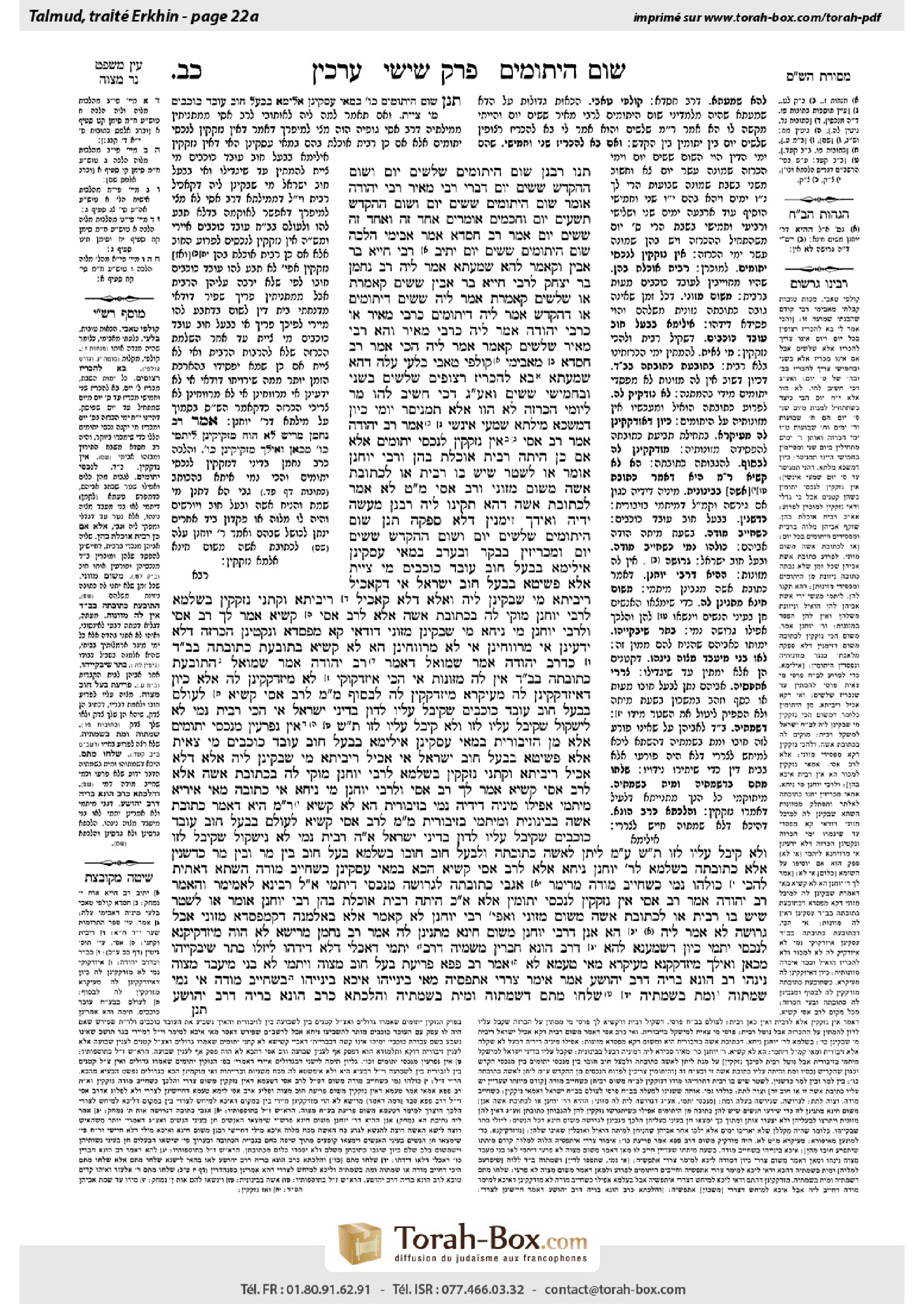
Arakhin 22a: Talmud study for Daf Yomi
Study the Talmud for Daf Yomi with scanned pages, Hebrew text, English translations from Sefaria and AI-generated French translations.
Passage selection and English or AI-generated French translation are available where the scan has annotations. Daf Study is independent of Torah-Box and Sefaria.
Browse Arakhin · ערכין · All tractatesArakhin 22a text and translations
This page of Arakhin includes the Aramaic text, an English translation and an AI-generated French translation, alongside the scan above.
ערכין כ״ב א · Aramaic and Hebrew text
תָּנוּ רַבָּנַן: שׁוּם הַיְּתוֹמִים שְׁלֹשִׁים יוֹם, וְשׁוּם הַהֶקְדֵּשׁ שִׁשִּׁים יוֹם, דִּבְרֵי רַבִּי מֵאִיר. רַבִּי יְהוּדָה אוֹמֵר: שׁוּם הַיְּתוֹמִים שִׁשִּׁים יוֹם, וְשׁוּם הַהֶקְדֵּשׁ תִּשְׁעִים יוֹם. וַחֲכָמִים אוֹמְרִים: אֶחָד זֶה וְאֶחָד זֶה שִׁשִּׁים יוֹם. אָמַר רַב חִסְדָּא אָמַר אֲבִימִי: הֲלָכָה שׁוּם הַיְּתוֹמִים שִׁשִּׁים יוֹם.
יָתֵיב רַבִּי חִיָּיא בַּר אָבִין וְקָאָמַר לְהָא שְׁמַעְתָּא. אֲמַר לֵיהּ רַב נַחְמָן בַּר יִצְחָק לְרַבִּי חִיָּיא בַּר אָבִין: שִׁשִּׁים קָאָמְרַתְּ אוֹ שְׁלֹשִׁים קָאָמְרַתְּ? אֲמַר לֵיהּ: שִׁשִּׁים. דִּיתוֹמִים אוֹ דְּהֶקְדֵּשׁ? אֲמַר לֵיהּ: דִּיתוֹמִים.
כְּרַבִּי מֵאִיר אוֹ כְּרַבִּי יְהוּדָה? אֲמַר לֵיהּ: כְּרַבִּי מֵאִיר, וְהָא רַבִּי מֵאִיר שְׁלֹשִׁים קָאָמַר!
אֲמַר לֵיהּ: הָכִי אָמַר רַב חִסְדָּא: מֵאֲבִימִי קוּלְפֵי טָאבֵי בְּלַעִי עֲלַהּ דְּהָא שְׁמַעְתָּא, בָּא לְהַכְרִיז רְצוּפִים — שְׁלֹשִׁים.
בְּשֵׁנִי וּבַחֲמִישִׁי, שִׁשִּׁים, וְאַף עַל גַּב דְּכִי חָשֵׁיב לְהוּ מָר לְיוֹמֵי הַכְרָזָה לָא הָווּ אֶלָּא תְּמָנֵיסַר יוֹמֵי, כֵּיוָן דְּמָשְׁכָא מִילְּתָא שָׁמְעִי אִינָשֵׁי.
אָמַר רַב יְהוּדָה אָמַר רַב אַסִּי: אֵין נִזְקָקִין לְנִכְסֵי יְתוֹמִים, אֶלָּא אִם כֵּן הָיְתָה רִבִּית אוֹכֶלֶת בָּהֶן. וְרַבִּי יוֹחָנָן אוֹמֵר: אוֹ לִשְׁטָר שֶׁיֵּשׁ בּוֹ רִבִּית, אוֹ לִכְתוּבַּת אִשָּׁה מִשּׁוּם מְזוֹנֵי.
וְרַב אַסִּי מַאי טַעְמָא לָא אָמַר לִכְתוּבַּת אִשָּׁה? דְּהָא תַּקִּינוּ לֵיה רַבָּנַן מַעֲשֵׂה יָדֶיהָ, וְאִידַּךְ? זִימְנִין דְּלָא סָפְקָה.
תְּנַן: שׁוּם הַיְּתוֹמִים שְׁלֹשִׁים יוֹם, וְשׁוּם הַהֶקְדֵּשׁ שִׁשִּׁים יוֹם, וּמַכְרִיזִין בַּבֹּקֶר וּבָעֶרֶב. בְּמַאי עָסְקִינַן? אִילֵימָא בְּבַעַל חוֹב גּוֹי, מִי צָיֵית? אֶלָּא פְּשִׁיטָא בְּבַעַל חוֹב יִשְׂרָאֵל. אִי דְּקָאָכֵיל רִיבִּיתָא, מִי שָׁבְקִינַן לֵיהּ? וְאֶלָּא דְּלָא קָאָכֵיל רִיבִּיתָא, וְקָתָנֵי: נִזְקָקִין!
בִּשְׁלָמָא לְרַבִּי יוֹחָנָן, מוֹקֵי לַהּ בִּכְתוּבַּת אִשָּׁה, אֶלָּא לְרַב אַסִּי קַשְׁיָא. אָמַר לְךָ רַב אַסִּי: וּלְרַבִּי יוֹחָנָן מִי נִיחָא? מִי שָׁבְקִינַן מְזוֹנֵי דְּוַדַּאי קָא מַפְסְדָא, וְנָקְטִינַן הַכְרָזָה דְּלָא יָדְעִינַן אִי מַרְוְוחִינַן אִי לָא מַרְוְוחִינַן?
הָא לָא קַשְׁיָא, בְּתוֹבַעַת כְּתוּבָּתָהּ בְּבֵית דִּין, כִּדְרַב יְהוּדָה אָמַר שְׁמוּאֵל, דְּאָמַר רַב יְהוּדָה אָמַר שְׁמוּאֵל: הַתּוֹבַעַת כְּתוּבָּתָהּ בְּבֵית דִּין אֵין לָהּ מְזוֹנוֹת.
אִי הָכִי, אִיזְדְּקוֹקֵי לָא מִיזְדַּקְקִינַן לַהּ, אֶלָּא כֵּיוָן דְּאִיזְדַּקְקִינַן לַהּ מֵעִיקָּרָא, מִיזְדַּקְקִינַן לַהּ לְבַסּוֹף.
מִכׇּל מָקוֹם, לְרַב אַסִּי קַשְׁיָא! לְעוֹלָם בְּבַעַל חוֹב גּוֹי, שֶׁקִּיבֵּל עָלָיו לָדוּן בְּדִינֵי יִשְׂרָאֵל.
אִי הָכִי, רִבִּית נָמֵי לָא לִישְׁקוֹל! שֶׁקִּיבֵּל עָלָיו לָזוֹ, וְלֹא קִיבֵּל עָלָיו לָזוֹ.
תָּא שְׁמַע: ״אֵין נִפְרָעִין מִנִּכְסֵי יְתוֹמִים אֶלָּא מִן הַזִּיבּוּרִית״. בְּמַאי עָסְקִינַן? אִילֵימָא בְּבַעַל חוֹב גּוֹי — מִי צָאֵית? אֶלָּא פְּשִׁיטָא בְּבַעַל חוֹב יִשְׂרָאֵל. אִי אָכֵיל רִיבִּיתָא — מִי שָׁבְקִינַן לֵיהּ? אֶלָּא דְּלָא אָכֵיל רִיבִּיתָא, וְקָתָנֵי: נִזְקָקִין!
בִּשְׁלָמָא לְרַבִּי יוֹחָנָן, מוֹקֵי לַהּ בִּכְתוּבַּת אִשָּׁה, אֶלָּא לְרַב אַסִּי קַשְׁיָא. אָמַר לְךָ רַב אַסִּי: וּלְרַבִּי יוֹחָנָן מִי נִיחָא? אִי כְּתוּבָּה, מַאי אִירְיָא מִיַּתְמֵי? אֲפִילּוּ מִינֵּיהּ דִּידֵיהּ נָמֵי בְּזִיבּוּרִית!
הָא לָא קַשְׁיָא, רַבִּי מֵאִיר הִיא, דְּאָמַר: כְּתוּבַּת אִשָּׁה בְּבֵינוֹנִית, וּמִיַּתְמֵי בְּזִיבּוּרִית.
מִכׇּל מָקוֹם, לְרַב אַסִּי קַשְׁיָא! לְעוֹלָם בְּבַעַל חוֹב גּוֹי, שֶׁקִּיבֵּל עָלָיו לָדוּן בְּדִינֵי יִשְׂרָאֵל. אִי הָכִי, רִבִּית נָמֵי לָא נִישְׁקוֹל! שֶׁקִּיבֵּל לְזוֹ, וְלֹא קִיבֵּל עָלָיו לָזוֹ.
תָּא שְׁמַע: עַל מְנָת לִיתֵּן לָאִשָּׁה כְּתוּבָּתָהּ וּלְבַעַל חוֹב חוֹבוֹ. בִּשְׁלָמָא בַּעַל חוֹב, בֵּין מָר וּבֵין מָר — כִּדְשַׁנִּין.
אֶלָּא כְּתוּבָּתָהּ, בִּשְׁלָמָא לְרַבִּי יוֹחָנָן נִיחָא, אֶלָּא לְרַב אַסִּי קַשְׁיָא!
הָכָא בְּמַאי עָסְקִינַן — כְּשֶׁחַיָּיב מוֹדֶה. הַשְׁתָּא דְּאָתֵית לְהָכִי, כּוּלְּהוּ נָמֵי כְּשֶׁחַיָּיב מוֹדֶה.
מָרִימָר אַגְבֵּי (כתובתה) [כְּתוּבָּה] לִגְרוּשָׁה מִנִּכְסֵי דְּיַתְמֵי. אֲמַר לֵיהּ רָבִינָא לְאַמֵּימָר: וְהָאָמַר רַב יְהוּדָה אָמַר רַב אַסִּי: ״אֵין נִזְקָקִין לְנִכְסֵי יְתוֹמִין אֶלָּא אִם כֵּן הָיְתָה רִבִּית אוֹכֶלֶת בָּהֶן״. רַבִּי יוֹחָנָן אוֹמֵר: אוֹ לִשְׁטָר שֶׁיֵּשׁ בּוֹ רִבִּית, אוֹ לִכְתוּבַּת אִשָּׁה מִשּׁוּם מְזוֹנֵי!
וַאֲפִילּוּ רַבִּי יוֹחָנָן לָא קָאָמַר אֶלָּא בְּאַלְמָנָה, דְּקָמַפְסְדָא מְזוֹנֵי, אֲבָל גְּרוּשָׁה לָא!
אֲמַר לֵיהּ: הָא אֲנַן דְּרַבִּי יוֹחָנָן מִשּׁוּם חִינָּא מַתְנִינַן לַהּ.
אָמַר רַב נַחְמָן: מֵרֵישָׁא לָא הֲוָה מִיזְדְּקִיקְנָא לְנִכְסֵי יַתְמֵי, כֵּיוָן דִּשְׁמַעְנָא לְהָא דְּרַב הוּנָא חַבְרִין מִשְּׁמֵיהּ דְּרַב: ״יַתְמֵי דְּאָכְלִי דְּלָא דִּידְהוּ לֵיזְלוּ בָּתַר שִׁיבְקַיְיהוּ״, מִכָּאן וְאֵילָךְ מִיזְדְּקִקְנָא.
מֵעִיקָּרָא מַאי טַעְמָא לָא אָמַר רַב פָּפָּא: פְּרִיעַת בַּעַל חוֹב מִצְוָה, וְיַתְמֵי לָא בְּנֵי מֶיעְבַּד מִצְוָה נִינְהוּ. רַב הוּנָא בְּרֵיהּ דְּרַב יְהוֹשֻׁעַ אָמַר: אֵימַר צְרָרֵי אַתְפְּסֵיהּ.
מַאי בֵּינַיְיהוּ? אִיכָּא בֵּינַיְיהוּ בְּשֶׁחַיָּיב מוֹדֶה, אִי נָמֵי שַׁמְּתוּהּ וּמִית בְּשַׁמְתֵּיהּ.
שְׁלַחוּ מִתָּם, דְּשַׁמְּתוּהּ וּמִית בְּשַׁמְתֵּיהּ, וְהִלְכְתָא כְּרַב הוּנָא בְּרֵיהּ דְּרַב יְהוֹשֻׁעַ.
Arakhin 22a · English translation
With regard to the duration of time for the proclamation, the Sages taught: One proclaims the appraisal of the property inherited by minor orphans for thirty days, and one proclaims the appraisal of consecrated property for sixty days. This is the statement of Rabbi Meir. Rabbi Yehuda says: One proclaims the appraisal of the property of orphans for sixty days, and one proclaims the appraisal of consecrated property for ninety days. And the Rabbis say: Both this and that are proclaimed for sixty days. Rav Ḥisda says that Avimi says: The halakha is that one proclaims the appraisal of the property of orphans for sixty days.
The Gemara relates that Rabbi Ḥiyya bar Avin was sitting and saying this halakha stated by Rav Ḥisda in the name of Avimi. Rav Naḥman bar Yitzḥak said to Rabbi Ḥiyya bar Avin: Did you say that the proclamation is for sixty days or did you say that it is for thirty days? Rabbi Ḥiyya bar Avin said to him: It is for sixty days. Rav Naḥman bar Yitzḥak continued: Is this the halakha with regard to the property of orphans or with regard to consecrated property? Rabbi Ḥiyya bar Avin said to him: It applies to the property of orphans.
Rav Naḥman bar Yitzḥak persisted: Do you rule in accordance with the opinion of Rabbi Meir or in accordance with the opinion of Rabbi Yehuda? Rabbi Ḥiyya bar Avin said to him: I rule in accordance with the opinion of Rabbi Meir. Rav Naḥman bar Yitzḥak raised a difficulty: But Rabbi Meir says that the appraisal of the property of orphans is proclaimed for thirty days.
Rabbi Ḥiyya bar Avin said to him that Rav Ḥisda said like this: I absorbed many blows [kulfei] from Avimi due to that halakha, i.e., Avimi would disparage me when I questioned his statement that according to Rabbi Meir one proclaims the appraisal of the property of orphans for sixty days, which is contradicted by the baraita. Avimi explained to Rav Ḥisda that if the court comes to proclaim the sale on consecutive days, then it is proclaimed for thirty days, in accordance with the baraita.
But if it is proclaimed only on Monday and on Thursday, when the markets are open, villagers gather in the city, and the courts sit in judgment, then it is proclaimed over the course of sixty days. And even though if Master counts the number of days on which there is actually a proclamation, there are only eighteen days, far fewer than the thirty of the consecutive days, since the matter extends over the course of sixty days, people will hear about the sale.
§ Rav Yehuda says that Rav Asi says: The court attends to the property of minor orphans,to sell it in order to pay a debt, only if the debt was accruing interest that consumes the property of the orphans, since if they delay payment of the debt, it will grow dramatically. In other cases the court delays payment until the orphans reach majority. And Rabbi Yoḥanan says: The court attends to their property either to pay a debt recorded in a promissory note that contains interest or to pay a wife’s marriage contract, due to the standing obligation of the orphans to provide sustenance for their father’s widow from his estate as long as she has not received payment of her marriage contract. It is therefore beneficial to the orphans that she should collect her marriage contract immediately.
The Gemara asks: And Rav Asi, what is the reason that he did not state that the court attends to their property for the purpose of paying the marriage contract of a wife? The Gemara responds: There is no financial loss to the orphans in such a case, because the Sages established for the late husband that as long as she receives sustenance from his estate, the orphans are entitled to her earnings. The Gemara asks: And the other, Rabbi Yoḥanan, in light of this fact why does he rule that the court attends to their property? The Gemara responds: Sometimes her earnings do not provide enough to reimburse the money spent on her sustenance.
The Gemara continues: We learned in the mishna that one proclaims the appraisal of the property inherited by orphans for thirty days and the appraisal of consecrated property for sixty days, and one proclaims it in the morning and in the evening. The Gemara asks: What case are we dealing with in the mishna? If we say that we are dealing with a gentile creditor, will he comply with the ruling of the Jewish court that payment be delayed for thirty days? Rather, it is obvious that we are dealing with a Jewish creditor. Now, if the mishna is dealing with a situation where the interest consumes the orphans’ property, do we leave a Jew to collect interest? But rather, it must be referring to a case where the interest does not consume the orphans’ property, and nevertheless the mishna teaches that the court attends to the property of orphans even when no interest accrues on the loan. This apparently contradicts the opinions of Rav Asi and Rabbi Yoḥanan.
Granted, according to the opinion of Rabbi Yoḥanan the mishna is not difficult, as he can establish it as referring to payment of the marriage contract of a wife. But according to the opinion of Rav Asi, that the court does not attend to the property of orphans in such a case, the mishna poses a difficulty. The Gemara responds: Rav Asi could say to you: And according to the opinion of Rabbi Yoḥanan, does it work out well that the mishna requires thirty days of proclamation before the sale of the property? Do we leave aside the sustenance that the orphans certainly lose to the wife for the duration of the thirty days and take, i.e., implement, the proclamation, with regard to which we do not know if they will gain from it or if they will not gain, as it is uncertain that an offer matching the appraisal of the court will be made?
The Gemara rejects this argument: This is not difficult, as Rabbi Yoḥanan can explain that the mishna is referring to a widow who claims her marriage contract in court. And this is in accordance with a ruling that Rav Yehuda says that Shmuel says, as Rav Yehuda says that Shmuel says: A widow who claims payment of her marriage contract in court no longer receives sustenance from the estate of her husband.
The Gemara asks: If so, then we should not attend to her request to collect payment of her marriage contract at all. Rather, the court should delay payment until the orphans reach majority, as they incur no loss by delaying the payment. The Gemara rejects this suggestion: That is not appropriate; rather, since we attend to her initially, when she claims the payment of her marriage contract in court, we attend to her in the end as well, in order to collect payment from the orphans, despite the fact that the orphans will not lose money if they do not pay immediately.
The Gemara returns to its initial question: In any case, the mishna poses a difficulty for the opinion of Rav Asi, who maintains that the court attends to the property of orphans only in order to collect the payment of a loan that accrues interest, not for the payment of a marriage contract. If the mishna is dealing with a gentile creditor, he will not wait thirty days to collect payment, and if it is referring to a Jewish creditor, he is prohibited from charging interest in the first place. The Gemara responds: Actually, the mishna is referring to a gentile creditor, in the specific case of one who accepted upon himself to adjudicate in accordance with Jewish law. He therefore agrees to delay collection for thirty days.
The Gemara asks: If so, let him also not take interest, as it is prohibited to do so according to Jewish law. The Gemara responds: The mishna is dealing with a case where he accepted Jewish law upon himself for this matter, to delay collection for thirty days, but he did not accept it upon himself for that matter, not to collect interest.
The Gemara suggests: Come and hear a difficulty for the opinions of Rav Asi and Rav Yoḥanan from a mishna (Gittin 48b): A court can collect a father’s debt from the property of orphans only from land of the lowest quality. The Gemara asks: What are we dealing with in this mishna? If we say that the mishna is referring to a gentile creditor, will he comply and accept inferior-quality land as payment? Rather, it is obvious that we are dealing with a Jewish creditor. Now, if the mishna is referring to a case where the interest consumes the orphans’ property, do we leave him to collect interest? Rather, it must be dealing with a case where the interest does not consume the orphans’ property, and yet it is taught in the mishna that the court attends to the property of orphans even when no interest accrues on the loan.
Once again, the Gemara states: Granted, the mishna is not difficult according to the opinion of Rabbi Yoḥanan, as he can establish it as referring to payment of the marriage contract of a wife. But according to the opinion of Rav Asi, that the court does not attend to the property of orphans in such a case, the mishna poses a difficulty. The Gemara responds that Rav Asi could say to you: And according to the opinion of Rabbi Yoḥanan, does the mishna work out well? If the mishna is referring to payment of a wife’s marriage contract, why does it discuss specifically a collection from orphans? Even in a case of a divorced woman who collects payment from the husband himself, she also receives only inferior-quality land.
The Gemara answers: This is not difficult, as Rabbi Yoḥanan would reply that the mishna is in accordance with the opinion of Rabbi Meir, who says: A marriage contract of a wife is generally paid with intermediate-quality land, and if payment is collected from orphans, the marriage contract is paid with inferior-quality land.
The Gemara asks: In any case, the mishna poses a difficulty for the opinion of Rav Asi. The Gemara responds: Actually, the mishna is referring to a gentile creditor who accepted upon himself to adjudicate in accordance with Jewish law. He therefore agrees to accept payment from inferior-quality land. The Gemara asks: If so, let him also not take interest, which is prohibited according to Jewish law. The Gemara responds: The mishna is dealing with a case where he accepted Jewish law upon himself for this matter, to delay collection for thirty days, but he did not accept it upon himself for that matter, not to collect interest. The court therefore attends to the property of the orphans in order to minimize the interest owed to the creditor.
The Gemara further suggests: Come and hear a difficulty from a baraita: When one proclaims the appraisal of the property of orphans, he announces that the property is being sold in order to give the proceeds to a wife as payment of her marriage contract or in order to give a creditor payment of his debt. The Gemara explains: Granted, there is no difficulty in the ruling that one proclaims that the property is being sold in order to give a creditor payment of a debt, as whether according to this Sage or whether according to that Sage, i.e., Rav Asi or Rabbi Yoḥanan, the mishna is in accordance with that which we taught above, that it is dealing with a gentile creditor who collects interest but agrees to delay payment.
But with regard to the proclamation that the property is being sold in order to pay the wife’s marriage contract, granted, according to the opinion of Rabbi Yoḥanan, who maintains that the court attends to the property of orphans in such a case, the baraita works out well. But according to the opinion of Rav Asi, that the court does not attend to their property in order to pay a marriage contract, the baraita poses a difficulty.
The Gemara responds: Here we are dealing with a case where the one who is obligated to pay admits that he has not yet paid, i.e., the father admitted before his death that he has not yet paid the obligation stated in the marriage contract. The Gemara notes: Now that you have arrived at this response, it is no longer necessary to establish that the previous cases are referring to a gentile creditor. Rather, all of them are also dealing with Jewish creditors, as they are referring to situations where the one who is obligated to pay admits that he has not yet paid. In such cases, the court collects payment from the property of the orphans without delay.
§ With regard to the dispute between Rav Asi and Rabbi Yoḥanan, the Gemara relates that Mareimar collected the payment of a marriage contract for a divorced woman from the property of minor orphans. Ravina said to Ameimar: But doesn’t Rav Yehuda say that Rav Asi says that the court does not attend to the property of minor orphans unless interest was consuming it, and Rabbi Yoḥanan says that the court attends to their property either to pay a debt recorded in a promissory note that contains interest or to pay a wife’s marriage contract, due to the obligation of the orphans to provide her sustenance.
Ravina added: And even Rabbi Yoḥanan says that they attend to the property of minor orphans only in the case of a widow, as she causes loss to their property due to the sustenance she receives until she collects payment of her marriage contract. But in the case of a divorced woman, who does not receive sustenance from their property, Rabbi Yoḥanan agrees that the court does not collect payment of her marriage contract until the orphans reach majority.
Ameimar said to Ravina: We learned that this statement of Rabbi Yoḥanan, that the court attends to the property of minor orphans in order to collect the payment of a marriage contract, is for the sake of favor, i.e., the court collects payment of a wife’s marriage contract not due to the sustenance that consumes the property of the orphans, but in order that the wife will find favor in the eyes of men so that they will marry her. This reason is equally applicable in the cases of a widow and a divorced woman.
With regard to attending to the property of orphans, Rav Naḥman says: At first, I would not attend to the property of orphans in order to collect payment of a standard debt. Once I heard that which Rav Huna, our friend, said in the name of Rav: Orphans who consume that which is not theirs, let them follow their deceased parent to the graveyard, from that point forward I would attend to their property.
The Gemara asks: At the outset, what is the reason that Rav Naḥman would not collect payment from minor orphans? Rav Pappa says: The repayment of a creditor is a mitzva, and minor orphans are not obligated in performing that mitzva. Rav Huna, son of Rav Yehoshua, said: The reason is that we say there is a concern that the father might have transferred bundles of coins to the creditor before his death as collateral and we are unaware of such a payment. Therefore, the court delays payment until the orphans reach majority in order to allow them time to clarify whether such payment was in fact made.
The Gemara asks: What is the practical difference between these two explanations? The Gemara responds: There is a practical difference between them in a case where the one who is obligated to pay admits that he still owes the money, or in a case where the court excommunicated the father in order to force him to pay and he died in a state of excommunication. In such instances, there is no doubt that the debt must be paid. According to Rav Pappa, even in such cases the court does not collect payment from minor orphans, as they are not obligated in the performance of the mitzva, whereas Rav Huna would rule that the court collects payment even before they reach majority, as there is no doubt that the debt is unpaid.
The Gemara relates that they sent from there, Eretz Yisrael, a communication that all these cases cited above, in which the court collects payment of a debt from the property of minor orphans, are referring to situations where the court excommunicated the father and he died while under excommunication. And the halakha is in accordance with the opinion of Rav Huna, son of Rav Yehoshua.
Arakhin 22a · Traduction française (IA)
Concernant la durée du temps de l'annonce, les Sages enseignent : On proclame l'évaluation de la propriété héritée par des orphelins mineurs pendant trente jours, et on proclame l'évaluation de la propriété consacrée pendant soixante jours. C'est la déclaration du Rabbi Meir. Le Rabbi Yéhuda dit : On proclame l'évaluation de la propriété des orphelins pendant soixante jours, et on proclame l'évaluation de la propriété consacrée pendant quatre-vingt-dix jours. Et les Sages disent : À la fois cela et cela sont proclamés pendant soixante jours. Rav Chisda dit que Avimi dit : La halakha est que l'on proclame l'évaluation de la propriété des orphelins pendant soixante jours.
La Guemara rapporte que Rabbi Chiyah bar Avin était assis et disait cette halakha énoncée par Rav Chisda en nom d'Avimi. Rav Naḥman bar Yitzḥak dit à Rabbi Chiyah bar Avin : As-tu dit que l'annonce est faite pendant soixante jours ou as-tu dit qu'elle est faite pendant trente jours ? Rabbi Chiyah bar Avin dit à lui : C'est pour soixante jours. Rav Naḥman bar Yitzḥak continua : C'est la halakha concernant la propriété des orphelins ou concernant la propriété consacrée ? Rabbi Chiyah bar Avin dit à lui : Cela s'applique à la propriété des orphelins.
Rav Naḥman bar Yitzḥak persista : Est-ce que tu tiens compte de l'opinion du Rabbi Meir ou de celle du Rabbi Yéhuda ? Rabbi Chiyah bar Avin dit à lui : Je tiens compte de l'opinion du Rabbi Meir. Rav Naḥman bar Yitzḥak souleva un doute : Mais le Rabbi Meir dit que l'évaluation de la propriété des orphelins est faite pendant trente jours.
Rabbi Chiyah bar Avin dit à lui que Rav Chisda dit ainsi : J'ai subi beaucoup de coups [kulfei] d'Avimi à cause de cette halakha, c'est-à-dire Avimi me dénigrait quand je questionnais son affirmation selon laquelle selon Rabbi Meir, l'évaluation de la propriété des orphelins est faite pendant soixante jours, ce qui est contredit par la baraïta. Avimi expliqua à Rav Chisda que si le tribunal vient à proclamer la vente sur des jours consécutifs, alors elle est faite pendant trente jours, conformément à la baraïta.
Mais si elle est proclamée uniquement lundi et jeudi, quand les marchés sont ouverts, les villageois se réunissent en ville, et les tribunaux rendent leur jugement, alors elle est proclamée sur une période de soixante jours. Et même si le maître compte le nombre de jours où il y a effectivement une proclamation, il n'y en a que dix-huit jours, bien moins que les trente jours consécutifs, car l'affaire s'étend sur soixante jours, les gens apprendront de la vente.
§ Rav Yéhuda dit que Rav Asi dit : Le tribunal s'occupe de la propriété des orphelins mineurs, pour la vendre afin de payer une dette, uniquement si la dette rapportait des intérêts qui consommaient la propriété des orphelins, car si on diffère le paiement de la dette, elle augmentera considérablement. Dans d'autres cas, le tribunal reporte le paiement jusqu'à ce que les orphelins atteignent la majorité. Et le Rabbi Yoḥanan dit : Le tribunal s'occupe de leur propriété soit pour payer une dette inscrite dans un billet de change qui rapportait des intérêts, soit pour payer le contrat de mariage d'une épouse, en raison de l'obligation permanente des orphelins de fournir un soutien à leur veuve du défunt, tant qu'elle n'a pas reçu le paiement de son contrat de mariage. Il est donc bénéfique pour les orphelins qu'elle récupère son contrat de mariage immédiatement.
La Guemara pose la question : Et Rav Asi, quelle est la raison qu'il n'a pas dit que le tribunal s'occupe de leur propriété pour le paiement du contrat de mariage d'une épouse ? La Guemara répond : Il n'y a pas de perte financière pour les orphelins dans ce cas-là, car les Sages ont établi pour le mari décédé que tant qu'elle reçoit un soutien de son patrimoine, les orphelins sont autorisés à récupérer ses revenus. La Guemara pose la question : Et l'autre, Rabbi Yoḥanan, en lumière de ce fait, pourquoi décide-t-il que le tribunal s'occupe de leur propriété ? La Guemara répond : Parfois ses revenus ne suffisent pas pour compenser les dépenses liées à son soutien.
La Guemara continue : Nous avons appris dans la mishna que l'on proclame l'évaluation de la propriété héritée par les orphelins pendant trente jours et l'évaluation de la propriété consacrée pendant soixante jours, et l'on l'annonce le matin et le soir. La Guemara pose la question : De quel cas s'agit-il dans la mishna ? Si nous disons qu'il s'agit d'un créancier païen, acceptera-t-il la décision du tribunal juif de reporter le paiement pendant trente jours ? Plutôt, il est évident qu'il s'agit d'un créancier juif. Maintenant, si la mishna s'occupe d'un cas où les intérêts consomment la propriété des orphelins, laissons-nous un Juif collecter des intérêts ? Mais plutôt, il doit s'agir d'un cas où les intérêts ne consomment pas la propriété des orphelins, et pourtant la mishna enseigne que le tribunal s'occupe de la propriété des orphelins même quand aucun intérêt n'accumule sur le prêt. Cela semble contredire les opinions de Rav Asi et de Rabbi Yoḥanan.
D'accord, selon l'opinion du Rabbi Yoḥanan, la mishna n'est pas difficile, car il peut l'établir comme faisant référence au paiement du contrat de mariage d'une épouse. Mais selon l'opinion de Rav Asi, qui affirme que le tribunal ne s'occupe pas de la propriété des orphelins dans ce cas-là, la mishna pose un problème. La Guemara répond : Rav Asi pourrait dire à toi : Et selon l'opinion du Rabbi Yoḥanan, cela s'arrange-t-il bien que la mishna exige trente jours d'annonce avant la vente de la propriété ? Laissons-nous ignorer le soutien que les orphelins perdent certainement à l'épouse pendant les trente jours et appliquons, c'est-à-dire mettons en œuvre, l'annonce, concernant laquelle nous ne savons pas si elle en tirera profit ou non, car il est incertain qu'une offre correspondant à l'évaluation du tribunal soit faite.
La Guemara rejette cet argument : Ce n'est pas difficile, car Rabbi Yoḥanan peut expliquer que la mishna fait référence à une veuve qui réclame le paiement de son contrat de mariage en justice. Et cela correspond à un jugement que Rav Yéhuda rapporte que Shmuel a dit, car Rav Yéhuda rapporte que Shmuel a dit : Une veuve qui réclame le paiement de son contrat de mariage en justice ne reçoit plus de soutien du patrimoine de son mari.
La Guemara pose la question : Si c'est ainsi, nous ne devrions pas du tout prendre en compte sa demande de récupérer le paiement du contrat de mariage. Au contraire, le tribunal devrait reporter le paiement jusqu'à ce que les orphelins atteignent l'âge de la majorité, car ils ne subissent aucun préjudice en retardant le paiement. La Guemara rejette cette suggestion : Ce n'est pas approprié ; au contraire, puisque nous prenons en compte sa demande initialement, lorsqu'elle réclame le paiement du contrat de mariage devant le tribunal, nous prenons en compte sa demande à la fin également, afin de récupérer le paiement auprès des orphelins, malgré le fait que les orphelins ne perdent pas d'argent s'ils ne paient pas immédiatement.
La Guemara revient à sa question initiale : En tout cas, la mitsna pose un problème pour l'opinion de Rav Asi, qui affirme que le tribunal prend en compte la propriété des orphelins uniquement afin de récupérer le paiement d'un prêt qui génère des intérêts, pas pour le paiement d'un contrat de mariage. Si la mitsna fait référence à un créancier païen, il ne va pas attendre trente jours pour récupérer le paiement, et si elle fait référence à un créancier juif, il est interdit de charger des intérêts dès le départ. La Guemara répond : En réalité, la mitsna fait référence à un créancier païen, dans le cas spécifique d'une personne qui s'est engagé à régler selon la loi juive. Il accepte donc de reporter la collecte pendant trente jours.
La Guemara pose la question : Si c'est ainsi, pourquoi ne pas non plus prendre des intérêts, puisque c'est interdit selon la loi juive. La Guemara répond : La mitsna fait référence à un cas où il a accepté la loi juive pour cette affaire, afin de reporter la collecte pendant trente jours, mais il n'a pas accepté de ne pas prendre d'intérêts pour cette affaire-là.
La Guemara suggère : Viens écouter un problème pour les opinions de Rav Asi et de Rav Yoḥanan à partir d'une mitsva (Gittin 48b) : Un tribunal peut récupérer la dette d'un père auprès de la propriété des orphelins uniquement à partir de terres de qualité inférieure. La Guemara pose la question : De quoi sommes-nous en train de parler dans cette mitsva ? Si nous disons qu'il s'agit d'un créancier juif, acceptera-t-il de recevoir des terres de qualité inférieure comme paiement ? Plutôt, il est évident que nous parlons d'un créancier païen. Maintenant, si la mitsva fait référence à un cas où les intérêts consomment la propriété des orphelins, laissons-le récupérer les intérêts ? Plutôt, il doit s'agir d'un cas où les intérêts ne consomment pas la propriété des orphelins, et pourtant, il est enseigné dans la mitsva que le tribunal prend en compte la propriété des orphelins même lorsque les intérêts ne s'accumulent pas sur le prêt.
Encore une fois, la Guemara affirme : D'accord, la mitsva ne pose pas de difficulté selon l'opinion de Rabbi Yoḥanan, car il peut l'établir comme faisant référence au paiement du contrat de mariage d'une épouse. Mais selon l'opinion de Rav Asi, qui affirme que le tribunal ne prend pas en compte la propriété des orphelins dans ce cas, la mitsva pose un problème. La Guemara répond que Rav Asi pourrait dire à vous : Et selon l'opinion de Rabbi Yoḥanan, la mitsva fonctionne-t-elle bien ? Si la mitsva fait référence au paiement du contrat de mariage d'une épouse, pourquoi discute-t-elle spécifiquement d'une collecte auprès des orphelins ? Même dans le cas d'une femme divorcée qui récupère le paiement auprès de son ex-mari, elle reçoit uniquement des terres de qualité inférieure.
La Guemara répond : Ce n'est pas difficile, car Rabbi Yoḥanan répondrait que la mitsva est en conformité avec l'opinion de Rabbi Meir, qui dit : Le contrat de mariage d'une épouse est généralement payé avec des terres de qualité intermédiaire, et si le paiement est récupéré auprès des orphelins, le contrat de mariage est payé avec des terres de qualité inférieure.
La Guemara pose la question : En tout cas, la Michna pose un problème pour l'opinion de Rav Asi. La Guemara répond : En réalité, la Michna fait référence à un créancier païen qui s'est engagé à régler selon la loi juive. Il accepte donc de recevoir le paiement à partir de terres de qualité inférieure. La Guemara pose la question : Si c'est ainsi, pourquoi ne pas non plus prendre des intérêts, ce qui est interdit selon la loi juive. La Guemara répond : La Michna fait référence à un cas où il a accepté la loi juive pour cette affaire, afin de reporter la collecte pendant trente jours, mais il n'a pas accepté de ne pas prendre d'intérêts pour cette affaire-là. Le tribunal prend donc en compte la propriété des orphelins afin de minimiser les intérêts dus au créancier.
La Guemara suggère davantage : Viens écouter un problème à partir d'une baraïta : Lorsqu'on proclame l'évaluation de la propriété des orphelins, on annonce que la propriété est vendue afin de donner les recettes à une épouse comme paiement de son contrat de mariage ou afin de donner un paiement à un créancier d'une dette. La Guemara explique : D'accord, il n'y a pas de difficulté dans la décision que l'on proclame que la propriété est vendue afin de donner un paiement à un créancier d'une dette, car que ce soit selon ce Sage ou selon celui-ci, c'est-à-dire Rav Asi ou Rabbi Yoḥanan, la Michna est en conformité avec ce que nous avons enseigné ci-dessus, à savoir qu'il s'agit d'un créancier païen qui charge des intérêts mais accepte de reporter le paiement.
Mais concernant la proclamation que la propriété est vendue afin de payer le contrat de mariage d'une épouse, d'accord, selon l'opinion de Rabbi Yoḥanan, qui affirme que le tribunal prend en compte la propriété des orphelins dans ce cas, la baraïta fonctionne bien. Mais selon l'opinion de Rav Asi, qui affirme que le tribunal ne prend pas en compte leur propriété afin de payer un contrat de mariage, la baraïta pose un problème.
La Guemara répond : Ici, nous parlons d’un cas où la personne obligée de payer admet qu’elle n’a pas encore payé, c’est-à-dire que le père a admis avant sa mort qu’il n’avait pas encore payé l’obligation mentionnée dans le contrat de mariage. La Guemara note : Maintenant que vous avez atteint cette réponse, il n’est plus nécessaire d’établir que les cas précédents font référence à un créancier païen. Plutôt, tous d’entre eux font également référence à des créanciers juifs, car ils font référence à des situations où la personne obligée de payer admet qu’elle n’a pas encore payé. Dans ces cas, le tribunal récupère le paiement auprès de la propriété des orphelins sans délai.
§ Concernant le débat entre Rav Asi et Rabbi Yoḥanan, la Guemara rapporte que Mareimar a récupéré le paiement d'un contrat de mariage pour une femme divorcée à partir des biens de mineurs orphelins. Ravina dit à Ameimar : Mais n'est-ce pas ce que Rav Yehuda rapporte que Rav Asi affirme que la cour ne s'occupe pas des biens des mineurs orphelins à moins que les intérêts ne les consomment, et Rabbi Yoḥanan affirme que la cour s'occupe de leurs biens soit pour payer une dette inscrite dans une promesse de prêt qui comporte des intérêt, soit pour payer le contrat de mariage d'une épouse, en raison de l'obligation des orphelins de lui fournir un soutien.
Ravina ajouta : Et même Rabbi Yoḥanan dit que la cour s'occupe des biens des orphelins mineurs uniquement dans le cas d'une veuve, car elle cause une perte à leurs biens en raison du soutien qu'elle reçoit jusqu'à ce qu'elle récupère le paiement de son contrat de mariage. Mais dans le cas d'une femme divorcée, qui ne reçoit pas de soutien à partir de leurs biens, Rabbi Yoḥanan admet que la cour ne récupère pas le paiement de son contrat de mariage avant que les orphelins atteignent l'âge de la majorité.
Ameimar dit à Ravina : Nous avons appris que cette déclaration de Rabbi Yoḥanan, que la cour s'occupe des biens des orphelins mineurs afin de récupérer le paiement d'un contrat de mariage, est en faveur de la bienveillance, c'est-à-dire que la cour récupère le paiement du contrat de mariage d'une épouse non en raison du soutien qui consomme les biens des orphelins, mais afin que la femme trouve la bienveillance des hommes afin qu'ils l'épousent. Ce motif s'applique également aux cas d'une veuve et d'une femme divorcée.
Concernant l'attention portée aux biens des orphelins, Rav Naḥman dit : D'abord, je ne m'occupais pas des biens des orphelins afin de récupérer le paiement d'une dette normale. Une fois que j'ai entendu ce que Rav Huna, notre ami, a dit au nom de Rav : Les orphelins qui consomment ce qui n'est pas à eux, qu'ils suivent leur père défunt au cimetière, à partir de ce moment-là, je m'occupais de leurs biens.
La Guemara pose la question : Au début, quelle est la raison pour laquelle Rav Naḥman ne récupérait pas le paiement des mineurs orphelins ? Rav Pappa dit : Le paiement d'un créancier est une mitsva, et les mineurs orphelins ne sont pas tenus de l'accomplir. Rav Huna, fils de Rav Yehoshua, dit : La raison est que nous disons qu'il y a une crainte que le père ait transféré des ballots de monnaie au créancier avant sa mort en tant que caution et nous ne savons pas s'il a effectué ce paiement. Par conséquent, la cour reporte le paiement jusqu'à ce que les orphelins atteignent l'âge de la majorité afin de leur permettre de clarifier si ce paiement a effectivement été effectué.
La Guemara pose la question : Quelle est la différence pratique entre ces deux explications ? La Guemara répond : Il y a une différence pratique entre elles dans le cas où celui qui est tenu de payer admet qu'il reste encore de l'argent à payer, ou dans le cas où la cour a excommunié le père afin de le forcer à payer et qu'il est mort dans l'état d'excommunication. Dans de tels cas, il n'y a aucun doute que la dette doit être payée. Selon Rav Pappa, même dans de tels cas, la cour ne récupère pas le paiement des mineurs orphelins, car ils ne sont pas tenus d'accomplir la mitsva, tandis que Rav Huna jugerait que la cour récupère le paiement même avant qu'ils atteignent l'âge de la majorité, car il n'y a aucun doute que la dette n'a pas été payée.
La Guemara rapporte que depuis là, d'Eretz Yisrael, un message a été envoyé indiquant que tous ces cas cités ci-dessus, dans lesquels la cour récupère le paiement d'une dette à partir des biens des mineurs orphelins, se réfèrent à des situations où la cour a excommunié le père et qu'il est mort sous l'excommunication. Et la halakha suit l'opinion de Rav Huna, fils de Rav Yehoshua.
Traduction française générée par IA à partir de l’édition anglaise de Sefaria. Vérifie toujours un passage avec le texte source.
Text from Sefaria: William Davidson Edition - Vocalized Aramaic (CC BY NC); William Davidson Edition - English (CC BY NC).