Arakhin 22b: Talmud study for Daf Yomi
Study the Talmud for Daf Yomi with scanned pages, Hebrew text, English translations from Sefaria and AI-generated French translations.
Passage selection and English or AI-generated French translation are available where the scan has annotations. Daf Study is independent of Torah-Box and Sefaria.
Browse Arakhin · ערכין · All tractatesArakhin 22b text and translations
This page of Arakhin includes the Aramaic text, an English translation and an AI-generated French translation, alongside the scan above.
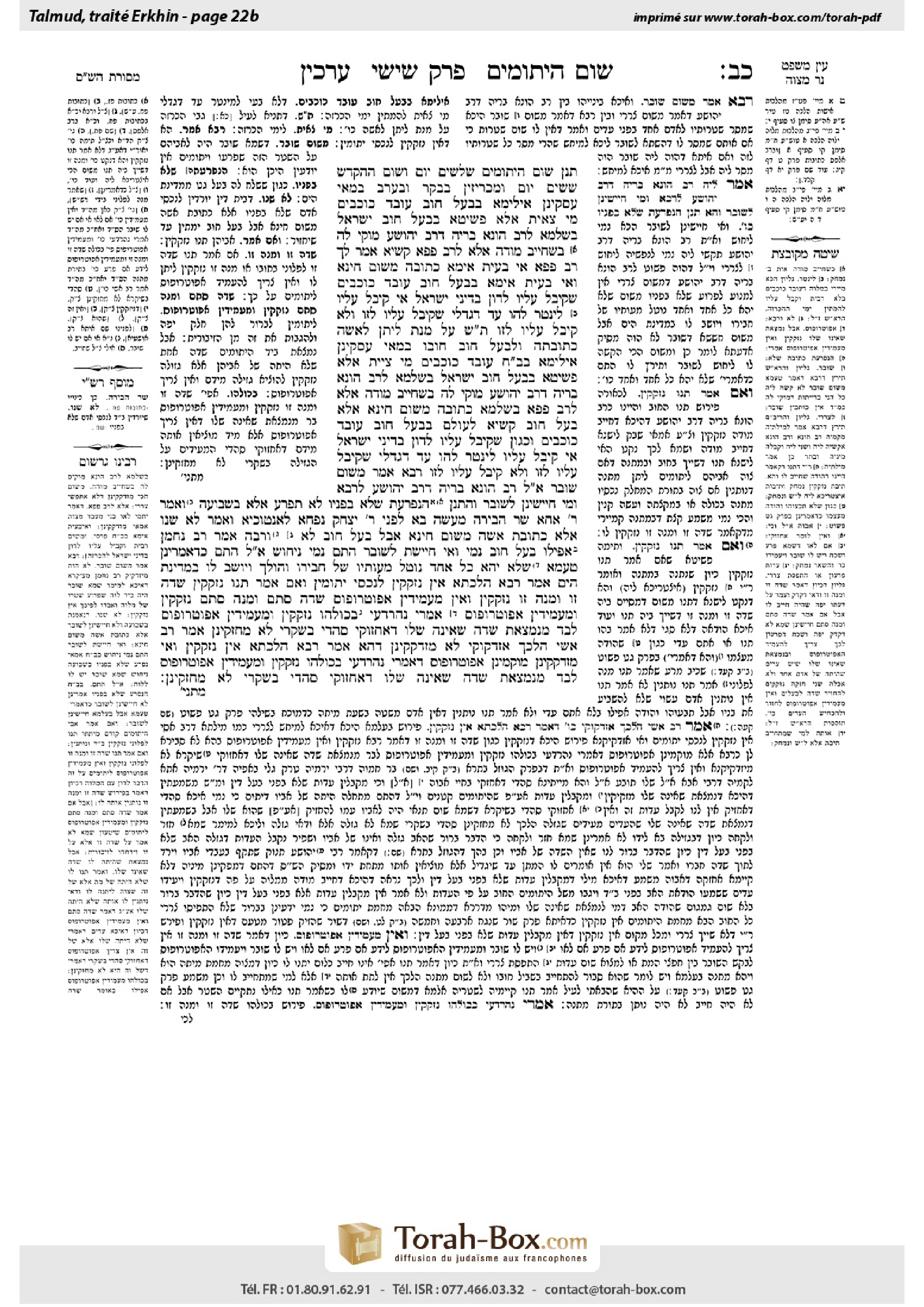
ערכין כ״ב ב · Aramaic and Hebrew text
תְּנַן: שׁוּם הַיְּתוֹמִים שְׁלֹשִׁים יוֹם, וְשׁוּם הַהֶקְדֵּשׁ שִׁשִּׁים יוֹם, וּמַכְרִיזִין בַּבֹּקֶר וּבָעֶרֶב. בְּמַאי עָסְקִינַן? אִילֵימָא בְּבַעַל חוֹב גּוֹי — מִי צָאֵית? אֶלָּא פְּשִׁיטָא בְּבַעַל חוֹב יִשְׂרָאֵל.
בִּשְׁלָמָא לְרַב הוּנָא בְּרֵיהּ דְּרַב יְהוֹשֻׁעַ, מוֹקֵי לַהּ בְּשֶׁחַיָּיב מוֹדֶה, אֶלָּא לְרַב פָּפָּא — קַשְׁיָא!
אָמַר לְךָ רַב פָּפָּא: אִי בָּעֵית אֵימָא — כְּתוּבָּה מִשּׁוּם חִינָּא, וְאִי בָּעֵית אֵימָא — בְּבַעַל חוֹב גּוֹי שֶׁקִּיבֵּל עָלָיו לָדוּן בְּדִינֵי יִשְׂרָאֵל.
אִי קִיבֵּל עָלָיו, לִינְטַר לְהוּ עַד דְּגָדְלִי! שֶׁקִּיבֵּל עָלָיו לָזוֹ, וְלֹא קִיבֵּל עָלָיו לָזוֹ.
תָּא שְׁמַע: עַל מְנָת לִיתֵּן לָאִשָּׁה כְּתוּבָּתָהּ, וּלְבַעַל חוֹב חוֹבוֹ. בְּמַאי עָסְקִינַן? אִילֵימָא בְּבַעַל חוֹב גּוֹי — מִי צָיֵית? אֶלָּא פְּשִׁיטָא בְּבַעַל חוֹב יִשְׂרָאֵל.
בִּשְׁלָמָא לְרַב הוּנָא בְּרֵיהּ דְּרַב יְהוֹשֻׁעַ, מוֹקֵי לַהּ בְּשֶׁחַיָּיב מוֹדֶה. אֶלָּא לְרַב פָּפָּא, בִּשְׁלָמָא כְּתוּבָּה — מִשּׁוּם חִינָּא, אֶלָּא בַּעַל חוֹב קַשְׁיָא!
לְעוֹלָם בְּבַעַל חוֹב גּוֹי, וּכְגוֹן שֶׁקִּיבֵּל עָלָיו לָדוּן בְּדִינֵי יִשְׂרָאֵל. אִי קִיבֵּל עָלָיו, לִינְטַר לְהוּ עַד דְּגָדְלִי! שֶׁקִּיבֵּל עָלָיו לָזוֹ, וְלֹא קִיבֵּל עָלָיו לָזוֹ.
רָבָא אָמַר: מִשּׁוּם שׁוֹבָר. אֲמַר לֵיהּ רַב הוּנָא בְּרֵיהּ דְּרַב יְהוֹשֻׁעַ לְרָבָא: וּמִי חָיְישִׁינַן לְשׁוֹבָר? וְהָתְנַן: הַנִּפְרַעַת שֶׁלֹּא בְּפָנָיו — לֹא תִּפָּרַע אֶלָּא בִּשְׁבוּעָה.
וְאָמַר רַבִּי אַחָא שַׂר הַבִּירָה: מַעֲשֶׂה בָּא לִפְנֵי רַבִּי יִצְחָק נַפָּחָא לְאַנְטוֹכְיָא, וְאָמַר: לֹא שָׁנוּ אֶלָּא כְּתוּבַּת אִשָּׁה מִשּׁוּם חִינָּא, אֲבָל בַּעַל חוֹב — לָא, וְרַבָּה אָמַר רַב נַחְמָן: אֲפִילּוּ בַּעַל חוֹב נָמֵי,
וְאִי חָיְישַׁתְּ לְשׁוֹבָר — הָתָם נָמֵי נֵיחוּשׁ! אֲמַר לֵיהּ: הָתָם, כִּדְאָמְרִינַן טַעְמָא, שֶׁלֹּא יְהֵא כׇּל אֶחָד נוֹטֵל מְעוֹתָיו שֶׁל חֲבֵירוֹ וְהוֹלֵךְ וְיוֹשֵׁב לוֹ בִּמְדִינַת הַיָּם.
אָמַר רָבָא, הִלְכְתָא: אֵין נִזְקָקִין לְנִכְסֵי יְתוֹמִין, וְאִם אָמַר: ״תְּנוּ״ — נִזְקָקִין. ״שָׂדֶה זוֹ״ וּ״מָנֶה זוֹ״ — נִזְקָקִין וְאֵין מַעֲמִידִין אַפּוֹטְרוֹפּוֹס, ״שָׂדֶה״ סְתָם וּ״מָנֶה״ סְתָם — נִזְקָקִין וּמַעֲמִידִין אַפּוֹטְרוֹפּוֹס.
אָמְרִי נְהַרְדָּעֵי: בְּכוּלְּהוּ נִזְקָקִין וּמַעֲמִידִין אַפּוֹטְרוֹפּוֹס, לְבַד מִנִּמְצֵאת שָׂדֶה שֶׁאֵינָהּ שֶׁלּוֹ, דְּאַחְזוֹקֵי סָהֲדֵי בְּשַׁקָּרֵי לָא מַחְזְקִינַן.
אָמַר רַב אָשֵׁי: הִלְכָּךְ אִזְדְּקוֹקֵי לָא מִזְדַּקְקִינַן, דְּהָא אָמַר רָבָא: הִלְכְתָא אֵין נִזְקָקִין, וְאִי מִזְדַּקְקִינַן מוֹקְמִינַן אַפּוֹטְרוֹפּוֹס, דְּאָמְרִי נְהַרְדָּעֵי: בְּכוּלְּהוּ נִזְקָקִין וּמַעֲמִידִין אַפּוֹטְרוֹפּוֹס, לְבַד מִנִּמְצֵאת שָׂדֶה שֶׁאֵינָהּ שֶׁלּוֹ, דְּאַחְזוֹקֵי סָהֲדֵי בְּשַׁקָּרֵי לָא מַחְזְקִינַן.
Arakhin 22b · English translation
The Gemara attempts to determine the correct reason why the court does not attend to the property of minor orphans: We learned in the mishna that one proclaims the appraisal of the property of minor orphans that is being sold for thirty days, and one proclaims the appraisal of consecrated property for sixty days, and one proclaims it in the morning and in the evening. The Gemara asks: What are we dealing with here? If we say that the mishna is dealing with a gentile creditor who is unwilling to wait until the orphans reach majority, will he comply with the court’s directive that the appraisal of the property be proclaimed for thirty days before it is sold? Rather, it is obvious that the mishna is dealing with a Jewish creditor.
The Gemara concludes its proof: Granted, according to the opinion of Rav Huna, son of Rav Yehoshua, who says that the court does not attend to the property of minor orphans due to a concern that their father might have left bundles of coins with the creditor, he can establish the mishna as referring to a case where the one obligated to pay, i.e., the father, admits before his death that he has not paid. In such a case, the court does not wait to collect payment until the orphans reach majority. But according to the opinion of Rav Pappa, that the court does not attend to the property of minor orphans because they are not obligated in the mitzva to repay a loan, the mishna poses a difficulty.
The Gemara explains that Rav Pappa could say to you: If you wish, say that the mishna is referring to a case where the court sells the property of the orphans in order to collect payment for a marriage contract, which the court does for the sake of favor, i.e., in order that the wife will own property and be desirable for marriage. And if you wish, say instead that the mishna is dealing with a gentile creditor who accepted upon himself to adjudicate in accordance with Jewish law. He therefore agrees to delay collection for thirty days.
The Gemara objects: If he accepted Jewish law upon himself, then let him wait for the orphans until they reach majority before demanding payment of the loan. The Gemara explains: The mishna is referring to a case where he accepted Jewish law upon himself for this matter, to delay collection for thirty days, but he did not accept it upon himself for that matter, to wait until they reach majority.
The Gemara suggests: Come and hear a proof from a baraita: When one proclaims the appraisal of the property of orphans, he announces that the property is being sold in order to give the proceeds to a wife as payment of her marriage contract, or in order to give a creditor payment of his debt. The Gemara asks: What are we dealing with in the baraita? If we say that the baraita is referring to a gentile creditor who is unwilling to wait until the orphans reach majority, will he comply with the court’s directive that the appraisal of the property is proclaimed for thirty days before it is sold? Rather, it is obvious that the mishna is referring to a Jewish creditor.
The Gemara continues: Granted, according to the opinion of Rav Huna, son of Rav Yehoshua, he can establish the mishna as referring to a case where the one obligated to pay admits before his death that he has not paid. But according to the opinion of Rav Pappa, granted, the court collects payment of a marriage contract for the sake of favor; but the fact that they sell the property in order to pay a creditor poses a difficulty.
The Gemara responds: Actually, the baraita is dealing with a gentile creditor, and is it referring to a case where he accepted upon himself to adjudicate in accordance with Jewish law. He therefore agrees to delay collection for thirty days. The Gemara objects: If he accepted Jewish law upon himself, then let him wait for the orphans until they reach majority before demanding payment of the loan. The Gemara again explains: The baraita is dealing with a case where he accepted Jewish law upon himself for this matter, to delay collection for thirty days, but he did not accept it upon himself for that matter, to wait until they reach majority.
Rava says: The court does not collect payment from the property of minor orphans due to the concern that there might be a receipt, i.e., perhaps their father repaid the loan and received a receipt attesting to his payment and the orphans are unaware of its existence. Rav Huna, son of Rav Yehoshua, said to Rava: But are we concerned for the existence of a receipt? Didn’t we learn in a mishna (Ketubot 87a): A woman who collects the payment of her marriage contract from the property of her husband when not in his presence, e.g., if her husband is overseas, may collect only by means of an oath that she has not yet received payment.
And Rabbi Aḥa Sar HaBira says: An incident came before Rabbi Yitzḥak Nappaḥa in Antioch, and he issued a ruling and said: They taught this halakha, that she may collect the payment of her marriage contract in her husband’s absence, only with regard to the wife’s marriage contract, for the sake of favor. But a creditor does not have the right to collect the debt that is owed to him in the debtor’s absence. And Rabba says that Rav Naḥman says: Even a creditor may collect a payment by means of an oath in the debtor’s absence.
Rav Huna explains the difficulty: And if you are concerned for the existence of a receipt, then in that case there as well, where the obligated party is overseas, let us be concerned that he has in fact paid the debt and received a receipt. Rava said to him: In that case there, one is not concerned about the existence of a receipt, in accordance with the reason that we say: It is in order that there should not be a situation where every person will take the money of another and go and reside in a country overseas, to prevent the creditor from collecting the money from his property.
§ Rava says: The halakha is that the court does not attend to the property of minor orphans in order to pay the debts owed by their father. But if their father said before his death: Give so-and-so the payment of my debt, the court attends to their property. Specifically, if the father said: Give this field to so-and-so, or: Give this one hundred dinars to so-and-so, then the court attends to their property to collect payment, and the court does not install a steward [apotropos] to negotiate with the creditor on their behalf. If he said: Give a field to so-and-so, i.e., an unspecified field, or: Give one hundred dinars to so-and-so, i.e., unspecified dinars, then the court attends to the property of the orphans and they install a steward to act on their behalf, to ensure that the best fields remain in their possession.
By contrast, the Sages of Neharde’a say: In all of these cases where the father told his children before his death to give an item, the court attends to the property of the orphans and they install a steward to act on their behalf, except for a situation where a field is found in their possession with regard to which witnesses have testified that it is not their father’s, but is in fact stolen. In such a case, the stolen field is seized and returned to its owner without recourse to a steward, as we do not presume that witnesses are liars.
Rav Ashi says: Therefore, we do not attend to the property of minor orphans in order to repay a standard loan, as Rava says: The halakha is that the court does not attend to their property. And if we attend to their property, e.g., in a case where the father told his children to repay the debt, we install a steward to act on behalf of the orphans, as the Sages of Neharde’a say: In all of the cases, the court attends to the property of minor orphans and installs a steward, except for a situation where a field is found in their possession that is not the father’s, as we do not presume that witnesses are liars.
Arakhin 22b · Traduction française (IA)
La Guemara tente de déterminer la raison correcte pour laquelle le tribunal ne s'occupe pas des biens des orphelins mineurs : Nous avons appris dans la Michna que l'on proclame l'évaluation des biens des orphelins mineurs qui sont vendus pendant trente jours, et l'on proclame l'évaluation des biens consacrés pendant soixante jours, et l'on proclame l'évaluation à l'aube et au crépuscule. La Guemara pose la question : De quoi est-on en train de parler ici ? Si l'on dit que la Michna parle d'un créancier juif qui n'est pas prêt à attendre que les orphelins atteignent la majorité, acceptera-t-il la directive du tribunal selon laquelle l'évaluation des biens doit être proclamée pendant trente jours avant la vente ? Plutôt, il est évident que la Michna parle d'un créancier juif.
La Guemara conclut sa démonstration : Admettons, selon l'opinion de Rav Huna, fils de Rav Yéhoshua, qui dit que le tribunal ne s'occupe pas des biens des orphelins mineurs en raison de la crainte que leur père ait laissé des ballots de monnaie avec le créancier, il peut établir la Michna comme faisant référence à un cas où la personne obligée de payer, c'est-à-dire le père, admet avant sa mort qu'il n'a pas payé. Dans ce cas, le tribunal ne tarde pas à recouvrer le paiement jusqu'à ce que les orphelins atteignent la majorité. Mais selon l'opinion de Rav Pappa, qui dit que le tribunal ne s'occupe pas des biens des orphelins mineurs car ils ne sont pas obligés de remplir la Mitsva de rembourser un prêt, la Michna pose un problème.
La Guemara explique que Rav Pappa pourrait dire : Si tu le souhaites, dis que la Michna parle d'un cas où le tribunal vend les biens des orphelins afin de recouvrer un prêt pour un contrat de mariage, ce que le tribunal fait par l'intérêt, c'est-à-dire afin que la femme possède des biens et soit désirable pour le mariage. Et si tu le souhaites, dis plutôt que la Michna parle d'un créancier païen qui s'est engagé à résoudre les affaires selon la loi juive. Il accepte donc de reporter le recouvrement pendant trente jours.
La Guemara s'oppose : Si il a accepté la loi juive, alors laisse-le attendre jusqu'à ce que les orphelins atteignent la majorité avant de demander le paiement du prêt. La Guemara explique : La Michna parle d'un cas où il a accepté la loi juive pour cette affaire, afin de reporter le recouvrement pendant trente jours, mais il n'a pas accepté de le faire pour cette affaire, afin d'attendre jusqu'à ce qu'ils atteignent la majorité.
La Guemara suggère : Viens écouter une démonstration d'une baraïta : Lorsqu'on proclame l'évaluation des biens des orphelins, on annonce que les biens sont vendus afin de donner les recettes à une épouse comme paiement de son contrat de mariage, ou afin de donner un paiement à un créancier. La Guemara pose la question : De quoi est-on en train de parler dans la baraïta ? Si l'on dit que la baraïta parle d'un créancier païen qui n'est pas prêt à attendre que les orphelins atteignent la majorité, acceptera-t-il la directive du tribunal selon laquelle l'évaluation des biens doit être proclamée pendant trente jours avant la vente ? Plutôt, il est évident que la Michna parle d'un créancier juif.
La Guemara continue : Admettons, selon l'opinion de Rav Huna, fils de Rav Yéhoshua, il peut établir la Michna comme faisant référence à un cas où la personne obligée de payer admet avant sa mort qu'il n'a pas payé. Mais selon l'opinion de Rav Pappa, admettons, le tribunal recouvre le paiement d'un contrat de mariage par l'intérêt ; mais le fait qu'ils vendent les biens afin de payer un créancier pose un problème.
La Guemara répond : En réalité, la baraïta parle d'un créancier païen, et elle fait référence à un cas où il s'est engagé à résoudre les affaires selon la loi juive. Il accepte donc de reporter le recouvrement pendant trente jours. La Guemara s'oppose : Si il a accepté la loi juive, alors laisse-le attendre jusqu'à ce que les orphelins atteignent la majorité avant de demander le paiement du prêt. La Guemara explique à nouveau : La baraïta parle d'un cas où il a accepté la loi juive pour cette affaire, afin de reporter le recouvrement pendant trente jours, mais il n'a pas accepté de le faire pour cette affaire, afin d'attendre jusqu'à ce qu'ils atteignent la majorité.
Rava dit : Le tribunal ne recouvre pas le paiement des biens des orphelins mineurs en raison de la crainte qu'il y ait un reçu, c'est-à-dire peut-être que leur père ait remboursé le prêt et reçu un reçu attestant de son paiement et que les orphelins ne soient pas conscients de son existence. Rav Huna, fils de Rav Yéhoshua, dit à Rava : Mais sommes-nous préoccupés par l'existence d'un reçu ? N'avons-nous pas appris dans une Michna (Ketubot 87a) : Une femme qui recouvre le paiement de son contrat de mariage des biens de son mari lorsqu'il n'est pas présent, par exemple si son mari est à l'étranger, peut recouvrer uniquement par serment qu'elle n'a pas encore reçu le paiement.
Et Rabbi Acha Sar HaBira dit : Un cas est venu devant Rabbi Yitzhak Nappaĥa à Antioche, et il a rendu un jugement et a dit : Ils ont enseigné cette halakha, qu'elle peut recouvrer le paiement de son contrat de mariage en l'absence de son mari, uniquement concernant le contrat de mariage de la femme, par l'intérêt. Mais un créancier n'a pas le droit de recouvrer la dette qu'on lui doit en l'absence du débiteur. Et Rabba dit que Rav Naḥman dit : Même un créancier peut recouvrer un paiement par serment en l'absence du débiteur.
Rav Huna explique la difficulté : Et si tu es préoccupé par l'existence d'un reçu, alors dans ce cas-là également, où la personne obligée est à l'étranger, laisseons-nous préoccuper qu'il a effectivement payé la dette et reçu un reçu. Rava a dit à lui : Dans ce cas-là, on n'est pas préoccupé par l'existence d'un reçu, conformément à la raison que nous disons : Afin qu'il n'y ait pas de situation où chaque personne prenne l'argent d'un autre et va s'installer dans un pays étranger, afin d'empêcher le créancier de recouvrer l'argent de ses biens.
§ Rava dit : La halakha est que la cour ne s'occupe pas des biens des orphelins mineurs afin de rembourser les dettes de leur père. Cependant, si leur père avait dit avant sa mort : Donne à tel ou tel le paiement de ma dette, la cour s'occupe de leurs biens. Plus précisément, si le père avait dit : Donne ce champ à tel ou tel, ou : Donne cent drachmes à tel ou tel, alors la cour s'occupe de leurs biens pour recouvrer le paiement, et la cour ne désigne pas un administrateur [apotropos] pour négocier avec le créancier à leur place. Si il avait dit : Donne un champ à tel ou tel, c'est-à-dire un champ indéterminé, ou : Donne cent drachmes à tel ou tel, c'est-à-dire des drachmes indéterminées, alors la cour s'occupe des biens des orphelins et désigne un administrateur pour agir à leur place, afin de garantir que les meilleurs champs restent en leur possession.
Par contraste, les Sages de Neharde’a disent : Dans tous les cas où le père avait dit à ses enfants avant sa mort de donner un objet, la cour s'occupe des biens des orphelins et désigne un administrateur à leur place, sauf dans le cas où un champ est trouvé en leur possession concernant lequel des témoins ont témoigné qu'il n'appartient pas à leur père, mais est en réalité volé. Dans ce cas, le champ volé est confisqué et rendu à son propriétaire sans recourir à un administrateur, car nous ne supposons pas que les témoins sont menteurs.
Rav Ashi dit : Par conséquent, nous ne nous occupons pas des biens des orphelins mineurs afin de rembourser un prêt ordinaire, car Rava dit : La halakha est que la cour ne s'occupe pas de leurs biens. Et si nous nous occupons de leurs biens, par exemple dans le cas où le père avait dit à ses enfants de rembourser la dette, nous désignons un administrateur à leur place, comme les Sages de Neharde’a disent : Dans tous les cas, la cour s'occupe des biens des orphelins mineurs et désigne un administrateur, sauf dans le cas où un champ est trouvé en leur possession qui n'appartient pas à leur père, car nous ne supposons pas que les témoins sont menteurs.
Traduction française générée par IA à partir de l’édition anglaise de Sefaria. Vérifie toujours un passage avec le texte source.
Text from Sefaria: William Davidson Edition - Vocalized Aramaic (CC BY NC); William Davidson Edition - English (CC BY NC).