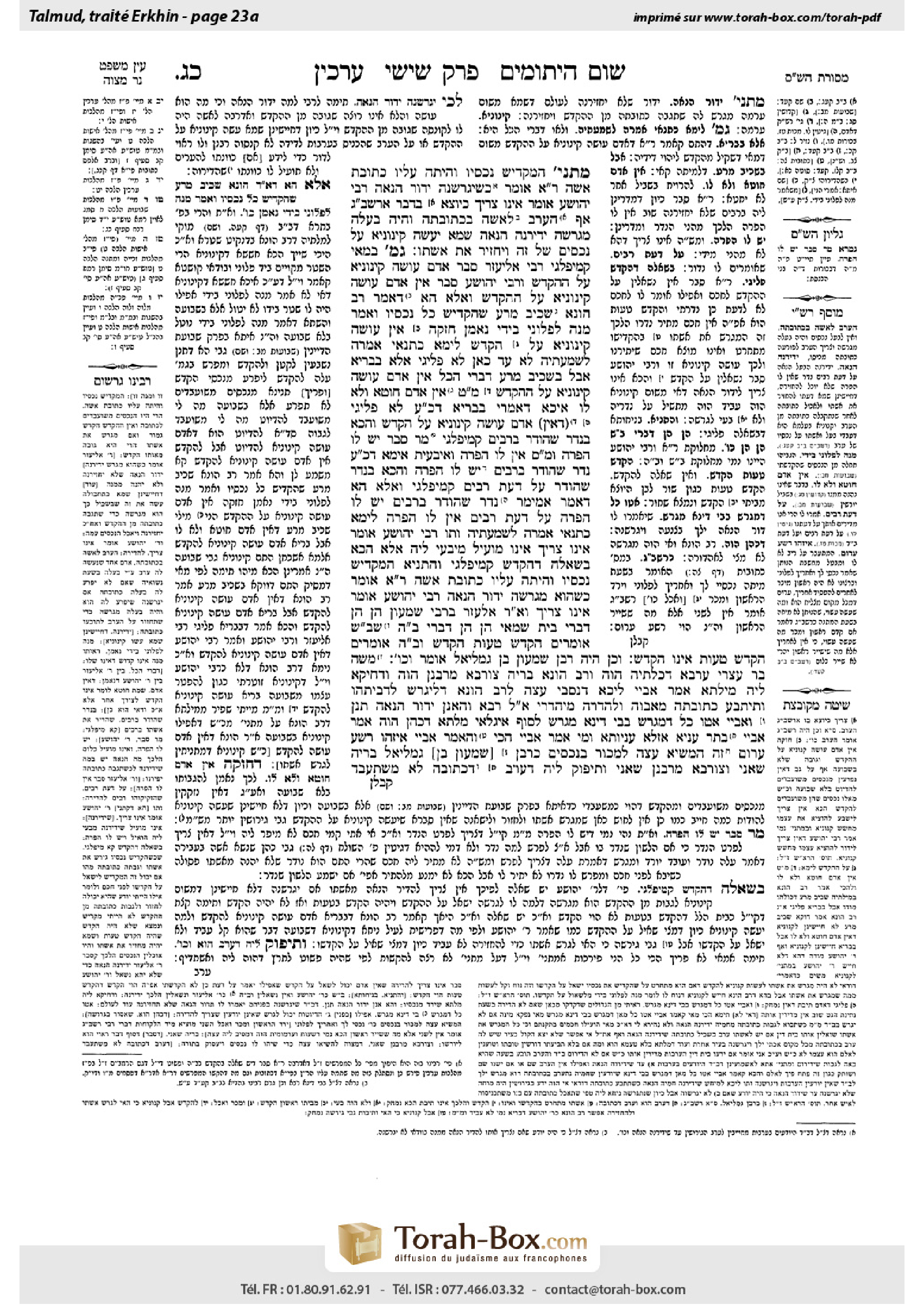
Arakhin 23a: Talmud study for Daf Yomi
Study the Talmud for Daf Yomi with scanned pages, Hebrew text, English translations from Sefaria and AI-generated French translations.
Passage selection and English or AI-generated French translation are available where the scan has annotations. Daf Study is independent of Torah-Box and Sefaria.
Browse Arakhin · ערכין · All tractatesArakhin 23a text and translations
This page of Arakhin includes the Aramaic text, an English translation and an AI-generated French translation, alongside the scan above.
ערכין כ״ג א · Aramaic and Hebrew text
מַתְנִי׳ הַמַּקְדִּישׁ נְכָסָיו וְהָיְתָה עָלָיו כְּתוּבַּת אִשָּׁה, רַבִּי אֱלִיעֶזֶר אוֹמֵר: כְּשֶׁיְּגָרְשֶׁנָּה יִדּוֹר הֲנָאָה, רַבִּי יְהוֹשֻׁעַ אוֹמֵר: אֵינוֹ צָרִיךְ. כַּיּוֹצֵא בְּדָבָר אָמַר רַבָּן שִׁמְעוֹן בֶּן גַּמְלִיאֵל: אַף הֶעָרֵב לָאִשָּׁה בִּכְתוּבָּתָהּ וְהָיָה בַּעְלָהּ מְגָרְשָׁהּ יַדִּירֶנָּה הֲנָאָה, שֶׁמָּא יַעֲשֶׂה קִינוּנְיָא עַל נְכָסִים שֶׁל זֶה וְיַחְזִיר אֶת אִשְׁתּוֹ.
גְּמָ׳ בְּמַאי קָמִיפַּלְגִי? רַבִּי אֱלִיעֶזֶר סָבַר: אָדָם עוֹשֶׂה קִינוּנְיָא עַל הַהֶקְדֵּשׁ, וְרַבִּי יְהוֹשֻׁעַ סָבַר: אֵין אָדָם עוֹשֶׂה קִינוּנְיָא עַל הַהֶקְדֵּשׁ.
וְאֶלָּא הָא דְּאָמַר רַב הוּנָא: שְׁכִיב מְרַע שֶׁהִקְדִּישׁ כׇּל נְכָסָיו, וְאָמַר: ״מָנֶה לִפְלוֹנִי בְּיָדִי״ — נֶאֱמָן, חֲזָקָה אֵין עוֹשֶׂה קִינוּנְיָא עַל הֶקְדֵּשׁ, לֵימָא כְּתַנָּאֵי אַמְרַהּ לִשְׁמַעְתֵּיהּ?
לָא, עַד כָּאן לָא פְּלִיגִי אֶלָּא בְּבָרִיא, אֲבָל בִּשְׁכִיב מְרַע — דִּבְרֵי הַכֹּל אֵין אָדָם עוֹשֶׂה קִינוּנְיָא עַל הַהֶקְדֵּשׁ. מַאי טַעְמָא? אֵין אָדָם חוֹטֵא וְלֹא לוֹ.
אִיכָּא דְּאָמְרִי: בְּבָרִיא דְּכוּלֵּי עָלְמָא לָא פְּלִיגִי דְּאֵין אָדָם עוֹשֶׂה קִינוּנְיָא עַל הֶקְדֵּשׁ, וְהָכָא בְּנֶדֶר שֶׁהוּדַּר בְּרַבִּים קָמִיפַּלְגִי, מָר סָבַר: יֵשׁ לוֹ הֲפָרָה, וּמַר סָבַר: אֵין לוֹ הֲפָרָה.
וְאִיבָּעֵית אֵימָא: דְּכוּלֵּי עָלְמָא נֶדֶר שֶׁהוּדַּר בָּרַבִּים יֵשׁ לוֹ הֲפָרָה, וְהָכָא בְּנֶדֶר שֶׁהוּדַּר עַל דַּעַת רַבִּים קָמִיפַּלְגִי.
וְאֶלָּא הָא דְּאָמַר אַמֵּימָר: נֶדֶר שֶׁהוּדַּר בָּרַבִּים יֵשׁ לוֹ הֲפָרָה, עַל דַּעַת רַבִּים אֵין לוֹ הֲפָרָה — לֵימָא כְּתַנָּאֵי אַמְרַהּ לִשְׁמַעְתֵּיהּ? וְתוּ, רַבִּי יְהוֹשֻׁעַ אוֹמֵר: ״אֵינוֹ צָרִיךְ״? ״אֵינוֹ מוֹעִיל״ מִיבְּעֵי לֵיהּ!
אֶלָּא הָכָא בִּשְׁאֵלָה דְּהֶקְדֵּשׁ קָמִיפַּלְגִי.
וְהָתַנְיָא: הַמַּקְדִּישׁ נְכָסָיו וְהָיְתָה עָלָיו כְּתוּבַּת אִשָּׁה, רַבִּי אֱלִיעֶזֶר אוֹמֵר: כְּשֶׁהוּא מְגָרְשָׁהּ יִדּוֹר הֲנָאָה, רַבִּי יְהוֹשֻׁעַ אוֹמֵר: אֵינוֹ צָרִיךְ, וְאָמַר רַבִּי אֶלְעָזָר בְּרַבִּי שִׁמְעוֹן: הֵן הֵן דִּבְרֵי בֵּית שַׁמַּאי, הֵן הֵן דִּבְרֵי בֵּית הִלֵּל.
שֶׁבֵּית שַׁמַּאי אוֹמְרִים: הֶקְדֵּשׁ טָעוּת הֶקְדֵּשׁ, וּבֵית הִלֵּל אוֹמְרִים: הֶקְדֵּשׁ טָעוּת אֵינוֹ הֶקְדֵּשׁ.
וְכֵן הָיָה רַבָּן שִׁמְעוֹן בֶּן גַּמְלִיאֵל אוֹמֵר וְכוּ׳. מֹשֶׁה בַּר עַצְרִי עָרְבָא דְּכַלְּתֵיהּ הֲוָה, וְרַב הוּנָא בְּרֵיהּ צוּרְבָּא מֵרַבָּנַן הֲוָה, וּדְחִיקָא לֵיהּ מִילְּתָא. אָמַר אַבָּיֵי: לֵיכָּא דְּנַסְּבֵיהּ עֵצָה לְרַב הוּנָא, דְּלִיגָרֵשׁ לִדְבֵיתְהוּ וְתִיתְבַּע כְּתוּבְּתַהּ מֵאֲבוּהּ, וְלַהְדְּרַהּ מִיהֲדָרי.
אֲמַר לֵיהּ רָבָא: וְהָאֲנַן ״יִדּוֹר הֲנָאָה״ תְּנַן! וְאַבָּיֵי — אַטּוּ כֹּל דִּמְגָרֵשׁ בְּבֵי דִינָא מְגָרֵשׁ? לְסוֹף אִיגַּלַּאי מִלְּתָא דְּכֹהֵן הֲוָה. אָמַר אַבָּיֵי: בָּתַר עַנְיָא אָזְלָא עַנְיוּתָא.
וּמִי אָמַר אַבָּיֵי הָכִי? וְהָאָמַר אַבָּיֵי: אֵיזֶהוּ רָשָׁע עָרוּם? זֶה הַמַּשִּׂיא עֵצָה לִמְכּוֹר בִּנְכָסִים, כְּרַבָּן גַּמְלִיאֵל.
בְּרֵיהּ שָׁאנֵי, וְצוּרְבָּא מֵרַבָּנַן שָׁאנֵי.
וְתִיפּוֹק לֵיהּ דְּעָרֵב דִּכְתוּבָּה לָא מִשְׁתַּעְבַּד!
Arakhin 23a · English translation
MISHNA: In the case of one who consecrates his property and there was the outstanding debt of the marriage contract of his wife, for whose repayment one’s property is liened, Rabbi Eliezer says: When he divorces her, he shall vow that benefit from her is forbidden to him. This is to prevent collusion, by which he divorces her, she collects payment from the consecrated property, and he then remarries her. Rabbi Yehoshua says: He need not do so. On a similar note, Rabban Shimon ben Gamliel said: Even in the case of the guarantor of a woman for her marriage contract, and her husband was divorcing her and could not pay the debt, the husband shall vow that benefit from her is forbidden to him, lest he and his wife engage in collusion [kinunya] and collect payment from the property of that guarantor, and then the husband will remarry his wife.
GEMARA: The mishna teaches that there is a dispute between Rabbi Eliezer and Rabbi Yehoshua with regard to a case where one consecrates his property and then divorces his wife. The Gemara asks: With regard to what principle do they disagree? The Gemara explains: Rabbi Eliezer holds that a person would engage in collusion against even the Temple treasury, and for this reason he divorces his wife. The required vow serves to prevent such a possibility. And Rabbi Yehoshua holds that a person would not engage in collusion against the Temple treasury.
The Gemara asks: But if so, consider that which Rav Huna says: If a person on his deathbed consecrated all of his property and said: So-and-so has one hundred dinars that I owe him in my possession, his statement is deemed credible, as there is a presumption that a person does not engage in collusion against the Temple treasury. Let us say that Rav Huna stated this halakha with regard to a matter that is the subject of a dispute between tanna’im.
The Gemara responds: No, Rabbi Eliezer and Rabbi Yehoshua disagree whether or not one colludes against the Temple treasury only with regard to a healthy person. But with regard to a person on his deathbed, everyone agrees that such a person does not engage in collusion against the Temple treasury. What is the reason? Since he will soon die, he does not stand to gain anything from his statement, and a person sins only for his own benefit, not for the benefit of others.
Some say that in the case of a healthy person, everyone agrees on the question of whether or not a person would engage in collusion against the Temple treasury, i.e., they agree that one must be concerned that a person may engage in collusion. And here, they disagree with regard to a vow administered in public, e.g., a vow administered by the court. One Sage, Rabbi Yehoshua, holds that such a vow has the option of nullification. Consequently, there is no use in requiring the husband to take a vow even in public, as a halakhic authority can later dissolve it. And one Sage, Rabbi Eliezer, holds that such a vow does not have the option of nullification. Therefore, the court administers a vow in public to prevent collusion.
And if you wish, say instead: Everyone agrees that a vow administered in public has the option of nullification. And here, they disagree with regard to a vow administered based on the consent of the public, i.e., when the court says to the husband: You are taking a vow that benefit from your wife is forbidden to you based on our consent. According to Rabbi Eliezer, there is no option of nullification for such a vow, and therefore it is effective in preventing collusion, whereas Rabbi Yehoshua maintains that even such a vow can be nullified and is therefore ineffective in preventing collusion.
The Gemara asks: But if so, consider that which Ameimar says: A vow that was taken in public has the option of nullification; if it was taken based on the consent of the public it does not have the option of nullification. Let us say that Ameimar stated this halakha with regard to a matter that is the subject of a dispute between tanna’im. And furthermore, Rabbi Yehoshua says in the mishna that the husband need not take a vow. If his reason is that such a vow is ineffective, he should have stated: It is ineffective.
Rather, here they disagree with regard to one’s ability to request the dissolution of a vow involving consecrated property. Rabbi Eliezer holds that one may not request the dissolution of a vow involving consecrated property. Accordingly, there is a concern that the husband might collude with his wife by divorcing her in order to extract the consecrated property from the Temple treasury, as he has no other means of releasing the property. In contrast, Rabbi Yehoshua maintains that such a vow may be dissolved and therefore there is no reason for the husband to collude with his wife.
The Gemara adds: And it is likewise taught in a baraita: In the case of one who consecrates his property and there was the outstanding debt of the marriage contract of his wife upon it, Rabbi Eliezer says: When he divorces her, he shall vow that benefit from her is forbidden to him, to prevent collusion. Rabbi Yehoshua says: He need not do so. And Rabbi Elazar, son of Rabbi Shimon, said: This statement of Rabbi Eliezer is the same as the statement of Beit Shammai, and this statement of Rabbi Yehoshua is the same as the statement of Beit Hillel.
As Beit Shammai say: Consecration that one performed in error is effective as consecration. Consequently, one cannot request the dissolution of his consecration due to circumstances that unfolded on the grounds that he did not mean to make a vow. And Beit Hillel say: Consecration that one performed in error is not consecration, and one may therefore request the dissolution of his consecration.
§ The mishna teaches: On a similar note, Rabban Shimon ben Gamliel said that even in the case of a guarantor for a woman for her marriage contract, he vows that benefit from her is forbidden to him, lest he and his wife engage in collusion. The Gemara relates that Moshe bar Atzrei was the guarantor for the marriage contract of his daughter-in-law, and Rav Huna, his son, was a Torah scholar and was hard-pressed for money. Abaye said: Is there no one who will advise Rav Huna that he should divorce his wife, and she should claim her marriage contract from his father, the guarantor of the marriage contract, and that he should then return and remarry her, and in this manner they will obtain money?
Rava said to Abaye: But we learned in the mishna that in such a case he shall vow that benefit from her is forbidden to him. If so, Rav Huna cannot remarry her. And the Gemara explains that Abaye would argue: Is that to say that anyone who divorces, divorces in court? Let Rav Huna divorce his wife outside the court, so that he will not be forced to take a vow and he will therefore be allowed to remarry her. The Gemara relates that ultimately it was revealed that Rav Huna was a priest, which means that if he had divorced his wife he would have been prohibited from remarrying her. Abaye said of this revelation: This is an example of the saying that poverty follows the poor, i.e., it is difficult to remove a poor person from a state of poverty.
The Gemara asks: And did Abaye actually say this? Doesn’t Abaye say: Who is a wily, wicked person? This is one who advises another to sell property that he received from someone who stipulated that the property should pass to a second beneficiary upon the death of the first. And this is in accordance with the ruling of Rabban Shimon ben Gamliel, who maintains that the sale is valid and the second beneficiary may not remove the property from the possession of the buyer. If Abaye considers this individual as wicked for advising one to act against the intentions of a benefactor, how could he suggest that Rav Huna should extract money from the guarantor in the above case?
The Gemara answers: When one is a guarantor for his son it is different, as he would forgive his son for acting in this manner, as the son will in any case inherit his property. And furthermore, when this is performed for the benefit of a Torah scholar it is different, as it is proper to assist him so that he may continue studying Torah.
The Gemara objects: And let Abaye deduce that such a course of action is ineffective, as a guarantor of a marriage contract is not legally responsible to pay the marriage contract.
Arakhin 23a · Traduction française (IA)
MICHNA : Dans le cas d'une personne qui consacre sa propriété et qu'il existe une dette restante du contrat de mariage de sa femme, pour laquelle la propriété est hypothéquée, le rabbi Eliezer dit : Lorsqu'il divorce d'elle, il doit jurer que les bénéfices provenant d'elle lui sont interdits. Cela vise à empêcher la collusion, par laquelle il divorce d'elle, elle récupère le paiement à partir de la propriété consacrée, et il se remarie ensuite avec elle. Le rabbi Yéhoshua dit : Il n'a pas besoin de le faire. Sur un sujet similaire, le rabban Shimon ben Gamliel dit : Même dans le cas d'un garant d'une femme pour son contrat de mariage, et que son mari divorce d'elle et ne peut pas payer la dette, le mari doit jurer que les bénéfices provenant d'elle lui sont interdits, afin d'éviter qu'il et sa femme ne collaborent [kinunya] pour récupérer le paiement à partir de la propriété de ce garant, et que le mari se remarie avec sa femme.
GUEMARA : La mishna enseigne qu'il existe un désaccord entre le rabbi Eliezer et le rabbi Yéhoshua concernant un cas où une personne consacre sa propriété et divorce ensuite de sa femme. La Guemara demande : Sur quel principe se déroule ce désaccord ? La Guemara explique : Le rabbi Eliezer considère qu'une personne collabore même contre le trésor du Temple, et pour cette raison il divorce de sa femme. Le serment requis sert à empêcher une telle possibilité. Et le rabbi Yéhoshua considère qu'une personne ne collabore pas contre le trésor du Temple.
La Guemara demande : Mais si c'est ainsi, considérons ce que dit Rav Huna : Si une personne, sur son lit de mort, consacre toute sa propriété et dit : Tel et tel a un hundred de drachmes que je lui dois et qui sont en mon possession, son déclaration est considérée comme crédible, car il y a une présomption que personne ne collabore contre le trésor du Temple. Disons que Rav Huna a formulé cette halakha concernant une question sujette à un désaccord entre les tannaïm.
La Guemara répond : Non, le rabbi Eliezer et le rabbi Yéhoshua s'opposent sur la question de savoir si une personne collabore contre le trésor du Temple uniquement concernant une personne en bonne santé. Mais concernant une personne sur son lit de mort, tout le monde convient qu'une telle personne ne collabore pas contre le trésor du Temple. Quelle est la raison ? Parce qu'il va bientôt mourir, il n'a plus rien à gagner de sa déclaration, et une personne ne commet un péché que pour son propre bénéfice, pas pour celui des autres.
Certains disent que concernant une personne en bonne santé, tout le monde convient de la question de savoir si une personne collabore contre le trésor du Temple, c'est-à-dire qu'ils conviennent qu'il faut s'inquiéter que une personne collabore. Et ici, ils s'opposent concernant un serment administré en public, par exemple un serment administré par le tribunal. Un sage, le rabbi Yéhoshua, considère que ce serment a la possibilité d'être annulé. Par conséquent, il n'y a pas de raison de demander au mari de prendre un serment même en public, car un autorité halakhique peut l'annuler plus tard. Et un autre sage, le rabbi Eliezer, considère que ce serment n'a pas la possibilité d'être annulé. Par conséquent, le tribunal administre un serment en public pour empêcher la collusion.
Et si vous le souhaitez, dites plutôt : Tout le monde convient qu'un serment administré en public a la possibilité d'être annulé. Et ici, ils s'opposent concernant un serment administré sur la base du consentement du public, c'est-à-dire lorsque le tribunal dit au mari : Vous prenez un serment que les bénéfices provenant de votre femme vous sont interdits, sur notre consentement. Selon le rabbi Eliezer, ce serment n'a pas la possibilité d'être annulé, et par conséquent il est efficace pour empêcher la collusion, tandis que le rabbi Yéhoshua considère que même ce serment peut être annulé et est donc inefficace pour empêcher la collusion.
La Guemara demande : Mais si c'est ainsi, considérons ce que dit Ameimar : Un serment prononcé en public peut être annulé ; si il a été prononcé sur la base du consentement du public, il ne peut pas être annulé. Disons que Ameimar a formulé cette halakha concernant une question sujette à un désaccord entre les tannaïm. Et de plus, le rabbi Yéhoshua dit dans la mishna que le mari n'a pas besoin de prendre un serment. Si sa raison est que ce serment est inefficace, il aurait dû dire : Il est inefficace.
Plutôt, ici ils s'opposent quant à la capacité de demander l'annulation d'un serment concernant une propriété consacrée. Rabbi Eliezer considère qu'on ne peut pas demander l'annulation d'un serment concernant une propriété consacrée. Par conséquent, il y a une crainte que le mari collabore avec sa femme en divorçant d'elle afin d'extraire la propriété consacrée du trésor du Temple, car il n'a pas d'autre moyen de libérer la propriété. À l'inverse, Rabbi Yéhoshua considère que ce serment peut être annulé et par conséquent il n'y a pas de raison pour que le mari collabore avec sa femme.
La Guemara ajoute : Et cela est également enseigné dans une baraïta : Dans le cas d'une personne qui consacre sa propriété et qu'il existe une dette restante du contrat de mariage de sa femme sur celle-ci, Rabbi Eliezer dit : Lorsqu'il divorce d'elle, il doit jurer que les bénéfices provenant d'elle lui sont interdits, afin d'empêcher la collusion. Rabbi Yéhoshua dit : Il n'a pas besoin de le faire. Et Rabbi Elazar, fils de Rabbi Shimon, dit : Cette déclaration de Rabbi Eliezer est la même que celle de Beit Shammai, et cette déclaration de Rabbi Yéhoshua est la même que celle de Beit Hillel.
Comme le Beit Shammai le disent : Une consécration accomplie par erreur est efficace comme une consécration. Par conséquent, on ne peut pas demander l'annulation de sa consécration en raison de circonstances qui se sont produites sur la base du fait qu'il n'avait pas l'intention de faire un serment. Et le Beit Hillel le disent : Une consécration accomplie par erreur n'est pas une consécration, et on peut donc demander l'annulation de sa consécration.
§ La Michna enseigne : Sur un sujet similaire, Rabban Shimon ben Gamliel a dit que même dans le cas d'un garant d'une femme pour son contrat de mariage, il jure que les bénéfices provenant d'elle lui sont interdits, afin que lui et sa femme ne collaborent pas. La Guemara rapporte que Moshe bar Atzrei était le garant du contrat de mariage de sa belle-fille, et que Rav Huna, son fils, était un savant de la Torah et manquait de fonds. Abaye a dit : N'y a-t-il pas quelqu'un qui conseillerait à Rav Huna de divorcer de sa femme, et qu'elle réclame son contrat de mariage auprès de son père, le garant du contrat, et qu'il retrouve ensuite son épouse, de sorte qu'ils obtiendraient ainsi de l'argent ?
Rava a dit à Abaye : Mais nous avons appris dans la Michna que dans un tel cas il doit jurer que les bénéfices provenant d'elle lui sont interdits. Si c'est ainsi, Rav Huna ne peut pas se remarier avec elle. Et la Guemara explique que Abaye aurait argumenté ainsi : Est-ce que cela signifie que celui qui divorce divorce en justice ? Que Rav Huna divorce hors de la justice, de sorte qu'il ne sera pas contraint de prendre un serment et qu'il pourra donc se remarier avec elle. La Guemara rapporte que finalement il a été révélé que Rav Huna était un prêtre, ce qui signifie qu'en divorçant il aurait été interdit de se remarier avec elle. Abaye a dit de cette révélation : C'est un exemple de la parole : la pauvreté suit le pauvre, c'est-à-dire qu'il est difficile de sortir un pauvre d'un état de pauvreté.
La Guemara pose la question : Et Abaye a-t-il vraiment dit cela ? N'a-t-il pas dit : Qui est un homme rusé, méchant ? C'est celui qui conseille à quelqu'un de vendre une propriété qu'il a reçue d'une personne qui avait stipulé que la propriété passe à un deuxième bénéficiaire en cas de décès du premier. Et cela est selon la décision de Rabban Shimon ben Gamliel, qui considère que la vente est valide et que le deuxième bénéficiaire ne peut pas retirer la propriété du possesseur. Si Abaye considère cet individu comme méchant pour conseiller à quelqu'un d'agir contre les intentions d'un bienfaiteur, comment pourrait-il suggérer à Rav Huna d'extraire de l'argent du garant dans le cas mentionné ci-dessus ?
La Guemara répond : Quand on est garant pour son fils, c'est différent, car il pardonnerait à son fils d'agir ainsi, car le fils héritera tout de toute façon de ses biens. Et de plus, quand cela est fait pour le bénéfice d'un savant de la Torah, c'est différent, car il est approprié d'aider celui-ci afin qu'il puisse continuer à étudier la Torah.
La Guemara s'oppose : Et que Abaye déduise que cette démarche est inefficace, car un garant d'un contrat de mariage n'est pas légalement responsable de payer le contrat de mariage.
Traduction française générée par IA à partir de l’édition anglaise de Sefaria. Vérifie toujours un passage avec le texte source.
Text from Sefaria: William Davidson Edition - Vocalized Aramaic (CC BY NC); William Davidson Edition - English (CC BY NC).