Arakhin 23b: Talmud study for Daf Yomi
Study the Talmud for Daf Yomi with scanned pages, Hebrew text, English translations from Sefaria and AI-generated French translations.
Passage selection and English or AI-generated French translation are available where the scan has annotations. Daf Study is independent of Torah-Box and Sefaria.
Browse Arakhin · ערכין · All tractatesArakhin 23b text and translations
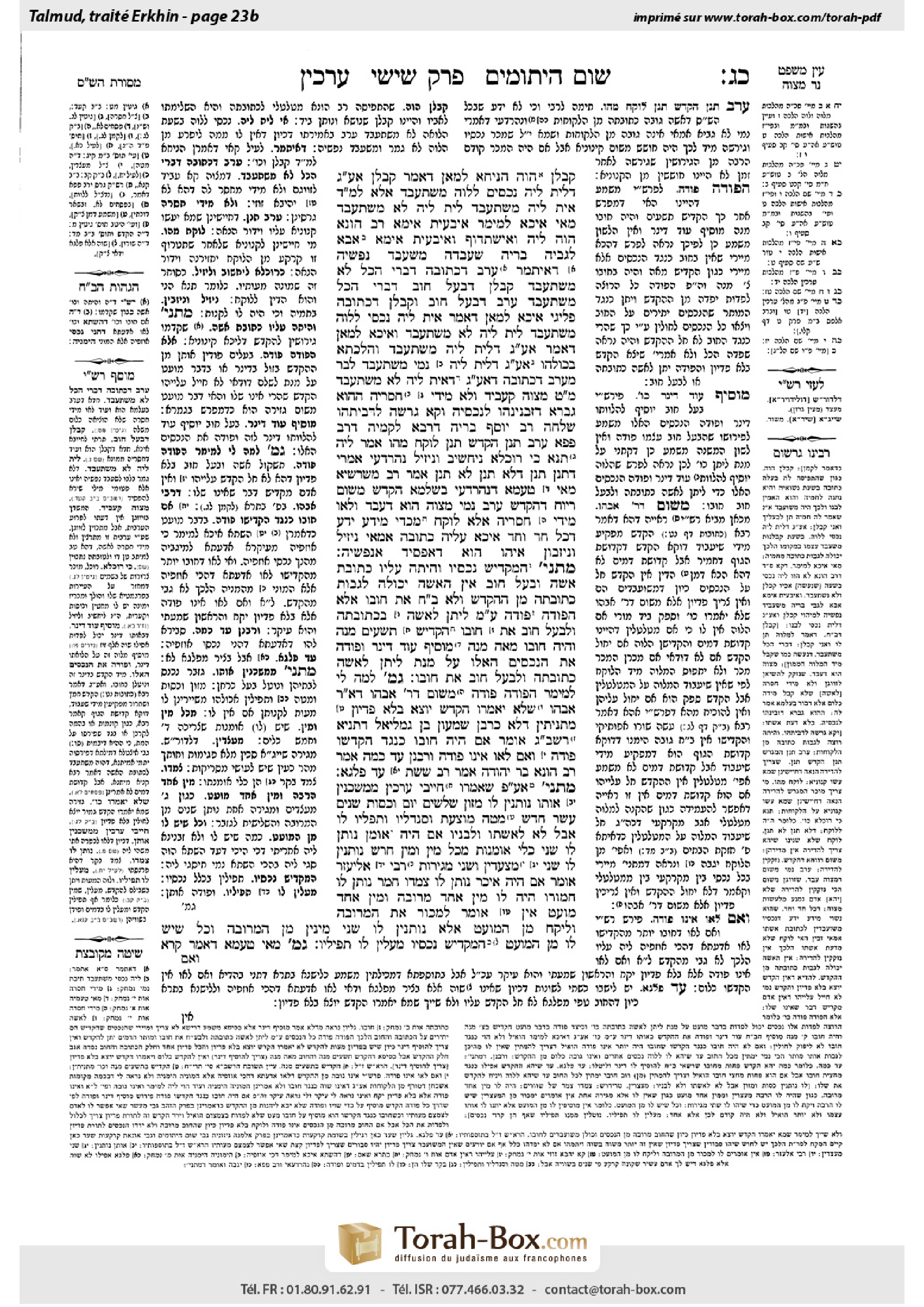
This page of Arakhin includes the Aramaic text, an English translation and an AI-generated French translation, alongside the scan above.
ערכין כ״ג ב · Aramaic and Hebrew text
קַבְּלָן הֲוָה. הָנִיחָא לְמַאן דְּאָמַר: קַבְּלָן, אַף עַל גַּב דְּלֵית לֵיהּ נְכָסִים לְלֹוֶה — מִשְׁתַּעְבַּד, אֶלָּא לְמַאן דְּאָמַר: אִית לֵיהּ — מִשְׁתַּעְבַּד, לֵית לֵיהּ — לָא מִשְׁתַּעְבַּד, מַאי אִיכָּא לְמֵימַר?
אִיבָּעֵית אֵימָא: רַב הוּנָא הֲוָה לֵיהּ וְאִישְׁתְּדוּף, וְאִיבָּעֵית אֵימָא: אַבָּא לְגַבֵּיהּ בְּרֵיהּ שַׁעְבּוֹדֵי מְשַׁעְבֵּד נַפְשֵׁיהּ.
דְּאִיתְּמַר: עָרֵב דִּכְתוּבָּה — דִּבְרֵי הַכֹּל לָא מִשְׁתַּעְבַּד, קַבְּלָן דְּבַעַל חוֹב — דִּבְרֵי הַכֹּל מִשְׁתַּעְבַּד, עָרֵב דְּבַעַל חוֹב וְקַבְּלָן דִּכְתוּבָּה — פְּלִיגִי. אִיכָּא לְמַאן דְּאָמַר: אִית לֵיהּ נִכְסֵי לְלֹוֶה — מִשְׁתַּעְבַּד, לֵית לֵיהּ — לָא מִשְׁתַּעְבַּד, וְאִיכָּא לְמַאן דְּאָמַר: אַף עַל גַּב דְּלֵית לֵיהּ — מִשְׁתַּעְבַּד.
וְהִלְכְתָא בְּכוּלְּהוּ, אַף עַל גַּב דְּלֵית לֵיהּ נָמֵי מִשְׁתַּעְבַּד, לְבַר מֵעָרֵב דִּכְתוּבָּה, דְּאַף עַל גַּב דְּאִית לֵיהּ לָא מִשְׁתַּעְבַּד. מַאי טַעְמָא? מִצְוָה קָעָבֵיד, וְלָא מִידֵּי חַסְּרֵיהּ.
הָהוּא גַּבְרָא דְּזַבְּנִינְהוּ לְנִכְסֵיהּ, וְקָא (גרשה) [מְגָרְשַׁהּ] לִדְבֵיתְהוּ. שַׁלְחַהּ רַב יוֹסֵף בְּרֵיהּ דְּרָבָא לְקַמֵּיהּ דְּרַב פָּפָּא: עָרֵב תְּנַן, הֶקְדֵּשׁ תְּנַן, לוֹקֵחַ מַהוּ? אֲמַר לֵיהּ: תַּנָּא כִּי רוֹכְלָא נִיחַשֵּׁיב וְנֵיזִיל?
נְהַרְדָּעֵי אָמְרִי: דִּתְנַן תְּנַן, דְּלָא תְּנַן לָא תְּנַן. אָמַר רַב מְשַׁרְשְׁיָא: מַאי טַעְמָא דִּנְהַרְדָּעֵי? בִּשְׁלָמָא הֶקְדֵּשׁ — מִשּׁוּם רֶיוַח דְּהֶקְדֵּשׁ, עָרֵב נָמֵי — מִצְוָה הוּא דַּעֲבַד, וְלָאו מִידֵּי חַסְּרֵיהּ.
אֶלָּא לוֹקֵחַ, מִכְּדֵי מִידָּע יָדַע דְּכֹל חַד וְחַד אִיכָּא עֲלֵיהּ כְּתוּבָּה, אַמַּאי נֵיזִיל וְנִיזְבּוֹן? אִיהוּ הוּא דְּאַפְסֵיד אַנַּפְשֵׁיהּ!
מַתְנִי׳ הַמַּקְדִּישׁ נְכָסָיו, וְהָיְתָה עָלָיו כְּתוּבַּת אִשָּׁה וּבַעַל חוֹב — אֵין הָאִשָּׁה יְכוֹלָה לִגְבּוֹת כְּתוּבָּתָהּ מִן הַהֶקְדֵּשׁ, וְלֹא בַּעַל חוֹב אֶת חוֹבוֹ, אֶלָּא הַפּוֹדֶה פּוֹדֶה עַל מְנָת לִיתֵּן לְאִשָּׁה בִּכְתוּבָּתָהּ וּלְבַעַל חוֹב אֶת חוֹבוֹ. הִקְדִּישׁ תִּשְׁעִים מָנֶה וְהָיָה חוֹבוֹ מֵאָה מָנֶה — מוֹסִיף עוֹד דִּינָר, וּפוֹדֶה אֶת הַנְּכָסִים הָאֵלּוּ עַל מְנָת לִיתֵּן לָאִשָּׁה כְּתוּבָּתָהּ וּלְבַעַל חוֹב אֶת חוֹבוֹ.
גְּמָ׳ לְמָה לִי לְמֵימַר ״הַפּוֹדֶה פּוֹדֶה״? מִשּׁוּם דְּרַבִּי אֲבָהוּ, דְּאָמַר רַבִּי אֲבָהוּ: שֶׁלֹּא יֹאמְרוּ הֶקְדֵּשׁ יוֹצֵא בְּלֹא פִּדְיוֹן.
מַתְנִיתִין דְּלָא כְּרַבָּן שִׁמְעוֹן בֶּן גַּמְלִיאֵל, דְּתַנְיָא: רַבָּן שִׁמְעוֹן בֶּן גַּמְלִיאֵל אוֹמֵר: אִם הָיָה חוֹבוֹ כְּנֶגֶד הֶקְדֵּשׁוֹ — פּוֹדֶה,
וְאִם לָאו — אֵינוֹ פּוֹדֶה. וְרַבָּנַן, עַד כַּמָּה? אָמַר רַב הוּנָא בַּר יְהוּדָה אָמַר רַב שֵׁשֶׁת: עַד פַּלְגָא.
מַתְנִי׳ אַף עַל פִּי שֶׁאָמְרוּ חַיָּיבֵי עֲרָכִין מְמַשְׁכְּנִין (אוֹתוֹ) [אוֹתָן], נוֹתְנִין לוֹ מְזוֹן שְׁלֹשִׁים יוֹם, וּכְסוּת שְׁנֵים עָשָׂר חֹדֶשׁ, מִטָּה מוּצַּעַת, וְסַנְדָּלָיו, וּתְפִלָּיו — לוֹ, אֲבָל לֹא לְאִשְׁתּוֹ וּלְבָנָיו.
אִם הָיָה אוּמָּן — נוֹתֵן לוֹ שְׁנֵי כְּלֵי אוּמָּנוּת מִכׇּל מִין וּמִין, חָרָשׁ — נוֹתְנִין לוֹ שְׁנֵי מַעֲצָדִין וּשְׁנֵי מְגֵירוֹת. רַבִּי אֱלִיעֶזֶר אוֹמֵר: אִם הָיָה אִיכָּר — נוֹתֵן לוֹ צִמְדּוֹ, חַמָּר — נוֹתֵן לוֹ חֲמוֹרוֹ.
הָיָה לוֹ מִין אֶחָד מְרוּבֶּה וּמִין אֶחָד מוּעָט — אֵין אוֹמֵר לִמְכּוֹר אֶת הַמְרוּבֶּה וְלִיקַּח מִן הַמּוּעָט, אֶלָּא נוֹתְנִין לוֹ שְׁנֵי מִינִין מִן הַמְרוּבֶּה וְכֹל שֶׁיֵּשׁ לוֹ מִן הַמּוּעָט. הַמַּקְדִּישׁ נְכָסָיו — מַעֲלִין לוֹ תְּפִילָּיו.
גְּמָ׳ מַאי טַעְמָא? דְּאָמַר קְרָא:
Arakhin 23b · English translation
The Gemara responds: Moshe bar Atzrei was a guarantor who accepted unconditional responsibility [kablan] for the payment of the marriage contract. The Gemara objects: This works out well according to the one who says that with regard to a kablan, even though the debtor has no property at the time of the loan, nevertheless the kablan is responsible for payment. But according to the one who says that if the debtor has property then the kablan is responsible, but if he does not have property then the kablan does not agree to become responsible for the payment, what can be said? Since Rav Huna owned no property, how could payment of the marriage contract be collected from Moshe bar Atzrei?
The Gemara responds: If you wish, say that Rav Huna had property at the time that his father accepted upon himself to be a guarantor, and it became blighted. And if you wish, say instead that a father, with regard to his son, accepts responsibility upon himself even if his son owns no property.
The Gemara cites the aforementioned dispute in detail. As it was stated: Everyone agrees that an ordinary guarantor of a marriage contract does not resolve to become responsible for paying the marriage contract. Everyone also agrees that a kablan for a creditor is responsible for paying the debtor’s debt. By contrast, with regard to an ordinary guarantor of a debt owed to a creditor and a kablan for the payment of a marriage contract, the Sages disagree. There is one Sage who says: If the debtor or the husband has property then the guarantor becomes responsible, but if he does not have property then he does not become responsible. And there is another Sage who says: Even though the debtor or the husband does not have property, the guarantor becomes responsible for payment of the obligation.
And the halakha in all of these cases is: Even though the principal does not have property of his own, the guarantor still becomes responsible for paying the obligation, except for the case of an ordinary guarantor of a marriage contract, with regard to which, even though the husband has property of his own when he draws up the marriage contract, the guarantor does not resolve to become responsible. What is the reason? He performs a mitzva, i.e., he agrees to be a guarantor only so that the woman will consent to the marriage but he does not actually resolve to become responsible. And furthermore, the woman did not lose anything in exchange for which the guarantor would have accepted responsibility, as the husband did not borrow money from her.
§ The Gemara relates that there was a certain man who sold his property and later when he divorced his wife he had no property with which to pay the marriage contract. The wife therefore sought to collect payment from the buyers. Rav Yosef, son of Rava, sent the case before Rav Pappa: When a wife’s marriage contract is paid by a guarantor, we learned in the mishna that the husband vows that benefit from her is forbidden to him. Similarly, when she collects her marriage contract from consecrated property, we learned in the mishna that the husband takes such a vow. What is the halakha when she collects payment from a buyer? Rav Pappa said to him: Should the tanna have continued reckoning cases like a peddler, who announces all his wares? Obviously, the halakha is the same in the case of a buyer, as the identical reasoning applies despite the fact that the tanna neglected to mention this case.
The Sages of Neharde’a say: That which we learned in the mishna we learned, and that which we did not learn in the mishna we did not learn, i.e., the husband does not need to make the vow when the payment of the marriage contract is collected from buyers. Rav Mesharshiyya said: What is the reasoning of the Sages of Neharde’a? Granted, when the payment of the marriage contract is collected from consecrated property the husband must make the vow due to the importance of maintaining the profit of the Temple treasury. In the case of a guarantor as well, the husband must make the vow, as the guarantor performed a mitzva and the woman did not lose anything, i.e., the guarantor received nothing from the wife, and he nevertheless accepted responsibility for the payment of the marriage contract. The husband therefore vows in order that others should not be discouraged from performing this mitzva.
But in the case of a buyer, since he knows that each and every married man has upon him the potential obligation to pay a marriage contract, why should he go and purchase a field from the husband when there is a lien on it due to the marriage contract? Since it is he who caused himself to lose out, it is unreasonable to prevent the husband from remarrying his wife merely for the benefit of the buyer.
MISHNA: In the case of one who consecrates his property and there was an outstanding debt of the marriage contract of his wife and of a creditor, the woman may not collect the payment of her marriage contract from the Temple treasury, nor may the creditor collect his debt. Rather, the one who redeems the property redeems it for a cheap price in order to give the woman her marriage contract payment and the creditor his debt. For example, if one consecrated property worth nine thousand dinars and his debt was ten thousand dinars, leaving no property for redemption, the creditor lends an additional dinar to the debtor and the debtor redeems the property with that dinar, in order to give the woman her marriage contract payment and the creditor his debt.
GEMARA: The Gemara asks: Why do I need the mishna to state that the one who redeems, redeems, i.e., why isn’t the property given directly to the creditor without redemption? The Gemara answers: This is due to the explanation of Rabbi Abbahu, as Rabbi Abbahu says: The property is redeemed so that people will not say that consecrated property exits to non-sacred status without redemption.
The mishna teaches that if one consecrated property worth nine thousand dinars and his debt was ten thousand dinars, the creditor lends an additional dinar to the debtor for him to redeem the property. The Gemara notes: The mishna is not in accordance with the opinion of Rabban Shimon ben Gamliel, as it is taught in a baraita that Rabban Shimon ben Gamliel says: If his debt corresponded to the value of his consecrated property, then the debtor redeems the property in the manner prescribed in the mishna.
But if the value of the consecrated property is not enough to cover the debt, he does not redeem the property in this manner. Instead, it must be redeemed in accordance with its value. The Gemara asks: And according to the Rabbis, up to what amount may the property be redeemed in the manner described in the mishna? Rav Huna bar Yehuda says that Rav Sheshet says: The consecrated property must be worth at least half of the debt. If the property is worth less, it may be redeemed only in accordance with its monetary value.
MISHNA: Although the Sages said (21a): With regard to those obligated to pay valuations, the court repossesses their property to pay their debt to the Temple treasury; nevertheless, the treasurer gives him permission to keep food sufficient for thirty days, and garments sufficient for twelve months, and a bed made with linens, and his sandals, and his phylacteries. The treasurer leaves these items for him, but he does not leave items for his wife or for his children.
If the one obligated to pay was a craftsman, the treasurer gives him permission to keep two tools of his craft of each and every type, e.g., for a carpenter, the treasurer gives him permission to keep two adzes [matzadin] and two saws. Rabbi Eliezer says: If he was a farmer, the treasurer gives him permission to keep his pair of oxen with which he plows the field. If he was a donkey driver, the treasurer gives him permission to keep his donkey.
If one had many tools of one type and few tools of one other type, e.g., three adzes and one saw, he may not say to the treasurer to sell one tool of the type of which he has many and to purchase for him one tool of the type of which he has few. Rather, the treasurer gives him two tools of the type of which he has many and he retains whatever he has of the type of which he has few. In contrast to one whose property is repossessed to pay valuations, from one who consecrates all his property, the treasurer takes his phylacteries, as they are included in the category of all his property.
GEMARA: The Gemara asks: What is the reason that the treasurer leaves him with all of the tools mentioned in the mishna? The Gemara explains that the reason is that the verse states:
Arakhin 23b · Traduction française (IA)
La Guemara répond : Moshe bar Atzéri était un garant qui a accepté une responsabilité inconditionnelle [kablan] pour le paiement du contrat de mariage. La Guemara s'oppose à cela : cela fonctionne bien selon celui qui dit que, concernant un kablan, même si le débiteur n'a pas de propriété au moment du prêt, le kablan reste responsable du paiement. Mais selon celui qui dit que si le débiteur a de la propriété, le kablan est responsable, mais si ce n'est pas le cas, le kablan ne s'engage pas à devenir responsable du paiement, que peut-on dire ? Puisque Rav Huna n'avait pas de propriété, comment pouvait-on récupérer le paiement du contrat de mariage auprès de Moshe bar Atzéri ?
La Guemara répond : Si vous le souhaitez, dites que Rav Huna avait de la propriété au moment où son père s'était engagé à être garant, et qu'elle avait été ravagée. Et si vous le souhaitez, dites plutôt que le père, concernant son fils, s'engage à être responsable même si son fils n'a pas de propriété.
La Guemara cite en détail le débat mentionné précédemment. Comme il a été dit : tout le monde convient qu'un garant ordinaire d'un contrat de mariage ne s'engage pas à devenir responsable du paiement du contrat de mariage. Tout le monde convient également qu'un kablan pour un créancier est responsable du paiement de la dette du débiteur. En revanche, concernant un garant ordinaire d'une dette due à un créancier et un kablan pour le paiement d'un contrat de mariage, les Sages s'entendent à l'unanimité. Il y a un Sage qui dit : si le débiteur ou le mari a de la propriété, le garant devient responsable, mais s'il n'en a pas, il ne devient pas responsable. Il y a un autre Sage qui dit : même si le débiteur ou le mari n'a pas de propriété, le garant devient responsable du paiement de l'obligation.
Et la halakha dans tous ces cas est : même si le principal n'a pas de propriété personnelle, le garant devient responsable du paiement de l'obligation, sauf dans le cas d'un garant ordinaire d'un contrat de mariage, concernant lequel, même si le mari a de la propriété personnelle lorsqu'il rédige le contrat de mariage, le garant ne s'engage pas à devenir responsable. Quelle est la raison ? Il accomplit une mitsva, c'est-à-dire qu'il s'engage à être garant uniquement afin que la femme accepte le mariage, mais il ne s'engage pas réellement à devenir responsable. De plus, la femme n'a pas perdu quelque chose en échange de quoi le garant aurait accepté la responsabilité, car le mari n'avait pas emprunté de l'argent à elle.
§ La Guemara rapporte qu'il y avait un certain homme qui avait vendu sa propriété et plus tard, lorsqu'il divorça, il n'avait plus de propriété avec laquelle payer le contrat de mariage. La femme voulait donc récupérer le paiement auprès des acheteurs. Rav Yosef, fils de Rava, envoya le cas devant Rav Pappa : lorsque la femme récupère le contrat de mariage grâce à un garant, nous avons appris dans la mitsva que le mari jure que le bénéfice de sa femme lui est interdit. De même, lorsque elle récupère le contrat de mariage à partir de la propriété consacrée, nous avons appris dans la mitsva que le mari prend un tel vœu. Quelle est la halakha lorsque elle récupère le paiement auprès d'un acheteur ? Rav Pappa dit à lui : devrait-on que le tanna ait continué à énumérer des cas comme un marchand, qui annonce tous ses marchandises ? Évidemment, la halakha est la même dans le cas d'un acheteur, car la même raisonnement s'applique, malgré le fait que le tanna n'ait pas mentionné ce cas.
Les Sages de Neharde’a disent : ce que nous avons appris dans la mitsna, nous l'avons appris, et ce que nous n'avons pas appris dans la mitsna, nous ne l'avons pas appris, c'est-à-dire que le mari n'a pas besoin de prendre le vœu lorsque le paiement du contrat de mariage est récupéré auprès des acheteurs. Rav Mesharshiyya dit : quelle est la raison des Sages de Neharde’a ? En effet, lorsque le paiement du contrat de mariage est récupéré auprès de la propriété consacrée, le mari doit prendre le vœu en raison de l'importance de préserver les bénéfices du trésor du Temple. Dans le cas d'un garant également, le mari doit prendre le vœu, car le garant a accompli une mitsva et la femme n'a pas perdu quelque chose, c'est-à-dire que le garant n'a rien reçu de la femme, et pourtant il a accepté la responsabilité du paiement du contrat de mariage. Le mari prend donc le vœu afin que les autres ne soient pas découragés d'accomplir cette mitsva.
Mais dans le cas d'un acheteur, puisque il sait que chaque homme marié a potentiellement l'obligation de payer un contrat de mariage, pourquoi devrait-il aller acheter un champ auprès du mari lorsqu'il y a un droit de préférence en raison du contrat de mariage ? Puisque c'est lui qui a causé sa perte, il est injuste de prévenir le mari de remettre sa femme en mariage uniquement au bénéfice de l'acheteur.
MICHNA: Dans le cas d'une personne qui consacre sa propriété et qu'il y a une dette non réglée du contrat de mariage de sa femme et d'un créancier, la femme ne peut pas récupérer le paiement de son contrat de mariage auprès du trésor du Temple, ni le créancier ne peut récupérer sa dette. Au contraire, celui qui rachète la propriété rachète la propriété à un prix bas afin de donner à la femme le paiement de son contrat de mariage et au créancier sa dette. Par exemple, si une personne a consacré une propriété valant neuf mille dinars et que sa dette était de dix mille dinars, laissant aucune propriété pour le rachat, le créancier prête un dinar supplémentaire au débiteur et le débiteur rachète la propriété avec ce dinar, afin de donner à la femme le paiement de son contrat de mariage et au créancier sa dette.
GUEMARA: La Guemara pose la question : pourquoi la mitsva mentionne-t-elle que celui qui rachète, rachète, c'est-à-dire pourquoi n'est-ce pas la propriété donnée directement au créancier sans rachat ? La Guemara répond : cela est dû à l'explication de Rabbi Abbahu, car Rabbi Abbahu dit : la propriété est rachetée afin que les gens ne disent pas que la propriété consacrée passe à un statut non sacré sans rachat.
La Michna enseigne que si l'on a consacré une propriété valant neuf mille dinars et que sa dette est de dix mille dinars, le créancier prête un dinar supplémentaire au débiteur afin qu'il puisse racheter la propriété. La Guemara note : La Michna ne correspond pas à l'opinion de Rabban Shimon ben Gamliel, car il est enseigné dans une baraïta que Rabban Shimon ben Gamliel dit : Si sa dette correspond à la valeur de sa propriété consacrée, le débiteur rachète la propriété selon la méthode prescrite dans la Michna.
Mais si la valeur de la propriété consacrée n'est pas suffisante pour couvrir la dette, il ne rachète pas la propriété selon cette méthode. Au contraire, il doit être racheté selon sa valeur. La Guemara pose la question : Selon les Rabbins, jusqu'à quel montant la propriété peut-elle être rachetée selon la méthode décrite dans la Michna ? Rav Huna bar Yehuda dit que Rav Sheshet dit : La propriété consacrée doit avoir une valeur d'au moins la moitié de la dette. Si la propriété est de valeur inférieure, elle peut être rachetée uniquement selon sa valeur monétaire.
MICHNA : Bien que les Sages aient dit (21a) : Concernant ceux qui doivent payer des évaluations, la cour confisque leur propriété pour payer leur dette au trésor du Temple ; néanmoins, le trésorier lui permet de garder de la nourriture suffisante pour trente jours, des vêtements suffisants pour douze mois, un lit fait de lin, ses sandales, ainsi que ses phylactères. Le trésorier laisse ces objets à son disposition, mais il ne laisse pas d'objets à sa femme ni à ses enfants.
Si celui qui devait payer était un artisan, le trésorier lui permet de garder deux outils de chaque type de son métier, par exemple, pour un charpentier, le trésorier lui permet de garder deux marteaux [matzadin] et deux scies. Rabbi Eliezer dit : Si c'était un agriculteur, le trésorier lui permet de garder sa paire de bœufs avec lesquels il laboure le champ. Si c'était un conducteur de chameau, le trésorier lui permet de garder son chameau.
Si l'on possédait beaucoup d'outils d'un type et peu d'outils d'un autre type, par exemple, trois marteaux et une scie, il ne peut pas demander au trésorier de vendre un outil du type dont il possède beaucoup et d'acheter pour lui un outil du type dont il possède peu. Plutôt, le trésorier lui donne deux outils du type dont il possède beaucoup et il conserve ce qu'il a du type dont il possède peu. Contrairement à celui dont la propriété est confisquée pour payer des évaluations, celui qui consacre toute sa propriété, le trésorier prend ses phylactères, car ils sont inclus dans la catégorie de toute sa propriété.
GUEMARA : La Guemara pose la question : Quelle est la raison pour laquelle le trésorier laisse à l'individu tous les outils mentionnés dans la Michna ? La Guemara explique que la raison est que le verset dit :
Traduction française générée par IA à partir de l’édition anglaise de Sefaria. Vérifie toujours un passage avec le texte source.
Text from Sefaria: William Davidson Edition - Vocalized Aramaic (CC BY NC); William Davidson Edition - English (CC BY NC).