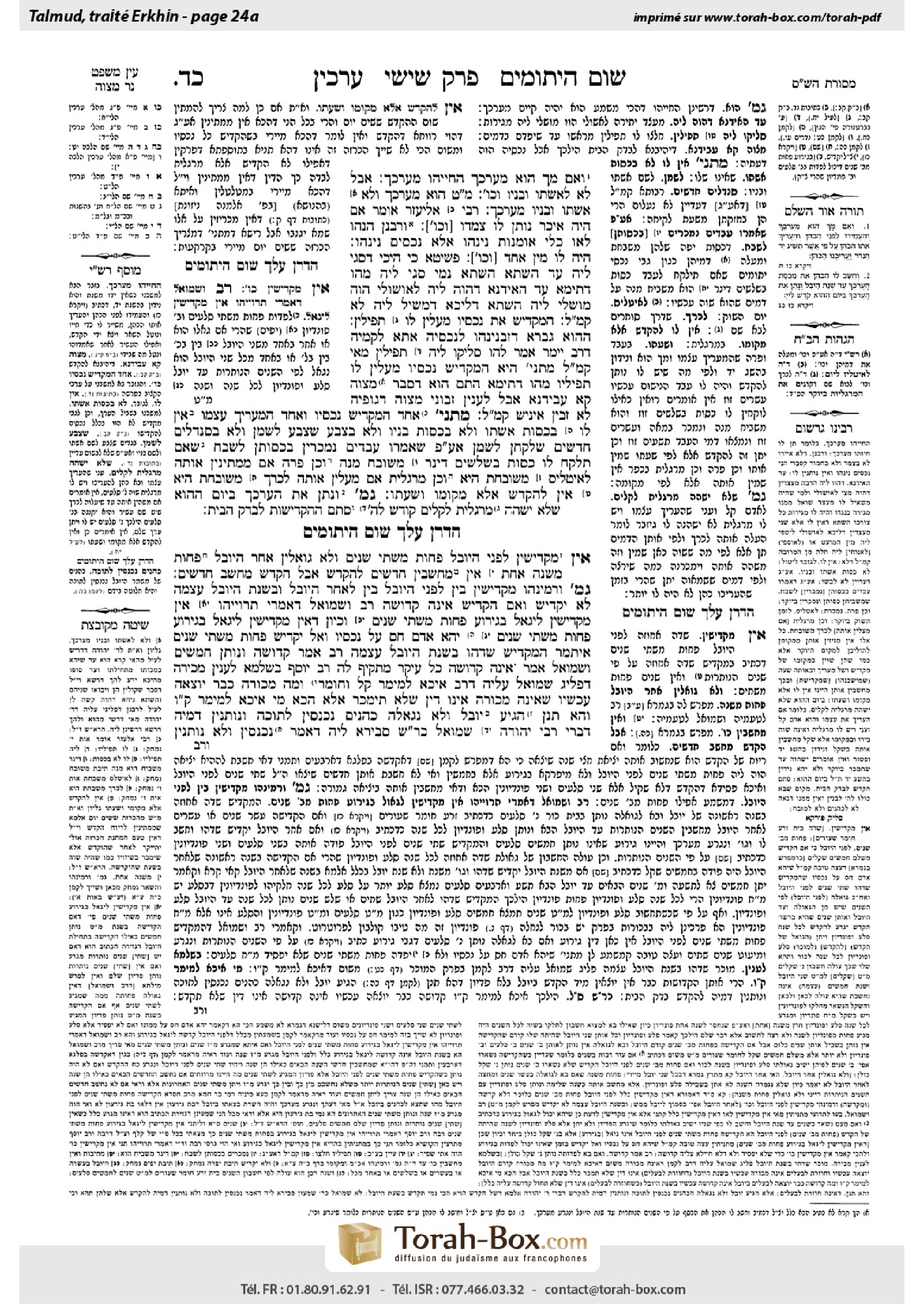
Arakhin 24a: Talmud study for Daf Yomi
Study the Talmud for Daf Yomi with scanned pages, Hebrew text, English translations from Sefaria and AI-generated French translations.
Passage selection and English or AI-generated French translation are available where the scan has annotations. Daf Study is independent of Torah-Box and Sefaria.
Browse Arakhin · ערכין · All tractatesArakhin 24a text and translations
This page of Arakhin includes the Aramaic text, an English translation and an AI-generated French translation, alongside the scan above.
ערכין כ״ד א · Aramaic and Hebrew text
״וְאִם מָךְ הוּא מֵעֶרְכֶּךָ״ — הַחֲיֵיהוּ מֵעֶרְכֶּךָ.
אֲבָל לֹא לְאִשְׁתּוֹ וּבָנָיו וְכוּ׳. מַאי טַעְמָא? ״הוּא מֵעֶרְכֶּךָ״, וְלֹא אִשְׁתּוֹ וּבָנָיו מֵעֶרְכֶּךָ.
רַבִּי אֱלִיעֶזֶר אוֹמֵר: אִם הָיָה אִיכָּר, נוֹתֵן לוֹ צִמְדּוֹ. וְרַבָּנַן? הָנְהוּ לָאו כְּלֵי אוּמָּנוּת נִינְהוּ, אֶלָּא נְכָסִים נִינְהוּ.
הָיָה לוֹ מִין אֶחָד. פְּשִׁיטָא! כִּי הֵיכִי דְּסַגִּי לֵיהּ עַד הַשְׁתָּא, הַשְׁתָּא נָמֵי סַגִּי לֵיהּ.
מַהוּ דְּתֵימָא: עַד הָאִידָּנָא דַּהֲוָה לֵיהּ לְאוֹשׁוֹלֵי הֲוָה מוֹשְׁלִי לֵיהּ, הַשְׁתָּא דְּלֵיכָּא דְּמֹשֵׁיל לֵיהּ — לָא, קָא מַשְׁמַע לַן.
הַמַּקְדִּישׁ אֶת נְכָסָיו מַעֲלִין לוֹ תְּפִילִּין. הָהוּא גַּבְרָא דְּזַבְּנִינְהוּ לְנִכְסֵיהּ, אֲתָא לְקַמֵּיהּ דְּרַב יֵימַר, אֲמַר לְהוּ: סַלִּיקוּ לֵיהּ תְּפִילִּין. מַאי קָא מַשְׁמַע לַן? מַתְנִיתִין הִיא! ״הַמַּקְדִּישׁ נְכָסָיו מַעֲלִין לוֹ תְּפִילָּיו״.
מַהוּ דְּתֵימָא, הָתָם הוּא דְּסָבַר מִצְוָה קָא עָבֵידְנָא, אֲבָל לְעִנְיַן זַבּוֹנֵי — מִצְוָה דְּגוּפֵיהּ לָא (זבין) [מְזַבֵּין] אִינִישׁ, קָא מַשְׁמַע לַן.
מַתְנִי׳ אֶחָד הַמַּקְדִּישׁ נְכָסָיו, וְאֶחָד הַמַּעֲרִיךְ עַצְמוֹ, אֵין לוֹ בִּכְסוּת אִשְׁתּוֹ, וְלֹא בִּכְסוּת בָּנָיו, וְלֹא בְּצֶבַע שֶׁצָּבַע לִשְׁמָן, וְלֹא בְּסַנְדָּלִים חֲדָשִׁים שֶׁלְּקָחָן לִשְׁמָן.
אַף עַל פִּי שֶׁאָמְרוּ: עֲבָדִים נִמְכָּרִין בִּכְסוּתָן לְשֶׁבַח, שֶׁאִם תִּלָּקַח לוֹ כְּסוּת בִּשְׁלֹשִׁים דִּינָר מְשׁוּבָּח מָנֶה, וְכֵן פָּרָה אִם מַמְתִּינִין אוֹתָהּ לָאִיטְלֵיס מְשׁוּבַּחַת הִיא, וְכֵן מַרְגָּלִית אִם מַעֲלִין אוֹתָהּ לַכְּרַךְ מְשׁוּבַּחַת הִיא — אֵין לַהֶקְדֵּשׁ אֶלָּא מְקוֹמוֹ וּשְׁעָתוֹ.
גְּמָ׳ תָּנוּ רַבָּנַן: ״וְנָתַן אֶת הָעֶרְכְּךָ בַּיּוֹם הַהוּא״ — שֶׁלֹּא יְשַׁהֶה מַרְגָּלִית לְקַלִּים, ״קֹדֶשׁ לַה׳״ — סְתָם הַהֶקְדֵּישׁוֹת לְבֶדֶק הַבַּיִת.
הֲדַרַן עֲלָךְ שׁוּם הַיְּתוֹמִים.
מַתְנִי׳ אֵין מַקְדִּישִׁין לִפְנֵי הַיּוֹבֵל פָּחוֹת מִשְׁתֵּי שָׁנִים, וְלֹא גּוֹאֲלִין אַחַר הַיּוֹבֵל פָּחוֹת מִשָּׁנָה אַחַת. אֵין מְחַשְּׁבִין חֳדָשִׁים לַהֶקְדֵּשׁ, אֲבָל הֶקְדֵּשׁ מְחַשֵּׁב חֳדָשִׁים.
גְּמָ׳ וּרְמִינְהוּ: מַקְדִּישִׁין בֵּין לִפְנֵי הַיּוֹבֵל בֵּין לְאַחַר הַיּוֹבֵל, וּבִשְׁנַת הַיּוֹבֵל עַצְמָהּ לֹא יַקְדִּישׁ, וְאִם הִקְדִּישׁ אֵינָהּ קְדוֹשָׁה!
רַב וּשְׁמוּאֵל דְּאָמְרִי תַּרְוַיְיהוּ: אֵין מַקְדִּישִׁין לִיגָּאֵל בְּגֵירוּעַ פָּחוֹת מִשְׁתֵּי שָׁנִים, וְכֵיוָן דְּאֵין מַקְדִּישִׁין לִיגָּאֵל בְּגֵירוּעַ פָּחוֹת מִשְׁתֵּי שָׁנִים — יְהֵא אָדָם חָס עַל נְכָסָיו וְאַל יַקְדִּישׁ פָּחוֹת מִשְׁתֵּי שָׁנִים.
אִיתְּמַר: הַמַּקְדִּישׁ שָׂדֵהוּ בִּשְׁנַת הַיּוֹבֵל עַצְמָהּ, רַב אָמַר: קְדוֹשָׁה, וְנוֹתֵן חֲמִשִּׁים, וּשְׁמוּאֵל אָמַר: אֵינָהּ קְדוֹשָׁה כׇּל עִיקָּר.
מַתְקֵיף לַהּ רַב יוֹסֵף: בִּשְׁלָמָא לְעִנְיַן מְכִירָה, דִּפְלִיג שְׁמוּאֵל עֲלֵיהּ דְּרַב, אִיכָּא לְמֵימַר קַל וָחוֹמֶר — וּמָה מְכוּרָה כְּבָר יוֹצְאָה עַכְשָׁיו, שֶׁאֵינָהּ מְכוּרָה אֵינוֹ דִּין שֶׁלֹּא תִּימָּכֵר?
אֶלָּא הָכָא, מִי אִיכָּא לְמֵימַר קַל וָחוֹמֶר? וְהָא תְּנַן: הִגִּיעַ יוֹבֵל וְלֹא נִגְאֲלָה — כֹּהֲנִים נִכְנָסִין לְתוֹכָהּ וְנוֹתְנִין דָּמֶיהָ, דִּבְרֵי רַבִּי יְהוּדָה.
שְׁמוּאֵל כְּרַבִּי שִׁמְעוֹן סְבִירָא לֵיהּ, דְּאָמַר: ״נִכְנָסִין וְלֹא נוֹתְנִין״.
Arakhin 24a · English translation
“But if he be too poor for your valuation” (Leviticus 27:8). The word “he” [hu] is interpreted as a variation of havaya, existence or sustenance. In this manner the verse can be read as an instruction to the treasurer: Sustain him from that which he is obligated to pay for your valuation.
The mishna teaches that food and garments are left for him, but not for his wife or his children. The Gemara asks: What is the reason? The verse states: “If he be too poor for your valuation,” which indicates that he must be sustained from your valuation, but his wife and his children are not sustained from your valuation.
The mishna teaches: Rabbi Eliezer says that if he was a farmer, the treasurer gives him his pair of oxen; if he was a donkey driver, the treasurer gives him his donkey. The Gemara asks: And the Rabbis, why do they rule that these animals are repossessed? The Gemara responds: According to the Rabbis, these animals are not tools of his craft; rather, they are his property.
The mishna teaches that if one had many tools of one type that he was allowed to keep and few tools of one other type, e.g., three adzes and one saw, the treasurer does not sell tools of the type of which there are many in order to purchase for him tools of the type of which he has few. The Gemara asks: Isn’t it obvious? Just as it was sufficient for him until now to work with one saw, now too a single saw should be sufficient for him.
The Gemara explains that the ruling is necessary lest you say that until now, when he was capable of lending one of his many adzes, if he required an additional saw someone would lend one to him, whereas now that his property has been repossessed there is no one who will lend such a tool to him, when he has nothing to offer in exchange. Consequently, the treasurer should not leave him with only one saw, but he should sell some of his adzes in order to purchase an additional saw. Therefore, the mishna teaches us that there is no concern that he might not be able to borrow a tool.
§ The mishna teaches: With regard to one who consecrates all his property, the treasurer takes his phylacteries. The Gemara relates that there was a certain man who sold his property. He came before Rav Yeimar, who said to the members of the court: Remove his phylacteries from his head and his arm and give them to the buyer, as they are included in his property. The Gemara asks: What is this incident teaching us? It is an explicit ruling of the mishna: With regard to one who consecrates all his property, the treasurer takes his phylacteries.
The Gemara explains: It is necessary, lest you say that it is only there, when one consecrates his property, that the halakha is that his phylacteries are taken, as he thinks to himself: I am performing a mitzva, and therefore he intended for his phylacteries to be included. But with regard to a sale, a person would not sell an item used for a mitzva that he performs with his body without explicitly stating so. The Gemara therefore teaches us by means of the above incident that phylacteries are included in the property of such a sale.
MISHNA: Both in the case of one who consecrates his property and the case of one who valuates himself, when the Temple treasurer repossesses his property he has the right to repossess neither the garment of his wife nor the garment of his children, nor the dyed garments that he dyed for their sake, even if they have yet to wear them, nor the new sandals that he purchased for their sake.
Although the merchants said: Slaves are sold in their garments for profit, as if a fine garment worth thirty dinars would be purchased for him, his sale price appreciates by one hundred dinars; and likewise with regard to a cow, if one waits to sell it until the market [la’itlis] day, when demand is high, its sale price appreciates; and likewise with regard to a pearl, if one brings it to sell it in the city, where demand is high, its sale price appreciates; nevertheless, one does not make such a calculation in this case. Rather, the Temple treasury has the right to collect the item based only on its current location and its price at the present time.
GEMARA: With regard to the statement of the mishna that the Temple treasury has the right to collect the item based only on its current location and its present time, the Sages taught in a baraita: The verse states, with regard to the redemption of a consecrated item: “And he shall give your valuation as of that day” (Leviticus 27:23). The phrase “as of that day” indicates that he should not delay the sale of a pearl for the light ones, i.e., for poor people, in order that they should take it to the city to sell it. Rather, it is appraised according to its present location. The verse continues: “As a holy thing unto the Lord,” which teaches that unspecified vows of consecration, e.g., when one states: My property is consecrated, are given for Temple maintenance, rather than to the priests.
MISHNA: One may neither consecrate an ancestral field, i.e., a field that he inherited, less than two years before the Jubilee Year, nor may one redeem such a field less than one year after the Jubilee Year. When redeeming an ancestral field that has been consecrated, the sum paid to redeem the field is calculated based on the number of years remaining until the Jubilee Year. When performing this calculation, one does not count months of a partial year in order to lower the price to be paid to the Temple treasury; rather, he pays for the entire year. But the Temple treasury may count months in order to raise the price of redemption, as will be explained.
GEMARA: The mishna teaches that one may not consecrate an ancestral field less than two years before the Jubilee Year. And with regard to this, the Gemara raises a contradiction from the following baraita: One may consecrate an ancestral field both before the Jubilee Year and after the Jubilee Year. But during the Jubilee Year itself, one may not consecrate it, and if he nevertheless did consecrate it, it is not consecrated. Although consecration of an ancestral field is ineffective during the Jubilee Year, it is clear that such a field may be consecrated at any time prior to the start of the year.
In response, Rav and Shmuel both say: The mishna means that one may not consecrate an ancestral field for it to be redeemed with a deduction, i.e., such that the redemption price will be reduced to reflect the number of years remaining until the Jubilee Year, less than two years before the Jubilee Year. If such a field is consecrated less than two years before the Jubilee, it is redeemed according to its full valuation, as though it had been consecrated and redeemed immediately after the Jubilee. And since one may not consecrate an ancestral field for it to be redeemed with a deduction less than two years before the Jubilee, the mishna teaches that a person should be concerned about his property, and should therefore not consecrate an ancestral field less than two years before the Jubilee.
§ It was stated: With regard to one who consecrates his field during the Jubilee Year itself, Rav says: It is consecrated, and if he wishes to redeem it he gives the full valuation of fifty sela, i.e., fifty silver biblical shekels, per unit of area required for sowing one kor of seed [beit kor], and Shmuel says: It is not consecrated at all, and therefore it is not redeemed for any sum.
Rav Yosef objects to this: Granted, with regard to the sale of an ancestral field during the Jubilee Year, it is logical that Shmuel disagrees with Rav and maintains that such a sale is invalid, as one can say the following a fortiori inference: And if a field that was already sold before the Jubilee Year leaves the possession of the buyer and returns to the original owner now in the Jubilee Year, then with regard to a field that has not been sold, is it not logical to conclude that it cannot be sold during the Jubilee Year?
But here, with regard to the consecration of a field during the Jubilee Year, can one say such an a fortiori inference? But didn’t we learn in a mishna (25b): If one consecrated his ancestral field and the Jubilee Year arrived and it was not redeemed by the owner, the priests enter into the field and give its redemption payment to the Temple treasury; this is the statement of Rabbi Yehuda? Since a field that was consecrated before the Jubilee Year does not return to its original owner without redemption, one cannot infer that if one consecrates his field during the Jubilee Year itself, it returns to him without redemption.
The Gemara answers: Shmuel holds in accordance with the opinion of Rabbi Shimon, who says that the priests enter into the field, but they do not give its redemption value to the Temple treasury. According to this opinion, a field consecrated before the Jubilee Year leaves the possession of the Temple treasury without redemption during the Jubilee Year, and therefore by a fortiori inference, if it was consecrated during the Jubilee Year, it does not require redemption.
Arakhin 24a · Traduction française (IA)
«Mais s'il est trop pauvre pour votre estimation» (Lévitique 27,8). Le mot «il» [hu] est interprété comme une variation de havaya, existence ou subsistance. Ainsi, la parole peut être lue comme une instruction pour le trésorier : subsistez-le à partir de ce à quoi il est tenu de payer pour votre estimation.
La Michna enseigne que la nourriture et les vêtements sont laissés pour lui, mais pas pour sa femme ou ses enfants. La Guemara demande : quelle est la raison ? La parole dit : «s'il est trop pauvre pour votre estimation», ce qui indique qu'il doit être sustenté à partir de votre estimation, mais sa femme et ses enfants ne sont pas sustentés à partir de votre estimation.
La Michna enseigne : Rabbi Eléazar dit que si l'on était un agriculteur, le trésorier lui donne ses deux bœufs ; si l'on était un conducteur de chameau, le trésorier lui donne son chameau. La Guemara demande : Et les Sages, pourquoi décident-ils que ces animaux sont confisqués ? La Guemara répond : Selon les Sages, ces animaux ne sont pas des outils de son métier ; ils sont plutôt ses biens.
La Michna enseigne que si l'on possédait beaucoup d'outils d'un type et peu d'outils d'un autre type, par exemple trois rabots et une scie, le trésorier ne vend pas des outils du type dont on possède beaucoup afin d'acheter pour lui des outils du type dont on en a peu. La Guemara demande : N'est-ce pas évident ? Comme il suffisait jusqu'à présent pour travailler avec une seule scie, une seule scie suffirait maintenant aussi.
La Guemara explique que cette décision est nécessaire afin de ne pas dire que jusqu'à présent, quand il pouvait prêter l'un de ses nombreux rabots, s'il avait besoin d'une autre scie, quelqu'un lui prêterait une scie ; mais maintenant que ses biens ont été confisqués, il n'y a plus personne qui lui prêterait un tel outil, quand il n'a rien à offrir en échange. Par conséquent, le trésorier ne devrait pas le laisser avec qu'une seule scie, mais il devrait vendre certains de ses rabots afin d'acheter une autre scie. Ainsi, la Michna nous enseigne que l'on n'a pas à craindre qu'il ne puisse pas emprunter un outil.
§ La Michna enseigne : Concernant celui qui consacre toute sa propriété, le trésorier prend ses phylactères. La Guemara rapporte qu'il y avait un certain homme qui vendait sa propriété. Il s'est présenté devant Rav Yéimar, qui a dit aux membres du tribunal : Retirez ses phylactères de sa tête et de son bras et donnez-les à l'acheteur, car ils font partie de sa propriété. La Guemara demande : Quel enseignement cet incident nous donne-t-il ? C'est une décision explicite de la Michna : Concernant celui qui consacre toute sa propriété, le trésorier prend ses phylactères.
La Guemara explique : Il est nécessaire, afin que l'on ne dise pas que c'est seulement lorsqu'on consacre sa propriété que la halakha est que ses phylactères sont pris, car il se dit lui-même : Je m'acquitte d'une mitsva, et donc il avait l'intention que ses phylactères soient inclus. Mais concernant une vente, une personne ne vendrait pas un objet utilisé pour une mitsva qu'il pratique avec son corps sans y faire explicitement mention. La Guemara enseigne donc par l'incident ci-dessus que les phylactères font partie de la propriété de telle vente.
MICHNA : Quand un homme consacre sa propriété ou qu'un homme évalue sa propre valeur, lorsqu'il est révoqué par le trésor du Temple, il n'a pas le droit de révoquer ni la robe de sa femme ni la robe de ses enfants, ni les robes teintes qu'il a teint à leur intention, même s'ils n'ont pas encore porté, ni les sandales neuves qu'il a acheté à leur intention.
Bien que les marchands aient dit : Les esclaves sont vendus avec leurs vêtements pour le profit, car si un vêtement fin et valant trente dinars est acheté pour lui, la valeur de la vente augmente d'une centaine de dinars ; de même concernant une vache, si l'on attend de vendre celle-ci jusqu'au jour de la demande [la’itlis], où la demande est forte, la valeur de la vente augmente ; de même concernant un perle, si l'on amène celle-ci pour la vendre en ville, où la demande est forte, la valeur de la vente augmente ; néanmoins, on ne fait pas ce calcul dans ce cas. Plutôt, le trésor du Temple a le droit de récupérer l'objet uniquement selon son emplacement actuel et sa valeur à l'heure actuelle.
GUEMARA : Concernant l'affirmation de la Michna que le trésor du Temple a le droit de récupérer l'objet uniquement selon son emplacement actuel et sa valeur à l'heure actuelle, les Sages ont enseigné dans une baraïta : La Parashah dit, concernant le rachat d'un objet consacré : « Et il donnera la valeur de ce jour » (Lévitique 27:23). La phrase « comme ce jour » indique qu'il ne faut pas retarder la vente d'une perle pour les pauvres, c'est-à-dire pour les personnes pauvres, afin qu'ils la portent en ville pour la vendre. Plutôt, elle est évaluée selon son emplacement actuel. La Parashah continue : « Comme un objet saint pour l'Éternel », ce qui enseigne que les vœux indéfinis de consécration, par exemple quand l'on dit : Ma propriété est consacrée, sont donnés à la maintenance du Temple, plutôt qu'aux prêtres.
MICHNA : On ne peut ni consacrer un champ ancestral, c'est-à-dire un champ hérité, moins de deux ans avant l'année du Jubilé, ni rédimer un tel champ moins d'un an après l'année du Jubilé. Lors de la rédemption d'un champ ancestral qui a été consacré, la somme payée pour rédimer le champ est calculée selon le nombre d'années restantes jusqu'au Jubilé. Lors de ce calcul, on ne compte pas les mois d'une année partielle afin de baisser le prix à payer au trésor du Temple ; plutôt, on paie pour l'année entière. Mais le trésor du Temple peut compter les mois afin d'augmenter le prix de la rédemption, comme cela sera expliqué.
GUEMARA : La Michna enseigne que l'on ne peut pas consacrer un champ ancestral moins de deux ans avant l'année de Jubilé. Et concernant cela, la Guemara soulève une contradiction tirée de la suivante baraïta : On peut consacrer un champ ancestral à la fois avant l'année de Jubilé et après l'année de Jubilé. Cependant, durant l'année de Jubilé elle-même, on ne peut pas le consacrer, et si l'on le consacre tout de même, il n'est pas consacré. Bien que la consécration d'un champ ancestral soit inefficace durant l'année de Jubilé, il est clair que ce champ peut être consacré à tout moment avant le début de l'année.
En réponse, Rav et Shmuel disent tous les deux : La Michna signifie que l'on ne peut pas consacrer un champ ancestral afin qu'il soit racheté avec une réduction, c'est-à-dire de sorte que le prix de rachat soit réduit en fonction du nombre d'années restantes jusqu'au Jubilé, moins de deux ans avant le Jubilé. Si un tel champ est consacré moins de deux ans avant le Jubilé, il est racheté selon sa valeur pleine, comme s'il avait été consacré et racheté immédiatement après le Jubilé. Et puisque l'on ne peut pas consacrer un champ ancestral afin qu'il soit racheté avec une réduction moins de deux ans avant le Jubilé, la Michna enseigne que la personne doit se soucier de ses biens et ne doit donc pas consacrer un champ ancestral moins de deux ans avant le Jubilé.
§ Il a été dit : Concernant celui qui consacre son champ durant l'année de Jubilé elle-même, Rav dit : Il est consacré, et si l'on souhaite le racheter, on paie la valeur pleine de cinquante sela, c'est-à-dire cinquante sicres d'argent biblique, par unité de surface nécessaire pour semer un kor de grain [beit kor], et Shmuel dit : Il n'est pas consacré du tout, et par conséquent, il n'est pas racheté pour quelque somme que ce soit.
Rav Yosef s'oppose à cela : C'est évident, concernant la vente d'un champ ancestral durant l'année de Jubilé, il est logique que Shmuel diverge avec Rav et maintienne que telle vente est nulle, car on peut établir l'inférence a fortiori suivante : Et si un champ déjà vendu avant l'année de Jubilé quitte la possession du vendeur et revient à l'original propriétaire maintenant durant l'année de Jubilé, alors concernant un champ qui n'a pas été vendu, n'est-il pas logique de conclure qu'il ne peut pas être vendu durant l'année de Jubilé ?
Mais ici, concernant la consécration d'un champ durant l'année de Jubilé, peut-on établir telle inférence a fortiori ? Mais n'avons-nous pas appris dans une Michna (25b) : Si l'on a consacré son champ ancestral et que l'année de Jubilé est arrivée et qu'il n'a pas été racheté par le propriétaire, les prêtres entrent dans le champ et versent le prix de rachat à la trésorerie du Temple ; c'est la déclaration de Rabbi Yéhouda ? Puisque un champ consacré avant l'année de Jubilé ne revient pas à son propriétaire original sans rachat, on ne peut pas inférer que si l'on consacre son champ durant l'année de Jubilé elle-même, il revient à lui sans rachat.
La Guemara répond : Shmuel adopte l'opinion de Rabbi Shimon, qui dit que les prêtres entrent dans le champ, mais qu'ils ne versent pas sa valeur de rachat à la trésorerie du Temple. Selon cette opinion, un champ consacré avant l'année de Jubilé quitte la possession de la trésorerie du Temple sans rachat durant l'année de Jubilé, et par conséquent, par inférence a fortiori, si l'on le consacre durant l'année de Jubilé elle-même, il n'a pas besoin d'être racheté.
Traduction française générée par IA à partir de l’édition anglaise de Sefaria. Vérifie toujours un passage avec le texte source.
Text from Sefaria: William Davidson Edition - Vocalized Aramaic (CC BY NC); William Davidson Edition - English (CC BY NC).