Arakhin 24b: Talmud study for Daf Yomi
Study the Talmud for Daf Yomi with scanned pages, Hebrew text, English translations from Sefaria and AI-generated French translations.
Passage selection and English or AI-generated French translation are available where the scan has annotations. Daf Study is independent of Torah-Box and Sefaria.
Browse Arakhin · ערכין · All tractatesArakhin 24b text and translations
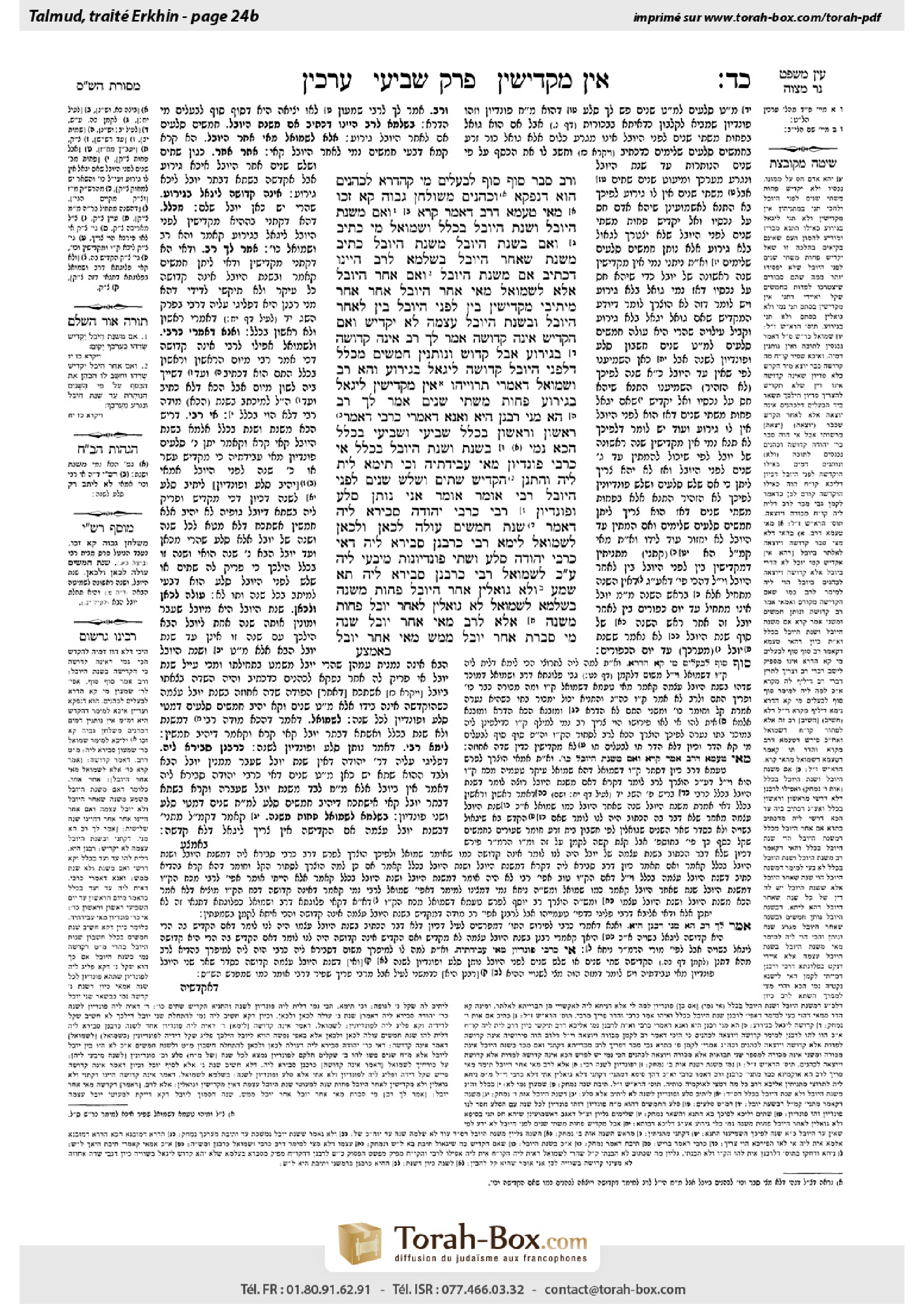
This page of Arakhin includes the Aramaic text, an English translation and an AI-generated French translation, alongside the scan above.
ערכין כ״ד ב · Aramaic and Hebrew text
וְרַב סָבַר: סוֹף סוֹף לַבְּעָלִים מִי קָהָדְרָא? לְכֹהֲנִים הוּא דְּנָפְקָא, וְכֹהֲנִים מִשּׁוּלְחַן גָּבוֹהַּ קָא זָכוּ!
מַאי טַעְמָא דְּרַב? דְּאָמַר קְרָא ״וְאִם מִשְּׁנַת הַיּוֹבֵל״, וּשְׁנַת הַיּוֹבֵל בַּכְּלָל.
וּשְׁמוּאֵל, מִי כְּתִיב ״וְאִם בִּשְׁנַת הַיּוֹבֵל״? ״מִשְּׁנַת הַיּוֹבֵל״ כְּתִיב — מִשָּׁנָה שֶׁאַחַר הַיּוֹבֵל.
בִּשְׁלָמָא לְרַב, הַיְינוּ דִּכְתִיב: ״אִם מִשְּׁנַת הַיּוֹבֵל״ ״וְאִם אַחַר הַיּוֹבֵל״, אֶלָּא לִשְׁמוּאֵל, מַאי ״אַחַר הַיּוֹבֵל״? אַחַר אַחַר.
מֵיתִיבִי: מַקְדִּישִׁין בֵּין לִפְנֵי הַיּוֹבֵל בֵּין לְאַחַר הַיּוֹבֵל, וּבִשְׁנַת הַיּוֹבֵל עַצְמָהּ לֹא יַקְדִּישׁ, וְאִם הִקְדִּישׁ — אֵינָהּ קְדוֹשָׁה! אָמַר לְךָ רַב: אֵינָהּ קְדוֹשָׁה בְּגֵירוּעַ, אֲבָל קְדוֹשָׁה וְנוֹתְנִין חֲמִשִּׁים.
מִכְּלָל דְּלִפְנֵי הַיּוֹבֵל קְדוֹשָׁה לִיגָּאֵל בְּגֵירוּעַ, וְהָא רַב וּשְׁמוּאֵל דְּאָמְרִי תַּרְוַיְיהוּ: אֵין מַקְדִּישִׁין לִיגָּאֵל בְּגֵירוּעַ פָּחוֹת מִשְׁתֵּי שָׁנִים!
אָמַר לְךָ רַב: הָא מַנִּי? רַבָּנַן הִיא, וַאֲנָא דְּאָמְרִי כְּרַבִּי, דְּאָמַר: ״רִאשׁוֹן״ וְרִאשׁוֹן בַּכְּלָל, ״שְׁבִיעִי״ וּשְׁבִיעִי בַּכְּלָל; הָכָא נָמֵי ״בִּשְׁנַת״ וּשְׁנַת הַיּוֹבֵל בַּכְּלָל.
אִי כְּרַבִּי, פּוּנְדְּיוֹן מַאי עֲבִידְתֵּיהּ?
וְכִי תֵּימָא לֵית לֵיהּ, וְהָתְנַן: הִקְדִּישׁ שְׁתַּיִם וְשָׁלֹשׁ שָׁנִים לִפְנֵי הַיּוֹבֵל, רַבִּי אוֹמֵר: אוֹמֵר אֲנִי נוֹתֵן סֶלַע וּפוּנְדְּיוֹן, רַבִּי כְּרַבִּי יְהוּדָה סְבִירָא לֵיהּ, דְּאָמַר: ״שְׁנַת חֲמִשִּׁים עוֹלָה לְכָאן וּלְכָאן״.
לִשְׁמוּאֵל, לֵימָא רַבִּי כְּרַבָּנַן סְבִירָא לֵיהּ, דְּאִי כְּרַבִּי יְהוּדָה — סֶלַע וּשְׁתֵּי פוּנְדְּיוֹנוֹת מִיבְּעֵי לֵיהּ! עַל כׇּרְחָךְ לִשְׁמוּאֵל, רַבִּי כְּרַבָּנַן סְבִירָא לֵיהּ.
תָּא שְׁמַע: ״וְלֹא גּוֹאֲלִין אַחַר הַיּוֹבֵל פָּחוֹת מִשָּׁנָה״. בִּשְׁלָמָא לִשְׁמוּאֵל — ״לֹא גּוֹאֲלִין לְאַחַר יוֹבֵל פָּחוֹת מִשָּׁנָה״, אֶלָּא לְרַב — מַאי ״אַחַר יוֹבֵל שָׁנָה״?
מִי סָבְרַתְּ אַחַר יוֹבֵל מַמָּשׁ? מַאי ״אַחַר יוֹבֵל״?
Arakhin 24b · English translation
And Rav holds: Even in accordance with the opinion of Rabbi Shimon, no a fortiori inference may be drawn, as ultimately, does the field return to the owner during the Jubilee Year? It does not, but rather it leaves the possession of the Temple treasury and is given to the priests. Therefore, there is no basis for an a fortiori inference, as a field consecrated before the Jubilee Year does not return to the owner during the Jubilee Year, and the priests receive their portion from the table of the Most High.
The Gemara asks: What is the reason for the opinion of Rav that consecration of a field during the Jubilee Year is effective and that the field must be redeemed for the full price of fifty sela per beit kor? As the verse states: “If he sanctifies his field from the Jubilee Year, according to your valuation it shall stand” (Leviticus 27:17). The verse indicates that a field is redeemed according to the valuation mentioned in the preceding verse, i.e., fifty sela per beit kor, and the Jubilee Year itself is included in this halakha, as the verse describes a period that begins “from the Jubilee Year,” which can be understood as including the Jubilee Year itself.
The Gemara asks: And how does Shmuel refute this claim? The Gemara explains that Shmuel would respond: Is it written in the verse: If he sanctifies his field during the Jubilee Year? No, instead: “From the Jubilee Year,” is written, indicating that the verse is referring to consecration beginning from the year that is after the Jubilee Year.
The Gemara asks: Granted, according to Rav, this is the meaning of that which is written in the verse: “If he sanctifies his field from the Jubilee Year, according to your valuation it shall stand. But if he sanctifies his field after the Jubilee, then the priest shall reckon for him the money according to the years that remain until the Jubilee Year, and a deduction shall be made from your valuation” (Leviticus 27:17–18). According to Rav’s interpretation, the second verse is referring to the year immediately following the Jubilee Year. But according to Shmuel, who maintains that the first verse is dealing with the year following the Jubilee Year, to what is the verse referring when it speaks of the year “after the Jubilee”? The Gemara responds: It is referring to the year after the year after the Jubilee Year.
The Gemara raises an objection to the opinion of Rav from the aforementioned baraita: One may consecrate an ancestral field both before the Jubilee Year and after the Jubilee Year. But during the Jubilee Year itself, one may not consecrate it, and if he nevertheless did consecrate it, that field is not consecrated. The Gemara explains: Rav could say to you: The baraita means that it is not consecrated in order to be redeemed with a deduction. But nevertheless it is consecrated, and one gives the full price of fifty sela per beit kor for its redemption.
The Gemara objects: One can conclude by inference from this response that according to Rav, when the baraita states that a field may be consecrated before the Jubilee Year, it means that it is consecrated to be redeemed with a deduction. But wasn’t it stated that Rav and Shmuel both say that one may not consecrate an ancestral field to be redeemed with a deduction less than two years before the Jubilee Year, but rather it is redeemed according to the total valuation of the field? If so, Rav could not have responded as suggested above.
Rather, Rav could say to you: In accordance with whose opinion is this baraita? It is in accordance with the opinion of the Rabbis, who maintain that whenever the verse employs an expression such as: From the first day, the first day itself is not included. Accordingly, when the verse states: “If he sanctifies his field from the Jubilee Year,” the Jubilee Year is not included. But I stated my ruling that a field may be consecrated during the Jubilee Year in accordance with the opinion of Rabbi Yehuda HaNasi, who says: The verse states: “Whoever eats leavened bread from the first day until the seventh day, that soul shall be cut off from Israel” (Exodus 12:15). It states: “From the first day,” and the first day is included, and it continues: “Until the seventh day,” and the seventh day is also included. Here too, the verse states: “If he sanctifies his field from the Jubilee Year,” and the Jubilee Year is included.
The mishna (25a) teaches that when one redeems an ancestral field, he gives a sela and a pundeyon, which is equivalent to one forty-eighth of a sela, per beit kor for each year remaining until the Jubilee Year. This amount is close to one forty-ninth of the total valuation of fifty sela, and there are no tannaitic disputes with regard to this mishna. The Gemara therefore asks: If Rav holds in accordance with the opinion of Rabbi Yehuda HaNasi, that one may consecrate an ancestral field during the Jubilee Year, what is the purpose of the additional pundeyon that one gives for each remaining year until the Jubilee? If the Jubilee Year itself is included in the calculation, the total price of fifty sela should be divided evenly, i.e., one sela should be paid for each remaining year of the fifty years.
And if you would say that Rabbi Yehuda HaNasi does not require the addition of a pundeyon for each remaining year, that is difficult: But didn’t we learn in a baraita: If one consecrated the field two or three years before the Jubilee Year, Rabbi Yehuda HaNasi says: I say that he gives a sela and a pundeyon per year? The Gemara answers: Rabbi Yehuda HaNasi holds in accordance with the opinion of Rabbi Yehuda, who says that the fiftieth year is counted both for this cycle and for that one, i.e., he maintains that the Jubilee Year is also considered the first year of the next cycle. Accordingly, there are actually only forty-nine years in a Jubilee cycle, and the total valuation of a field is therefore divided into forty-nine parts, which comes out to a sela and a pundeyon for each year.
The Gemara objects: According to Shmuel, who maintains that Rabbi Yehuda HaNasi concedes that an ancestral field may not be consecrated during the Jubilee Year, let him say that Rabbi Yehuda HaNasi holds in accordance with the opinion of the Rabbis, who disagree with Rabbi Yehuda and hold that the fiftieth year is not counted as the first year of the following cycle. Because if he holds in accordance with the opinion of Rabbi Yehuda, then he should require one to pay a sela and two pundeyon, i.e., one forty-eighth of the total valuation of a field, per year, as there are only forty-eight years during which one may consecrate a field. The Gemara explains: This is indeed the case. Perforce, according to Shmuel, Rabbi Yehuda HaNasi holds in accordance with the opinion of the Rabbis.
The Gemara suggests: Come and hear a proof for the opinion of Shmuel from the mishna: Nor may one redeem an ancestral field that was consecrated less than one year after the Jubilee Year. Granted, according to Shmuel, who says that one may not consecrate an ancestral field during the Jubilee Year itself, and therefore if a field was consecrated during the Jubilee Year it requires no redemption at all, the mishna is teaching that one may not redeem a field less than one year after the Jubilee, i.e., until the year after the Jubilee, as it cannot be consecrated until then. But according to Rav, who maintains that a field may be consecrated and redeemed during the Jubilee Year itself, what does the mishna mean when it states that one may not redeem a field less than one year after the Jubilee?
The Gemara responds: Do you maintain that the mishna is referring to the actual year after the Jubilee Year? This is not the case; rather, to what is the phrase: After the Jubilee Year, actually referring?
Arakhin 24b · Traduction française (IA)
Et Rav affirme : Même selon l'opinion de Rabbi Shimon, on ne peut pas tirer d'inférence a fortiori, car finalement, le champ revient-il au propriétaire durant l'année sabbatique ? Non, mais il quitte la possession du trésor du Temple et est donné aux prêtres. Ainsi, il n'y a pas de fondement pour une inférence a fortiori, car un champ consacré avant l'année sabbatique ne revient pas au propriétaire durant l'année sabbatique, et les prêtres reçoivent leur part de la table du Très-Haut.
La Guemara demande : Quel est le motif de l'opinion de Rav selon laquelle la consécration d'un champ durant l'année sabbatique est efficace et que le champ doit être racheté au prix total de cinquante sela par beit kor ? Comme le texte dit : « Si l'homme consacre son champ à partir de l'année sabbatique, selon votre estimation, il restera » (Lévitique 27:17). Le texte indique que le champ est racheté selon l'estimation mentionnée dans le verset précédent, c'est-à-dire cinquante sela par beit kor, et l'année sabbatique elle-même est incluse dans cette halakha, car le texte décrit une période qui commence « à partir de l'année sabbatique », ce qui peut être compris comme incluant l'année sabbatique elle-même.
La Guemara demande : Et comment Shmuel réfute-t-il cette affirmation ? La Guemara explique que Shmuel répondrait : Est-il écrit dans le texte : « Si l'homme consacre son champ durant l'année sabbatique ? » Non, au contraire : « À partir de l'année sabbatique », est écrit, indiquant que le texte fait référence à la consécration commençant à partir de l'année qui suit l'année sabbatique.
La Guemara demande : Admettons, selon Rav, c'est la signification du texte : « Si l'homme consacre son champ à partir de l'année sabbatique, selon votre estimation, il restera. Mais si l'homme consacre son champ après l'année sabbatique, alors le prêtre calculera pour lui l'argent selon les années restantes jusqu'à l'année sabbatique, et une déduction sera faite de votre estimation » (Lévitique 27:17–18). Selon l'interprétation de Rav, le second texte fait référence à l'année immédiatement suivant l'année sabbatique. Mais selon Shmuel, qui maintient que le premier texte fait référence à l'année suivant l'année sabbatique, à quoi fait-il référence lorsqu'il parle de l'année « après l'année sabbatique » ? La Guemara répond : Il fait référence à l'année après l'année après l'année sabbatique.
La Guemara soulève une objection contre l'opinion de Rav à partir de la baraïta mentionnée précédemment : On peut consacrer un champ ancestral avant l'année sabbatique et après l'année sabbatique. Mais durant l'année sabbatique elle-même, on ne peut pas le consacrer, et si l'on le fait néanmoins, ce champ n'est pas consacré. La Guemara explique : Rav pourrait répondre à cela : La baraïta signifie que ce n'est pas consacré afin d'être racheté avec une déduction. Mais il est tout de même consacré, et on paie le prix total de cinquante sela par beit kor pour son rachat.
La Guemara objecte : On peut conclure par l'inférence à partir de cette réponse que selon Rav, lorsque la baraïta dit qu'un champ peut être consacré avant l'année sabbatique, cela signifie qu'il est consacré afin d'être racheté avec une déduction. Mais n'était-il pas dit que Rav et Shmuel disent tous les deux que l'on ne peut pas consacrer un champ ancestral afin d'être racheté avec une déduction inférieure à deux ans avant l'année sabbatique, mais plutôt il est racheté selon l'estimation totale du champ ? Si c'est le cas, Rav ne pourrait pas avoir répondu comme suggéré ci-dessus.
Plutôt, Rav pourrait répondre à cela : Selon l'opinion de qui est cette baraïta ? C'est selon l'opinion des Rabbins, qui maintiennent que lorsque le texte utilise une expression telle que : « À partir du premier jour », le premier jour lui-même n'est pas inclus. Ainsi, lorsque le texte dit : « Si l'homme consacre son champ à partir de l'année sabbatique », l'année sabbatique n'est pas incluse. Mais j'ai dit mon jugement selon l'opinion de Rabbi Yehuda HaNasi, qui dit : Le texte dit : « Celui qui mange du pain levé du premier jour jusqu'au septième jour, cette âme sera coupée de Israël » (Ex 12:15). Il dit : « À partir du premier jour », et le premier jour est inclus, et il continue : « Jusqu'au septième jour », et le septième jour est également inclus. Ici aussi, le texte dit : « Si l'homme consacre son champ à partir de l'année sabbatique », et l'année sabbatique est incluse.
La mitsva (25a) enseigne que lorsqu'on rachète un champ ancestral, on paie un sela et un pundeyon, ce qui équivaut à un quarante-huitième de sela, par beit kor pour chaque année restante jusqu'à l'année sabbatique. Cette somme est proche d'un quarante-neuvième de l'estimation totale de cinquante sela, et il n'y a pas de désaccord tannaitique concernant cette mitsva. La Guemara demande donc : Si Rav maintient l'opinion de Rabbi Yehuda HaNasi, selon laquelle on peut consacrer un champ ancestral durant l'année sabbatique, à quoi sert l'ajout du pundeyon que l'on paie pour chaque année restante jusqu'à l'année sabbatique ? Si l'année sabbatique elle-même est incluse dans le calcul, le prix total de cinquante sela devrait être divisé également, c'est-à-dire un sela devrait être payé pour chaque année restante des cinquante ans.
Et si vous dites que Rabbi Yehuda HaNasi ne nécessite pas l'ajout d'un pundeyon pour chaque année restante, cela est difficile : Mais n'avons-nous pas appris dans une baraïta : Si l'on a consacré le champ deux ou trois ans avant l'année sabbatique, Rabbi Yehuda HaNasi dit : Je dis qu'il paie un sela et un pundeyon par année ? La Guemara répond : Rabbi Yehuda HaNasi suit l'opinion de Rabbi Yehuda, qui dit que la cinquantième année est comptée à la fois pour ce cycle et pour le suivant, c'est-à-dire qu'il considère que l'année sabbatique est également le premier année du prochain cycle. Ainsi, il y a effectivement seulement quarante-neuf ans dans un cycle de sabbat, et l'estimation totale du champ est donc divisée en quarante-neuf parties, ce qui donne un sela et un pundeyon pour chaque année.
La Guemara rétorque : Selon Shmuel, qui affirme que Rabbi Yehuda HaNasi reconnaît qu'un champ ancestral ne peut être consacré pendant l'année sabbatique, qu'il dise que Rabbi Yehuda HaNasi suit l'opinion des Sages, qui s'opposent à Rabbi Yehuda et qui considèrent que l'année cinquantième n'est pas comptée comme la première année du cycle suivant. Car si il suit l'opinion de Rabbi Yehuda, alors il devrait exiger de payer un sela et deux pundeyon, c'est-à-dire un quarantième-huitième de la valeur totale d'un champ, par an, car il n'y a que quarante-huit ans pendant lesquels on peut consacrer un champ. La Guemara explique : C'est effectivement le cas. Par conséquent, selon Shmuel, Rabbi Yehuda HaNasi suit l'opinion des Sages.
La Guemara suggère : Viens écouter une preuve pour l'opinion de Shmuel à partir de la mitsva : On ne peut pas racheter un champ ancestral consacré depuis moins d'un an après l'année sabbatique. En effet, selon Shmuel, qui dit qu'on ne peut pas consacrer un champ ancestral pendant l'année sabbatique elle-même, et donc si un champ a été consacré pendant l'année sabbatique, il ne nécessite aucun rachat, la mitsva enseigne que l'on ne peut pas racheter un champ depuis moins d'un an après l'année sabbatique, c'est-à-dire jusqu'à l'année suivante, car il ne peut être consacré qu'à ce moment-là. Mais selon Rav, qui affirme qu'un champ peut être consacré et racheté pendant l'année sabbatique elle-même, à quoi la mitsva fait-elle référence lorsqu'elle dit qu'on ne peut pas racheter un champ depuis moins d'un an après l'année sabbatique ?
La Guemara répond : Maintenez-vous que la mitsva fait référence à l'année réelle après l'année sabbatique ? Ce n'est pas le cas ; plutôt, à quoi fait référence la phrase : Après l'année sabbatique, en réalité ?
Traduction française générée par IA à partir de l’édition anglaise de Sefaria. Vérifie toujours un passage avec le texte source.
Text from Sefaria: William Davidson Edition - Vocalized Aramaic (CC BY NC); William Davidson Edition - English (CC BY NC).